

PROJECT LUXOR
Container City

THE CONCEPT
The idea of developing this project arises as our own experience because we young University students often travel to other states and in search of good schools, but unfortunately the cities do not offer the best facilities for a student.In this project the building is designed with the necessary activities for study and recreation in the room.
Urbanization through the environment. Create a habitable space for young students from Puebla in Mexico, using recycled media to conserve green spaces.
BACKGROUND OF THE SITE
We looked for the best location for the project. Our building is located opposite the Main Avenue "Av. of the Sun" and "Calzada Centauro" which makes an excellent social mobility including in public transport and car. The building is surrounded by hospitals, universities, shopping centers and tourist attractions, which turns out to be a safer and more accessible space.
ITERATIONS
4 proposals were developed with the most optimal search, for the benefit of young people, including necessary and comfortable spaces for their stay and socialization and security.
METHODS OF DESIGN
The design of our work is a building, taking the most effective and basic intention in the Architecture "load" this allows the containers to be connected by means of a central distributor, creating a building. The design of each department was done according to the original zoning of a principle, to meet the main needs that a University student might have.
The location and position of the upper floor has been designed to take full advantage of the view and natural sunlight; also within this area of the house is offered an emotion of a relaxed and calm atmosphere.
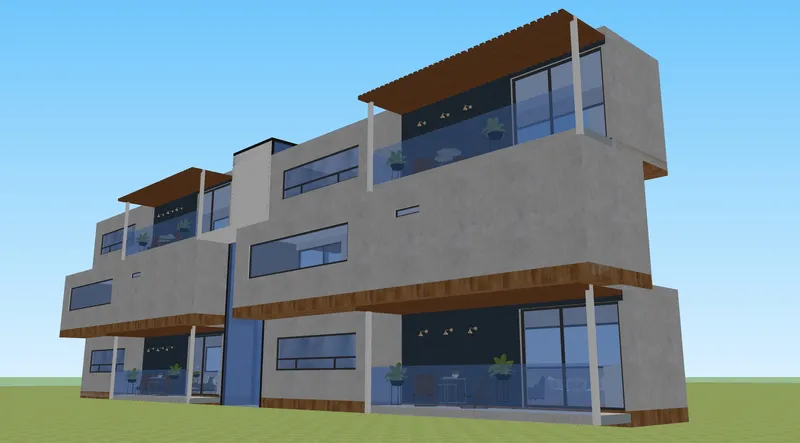
Main Facade
FINAL PROGRAM
Daily life moves us at a dizzying pace, starting with the choice of having a place to live and be. Marine containers emerged in response to the original design of the house. The concept of this type of project is based on sustainability and reuse of materials. The housing units were made from containers of 40 feet each, which has bedroom, bathroom, living room, desk, kitchen and a terrace.
The project has three volumes, each container superimposed, and through an overhead opening system that "separates" the volumes and houses the vertical circulations.
The building has a rainwater collection system for bathrooms and irrigation, the ventilation is sufficient so that the house does not need air conditioning and natural light penetrates into the window that serves as the main entrance to the room.
MATERIALS
We look for the most resistant and aesthetic materials for building formation. Because this project is sustainable and recycled steel and wood substitutes are used in finishes and covers for the Acoustic and thermal in each department. The project has an excellent expansion for the creation of many spaces with a great diversity such as cafeterias, departments or gyms, with the great advantage of being more economical, modular and fast construction.
To cover the external facade, materials that could be renewable, reusable or recyclable, durable and low maintenance were contemplated, since these are housing units for students, it is important to take into account the optimization of these. Cedar wood was used as floating floors and in some details of the house, such as the pergola that covers the terrace and creates a shade to the outside. For the slabs, we proceeded by painting and leaving the natural composition of the marine containers. The openings to the street were made using steel sheet extracted from the walls of the same containers.
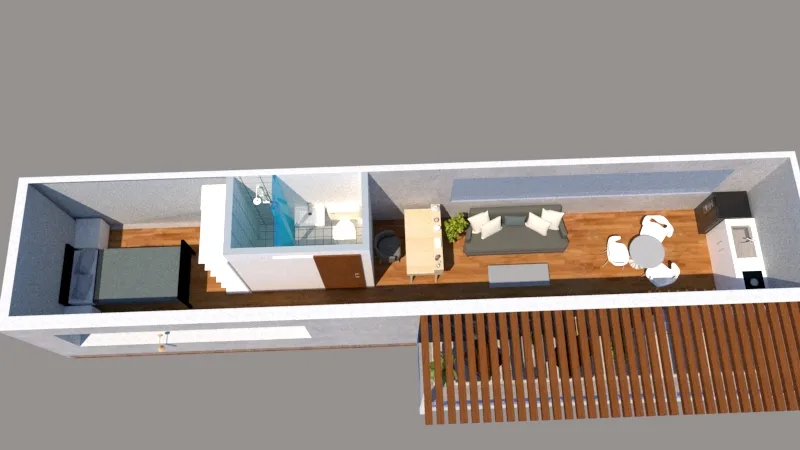
Architectural floor
EXPANSION PLAN
Due to their convenient size, the containers are suitable for use in homes and their appeal lies in their apparent simplicity: not only can you get a room in one piece, if not you can also gather them to form several rooms or unite them to create even larger enclosures.
PROJECT TRANFORMATION PLAN
The development of this project has a great future, because Puebla is a state with great student demand University and constantly growing as a metropolis city, so this project could be used in many more areas and branches even reaching different urban and rural communities.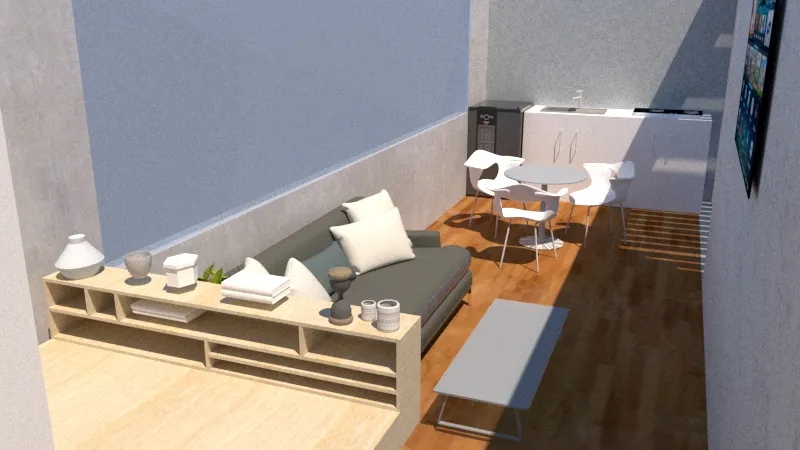
Interior perspective

Popular Articles
Popular articles from the community


Jaramillo Van Sluys Arquitectura and Urbanismo Turn a Demolished Registry Lot in Quito into an Orchard Plaza
In Quito's Centro Histórico, a 2,800 m² plaza exposes the San Agustín convent wall and redraws its lost Augustinian orchard in volcanic stone.

Cube Design Draws an Ecological Corridor Between Two Shenzhen Hills with the Nankai Building
Beside Shenzhen's container docks, the Nankai Building pairs stacked balconies with a climbing green screen to connect two hillsides across its height.

Architekt Andreas Gruber Scatters 23 Dark Timber Chalets Across a South Tyrolean Forest Edge
In Molini di Tures, Amonti Chalets breaks a resort into a hamlet of gabled timber houses, with parking, storage and services pushed into the slope.

U.GA Architects Wraps an Oval Rooftop Pool in Curved Board-Formed Concrete on Busan's Jeollidan-gil
In Busan's Jeonpo-dong, a 454 m² mixed-use block stacks a neighborhood facility, guest rooms and an oval rooftop pool inside spiraling concrete walls.

Similar Reads
You might also enjoy these articles


Vereda Arquitetos Renovates a 40-Square-Meter Apartment Inside Niemeyer's Copan Building
A compact unit in São Paulo's most iconic residential tower gets a material overhaul that pairs exposed concrete with bold blue Formica.

Shakur's House: Exposed Brick as an Interior Organiser in a 168 m² Mashhad Residence
Brick moves indoors in this Mashhad residence, where masonry walls, glass partitions and teal planes sequence a compact home without closing it off.

Day and Night Park: A Time-Based Urban Newsstand in Beijing
A temporary urban newsstand in Beijing blending travel, light, and reading through poetic colors, compact form, and community-focused design.

Modernist Patio Renovation in El Masnou, Barcelona by Oliver Segura Arquitectura + Cebrià Arquitectura
Modernist patio renovation blending tradition and innovation with a movable pool, leveled floors, and Catalan materials in El Masnou.

Explore Container City Competitions
Discover active competitions in this discipline


Comments (0)
Please login or sign up to add comments
No comments yet. Be the first to comment!