
Projekt V Arhitektura Crafts a 50 m² Sarajevo Apartment from Earth, Clay, and Post-War Resilience
In the Grbavica neighbourhood of Sarajevo, a retrofit apartment rewires Bosnia-Herzegovina's relationship with natural materials and self-building.


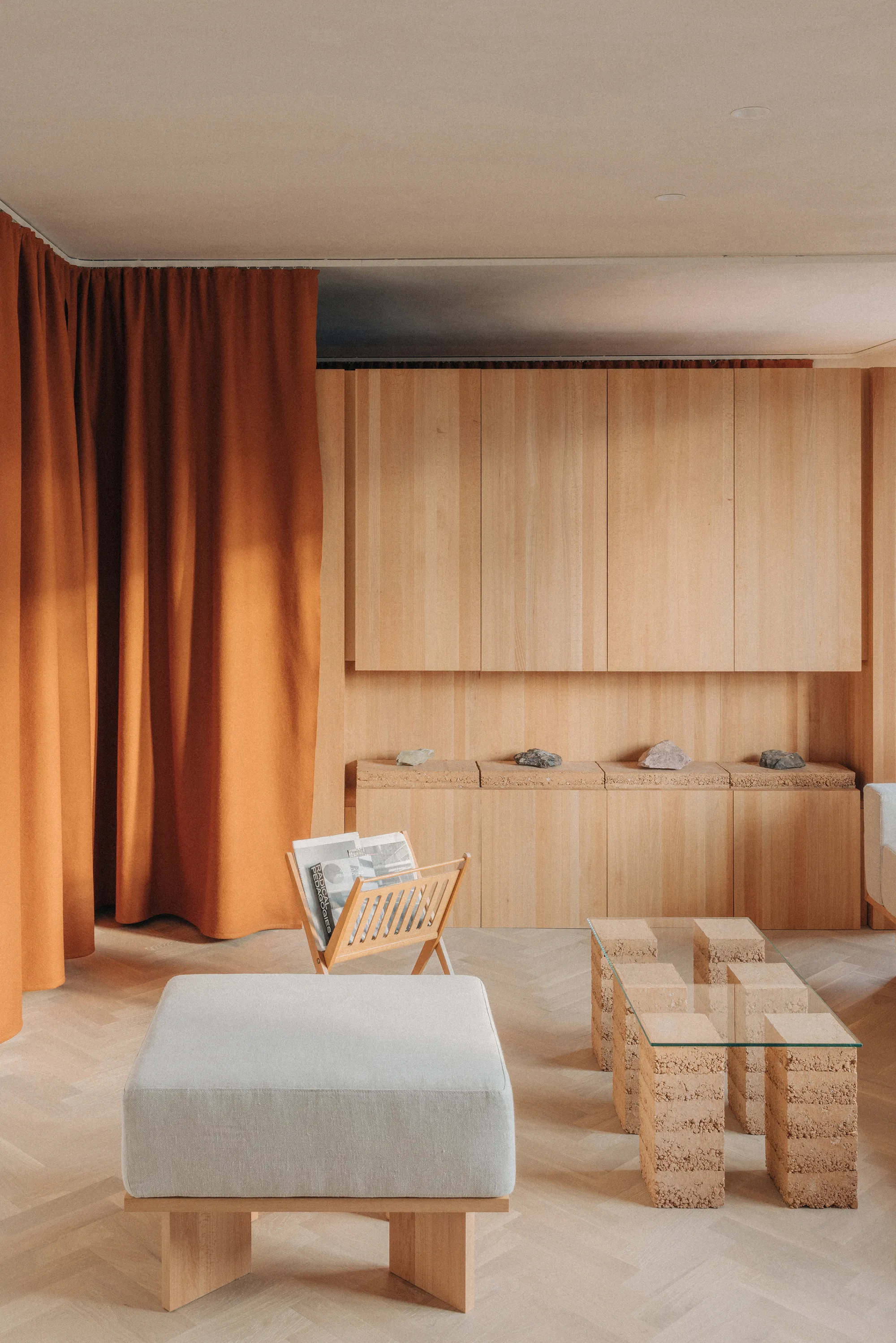
Zemlja means earth, land, and country in Bosnian, and this 50 m² apartment in Sarajevo's Grbavica neighbourhood tries to hold all three meanings at once. Designed by Projekt V Arhitektura, the retrofit sits inside a former socialist housing block in a neighbourhood still carrying the weight of the Bosnian War and the Siege of Sarajevo. It is not a renovation that pretends history didn't happen. Instead, it proposes a constructive response: locally sourced materials, self-built furniture, and a spatial logic that replaces partition walls with furniture islands, allowing air, light, and movement to circulate through the entire plan.
What makes Zemlja genuinely interesting, beyond its warm material palette, is its position as a working thesis against the unsustainable building practices that dominated post-war reconstruction in Bosnia-Herzegovina. The architects managed the entire construction process themselves, fabricated specialist furniture in workshops, and sourced materials from a dispersed network of mines, factories, and craftspeople across the country. The natural clay plaster coating the walls and ceilings is reportedly the first contemporary application of its kind in Bosnia-Herzegovina, reviving a local tradition that had been all but abandoned. This is architecture as a deliberate act of reconnection.
Three Islands, One Room

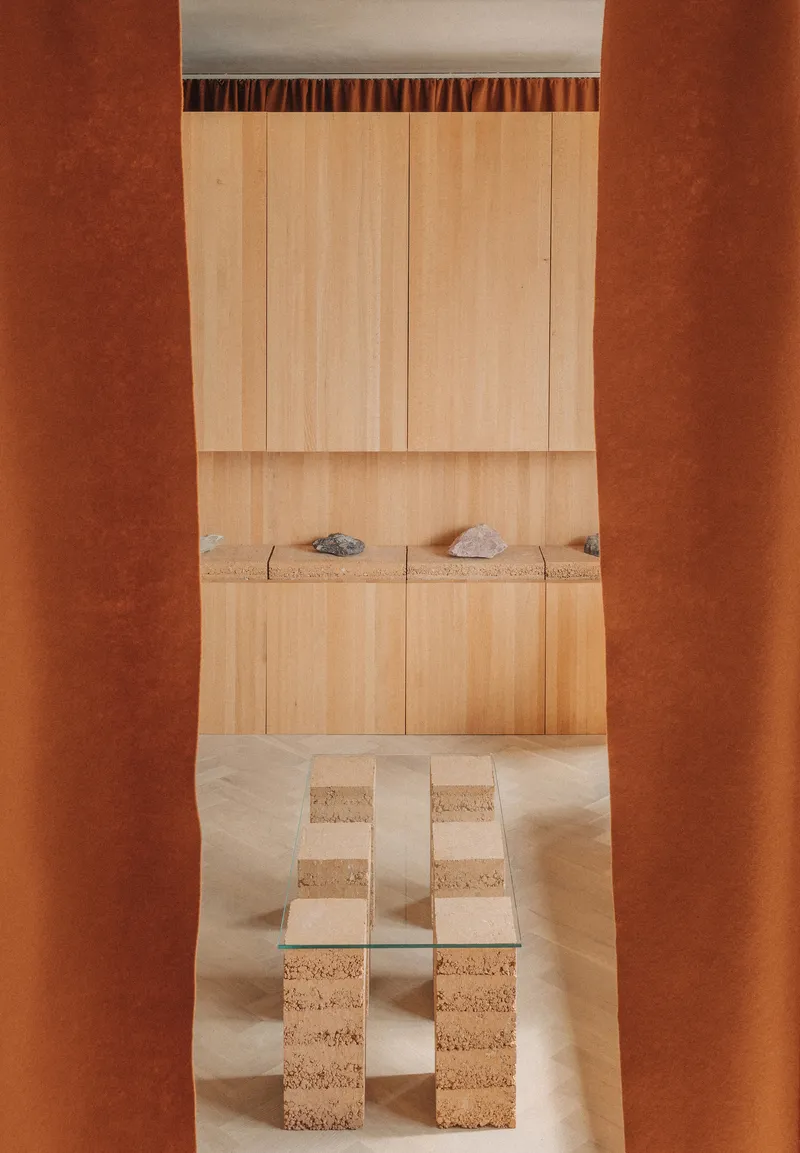

The plan strategy hinges on three bespoke furniture islands, each set inboard from the external walls and ceiling so that circulation flows continuously around the perimeter. A three-sided beech wood monolith is the central organizer: one face becomes a wardrobe, another a TV cupboard and storage wall, a third a work desk. It divides sleeping, working, and living without ever fully closing off one zone from another. Built-in bench seating appears repeatedly, turning corridors and thresholds into usable space rather than dead circulation.
The effect is an apartment that reads as a single generous room rather than a sequence of tight compartments. The sleeping area sits deep in the plan, sheltered by the monolith. Near the entrance, a wall was removed to open sightlines toward the kitchen, replaced by a window with integrated seating and storage. At 50 m², Zemlja proves that spatial generosity has very little to do with square footage.
Clay, Cork, and Curtains
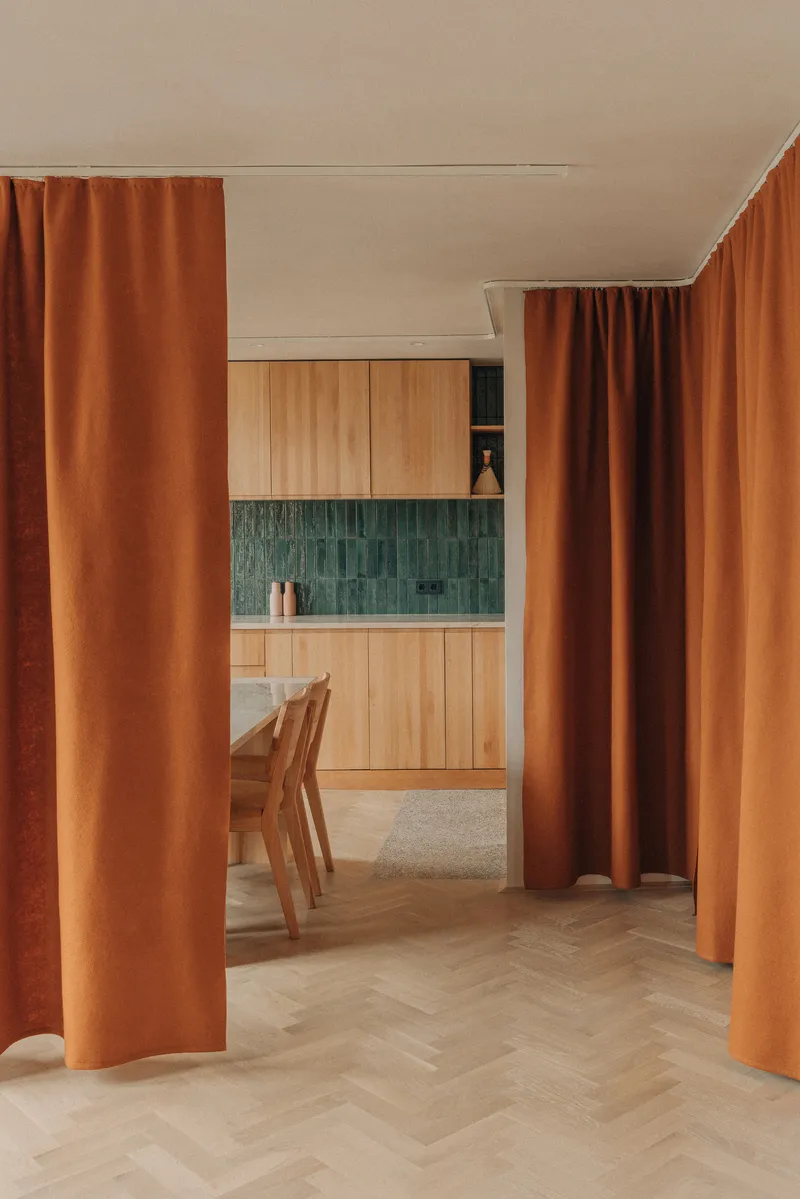
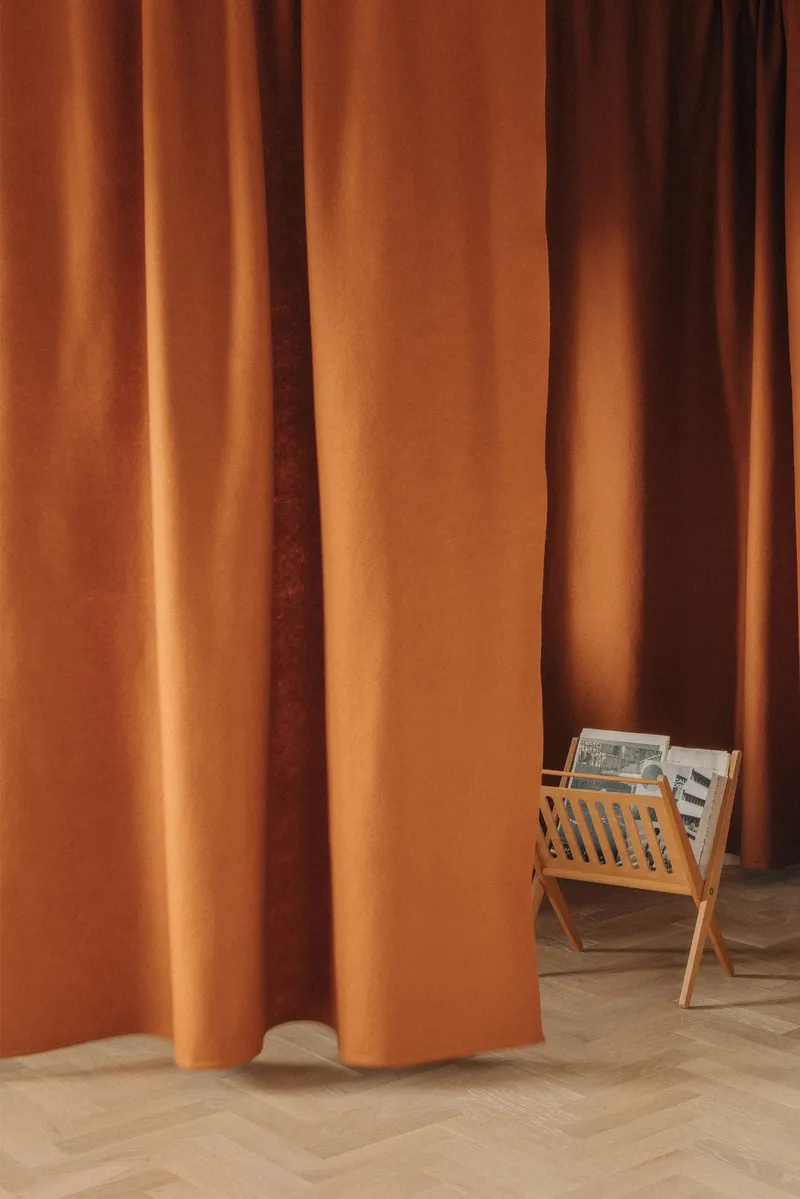
The material vocabulary is restrained and purposeful. White-oiled oak in a herringbone pattern covers the main floors, while original terrazzo has been retained in the kitchen and bathroom, a quiet nod to the building's socialist-era origins. Walls and ceilings are finished in natural clay plaster, left with visible traces of the hand that applied it. The result is surfaces that feel alive, warm to the touch and responsive to changing light throughout the day.
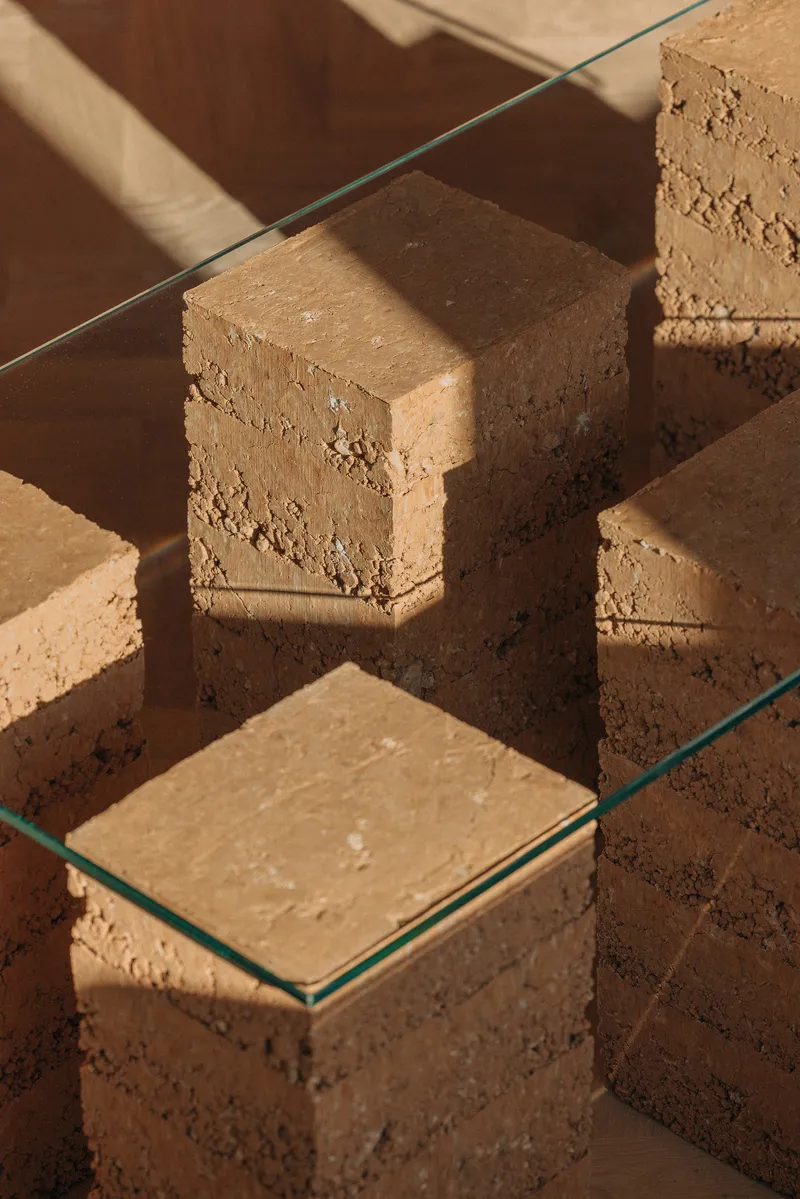
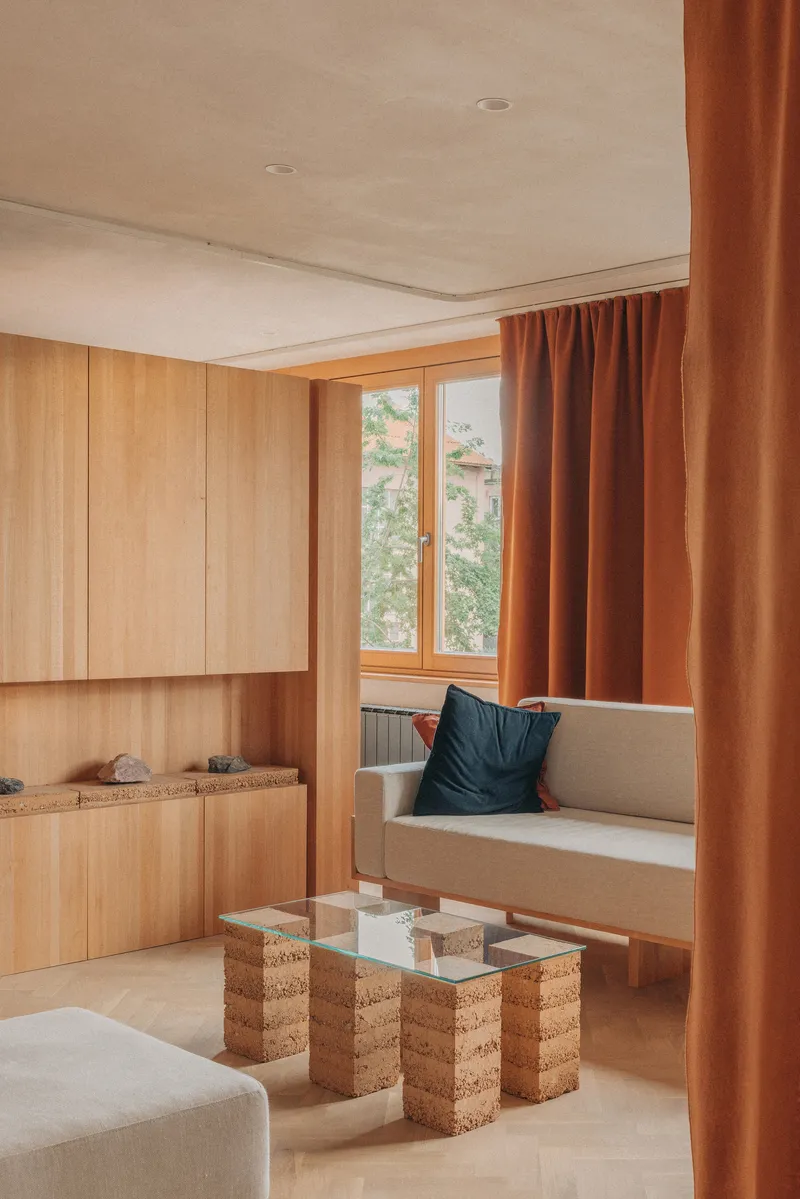
Floor-to-ceiling terracotta-coloured curtains serve as the apartment's soft partitions, replacing doors and fixed walls in most transitions. They absorb sound, filter light, and introduce a theatrical quality: rooms are revealed and concealed with a sweep of fabric. Cork blocks, stacked and topped with glass, function as side tables, contributing thermal mass and visual texture. Every material was chosen not just for appearance but for its ecological and economic performance.
The Beech Monolith
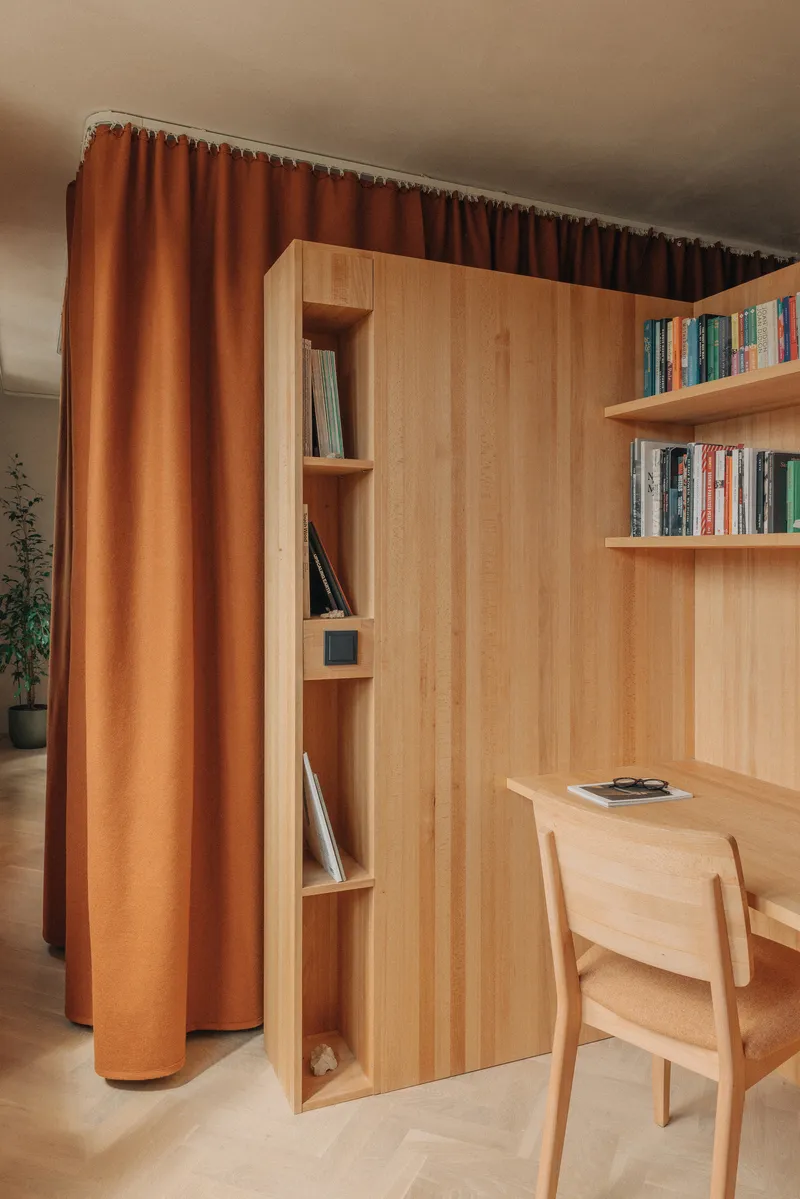


The custom furniture range designed and self-built by Projekt V Arhitektura deserves attention as a project within the project. The beech monolith is the most ambitious piece: a freestanding volume that houses desk, wardrobe, television niche, and storage within a single timber construction. Solid beech boards are detailed with vertical pull handles, flush panels, and slim reveals. There is no plywood backing hidden behind a veneer. The construction is honest throughout.
Narrow vertical storage niches, magazine racks, and shelf recesses appear at the edges of each furniture island, filling the gaps that standard cabinetry would leave dead. A rammed earth table anchors the dining zone, its mass contrasting with the lighter beech surrounding it. These are not styling props. They are load-bearing, space-defining elements that replace conventional walls.
Kitchen and Thresholds
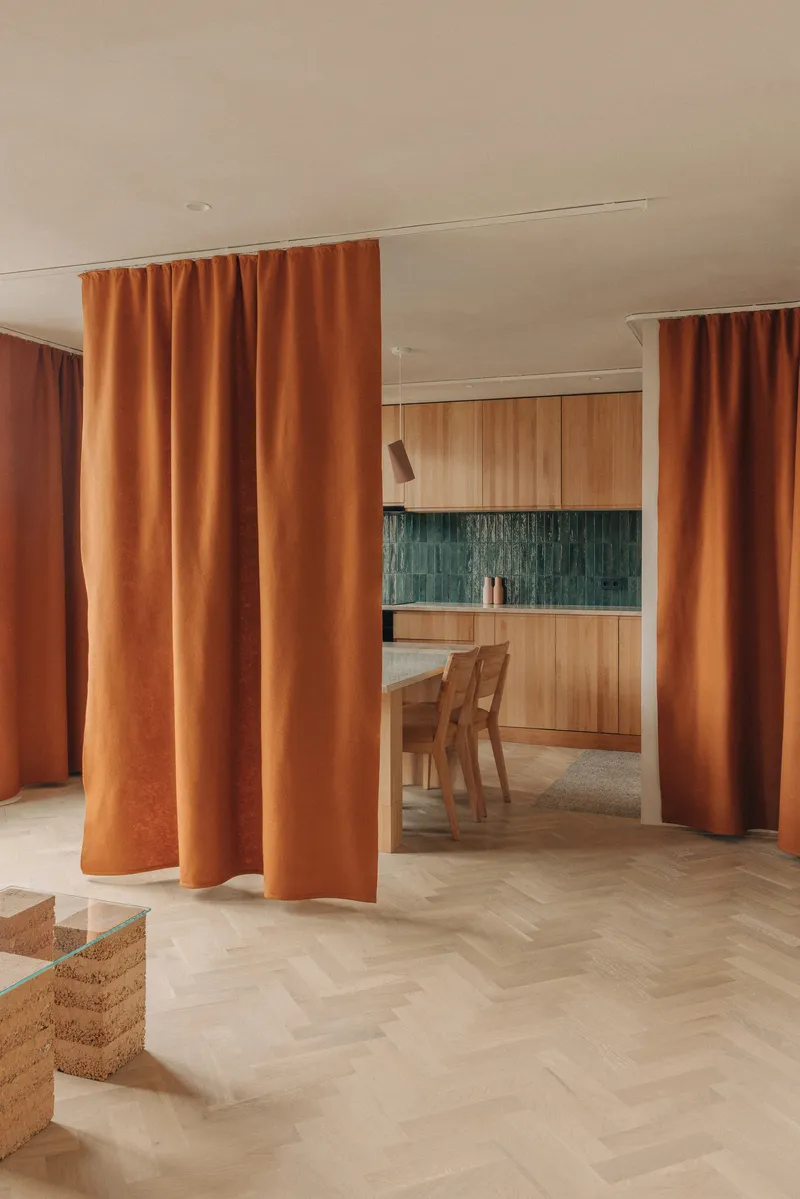
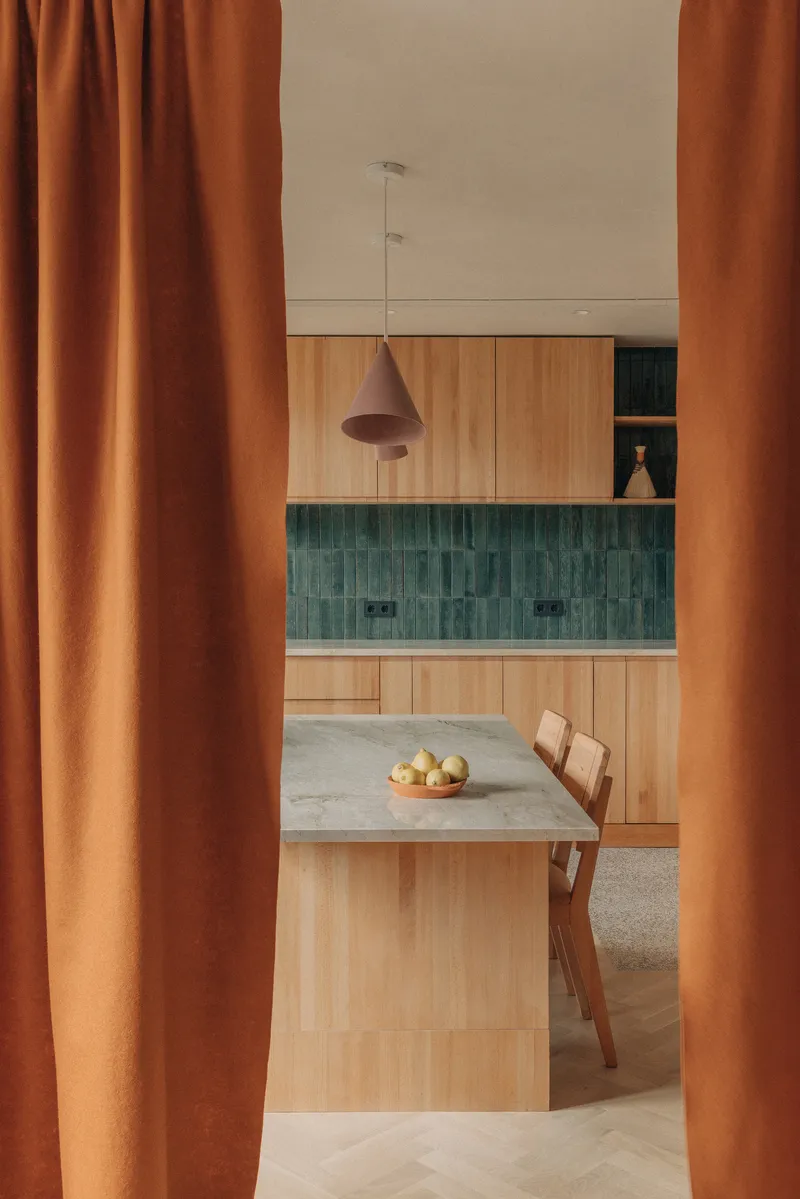
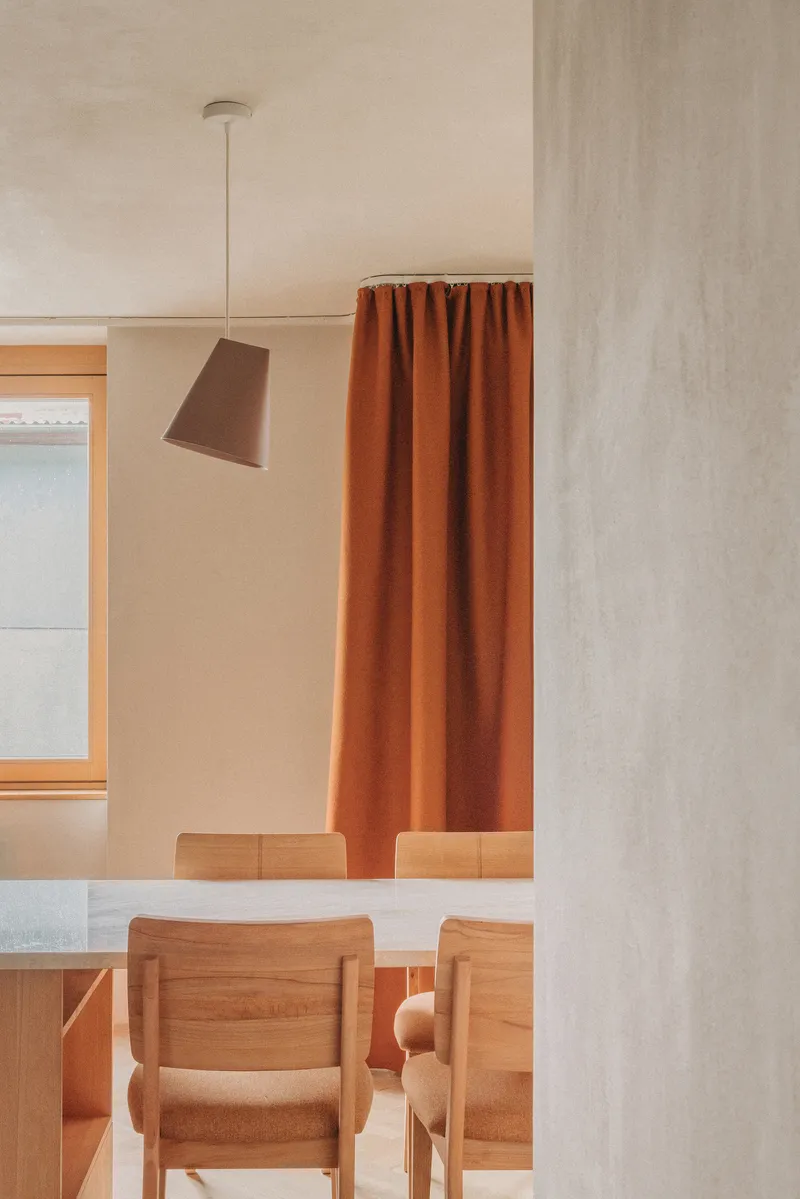
The kitchen occupies a compact zone marked by a green zellige tile backsplash that reads as a colour counterpoint to the pervasive terracotta palette. A pendant light drops over the dining table, composed of marble and beech wood, its mixed materials echoing the apartment's broader logic of combining natural substances without synthetic fillers. The kitchen retains its original terrazzo floor, creating a deliberate material shift underfoot that signals the transition from the timber-floored living zones.
Every threshold in the apartment is handled with care. The curtain-framed passage between dining and living areas, visible in several views, uses a concrete column as a fixed datum against which the soft fabric drapes. This is not open-plan laziness. The architects have thought about how each zone begins and ends, using colour, material, and light level to differentiate programme without resorting to walls.
The Balcony and the City
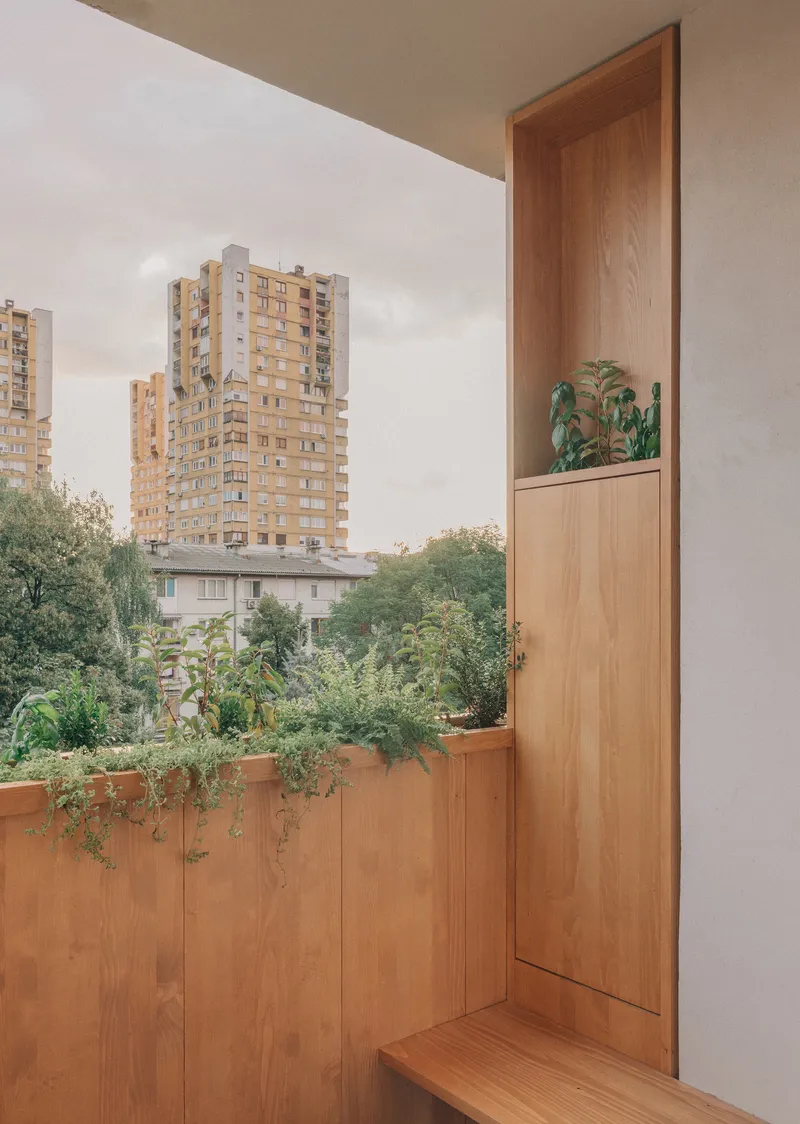
Sarajevo's residential blocks are characterized by a patchwork of self-built balconies, each one an improvised negotiation between private life and public space. Zemlja's timber balcony, lined in spruce with built-in planter boxes, builds on this spirit of Sarajevan adhocism but refines it. The spruce lining and planters create a green buffer between the apartment interior and the view of surrounding tower blocks, reintroducing nature at the scale of a single dwelling.
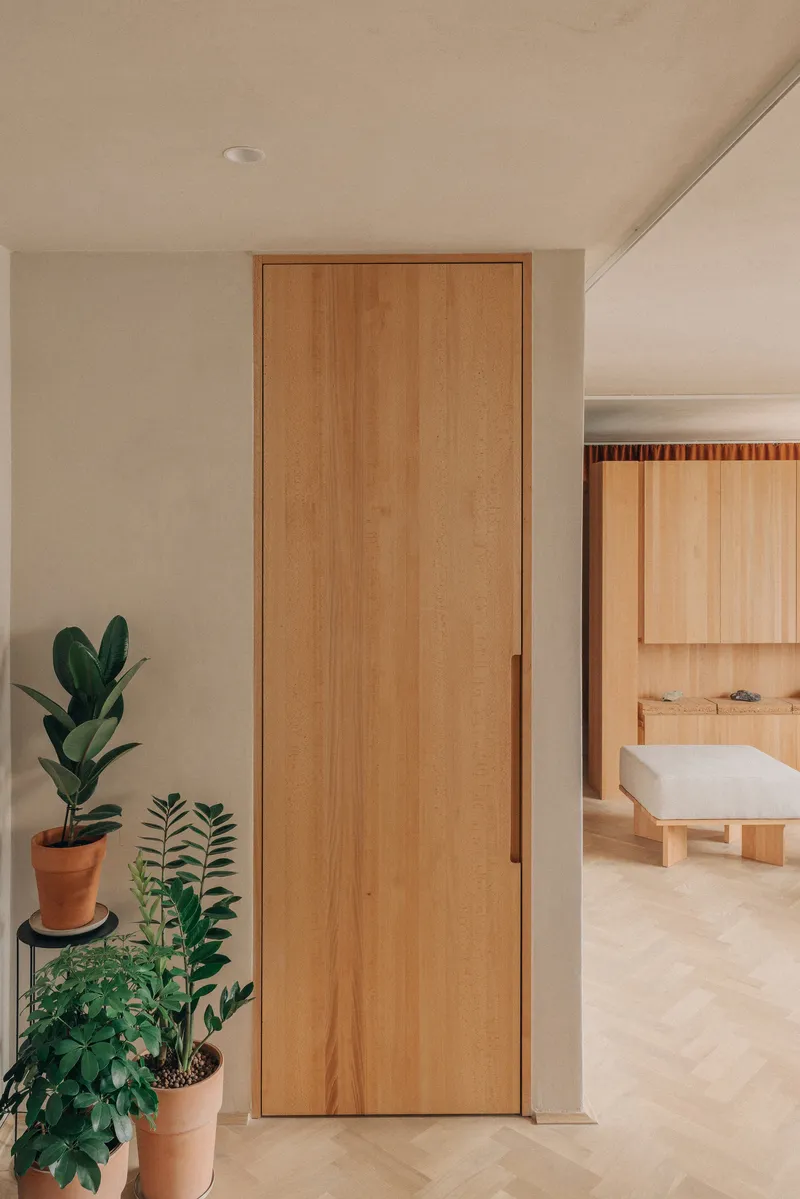
Inside, the view through terracotta curtains toward foliage-framed windows collapses the boundary between interior and balcony. A freestanding bathtub, glimpsed through a timber doorway flanked by potted plants, suggests a relationship with water and greenery that feels almost rural. The thermal performance of the natural materials, clay plaster, timber, and earth, is tangible: heating is reportedly reduced to just a few hours per day even during sub-freezing Sarajevo winters.
Nooks, Seating, and the Inhabited Edge
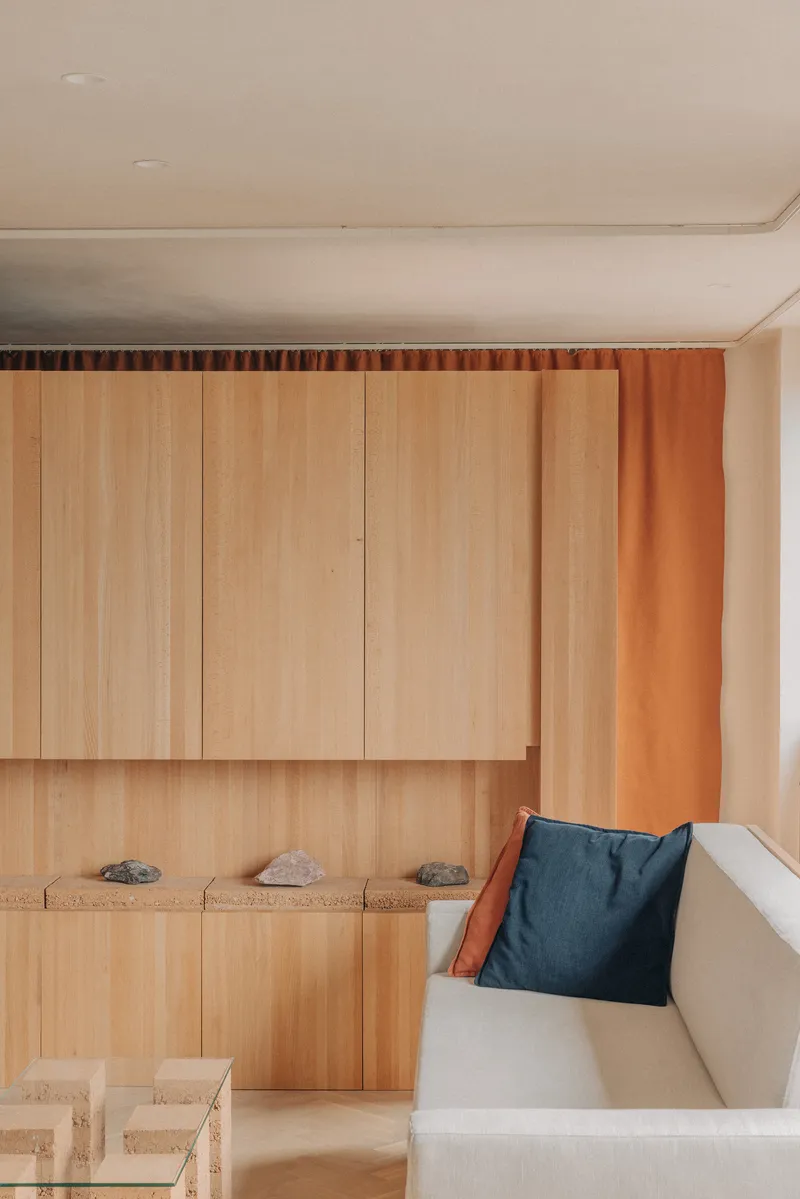
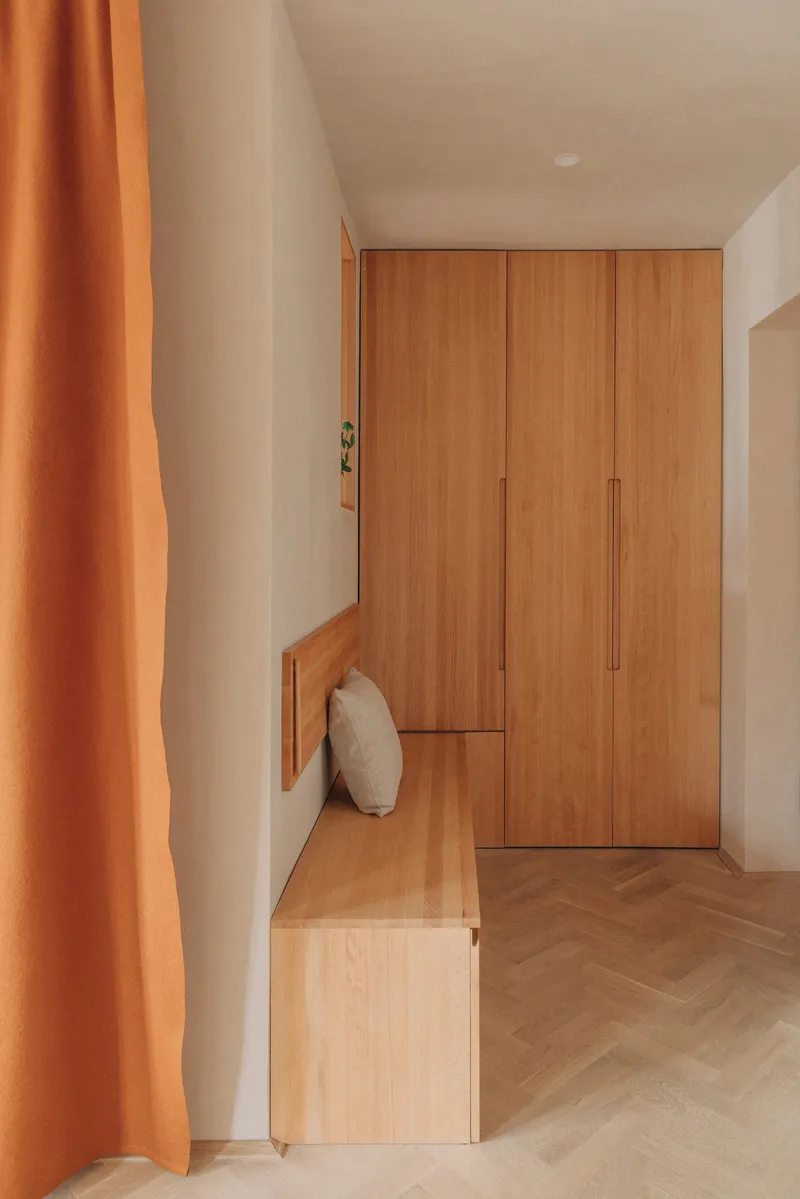
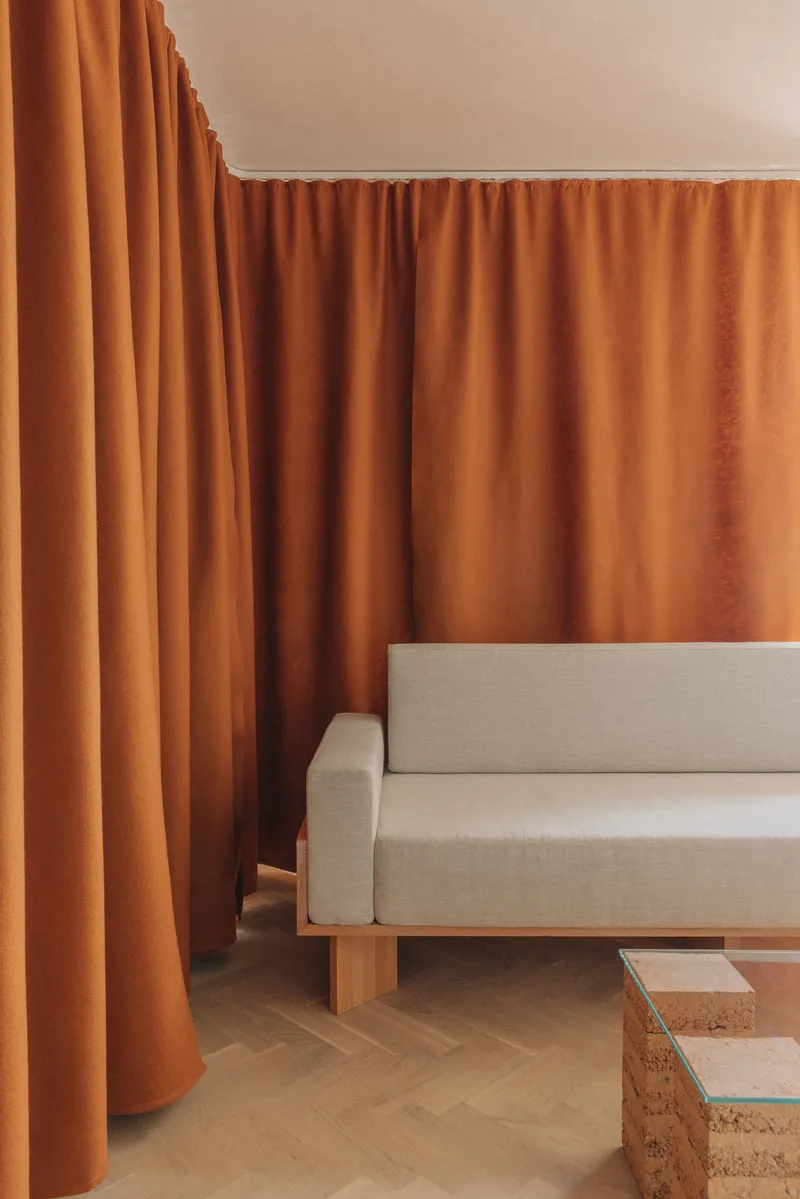
One of the strongest moves in the apartment is the consistent treatment of edges. Rather than pushing furniture against walls and calling it done, Projekt V has turned every perimeter into a functional surface. Upholstered benches sit on timber plinths. Entryway wardrobes double as room dividers. Cork-topped side tables nestle between curtain folds. The result is an apartment that feels larger than its footprint because every centimetre is activated, not just the centre of each room.
The blue cushion on a built-in bench beside the wardrobe wall introduces a single cool note into the warm palette, a small but effective reminder that restraint does not mean monotony. The seating nook at the entrance, framed by the timber wardrobe and screened by a curtain, functions as a decompression zone between the city outside and the earth-toned interior world.
The Dining Table as Rammed Earth
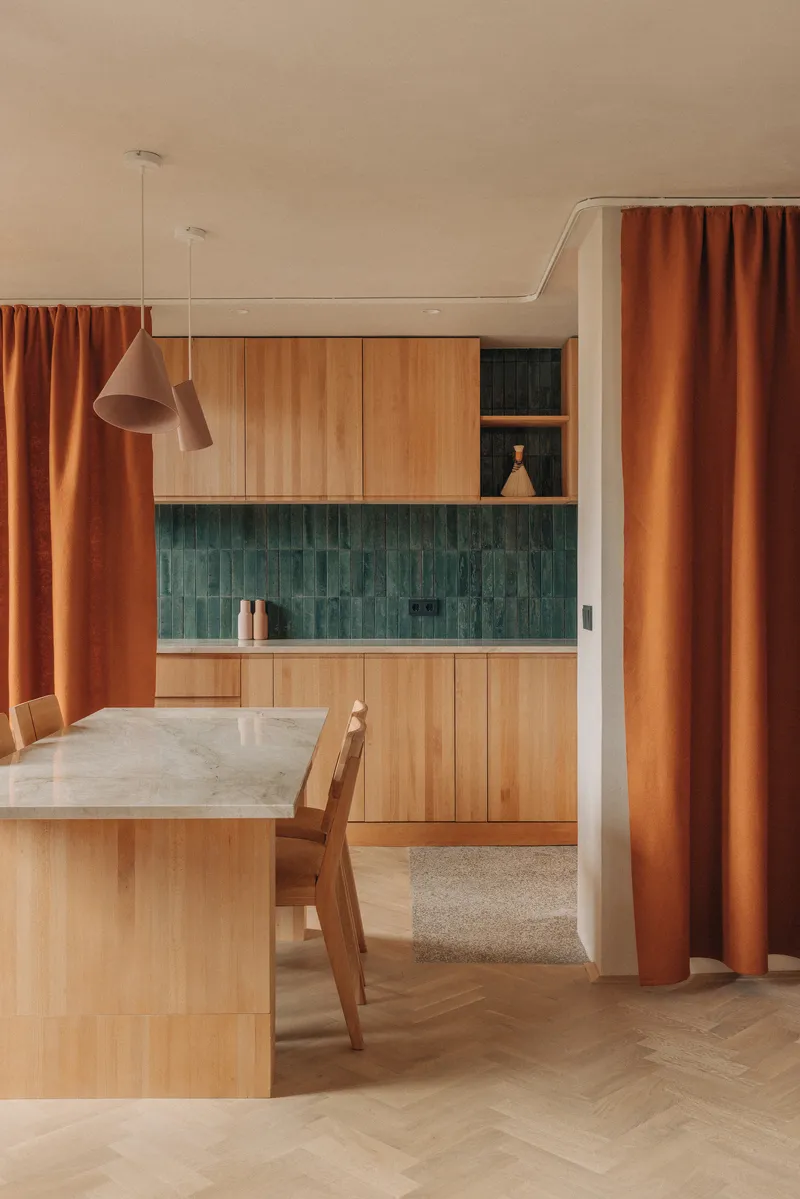

The rammed earth dining table is the project's most symbolic gesture. Earth is literally brought inside and given a central role in daily life, not as decoration but as a functional surface where meals are shared. Its layered, striated texture stands in contrast to the smooth beech and oiled oak elsewhere, introducing a raw, geological quality into a domestic setting. Combined with timber chairs and the pendant light overhead, the dining zone becomes the apartment's social anchor.
Plans and Drawings
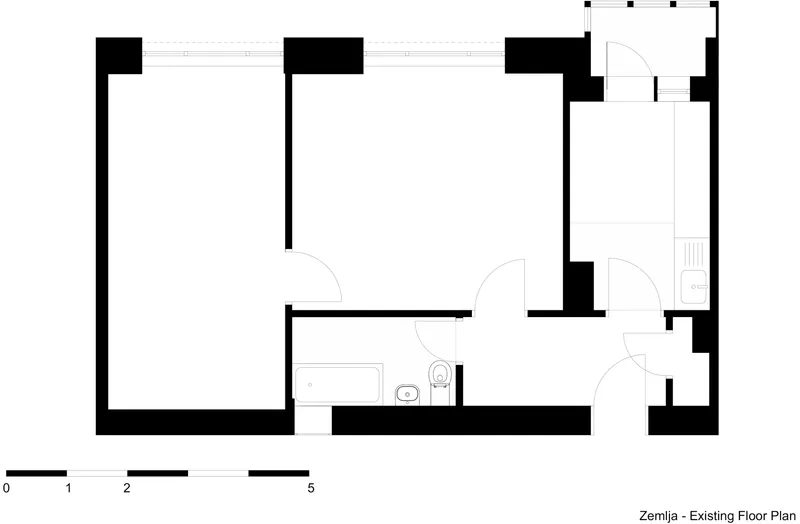
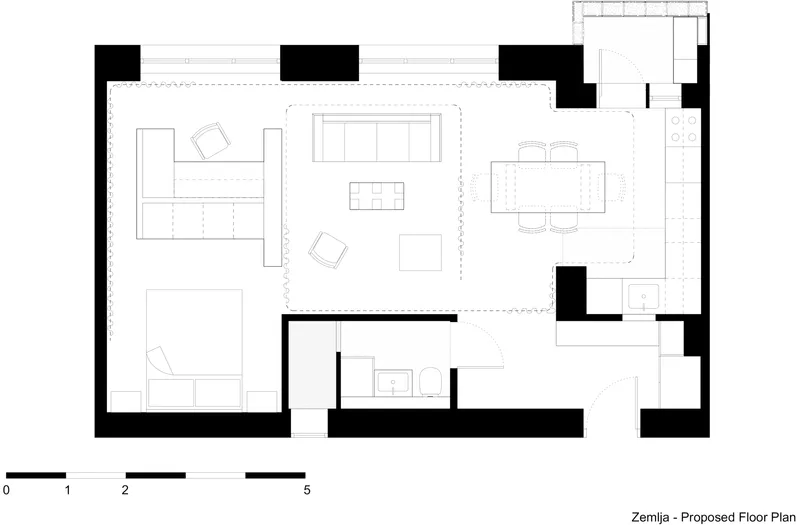
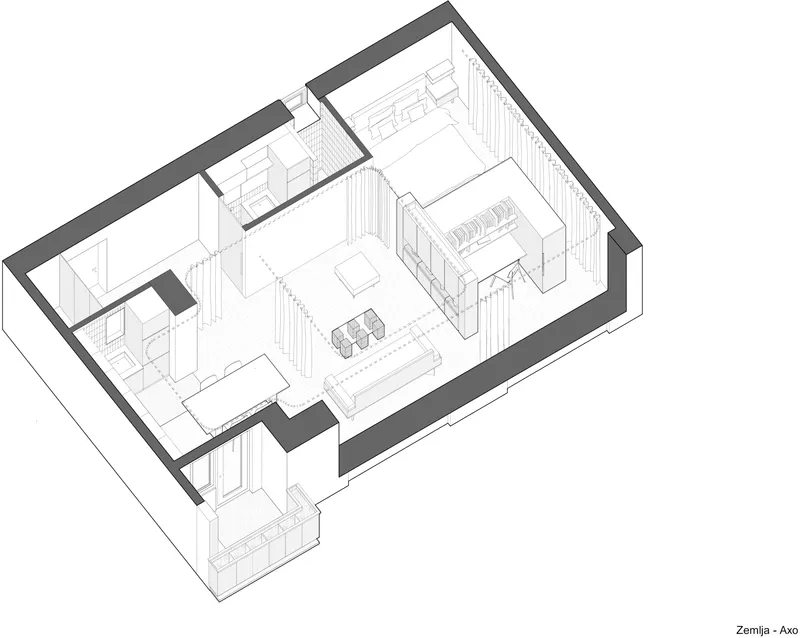
The existing plan shows a conventional two-room apartment with a separate kitchen and bathroom: the standard socialist-era layout of partition walls defining small, discrete rooms. The proposed plan removes the central wall to create a continuous living and dining zone, with the bedroom folded into the depth of the plan behind the furniture monolith. The axonometric drawing reveals how the three furniture islands sit free of the walls, establishing the circulatory logic that drives the whole scheme. The gap between furniture and ceiling is clearly visible, allowing air and sightlines to pass over each island.
Why This Project Matters
Zemlja matters because it treats material choice as a political act. In a country where post-war reconstruction defaulted to cheap synthetics and imported products, this apartment deliberately reconnects with Bosnian clay, Bosnian timber, and Bosnian craft. The architects did not simply specify these materials; they sourced them from a fragmented domestic supply chain and, in many cases, built the furniture themselves. That process is the project as much as the finished space. The Grand Prix at Collegium Artisticum, Bosnia-Herzegovina's national architecture award, confirms that the local profession recognizes the significance of the gesture.
Beyond its regional context, Zemlja is a credible model for sustainable urban retrofit at the smallest scale. Fifty square metres, natural materials, self-build construction, dramatically reduced heating loads, and a spatial strategy that makes a two-room apartment feel like a loft. It argues that ecological ambition does not require new construction, large budgets, or imported technology. Sometimes it just requires earth, wood, and the willingness to get your hands dirty.
Zemlja Earth Apartment by Projekt V Arhitektura, Grbavica, Sarajevo, Bosnia and Herzegovina. 50 m², completed 2023. Photography by Shantanu Starick.
About the Studio
Share Your Own Work on uni.xyz
If projects like this are the kind of work you want to make, uni.xyz is a place to publish your own, find collaborators, and enter design competitions.




Popular Articles
Popular articles from the community


Conexión: Biophilic Design Reimagines High-Rise Living in Hong Kong
Conexión reimagines high-rise living in Hong Kong through biophilic design, green facades, shared spaces, daylight, water and nature within.

The Ocean Hive: Sustainable Architecture for a Self-Sufficient Civilization at Sea
The Ocean Hive imagines sustainable architecture at sea, where modular habitats, algae, wave power and ocean waste sustain a growing colony.

Riyadh For All: Intergenerational Urban Design for Active Aging in Rabat
Riyadh For All reimagines urban design in Rabat with intergenerational co-living, adaptive courtyards, and Moroccan cultural exchange today.

The Musturak Paradise: Senior Living Architecture for a Connected Future in Temara, Morocco
The Musturak Paradise reimagines senior living architecture in Temara via private homes, social spaces, culture, community, and shared care.


Similar Reads
You might also enjoy these articles

Bao Huynh Watercolor Atelier: A Serene Art Retreat in Hội An
Bao Huynh Watercolor Atelier in Hội An blends multifunctional art spaces, sustainable design, local materials, and family-friendly living in a serene environment.

Atelier Macri Concept Store Interior Design by CASE-REAL
Atelier Macri store features a "ko" counter, walnut wood details, cork displays, blending retail, gallery, and seamless customer experiences.

Manuel Vargas Izquierdo Stadium and High-Performance Sports Center: Architectural Excellence in Jalpa de Méndez
The Manuel Vargas Izquierdo Stadium blends sustainable design, inclusive sports facilities, and cultural-inspired architecture, revitalizing Jalpa de Méndez’s public spaces.

KAKR Buluh Awar Hall: Revitalizing Community and Ecology Through Bamboo Architecture
Community built bamboo hall revitalizes Buluh Awar village, empowering youth, restoring ecology, celebrating vernacular craftsmanship through sustainable architecture and culture.

Explore Apartments Competitions
Discover active competitions in this discipline



Challenge to reimagine the Iron Throne


Photograph architecture without architects


Illustrate the lost glory of Angkor Wat - Render Challenge


Design challenge to reuse E-waste
Comments (0)
Please login or sign up to add comments
No comments yet. Be the first to comment!