

PsA Architecture Designs Its Own Da Nang Home as a Climate-Tuned Stack of Concrete Blocks
On the banks of the Cam Le River, a 192-square-metre house doubles as a studio, cooled by courtyards, ponds, and climbing plants.


When an architecture studio builds its own headquarters, the result tends to reveal more about its convictions than any client project could. PsA Architecture took exactly that opportunity in Da Nang, Vietnam, designing a 192-square-metre building near the Cam Le River that stacks living quarters above a ground-floor office. The house sits in a low-density urban area on the city's fringe, and its three interlocking concrete volumes are pulled apart just enough to let wind, water, and greenery do much of the heavy lifting on comfort.
What makes PsA House genuinely interesting is not the minimalist label it wears but the mechanics behind it. Every gap between blocks serves a purpose: a pond cools incoming air, climbing plants filter sunlight before it hits interior walls, and vertical passages between volumes accelerate cross-ventilation. Central Vietnam's climate is punishing, with scorching summers and a long rainy season. Rather than sealing up and air-conditioning the problem away, PsA structured the building so passive strategies come first. The office on the ground floor even has its own separate circulation path, meaning clients and colleagues never cross through the family's private domain upstairs.
Three Blocks and the Gaps Between Them
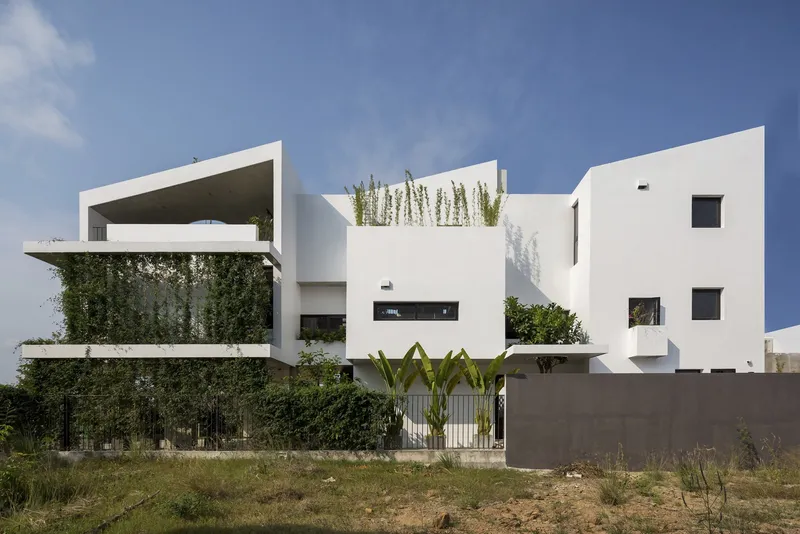
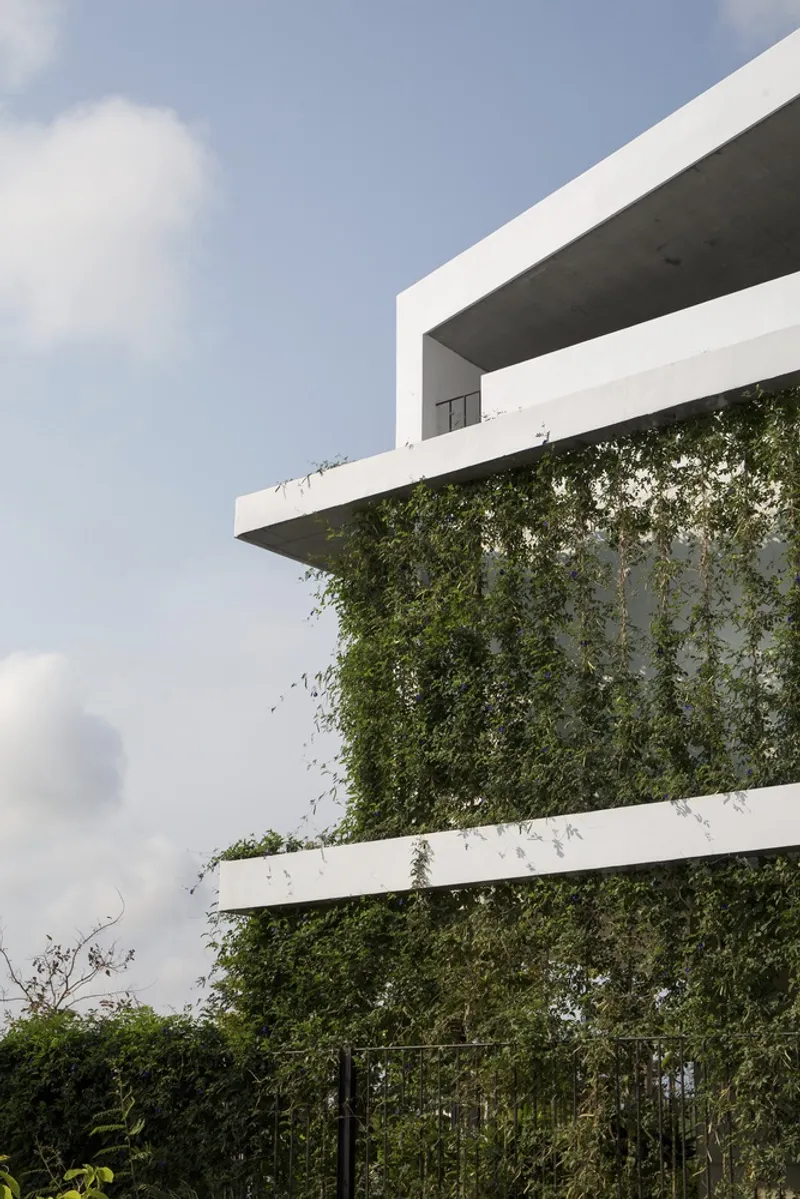
The building reads from the street as a composition of white stucco volumes set back behind a grey perimeter wall, with planted terraces spilling green over the edges. The setback from neighboring structures is deliberate: it guarantees control over light and airflow regardless of future development on adjacent plots. Between the blocks, voids appear as courtyards, vertical shafts, and planted slots that function collectively as the building's respiratory system.
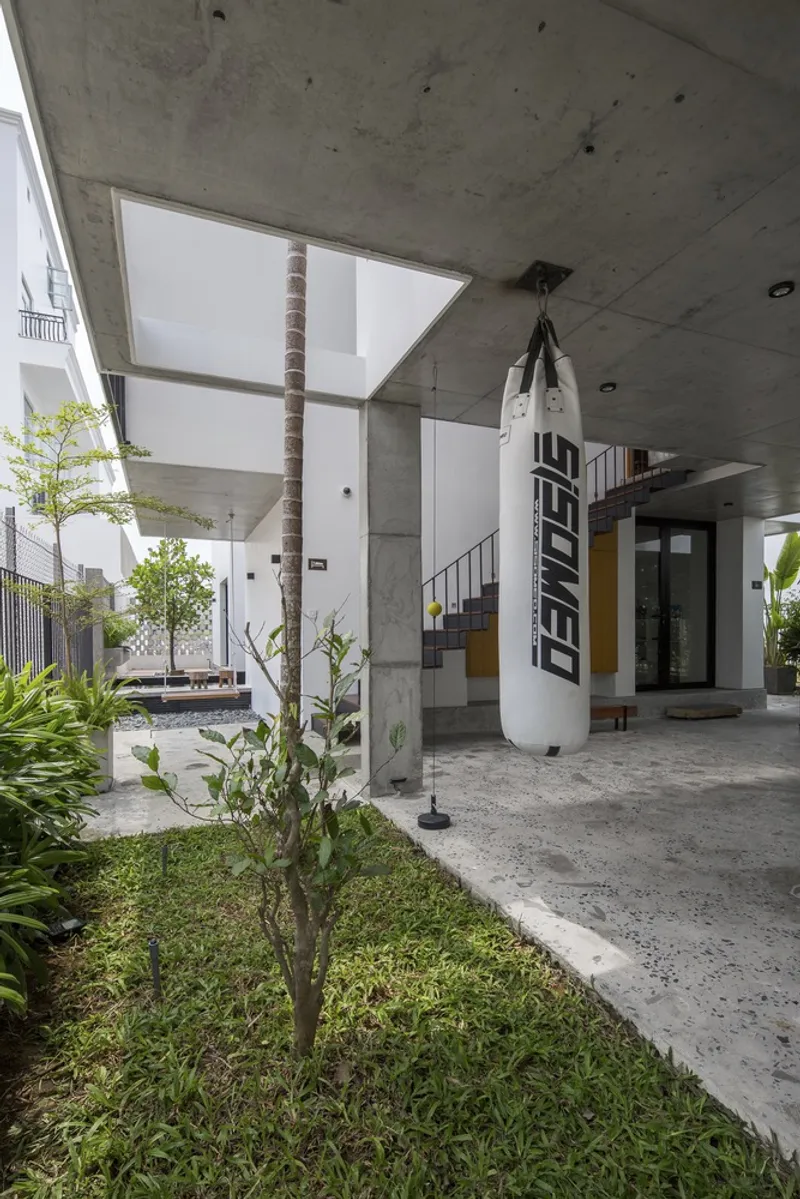
A cantilevered balcony extends outward with cascading green wall planting wedged between concrete slabs, turning the facade into something closer to a living section drawing. At ground level, a covered courtyard framed by concrete columns holds a tree and, somewhat unexpectedly, a suspended punching bag. It is a reminder that these in-between spaces are not ornamental leftovers but actively used zones that blur the line between inside and out.
Courtyards That Work as Climate Machines

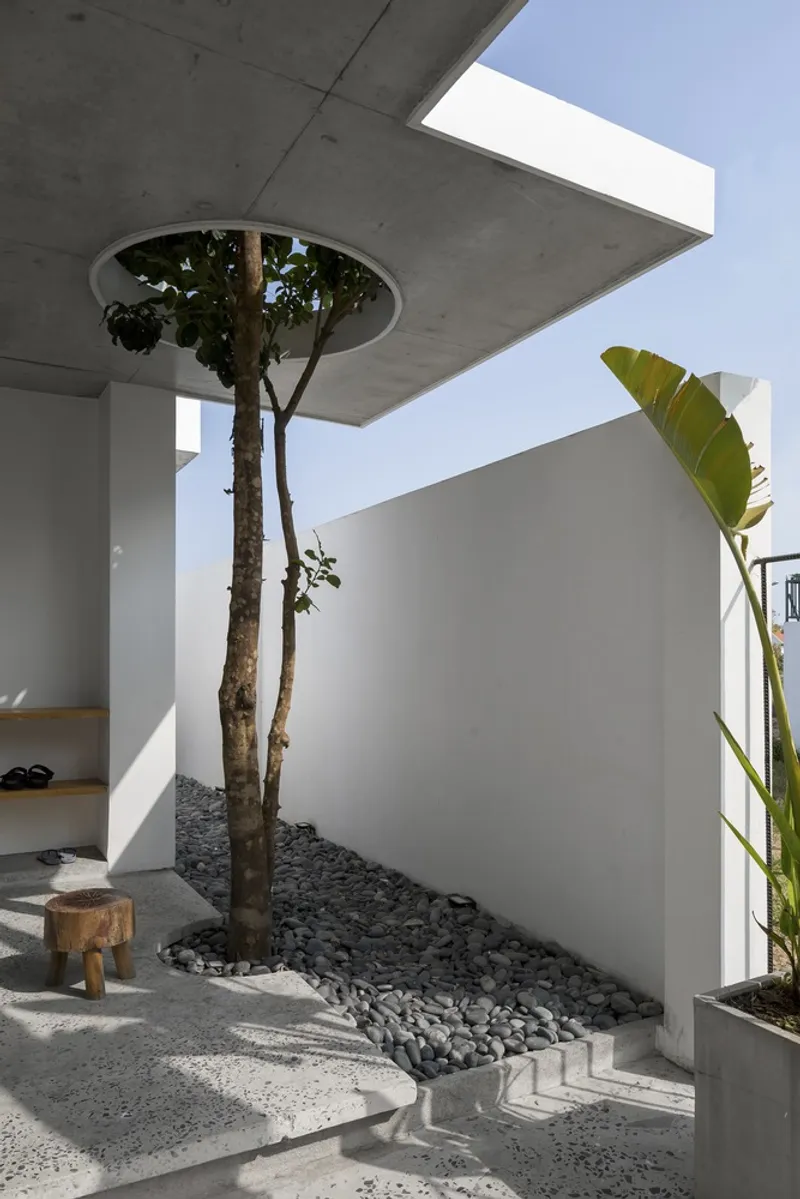
Two interior courtyards anchor the building's passive cooling strategy. One features a timber swing, grey pebbles, and a raised planting bed beneath a concrete overhang, creating a pocket of shade that stays cool even at midday. The other opens directly to the sky through a circular cut in the ceiling slab, allowing a tree to grow upward through the structure. That oculus doubles as a chimney effect driver, pulling warm air out and drawing cooler air from the pond below.
These are not token courtyards dropped in for atmosphere. Their dimensions and positions along the building's length were calibrated to accelerate wind movement between blocks. The pond placed at the junction of two volumes adds evaporative cooling on hot days. It is a straightforward thermodynamic trick, but executed here with enough spatial generosity that it registers as landscape rather than engineering.
Exposed Concrete, Timber, and a Restrained Palette
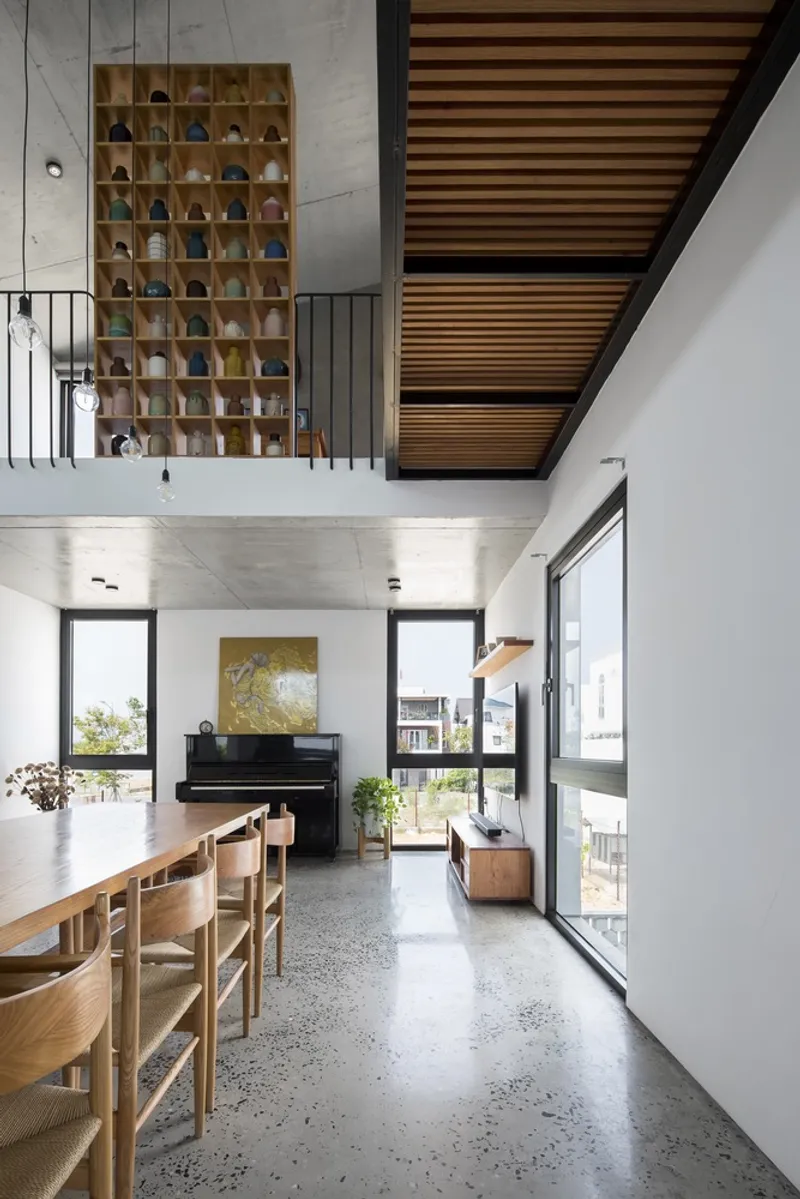
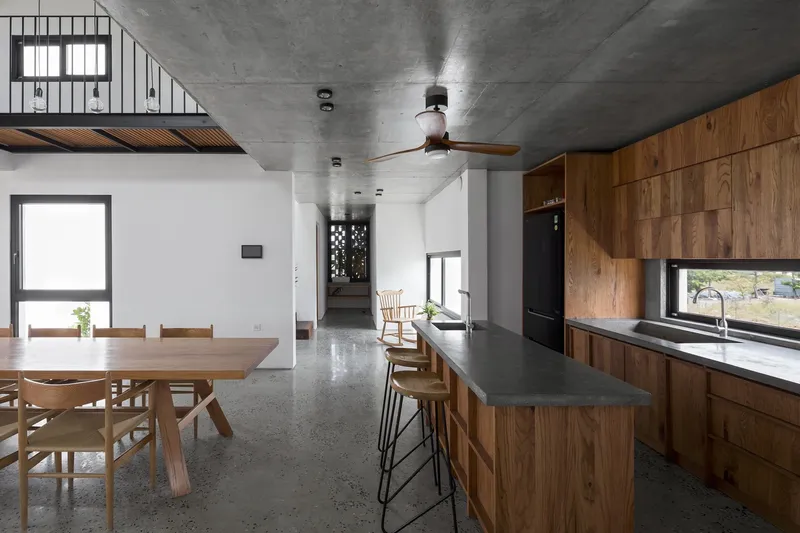
Inside, the material vocabulary is tight: exposed concrete ceilings, polished terrazzo floors, and natural timber for cabinetry, slat screens, and mezzanine overhangs. The double-height living space features a timber slat mezzanine that filters light while providing visual connection between levels. In the kitchen and dining area, timber cabinetry sits against terrazzo flooring under a raw concrete ceiling with a single ceiling fan. The restraint is consistent enough that it reads as a conviction rather than a budget limitation.
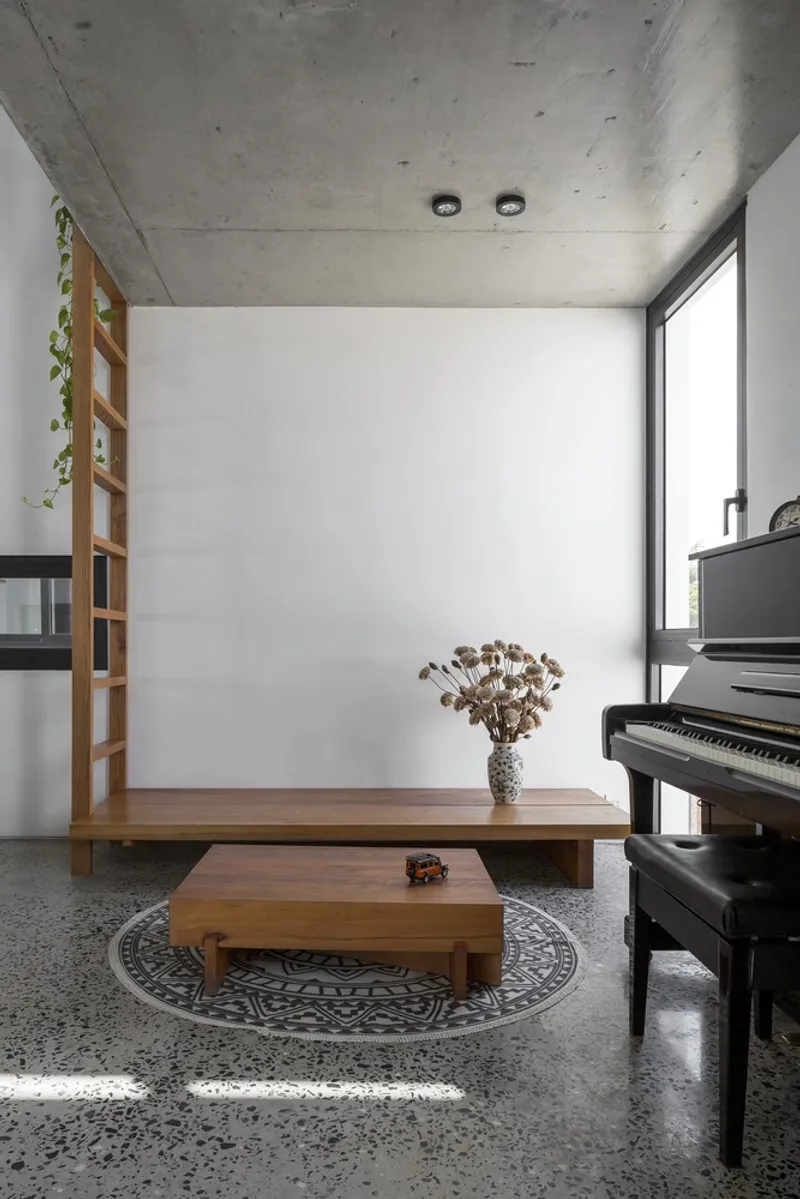
A living room corner pairs a low timber bench with an upright piano on a circular patterned rug, a composition that feels considered without being staged. The material choices, including products from An Cuong Wood and Vietceramics, are intended to age well under Central Vietnam's humidity and temperature swings. Durability here is not just a talking point but a design requirement: exposed concrete weathers gracefully, terrazzo resists moisture, and timber patinas rather than deteriorates when properly treated.
Thresholds and Filtered Light
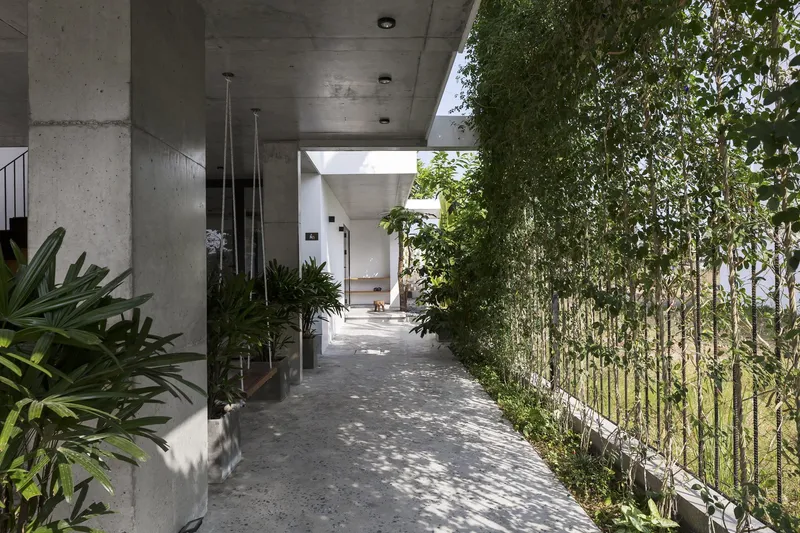

The covered entry passage is one of the building's strongest moments. An exposed concrete ceiling extends over planted beds and a bamboo screen wall, catching dappled sunlight that shifts throughout the day. The passage works as a compression zone, a transition from the street's heat and glare into the cooler, dimmer interior. Bamboo screening softens the boundary without fully enclosing it, keeping air moving while filtering the harshest sun angles.
Even the bathroom gets this treatment. A vertical window frames dense green foliage outside, turning the shower into a moment of visual connection with the landscape. The exposed concrete ceiling overhead keeps the room cool and honest. There are no applied finishes disguising the structure here, just the bones of the building and a carefully positioned slot of glass that brings nature close without sacrificing privacy.
The Rooftop as a Fifth Elevation

The rooftop terrace extends the building's logic upward, with a circular skylight punched above a concrete planter box and reflecting pool. From above, the house reveals its strategy: the gaps between blocks are not just sectional devices but planimetric ones, organizing the roof into a series of outdoor rooms connected by planted bridges and water surfaces. The reflecting pool catches sky and softens the concrete mass, while the planter box brings greenery to the highest point of the building where it is most exposed to sun and wind.
Treating the roof as a usable landscape rather than a neglected utility surface is a pragmatic choice in Da Nang, where flat roofs absorb enormous amounts of solar radiation. Water and planting on the roof act as thermal buffers, reducing heat transfer to the rooms below. It is another instance of PsA making passive strategy do double duty as spatial design.
Why This Project Matters
PsA House is a compact argument for how tropical architecture can be both rigorous and livable without relying on mechanical systems as the primary comfort strategy. The building's three-block plan, its carefully sized courtyards, its climbing plants and ponds, all of these moves are simple in principle. What sets the project apart is the discipline with which they are combined. Nothing is decorative that does not also perform a climatic or spatial function.
For a studio designing its own home and workplace, the stakes are personal. Every detail is a statement of method. PsA Architecture chose to let the gaps between things, the courtyards, the vertical passages, the planted thresholds, do the real architectural work. The solids are reduced to plain geometric volumes in exposed concrete and white stucco. It is the voids that make the building breathe, literally and figuratively, and that is the lesson worth taking from Da Nang's riverbank.
PsA House by PsA Architecture, Da Nang, Vietnam. 192 m², completed 2020. Photography by Hoang Le.
About the Studio
Share Your Own Work on uni.xyz
If projects like this are the kind of work you want to make, uni.xyz is a place to publish your own, find collaborators, and enter design competitions.



Popular Articles
Popular articles from the community


The Musturak Paradise: Senior Living Architecture for a Connected Future in Temara, Morocco
The Musturak Paradise reimagines senior living architecture in Temara via private homes, social spaces, culture, community, and shared care.

Co-life: Sustainable Architecture for Age-Friendly Community Living
Co-life reimagines sustainable architecture for seniors through courtyards, rammed earth, shared gardens, and spaces designed for belonging.

Conexión: Biophilic Design Reimagines High-Rise Living in Hong Kong
Conexión reimagines high-rise living in Hong Kong through biophilic design, green facades, shared spaces, daylight, water and nature within.

EW PARK: Sustainable Architecture Reimagines the Future of Urban Parking
EW PARK reimagines city parking as a modular wooden tower combining automation, solar energy, electric mobility, and adaptable urban design.


Similar Reads
You might also enjoy these articles


Hodi-Mandai Geram
Project Function: Preservation and revitalization of the Intangible heritage and socio-spatial identity of the Hodi by Housing, Cultural Memory Center, Sacred Grove, landscape, local tourism economy


Olio Towers: A Mid-Rise for Performers That Fuses Housing, Rehearsal, and Stage
Located blocks from Houston's Theater District, this modular tower stacks living units around a central performance atrium.

Oasis: Modular Green Housing Carved into Dhaka's Urban Fabric
A shortlisted Plugin Housing entry reclaims unauthorized settlements in Dhaka with stepped concrete volumes, green roofs, and ventilation-driven design.

Black Hole: A Floating Megastructure for the Post-Physical Era
Emiliano Mazzarotto envisions a spherical, self-scaling arena where e-sports, digital hotels, and holographic stadiums replace traditional public space.


Explore Architecture Competitions
Discover active competitions in this discipline



Challenge to reimagine the Iron Throne


Photograph architecture without architects


Illustrate the lost glory of Angkor Wat - Render Challenge


Design challenge to reuse E-waste
Comments (0)
Please login or sign up to add comments
No comments yet. Be the first to comment!