

Public Smart Bin: Turning Waste Disposal Into a Self-Sustaining Urban Ritual
A solar-powered, app-connected waste receptacle that rewards users, grows plants, and aims to last fifty years in the public realm.


What if a trash bin could do more than collect waste? What if it could harvest its own energy, grow a garden on its back, gamify recycling through a phone app, and still look good enough to anchor a city plaza? The Public Smart Bin treats the humble waste receptacle as genuine urban infrastructure: a self-sufficient device that generates power, sorts refuse, tracks user behavior, and integrates living greenery into a single compact structure designed to endure over fifty years of public use.
Designed by Nicklas Jorgensen, this project is a winning entry in the Trashed competition on uni.xyz. The brief called for rethinking how cities deal with public waste, and Jorgensen's response refuses to treat the problem as merely logistical. Instead, the design merges smart city technology, biophilic elements, and behavioral psychology into a single object that asks pedestrians to reconsider their relationship with what they throw away.
A Barrel Vault of Solar Cells Over Reclaimed Timber
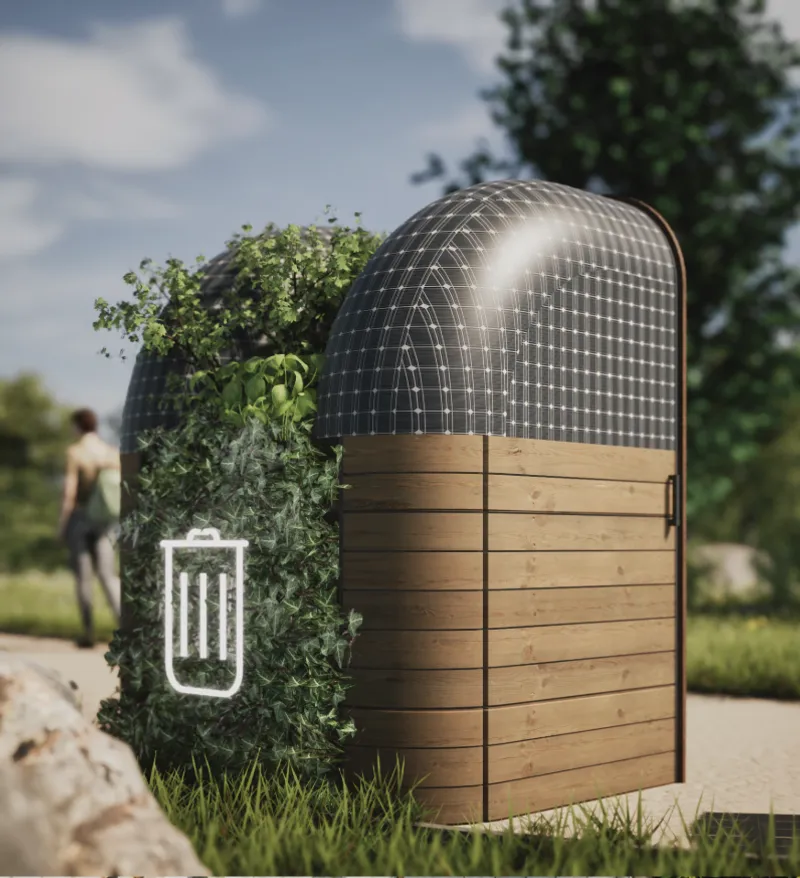

The most immediately striking element is the domed roof: a barrel vault clad in solar cells that harvests energy throughout the day, powering every integrated component, from LED panels and touchscreens to sensors and connectivity modules. Below that canopy, the body of the bin is wrapped in reclaimed wood side panels and recycled metal cladding, materials chosen for resilience and environmental responsibility rather than mere appearance. The result reads less like street furniture and more like a small piece of civic architecture.
From above, the twin curved roofs flank a strip of living vegetation, creating a green seam that softens the object in plan view. Pedestrians walking past encounter a structure that feels planted in the landscape rather than dropped onto it. The metal skeleton is anchored directly to the ground for stability and vandal resistance, a practical detail that acknowledges the realities of public installation without compromising the formal language.
Material Logic: Solar Plastic, Living Walls, and Circular Assembly
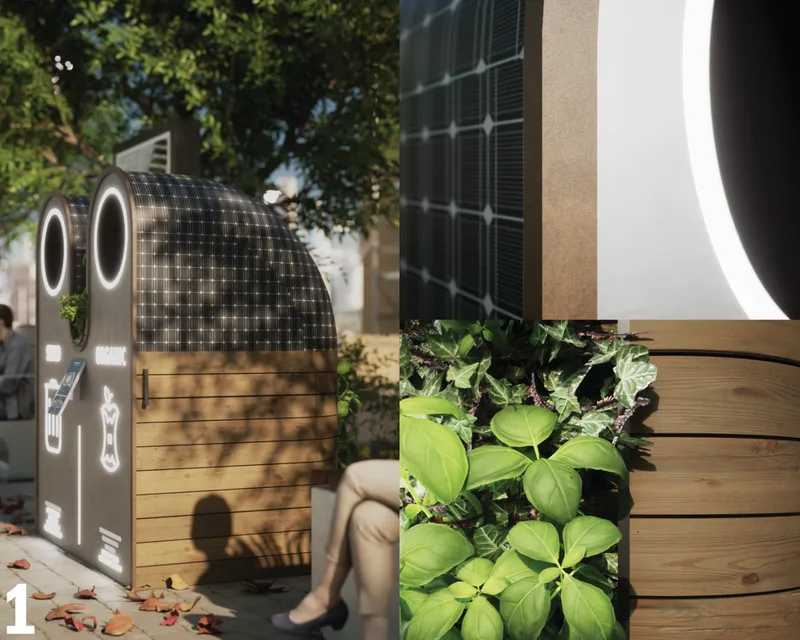
A close look at the material palette reveals how deliberately each layer has been considered. Solar plastic hoods cap the structure, reclaimed wood provides warmth and texture at eye level, and circular illuminated openings signal where waste should go. At the rear, a vertical garden composed of leafy greens improves air quality, enhances biodiversity, and introduces a biophilic dimension that makes the bin feel alive. These are not decorative gestures; they form a coherent argument about what public objects owe the ecosystems they sit within.
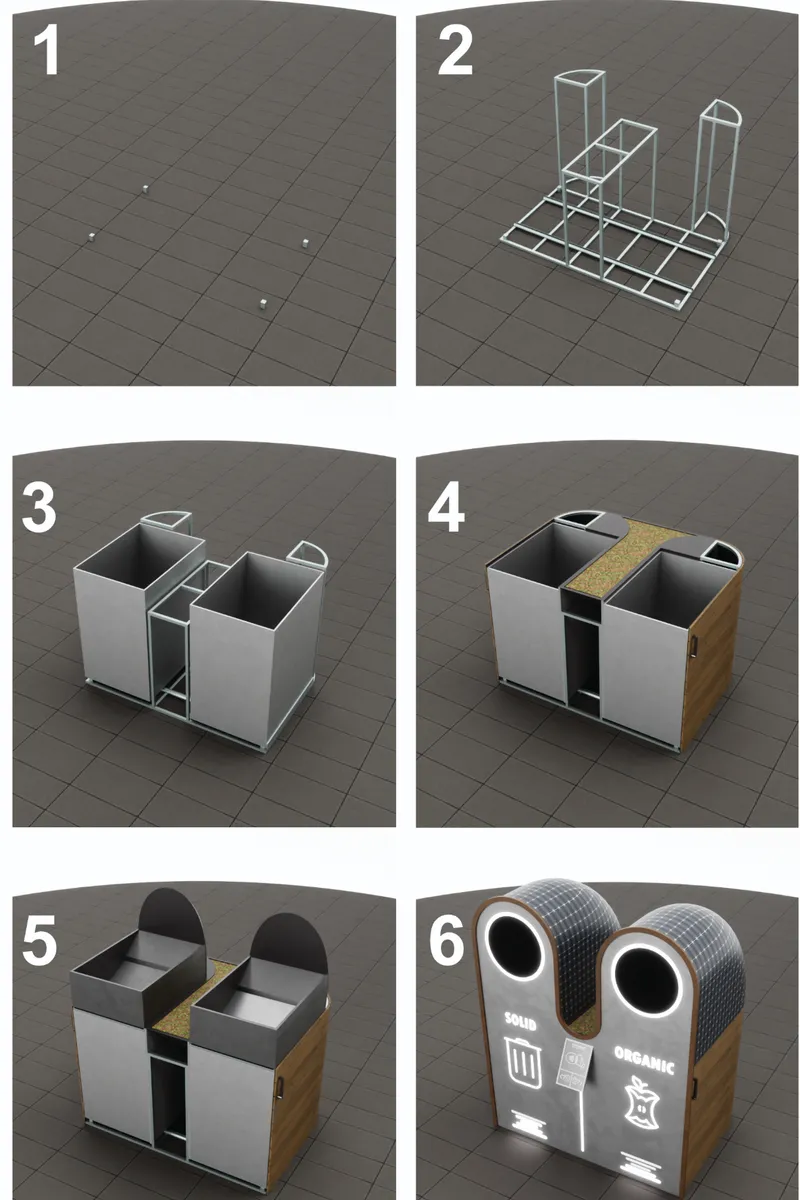
The axonometric assembly diagram makes the engineering legible. A dual-compartment receptacle separates organic and solid waste at the point of disposal. The curved solar roof, timber cladding, planted wall, and structural frame stack into a logical sequence that could be fabricated, shipped, and installed with minimal site work. Every component targets longevity over fifty years, a commitment that drastically reduces the lifecycle carbon footprint compared to conventional bins replaced on shorter cycles.
Glowing Portals and Behavioral Nudges at Dusk
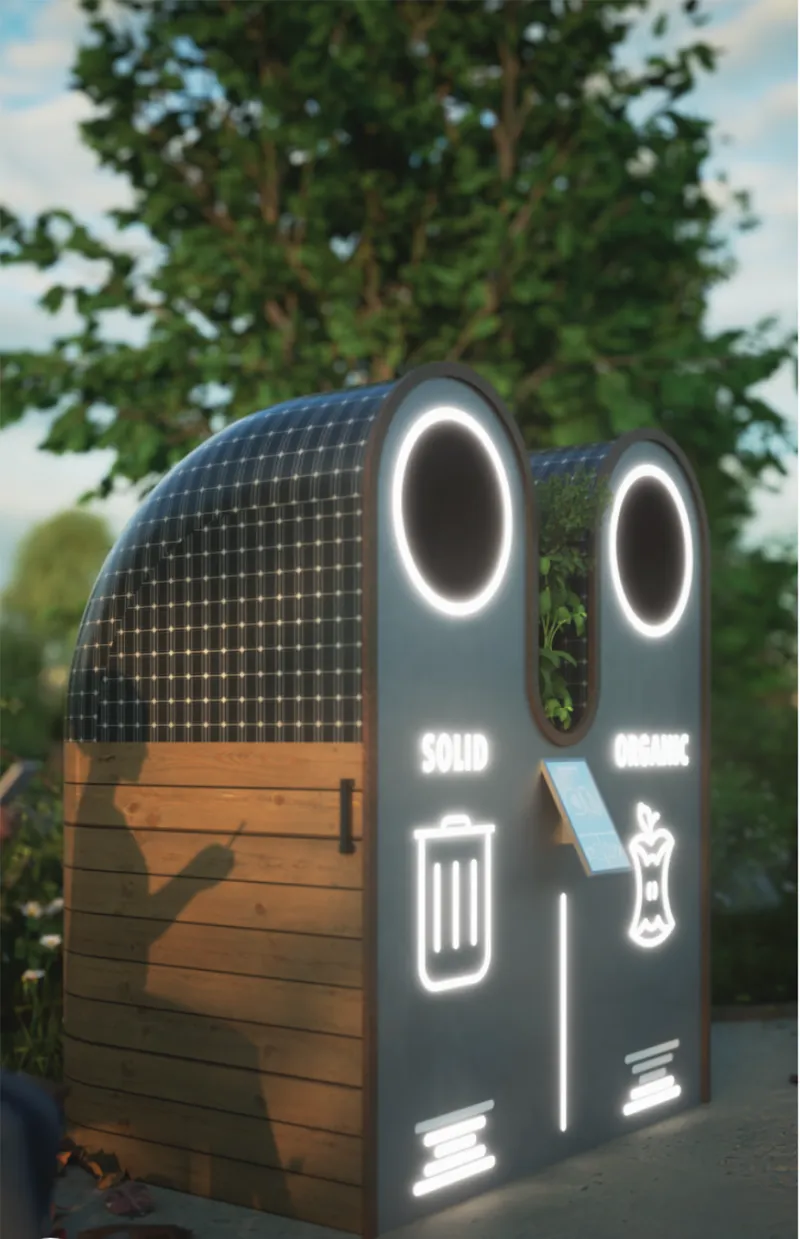
At dusk, the bin transforms. Twin illuminated openings glow beneath the solar canopy, each marked with labeled sorting icons that make waste separation intuitive even in low light. Softly shifting LED panels draw attention from a distance, turning the bin into a wayfinding beacon. The front panel functions as an interactive touchscreen interface connected to a dedicated app: users scan their phones, weigh their waste, and accumulate points redeemable as discounts, digital rewards, or community credits.
Jorgensen grounds this gamification in three psychological drivers: reward, curiosity, and accountability. The point system rewards proper sorting. The sleek, slightly futuristic appearance sparks curiosity, prompting people to investigate rather than walk past. And subtle interface cues introduce a gentle sense of responsibility for what gets discarded and where. The combination turns a mundane act into a feedback loop, generating data that municipalities can analyze to refine urban environmental strategies.
Why This Project Matters
Most public bins are afterthoughts: generic cylinders bolted to sidewalks, replaced when they rust, and ignored by the people who use them. The Public Smart Bin argues that waste infrastructure deserves the same design rigor applied to transit shelters or park pavilions. By bundling energy generation, digital interaction, living vegetation, and durable material selection into a single unit, Jorgensen demonstrates that even the smallest piece of the urban kit can carry significant environmental and social weight.
The project's real ambition is behavioral. Technology and greenery are compelling, but the deeper proposition is that design can reshape habits at the scale of a single interaction. If scanning a phone and sorting waste becomes rewarding and even enjoyable, the circular economy stops being an abstract policy goal and starts being something a person does on their lunch break. That shift, from passive disposal to active participation, is where this design finds its most consequential territory.
View the Full Project
About the Designers
Designer: Nicklas Jorgensen
Enter a Design Competition on uni.xyz
uni.xyz runs architecture and design competitions year-round that reward proposals with spatial conviction and real site intelligence.
Project credits: Public Smart Bin by Nicklas Jorgensen Trashed (uni.xyz).


Popular Articles
Popular articles from the community

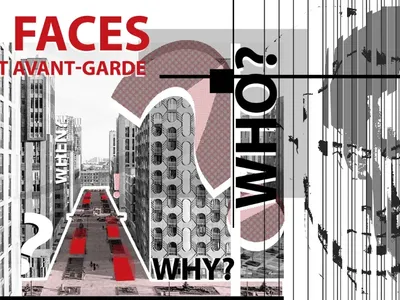
Faces of the Soviet Avant-Garde: Turning Moscow's Street Names into an Open-Air Museum
A network of sculptural installations across a Moscow residential district transforms forgotten architect names into spatial encounters with cultural memor

Opera on the Sea: Driftwood Logic Shapes a Timber Opera House on Estonia's Coast
Trevor Orgill's opera house translates the entangled drift of floating timber into a civic building where wood, water, and music converge.

Extended Shell: Retrofitting Kolkata's Balconies as Living Urban Thresholds
A modular retrofit system recovers the social and environmental intelligence of Kolkata's historic verandas for contemporary Park Street residents.

Temporary Home for Dogs: A Reversed Zoo Rethinks Animal Shelter Architecture
In Bucharest, a sinuous corridor and freed landscape flip the logic of containment, designing a shelter that works to make itself unnecessary.

Similar Reads
You might also enjoy these articles

Shakur's House: Exposed Brick as an Interior Organiser in a 168 m² Mashhad Residence
Brick moves indoors in this Mashhad residence, where masonry walls, glass partitions and teal planes sequence a compact home without closing it off.

Day and Night Park: A Time-Based Urban Newsstand in Beijing
A temporary urban newsstand in Beijing blending travel, light, and reading through poetic colors, compact form, and community-focused design.

Modernist Patio Renovation in El Masnou, Barcelona by Oliver Segura Arquitectura + Cebrià Arquitectura
Modernist patio renovation blending tradition and innovation with a movable pool, leveled floors, and Catalan materials in El Masnou.

Alto Residencial Coop: Cooperative Housing Development in Santiago de Compostela by Carbajo Barrios Arquitectos
A linear cooperative housing complex blending white volumes and perforated metal façades, enhancing community living, natural light, privacy, and urban integration.

Explore Urban Design Competitions
Discover active competitions in this discipline

Design challenge to reuse E-waste

Packaging challenge - Design meets sustainability
Comments (0)
Please login or sign up to add comments
No comments yet. Be the first to comment!