

Quzhou No.6 Experimental School: A New Model for Integrated, Future-Ready Learning Environments
A flexible, future-ready campus with tree-inspired design, playful cultural spaces, pocket gardens, and interconnected streets encouraging exploration, creativity, and vibrant student interaction.


H1: Quzhou No.6 Experimental School – LYCS Architecture Creates a Future-Focused Campus for Exploration and Growth
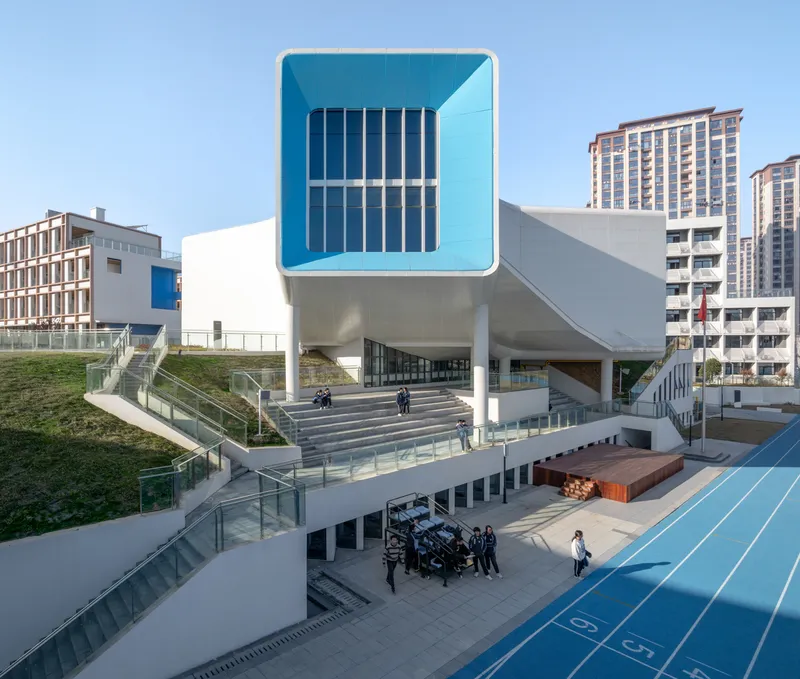
Completed in 2024, Quzhou No.6 Experimental School by LYCS Architecture redefines the educational landscape of Quzhou’s High-Speed Rail New Town. Spanning 67,500 m², the campus accommodates a 36-class primary school and an 18-class middle school, forming a comprehensive and flexible learning environment that moves beyond the constraints of traditional school planning.
Rather than relying on rigid grids of courtyards, plazas, and corridors, the architects envisioned a campus that nurtures curiosity, collaboration, and creativity—a place where students can explore, observe, and interact seamlessly throughout their daily routines.
H2: Reimagining the Campus Through the “Tree of Growth” Concept
At the core of the design is the “Tree of Growth” metaphor, a spatial framework that organizes the campus along a fluid west-to-east axis.
- Roots – Teaching Spaces Classrooms and academic clusters form the foundational elements.
- Trunk – Hybrid Spaces Flexible, informal zones create connective layers that blend circulation with learning.
- Canopy – Innovation Spaces Larger cultural, athletic, and exploratory venues act as shared communal hubs.
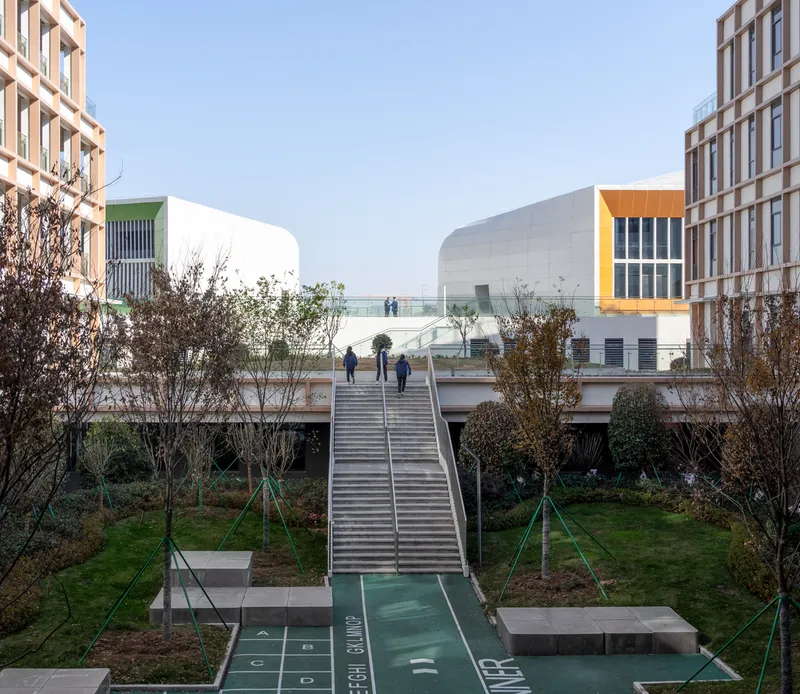
This conceptual structure supports a vibrant mix of public and semi-public spaces, including street-like corridors, pocket parks, gable-end alcoves, and multi-level terraces. The result is a layered network of environments designed for both structured learning and spontaneous encounters.
H2: Campus Streets that Encourage Movement and Discovery
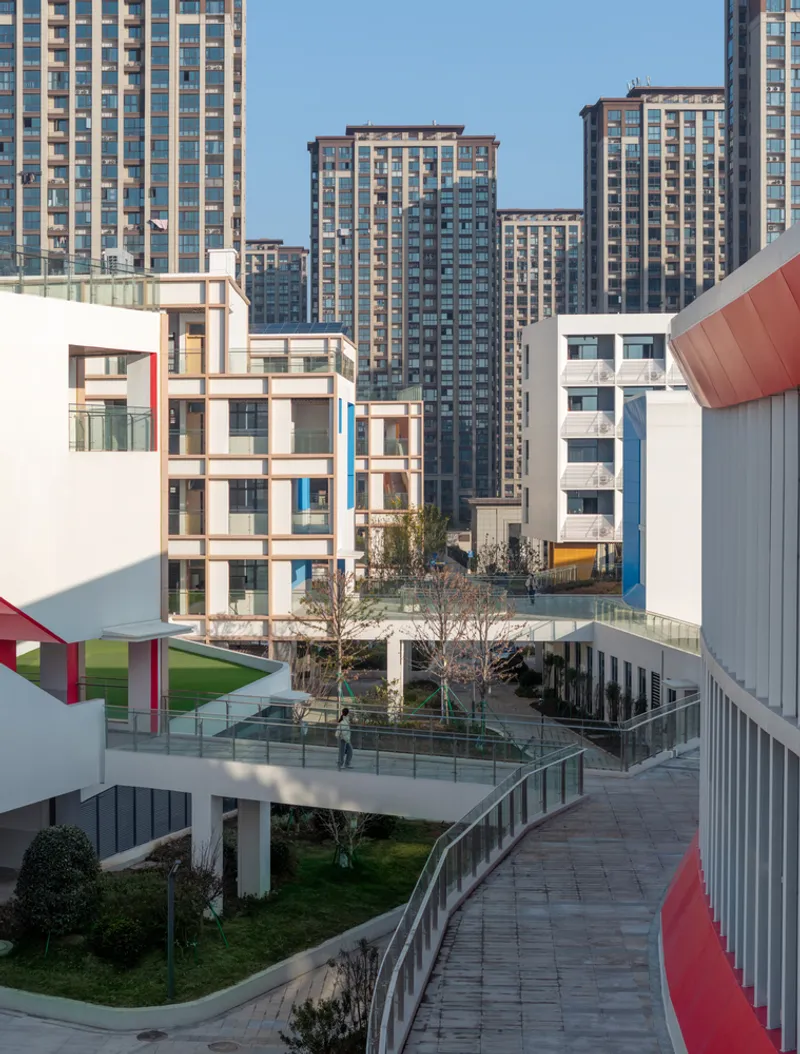
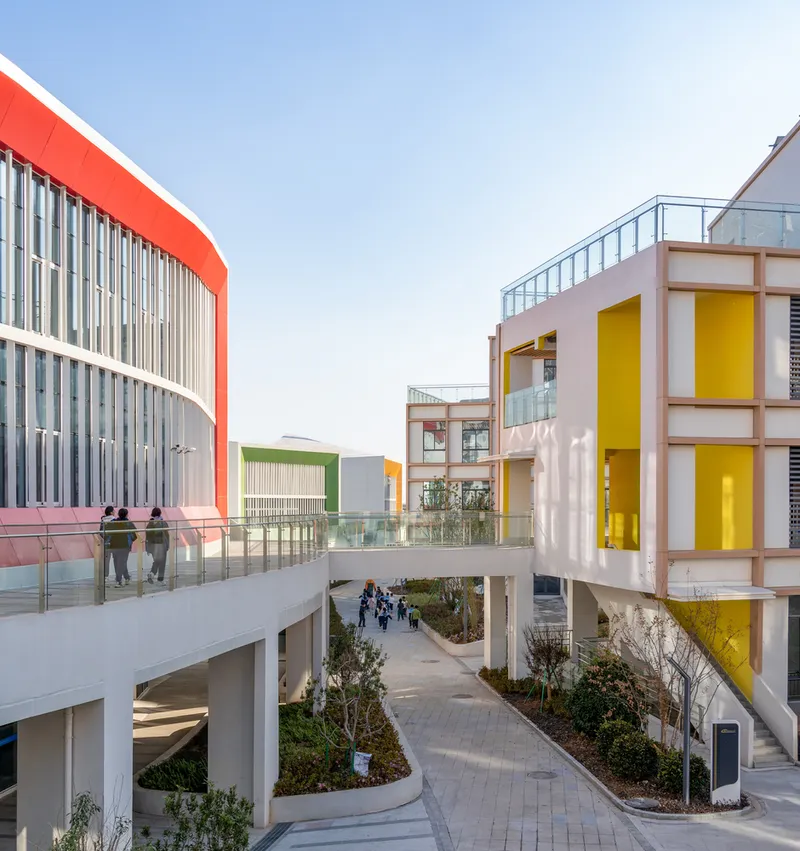
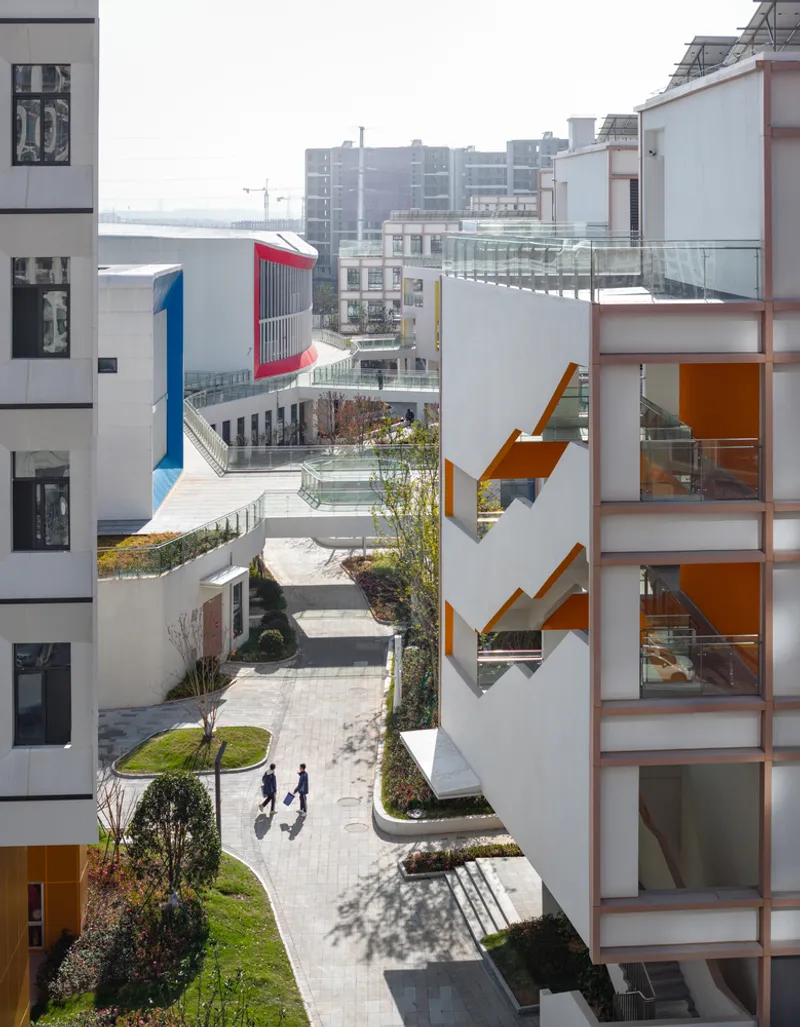
LYCS Architecture introduces an urban planning strategy within the school: a primary meandering “campus street”, accompanied by secondary pathways that travel across varied elevations. These pedestrian routes weave between major functional zones, ensuring:
- Smooth circulation
- Visual connection across levels
- Opportunities for social interaction
- A walkable and engaging campus atmosphere
Every turn, bend, and elevation shift enriches students’ sense of discovery, turning daily school life into a dynamic spatial experience.
H2: “E”-Shaped Academic Clusters with Pocket Gardens
H3: Thickened Gable-End Façades and Vertical Spatial Layers
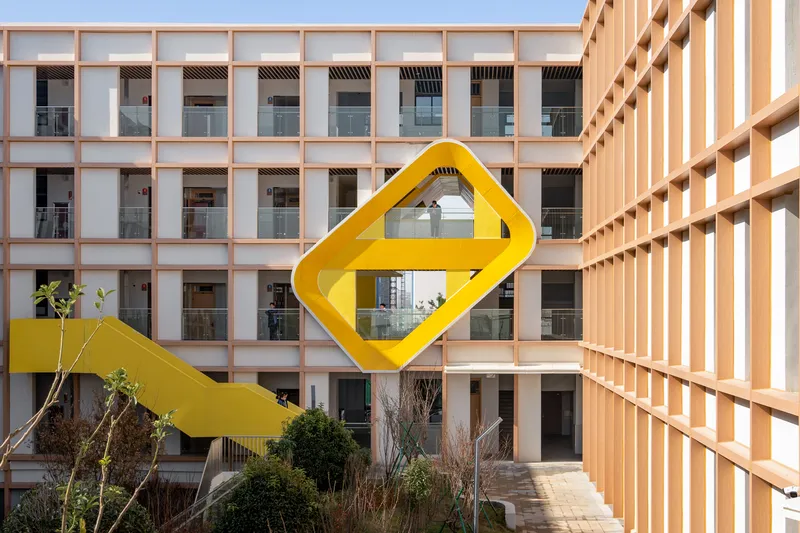
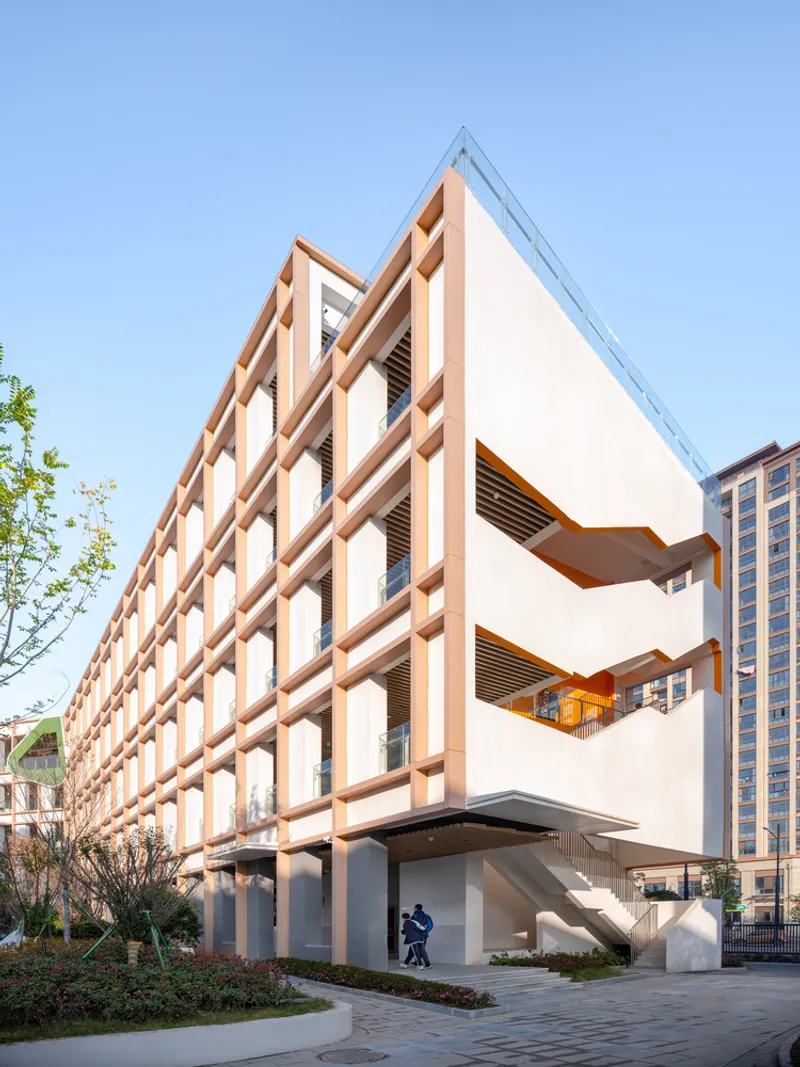
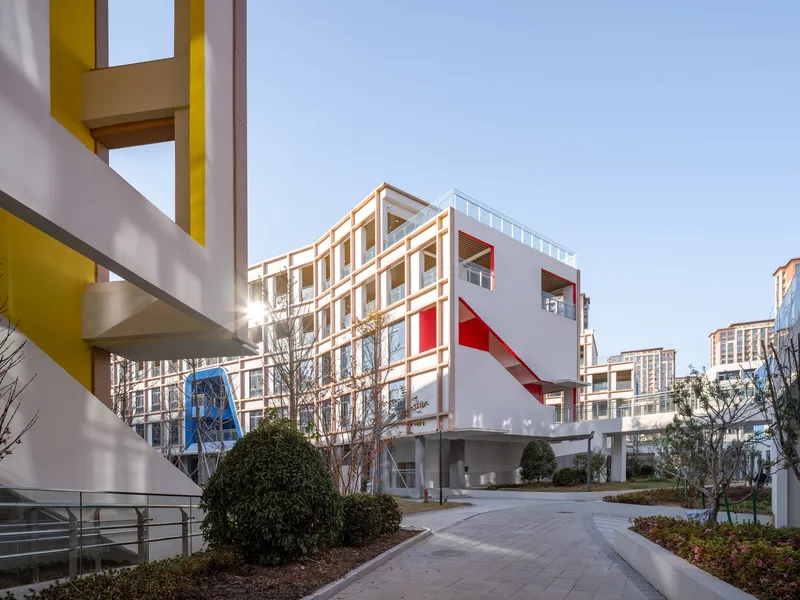
The teaching area is defined by two “E”-shaped academic blocks. Their thickened gable-end façades are designed not merely as architectural ends but as multifunctional vertical volumes that integrate:
- Single and double-flight staircases
- Resting platforms
- Transitional learning zones
- Sheltered open-air ground-level entrances
- Rooftop terraces offering outdoor classroom potential
H3: Pocket Parks as Elevated Learning Spaces
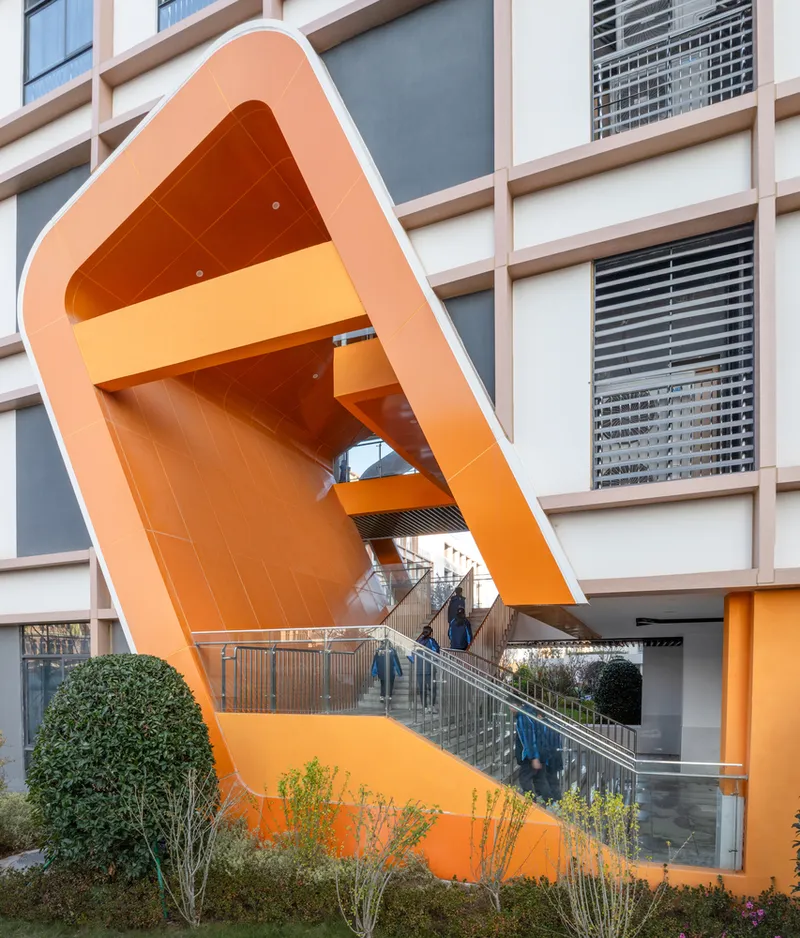
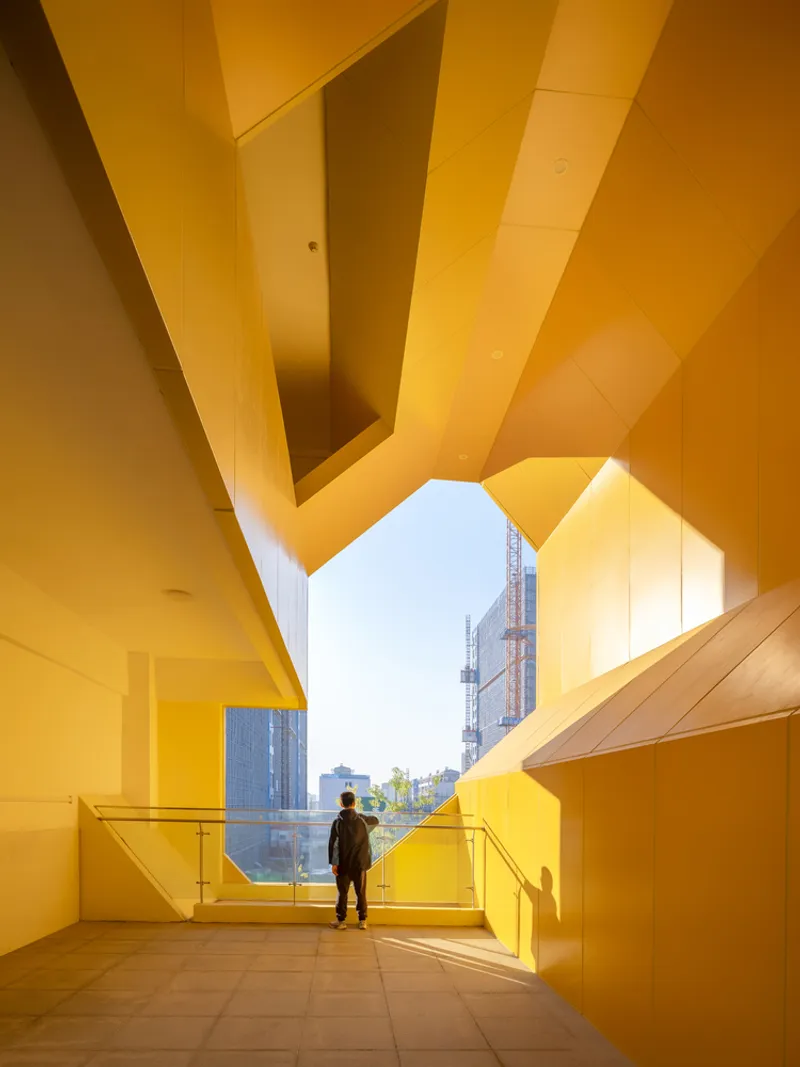
“Pocket parks” extend the concept of the campus street into the upper floors, creating small, themed outdoor rooms where students can:
- Study informally
- Gather between classes
- Play and relax
- Observe campus life from above
Each pocket garden varies in color, form, and ambiance, reinforcing the school’s overall sense of diversity and discovery.
H2: A Playful Cultural and Sports Center Integrated into the Terrain
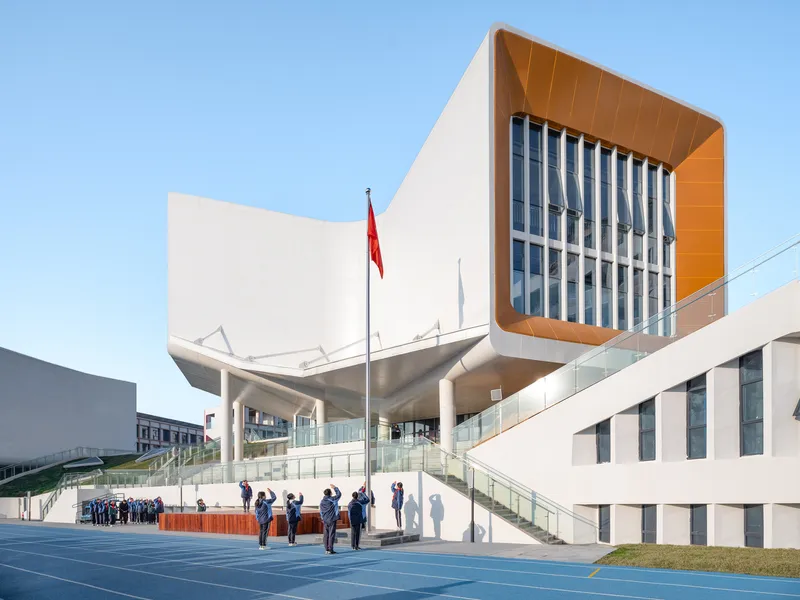
Opposite the academic area is the Cultural and Sports Center, a lively cluster of four uniquely shaped buildings placed across a landscaped slope. These structures form a playful composition that contrasts with the organized academic blocks while enriching the school’s communal vitality.
H3: Grand Steps as a Social and Functional Heart
The landscape addresses significant elevation changes through a set of “Grand Steps”, which serve as:
- A daily circulation route
- A venue for assemblies and flag-raising ceremonies
- A natural amphitheater for choral events
- A flexible platform for outdoor performances and gatherings
This terraced landscape links sports fields, cultural spaces, and circulation paths in a unified, interactive sequence.
H2: A Holistic Educational Environment for Contemporary Learning
Ultimately, Quzhou No.6 Experimental School demonstrates how architecture can promote flexibility, playfulness, and holistic learning. LYCS Architecture has crafted a campus that operates not merely as a collection of buildings but as an interconnected ecosystem supporting:
- Multimodal learning
- Active exploration
- Social engagement
- Integrated indoor–outdoor education
All photographs are works of Shan-Jian images


Popular Articles
Popular articles from the community


U.GA Architects Wraps an Oval Rooftop Pool in Curved Board-Formed Concrete on Busan's Jeollidan-gil
In Busan's Jeonpo-dong, a 454 m² mixed-use block stacks a neighborhood facility, guest rooms and an oval rooftop pool inside spiraling concrete walls.

David Macias Steps a Doorless Stone and Plaster House Down a Tropical Colombian Hillside
In the humid hills of Colombia, Threshold House replaces the front door with an open void and terraces its 850 m² down the slope instead of fighting it.

GROUP A Strips a 1969 Rotterdam Harbor Headquarters to Its Frame and Wraps It in Timber Louvers
In Rotterdam's M4H harbor district, Ferro Offices reuses a 1969 frame, adds one timber storey and reaches BREEAM-NL Outstanding.

longwave studio Reorganizes a 112 m² Tainan Apartment Around the Daily Routines of a Family and Two Cats
In Tainan, Taiwan, birch plywood, rust-red furniture and a freestanding plaster wall link arrival, storage, work and family life in one apartment.

Similar Reads
You might also enjoy these articles


Hodi-Mandai Geram
Project Function: Preservation and revitalization of the Intangible heritage and socio-spatial identity of the Hodi by Housing, Cultural Memory Center, Sacred Grove, landscape, local tourism economy


Olio Towers: A Mid-Rise for Performers That Fuses Housing, Rehearsal, and Stage
Located blocks from Houston's Theater District, this modular tower stacks living units around a central performance atrium.

Oasis: Modular Green Housing Carved into Dhaka's Urban Fabric
A shortlisted Plugin Housing entry reclaims unauthorized settlements in Dhaka with stepped concrete volumes, green roofs, and ventilation-driven design.

Black Hole: A Floating Megastructure for the Post-Physical Era
Emiliano Mazzarotto envisions a spherical, self-scaling arena where e-sports, digital hotels, and holographic stadiums replace traditional public space.

Explore Educational Building Competitions
Discover active competitions in this discipline

Challenge to design public laboratory

Challenge to reimagine the Iron Throne

Photograph architecture without architects

Illustrate the lost glory of Angkor Wat - Render Challenge
Comments (0)
Please login or sign up to add comments
No comments yet. Be the first to comment!