
RAGE: A School Built from Garbage on a Bangalore Landfill
A recycling-driven educational complex in Mavallipura transforms landfill waste into building materials, farmland, and a radical new pedagogy.


What if a school could eat a landfill? RAGE (Recycling, Architecture, Garbage, Engineering) proposes exactly that: a new typology of educational building that doesn't merely sit on remediated land but actively digests the waste beneath it, converting garbage into construction material, compost, and curriculum. Sited on the Mavallipura landfill in Bangalore, India, the project treats architecture as a metabolic organism, one that ingests refuse and outputs fertile soil, usable bricks, and trained graduates equipped to replicate the process elsewhere.
Designed by Marija Stojkovic, RAGE was shortlisted in the Bauhaus Neue competition. The project addresses five interconnected crises: landfill overflow, recycling inefficiency, technological scarcity, food insecurity, and poor living conditions. Rather than treating these as separate problems, Stojkovic collapses them into a single architectural and pedagogical system where the building itself is both the classroom and the subject of study.
A Circular Curriculum Encoded in Concentric Rings


The conceptual framework of RAGE is structured as a set of concentric circles, each ring representing a phase of learning and material transformation. Students begin at the outer edge by studying the socio-economic conditions that produce landfills, examining how post-colonial urban sprawl shaped India's waste crisis. They then move inward through hands-on modules: robotics-driven sorting and recycling, laboratory experiments that convert plastic, paper, e-waste, and organic refuse into new building materials, and finally design studios where those materials are assembled into instruments, structures, and infrastructure. The diagram reads like a target, and the bullseye is tangible output.
A companion site map radiates purple circulation zones outward from the school's core, tracing the logistical flows that connect the campus to its urban context in Bangalore. Vacuum extraction systems pull waste from the surrounding landfill into vertical drop-off points, where sorting begins. The map reveals that RAGE is not an isolated campus but a node in a larger metabolic network, absorbing waste streams and returning processed resources to the city.
From Contaminated Ground to Agricultural Rows

Perhaps the most striking drawing in the set is the axonometric before-and-after comparison. On one side, the Mavallipura site appears as a mound of compacted refuse, serviced by collection vehicles. On the other, the same ground has been converted into ordered rows of green agricultural land, nourished by biofertilizers derived from organic waste processed on site. The transformation is not metaphorical; RAGE proposes a complete lifecycle in which dedicated workshops produce compost for farming and bricks for construction from the very material that once poisoned the soil. The school literally builds its future from the debris of the past.
Biomorphic Pods Suspended Over Reclaimed Terrain


RAGE's architectural language is deliberately mechanical and organic at once. The collage rendering shows geometric pod structures hovering above a textured, almost geological landscape, linked by purple circulation ribbons that weave through the complex like conveyor belts. These pods are not decorative; they represent the functional organs of a recycling organism. Membranes, spiral sorters, and processing chambers are expressed as building components, making the architecture's purpose legible from every angle.
The elevation drawing reinforces this reading. Branching, almost dendritic forms reach outward from a central spine, with green planted zones occupying the spaces between structural members. The effect is of a building that grows rather than one that was assembled, a fitting metaphor for a project whose primary material source is waste that would otherwise accumulate without end. The planted zones also signal one of RAGE's two primary outcomes: the restoration of agricultural land through biofertilizers, alongside the production of construction-ready bricks from processed e-waste and plastics.
Spiral Ramps as Sorting Infrastructure

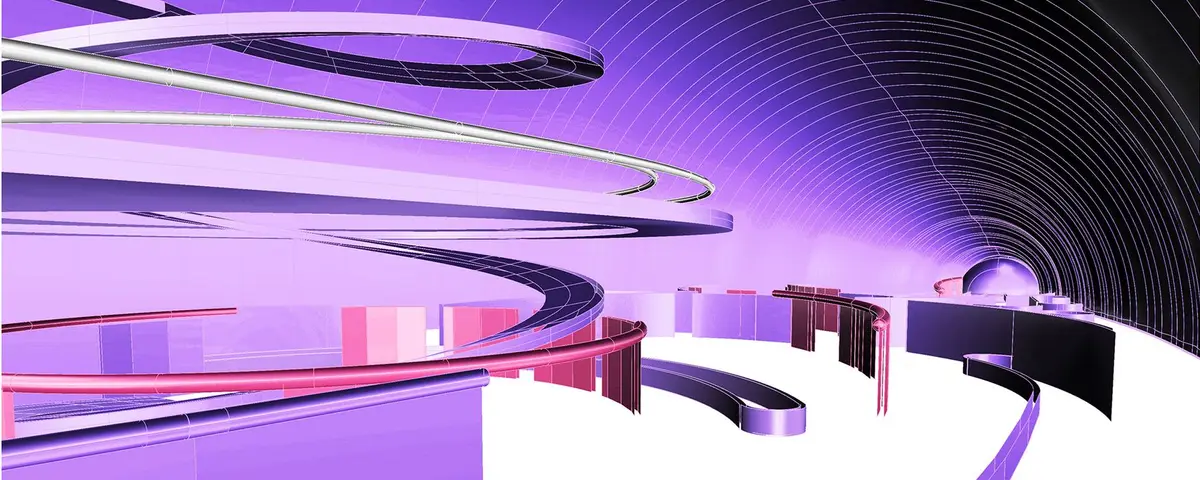
The final axonometric, rendered in deep purple tones, reveals the school's internal circulation: a continuous spiral ramp connecting multi-level platforms. The ramp does double duty. For students, it is the connective tissue between classrooms, workshops, and labs. For materials, it echoes the vertical drop-off and sorting sequence that processes waste from raw intake to refined output. The spiral form compresses the entire pedagogical journey into a single spatial experience, where ascending through the building mirrors advancing through the curriculum. It is an elegant solution that avoids corridors and dead ends, keeping both people and materials in constant, productive motion.
Why This Project Matters
RAGE refuses the comfortable distance that most sustainable design proposals maintain from the mess they claim to address. By siting a school directly on a landfill and constructing it from the waste found there, Stojkovic collapses the gap between environmental rhetoric and physical reality. The four-course curriculum is not supplementary to the architecture; it is the architecture's operating manual, training each cohort of students to maintain, extend, and eventually replicate the system in other waste-burdened regions.
At a moment when architectural discourse around sustainability often stops at carbon calculations and material passports, RAGE pushes further. It asks what happens when a building's programme, its pedagogy, its construction method, and its site remediation strategy are all the same thing. The answer, as this project demonstrates, is an architecture that doesn't just reduce harm but actively reverses it, turning the most degraded landscapes into the most productive ones.
View the Full Project
About the Designers
Designer: Marija Stojkovic
Enter a Design Competition on uni.xyz
uni.xyz runs architecture and design competitions year-round that reward proposals with spatial conviction and real site intelligence.
Project credits: RAGE by Marija Stojkovic Bauhaus Neue (uni.xyz).


Popular Articles
Popular articles from the community


David Ortega Stacks a Two-Story Mexico City Penthouse Around a Steel Stair and a Pergola-Shaded Roof Terrace
In Colonia Roma, a 300 m² penthouse uses oak joinery, a planted steel stair and a slatted roof pergola to make a new-build apartment feel like a house.

Cube Design Draws an Ecological Corridor Between Two Shenzhen Hills with the Nankai Building
Beside Shenzhen's container docks, the Nankai Building pairs stacked balconies with a climbing green screen to connect two hillsides across its height.

U.GA Architects Wraps an Oval Rooftop Pool in Curved Board-Formed Concrete on Busan's Jeollidan-gil
In Busan's Jeonpo-dong, a 454 m² mixed-use block stacks a neighborhood facility, guest rooms and an oval rooftop pool inside spiraling concrete walls.

Architekt Andreas Gruber Scatters 23 Dark Timber Chalets Across a South Tyrolean Forest Edge
In Molini di Tures, Amonti Chalets breaks a resort into a hamlet of gabled timber houses, with parking, storage and services pushed into the slope.

Similar Reads
You might also enjoy these articles


Vereda Arquitetos Renovates a 40-Square-Meter Apartment Inside Niemeyer's Copan Building
A compact unit in São Paulo's most iconic residential tower gets a material overhaul that pairs exposed concrete with bold blue Formica.

Shakur's House: Exposed Brick as an Interior Organiser in a 168 m² Mashhad Residence
Brick moves indoors in this Mashhad residence, where masonry walls, glass partitions and teal planes sequence a compact home without closing it off.

Day and Night Park: A Time-Based Urban Newsstand in Beijing
A temporary urban newsstand in Beijing blending travel, light, and reading through poetic colors, compact form, and community-focused design.

Modernist Patio Renovation in El Masnou, Barcelona by Oliver Segura Arquitectura + Cebrià Arquitectura
Modernist patio renovation blending tradition and innovation with a movable pool, leveled floors, and Catalan materials in El Masnou.

Explore Recycled Ruin Competitions
Discover active competitions in this discipline

Challenge to visualize future spaces of waste

Challenge to design public laboratory

VR headsets Storefront design competition
Comments (0)
Please login or sign up to add comments
No comments yet. Be the first to comment!