
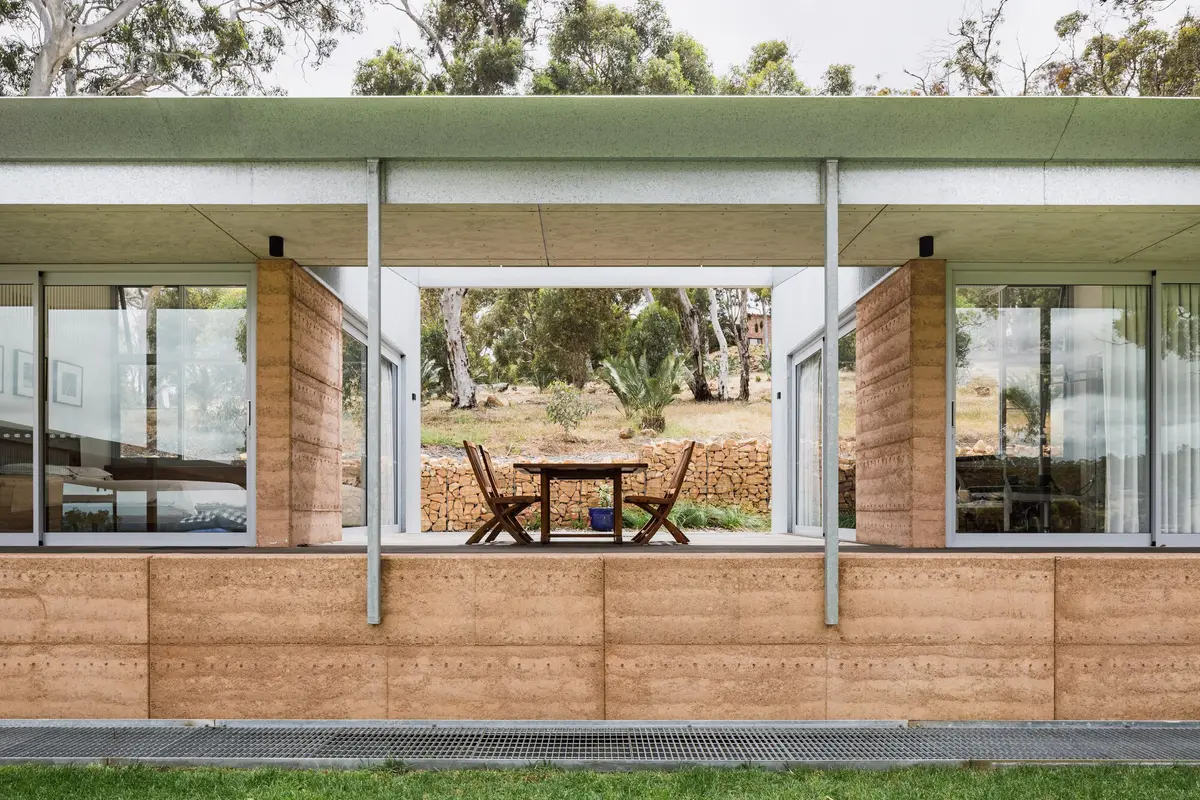
Rapid Close House: A V-Shaped Off-Grid Home Rooted in Landscape and Passive Living
Off-grid V-shaped house using rammed earth, optimizing views, passive design, and landscape integration while ensuring sustainability, comfort, and minimal environmental impact.


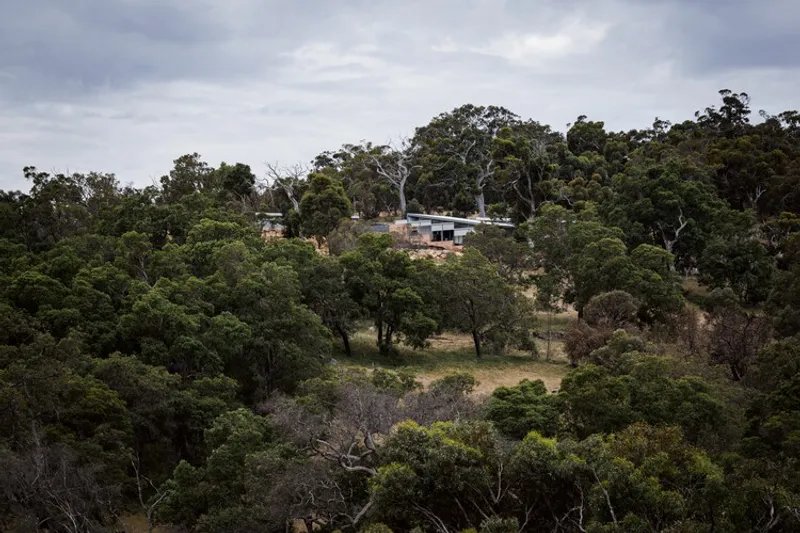
Set on an expansive two-hectare site in Brigadoon, Australia, the Rapid Close House by Philip Stejskal Architecture is a carefully sited dwelling that balances environmental responsiveness, rural character, and self-sufficient living. Positioned on the crest of a hill, the house captures sweeping views across the Swan Valley, Perth CBD, and the distant coastal plain, while remaining visually subdued within its natural surroundings.
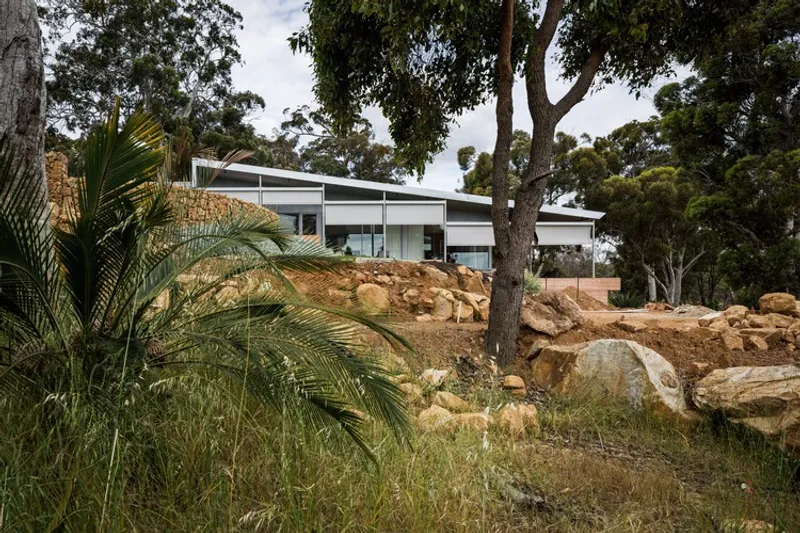
The design responds directly to its elevated and secluded context. Nestled among mature trees, the house minimizes its visual impact through material choices and form. Constructed primarily from rammed earth and other rural vernacular materials, it appears grounded, almost as if it has always belonged to the landscape.
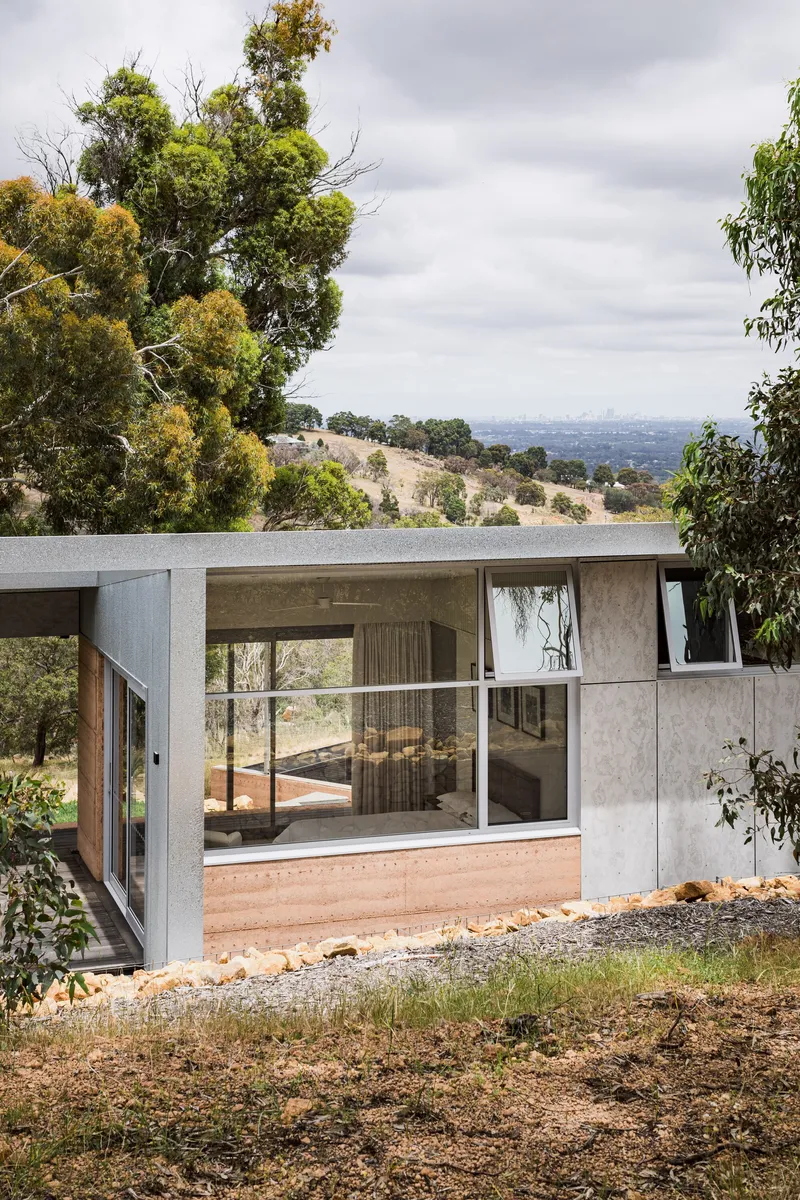
A defining feature of the project is its V-shaped plan, which organizes the house into two distinct wings. One wing stretches along the ridge, while the other steps gently down the slope, following the natural contours of the terrain. This configuration not only reduces site disturbance but also enhances environmental performance, allowing the building to orient itself toward optimal sunlight, prevailing winds, and key views.
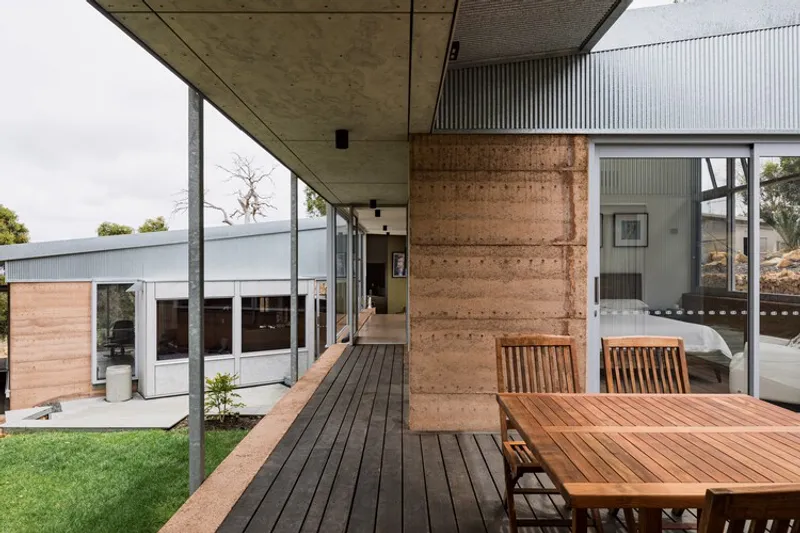
The layout is carefully calibrated for passive design. Northern light is drawn deep into the interiors, while cooling breezes from the southwest are captured to provide natural ventilation. At the same time, the geometry of the house frames panoramic vistas to the west and south, ensuring a continuous visual connection to the surrounding landscape.
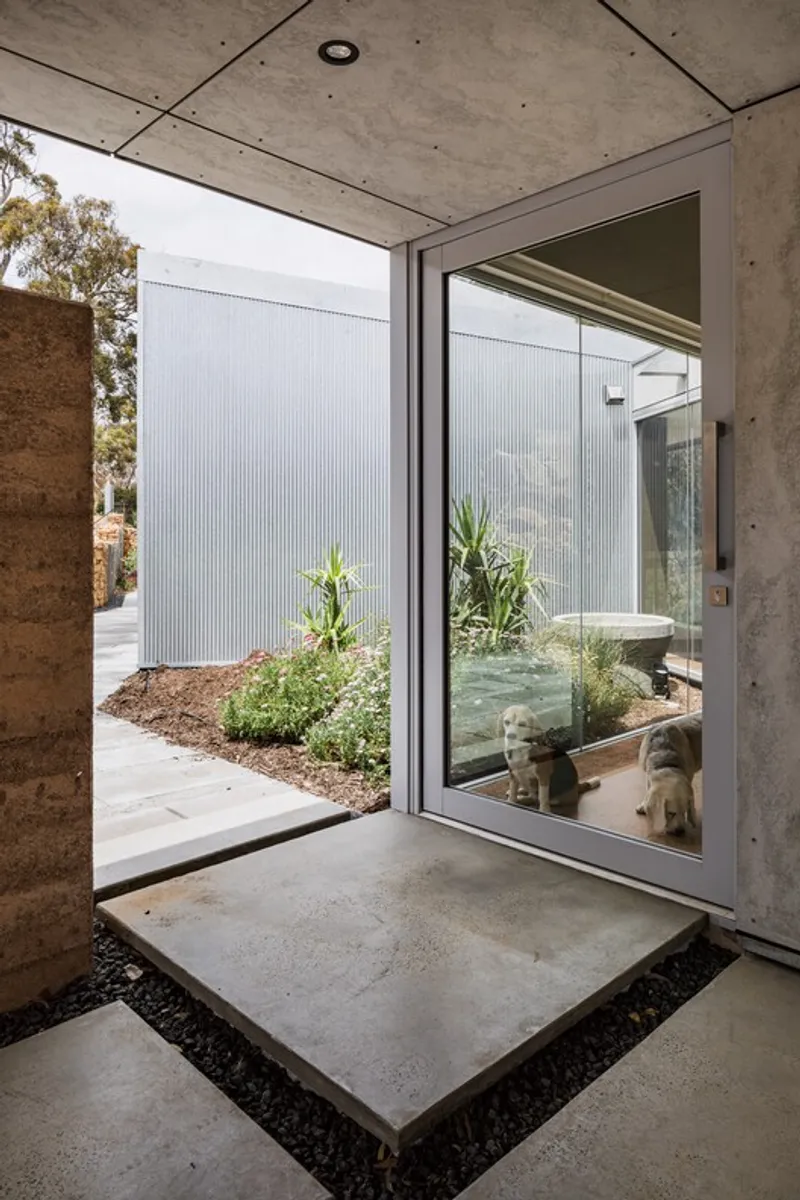
Arrival is marked by a carport leading to a glazed courtyard, which introduces light into the living wing and establishes a transitional space between exterior and interior. From here, a sequence of level changes subtly organizes the program. Service areas lead into the kitchen, dining, and living spaces, which gradually open toward a floating deck overlooking the landscape. This progression creates a layered spatial experience that unfolds in response to both function and view.
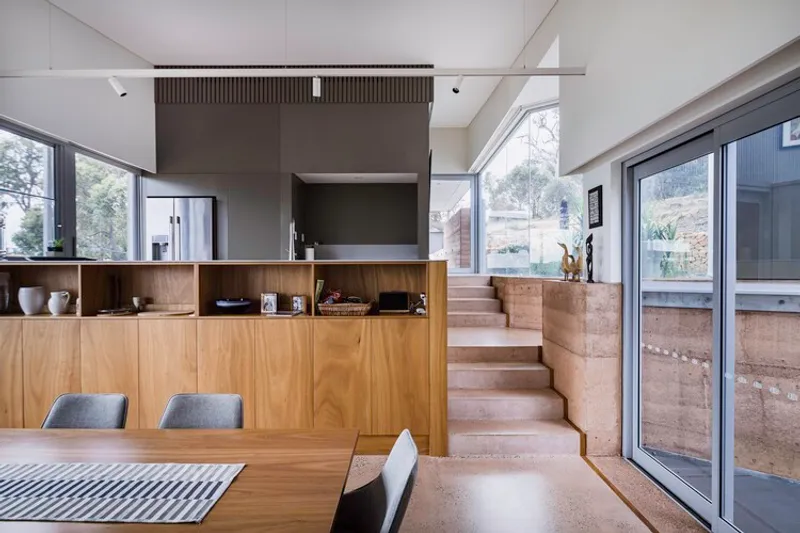
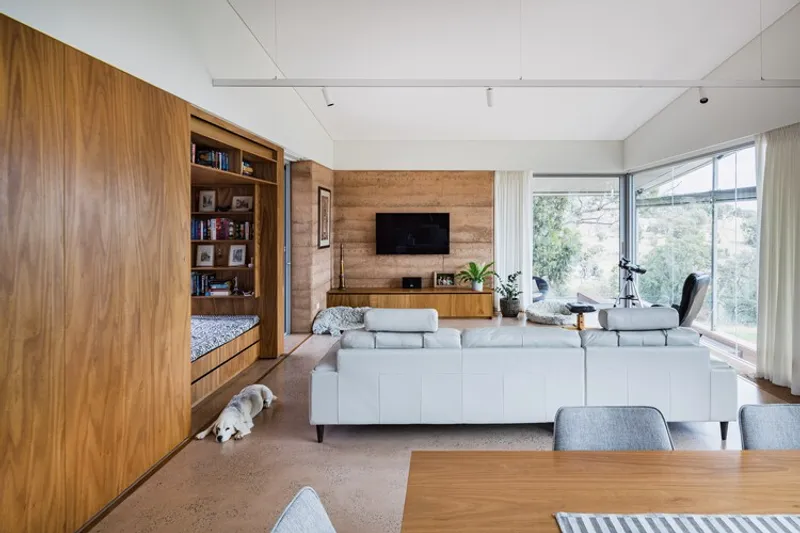
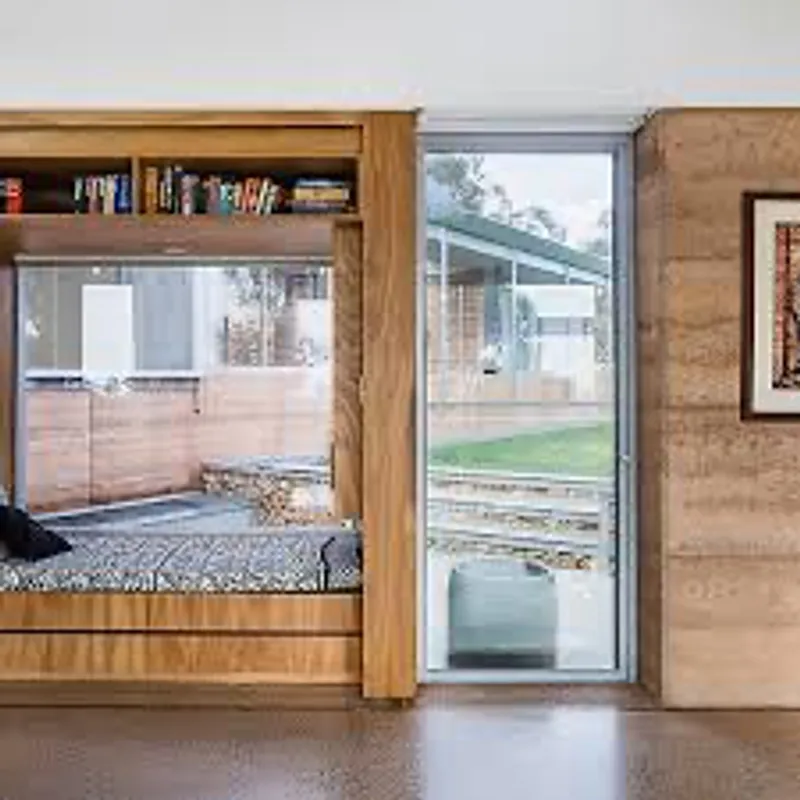
The living wing also incorporates a flexible “pop-out” volume to the east, housing a study and daybed area. This space can be enclosed with sliding doors, offering adaptability for different uses. The second wing, dedicated to private spaces, is connected via a glazed bridge. Within this wing, a gallery-like corridor links bedrooms, a laundry, and a guest suite, while also providing access to a protected courtyard.
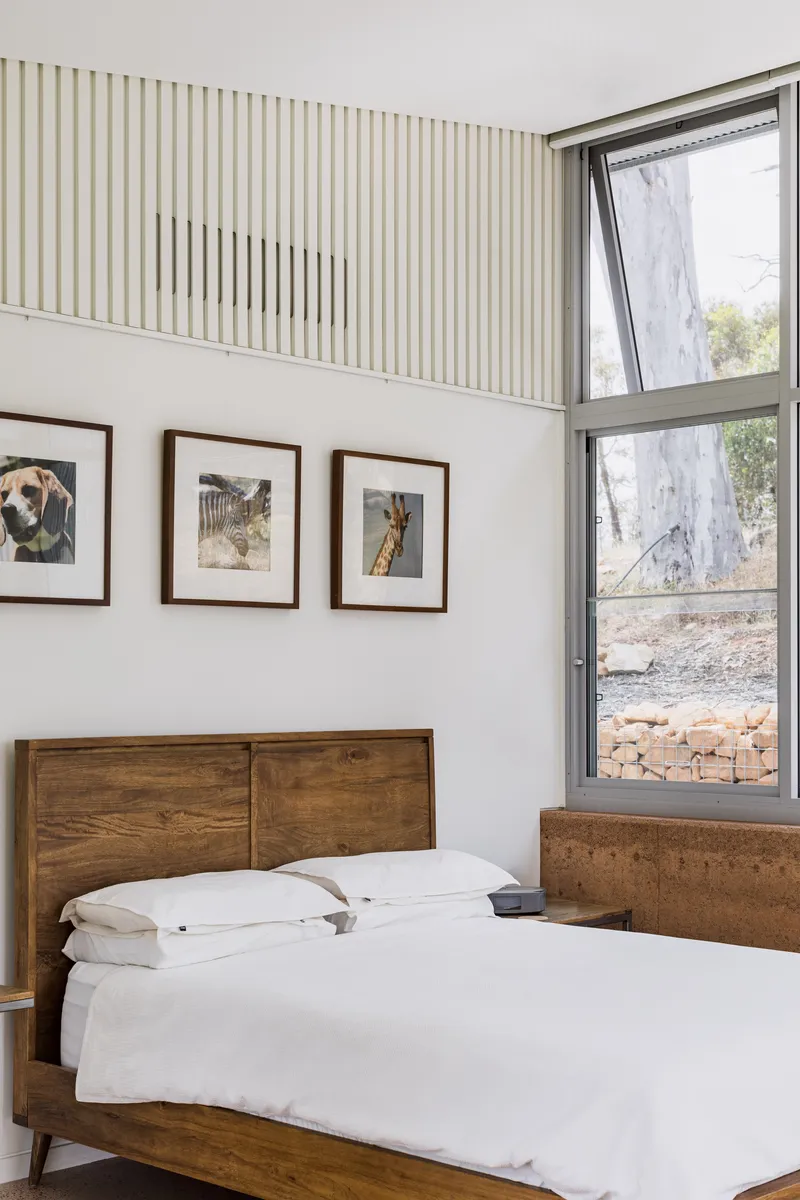
Despite its south-facing orientation, the bedroom wing remains well-lit and thermally comfortable through the use of high-level north-facing windows. These openings bring in winter sunlight and maintain a connection to the outdoors, overlooking lawns, trees, and remnant bushland.
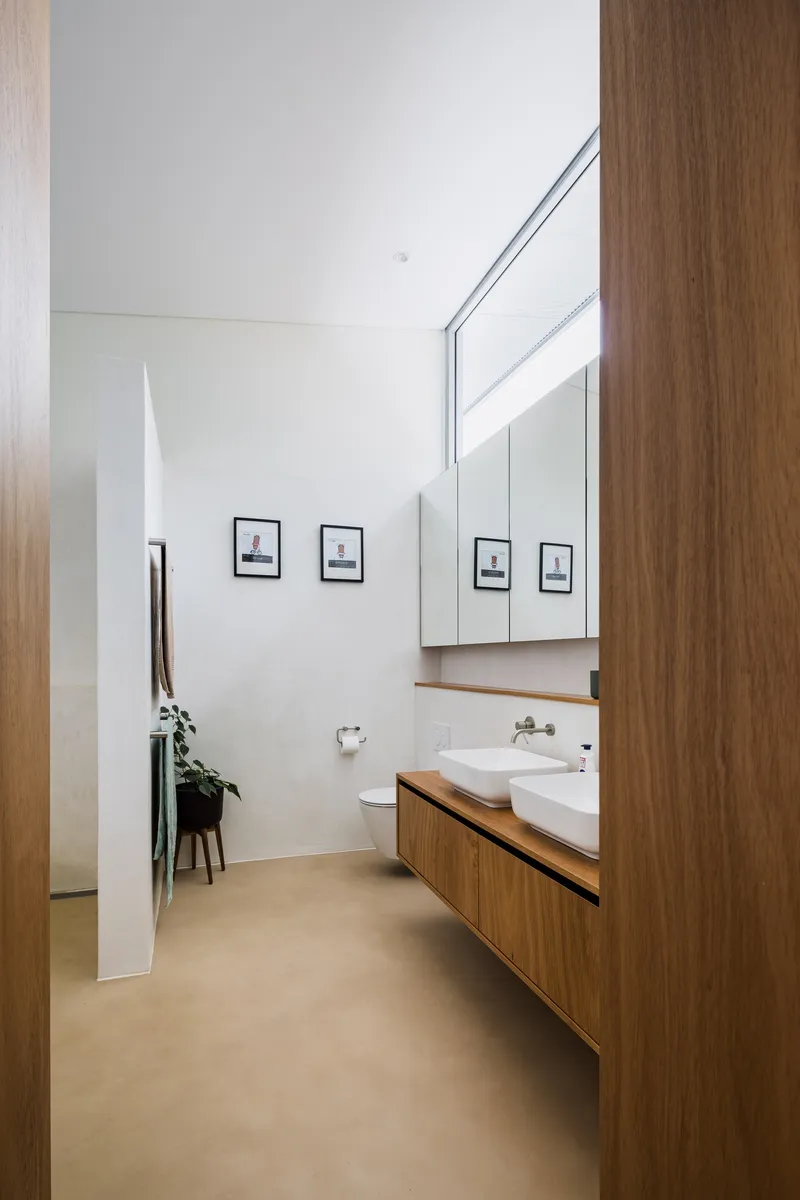
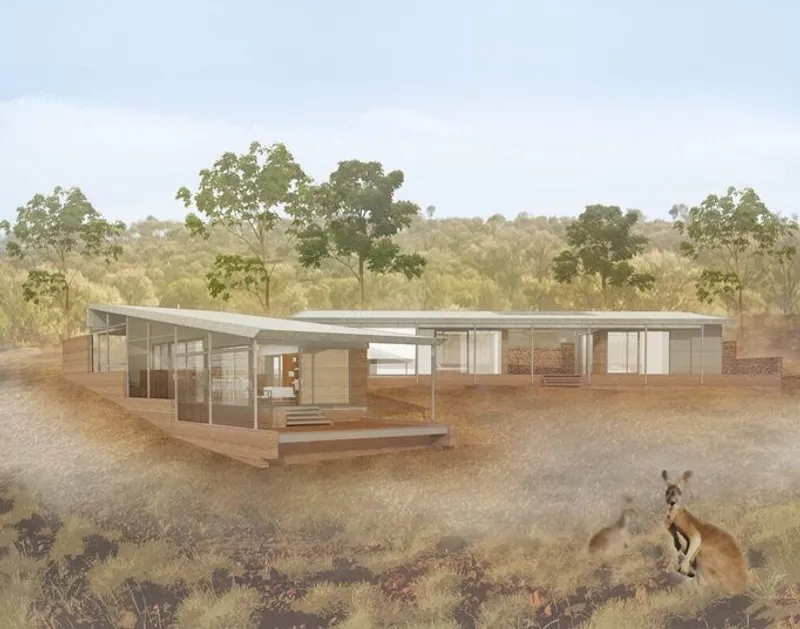
Materiality reinforces the project’s connection to place. Rammed earth walls, tinted concrete floors, galvanized steel cladding, and roofing create a palette that is both robust and low-maintenance. Locally sourced stone, excavated during construction, is reused in retaining walls and gabion structures, further embedding the house within its site. Subtle touches of refinement, such as blackbutt timber joinery and polished Marrakech plaster in the bedrooms, add warmth and texture without compromising the overall simplicity.
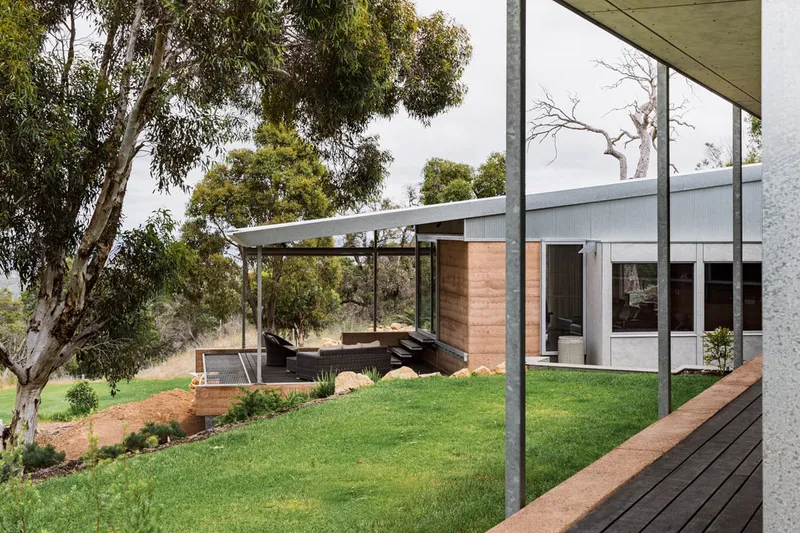
Sustainability is central to the project’s design. The house operates entirely off-grid, with photovoltaic panels supplying energy and rainwater harvested from the roof stored in on-site tanks. Passive heating and cooling strategies ensure year-round comfort, while extended roof overhangs and retractable blinds provide protection from harsh summer sun.
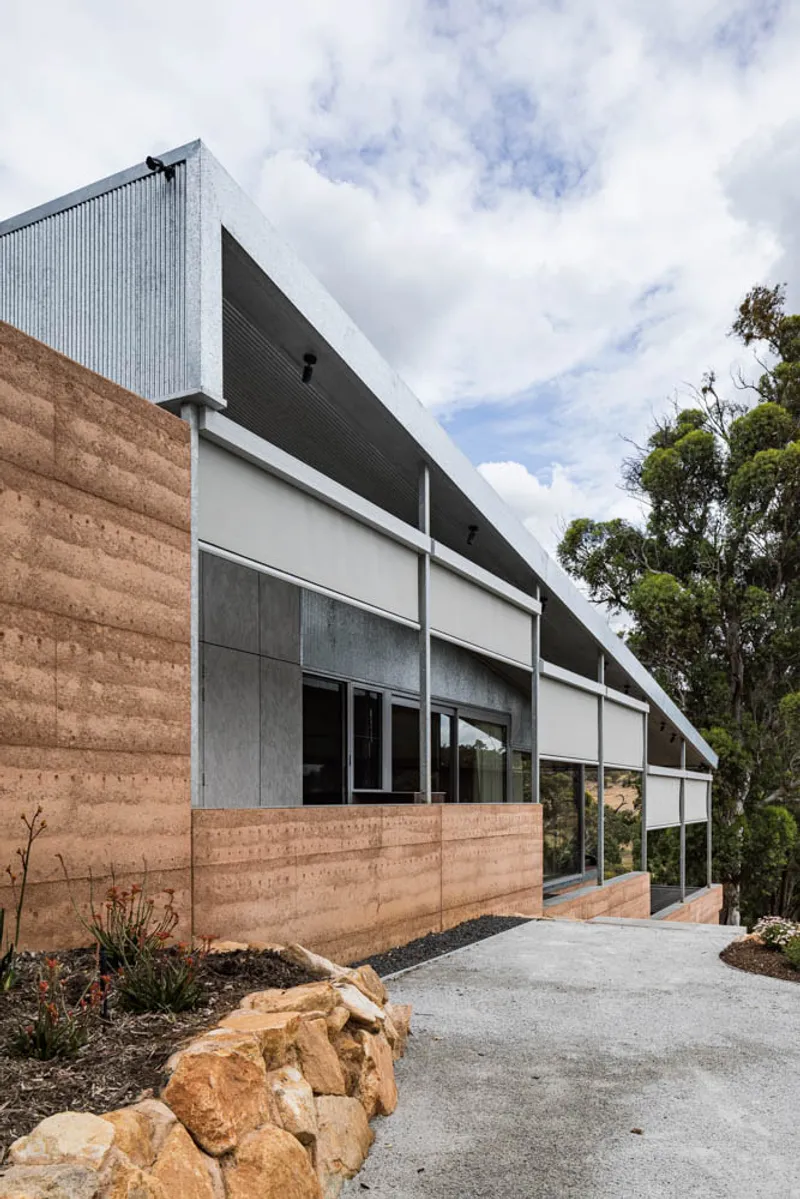
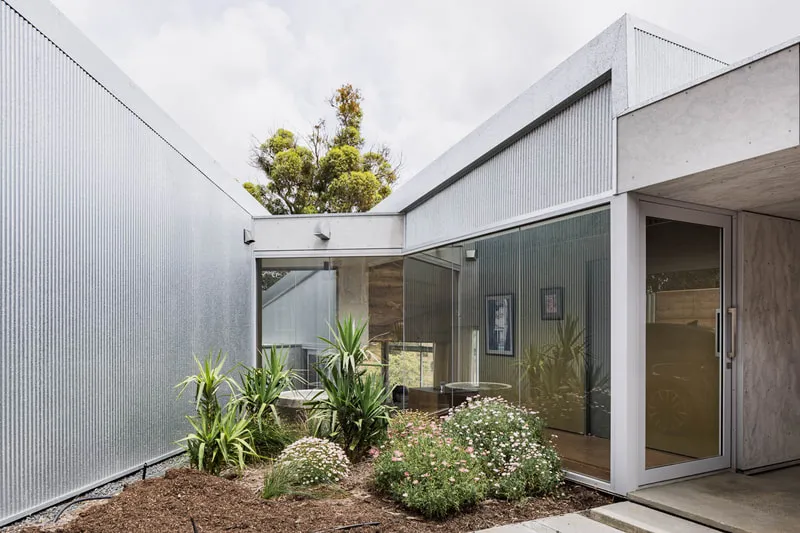
The construction process itself reflects a hands-on and resource-conscious approach. The clients, acting as owner-builders, were directly involved in both construction and landscaping, contributing to a deeper connection between inhabitants and their home. Native planting and site-sensitive interventions further enhance the ecological integration of the project.
Designed to meet bushfire safety standards, the house combines resilience with comfort, offering a durable and enduring living environment. It supports a lifestyle that is both connected to nature and within reach of urban Life, allowing its occupants to balance rural tranquility with access to the city.
Ultimately, Rapid Close House is an architecture of balance: between exposure and shelter, permanence and adaptability, independence and connection. Through its thoughtful siting, passive design, and material honesty, it creates a home that is both environmentally responsible and deeply attuned to its landscape.
All the Photographs are works of Nicholas Putrasia


Popular Articles
Popular articles from the community


Architekt Andreas Gruber Scatters 23 Dark Timber Chalets Across a South Tyrolean Forest Edge
In Molini di Tures, Amonti Chalets breaks a resort into a hamlet of gabled timber houses, with parking, storage and services pushed into the slope.

David Ortega Stacks a Two-Story Mexico City Penthouse Around a Steel Stair and a Pergola-Shaded Roof Terrace
In Colonia Roma, a 300 m² penthouse uses oak joinery, a planted steel stair and a slatted roof pergola to make a new-build apartment feel like a house.

LT2A and OPEN Architectes Thread a Brick and Glass High School Through a Wooded Belgian Campus
In Braine-l'Alleud, a 3,000 m² wing for Collège Cardinal Mercier pairs pale brick with a glazed colonnade, deferring to a small chapel and a dense wood.

U.GA Architects Wraps an Oval Rooftop Pool in Curved Board-Formed Concrete on Busan's Jeollidan-gil
In Busan's Jeonpo-dong, a 454 m² mixed-use block stacks a neighborhood facility, guest rooms and an oval rooftop pool inside spiraling concrete walls.

Similar Reads
You might also enjoy these articles

Gil Mello Arquitetura Tilts a Single Roof Toward the Waterfalls on a Plateau Above Aiuruoca, Brazil
In Aiuruoca, Minas Gerais, a 200 m² house of local labor and reclaimed poles pairs a low valley veranda with a tall mountain one.
U.GA Architects Wraps an Oval Rooftop Pool in Curved Board-Formed Concrete on Busan's Jeollidan-gil
In Busan's Jeonpo-dong, a 454 m² mixed-use block stacks a neighborhood facility, guest rooms and an oval rooftop pool inside spiraling concrete walls.

Felipe Hess Arquitetos Turns a Blind Stone Wall to the Street and Opens a Brazilian House onto a Courtyard and Canal
A canal-front house in Brazil hides behind painted stone and planting, then opens to an olive-tree courtyard, a reed-ceilinged porch and a curving pool.

David Macias Steps a Doorless Stone and Plaster House Down a Tropical Colombian Hillside
In the humid hills of Colombia, Threshold House replaces the front door with an open void and terraces its 850 m² down the slope instead of fighting it.

Explore Architecture Competitions
Discover active competitions in this discipline

Challenge to reimagine the Iron Throne

Photograph architecture without architects

Illustrate the lost glory of Angkor Wat - Render Challenge

Design challenge to reuse E-waste
Comments (0)
Please login or sign up to add comments
No comments yet. Be the first to comment!