

RE-NKRA
This project is aimed at educasing and socially oriented e-waste collectors in Ghana, both to raise public awareness and to obtain a material interest and to ensure the recycling of garbage in the factory part.

PURPOSE
The Agbogloshie region of the city of Accra is a region that has become a dump for the developed countries of the world. Developed countries of the world leave their garbage in certain areas of the city.
Therefore, the area where we work has become one of the largest electronic waste and landfills in the world. This negatively affects the public and leads to various diseases psychologically and physiologically. It also brings with it major ecological problems.
We have made some suggestions to find solutions to these problems. These proposals are to rehabilitate the surrounding people with a green space that we have created above ground and to provide the necessary skills and awareness with the workshops we have created.
CONTEXT
The origin of the word accra comes from "nkra". This means anthill in the local language. Inspired by this, we settled underground and tried to create a rehabilitation area by creating green areas at the top. With the various workshops we have created, we aimed to contribute to the education of the people and integrate them with art as a recycling awareness.
The users we address are locals who make a living collecting garbage in the environment and recycling electronic parts with their own means. On the other hand, we tried to attract people with certain qualifications to teach in workshops, but also to create a space where those interested in art gather.
We were positioned underground, making the upper part of the structure and half the land available to the public. In our design, we did not deprive the underground workers of natural ventilation and light. We took the garbage coming to the area to the factory area thanks to the platforms we opened from the side of the building close to the city dump.
CONCEPT
We work in Ghana – Accra within the scope of Bu project. The Agbogloshie region of the city of Accra is a region that has become a dump for the developed countries of the world. Developed countries of the world leave their garbage in certain areas of the city. This negatively affects the public and leads to various diseases psychologically and physiologically. It also brings with it major ecological problems.
With the design we have made , places have been established where people can socialize, get an education and also provide financial resources.
To rehabilitate the surrounding people with a green space that we have created on the Yer and also to provide the necessary skills and awareness with the workshops we have created. On the other hand, we tried to attract people with certain qualifications to teach in workshops, but also to create a space where those interested in art gather.
PROGRAM
We were positioned underground, making the upper part of the structure and half the land available to the public. In our design, we did not deprive the underground workers of natural ventilation and light. We took the garbage coming to the area to the factory area thanks to the platforms we opened from the side of the building close to the city dump.
In line with our researches, we have created the necessary factory system for the recycling of wastes. By separating according to the material of the incoming wastes, paper etc. is separated by human hands, metals by magnet, glass by passing through certain machines and plastics by giving certain temperatures with the help of machines.
It is directed to the required area where it can be used by separating the materials taken to the factory area.
The garbage coming to the factory area is separated according to its dimensions and type and turned into raw materials both by human hand and by machine. In the factory, the materials that are sorted, suitable for use or become raw materials are delivered to the loading area to reach the necessary places.
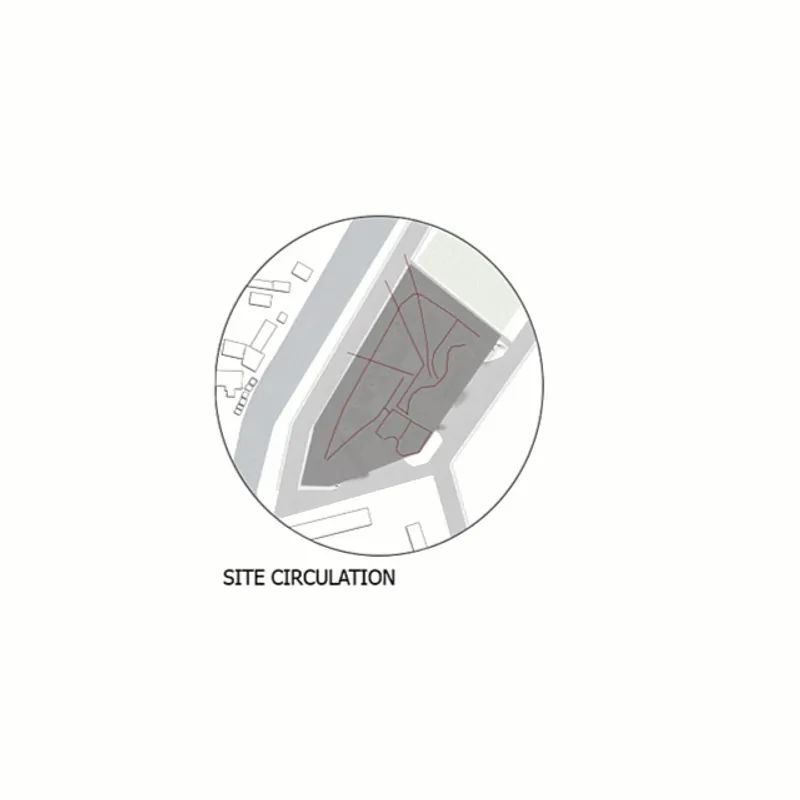
We've identified three access roads to our property. By creating a pocket in the south-west direction, which we defined as the main entrance, we created a parking area for bicycles and motorbikes, which is mostly used by employees and guests in the area. From the north-west direction, there are 2 more entrances to our structure.
The guests who come can easily visit and see the areas where the artistic works made in the workshops are exhibited with the circulation we have created in the parking area. Our tube, which has access to all floors, can be accessed from various jeans within the building we have created for the visitor who forms the main backbone of our structure. Our purpose in creating our visitor tube is to monitor the operation without any interference with the functioning inside.
In the park area, there are relaxation areas that we have inspired by the local architecture using local materials. There are two chimneys that we have created in order to expede the gases formed in the workshops and in the factory. We aimed to save energy to our construction with the wind stand we created in a chimney. With the amphitheater we have created, we aimed to keep the workers working on the lower floors in relation to the parking space.
There is a sales unit where products separated in the factory area or made in the workshop area can be put up for sale. There is also a clearing unit where locals can trade or sell the product with another product. These units also have warehouses.
On this floor, raw materials or materials suitable for use from the factory area are processed in workshops and made ready for sale. Artistic works made in workshops are also exhibited in exhibition areas.
Our workshop units located on the workshop floors are as follows;
Precious Metal Workshop, Glass Workshop, Metal Workshop, Repair Workshop and Plastics Workshop. There is also a dining hall, meeting room and service units on this floor.
Our goal is to raise awareness not only of the employees but also of the local people about recycling by moving visitors around all floors in the red tube we have created without interfering with the operation of the facility. We wanted the amphitheatre, which we associate with the factory area, to work as an interaction and recreation area in addition to ensuring that workers can get natural light and air. We wanted to provide integrity with the park with the green walls we created in the amphitheater area.
Visitors from the upper elevations finally see and visit the factory area and then access the parking area with the help of a tube. The offices we have created in -7 jeans are at a point that dominates the factory area.
As we mentioned in the factory organization chart, we have created the factory plan.
The garbage received is delivered to the factory area located on the lower floor with the help of moving flooring, i.e. platforms. In the next stages, these wastes are reached to the required floors thanks to the platforms. In addition, there are 2 garbage-taken platforms and one loading platform. There are green roofs and circulation areas created on the structure. At the same time, we designed the roof of the area that allows visitors to circulate as a viewing and resting area.

DESIGN
The origin of the word accra comes from "nkra". This means anthill in the local language. Inspired by this, we settled underground and tried to create a rehabilitation area by creating green areas at the top. With the various workshops we have created, we aimed to contribute to the education of the people and integrate them with art as a recycling awareness.
MATERIAL
Material selection Ghana's local production materials are taken into account.
The building was designed as reinforced concrete. By using the Dressing Façade, the opportunity to watch from the outside inside is provided. Seating areas and gazebo local material (double layer bamboo) were used in the garden. The shell on the moving flooring consists of local materials and recycling materials.
EXPANSION PLAN
Our project is to ensure that workers work in a regular and healthy way in the short term, and in the long term, to protect the environment and to provide the recycling experience by raising public awareness. With the design we created, we separated the entire land as a public space and made the project area available to the public. With the green space we created above ground, we designed a recycling center with many functions underground while rehabilitating the people a little bit from the pollution of the environment.


Popular Articles
Popular articles from the community


Opera by the Sea Estonia: Three Shells Dissolving Architecture into Tallinn's Coastline
A winning opera house proposal replaces monumental form with interconnected shells that blur the boundary between building, park and Baltic Sea.

Opera on the Sea: Driftwood Logic Shapes a Timber Opera House on Estonia's Coast
Trevor Orgill's opera house translates the entangled drift of floating timber into a civic building where wood, water, and music converge.

Manzana Morphosis: Stretching Barcelona's Grid into a Living Landscape for 2050
A radical reworking of the Eixample manzana turns density into a tool for generous public space, vertical ecology, and environmental performance.

Temporary Home for Dogs: A Reversed Zoo Rethinks Animal Shelter Architecture
In Bucharest, a sinuous corridor and freed landscape flip the logic of containment, designing a shelter that works to make itself unnecessary.

Similar Reads
You might also enjoy these articles

Shakur's House: Exposed Brick as an Interior Organiser in a 168 m² Mashhad Residence
Brick moves indoors in this Mashhad residence, where masonry walls, glass partitions and teal planes sequence a compact home without closing it off.

Day and Night Park: A Time-Based Urban Newsstand in Beijing
A temporary urban newsstand in Beijing blending travel, light, and reading through poetic colors, compact form, and community-focused design.

Modernist Patio Renovation in El Masnou, Barcelona by Oliver Segura Arquitectura + Cebrià Arquitectura
Modernist patio renovation blending tradition and innovation with a movable pool, leveled floors, and Catalan materials in El Masnou.

Alto Residencial Coop: Cooperative Housing Development in Santiago de Compostela by Carbajo Barrios Arquitectos
A linear cooperative housing complex blending white volumes and perforated metal façades, enhancing community living, natural light, privacy, and urban integration.

Explore Recycling Competitions
Discover active competitions in this discipline


Challenge to reimagine the Iron Throne

Photograph architecture without architects

Illustrate the lost glory of Angkor Wat - Render Challenge

Design challenge to reuse E-waste
Comments (0)
Please login or sign up to add comments
No comments yet. Be the first to comment!