
Realrich Architecture Workshop Turns a Bandung Storefront into a Total Work of Coffee Craft
Brick arches, bamboo weave ceilings, and six local materials transform a two-storey building in Bandung into an immersive coffee experience.


The phrase Gesamtkunstwerk, total work of art, gets thrown around loosely in architecture. At the Otten Coffee Experience in Bandung, Realrich Architecture Workshop earns the reference by treating a modest two-storey commercial building as a canvas for six local materials, each one pushed through a distinct craft experiment. Brick forms arches. Bamboo becomes woven ceiling planes. Stone, gypsum, concrete, and steel each occupy their own tectonic register. The result is a 777-square-metre retail and office space that reads less like a renovation and more like a thesis on Bandung's building culture, delivered through the medium of specialty coffee.
Lead architect Realrich Sjarief kept the existing urban structure intact while rewiring almost everything inside. The old U-shaped staircase was recut into an L. A foyer was emptied into a linear display hall. A tilted wall at the lobby produces a triangular double-height volume where none existed before. These are surgical moves, not demolition, and they let the building's bones remain visible while the new program fills in around them. What makes the project interesting is its refusal to default to a polished "café aesthetic." Every surface declares its method of making.
The Brick Facade and Cantilevered Canopy
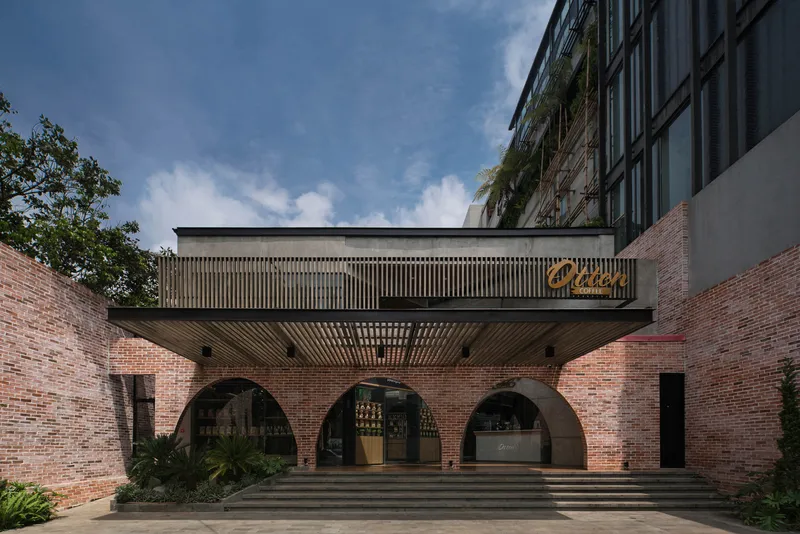
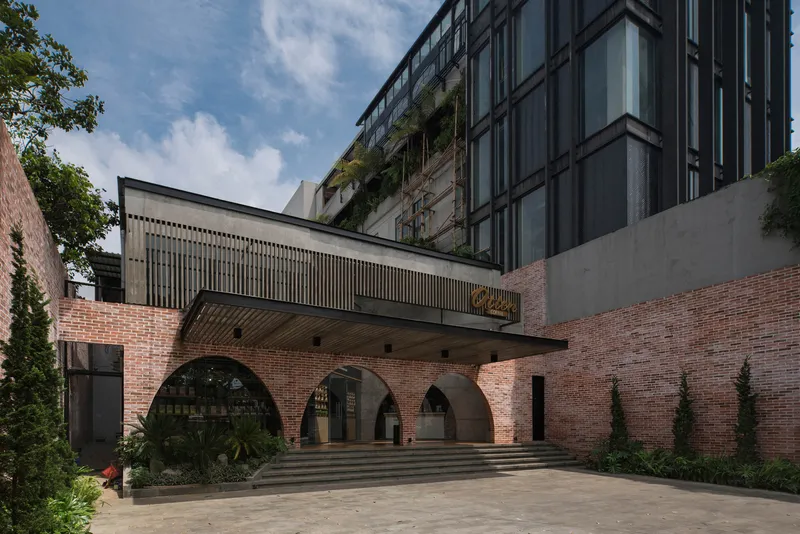
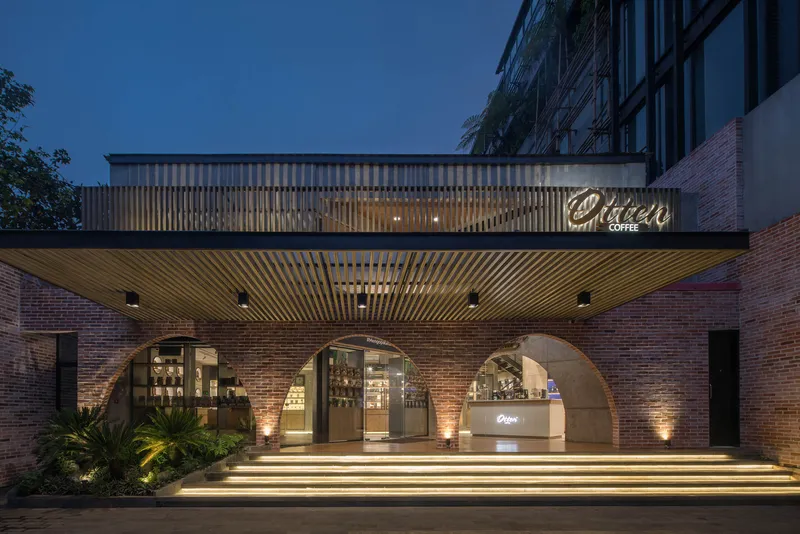
Three brick arches define the street-facing elevation, their semi-circular profiles covered in exposed cement that reads rough and deliberate. Above them, a cantilevered canopy clad in timber slats projects over the entrance courtyard, doing real climatic work: filtering equatorial sun, deflecting rain splash, and drawing a strong horizontal line that anchors the composition against the vertical brick piers below. The planted beds flanking the entrance steps soften the threshold between sidewalk and interior, a small gesture that matters in Bandung's dense urban fabric.
At dusk, the building inverts. The brick mass goes dark while the timber canopy glows from within, turning the arched openings into illuminated frames for the activity inside. A neon sign confirms the brand, but the architecture does most of the advertising on its own.
Entering Through the Canopy
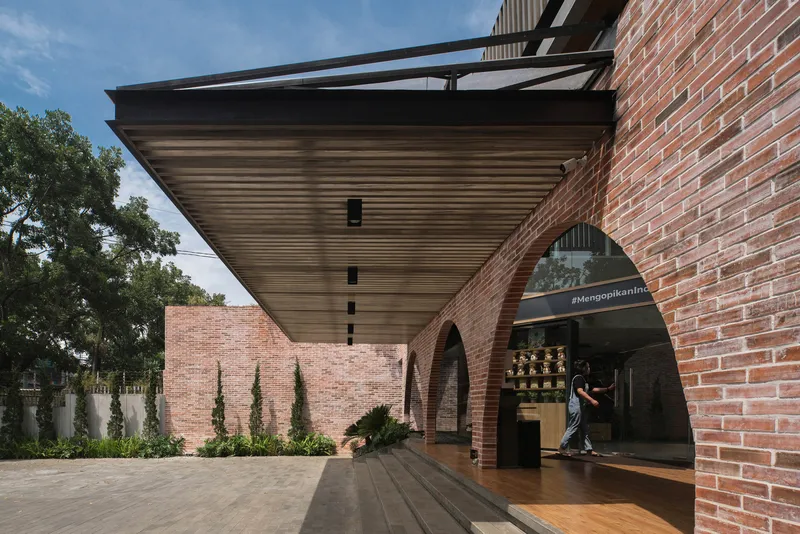
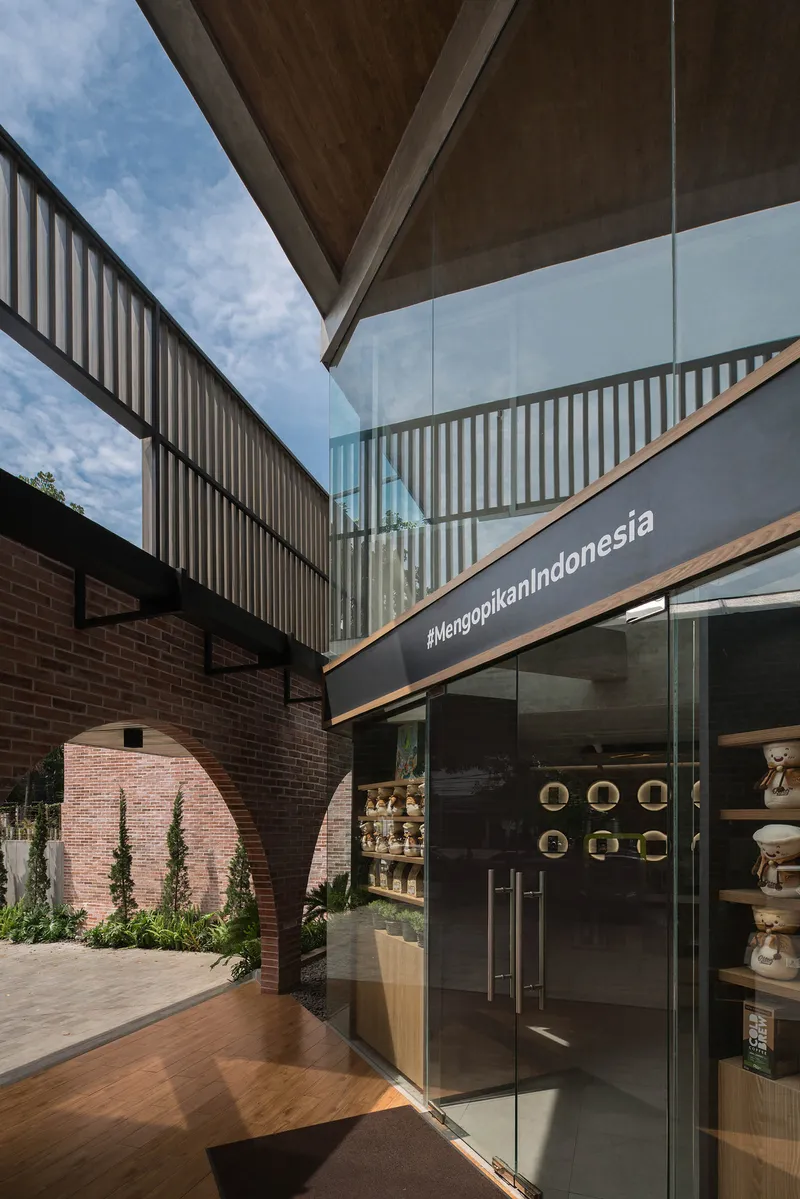
Walking under the canopy, you become aware of the timber slat screen as structure and filter simultaneously. Steel beams run overhead, exposed and painted, while the slats create a moiré effect as you move. The glass entrance door sits beneath an angular canopy edge that compresses the view before releasing you into the double-height lobby. The 36-square-metre digital lobby may be modest in plan, but the tilted wall beside it stretches the perceived volume upward into a triangle of light and air.
Brick Arches and Concrete Frames Inside
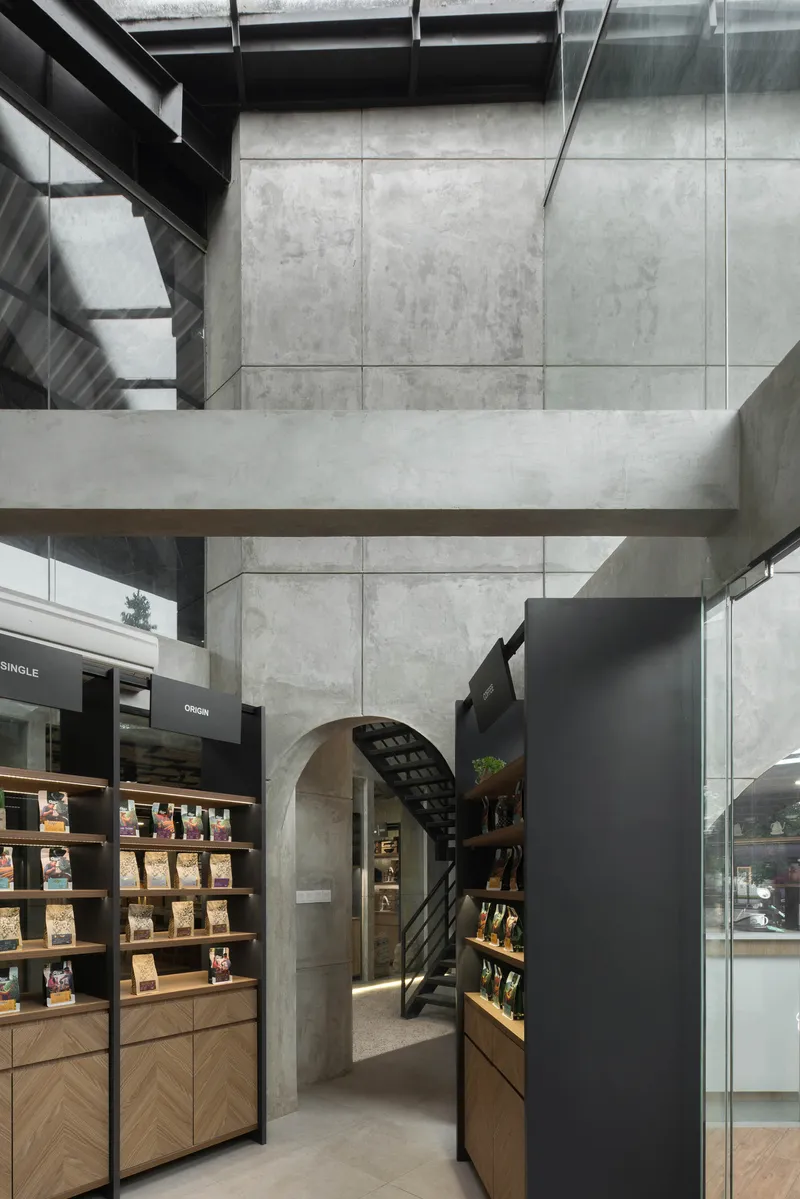
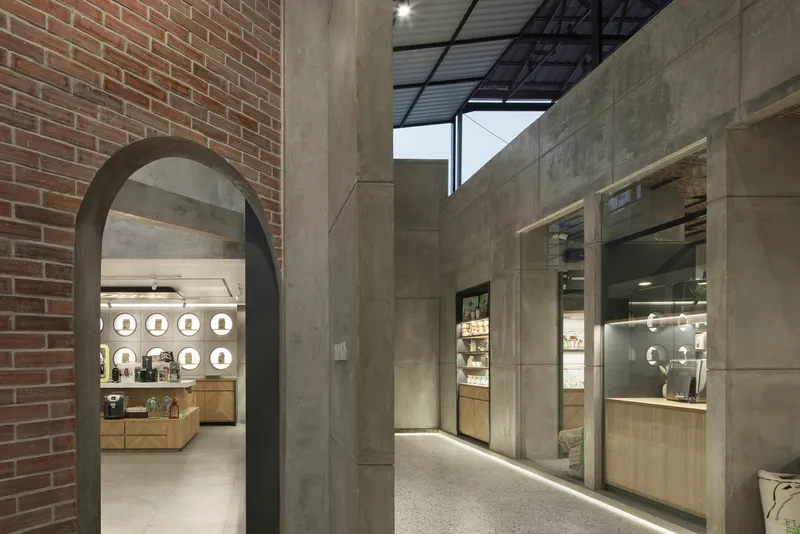
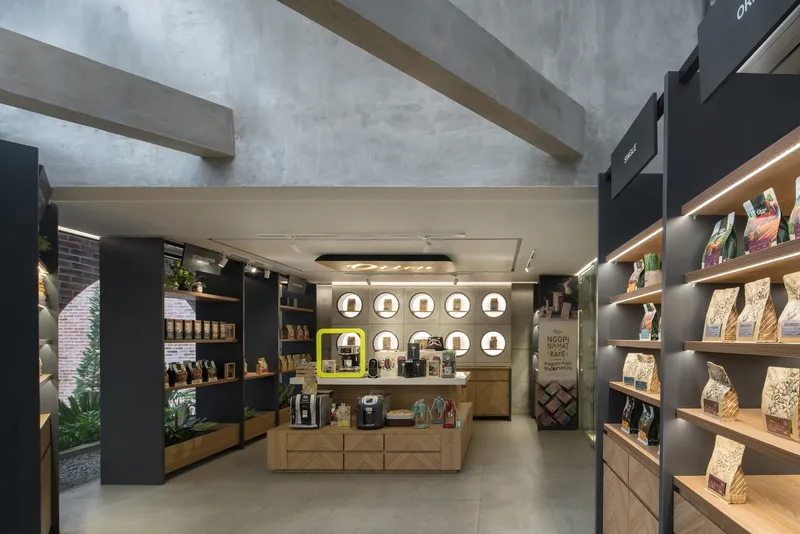
Inside, the repetition of brick arches continues from facade to interior, threading the craft language through partition walls and display alcoves. Concrete beams overhead are left raw, establishing a rhythm that organizes the long retail floor without subdividing it. Circular niches punched into the rear wall hold product on display, their geometry echoing the arched openings but scaled down to object size. The effect is almost ecclesiastical: a nave of coffee merchandise under concrete vaults, punctuated by moments of framed light.
The 24-square-metre linear display hall, formerly a foyer, channels visitors along a corridor lined with shelving. Terrazzo floors, glass partitions, and a restrained material palette keep the focus on product rather than spectacle.
The Bamboo Ceiling and Central Bar
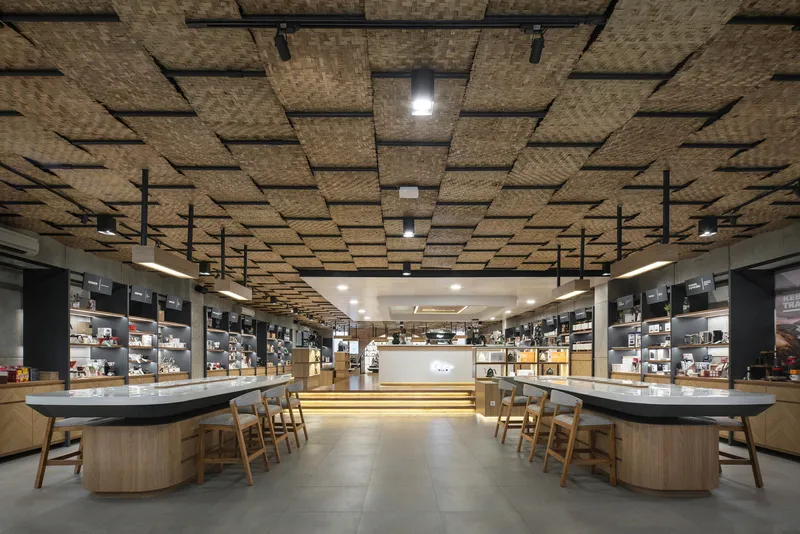
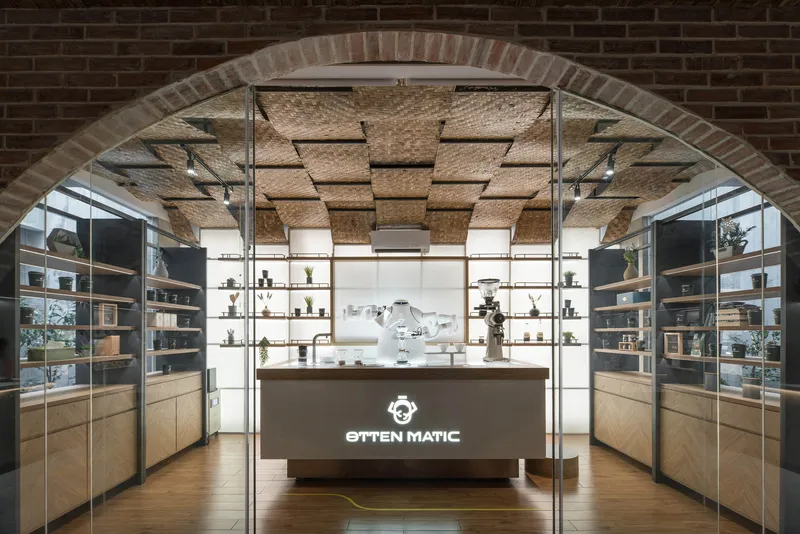
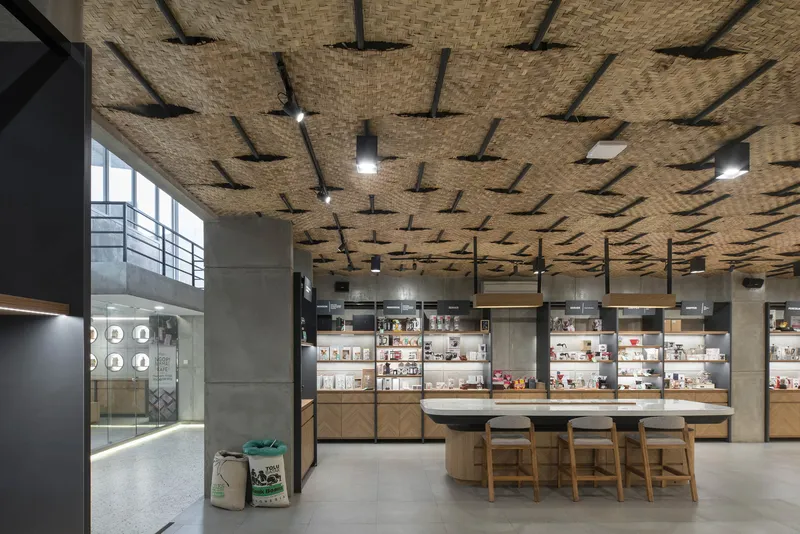
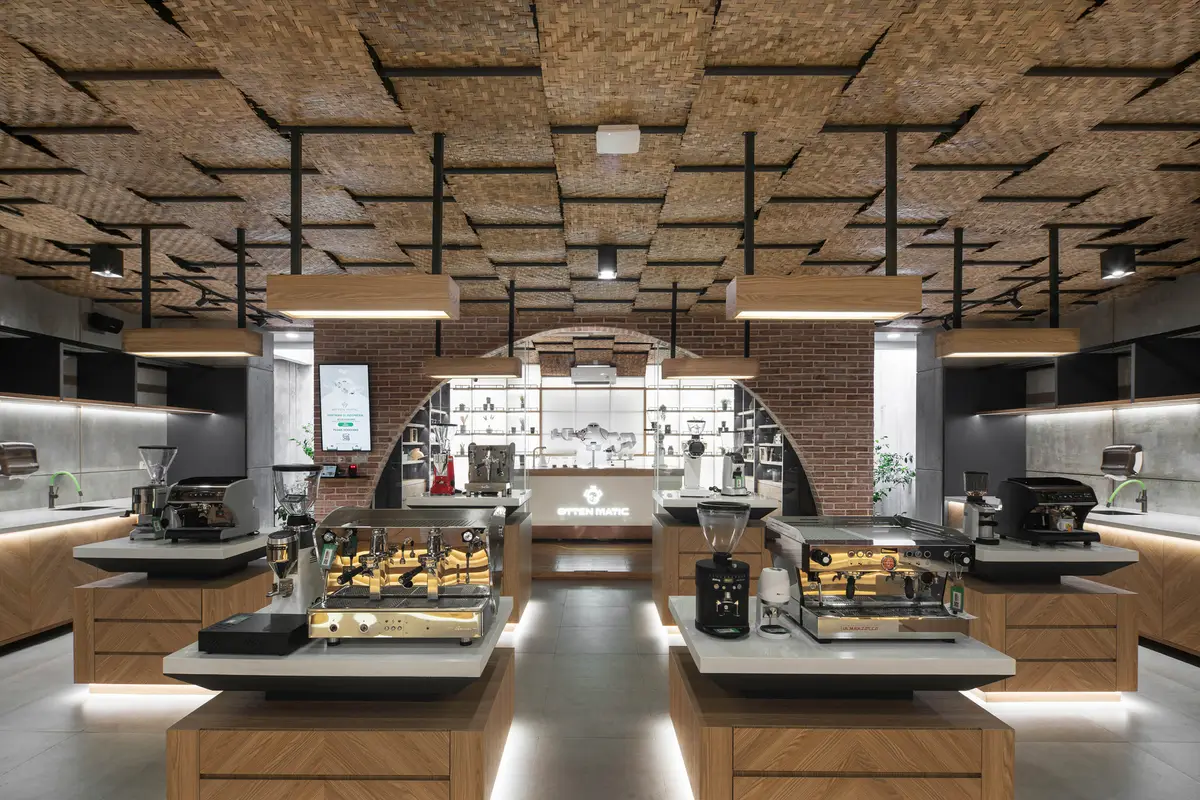
The project's most expressive move is the traditional gedek bamboo weave suspended as ceiling panels across the main space. These woven planes undulate gently overhead, introducing warmth and acoustic texture in a single material gesture. The craft is regional, the bamboo worked by local artisans using techniques rooted in Sundanese building tradition. Lit from above through transparent roofing, the weave creates a dappled, almost canopy-like atmosphere that transforms the flat roof structure into something organic.
Beneath this ceiling sits the elevated bar, a 36-square-metre timber-parquet island raised on a platform to establish visual hierarchy. Espresso machines are centered under the woven canopy, and brick arches frame the service zone behind. Wooden stools line the tasting counter. The bar is both the programmatic and spatial heart of the building, the place where material experimentation meets the actual cup of coffee.
Double Height, Mezzanine, and Circulation
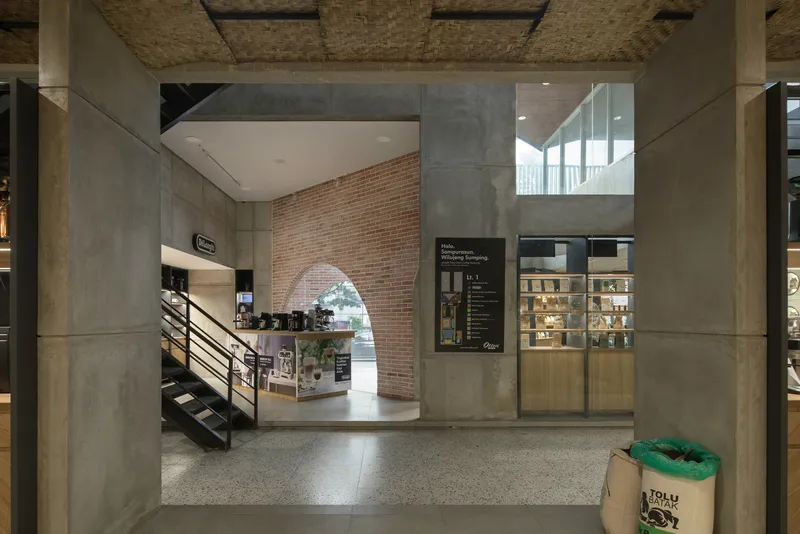
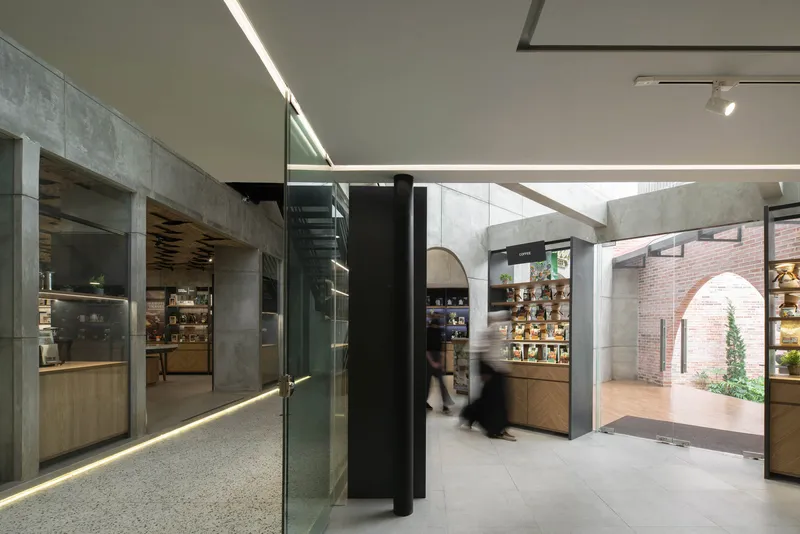
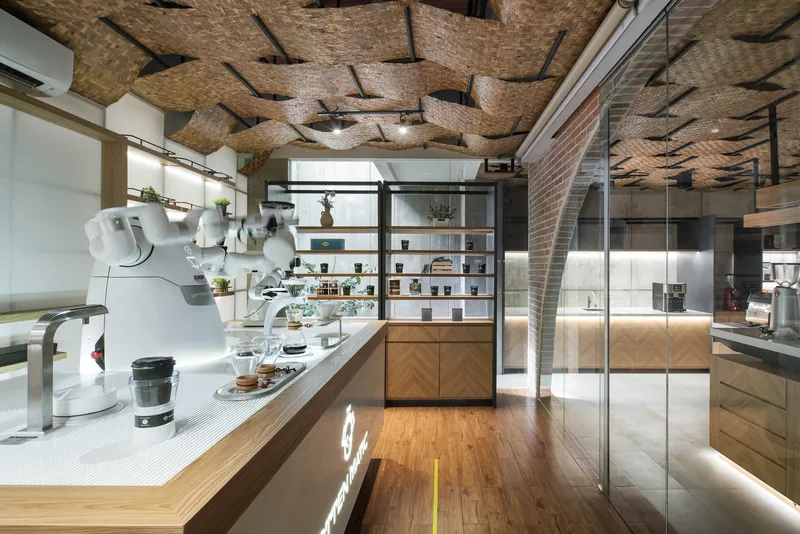
The conversion of the old U-shaped staircase to an L-shape was not cosmetic. It freed floor area on the ground level and redirected circulation so that the mezzanine, home to the office and a secondary coffee shop, connects more directly to the main retail space. A metal staircase climbs through the double-height volume beneath the woven ceiling, its industrial materiality playing against the artisanal bamboo overhead. Glass partitions separate service zones without blocking sightlines, keeping the spatial continuity that the renovation worked hard to create.
The 144-square-metre open-plan main area reads as a single room despite containing display zones, seating areas, and the bar. Elevated flooring with timber parquet marks transitions in program without walls. At the far end, a 15-square-metre robotic room introduces automated coffee preparation, a technological counterpoint to the handcraft narrative running through the rest of the building.
Climate and Passive Strategy
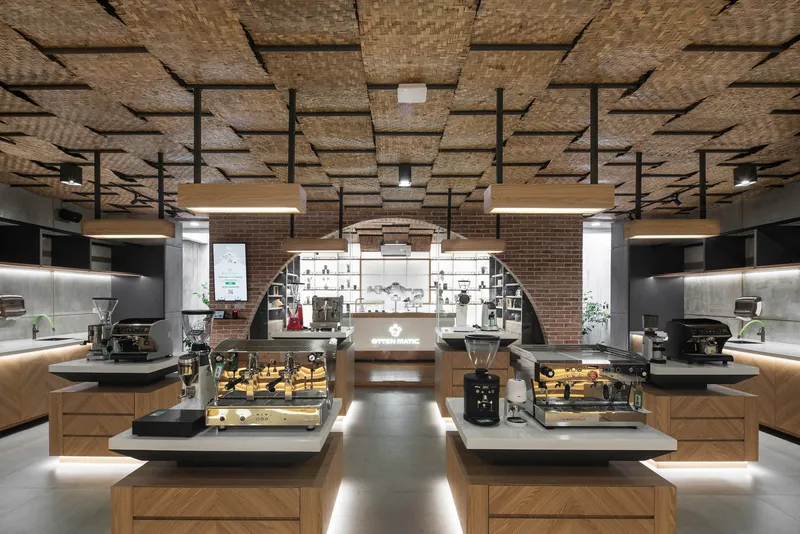
Bandung sits at roughly 768 metres above sea level, cooler than coastal Indonesian cities but still demanding shade and ventilation. North-south openings run through the building, ensuring cross-ventilation through the main spaces. The timber slats on the facade buffer direct sun while the transparent roofing overhead admits daylight without the heat gain of a fully glazed skylight. These are bioclimatic strategies embedded in the architecture rather than bolted on, and they let the building perform without heavy reliance on mechanical cooling.
Plans and Drawings
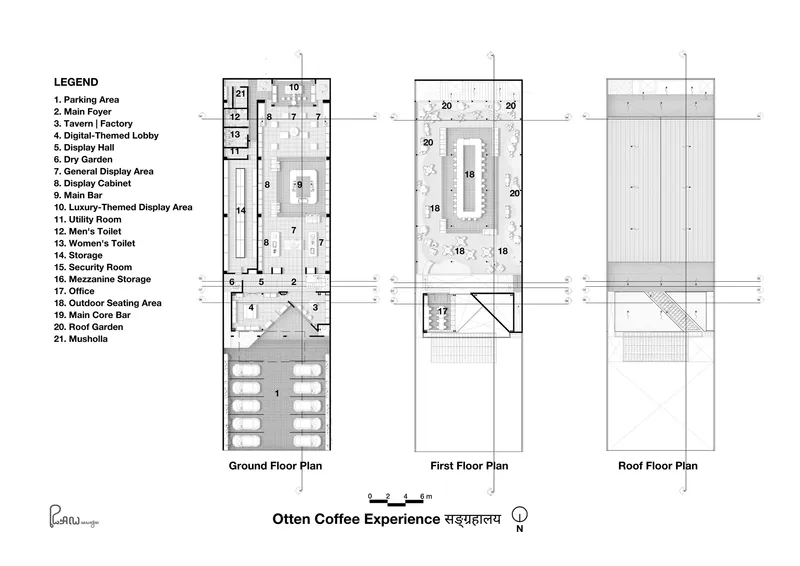
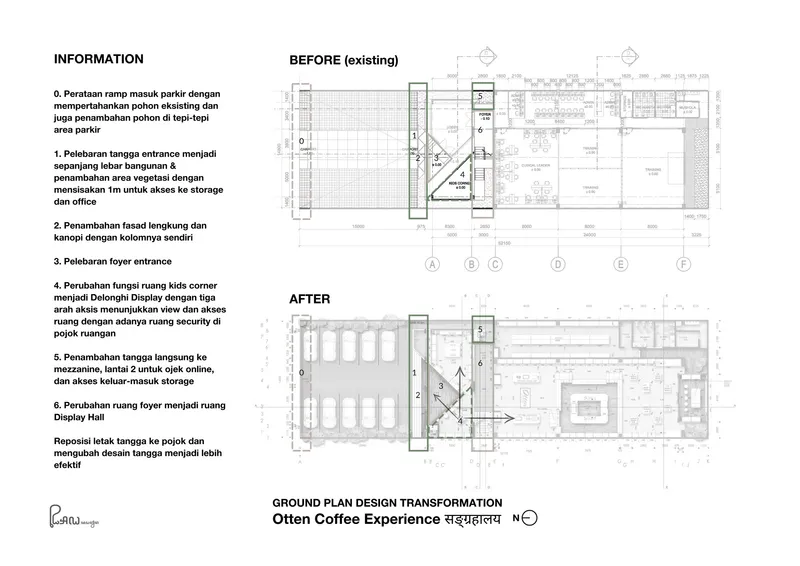
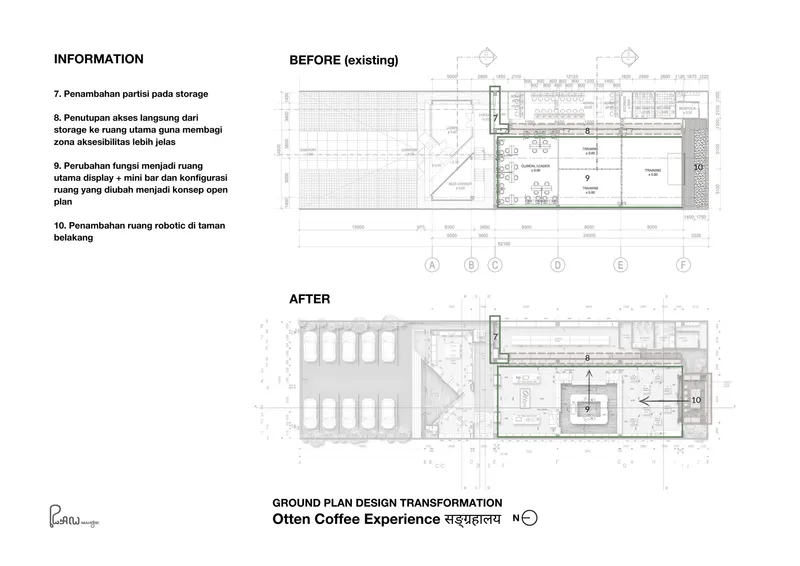
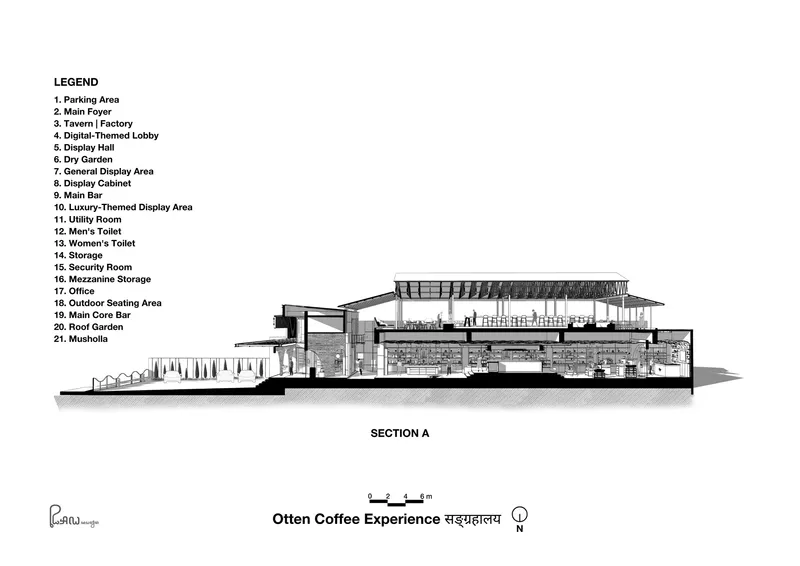
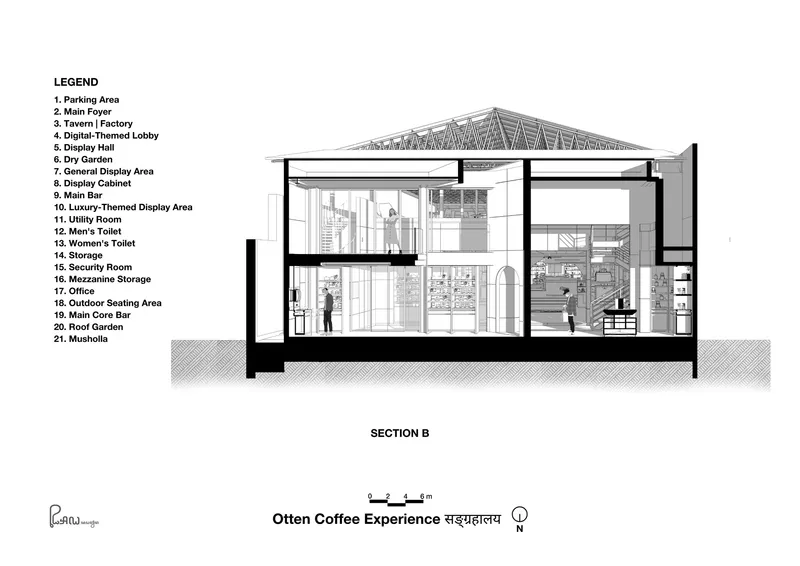
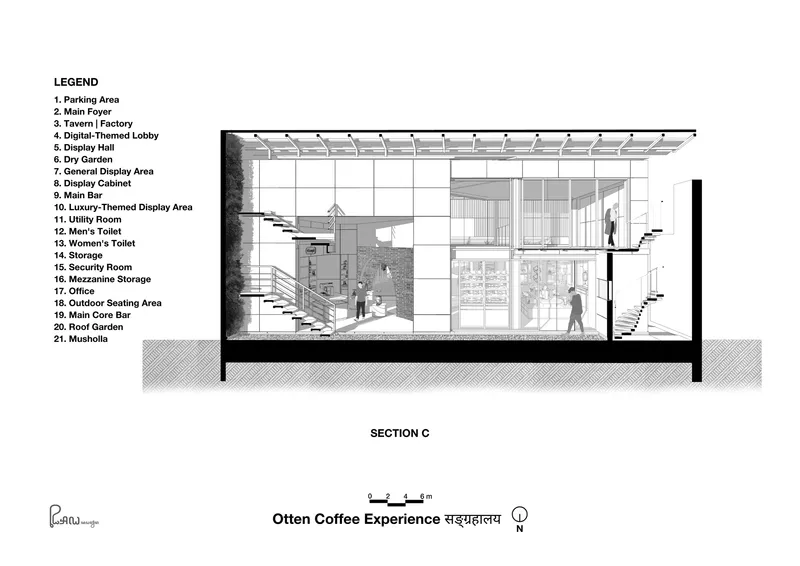
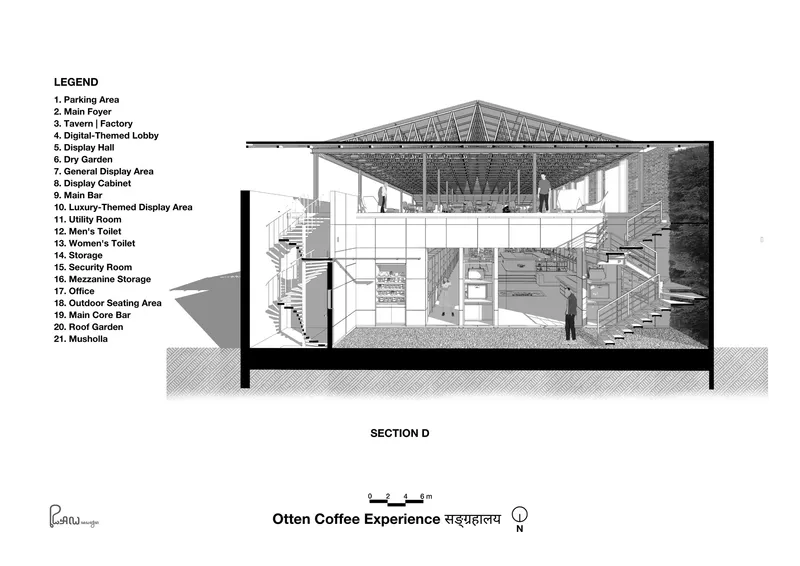
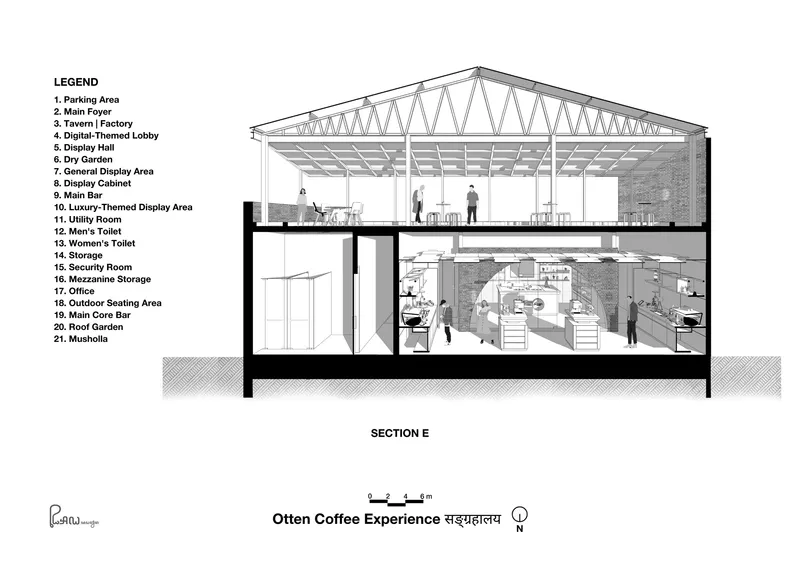
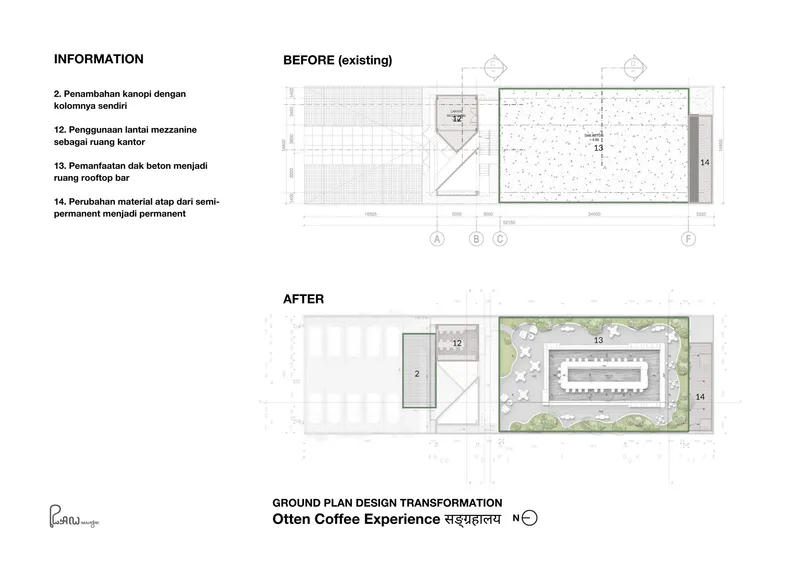
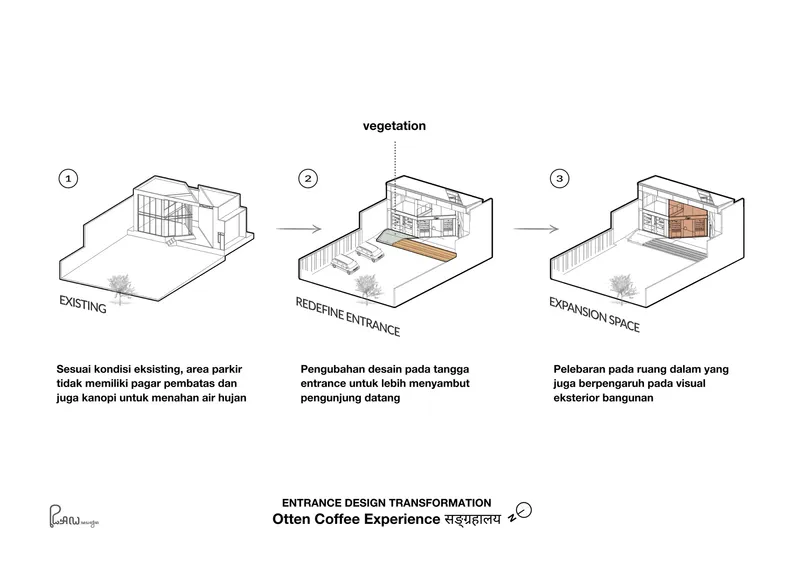
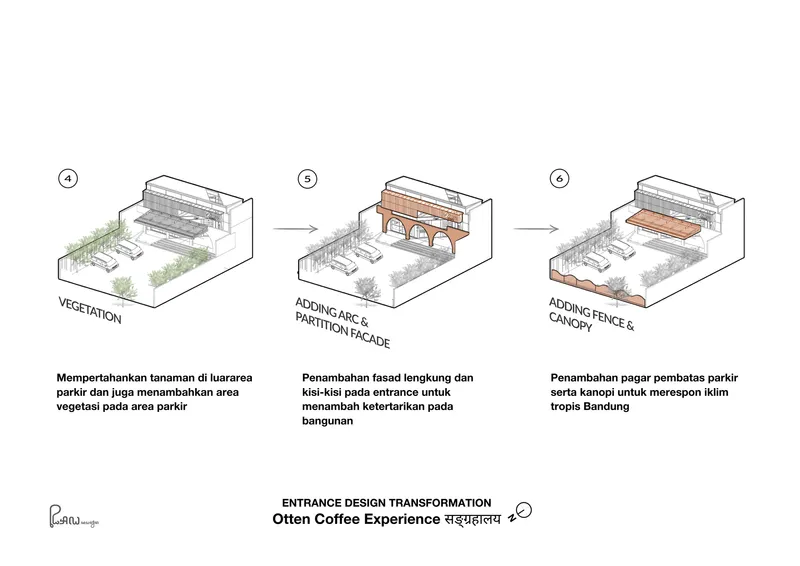
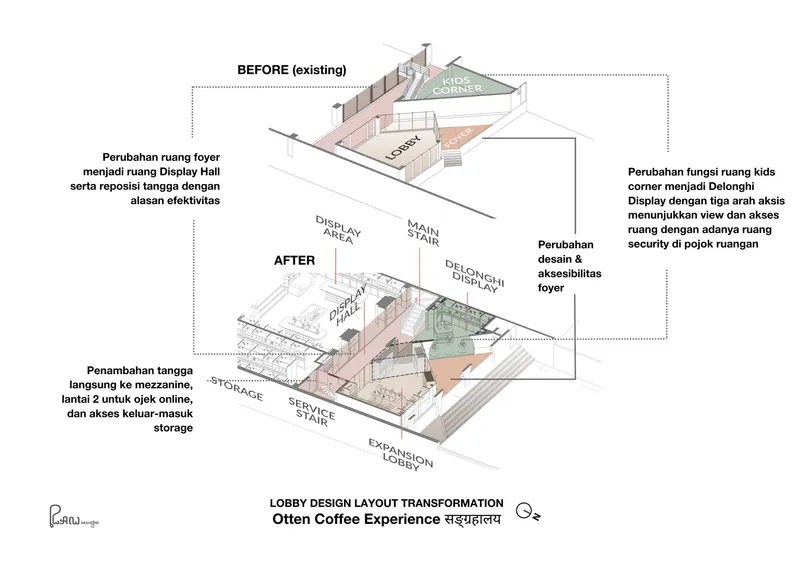
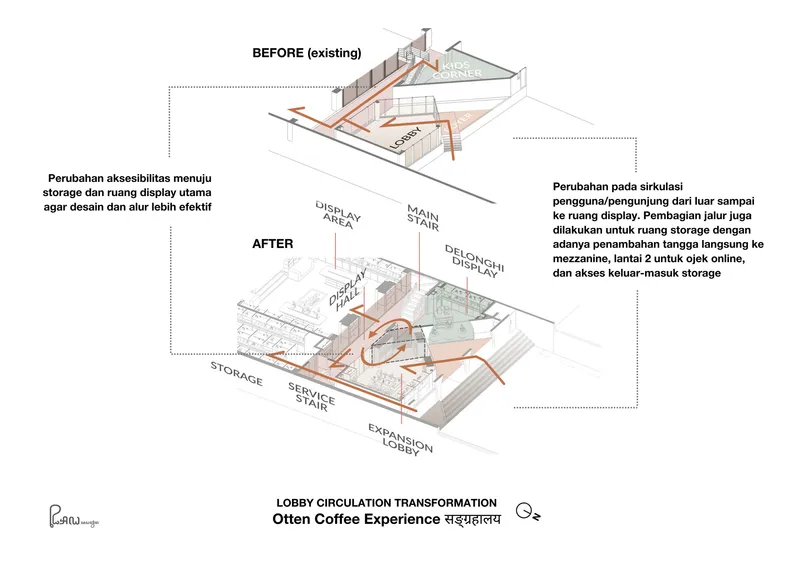
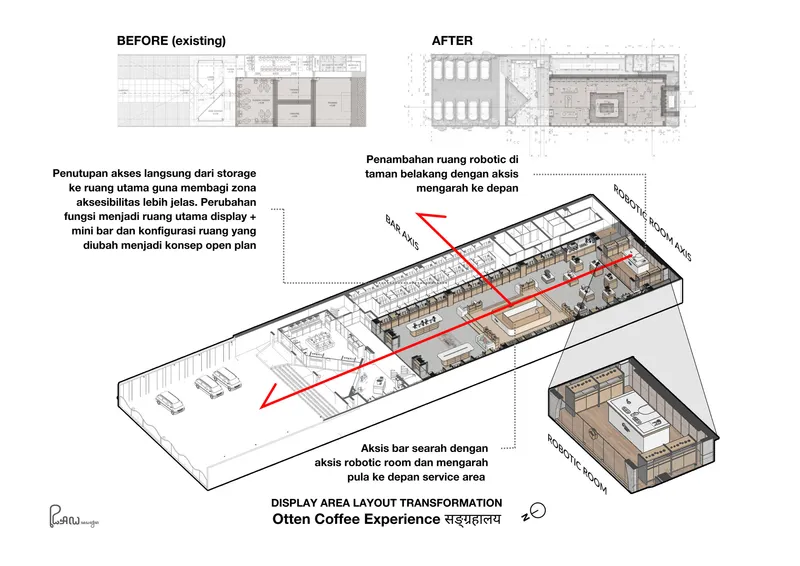
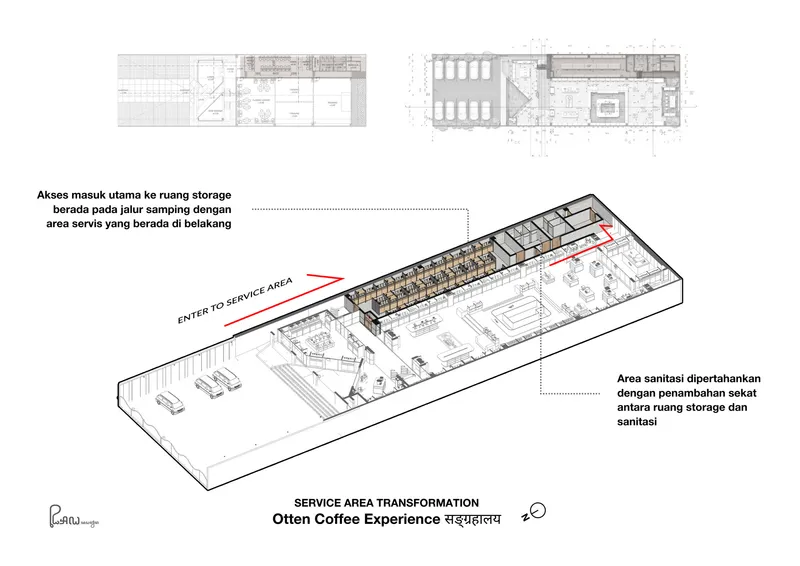
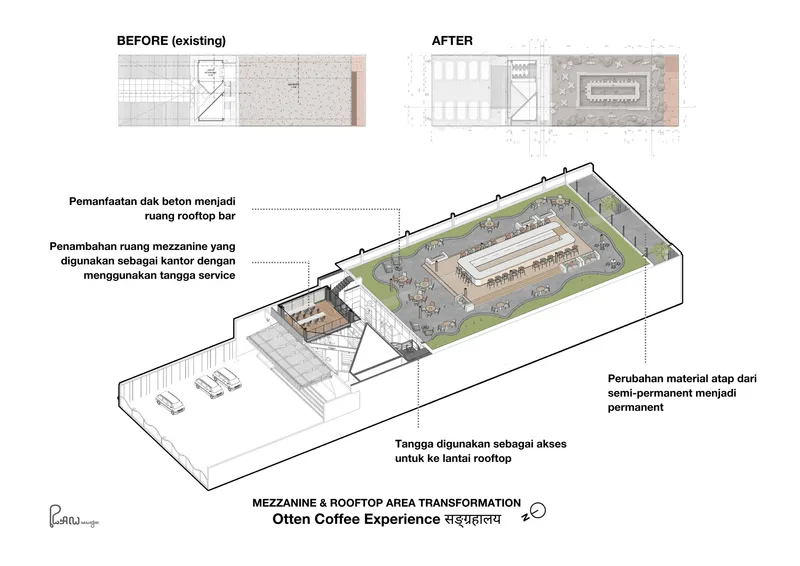
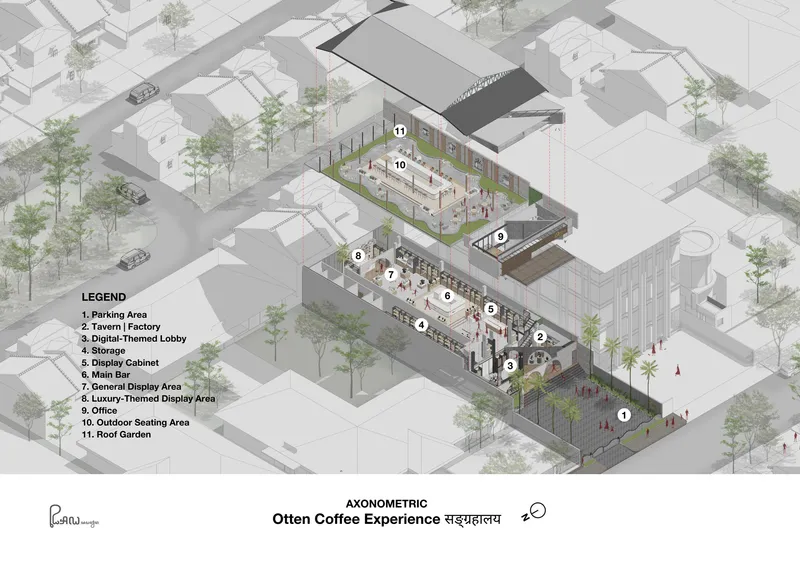
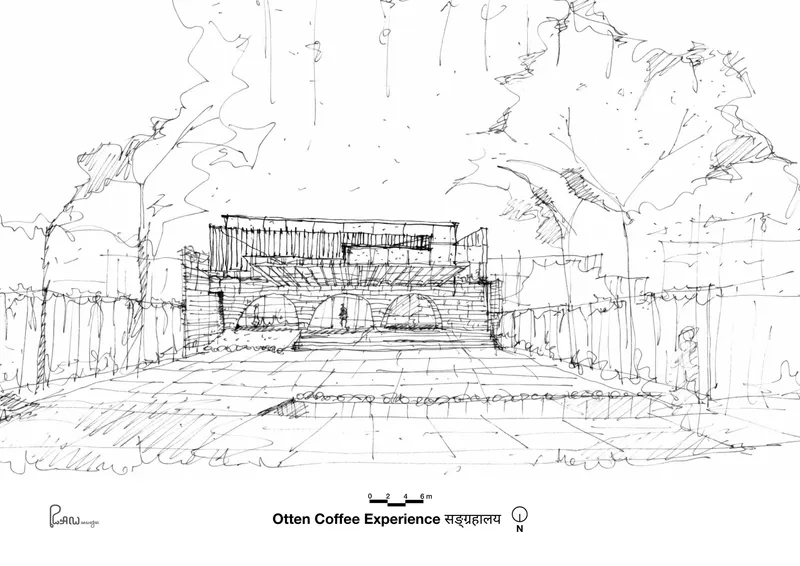
The drawing set reveals the renovation logic clearly. Before-and-after plan comparisons show how the entry ramp, parking zone, and interior partitions were reorganized to create continuous flow from street to backyard. The axonometric sequences are particularly instructive: each one isolates a single programmatic zone (lobby, display, service, mezzanine) and diagrams how circulation, storage, and access were rethought. Section drawings confirm the role of the truss roof structure as both structural frame and atmospheric device, with the cantilevered pergola extending the habitable zone beyond the building envelope. The exploded axonometrics tracking the landscape additions show that even the planting strategy was designed as a phased transformation, not an afterthought.
Why This Project Matters
Coffee brands worldwide invest heavily in spatial experience, but most default to a globalized palette of reclaimed wood, subway tile, and Edison bulbs. Otten Coffee Experience rejects that template. By anchoring every design decision in Bandung's craft traditions and locally sourced materials, Realrich Sjarief builds a case for regional specificity as a commercial advantage, not a limitation. The gedek bamboo ceiling alone would distinguish the space. Combined with brick arches, herringbone timber displays, and a deliberate bioclimatic strategy, the interior becomes a spatial argument for Indonesian material culture.
The deeper lesson here is about renovation discipline. The existing structure was preserved, not gutted. Every intervention, from the stair reconfiguration to the tilted lobby wall, works with the building's proportions rather than against them. In a moment when adaptive reuse often means little more than stripping a shell and starting over, this project shows what happens when an architect reads the bones of a building and lets them guide the design. The result is a space that feels simultaneously ancient and contemporary, local and aspirational.
Otten Coffee Experience by Realrich Architecture Workshop (lead architect: Realrich Sjarief). Bandung, Indonesia. 777 m². Completed 2021. Photography by Ernest Theofilus.
About the Studio
Share Your Own Work on uni.xyz
If projects like this are the kind of work you want to make, uni.xyz is a place to publish your own, find collaborators, and enter design competitions.


Popular Articles
Popular articles from the community


Tsunami Convergenics: Turning Catastrophic Ocean Forces into Underwater Housing Infrastructure
A speculative underwater settlement off the coast of Onagawa, Japan, treats tsunamis and typhoons as energy sources rather than threats.

Opera by the Sea Estonia: Three Shells Dissolving Architecture into Tallinn's Coastline
A winning opera house proposal replaces monumental form with interconnected shells that blur the boundary between building, park and Baltic Sea.

Cloaked Colonization: A Mobile Underwater Habitat That Moves Like a Fish
Micah Abaya's shortlisted EHC Pacific entry reimagines ocean settlement as a dispersed network of self-sustaining architectural organisms.

Extended Shell: Retrofitting Kolkata's Balconies as Living Urban Thresholds
A modular retrofit system recovers the social and environmental intelligence of Kolkata's historic verandas for contemporary Park Street residents.

Similar Reads
You might also enjoy these articles

Bao Huynh Watercolor Atelier: A Serene Art Retreat in Hội An
Bao Huynh Watercolor Atelier in Hội An blends multifunctional art spaces, sustainable design, local materials, and family-friendly living in a serene environment.

Atelier Macri Concept Store Interior Design by CASE-REAL
Atelier Macri store features a "ko" counter, walnut wood details, cork displays, blending retail, gallery, and seamless customer experiences.

Manuel Vargas Izquierdo Stadium and High-Performance Sports Center: Architectural Excellence in Jalpa de Méndez
The Manuel Vargas Izquierdo Stadium blends sustainable design, inclusive sports facilities, and cultural-inspired architecture, revitalizing Jalpa de Méndez’s public spaces.

KAKR Buluh Awar Hall: Revitalizing Community and Ecology Through Bamboo Architecture
Community built bamboo hall revitalizes Buluh Awar village, empowering youth, restoring ecology, celebrating vernacular craftsmanship through sustainable architecture and culture.

Comments (0)
Please login or sign up to add comments
No comments yet. Be the first to comment!