

Enlightening the Heritage: Memorial Architecture as Urban Healing in Aleppo
A subterranean plaza and cultural center near Aleppo's citadel reinterprets courtyard vernaculars to frame memory, light, and civic renewal.


Beneath a monolithic stone volume, daylight falls in controlled beams onto fragments of ruin. Artifacts and shards of a city's cultural life sit exactly where architecture meets memory, refusing to let either become abstract. "Enlightening the Heritage" proposes a hybrid intervention near the citadel of Aleppo, Syria, one of the oldest continuously inhabited urban structures on earth, now deeply scarred by prolonged conflict. The project fuses a solemn subterranean memorial plaza with an active cultural center above, using light, void, and material restraint to make grief tangible and renewal possible.
Designed by Nicolò Sciolti, the project was shortlisted in the international Memory competition. Sited adjacent to Aleppo's citadel, the proposal does not mimic historical forms but carefully reinterprets the axes, pathways, and courtyard typologies of the Aleppine urban fabric. The result is an architecture that bridges historical continuity with contemporary civic need, transforming the surrounding urban void from a scar of destruction into a platform for cultural rebirth.
An Oval Enclosure and Water Canal: Framing the Memorial Ground
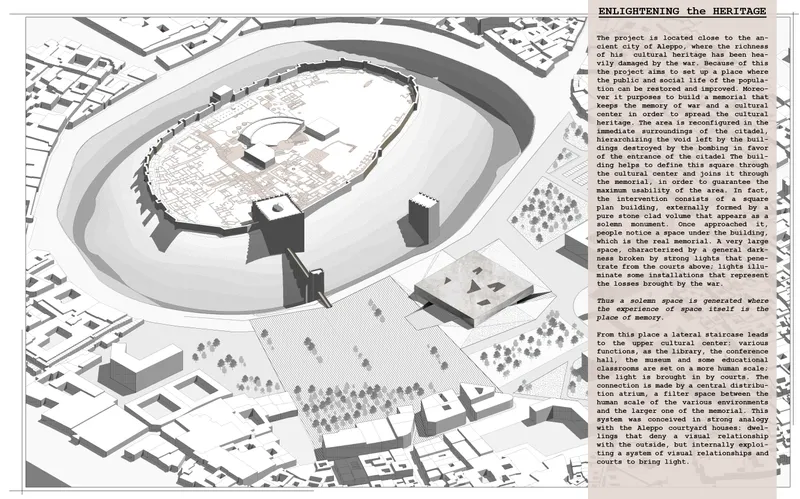
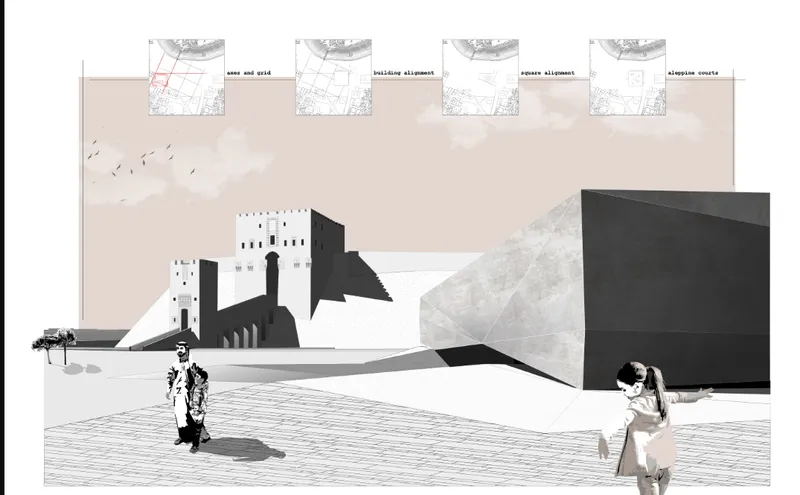
The axonometric drawing reveals the project's primary formal gesture: an oval memorial enclosure ringed by a curved water canal, set within the scattered geometry of the surrounding urban context. The canal acts as both a literal and symbolic threshold, separating the memorial precinct from the city's everyday noise. In the rendered elevation, layered geometric volumes stack with quiet precision over a paved plaza. Two figures cast long shadows across the stone surface, their scale reinforcing the monumental intent of the composition. The material palette here is immediately legible: stone and concrete, stripped of ornament, foregrounding spatial experience over decorative distraction.
A Transitional Landscape of Courts and Angular Volumes
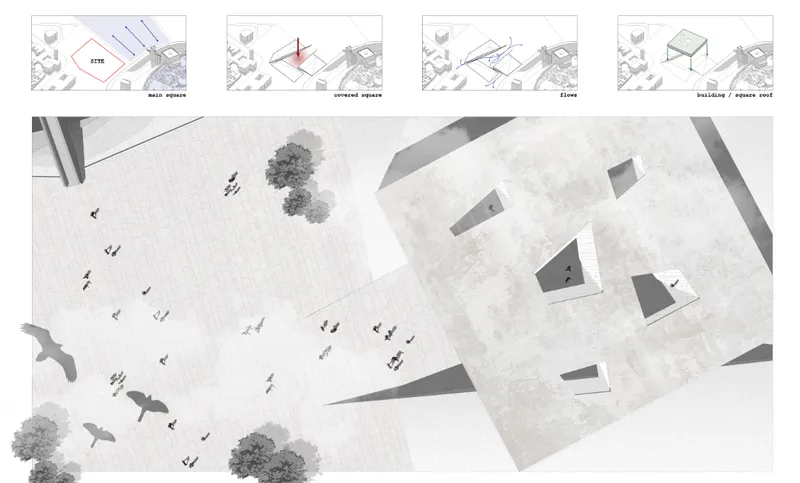
The aerial site plan rendering shows angular building volumes dispersed across a textured plaza, punctuated by trees and scattered figures. The arrangement is deliberate: pathways and voids are reimagined from Aleppo's historical urban morphology, forming a spatial composition that feels both ancient and unmistakably contemporary. The positioning of open courts, inspired by Aleppine courtyard houses, mediates light, climate, and social interaction in ways that reinforce local architectural vernaculars without resorting to pastiche.
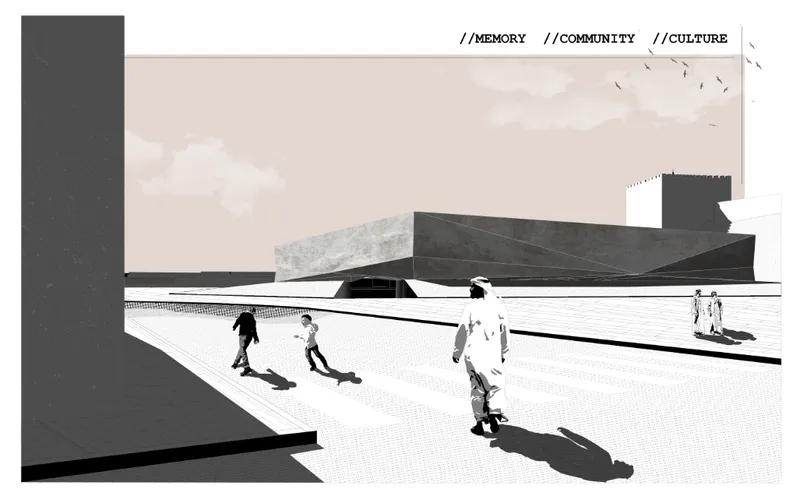
At eye level, the experience shifts. A paved courtyard stretches under an open sky, three figures walking through its calm expanse. The visitor's journey is designed as a gradual withdrawal from the city, a transitional sequence that peels away external chaos before delivering the individual into the darkened, introspective realm of the underground plaza below. The restrained materiality and generous proportions of this courtyard set the emotional register: stillness before descent.
Terraced Volumes Against the Citadel: A Sectional Dialogue with History
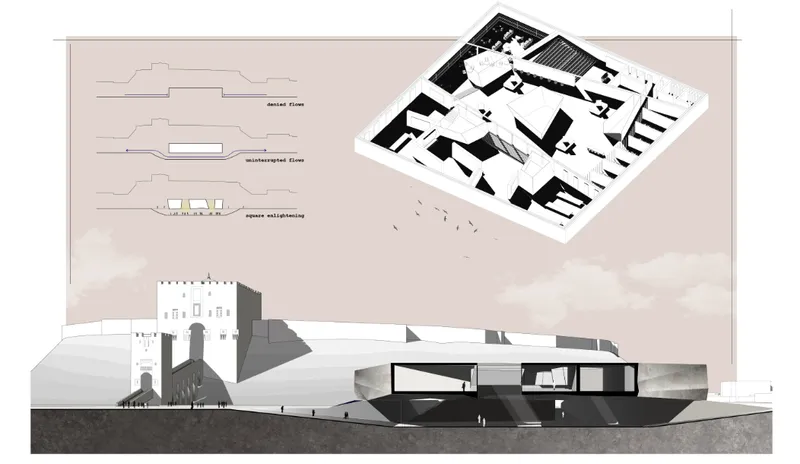
The section drawing, paired with a plan inset, makes the project's relationship to the historic citadel explicit. Terraced volumes step down toward the subterranean plaza, while the upper layer houses the cultural program: a library, memorial museum, conference halls, educational rooms, and a public auditorium. An external staircase connects the memorial square below to this multifunctional facility above. The section shows how these programs are not simply stacked but unified through shared visual and spatial relationships anchored around open courts. These courts channel daylight into the underground realm, creating the precisely placed beams that illuminate artifacts and ruins within the memorial space.
Rubble, Light, and a Child: The Interior as Sacred Encounter
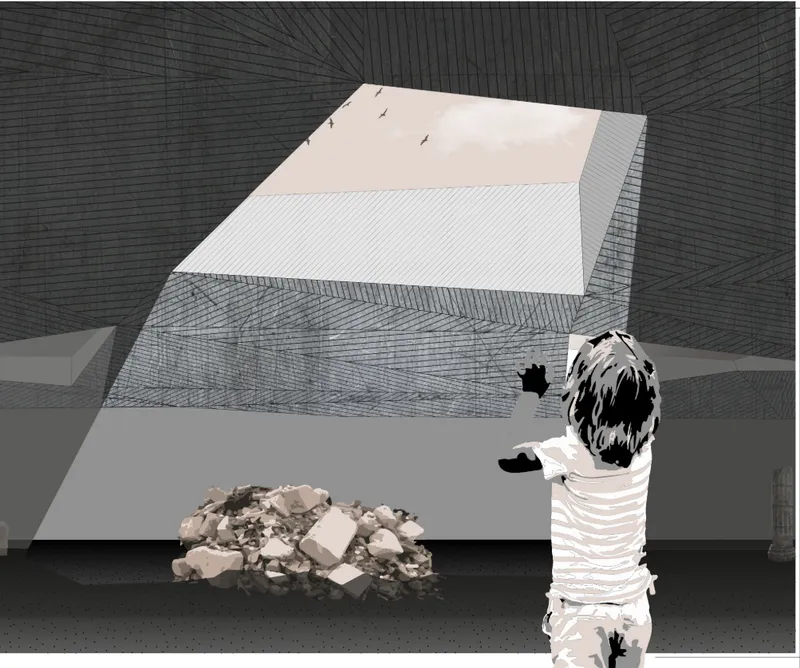
The most emotionally concentrated image in the project shows a child standing before a stepped platform, rubble gathered beside a textured wall. In the darker recesses of the underground square, light becomes sacred: a rare, focused presence that provokes not just reflection but a visceral connection to loss. The manipulation of light and shadow is perhaps the project's most poetic achievement. Moments of disorientation give way to calm and then to revelation as visitors move through the sequence. Artifacts and ruins are embedded in the architecture itself, ensuring that memory is never reduced to inscription on a plaque but remains physically present, spatially demanding.
The simplicity of the external façade conceals this richly choreographed interior landscape. Volumes shift, courts open overhead, and perspectives change continuously. Stone and concrete carry the weight of the narrative without competing with it. Architecture here serves as a frame for memory, where every surface, every shadow, every shaft of light supports a single purpose: to make the intangible weight of cultural loss something a visitor can stand inside.
Why This Project Matters
Memorial architecture risks two common failures: becoming so abstract that it detaches from the specific tragedy it commemorates, or becoming so literal that it reduces grief to spectacle. "Enlightening the Heritage" navigates between these poles by anchoring memory in physical fragments, real ruins and artifacts, while using spatial choreography, light, and material restraint to construct an emotional journey that resists easy consumption. The subterranean plaza is not a museum display; it is an immersive environment where the body, not just the eye, confronts loss.
Equally significant is the project's insistence that memorial and civic life are not opposites. By stacking a library, auditorium, and educational facilities above the memorial, Sciolti argues that remembrance and renewal must coexist. The courtyard typology borrowed from Aleppo's own domestic architecture roots the proposal in a living tradition rather than an imported formal language. In a city where so much has been destroyed, the decision to reinterpret rather than replicate is both a mark of respect and a practical commitment to a future that can hold its past without being paralyzed by it.
View the Full Project
About the Designers
Designer: Nicolò Sciolti
Enter a Design Competition on uni.xyz
uni.xyz runs architecture and design competitions year-round that reward proposals with spatial conviction and real site intelligence.
Project credits: enlightening the heritage by Nicolò Sciolti Memory (uni.xyz).


Popular Articles
Popular articles from the community

Temporary Home for Dogs: A Reversed Zoo Rethinks Animal Shelter Architecture
In Bucharest, a sinuous corridor and freed landscape flip the logic of containment, designing a shelter that works to make itself unnecessary.
Opera by the Sea Estonia: Three Shells Dissolving Architecture into Tallinn's Coastline
A winning opera house proposal replaces monumental form with interconnected shells that blur the boundary between building, park and Baltic Sea.

Opera on the Sea: Driftwood Logic Shapes a Timber Opera House on Estonia's Coast
Trevor Orgill's opera house translates the entangled drift of floating timber into a civic building where wood, water, and music converge.

Cloaked Colonization: A Mobile Underwater Habitat That Moves Like a Fish
Micah Abaya's shortlisted EHC Pacific entry reimagines ocean settlement as a dispersed network of self-sustaining architectural organisms.

Similar Reads
You might also enjoy these articles

Day and Night Park: A Time-Based Urban Newsstand in Beijing
A temporary urban newsstand in Beijing blending travel, light, and reading through poetic colors, compact form, and community-focused design.

Modernist Patio Renovation in El Masnou, Barcelona by Oliver Segura Arquitectura + Cebrià Arquitectura
Modernist patio renovation blending tradition and innovation with a movable pool, leveled floors, and Catalan materials in El Masnou.

Alto Residencial Coop: Cooperative Housing Development in Santiago de Compostela by Carbajo Barrios Arquitectos
A linear cooperative housing complex blending white volumes and perforated metal façades, enhancing community living, natural light, privacy, and urban integration.
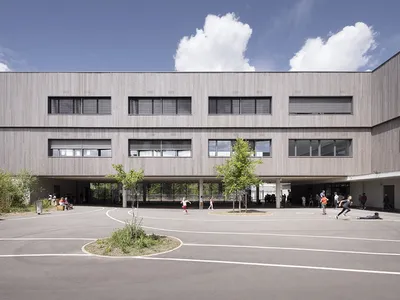
Vil Genis School by BPA ARCHITECTURE – Massy, France
Vil Genis School in Massy, France, features sustainable design, south-facing classrooms, community integration, accessible spaces, and modern educational architecture.


Comments (0)
Please login or sign up to add comments
No comments yet. Be the first to comment!