

Recollection of Echoes: Architecture as a Vehicle for Post-War Collective Healing
A layered urban proposal transforms ruins, water, and shared living into spatial instruments of remembrance, coexistence, and renewal.


What happens when architecture refuses both the impulse to forget and the compulsion to memorialize? "Recollection of Echoes" stakes out a third position: reframing. The proposal treats a war-scarred city not as a blank slate awaiting reconstruction but as a living repository of trauma and resilience, where ruin patterns become pathways, water features signal purification, and housing units embed coexistence into the rhythm of daily life. It is an argument that the built environment can hold two truths at once, the physical destruction of urban fabric and the silent fragmentation of the people who inhabited it, and still move forward.
Designed by Maria Selinotaki, Anastasia Milonas, Christos Savva, and Giorgos Agathocleous, the project assembles seven interconnected programmatic elements, from a museum and healing sanctuary to working hubs and social living units, into a single urban ecosystem. The ambition is clear: craft a setting where people from opposing sides of conflict can visit, learn, heal, and ultimately celebrate civilization together. Rather than presenting trauma as spectacle, the design frames memory as an opportunity for understanding and shared humanity.
Curved Walls and Vertical Connections as Spatial Mediators

The section drawing reveals a multi-level interior carved out by curved walls, with staircases threading between floors in a continuous vertical promenade. Figures populate each level, suggesting that the architecture is not merely observed but inhabited, moved through, lived in. The curving surfaces soften what could have been a stark institutional interior, producing pockets of intimacy within a larger civic volume. There is a deliberate avoidance of sharp orthogonal divisions; the building's internal logic favors flow over partition.
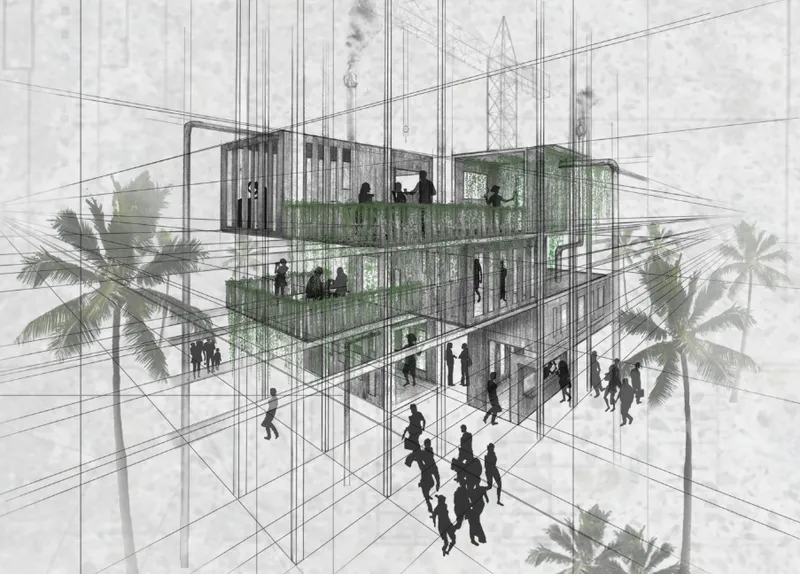
The axonometric view of a three-story structure with green-tinted walls reinforces this reading. Palm trees frame the building, and figures occupy every level, from ground-floor gathering areas to upper terraces. The tint of the walls hints at a material strategy that ties the architecture to its landscape, allowing vegetation and built form to read as a single organism rather than figure against ground. This is where the project's concept of a "cultivation arena" begins to manifest physically: the boundary between garden and building dissolves.
A Site Plan Built on Ruin Patterns and Landscape Memory

The site plan is perhaps the most telling drawing in the set. Building footprints nestle among clusters of palm trees and vegetation, with paved areas tracing paths that follow existing ruin patterns rather than imposing a new grid. The designers describe these fragments as "anchors of authenticity," and the plan bears that out: the new architecture is not superimposed on the site but threaded through it, allowing the scars of conflict to remain legible as spatial thresholds. Open areas between structures create informal gathering zones, the kind of interstitial space where chance encounters between formerly divided communities can occur.
Water features woven into the plan introduce what the designers call "auditory softness and visual calm," a deliberate counterpoint to the violence inscribed in the ground. The landscape reads as an oasis, not in a decorative sense, but as a genuine refuge where the programmatic anchors of exhibition, cultivation, work, and healing are held together by shared greenery and pedestrian circulation.
Stacked Volumes That House Memory and Everyday Life
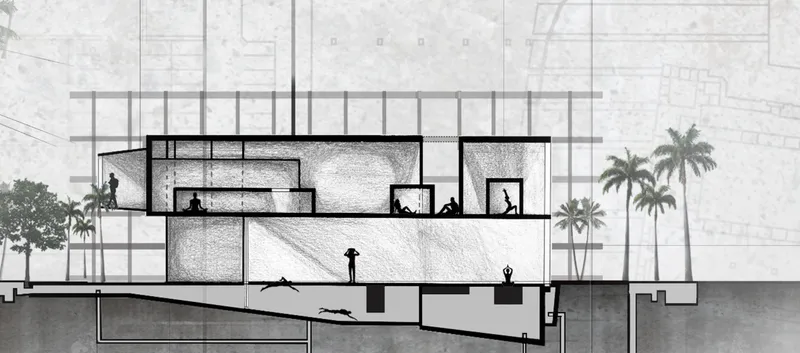

Two additional drawings, a cross-section and a perspective of stacked volumes, reveal how the project negotiates its vertical ambitions. The section cuts through a multi-level structure flanked by palm trees, showing figures in interior spaces that range from the intimate scale of a reading nook to the generous height of a double-volume gathering hall. The exposed structural frames in the perspective view suggest a deliberate rawness, an architecture that does not conceal its making. Exterior stairs cascade down through the stacked forms, making the act of ascent and descent a public performance rather than a hidden service route.
The social living units occupy these stacked volumes, transforming the proposal from a symbolic memorial into what the designers call "living architecture." Mixed communities are encouraged to inhabit side by side; the working hub on adjacent levels promotes knowledge exchange, traditional crafts, and new creative economies. A contemplative healing space completes the sequence, offering meditation areas and psychological support within the same urban fabric. The result is a single organism where remembrance, residence, and recovery coexist floor by floor.
Why This Project Matters
Post-war reconstruction projects too often default to one of two modes: erasure, in which the past is bulldozed for a clean start, or preservation, in which ruins are frozen as untouchable monuments. "Recollection of Echoes" refuses both. Its seven programmatic layers, from ruin-tracing pathways and water features to museums, cultivation arenas, housing, workspaces, and healing sanctuaries, compose a coherent argument that architecture can simultaneously acknowledge trauma and cultivate new civic life. The spatial sequence is not linear; it is woven, reflecting the messy, nonlinear reality of collective recovery.
What makes the proposal compelling is its insistence on the everyday. By embedding housing and workspaces alongside memorial and contemplative programs, Selinotaki, Milonas, Savva, and Agathocleous assert that healing is not an event but a condition sustained through daily coexistence. The drawings communicate this clearly: figures cook, walk, garden, work, and rest within the same architectural frame. If post-war architecture is to mean anything beyond shelter, it must create the spatial conditions for trust to rebuild slowly, one shared staircase and one communal garden at a time.
View the Full Project
About the Designers
Designers: Maria Selinotaki, Anastasia Milonas, Christos Savva, Giorgos Agathocleous
Enter a Design Competition on uni.xyz
uni.xyz runs architecture and design competitions year-round that reward proposals with spatial conviction and real site intelligence.
Project credits: Recollection of Echoes by Maria Selinotaki, Anastasia Milonas, Christos Savva, Giorgos Agathocleous.


Popular Articles
Popular articles from the community


longwave studio Reorganizes a 112 m² Tainan Apartment Around the Daily Routines of a Family and Two Cats
In Tainan, Taiwan, birch plywood, rust-red furniture and a freestanding plaster wall link arrival, storage, work and family life in one apartment.

Juan García Correa, John González and Claudia Rueda Sink a Circular Amphitheater into a Manizales Engineering Building
On the La Nubia campus in Manizales, Colombia, the S1 Building folds labs and offices into a hillside of ramped lawns that double as a campus route.

David Ortega Stacks a Two-Story Mexico City Penthouse Around a Steel Stair and a Pergola-Shaded Roof Terrace
In Colonia Roma, a 300 m² penthouse uses oak joinery, a planted steel stair and a slatted roof pergola to make a new-build apartment feel like a house.

Architekt Andreas Gruber Scatters 23 Dark Timber Chalets Across a South Tyrolean Forest Edge
In Molini di Tures, Amonti Chalets breaks a resort into a hamlet of gabled timber houses, with parking, storage and services pushed into the slope.

Similar Reads
You might also enjoy these articles


Aquadapt: An Underwater Habitat That Rewrites Its Rooms by the Hour
Curved modules ring the seabed while one shell shifts from breakfast room to cinema, farm and football pitch as residents' needs change.

Play: Fragments of Their World: Remembered Architecture Rebuilt as a Modular Playground for Refugee Camps
Tom Gardner abstracts domes, arches and towers from the homelands of displaced families into a kit of child-scaled play parts for camp settlements.
REBIRTH: A Circular Settlement Where Afghan Widows and Their Children Rebuild Life Together
A shortlisted Resile entry turns the circle into a protective ring of timber and brick, gathering homes, classrooms and gardens around a shared landscape.
The Main Dream: A Recycled Plastic Kit That Lets Refugee Children Build Their Own Playground
Thirty-centimetre interlocking cubes that connect on three axes turn play into construction, letting children author the spaces they occupy.

Explore Reimagining Competitions
Discover active competitions in this discipline

Challenge to design public laboratory

Design challenge to equip cities with modern furniture
Comments (0)
Please login or sign up to add comments
No comments yet. Be the first to comment!