
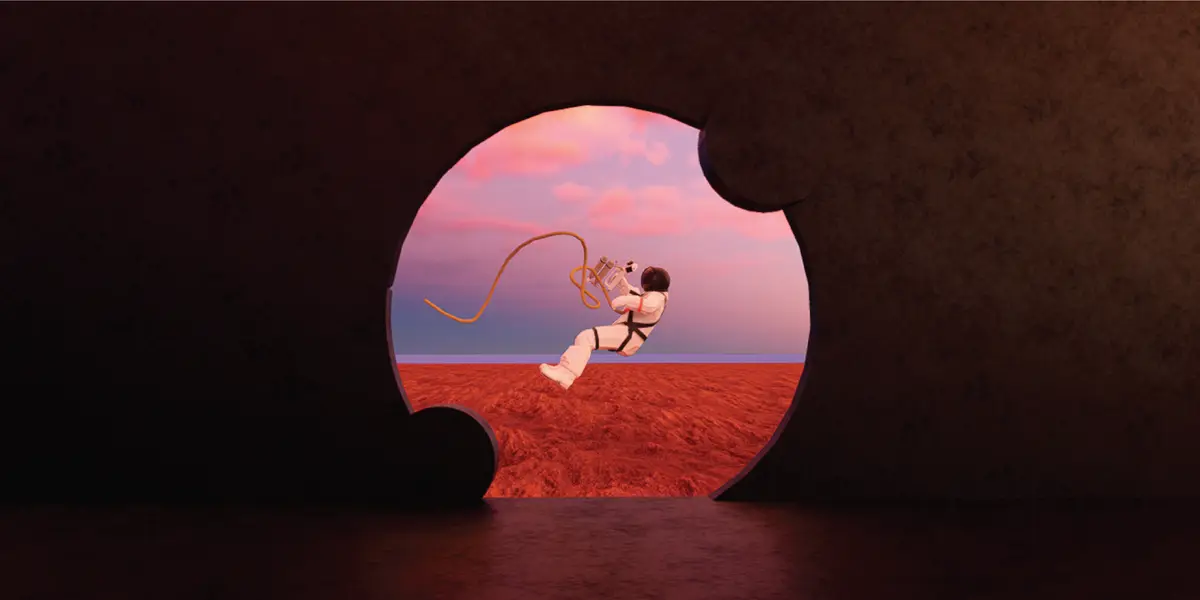
RED EARTH
Survival of the human race
The search for distant planets that could one-day harbor human life continues. When it comes to extraterrestrial simulation and testing environments, it is better to choose a location that matches the intended goal.
One of the driest regions on earth stretches for around 1,200 kilometers in the south of Peru and in the north of Chile: the Atacama Desert. With its gigantic salt lakes, colorful lagoons, hot springs, meter-high cacti, and brown mountains, this landscape looks like it's from another planet.
A hyperarid climate has existed in the central part of the desert for at least 15 million years. In a region about 100 km south of Antofagasta, averaging 3000 m elevation, the soil was compared to that of Mars. Because of these extreme bioclimatic conditions, the almost non-existent cloud cover, and the lack of light pollution and radio interference, the Atacama Desert is one of the best places in the world to conduct astronomical observations.
The circular design concept is based on the two moons that orbit Mars.
The research facility serves as the center and the prototype houses of the testing site serve as its satellites. The 'moons' of the design offer spaces for a visitor center and an auditorium.
The building itself stretches across two floors. The underground floor offers accommodations for up to fifty people with a man-made Oasis to fight the extreme heat of the desert. The ground floor is where the labs and research facilities are located.
The simple form of the design allows for it to be easily recognizable in the middle of the desert and thus become a landmark in its own right.

Popular Articles
Popular articles from the community

ALGAL REALM: A Bio-Integrated Lunar Habitat Design for Life Beyond Earth
ALGAL REALM reimagines lunar habitat design with algae-powered life support, 3D-printed regolith, and vertical living for a lunar future.

Little Red Riding Hood: Architectural Design as a Journey Through Fear, Light, and Storytelling
Little Red Riding Hood reimagines the fairy tale through architectural design shaped by fear, light, scale, memory, uncertainty, and choice.

Co-Life: Senior Housing Design That Reconnects Older Adults With the City
Co-Life reimagines senior housing design through healing gardens, shared streets, workshops, and a sustainable community across generations.

The Musturak Paradise: Senior Living Architecture for a Connected Future in Temara, Morocco
The Musturak Paradise reimagines senior living architecture in Temara via private homes, social spaces, culture, community, and shared care.

Similar Reads
You might also enjoy these articles

Day and Night Park: A Time-Based Urban Newsstand in Beijing
A temporary urban newsstand in Beijing blending travel, light, and reading through poetic colors, compact form, and community-focused design.

Modernist Patio Renovation in El Masnou, Barcelona by Oliver Segura Arquitectura + Cebrià Arquitectura
Modernist patio renovation blending tradition and innovation with a movable pool, leveled floors, and Catalan materials in El Masnou.

Alto Residencial Coop: Cooperative Housing Development in Santiago de Compostela by Carbajo Barrios Arquitectos
A linear cooperative housing complex blending white volumes and perforated metal façades, enhancing community living, natural light, privacy, and urban integration.
Vil Genis School by BPA ARCHITECTURE – Massy, France
Vil Genis School in Massy, France, features sustainable design, south-facing classrooms, community integration, accessible spaces, and modern educational architecture.

Explore Earth Architecture Competitions
Discover active competitions in this discipline


Challenge to reimagine the Iron Throne

Photograph architecture without architects

Illustrate the lost glory of Angkor Wat - Render Challenge

Design challenge to reuse E-waste
Comments (0)
Please login or sign up to add comments
No comments yet. Be the first to comment!