
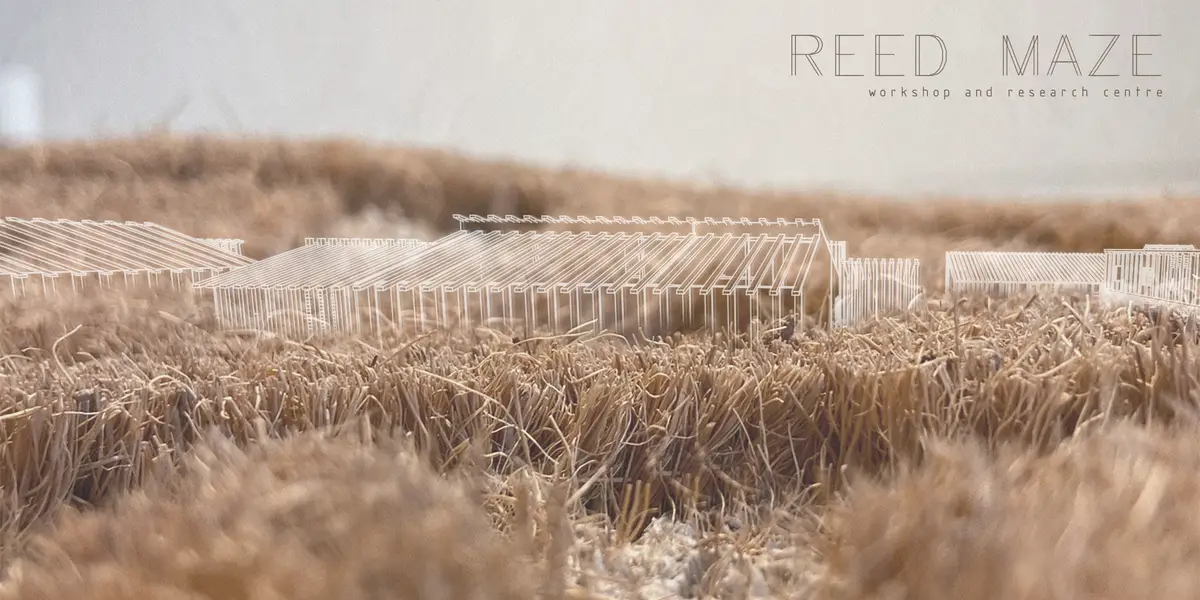
REED MAZE - workshop and research centre
A project that strives to preserve tradition and enrich nature
Concept
The concept derived from analysing the Tame Valley, surrounding landscape and its transformation over time. Special attention is paid to the period after the industrial revolution when the quality of the water in the river started to decline and the land began to be exploited. During this period the changes that took place permanently changed the appearance of the landscape and the life in it. On the one hand, the industry was growing with new mines, power stations and sand and gravel extraction, and on the other hand, nature was dying - the living world was disappearing from the river and its surroundings. Once a clear river became the dirtiest in The United Kingdom. Only after more than 100 years, the area started to be restored. The river Tame began to recover after the creation of new purification lakes. The living world began to return, and former gravel pits were flooded to form big areas of wetland. Parks and numerous nature reserves were formed along the restored river. The large area of reedbeds became an important feature of the whole Tame Valley.
Many of today's characteristics of this region would not exist if the land was not exploited - the wetland would not be created, and therefore the plant world would be different.
Goal of the project
The goal of the project is to pay tribute to the past in some way, while its program focuses on the present moment. This was achieved by introducing the plant Miscanthus × giganteus into the project. It is a species from the grass family, created by crossing the species of Chinese silver grass and the species of sugar cane. Biomass is obtained from the stem of this plant. It is mostly used as a biofuel, a substitute for wood or coal, and its combustion can produce electricity or heat. The use of this plant, apart from its characteristic appearance for the wetland area, is significant because it creates a connection between the past and the present. This connection, which might not be so apparent, is created by putting something characteristic for the wetland that provides resources without destroying the land on the place where the wetland was created due to land exploitation.
An additional connection between the past, tradition and the present that this plant creates is in the possibility of using it for educational purposes. As thatched roofs have been traditional in The United Kingdom since the 12th century, and the current number of thatch masters is about 800, part of the centre would be dedicated to workshops that educate about thatched roofs and create new thatch masters. In addition to roof workshops, a workshop for objects made of the reed is planned, as well as a botanical workshop through which the reed would be planted, given that the miscanthus plant is sterile and cannot know on its own.
Organization and program
The centre's program is completely aligned with the initial idea. Within the centre, apart from workshops dedicated to reeds, there are museums with exhibition spaces, accommodation units for workshop participants, a cafe-restaurant, service units and a technology centre.
The museums are thematically divided into three different units - the historical museum of the landscape, the museum dedicated to the wetland and its living world today, and the museum dedicated to reed, the history of its use, reed products, and objects made in workshops.
As the facilities are located in a reed field that resembles a labyrinth, the technology centre, apart from being an administrative unit, also serves as a creative core where new content is devised and new paths are created through the reed field. The paths of movement and connections between immovable objects are changed every 3 years. The active path is available by accessing the Qr code placed at the entrance.
Design
The buildings are designed as light structures with timber construction. All buildings are designed with sloped roofs. This is not visible only in the building of the technology centre which has a cylinder shape. This facility was specifically designed to visually show the difference in its use and stand out among the other facilities of the centre. It is also the only facility that visitors do not have access to. Each specific purpose of the building corresponds to a specific type of roof that is especially thought out in accordance with the needs of the building. This design, in addition to providing quality spaces for use, provides the possibility of distinguishing the buildings on the plot because the only thing visible in the period when the reed reaches its full height is the roof of the building. The internal organization of the buildings, as well as the roofs, is designed to provide users with space in accordance with their needs.
Placing the objects in the reed field posed a new challenge - finding the exact position for the objects. In order to find an adequate position for each object, a model was used. It is made from a door mat cut into 6 pieces. A path is cut in each part, and different paths are obtained by turning and positioning the parts. The chosen positions for the objects are selected by placing them at intersections of the 8 paths obtained from the model. Path that are used are the ones that were repeating most often.
Changes throughout the year
The appearance of the center changes throughout the year. The reed that surrounds it and its height allow the architecture to be hidden during a part of the year. When the reed reaches its full height, only the roofs of buildings emerge in the field. The color of the reed during one season varies from green to yellow, when it dries. At the end of the cycle, when the reed is harvested before the new season, the architecture becomes visible again.
Apart from the fact that this project aims to preserve tradition and make a link with the past, it also contributes to the present time in many ways. In addition to offering a more environmentally friendly construction and promoting the wetland, the project by integrating miscanthus x giganteus creates an interaction of nature and architecture, the possibility of production and a source of resources, which, unlike in the past, does not damage nature, but rather enriches it.

Popular Articles
Popular articles from the community


David Macias Steps a Doorless Stone and Plaster House Down a Tropical Colombian Hillside
In the humid hills of Colombia, Threshold House replaces the front door with an open void and terraces its 850 m² down the slope instead of fighting it.

U.GA Architects Wraps an Oval Rooftop Pool in Curved Board-Formed Concrete on Busan's Jeollidan-gil
In Busan's Jeonpo-dong, a 454 m² mixed-use block stacks a neighborhood facility, guest rooms and an oval rooftop pool inside spiraling concrete walls.

longwave studio Reorganizes a 112 m² Tainan Apartment Around the Daily Routines of a Family and Two Cats
In Tainan, Taiwan, birch plywood, rust-red furniture and a freestanding plaster wall link arrival, storage, work and family life in one apartment.

LT2A and OPEN Architectes Thread a Brick and Glass High School Through a Wooded Belgian Campus
In Braine-l'Alleud, a 3,000 m² wing for Collège Cardinal Mercier pairs pale brick with a glazed colonnade, deferring to a small chapel and a dense wood.

Similar Reads
You might also enjoy these articles


Vereda Arquitetos Renovates a 40-Square-Meter Apartment Inside Niemeyer's Copan Building
A compact unit in São Paulo's most iconic residential tower gets a material overhaul that pairs exposed concrete with bold blue Formica.

Shakur's House: Exposed Brick as an Interior Organiser in a 168 m² Mashhad Residence
Brick moves indoors in this Mashhad residence, where masonry walls, glass partitions and teal planes sequence a compact home without closing it off.

Day and Night Park: A Time-Based Urban Newsstand in Beijing
A temporary urban newsstand in Beijing blending travel, light, and reading through poetic colors, compact form, and community-focused design.

Modernist Patio Renovation in El Masnou, Barcelona by Oliver Segura Arquitectura + Cebrià Arquitectura
Modernist patio renovation blending tradition and innovation with a movable pool, leveled floors, and Catalan materials in El Masnou.

Explore Environmental Centre Competitions
Discover active competitions in this discipline


Challenge to design public laboratory

Challenge to reimagine the Iron Throne

Photograph architecture without architects

Illustrate the lost glory of Angkor Wat - Render Challenge
Comments (0)
Please login or sign up to add comments
No comments yet. Be the first to comment!