
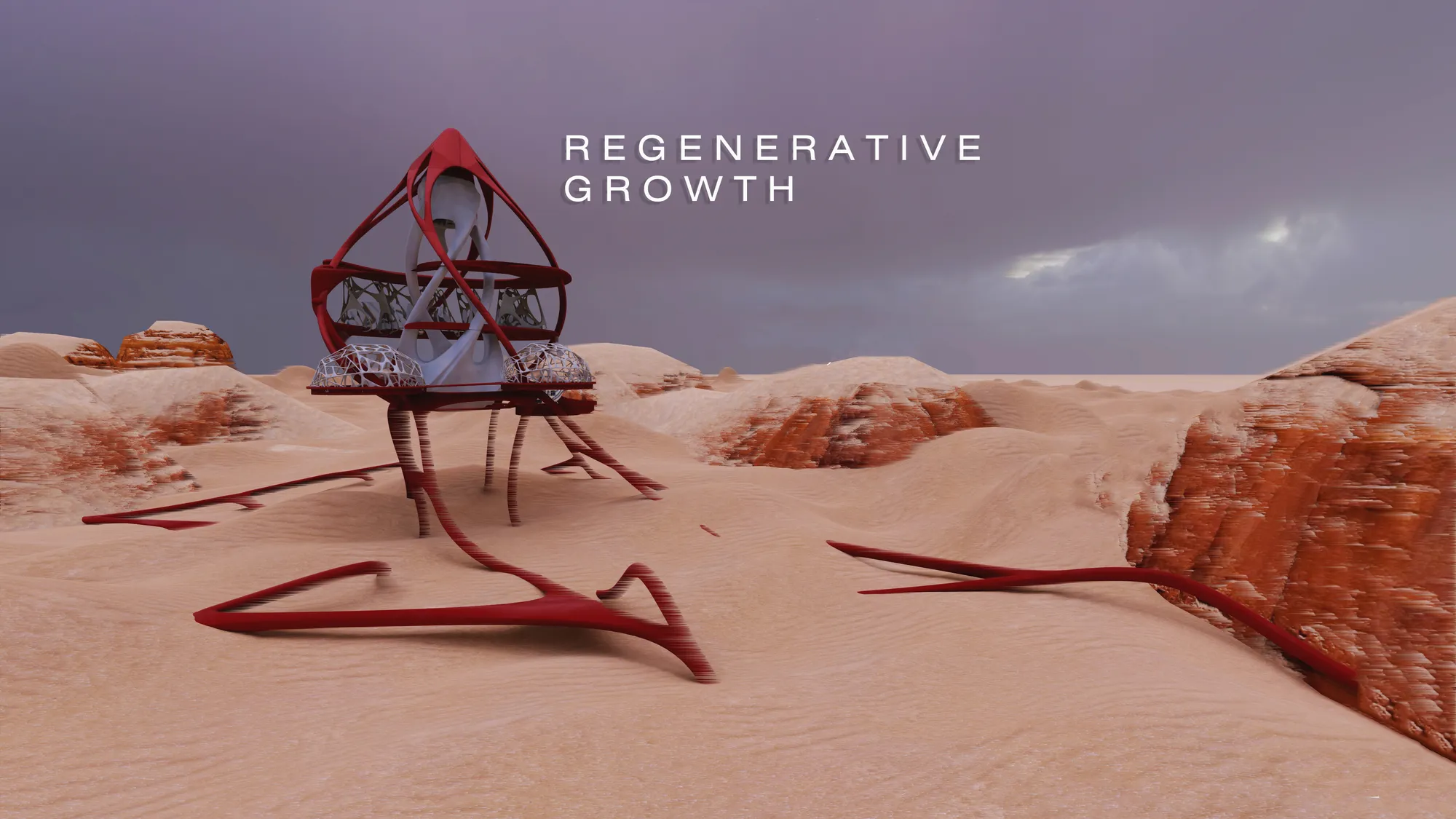
Regenerative Growth
A cancer remission facility on mars

The Regenerative Growth facility is located on Mars, Jezero Crater. This site is an on-again, off-again nature of the wet past of Mars. More than 3.5 billion years ago, river channels spilled over the crater wall and created a lake. The cancer facility was placed on Jezero Crater in order to excavate water from the crater lake.
The facility is a cancer facility that focuses on helping cancer patients transition into remission. The location of the facility, while not being a traditional location, is what will help create a treatment-focused plan for patients. The facility has three main levels; each level focuses on healing different aspects of the patient, being the mental, physical, and emotional problems caused by cancer. To better help the patients, the facility provides an environment that is protected from the mars environment.
There are programs such as spas and research spaces that focus on the regeneration of plants and humans. The spa helps heal the body through massage therapy, while feeding the body locally grown foods in their state of the art facilities. The regeneration of plants is a regenerative horticultural community working together to make a new ecosystem on mars. They will first start with making plants in their greenhouse to later trying to adapt them into mars soil. Their mission is to make a self-sustaining plant ecosystem on mars.
The two main sustainable systems used are wind turbines and liquid extractor. Regenerative growth not only stands for the generation the patients will experience during their stay in the facility, but it also stands for the regeneration of wind. The climate of Mars is known for high winds. The facility has a wind turbine that suctions the wind in through strong vents. The wind will be transformed into energy that powered the whole facility. For the water as a resource on the planet Mars the root-like structures are liquid extractors that double as a support structure and a liquid extractor. The location that the building was placed in is a mars lake that is mainly underground now. The arms of the structure dig into the surface and use a pump mechanism to extract the water. The water is used for the facility and the greenhouses.
There are a total of 40 people in the housing community, which includes scientists, researchers, biologists, permaculture designers, IT people, engineers, doctors, nurses, etc.The housing pods were used as a small housing system for the patients. The triangular t shape was created to be able to have more spaces in the semi-circle housing level. The individual hubs hold up to three beds for patients to shore a room. The walls of the housing were created with a vein-like look to them to make the rooms feel more t open. This also allows 360 views for the patients.
The facility has three main levels which are operation level on first. The operation level focuses on treatment far from the patients on the west wing. On the south wing has the kitchen, science labs, and housekeeping facilities. Regenerative housing levels on the second level are environmentally protected spaces for patients. And the last level is for leisure activities that is leisure space where the patients and staff can go and relax and enjoy the mars landscape.
In-site resources including Martian soil, basalt and Martian concrete are among the most feasible future construction materials on Mars. . A team of scientists from the Singapore University of Technology and Design discovered that, using simple chemistry, the organic polymer chitin—contained in the exoskeletons of insects and crustaceans—can easily be transformed into a viable building material for basic tools and habitats. Concrete requires a substantial amount of added water in order to be usable on site, and there is a pronounced short supply of water on both the moon and Mars. Glass is an excellent candidate for ISRU, as the source materials are abundant on Mars and local production costs should be orders of magnitude below transportation costs from Earth. Glass embodied energy is 6-15 MJ/kg for finished products. Steel can be made on Mars from local ingredients, various options. Concentrated carbonate deposits will be valuable – must search for them beneath Martian dust. Hence the materials we use are concrete, glass, and steel.
Mars will be colonized by humans by the year 2050, as long as autonomous mining processes quickly become more commercially viable. Hence our project would not only help heal people but also help them regenerate and find a new life on mars in a completely different environment as a process of rejuvenation.



Popular Articles
Popular articles from the community


Co-Life: Senior Housing Design That Reconnects Older Adults With the City
Co-Life reimagines senior housing design through healing gardens, shared streets, workshops, and a sustainable community across generations.

Co-life: Sustainable Architecture for Age-Friendly Community Living
Co-life reimagines sustainable architecture for seniors through courtyards, rammed earth, shared gardens, and spaces designed for belonging.

Riyadh For All: Intergenerational Urban Design for Active Aging in Rabat
Riyadh For All reimagines urban design in Rabat with intergenerational co-living, adaptive courtyards, and Moroccan cultural exchange today.

Play: Fragments of Their World
Familiar architecture becomes modular playground design, creating safe spaces where displaced children can learn, connect, imagine and play.


Similar Reads
You might also enjoy these articles

Day and Night Park: A Time-Based Urban Newsstand in Beijing
A temporary urban newsstand in Beijing blending travel, light, and reading through poetic colors, compact form, and community-focused design.

Modernist Patio Renovation in El Masnou, Barcelona by Oliver Segura Arquitectura + Cebrià Arquitectura
Modernist patio renovation blending tradition and innovation with a movable pool, leveled floors, and Catalan materials in El Masnou.

Alto Residencial Coop: Cooperative Housing Development in Santiago de Compostela by Carbajo Barrios Arquitectos
A linear cooperative housing complex blending white volumes and perforated metal façades, enhancing community living, natural light, privacy, and urban integration.
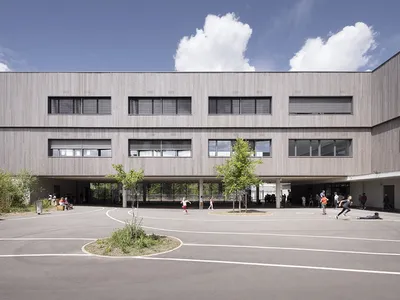
Vil Genis School by BPA ARCHITECTURE – Massy, France
Vil Genis School in Massy, France, features sustainable design, south-facing classrooms, community integration, accessible spaces, and modern educational architecture.

Comments (0)
Please login or sign up to add comments
No comments yet. Be the first to comment!