
Renewable Drone Race: Turning Solar Farms Into Nighttime E-Sport Arenas
A shortlisted entry for The Digital Colosseum 2020 that repurposes Spain's PS20 solar plant as a drone racing stadium after dark.


What happens to a solar farm when the sun goes down? For most of the year, the PS20 plant in southern Spain sits idle at night, its vast mirrored landscape cooling under a dark sky while the energy it harvested during the day flows elsewhere. Renewable Drone Race proposes a provocative answer: transform that dormant infrastructure into a fully powered drone racing arena, lit by the very energy the panels collected hours earlier. It is a closed-loop spectacle where architecture, energy production, and competitive gaming share the same ground.
Designed by Marguerite Cordelle and Abdel Helis, the project was shortlisted in The Digital Colosseum 2020 competition. The brief called for new typologies of competitive space suited to digital culture, and this entry responds by anchoring e-sport within existing energy infrastructure rather than building from scratch. The site is real, the statistics are grounded in projections that by 2050 solar fields could occupy 25% of available land, and the argument is straightforward: those fields need a second life after sunset.
A Canopy of Light Above the Mirror Field
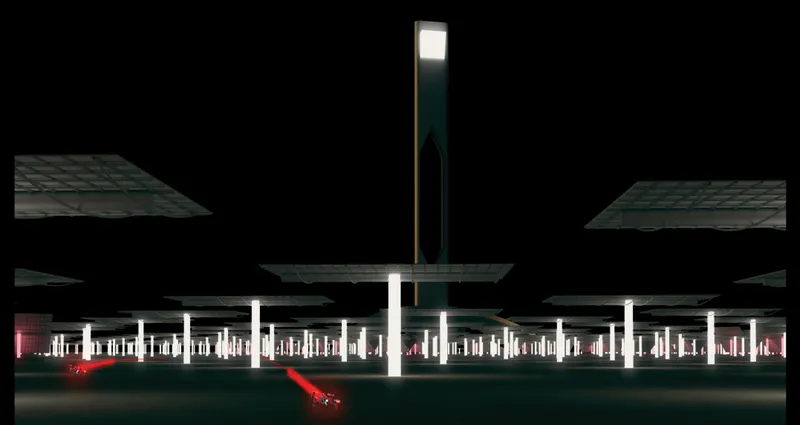
The night rendering reveals the arena's most striking spatial quality: an elevated canopy supported by illuminated white columns, hovering above the solar array like a second sky. Red streaks of traffic below suggest the integration of electric buses and cars into the site's transportation network, reinforcing the project's commitment to a fully renewable operational loop. The effect is theatrical without being gratuitous. Light traces the architecture rather than flooding it, so the structure reads as a luminous framework against the darkness of the Andalusian plain.
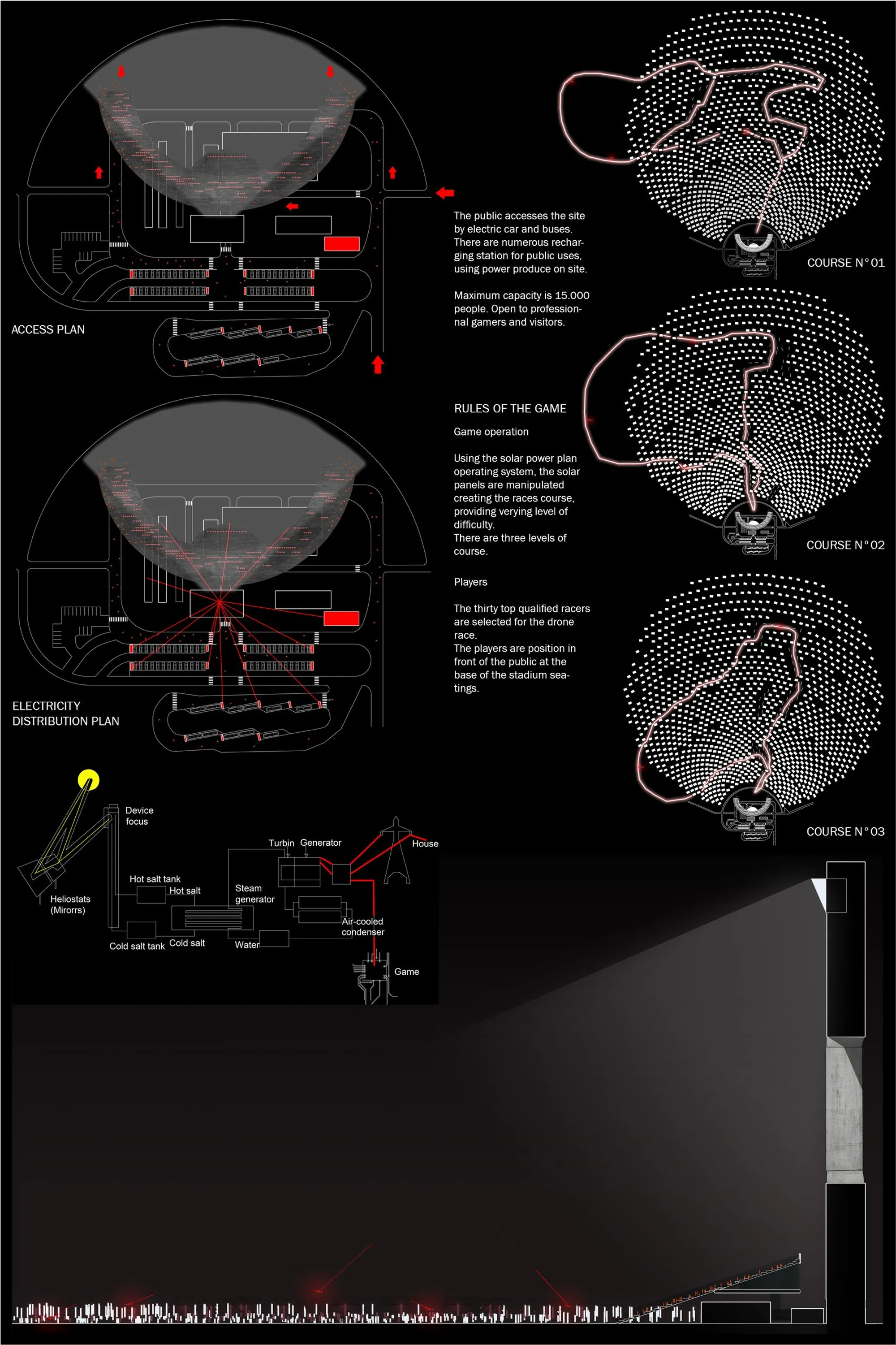
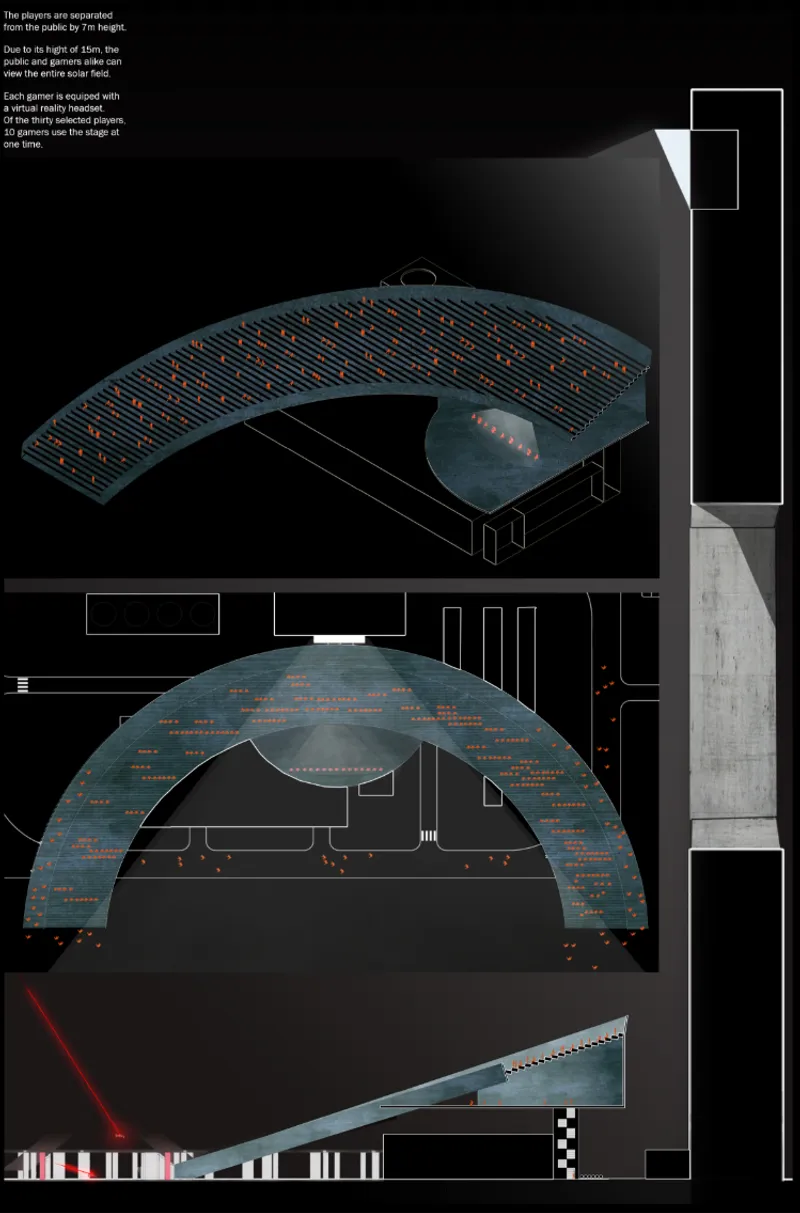
This is not decoration for its own sake. The columns and canopy define the spatial envelope of the race course, channeling drone trajectories through vertical and horizontal thresholds. Spectators sit 15 meters above the solar field, gaining a panoramic view that blurs the boundary between watching a race and surveying an energy landscape. The altitude matters: it keeps the audience clear of the drone flight paths while offering a vantage point that reveals the full scale of the PS20 site below.
Solar Infrastructure as Architectural Element
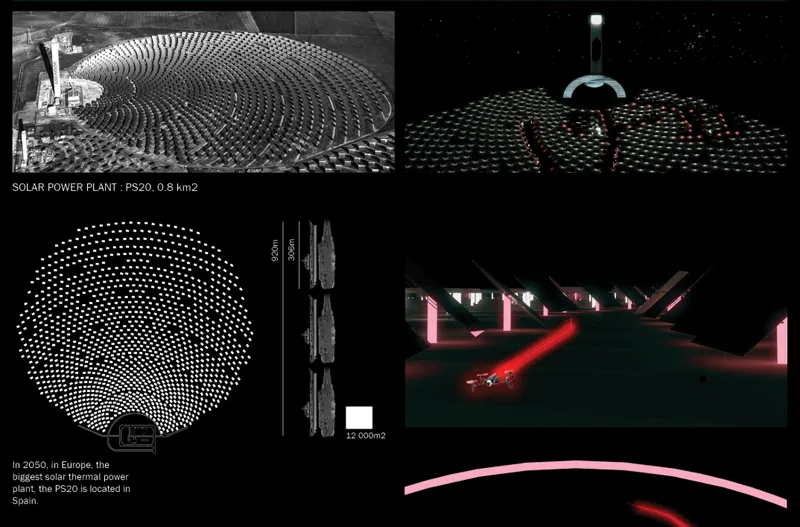
The composite panel and axonometric drawings expose the project's most inventive structural move. The solar panels are not passive backdrops; they rotate mechanically to generate different race configurations. Each shift in panel angle produces a new track layout, meaning no two races need follow the same path. The circular arrangement of the array, visible in the aerial diagrams, establishes a centripetal logic where drones spiral inward or orbit outward depending on the panel positions. Scale comparisons in the plan drawings anchor the proposal in reality, showing how the arena footprint maps onto the existing PS20 infrastructure without requiring additional land.
The curved roof structure shown in the elevation drawings wraps over a central void, creating both an open-air arena core and a sheltered perimeter for spectators and gamers. The section reveals how the roof profile follows the curvature of the solar array beneath it, establishing a dialogue between the two systems. Architecturally, the scheme reads as a techno-landscape: part infrastructure, part event space, with no clear line between the two. That ambiguity is the point. The designers argue for a future where energy production and public gathering are not separate programmes but overlapping conditions of the same site.
Ten Pilots, Thirty Qualifiers, One Immersive Loop
The programme accommodates ten simultaneous competitors selected from a pool of thirty qualified pilots, while the spectator system divides the audience through VR-enhanced viewing environments. Professional spectators receive data-rich overlays tracking drone speed and trajectory; casual visitors and families encounter a more scenic, narrative-driven version of the same race. The scenography itself evolves in real time based on drone movements, so the visual experience shifts continuously. It is a model of inclusive design applied to competitive gaming, welcoming novice players and seasoned pilots within the same spatial framework.
A Drone Over the Landing Field
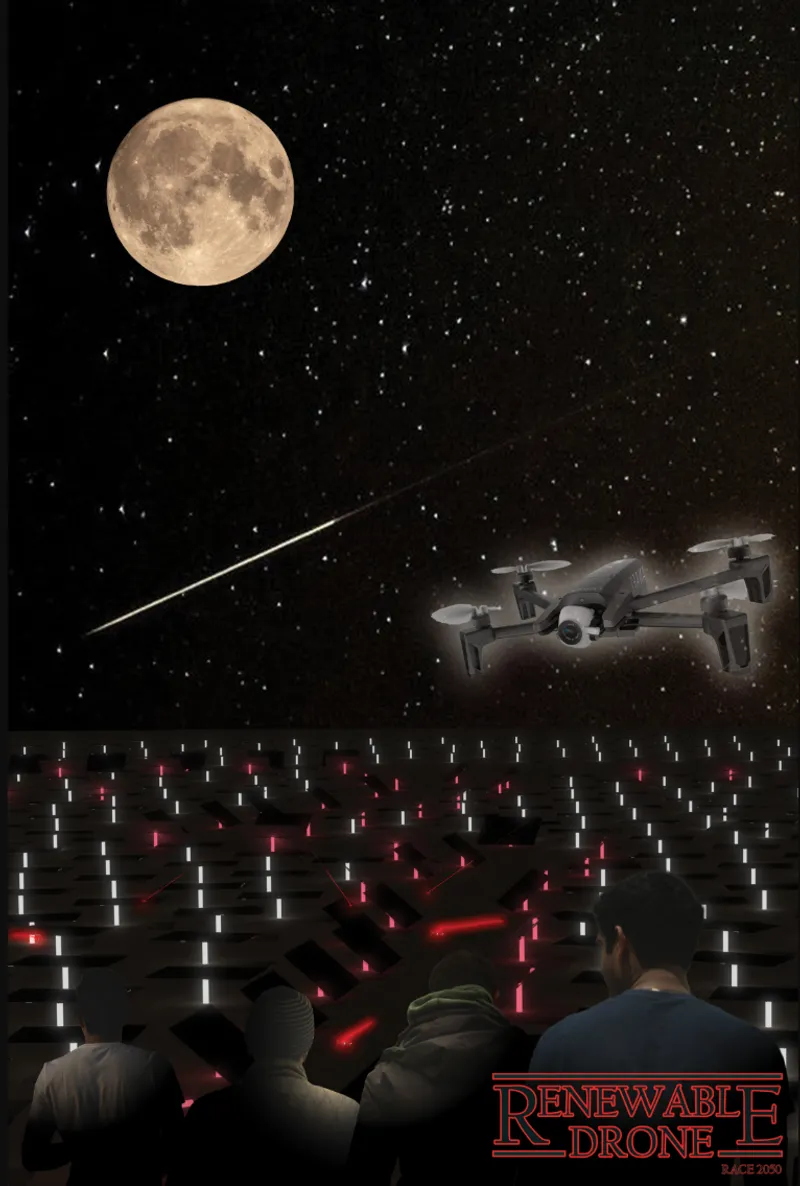
The final rendering distills the project to its most poetic moment: a single drone suspended above an illuminated landing field under a full moon. Stripped of the spectator stands and the canopy, the image reveals the essential relationship the designers are proposing. A machine hovers over a surface that spent the day collecting sunlight, now glowing with the stored energy of that same sun. The starry sky above completes the energy cycle visually, connecting the solar source to the illuminated ground. It is a quiet image for a project that could easily have leaned into spectacle alone, and it signals that the designers understand something important about restraint in speculative work.
Why This Project Matters
Renewable Drone Race does not propose a building. It proposes a policy: that the massive solar fields anticipated by mid-century energy projections should be designed from the start as dual-use landscapes. The architectural moves, rotating panels as track generators, elevated spectator platforms, VR-layered viewing, are all in service of that larger argument. By siting the arena on an existing power plant rather than a vacant lot, Cordelle and Helis sidestep the land-consumption problem that plagues new sports infrastructure and reframe energy sites as public space.
The project also offers a corrective to the tendency in e-sport architecture to default to enclosed, screen-lined black boxes. Here the arena is open to the sky, shaped by the movement of mechanical panels, and powered by the landscape it occupies. That integration of environment, energy, and entertainment is what gives the proposal its speculative credibility. It does not ask us to believe in a technology that does not exist; it asks us to imagine using what we already have in a way we have not yet considered.
View the Full Project
About the Designers
Designers: Marguerite Cordelle, Abdel Helis
Enter a Design Competition on uni.xyz
uni.xyz runs architecture and design competitions year-round that reward proposals with spatial conviction and real site intelligence.
Project credits: Renewable Drone Race by Marguerite Cordelle, Abdel Helis The Digital Colosseum 2020 (uni.xyz).




Popular Articles
Popular articles from the community


Play: Fragments of Their World
Familiar architecture becomes modular playground design, creating safe spaces where displaced children can learn, connect, imagine and play.

Lunar Spiral: Space Architecture Shaped by the Mathematics of the Universe
Lunar Spiral reimagines space architecture through Fibonacci geometry, lunar regolith, levitating habitats, and self-sustaining Moon living.

The Ocean Hive: Sustainable Architecture for a Self-Sufficient Civilization at Sea
The Ocean Hive imagines sustainable architecture at sea, where modular habitats, algae, wave power and ocean waste sustain a growing colony.

Co-life: Sustainable Architecture for Age-Friendly Community Living
Co-life reimagines sustainable architecture for seniors through courtyards, rammed earth, shared gardens, and spaces designed for belonging.

Similar Reads
You might also enjoy these articles

Day and Night Park: A Time-Based Urban Newsstand in Beijing
A temporary urban newsstand in Beijing blending travel, light, and reading through poetic colors, compact form, and community-focused design.

Modernist Patio Renovation in El Masnou, Barcelona by Oliver Segura Arquitectura + Cebrià Arquitectura
Modernist patio renovation blending tradition and innovation with a movable pool, leveled floors, and Catalan materials in El Masnou.
Alto Residencial Coop: Cooperative Housing Development in Santiago de Compostela by Carbajo Barrios Arquitectos
A linear cooperative housing complex blending white volumes and perforated metal façades, enhancing community living, natural light, privacy, and urban integration.
Vil Genis School by BPA ARCHITECTURE – Massy, France
Vil Genis School in Massy, France, features sustainable design, south-facing classrooms, community integration, accessible spaces, and modern educational architecture.





Comments (0)
Please login or sign up to add comments
No comments yet. Be the first to comment!