
Resolution: 4 Architecture Assembles a Prefab Weekend House on a Connecticut Hilltop
Four factory-built modules form an L-shaped retreat overlooking the Housatonic Valley in the wooded northwest corner of the state.


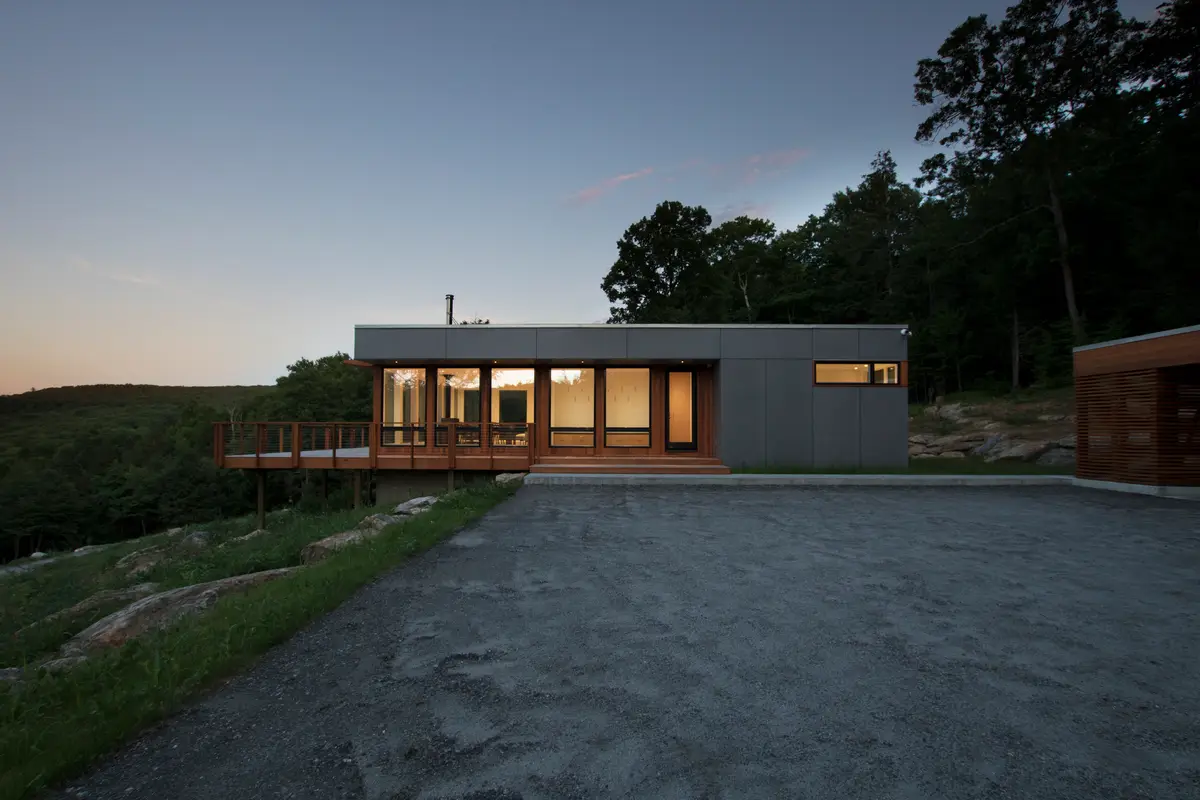
Prefabrication in residential architecture still carries a stigma, a lingering association with economy over expression. Resolution: 4 Architecture has spent years pushing back against that perception, and the Sharon Residence is one of their clearest arguments. Sited on a rocky, wooded hilltop in northwest Connecticut, the 1,892-square-foot house is composed of four modules, each 16 feet wide, trucked in and craned onto an insulated concrete foundation. What arrived on flatbeds reads, once assembled, as a sharp, deliberately composed object in the landscape: fibre-cement panels in cool gray, cedar infill, floor-to-ceiling glass, and a wraparound timber deck that floats over the hillside toward views of the Housatonic Valley.
The project's real achievement is not that it was built in a factory. It is that the factory logic, the dimensional constraints and the repetitive module width, generated a spatial plan that feels generous rather than constrained. An L-shaped layout separates a large communal volume for cooking, dining, and living from a linear bar of bedrooms and baths. The joint between the two wings opens the house to the landscape on three sides, and a brise-soleil overhead manages solar gain while defining an outdoor room as usable as any interior space.
A Module at a Time
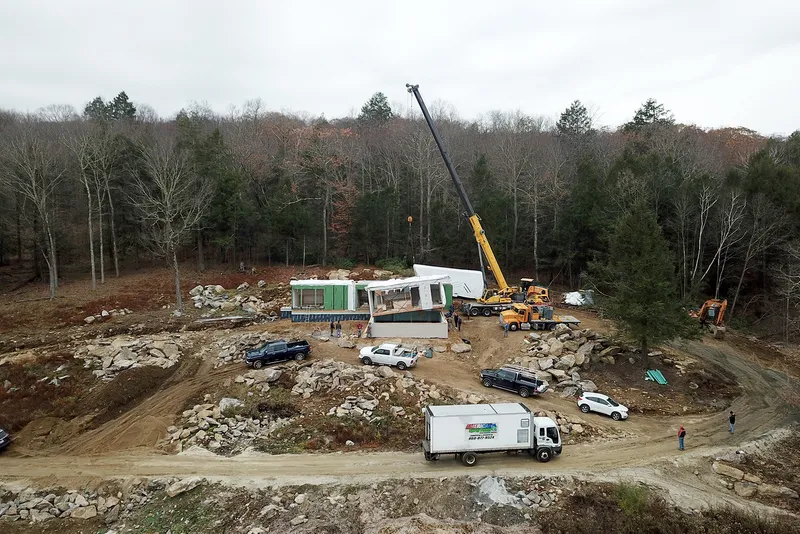
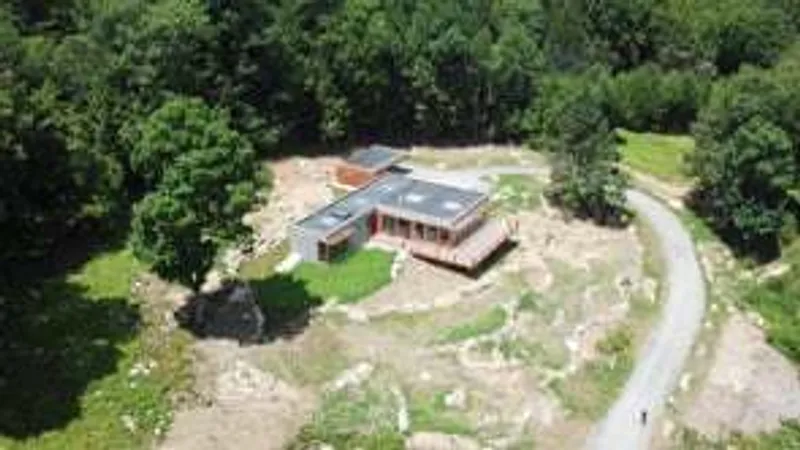
The construction photograph tells the whole story of method: a crane lifts a prefabricated box onto a cleared hillside amid bare winter trees. Each module arrived weathertight, with interior finishes largely complete. The aerial view, shot in summer, shows how little the site was disturbed once work finished. The house sits on a rocky clearing, the surrounding forest canopy closing back in almost immediately. Prefab's promise has always been speed and minimal site impact. Here, the evidence is visible from above.
Gray Volumes in a Green Field

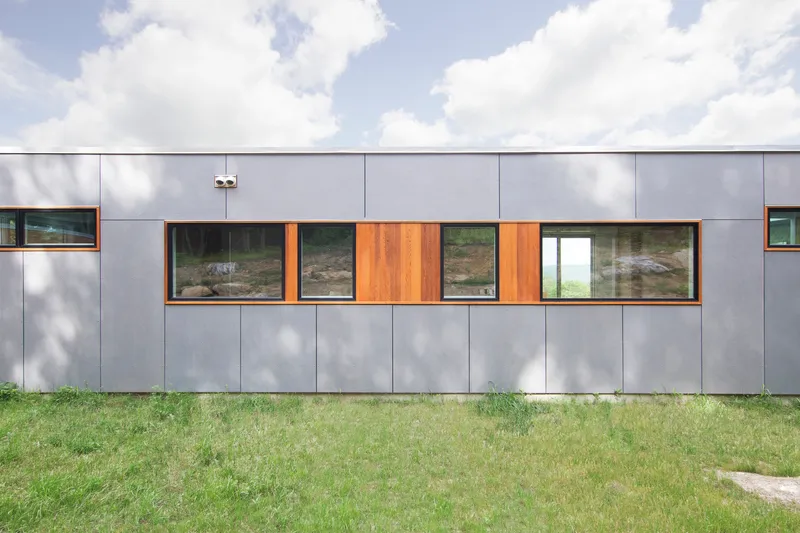
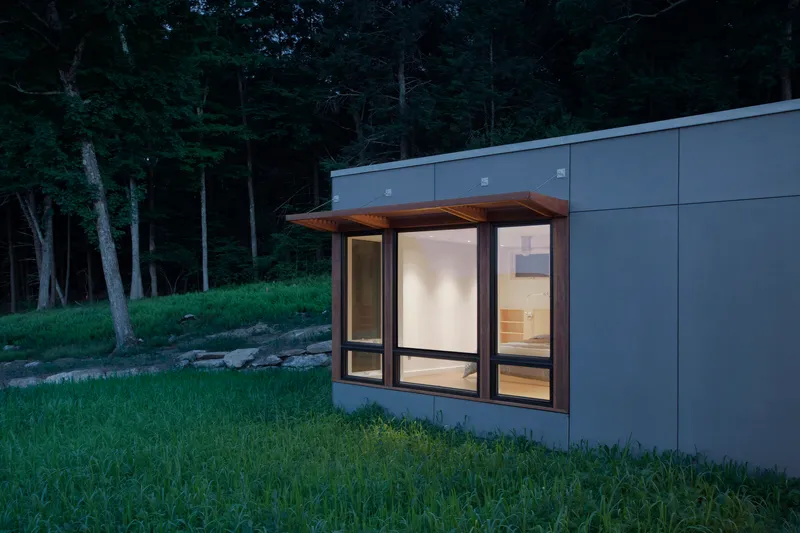
The exterior cladding is fibre-cement panel, a material that reads as restrained and slightly industrial without veering into coldness. Clear cedar fills the window frames and soffits, warming the composition at every point where the building meets the body: handrails, overhangs, the underside of the cantilevered deck. The street-facing elevation is the most closed, presenting a composed rectangular face to the approach. Walk around to the rear and the house opens up, its full-height glazing revealing every interior surface.
A corner bay window protrudes from the gray wall near the wooded slope, a small but telling gesture. It breaks the module grid just enough to signal that this is not a shipping container with windows punched in. The projection catches light from a different angle, pulls a slice of landscape into a room that might otherwise feel like an interior corridor. It is the kind of move that separates a considered house from a mere assembly.
The Deck as Mediator


The wraparound deck does more work than any single interior room. It connects the two wings, extends the living space outdoors, and manages the transition from finished floor to sloping terrain. A slatted pergola overhead, the brise-soleil mentioned earlier, filters direct sun and creates a dappled light condition that shifts through the day. Cable railings keep sightlines clean toward the valley.
At dusk, the cantilevered timber platform glows against the darkening hillside. The vertical slat railing adds texture without mass. It is worth noting how the deck's materiality, all natural timber, contrasts with the fibre-cement body of the house. The building proper is taut and precise; the deck is warmer, looser, a threshold between architecture and landscape that you actually want to stand on.
Living with the Valley in View
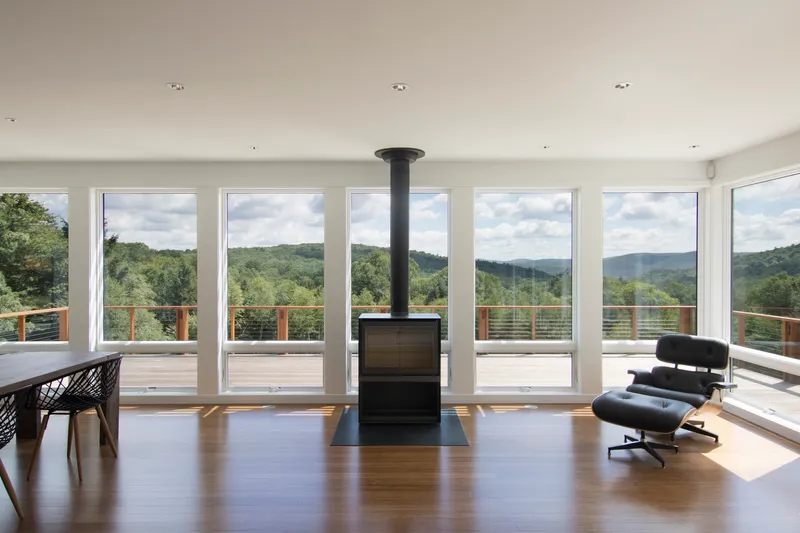

Inside, the communal space combines kitchen, dining, and living zones in a single open volume. A freestanding black stove anchors the living area, its chimney pipe a thin vertical line against the glass wall beyond. Dark bamboo flooring grounds the room, while maple cabinets and black quartz countertops define the kitchen without erecting visual barriers. The palette is limited to three or four materials, all honest, none competing for attention.
The dining area sits directly against the full-height windows, placing the Housatonic Valley's forested hills at eye level over every meal. Resolution: 4 have positioned the glass so the cable railing on the deck reads as a thin horizontal line in the middle distance, a datum that separates foreground timber from background forest. It is a simple compositional trick, but it makes the view feel composed rather than accidental.
Millwork That Does Everything


The bedrooms are where modular discipline becomes genuinely inventive. Each room is lined with a single plywood millwork wall that conceals a murphy bed, integrates shelving, incorporates a work desk, and frames a window seat below deck level. When the bed is stowed, the room is a study. When the bed is pulled down, storage and shelving remain accessible on either side. In 16 feet of width, every inch has been assigned a function.
This is the part of prefab that rarely gets celebrated: the interior joinery that turns a compact module into a room that feels neither cramped nor provisional. The light plywood finish keeps the surfaces bright, and the window at the end of each unit pulls in a garden view that prevents any sense of enclosure. It is bedroom-as-furniture, and it works.
Corner Conditions
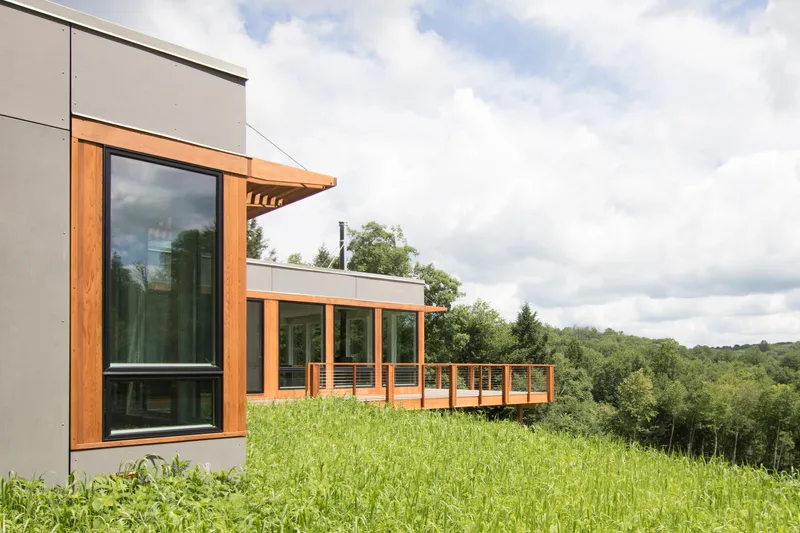

Two images capture the house at its corners, where the module grid meets the landscape most directly. In summer, the timber-framed glazing and cable railing sit against a grassy slope, the house reading as a light pavilion. At twilight, the grey-clad volume glows from within, its rectangular silhouette sharp against the forested hillside. These corners are where the L-plan creates its most dynamic spatial moment: two wings meeting at a right angle, the deck wrapping around the joint, the landscape visible in three directions simultaneously.
Plans and Drawings
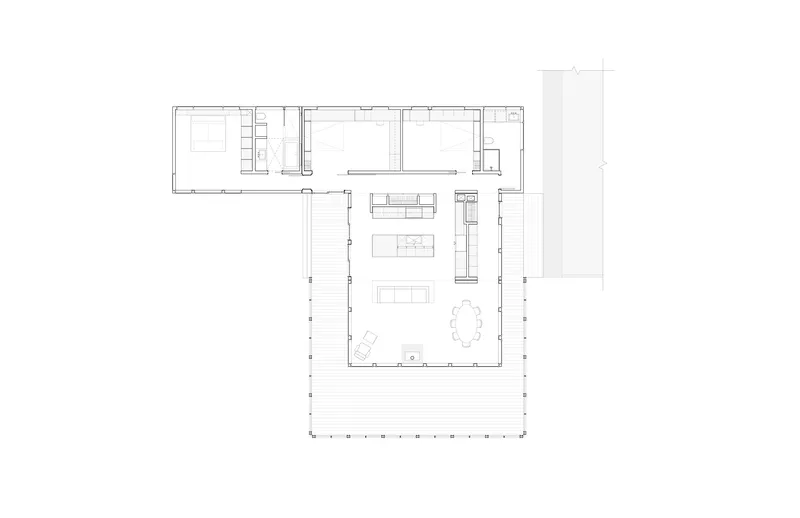
The floor plan confirms what the photographs suggest: the L-shape is not arbitrary. The longer bar holds the private program, bedrooms and baths stacked along a single-loaded corridor. The shorter, wider volume contains the open communal space. The wraparound deck stitches both wings together and extends the usable footprint well beyond the 1,892 square feet of enclosed area. Note how the deck widens at the junction of the two wings, creating an outdoor room scaled for gathering rather than mere circulation.
Why This Project Matters
The Sharon Residence matters because it treats prefabrication as a design method rather than a cost-cutting shortcut. The 16-foot module width is a constraint, and Resolution: 4 Architecture have used it to generate spatial clarity: communal versus private, open versus enclosed, timber versus fibre-cement. Every decision, from the L-shaped plan to the integrated millwork walls, follows from the logic of the module. The result is a house that feels intentional at every scale, from the overall silhouette on its hilltop to the hinge detail on a murphy bed.
For anyone skeptical that factory-built housing can produce architecture rather than product, this project offers a quiet rebuttal. It does not shout about its construction method. It simply sits on a Connecticut hilltop, opens to the valley, and performs exactly as a well-designed weekend house should. That ordinariness, in a prefab context, is the point.
Sharon Residence by Resolution: 4 Architecture. Located in northwest Connecticut, United States. 1,892 sq ft. Completed in 2020.
About the Studio
Share Your Own Work on uni.xyz
If projects like this are the kind of work you want to make, uni.xyz is a place to publish your own, find collaborators, and enter design competitions.


Popular Articles
Popular articles from the community


Lunar Spiral: Space Architecture Shaped by the Mathematics of the Universe
Lunar Spiral reimagines space architecture through Fibonacci geometry, lunar regolith, levitating habitats, and self-sustaining Moon living.

The Ocean Hive: Sustainable Architecture for a Self-Sufficient Civilization at Sea
The Ocean Hive imagines sustainable architecture at sea, where modular habitats, algae, wave power and ocean waste sustain a growing colony.

Play: Fragments of Their World
Familiar architecture becomes modular playground design, creating safe spaces where displaced children can learn, connect, imagine and play.

Co-Life: Senior Housing Design That Reconnects Older Adults With the City
Co-Life reimagines senior housing design through healing gardens, shared streets, workshops, and a sustainable community across generations.

Similar Reads
You might also enjoy these articles

Bao Huynh Watercolor Atelier: A Serene Art Retreat in Hội An
Bao Huynh Watercolor Atelier in Hội An blends multifunctional art spaces, sustainable design, local materials, and family-friendly living in a serene environment.

Atelier Macri Concept Store Interior Design by CASE-REAL
Atelier Macri store features a "ko" counter, walnut wood details, cork displays, blending retail, gallery, and seamless customer experiences.

Manuel Vargas Izquierdo Stadium and High-Performance Sports Center: Architectural Excellence in Jalpa de Méndez
The Manuel Vargas Izquierdo Stadium blends sustainable design, inclusive sports facilities, and cultural-inspired architecture, revitalizing Jalpa de Méndez’s public spaces.

KAKR Buluh Awar Hall: Revitalizing Community and Ecology Through Bamboo Architecture
Community built bamboo hall revitalizes Buluh Awar village, empowering youth, restoring ecology, celebrating vernacular craftsmanship through sustainable architecture and culture.

Explore Residence Competitions
Discover active competitions in this discipline

Challenge to design mud housing for contemporary communities

Challenge to reimagine the Iron Throne

Photograph architecture without architects

Illustrate the lost glory of Angkor Wat - Render Challenge
Comments (0)
Please login or sign up to add comments
No comments yet. Be the first to comment!