
Rever and Drage Architects Turn One Red Norwegian House into Three
A modest timber dwelling in Rælingen, Norway, grows into a trio of gabled volumes linked by courtyards, winter gardens, and an underground passage.


The red wooden house is practically an archetype in Norway. It carries a weight of associations: the forest clearing, the cultivated garden, the modest dwelling against a backdrop of conifers. At Chr. Tomters veg in Rælingen, Rever and Drage Architects have taken that archetype and multiplied it, transforming a single small red house into a composition of three distinct gabled volumes arranged along a narrow site. The result is 450 square meters of domestic space that reads from the street as a small settlement rather than a single residence.
What makes this project genuinely interesting is its refusal to demolish. The original house stays, anchoring the composition both structurally and emotionally. Two new volumes, one to the north and one to the south, frame a pair of courtyards between them: one planted and open to the sky, the other enclosed as a glazed winter garden facing the western forest. Below grade, an underground passageway knits the buildings together. It is a project built on the premise that keeping what exists is itself a design decision, and that expansion can be orchestrated as dialogue rather than replacement.
A Village of Three
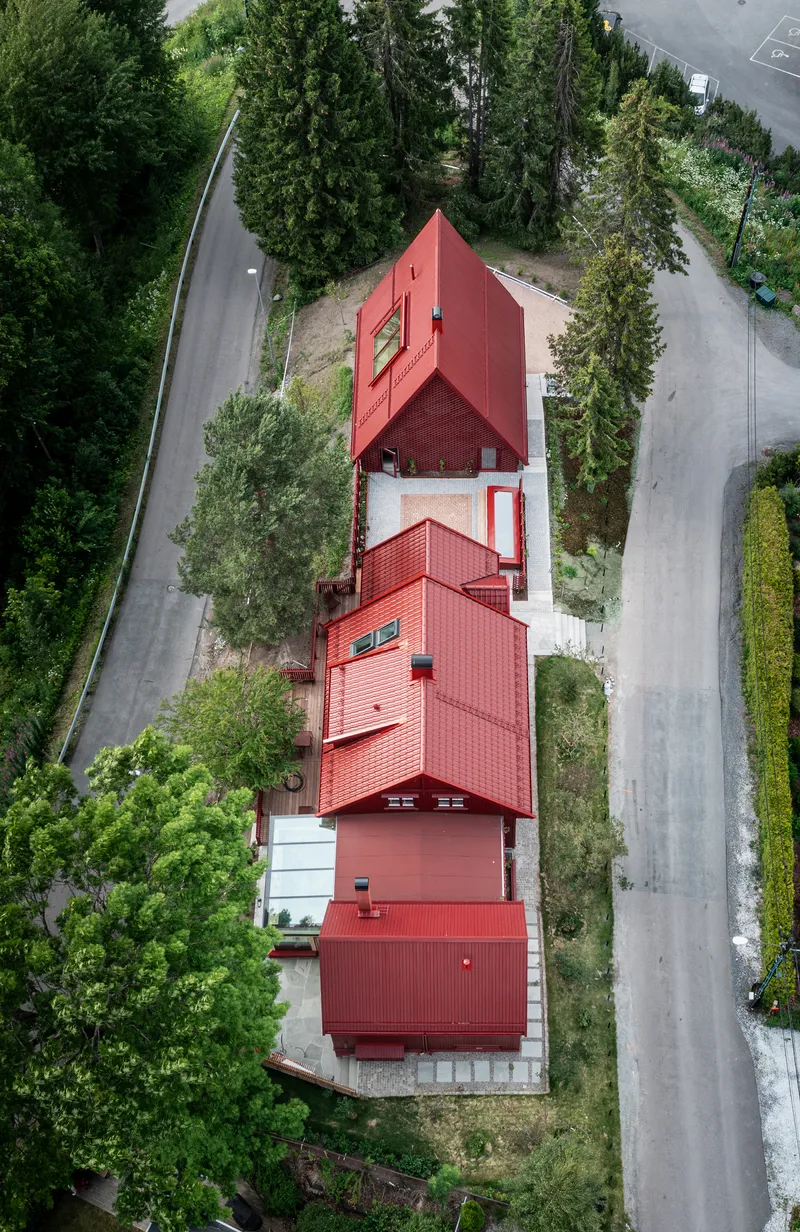
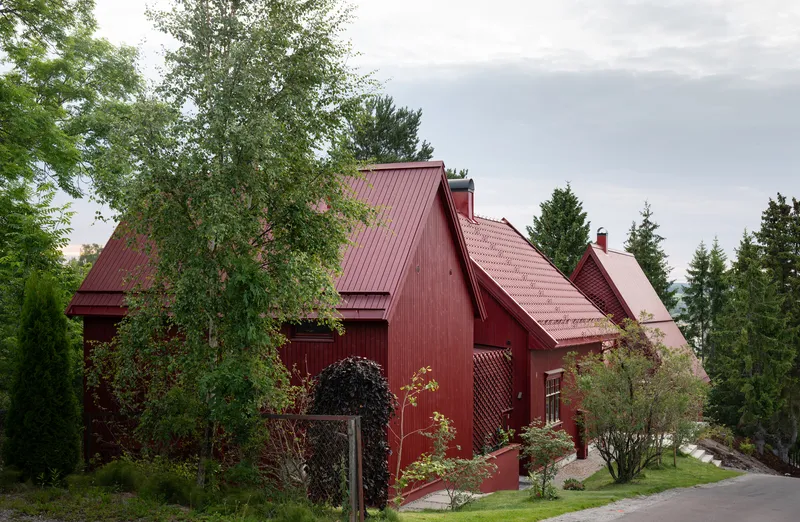
Seen from above, the three red roofs sit in a loose chain among the pines, their corrugated metal surfaces picking up the same deep red as the painted timber walls below. The gabled forms are deliberately similar in pitch and proportion, so the ensemble reads as a family of buildings rather than an original house with additions bolted on. That discipline is crucial. Without it, the project would be a sprawl of extensions. With it, the composition evokes something closer to a Norwegian farmstead, where outbuildings accumulate over generations around a shared yard.
The southern volume holds two storeys of bedrooms, a bathroom, a home office, and a snug. The northern volume stacks a garage and technical spaces at its base, a self-contained rental unit in the middle, and an atelier study under a steeply pitched roof at the top. Each building has its own identity and program, connected to the whole but capable of operating independently. The rental unit is especially pragmatic: a small apartment that justifies the project's ambition while generating income.
Courtyards as Connective Tissue
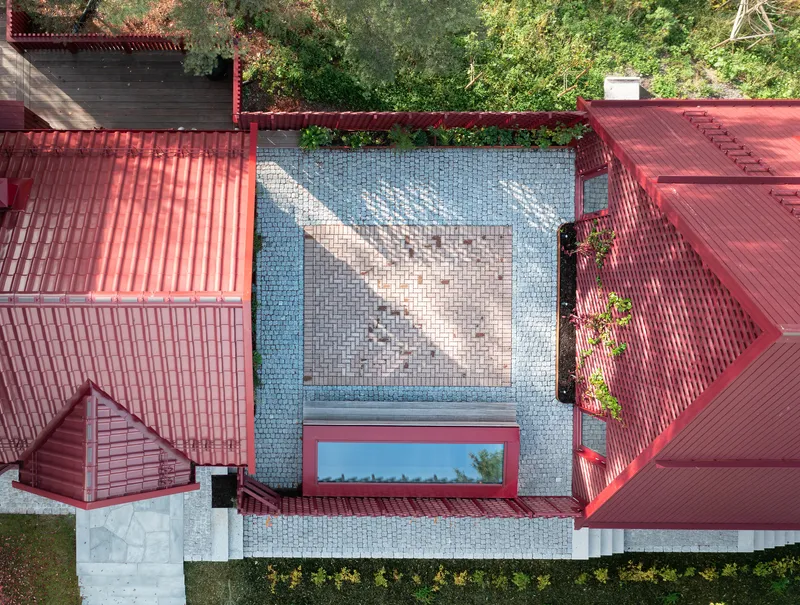
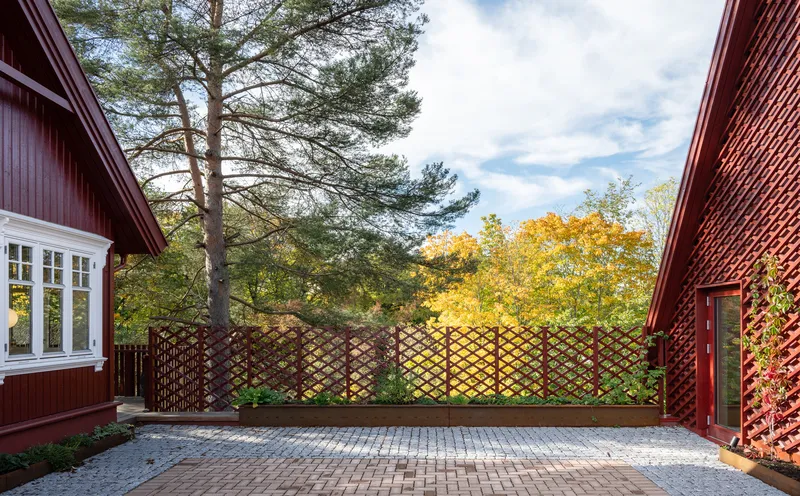
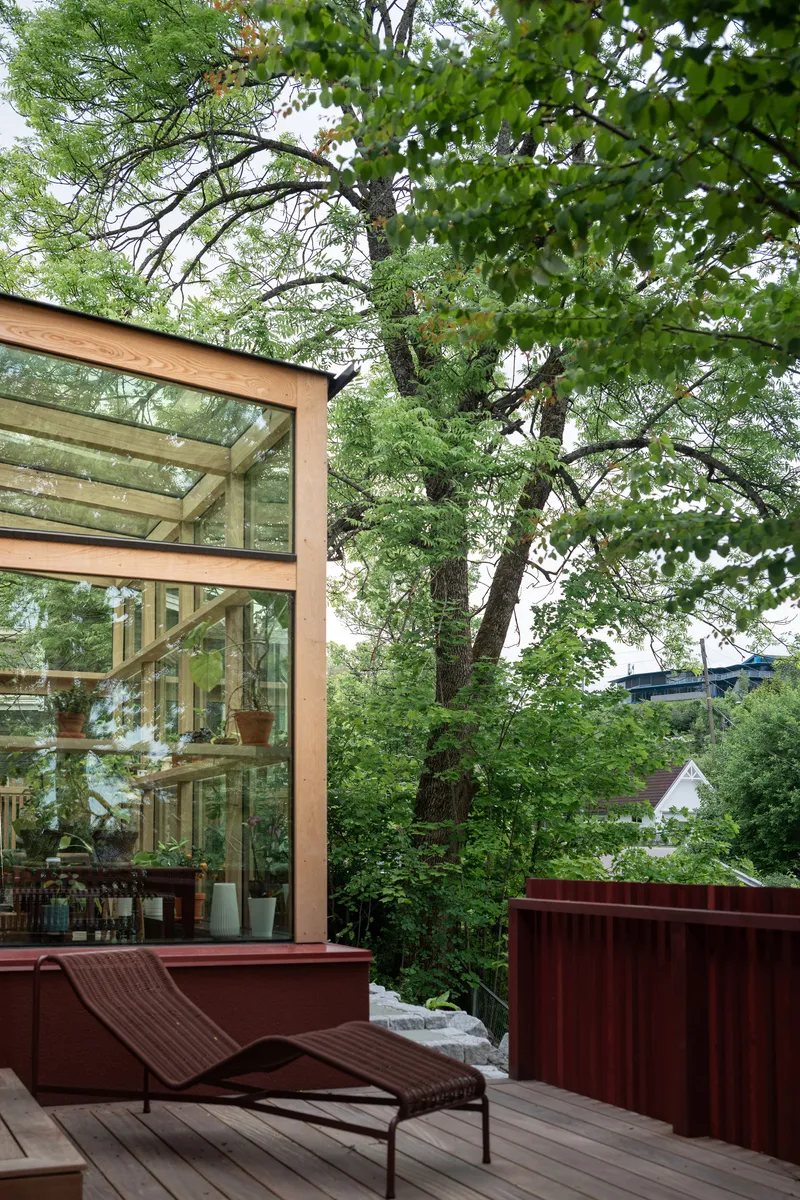
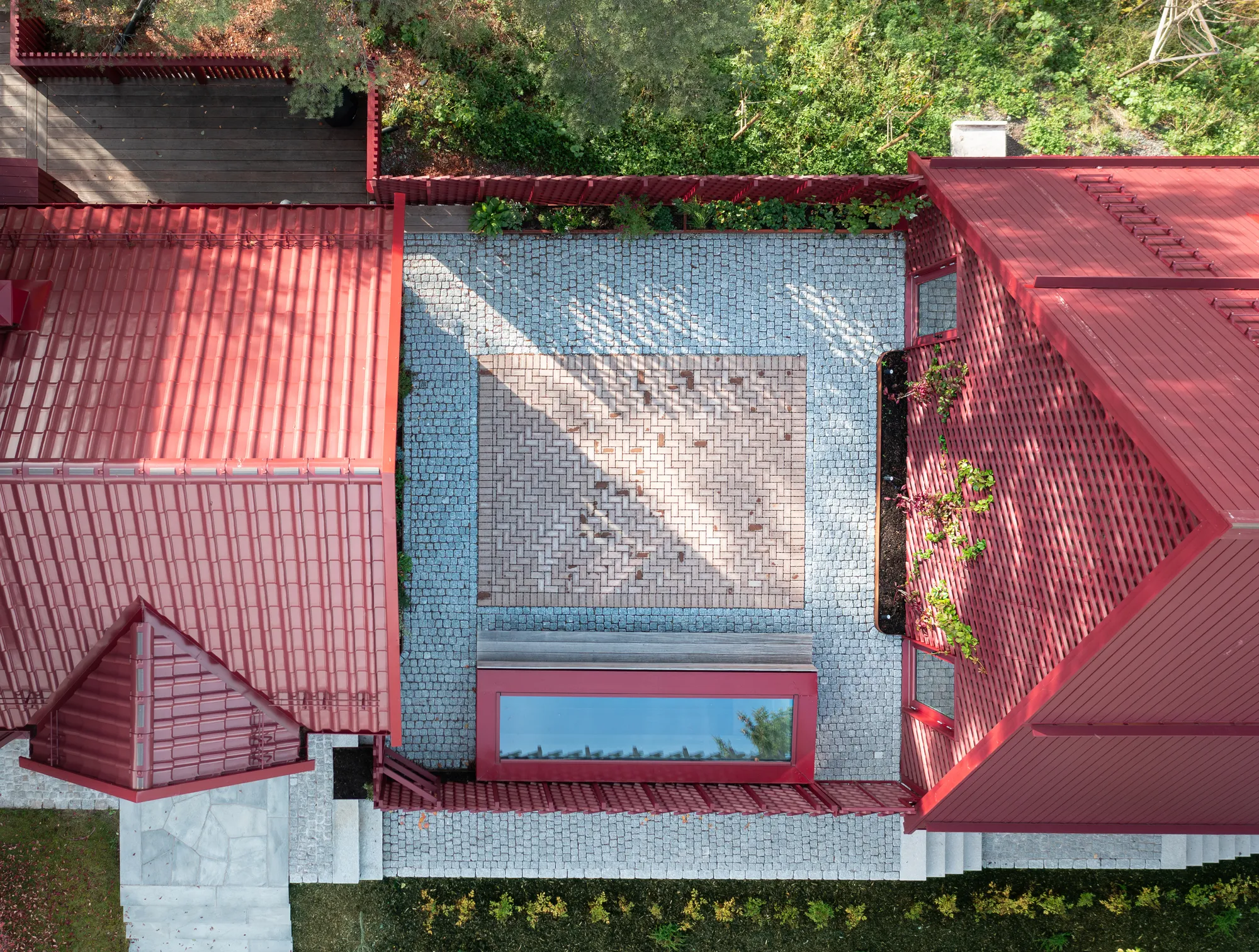
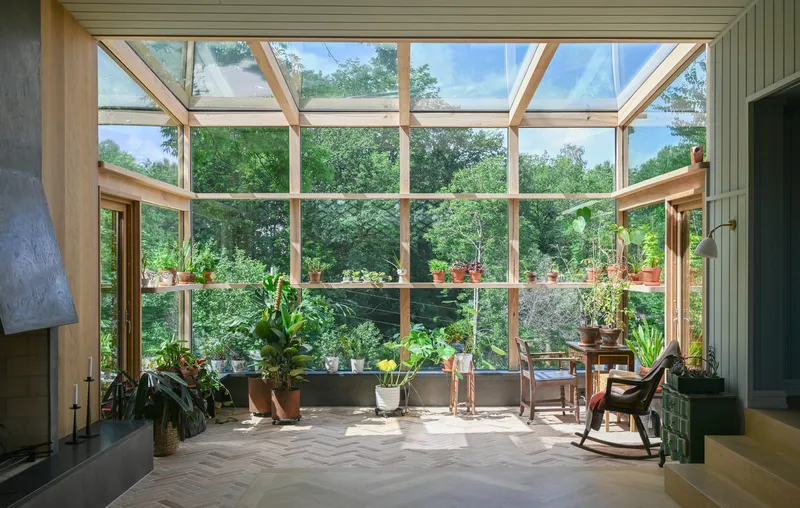
The two courtyards between the buildings are the real protagonists of the plan. The outdoor courtyard, paved in a chevron tile pattern and edged by planted beds, functions as a room without a ceiling. It organizes movement between volumes and brings daylight deep into the plan on both sides. The indoor winter garden, a glazed space filled with shelved plants and warmed by afternoon sun, acts as a transitional zone between the original house and the southern extension. It faces the forest to the west, pulling the landscape into the heart of the home.
This strategy of inserting green voids between built volumes is not new, but it is executed here with real conviction. The courtyards slow you down. They create thresholds that give each room a sense of arrival, preventing the 450 square meters from feeling like a corridor connecting endpoints. The site is long and narrow, wedged between two roads, and without these pauses the plan would feel relentless.
The Lattice and the Forest
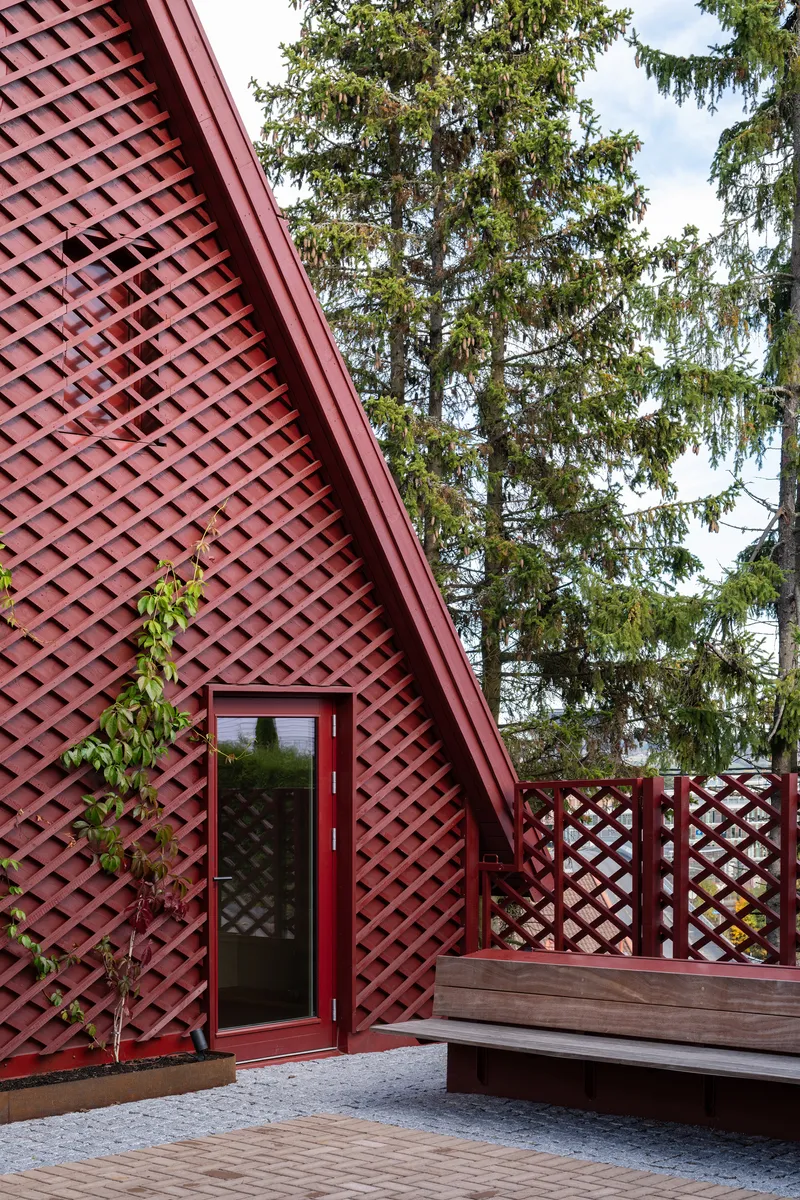
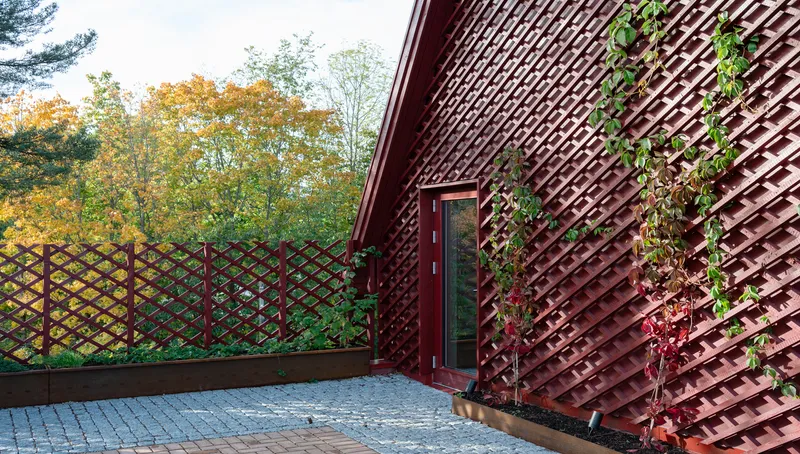
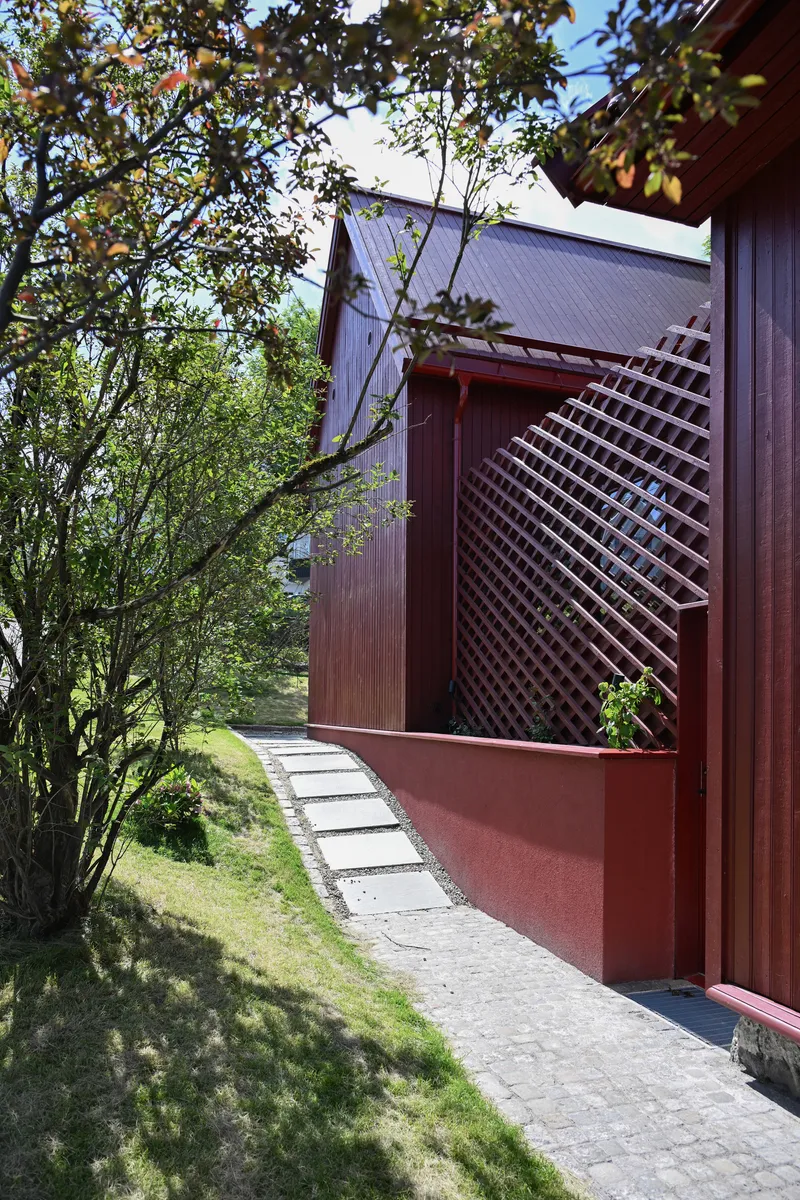
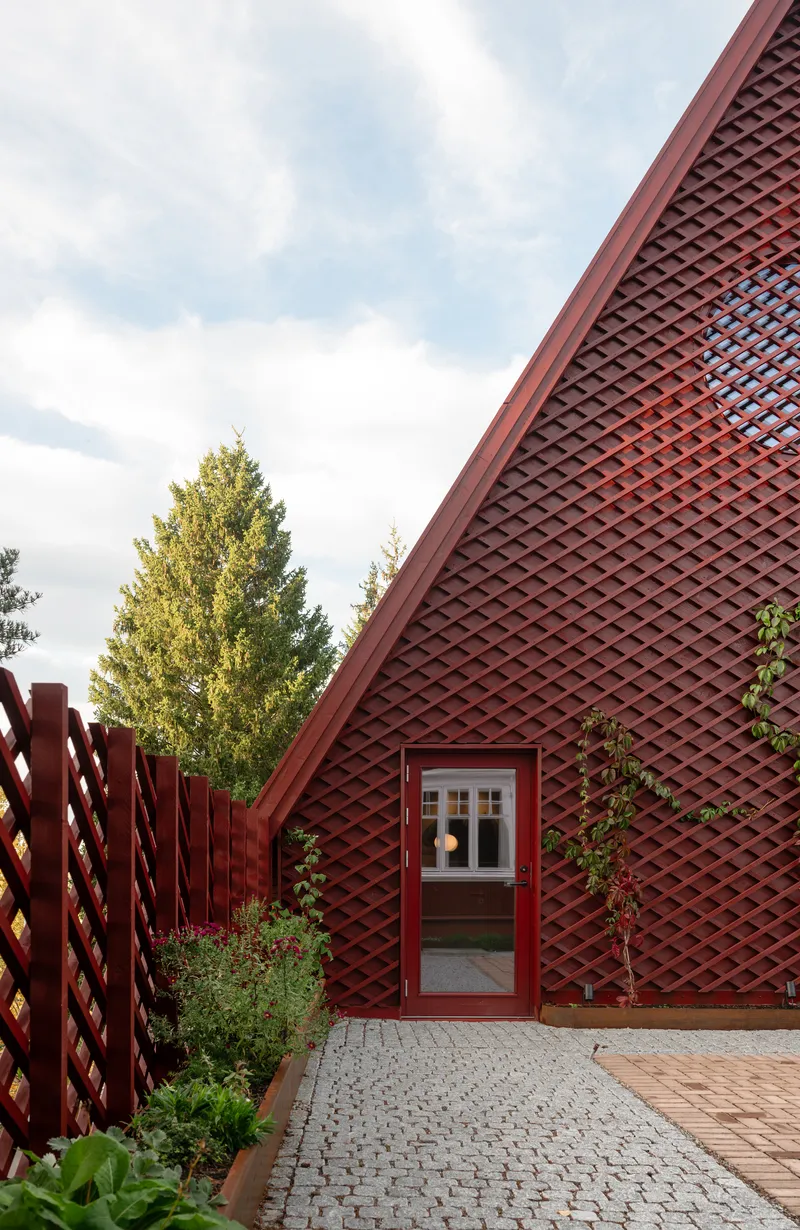
The exterior cladding strategy deserves a close look. Alongside the painted vertical siding and ribbed metal panels, diagonal lattice screens wrap portions of the facades, providing structure for climbing plants. Over time, these surfaces will soften as vines take hold, blurring the boundary between the garden and the building. It is a deliberate nod to seasonal variation: the house will look different in winter, when bare branches expose the underlying timber grid, than in summer, when foliage thickens into a green wall.
The lattice also serves a practical screening function, filtering views and light on the terrace side while maintaining the coherent red identity of the ensemble. Built-in timber benches along the terrace, set against the lattice backdrop, reinforce the sense that the boundary between inside and outside is negotiated rather than fixed.
Ash, Brick, Concrete, Brass
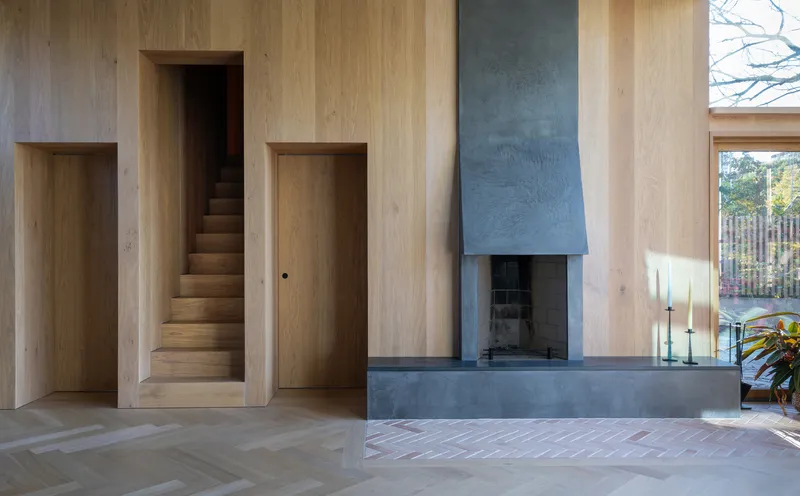
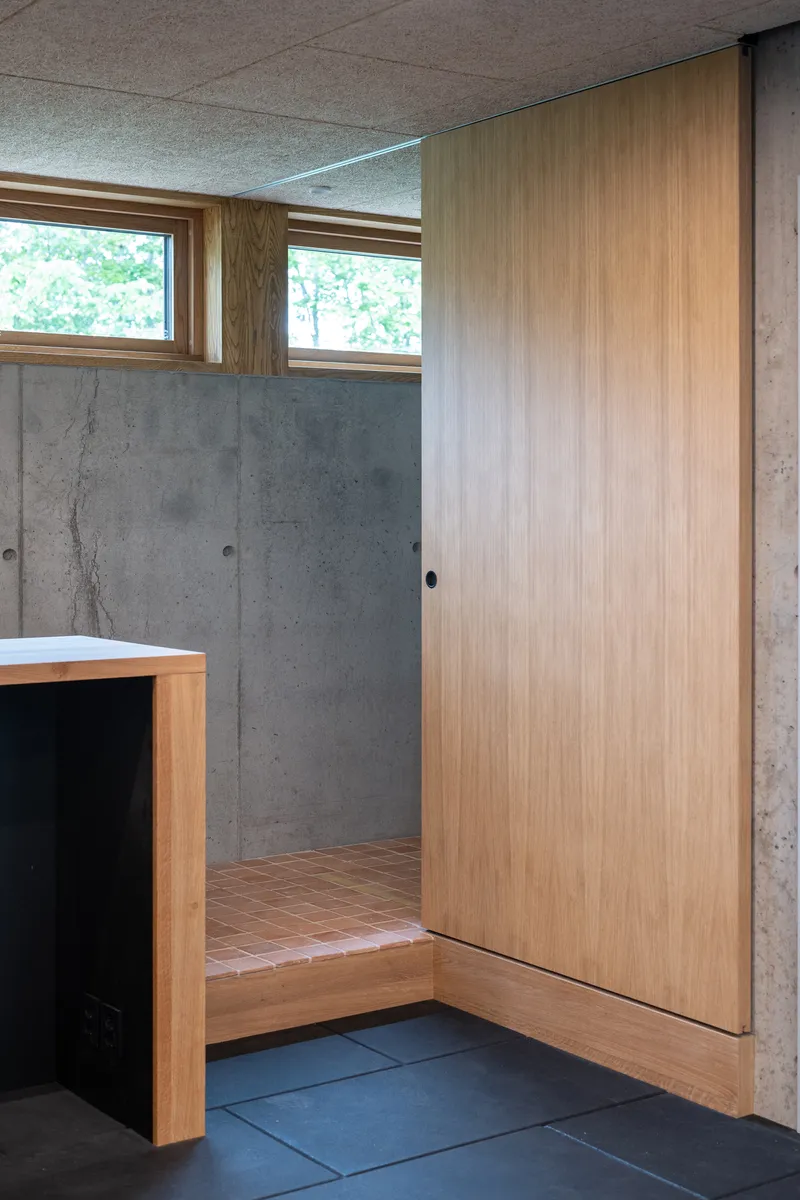
The interior material palette is more varied than the uniform red exterior suggests. Ash wood lines walls, ceilings, and built-in furniture throughout the living spaces, giving them a warm, pale tone that contrasts sharply with the concrete and brick below. A steel fireplace surround anchors one of the key living zones, its dark surface acting as a focal point against the lighter timber. Brass detailing at joints and edges adds a quiet sense of precision without veering into luxury signaling.
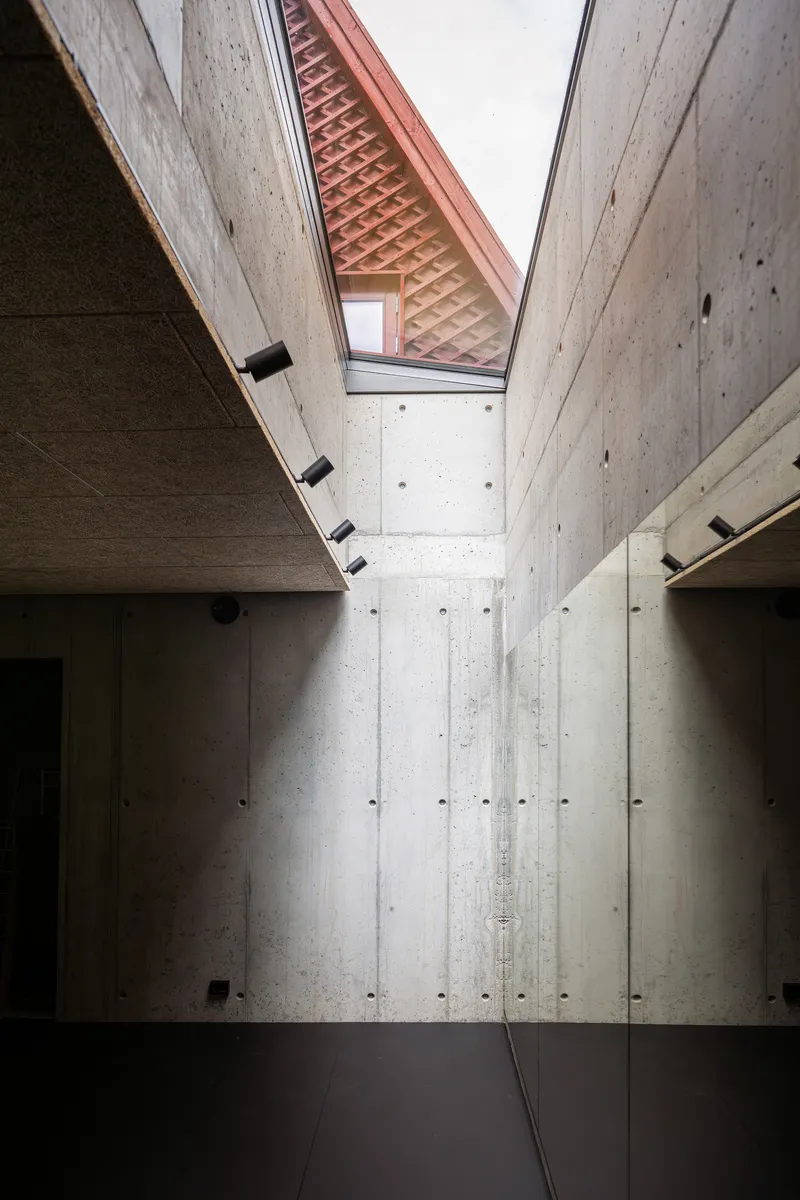
Below grade, the mood shifts entirely. The underground passageway connecting the buildings is rendered in poured concrete with a terracotta brick vault overhead, punctuated by a skylight that prevents it from feeling like a utility tunnel. The material change is deliberate: you know you are moving between worlds, from the domestic warmth of ash-clad rooms into something more infrastructural and raw. It is a surprisingly generous gesture for a passage that could have been merely functional.
Rooms at the Roof
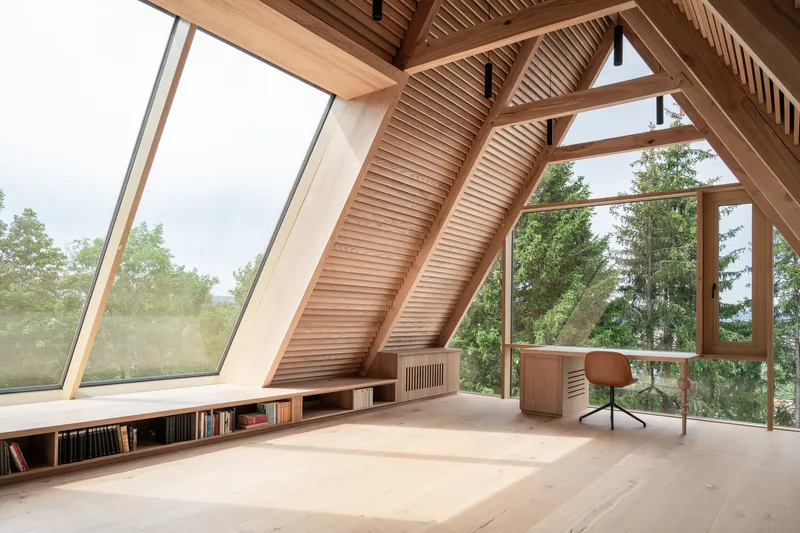
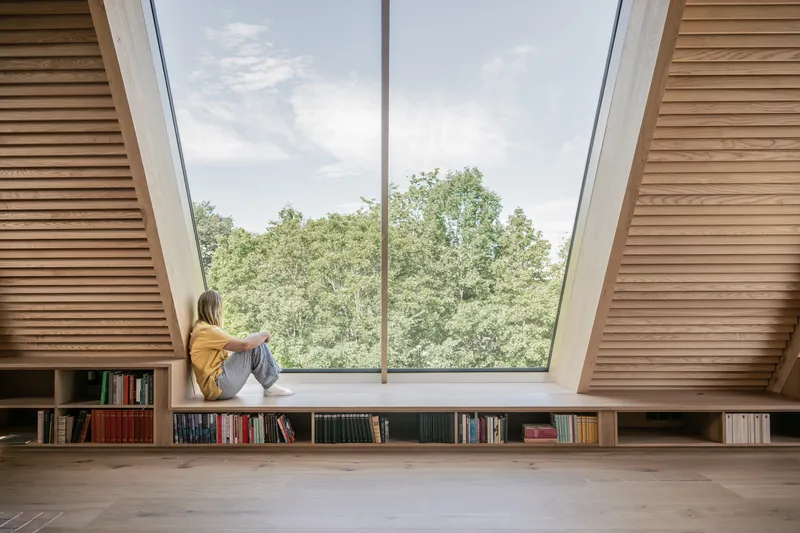
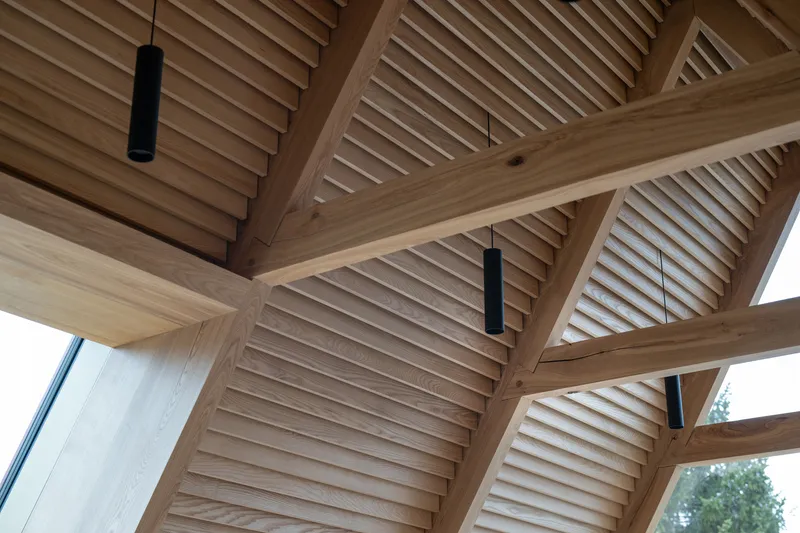
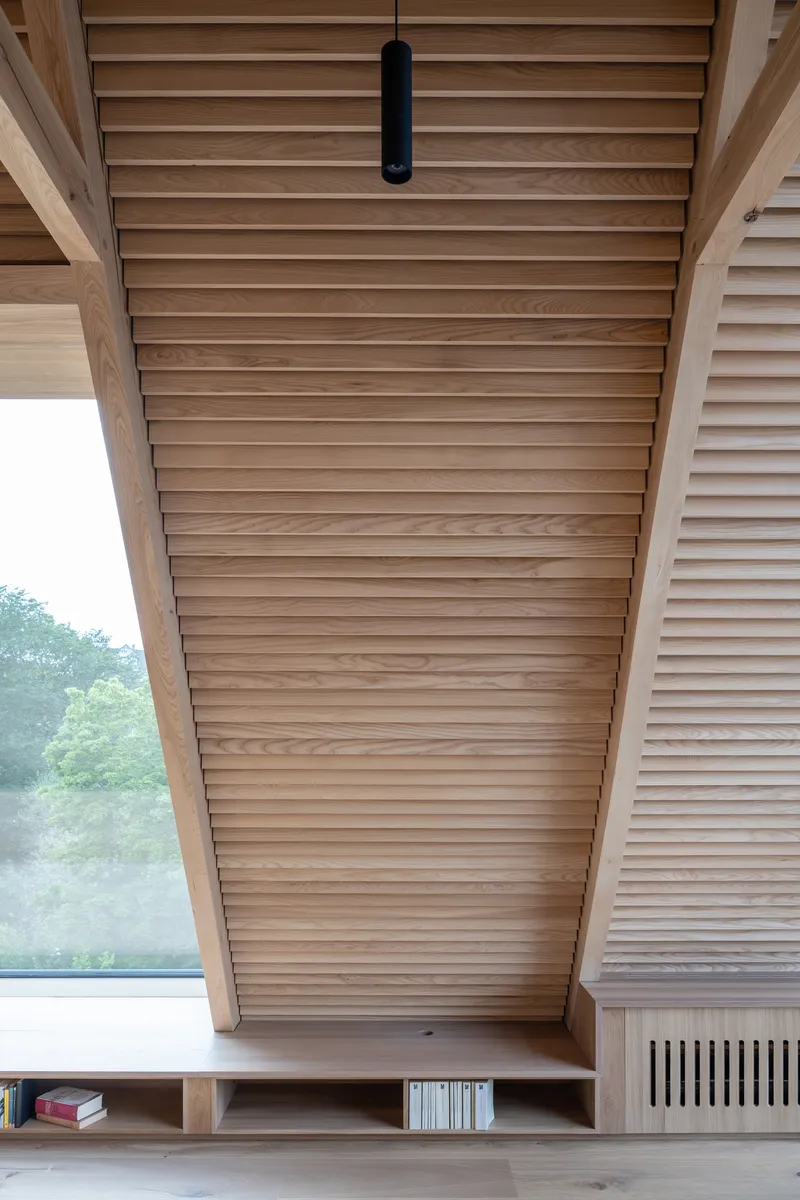
The atelier study under the northern volume's pitched roof is perhaps the most atmospheric space in the house. Exposed timber rafters and horizontal slatted ceiling panels create a rhythmic overhead geometry that channels light from angled glazing and a generous skylight window nook. The space is shaped entirely by the roof form, with no dropped ceilings or plasterboard smoothing out the angles. You sit inside the structure itself.
A window nook with built-in bookshelves turns the skylight into a reading seat, a detail that demonstrates the level of specificity at work here. These are not generic loft conversions. Every surface is considered: the turned timber balustrade with its spherical joint, the circular window with its gridded screen, the way horizontal slats meet at angles where roof planes intersect. The craft is evident but not performative.
Built-in Specificity
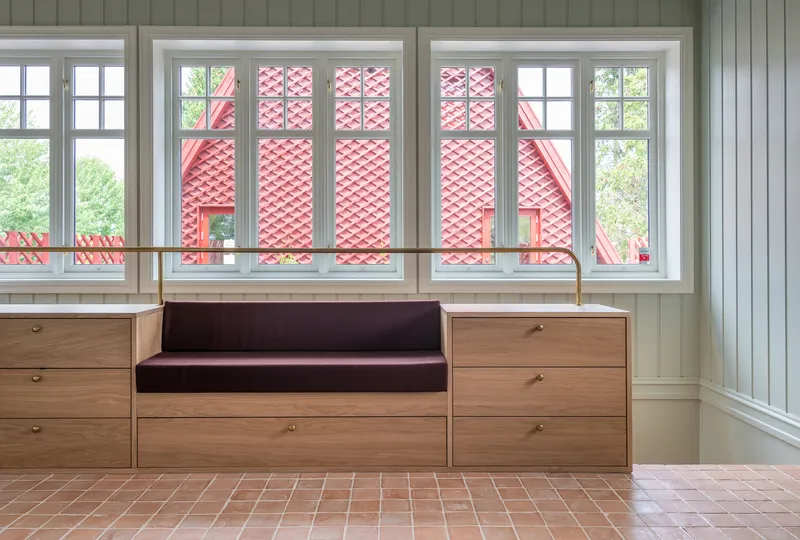
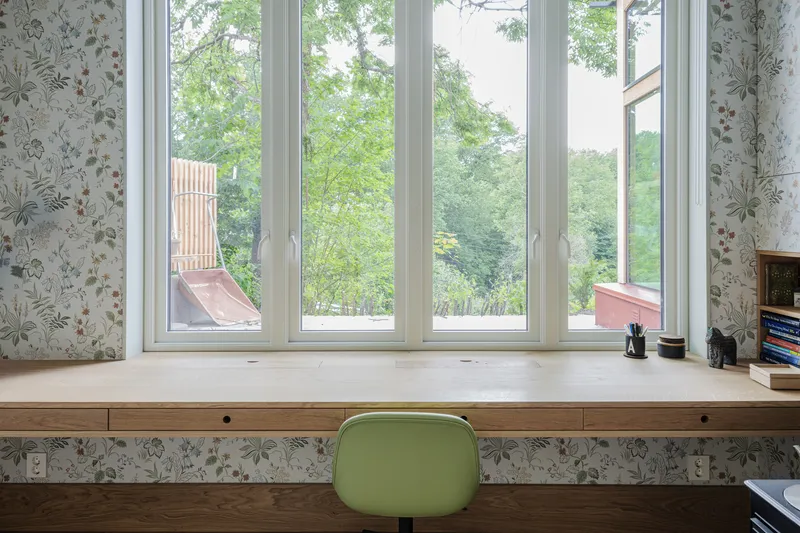
Throughout the house, built-in furniture does significant work. Bench seats with storage drawers below windows, desks integrated into window bays with floral wallpaper backdrops, and reading nooks tucked under sloped ceilings all suggest a design approach where architecture and furnishing were developed simultaneously. This matters because it means the rooms are designed for particular habits and routines, not just assembled from interchangeable parts.
The children's rooms, carved from the original house's former master bedroom, benefit from this approach. Instead of simply subdividing, the architects gave the reclaimed space new purpose through carefully placed built-ins and window seats that make compact rooms feel generous. The original blue door and sections of white window frames from the old house were preserved, a small but telling detail that keeps the history of the original dwelling present in daily life.
Material Details Up Close
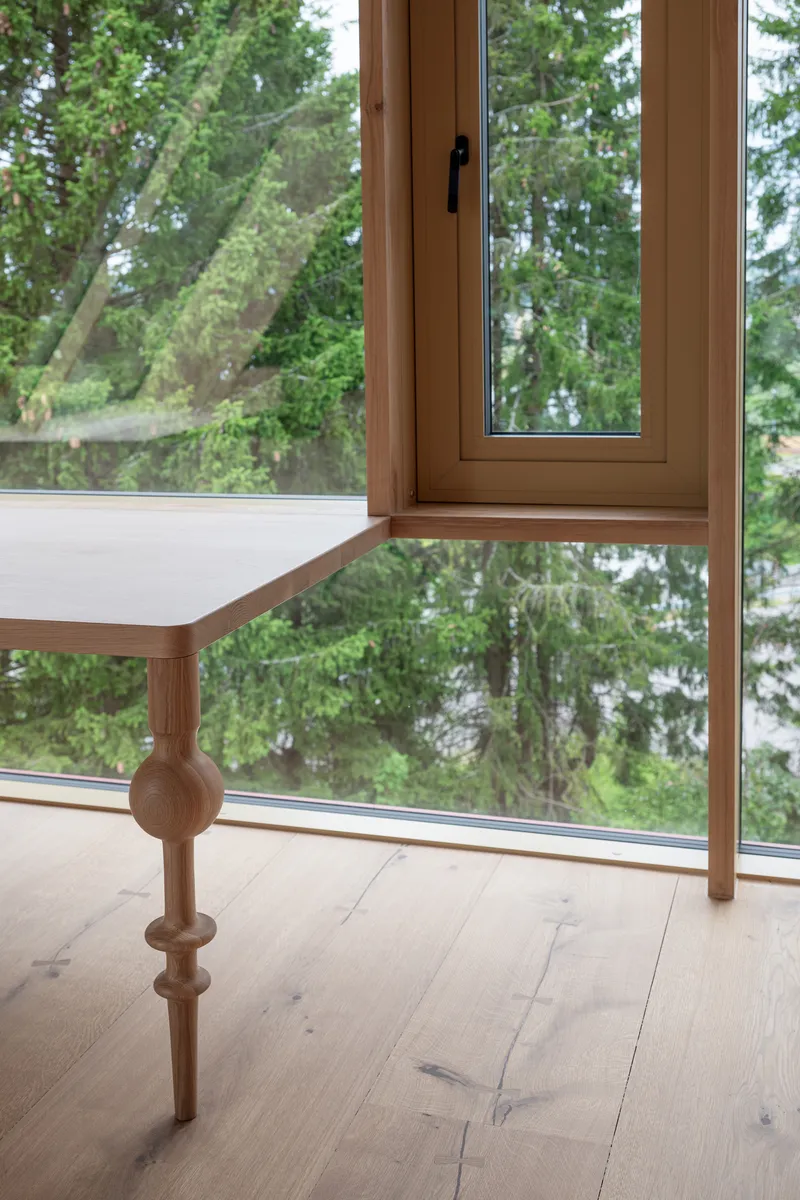
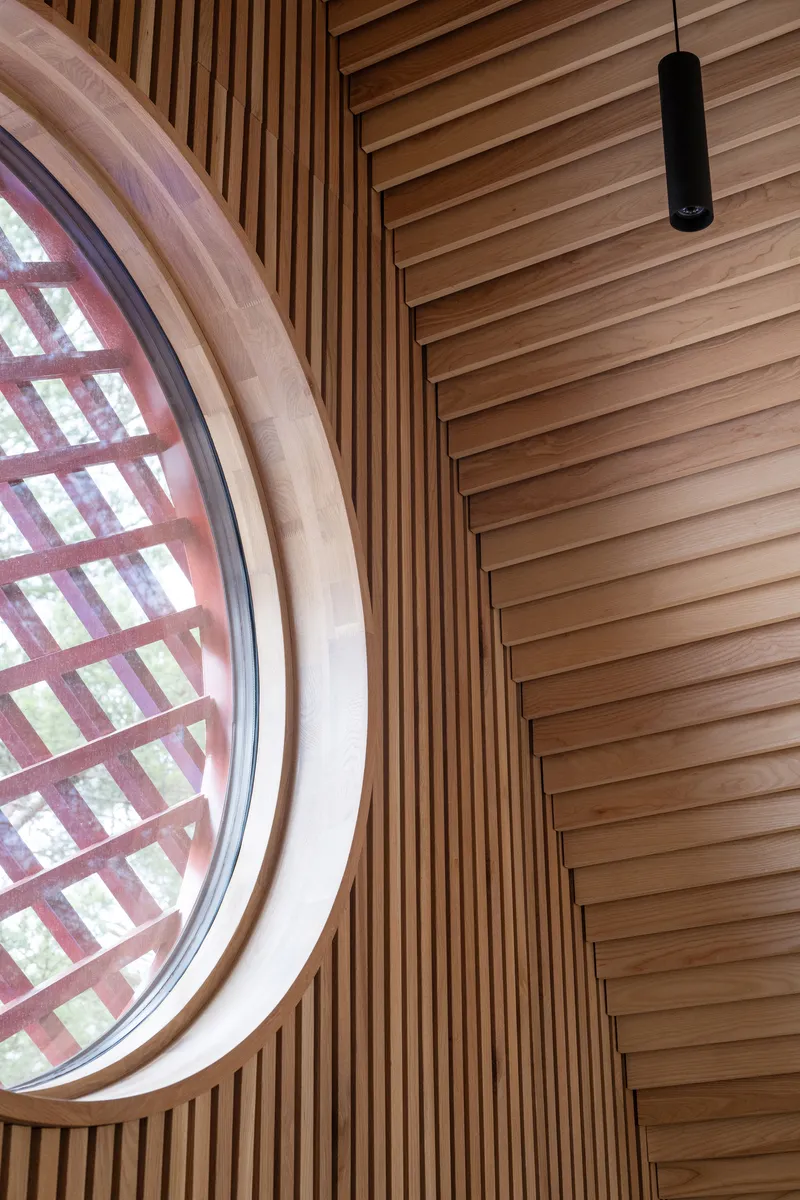
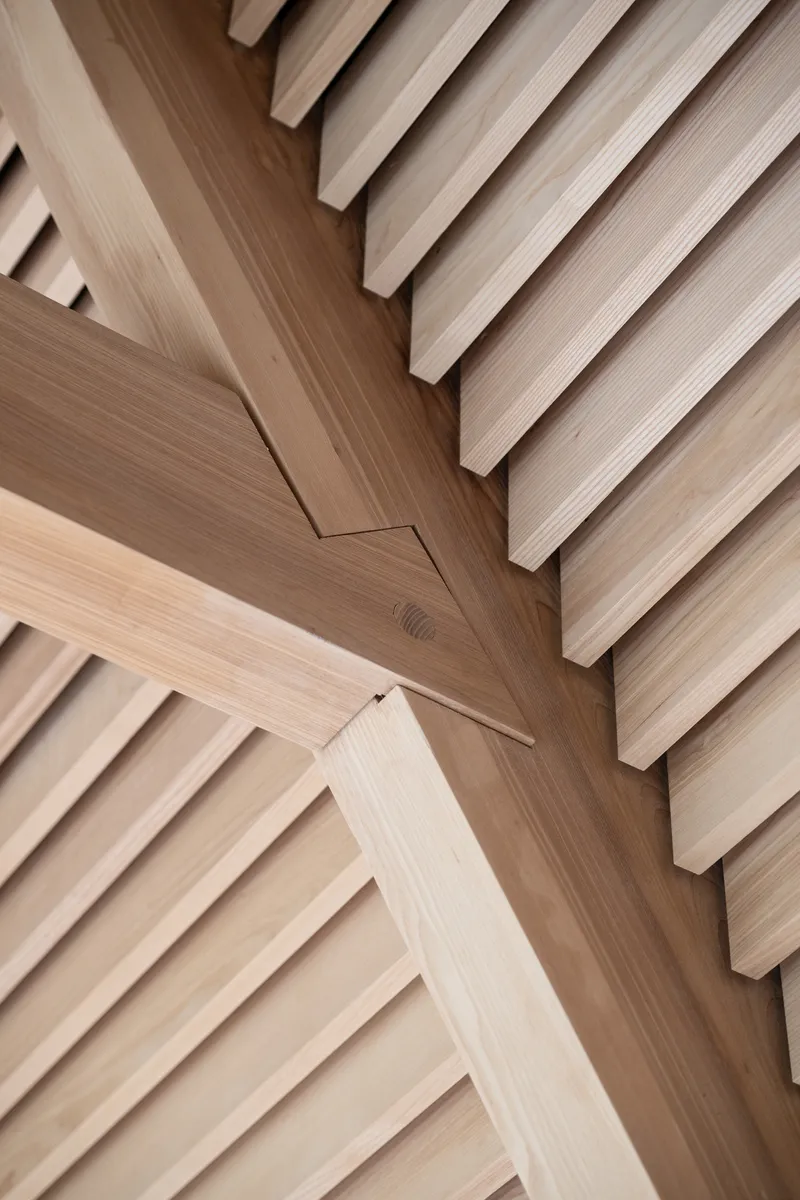
At the detail scale, the project rewards close attention. The turned timber balustrade, with its spherical joinery, sits beside a floor-to-ceiling window that frames the forest like a vertical landscape painting. A circular window punched through a wall of vertical slats creates a focal moment in what could otherwise be a monotonous surface. The intersection of timber beams with horizontal slatted panels is handled with care, the angles meeting cleanly rather than being concealed behind trim.
These are details that speak to a craft tradition still very much alive in Norwegian residential architecture. They also speak to a budget that was spent on material quality and joinery rather than on square footage alone. At 450 square meters, the house is not small, but its richness comes from how it is made rather than how much of it there is.
Plans and Drawings
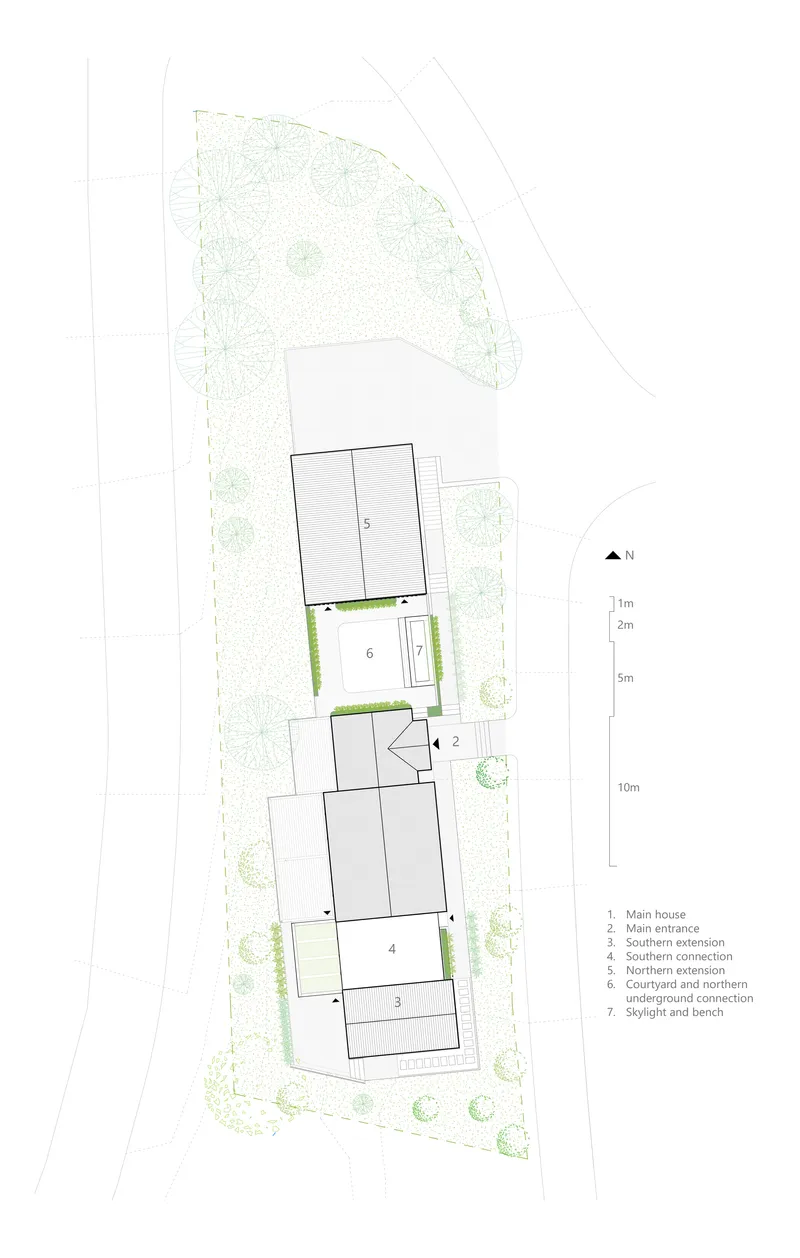
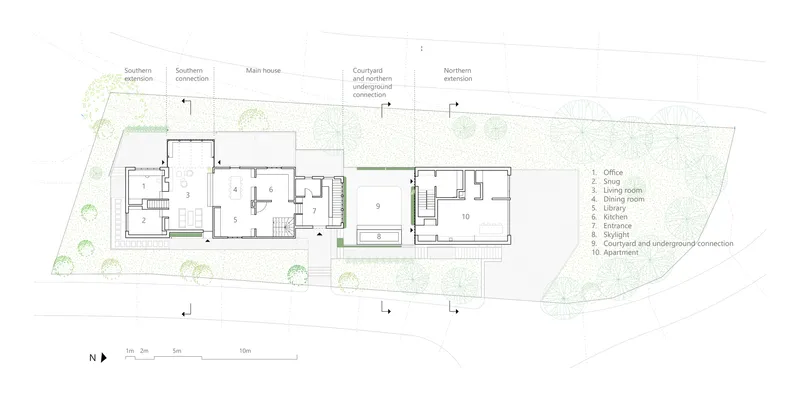
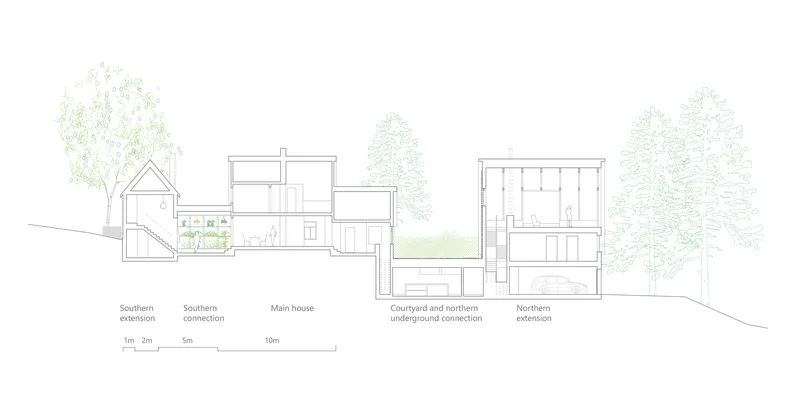
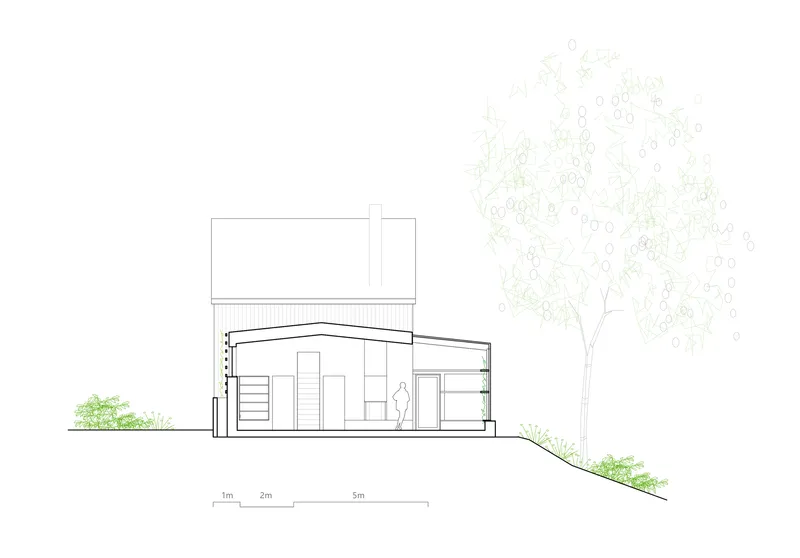
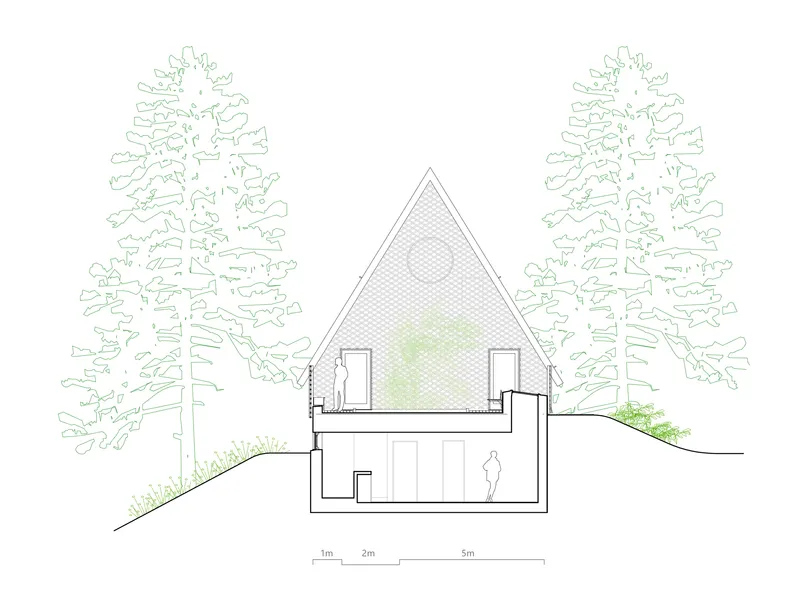
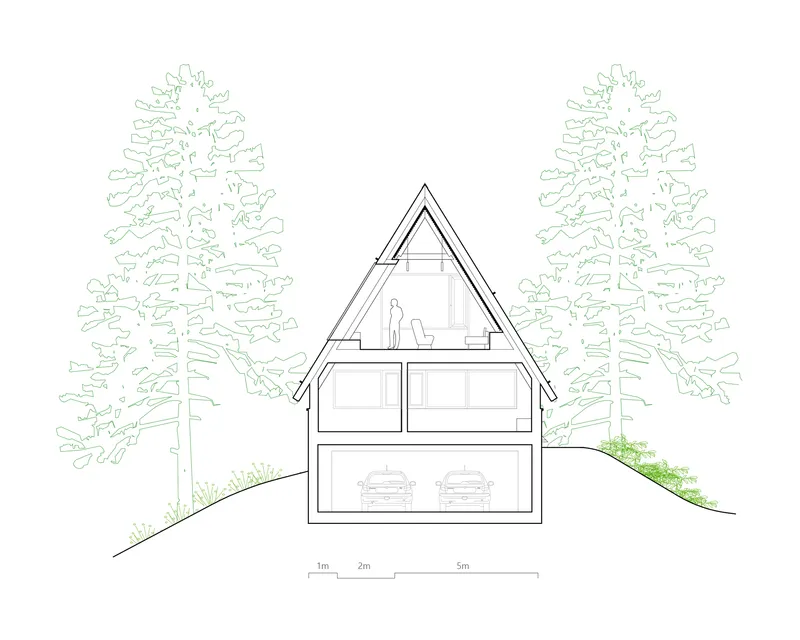
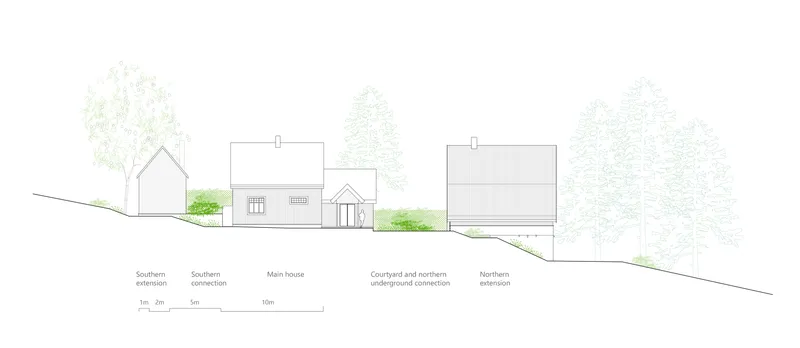
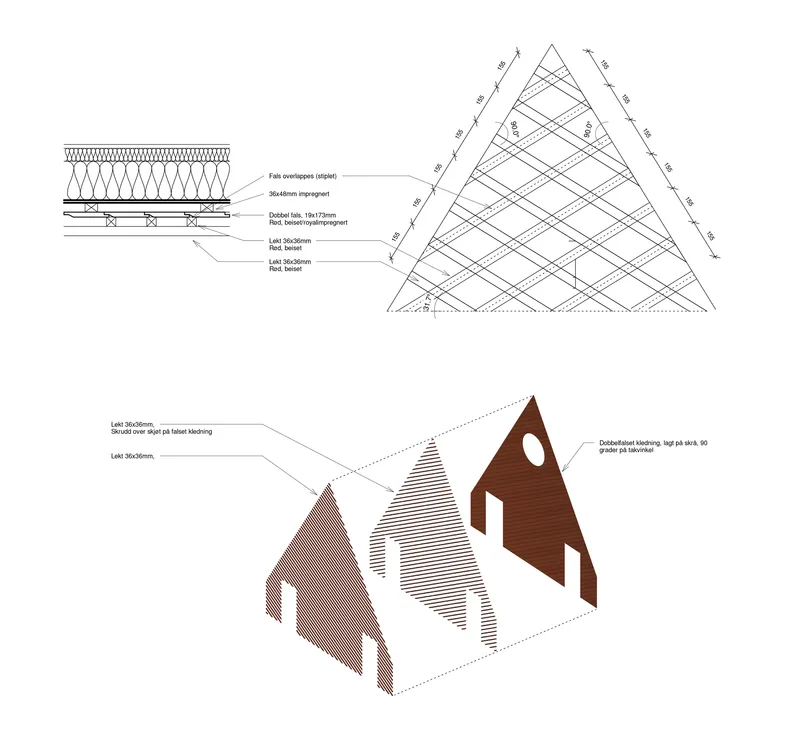
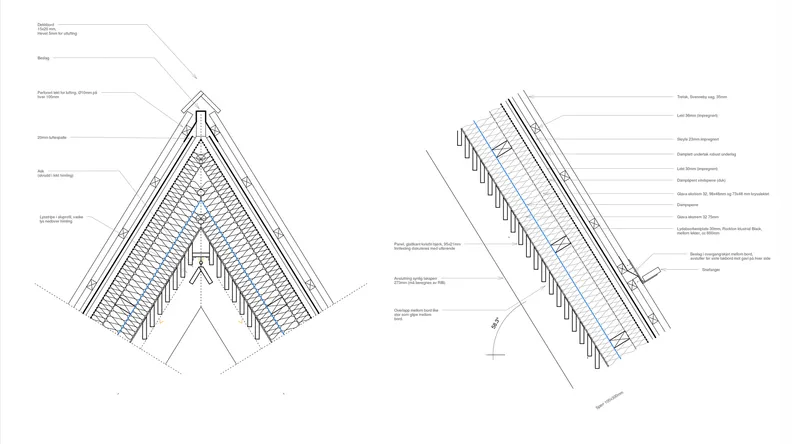
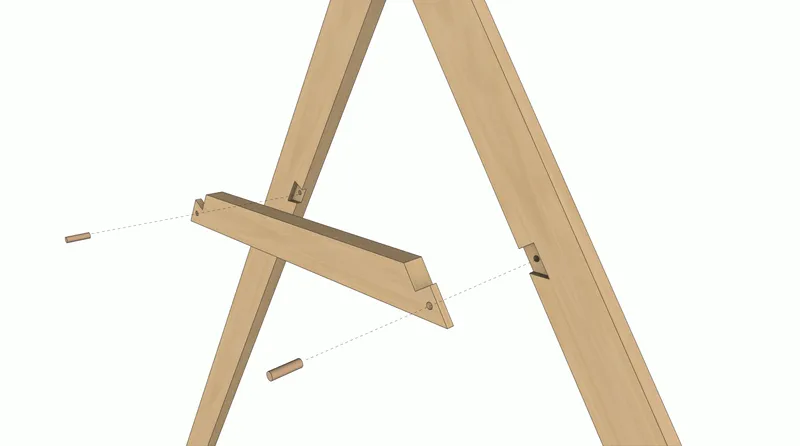
The site plan and floor plans make the three-volume strategy legible at a glance: three buildings, two courtyards, one underground link. The sections reveal how the site's topography is exploited rather than flattened, with the northern volume stepping down the slope to accommodate the garage at its base and the atelier at its crown. The detail drawings, particularly the axonometric of the timber beam joinery with dowel connections and the exploded cladding assembly, show a project where the construction logic was designed with the same care as the spatial concept.
The elevation drawing is worth studying for how it communicates the underground passage as a dotted line beneath the courtyards, a hidden infrastructure that binds the three houses into one. The technical sections of the ridge and eave construction document a roof assembly where every layer has been considered for thermal performance, weather resistance, and visual coherence with the red corrugated metal surface above.
Why This Project Matters
The most significant decision in this project was made before any pencil hit paper: keep the original house. In a market that routinely demolishes modest dwellings and replaces them with larger ones, choosing retention as a starting point is both an environmental and a cultural statement. The embodied carbon in the existing timber walls, the memory embedded in its blue door and white window frames, the romantic vernacular proportions that anchor the composition: all of these are preserved and amplified rather than erased. The new volumes do not compete with the old house. They defer to it while pushing the overall ensemble toward something far more ambitious.
Rever and Drage Architects have produced a house that operates at multiple scales simultaneously. From the street, it is a cluster of red gabled forms that could have accumulated over a century. From the courtyard, it is a carefully choreographed sequence of indoor and outdoor rooms. At the detail level, it is a showcase of timber craft and material specificity. The project demonstrates that domestic expansion does not have to mean erasure, and that the most interesting architectural moves often come from working with constraints rather than against them.
Chr. Tomters veg house, designed by Rever and Drage Architects. Located in Rælingen, Norway. 450 m². Completed in 2025. Photography by Tom Auger.
About the Studio
Share Your Own Work on uni.xyz
If projects like this are the kind of work you want to make, uni.xyz is a place to publish your own, find collaborators, and enter design competitions.



Popular Articles
Popular articles from the community


Co-Life: Senior Housing Design That Reconnects Older Adults With the City
Co-Life reimagines senior housing design through healing gardens, shared streets, workshops, and a sustainable community across generations.

The Ocean Hive: Sustainable Architecture for a Self-Sufficient Civilization at Sea
The Ocean Hive imagines sustainable architecture at sea, where modular habitats, algae, wave power and ocean waste sustain a growing colony.

Conexión: Biophilic Design Reimagines High-Rise Living in Hong Kong
Conexión reimagines high-rise living in Hong Kong through biophilic design, green facades, shared spaces, daylight, water and nature within.

Lunar Spiral: Space Architecture Shaped by the Mathematics of the Universe
Lunar Spiral reimagines space architecture through Fibonacci geometry, lunar regolith, levitating habitats, and self-sustaining Moon living.


Similar Reads
You might also enjoy these articles

Bao Huynh Watercolor Atelier: A Serene Art Retreat in Hội An
Bao Huynh Watercolor Atelier in Hội An blends multifunctional art spaces, sustainable design, local materials, and family-friendly living in a serene environment.

Atelier Macri Concept Store Interior Design by CASE-REAL
Atelier Macri store features a "ko" counter, walnut wood details, cork displays, blending retail, gallery, and seamless customer experiences.

Manuel Vargas Izquierdo Stadium and High-Performance Sports Center: Architectural Excellence in Jalpa de Méndez
The Manuel Vargas Izquierdo Stadium blends sustainable design, inclusive sports facilities, and cultural-inspired architecture, revitalizing Jalpa de Méndez’s public spaces.

KAKR Buluh Awar Hall: Revitalizing Community and Ecology Through Bamboo Architecture
Community built bamboo hall revitalizes Buluh Awar village, empowering youth, restoring ecology, celebrating vernacular craftsmanship through sustainable architecture and culture.




Comments (0)
Please login or sign up to add comments
No comments yet. Be the first to comment!