

VR Chic(k): Bamboo Arenas Under Bangkok's Highways Revive Cockfighting Through VR
A winning entry reimagines neglected highway underpasses as woven bamboo pavilions where Thai tradition meets virtual reality holograms.


Beneath the roaring concrete of elevated highways lies some of the most consistently wasted real estate in any city. VR Chic(k) takes that dead zone and turns it into something startling: a series of woven bamboo dome pavilions that host holographic cockfights, preserving a deeply rooted Thai cultural tradition while eliminating the animals entirely. The project refuses the false choice between heritage and ethics, proposing instead that virtual reality can carry the spectacle, the community gathering, and the competitive energy of traditional chicken fighting without a single living bird.
Designed by Boontita Boonsusakul, this concept won The Digital Colosseum 2020 competition, which asked entrants to rethink the arena typology for a digital age. The site sits under a highway interchange in Thailand, where informal settlements and neglected ground-level spaces persist in the shadow of massive infrastructure. Rather than proposing new construction that adds to urban congestion, VR Chic(k) occupies what already exists but goes unused, reclaiming it as civic and cultural space.
From Neglected Underpass to Gathering Ground
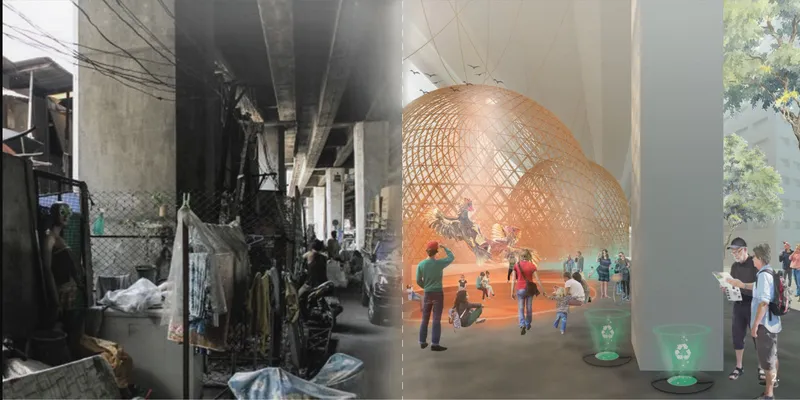
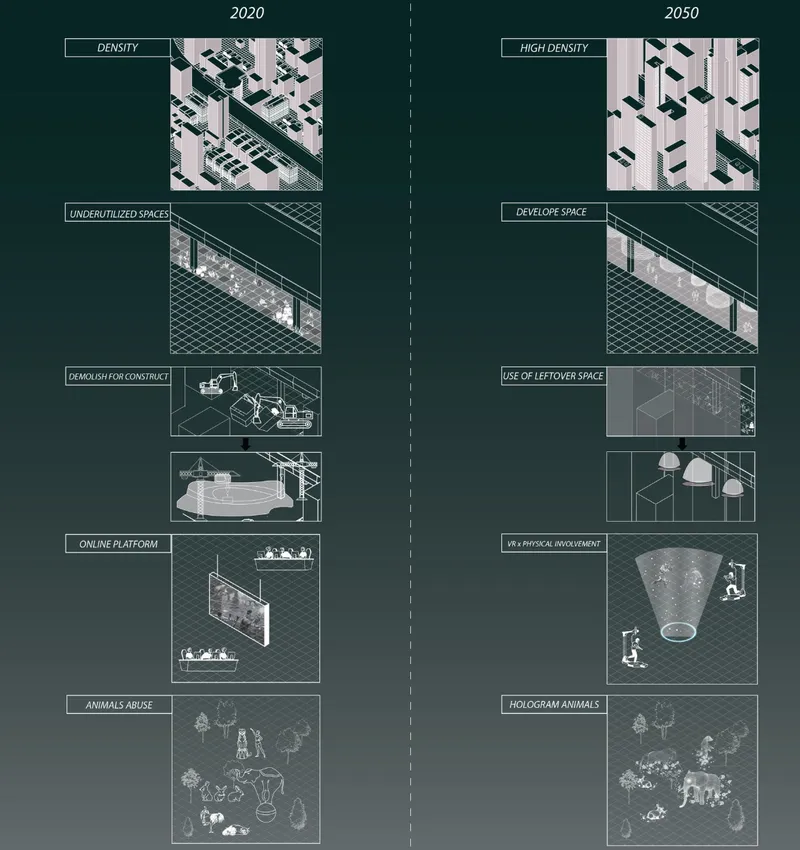
The split rendering tells the story immediately: on one side, the grim reality of a highway underpass defined by informal occupation and residual space; on the other, a lush intervention of interlocking bamboo pavilions where people actually want to be. The transformation is not cosmetic. It rethinks the relationship between overhead infrastructure and the ground plane, treating the highway columns as a pre-existing structural grid that defines where the new pavilions can sit. The diagram of urban density scenarios reinforces the argument: in a city projected to grow denser, new buildings are not the answer. Activating the gaps is.
Reading the Site: Infrastructure as Opportunity
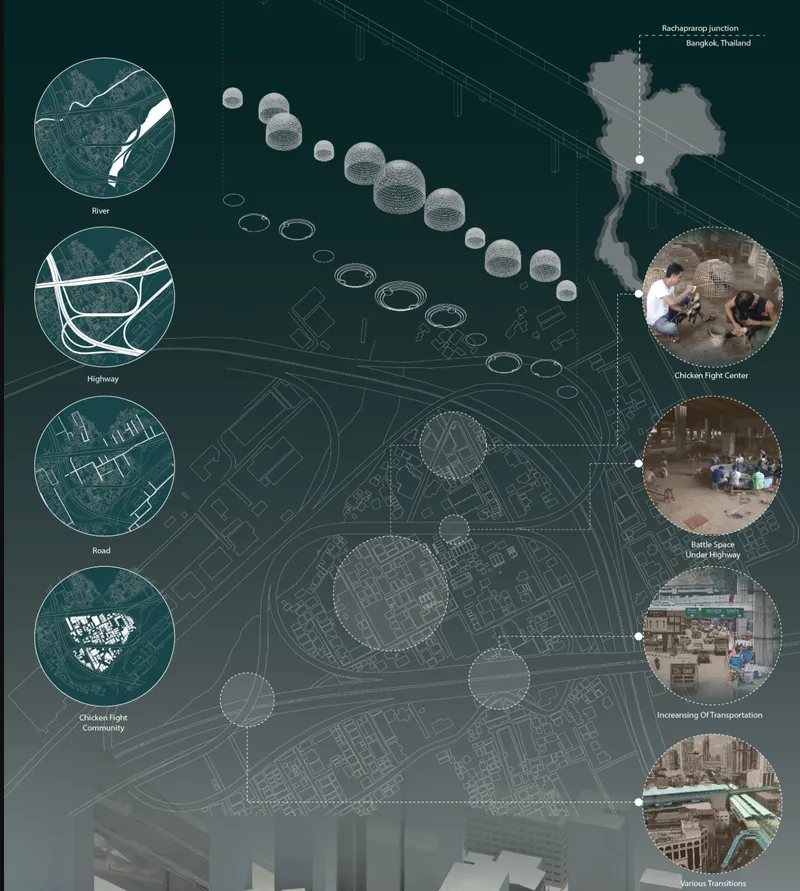
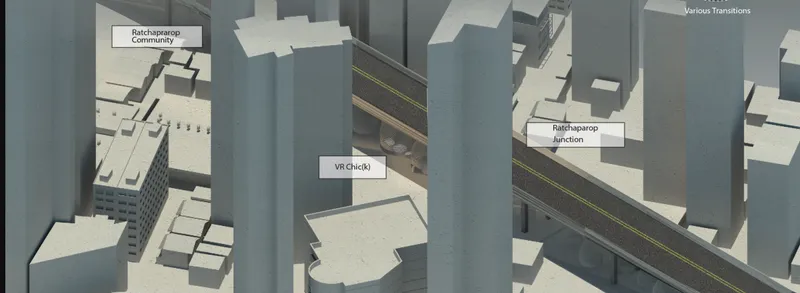
The site plan uses circular callouts to connect infrastructure elements to photographs of existing community activities, grounding the design in observed social patterns rather than abstract theory. People already gather under these highways, selling food, socializing, parking. VR Chic(k) formalizes those behaviors and gives them architecture. The axonometric drawing of the elevated highway intersection maps the surrounding urban districts and transportation networks, making clear that this is not a remote site but a highly connected node. The pavilions would be accessible from multiple directions, embedded in the daily routes of the surrounding population.
Woven Bamboo Domes Against Raw Concrete
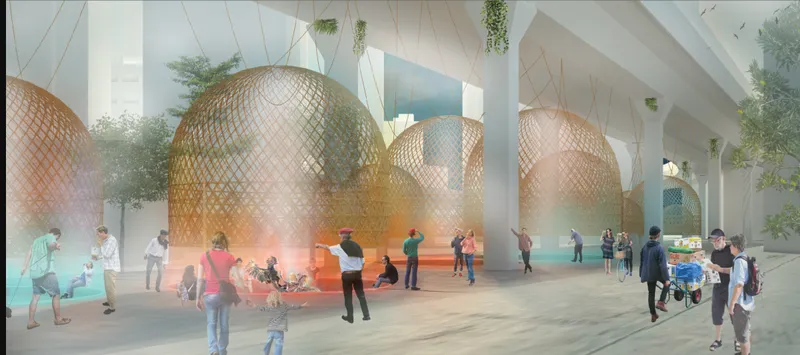
The interior perspective is the project's most compelling image. Woven bamboo domes rise between thick concrete highway columns, their organic geometry a deliberate counterpoint to the brutalist infrastructure overhead. Hanging plants soften the transition between structure and atmosphere, and the bamboo weave filters light in ways that shift throughout the day. People occupy the space casually, watching, talking, moving through. The material choice matters: bamboo is locally sourced, sustainable, and fast-growing, which means these pavilions could be constructed, maintained, and eventually replaced with minimal environmental cost. The contrast between the permanence of concrete and the lightness of bamboo becomes an architectural statement about how cities should layer temporary cultural programmes onto permanent infrastructure.
Construction Logic: How the Domes Come Together
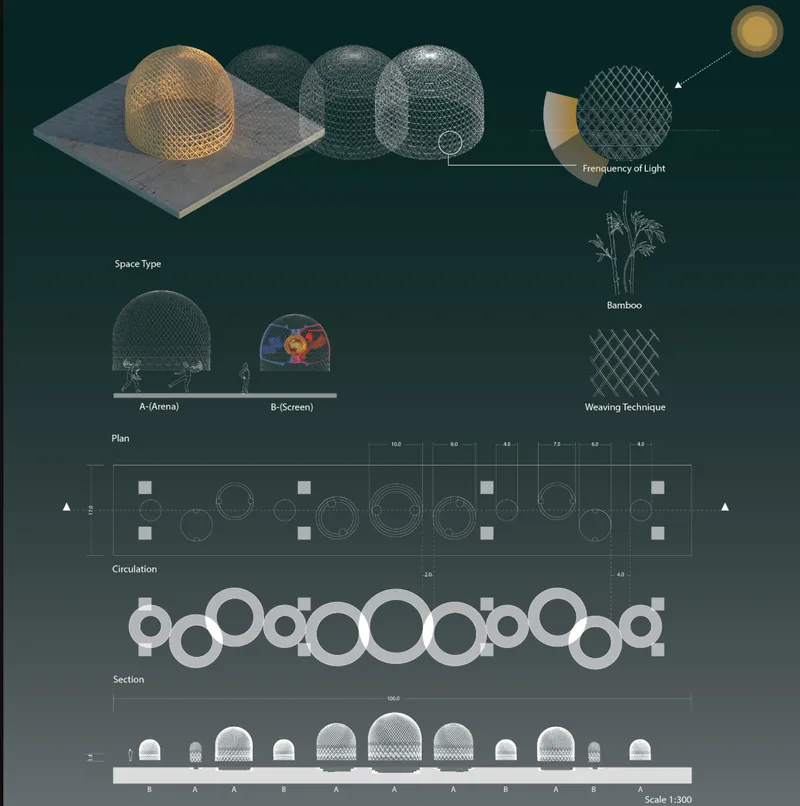
The technical drawing sheet strips the pavilion down to its components: plan, section, elevation, and material specifications. The dome geometry is legible and buildable, relying on interlocking bamboo members that form a self-supporting shell. This is not parametric fantasy; the construction details suggest a structure that local craftspeople could assemble using traditional bamboo joinery techniques, keeping fabrication costs low and community involvement high. The drawings also clarify the spatial relationship between the dome interior, where VR holographic cockfights would take place, and the surrounding circulation, which remains open and permeable beneath the highway.
Why This Project Matters
VR Chic(k) works because it stacks multiple provocations into a single clear proposition. It asks whether cultural traditions that involve animal cruelty can survive through technology. It asks whether cities should keep building or start occupying what they already have. And it asks whether lightweight, natural materials can hold their own against the monumental concrete that defines modern infrastructure. Each question has a spatial answer in the design.
Boontita Boonsusakul's winning entry demonstrates that the most interesting arena typologies for a digital age may not be stadiums at all, but parasitic interventions that nest inside existing structures and rewrite their social meaning. The bamboo domes do not compete with the highway above them. They simply prove that the space beneath it was never empty; it was just waiting for a reason to gather.
View the Full Project
About the Designers
Designer: Boontita Boonsusakul
Enter a Design Competition on uni.xyz
uni.xyz runs architecture and design competitions year-round that reward proposals with spatial conviction and real site intelligence.
Project credits: VR Chic(k) by Boontita Boonsusakul The Digital Colosseum 2020. (uni.xyz).


Popular Articles
Popular articles from the community


Opera by the Sea Estonia: Three Shells Dissolving Architecture into Tallinn's Coastline
A winning opera house proposal replaces monumental form with interconnected shells that blur the boundary between building, park and Baltic Sea.
Extended Shell: Retrofitting Kolkata's Balconies as Living Urban Thresholds
A modular retrofit system recovers the social and environmental intelligence of Kolkata's historic verandas for contemporary Park Street residents.

Singing Woman: Contemporary Architecture Inspired by Estonia’s Voice and the Sea
Singing Woman turns Estonia’s song culture into flowing opera house architecture, blending public life, landscape, sea, and national memory.

Opera on the Sea: Driftwood Logic Shapes a Timber Opera House on Estonia's Coast
Trevor Orgill's opera house translates the entangled drift of floating timber into a civic building where wood, water, and music converge.

Similar Reads
You might also enjoy these articles

Day and Night Park: A Time-Based Urban Newsstand in Beijing
A temporary urban newsstand in Beijing blending travel, light, and reading through poetic colors, compact form, and community-focused design.

Modernist Patio Renovation in El Masnou, Barcelona by Oliver Segura Arquitectura + Cebrià Arquitectura
Modernist patio renovation blending tradition and innovation with a movable pool, leveled floors, and Catalan materials in El Masnou.
Alto Residencial Coop: Cooperative Housing Development in Santiago de Compostela by Carbajo Barrios Arquitectos
A linear cooperative housing complex blending white volumes and perforated metal façades, enhancing community living, natural light, privacy, and urban integration.
Vil Genis School by BPA ARCHITECTURE – Massy, France
Vil Genis School in Massy, France, features sustainable design, south-facing classrooms, community integration, accessible spaces, and modern educational architecture.

Comments (0)
Please login or sign up to add comments
No comments yet. Be the first to comment!