

The Space of Aqueous: A Spiral Water Journey That Rewires How We Feel About Conservation
A shortlisted landscape installation uses cascading water walls, mist, and a spiral pathway to turn visitors into participants in an emotional conservation


Most urban water features ask nothing of you. A fountain splashes, a reflecting pool glimmers, and you walk past without a second thought. "The Space of Aqueous" reverses that dynamic entirely. By channeling visitors through a spiral pathway lined with translucent walls of cascading water, the installation forces a confrontation: water is not backdrop, it is protagonist. The one-way circulation means there is no shortcut through the experience, no way to skip the rising mist, the shifting reflections, or the slow crescendo of awareness that the designers have carefully orchestrated.
Designed by Wipasorn Pumsawai and Warintorn Makotsa, this project was shortlisted in the Ripple architecture competition. Sited on a lakeside plaza surrounded by mature trees, the circular glass structure sits at the intersection of natural landscape and public gathering space, using its waterfront context not as scenery but as source material for the entire spatial argument.
Deceiving Feelings: A Four-Stage Emotional Framework
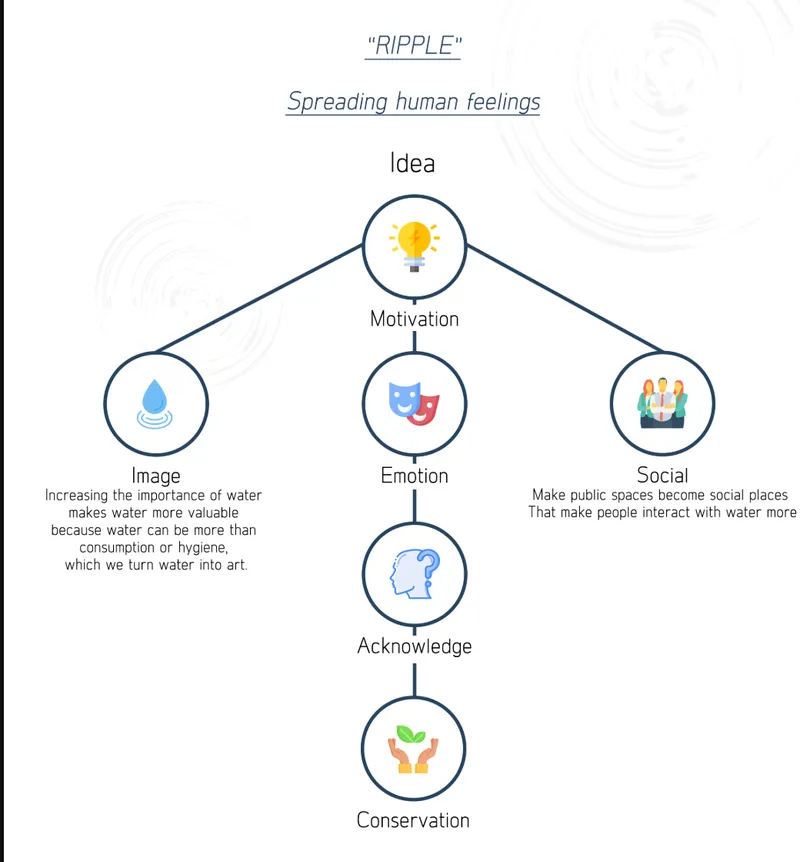
The conceptual diagram lays out the project's operating logic with disarming clarity. The designers frame the experience through four sequential stages: motivation (visual intrigue that draws people in), emotion (multisensory immersion in water's presence), acknowledgement (recognition of water's value beyond utility), and conservation (a shift in attitude toward stewardship). They call the overarching strategy "Deceiving People's Feelings," a phrase that sounds provocative but functions more like soft persuasion. The idea is that by the time visitors reach the end of the spiral, their relationship to water has been quietly but permanently altered.
What makes this framework compelling is its insistence on sequence. The diagram maps how image, emotion, social interaction, and acknowledgement feed into one another rather than existing as isolated moments. Conservation is positioned not as a starting message plastered on a sign but as an arrival point, something earned through bodily experience. That distinction between telling someone to care and making them feel their way into caring is the conceptual core of the entire project.
A Spiral of Glass and Water Set in Sand and Canopy
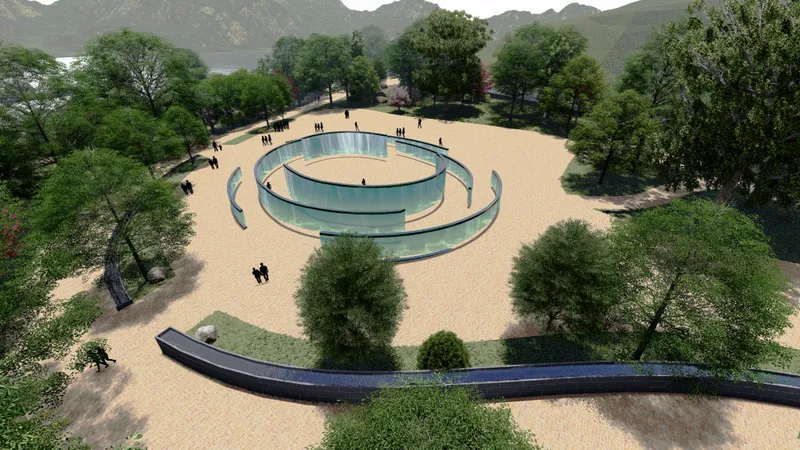
From above, the installation reads as a precise circular form carved into a sandy plaza, its spiral geometry immediately legible against the organic canopy of surrounding trees. The aerial rendering reveals how the curved glass walls create a continuous, tightening path that draws the eye (and the body) inward. The contrast between the rigid circularity of the structure and the loose, spreading forms of the mature trees is deliberate: nature is allowed to be nature, while the architecture announces itself as something consciously constructed, a lens rather than a mimic.
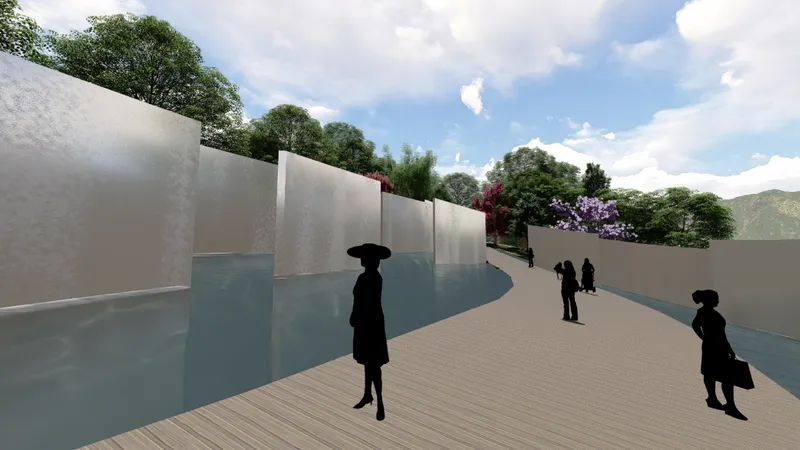
At ground level, the experience shifts from geometric legibility to sensory immersion. Visitors walk along a timber boardwalk flanked by curved glass walls where water cascades in continuous sheets. White panels behind the glass amplify the water's visual presence, turning each transparent surface into a screen of rippling light. The material palette is restrained: glass, timber, water, and white panels. Nothing competes for attention. Every surface exists to make water more visible, more audible, more present.
Mist, Silhouettes, and the Theatre of Arrival
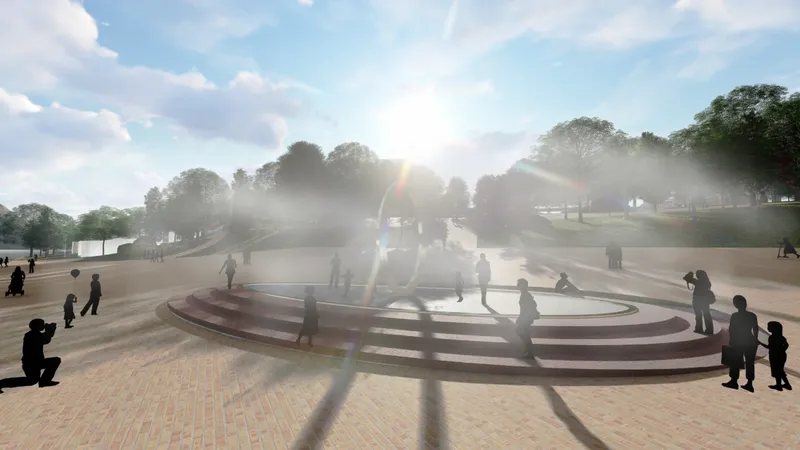
The ground-level rendering captures the installation at its most theatrical. Mist rises from the circular water feature, dissolving the boundary between solid structure and atmosphere. Visitors appear as silhouettes against bright backlit sunlight, their individual identities absorbed into the collective experience. This is not accidental. The designers have engineered a moment where the architecture recedes and the elemental qualities of water, light, and air take over. You stop seeing a building and start inhabiting a condition.
The mist serves a dual function. Practically, it extends the sensory range of water beyond the glass walls, making the installation feel larger and more enveloping than its physical footprint. Conceptually, it represents the transition from the "emotion" stage to "acknowledgement" in the designers' framework. The world outside the spiral blurs. What remains is you, the water, and the slow recognition that what surrounds you is not decoration but something vital.
Lakeside Context as Amplifier
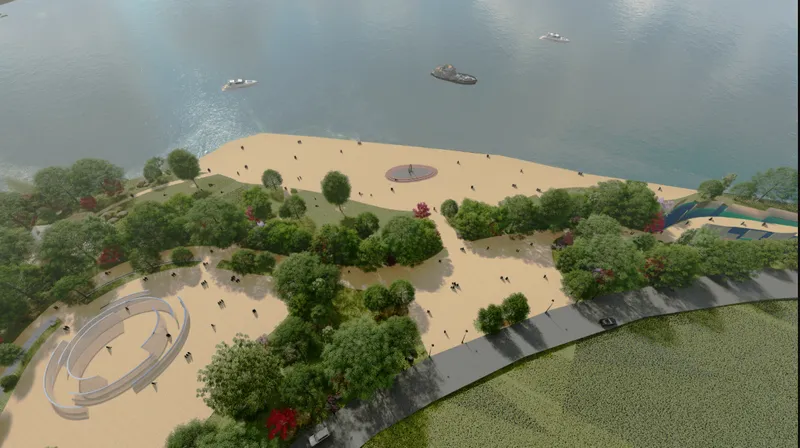
The second aerial rendering pulls back further to reveal the full lakeside context. The circular plaza and its spiraling water feature nestle into a clearing among dense tree cover, with the lake itself visible in the background. The siting is strategic: visitors approaching the installation already have water in their peripheral vision, but they encounter it as distant scenery, passive and unremarkable. The installation then intercepts that passivity, pulling water out of the background and wrapping it around the visitor's body. By the time they emerge from the spiral and see the lake again, the relationship has changed. The lake is no longer scenery. It is kin to the water that just surrounded them.
The lush green surroundings also reinforce the meditative character of the space. Rather than competing with a dense urban fabric, the installation occupies a threshold between the built environment and the natural waterfront, a position that allows it to function simultaneously as a sculptural landmark visible from a distance and an intimate, contemplative enclosure experienced from within.
Why This Project Matters
Environmental advocacy in architecture too often relies on didactic signage or performative sustainability metrics. "The Space of Aqueous" takes a fundamentally different approach: it trusts spatial experience to do the persuading. The spiral pathway, the cascading glass walls, the mist, the careful sequencing from curiosity to immersion to recognition all work together to produce a shift in consciousness that no infographic could achieve. The project treats the human body as the primary medium of communication, routing ecological awareness through sensation rather than information.
Pumsawai and Makotsa have produced something that operates on multiple registers at once. It is a public gathering space that encourages social interaction. It is a sculptural landmark that holds its own against the natural canopy. And it is, at its core, an argument that conservation begins not with data but with feeling. For a competition centered on rethinking our relationship with water, that argument is exactly right.
View the Full Project
About the Designers
Designers: Wipasorn Pumsawai, Warintorn Makotsa
Enter a Design Competition on uni.xyz
uni.xyz runs architecture and design competitions year-round that reward proposals with spatial conviction and real site intelligence.
Project credits: The space of aqueous by Wipasorn Pumsawai, Warintorn Makotsa Ripple (uni.xyz).


Popular Articles
Popular articles from the community


LT2A and OPEN Architectes Thread a Brick and Glass High School Through a Wooded Belgian Campus
In Braine-l'Alleud, a 3,000 m² wing for Collège Cardinal Mercier pairs pale brick with a glazed colonnade, deferring to a small chapel and a dense wood.

Jaramillo Van Sluys Arquitectura and Urbanismo Turn a Demolished Registry Lot in Quito into an Orchard Plaza
In Quito's Centro Histórico, a 2,800 m² plaza exposes the San Agustín convent wall and redraws its lost Augustinian orchard in volcanic stone.

Cube Design Draws an Ecological Corridor Between Two Shenzhen Hills with the Nankai Building
Beside Shenzhen's container docks, the Nankai Building pairs stacked balconies with a climbing green screen to connect two hillsides across its height.

David Ortega Stacks a Two-Story Mexico City Penthouse Around a Steel Stair and a Pergola-Shaded Roof Terrace
In Colonia Roma, a 300 m² penthouse uses oak joinery, a planted steel stair and a slatted roof pergola to make a new-build apartment feel like a house.

Similar Reads
You might also enjoy these articles

Gil Mello Arquitetura Tilts a Single Roof Toward the Waterfalls on a Plateau Above Aiuruoca, Brazil
In Aiuruoca, Minas Gerais, a 200 m² house of local labor and reclaimed poles pairs a low valley veranda with a tall mountain one.

U.GA Architects Wraps an Oval Rooftop Pool in Curved Board-Formed Concrete on Busan's Jeollidan-gil
In Busan's Jeonpo-dong, a 454 m² mixed-use block stacks a neighborhood facility, guest rooms and an oval rooftop pool inside spiraling concrete walls.

Felipe Hess Arquitetos Turns a Blind Stone Wall to the Street and Opens a Brazilian House onto a Courtyard and Canal
A canal-front house in Brazil hides behind painted stone and planting, then opens to an olive-tree courtyard, a reed-ceilinged porch and a curving pool.

David Macias Steps a Doorless Stone and Plaster House Down a Tropical Colombian Hillside
In the humid hills of Colombia, Threshold House replaces the front door with an open void and terraces its 850 m² down the slope instead of fighting it.

Comments (0)
Please login or sign up to add comments
No comments yet. Be the first to comment!