
Pezo von Ellrichshausen Places a Concrete Hearth Pavilion on a Chilean Hilltop
The ROSA Pavilion in Yungay distills architecture to its most elemental act: a fire, a roof, and a view of the mountains.


At 40 square metres, the ROSA Pavilion barely registers as a building. It is, in the most literal sense, a single room with a fireplace, set into a hillside on a 130-hectare rural property in Yungay, Chile. Yet this small gesture by Pezo von Ellrichshausen carries a density of ideas that most buildings ten times its size never approach. Completed in 2022, the pavilion sits at the only geographical inflection along a mountain river's course, occupying a rocky outcrop as though it had always been part of the terrain.
What makes ROSA genuinely interesting is how it collapses several architectural archetypes into one compact object. It is a primitive hut, an observation platform, a sundial, and a domestic hearth all at once. The pavilion belongs to Fundación Artificial, a cultural foundation established by Mauricio Pezo and Sofía von Ellrichshausen with the ambition of turning their rural property into a nature reserve and cultural institution. A sibling structure called Luna already exists on the site. ROSA is the second built proposition in what promises to be a slow, deliberate accumulation of architecture across the landscape.
Grounded in the Landscape
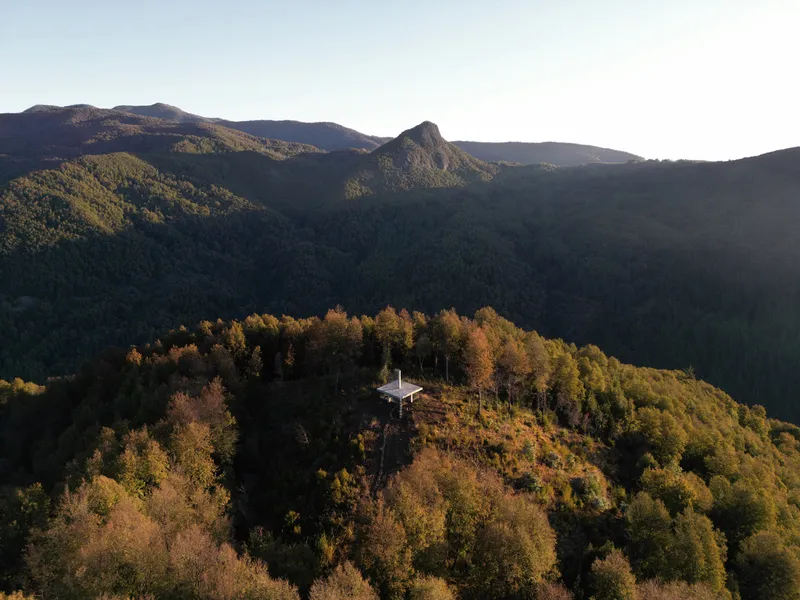
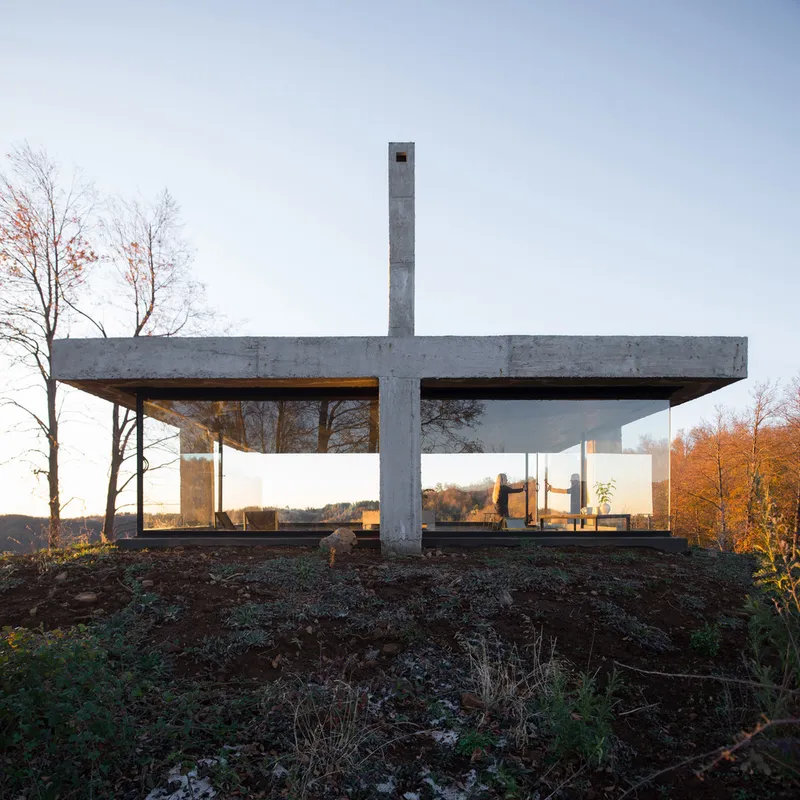
From the air, ROSA reads as a cruciform concrete slab hovering above a cleared earthen plateau. Autumn foliage wraps around the hilltop on every side, and distant peaks close the horizon. The building does not compete with this setting. It anchors itself to it. The floor level is set 60 centimetres below the surrounding ground plane, a subtle move that pulls the pavilion into the hill rather than letting it perch on top. You arrive at ROSA not by ascending to it, but by stepping down into it.
The siting is precise. Pezo von Ellrichshausen chose the only point of topographic inflection along the river, a rocky knoll that gives the pavilion both prospect and isolation. It stands alone, serene, as if it has been waiting for centuries to receive a roof.
Four Columns, No Corners
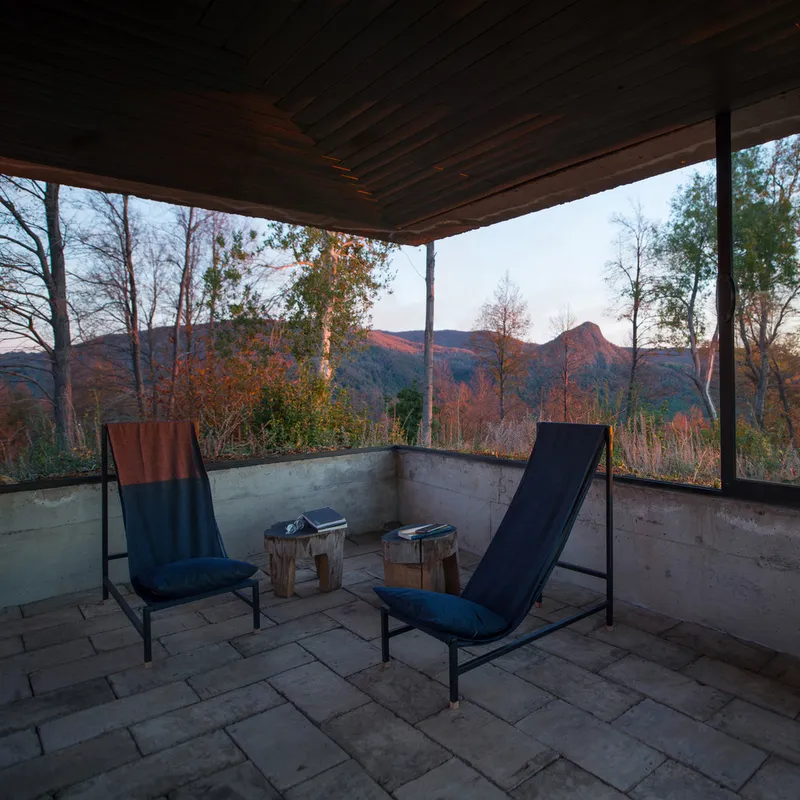
The structural logic is provocative in its simplicity. Four thick columns land at the midpoint of each side of the square plan, leaving every corner free and open. No structure touches the building's corners. This inversion of conventional framing means the pavilion's edges dissolve into either fixed glass panels or sliding ones that transform corners into open-air balconies. The result is a room that can be sealed or entirely exposed to the mountain air depending on the season or the mood of its occupants.
Crossed and diagonal beams embedded in the concrete slab handle seismic forces, a serious concern in Chile. The engineering is invisible from inside, absorbed into the geometry of the roof structure. A single slender column at the center of the platform carries the gravitational core of the building upward, becoming the chimney flue and, on the roof terrace above, the gnomon of a rudimentary sundial. Structure, program, and symbolism converge in one vertical element.
The Central Hearth
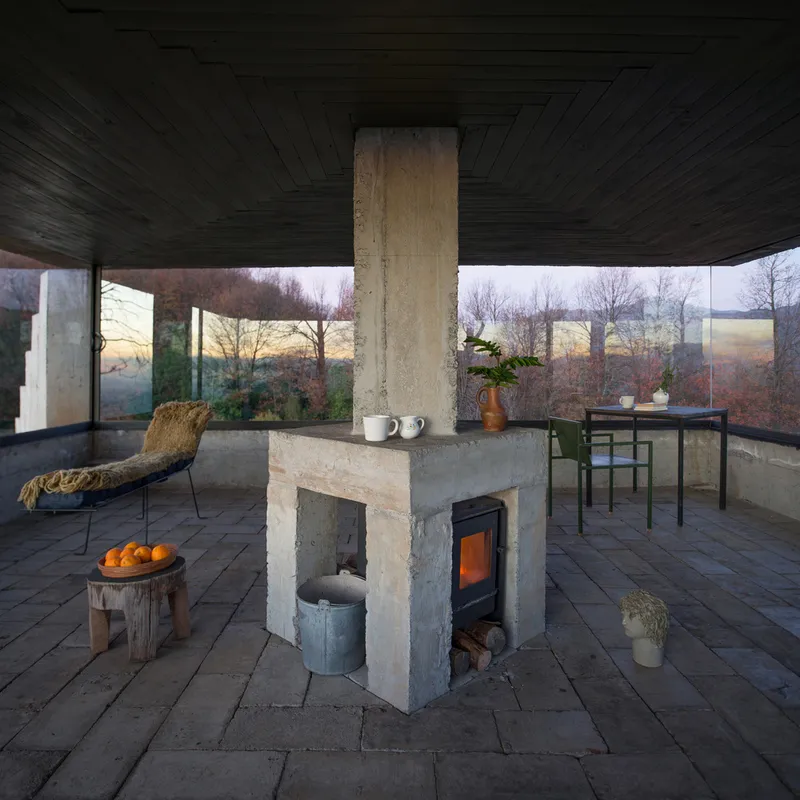
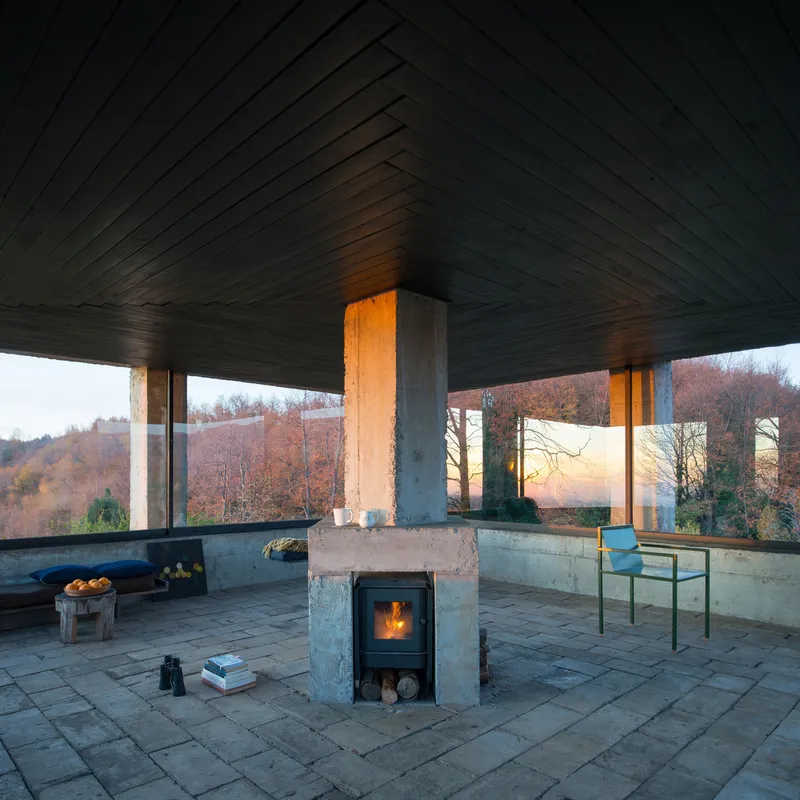
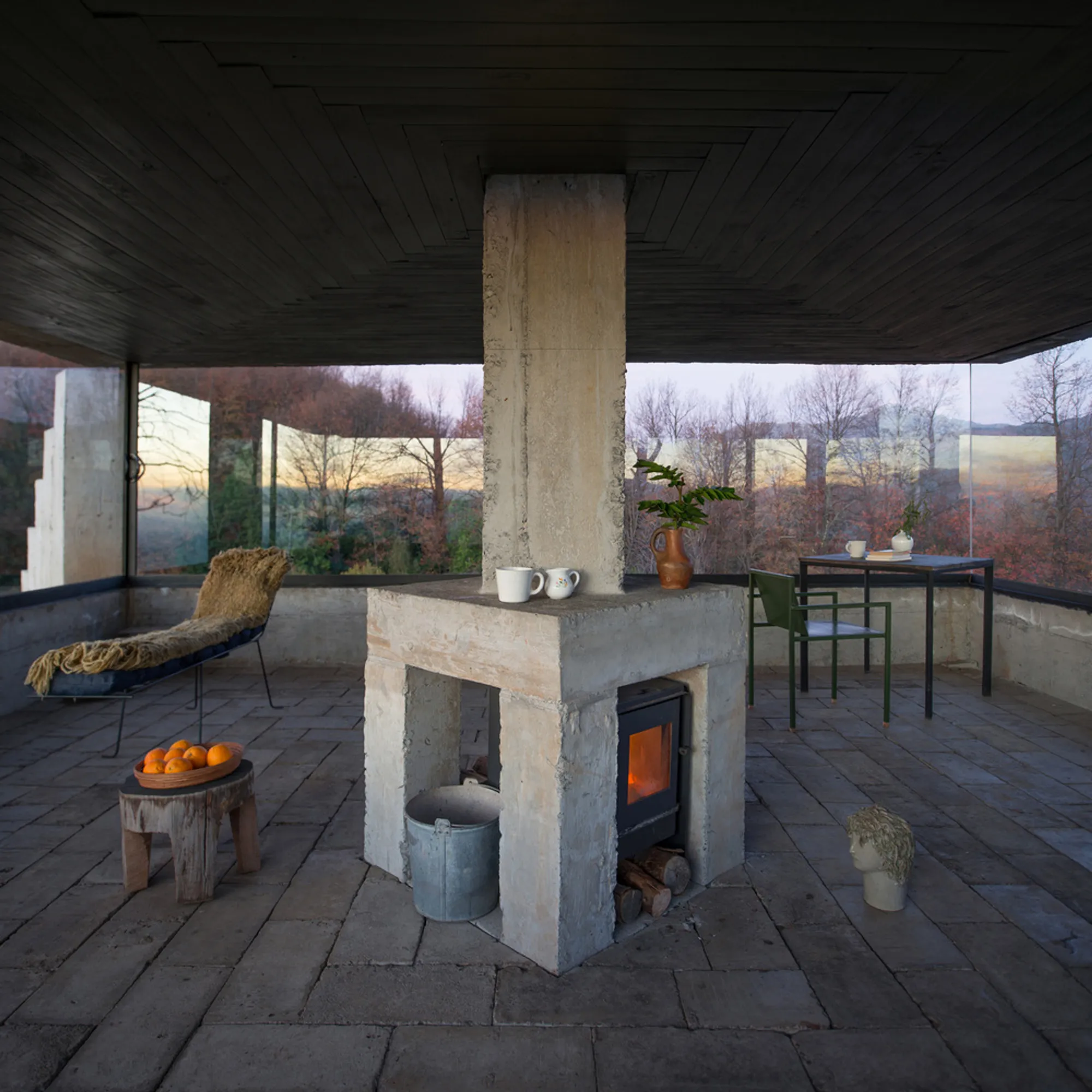
Everything in ROSA orbits the fireplace. The central concrete chimney organizes the square plan into four loosely defined quadrants: a dining area, a lounge zone, and two open terrace conditions. A monolithic staircase detaches at one corner, providing access to the roof. The divisions are more suggested than enforced. There are no walls inside the pavilion, only the gravitational pull of the hearth and the varying quality of light at each edge.
At dusk, the fire becomes the dominant light source, casting warm tones against the dark brown-greenish pigment of the board-formed timber ceiling. The exposed in-situ concrete, left without tint or treatment, absorbs the glow unevenly. It is a deliberate atmospheric strategy: the pavilion shifts from an observation platform during the day to a cave-like enclosure at night. The primitive hut analogy is not decorative. It is literal.
Living with the View

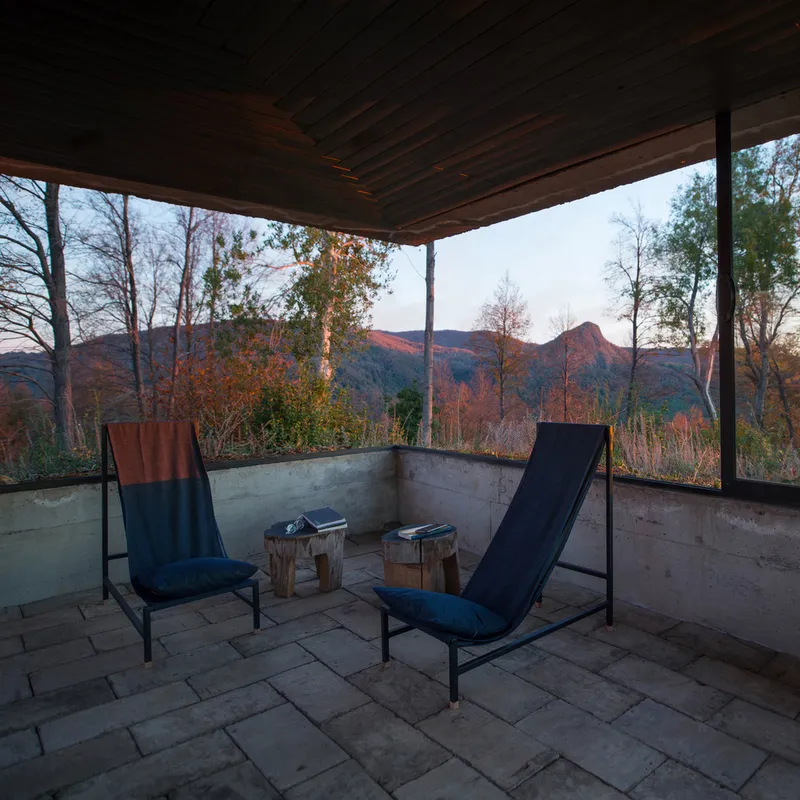
The sliding glass panels at two corners allow ROSA to operate as an open belvedere when weather permits. Two loungers face the mountain range through the frame of the concrete slab, and the composition is so deliberate it borders on cinematic. The horizontal roof defines the top edge of the view. The sunken floor defines the bottom. The columns crop the sides. You are not simply looking at a landscape; you are looking at a landscape that has been edited by architecture.
A table and chairs occupy one corner, positioned where the glass panels meet at sunset. The furnishings are sparse and purposeful. Nothing inside ROSA exists for decoration. Every object, from the stove to the lounge chair to the dining set, participates in the room's primary function: inhabiting a specific place on the earth with maximum awareness.
Plans and Drawings

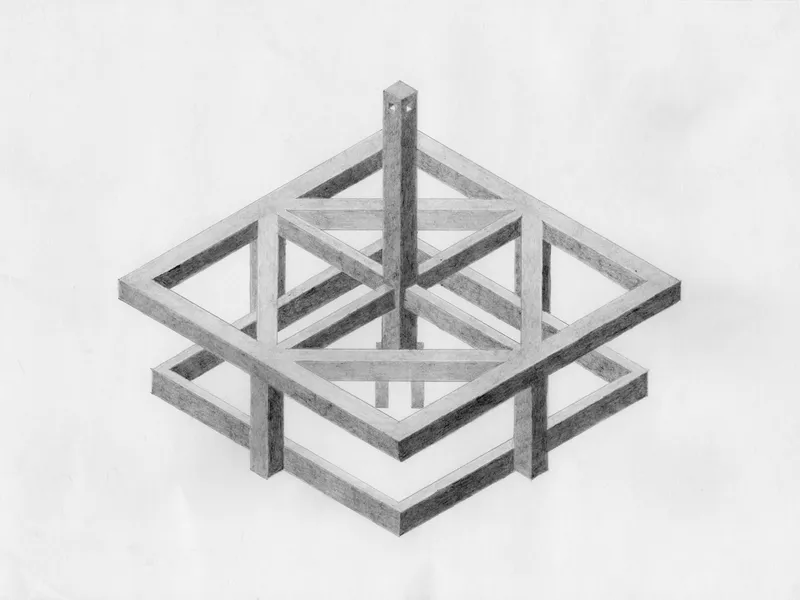
The painted illustration reveals the pavilion's proportional logic with surprising warmth. Blue columns frame red hills and water, abstracting the real landscape into a compositional study. It communicates the architects' intent more directly than a photograph: ROSA is a frame before it is a shelter. The axonometric drawing, meanwhile, exposes the pyramidal timber roof structure with its central column and diagonal bracing. The crossed beams that manage seismic loads are clearly visible, confirming that the structural gymnastics required to free the corners are not casual. They are hard-won.
Why This Project Matters
ROSA matters because it demonstrates that architectural ambition has nothing to do with scale. Forty square metres, a single room, one fireplace, four columns. The inventory is absurdly modest. Yet the pavilion asks fundamental questions about what a building needs to be: how little material can define a space, how structure can serve both gravity and meaning, how a floor lowered by 60 centimetres can change your entire relationship to a hillside. These are not theoretical provocations. They are built answers.
As part of the larger Fundación Artificial project, ROSA also points toward a model of cultural production that is patient and site-specific. Pezo von Ellrichshausen are not building a campus all at once. They are placing individual structures across 130 hectares over years, letting each one respond to a particular geographic condition. If ROSA occupies the inflection point of a river, the next building will occupy a different moment in the terrain. The ambition is cumulative, and the pavilion's restraint is the clearest evidence that the architects trust the long game.
ROSA Pavilion by Pezo von Ellrichshausen, Yungay, Chile. 40 m². Completed 2022.
About the Studio
Share Your Own Work on uni.xyz
If projects like this are the kind of work you want to make, uni.xyz is a place to publish your own, find collaborators, and enter design competitions.




Popular Articles
Popular articles from the community


The Earth Pod: 3D Printed Homes for Resilient Refugee Communities
The Earth Pod reimagines refugee housing through 3D printed homes made from clay, combining resilience, self-sufficiency, and rapid shelter.
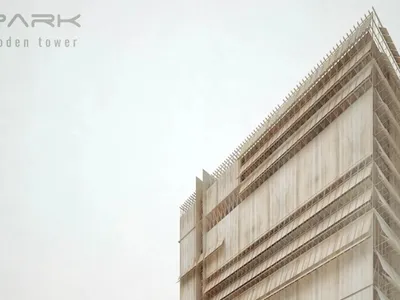
EW PARK: Sustainable Architecture Reimagines the Future of Urban Parking
EW PARK reimagines city parking as a modular wooden tower combining automation, solar energy, electric mobility, and adaptable urban design.

The Ocean Hive: Sustainable Architecture for a Self-Sufficient Civilization at Sea
The Ocean Hive imagines sustainable architecture at sea, where modular habitats, algae, wave power and ocean waste sustain a growing colony.

Hill & Cross Opera: Sculptural Opera House Architecture Shaped by Tallinn’s Landscape and Identity
Hill & Cross Opera reimagines opera house architecture in Tallinn through its sculptural hill, civic plaza, glass wave and a luminous cross.


Similar Reads
You might also enjoy these articles


Hodi-Mandai Geram
Project Function: Preservation and revitalization of the Intangible heritage and socio-spatial identity of the Hodi by Housing, Cultural Memory Center, Sacred Grove, landscape, local tourism economy


Olio Towers: A Mid-Rise for Performers That Fuses Housing, Rehearsal, and Stage
Located blocks from Houston's Theater District, this modular tower stacks living units around a central performance atrium.

Oasis: Modular Green Housing Carved into Dhaka's Urban Fabric
A shortlisted Plugin Housing entry reclaims unauthorized settlements in Dhaka with stepped concrete volumes, green roofs, and ventilation-driven design.

Black Hole: A Floating Megastructure for the Post-Physical Era
Emiliano Mazzarotto envisions a spherical, self-scaling arena where e-sports, digital hotels, and holographic stadiums replace traditional public space.


Explore Architecture Competitions
Discover active competitions in this discipline


Challenge to design a portable theatre

Challenge to design a portable music platform


Challenge to design an open learning module for the elderly


Challenge to reimagine the Iron Throne
Comments (0)
Please login or sign up to add comments
No comments yet. Be the first to comment!