
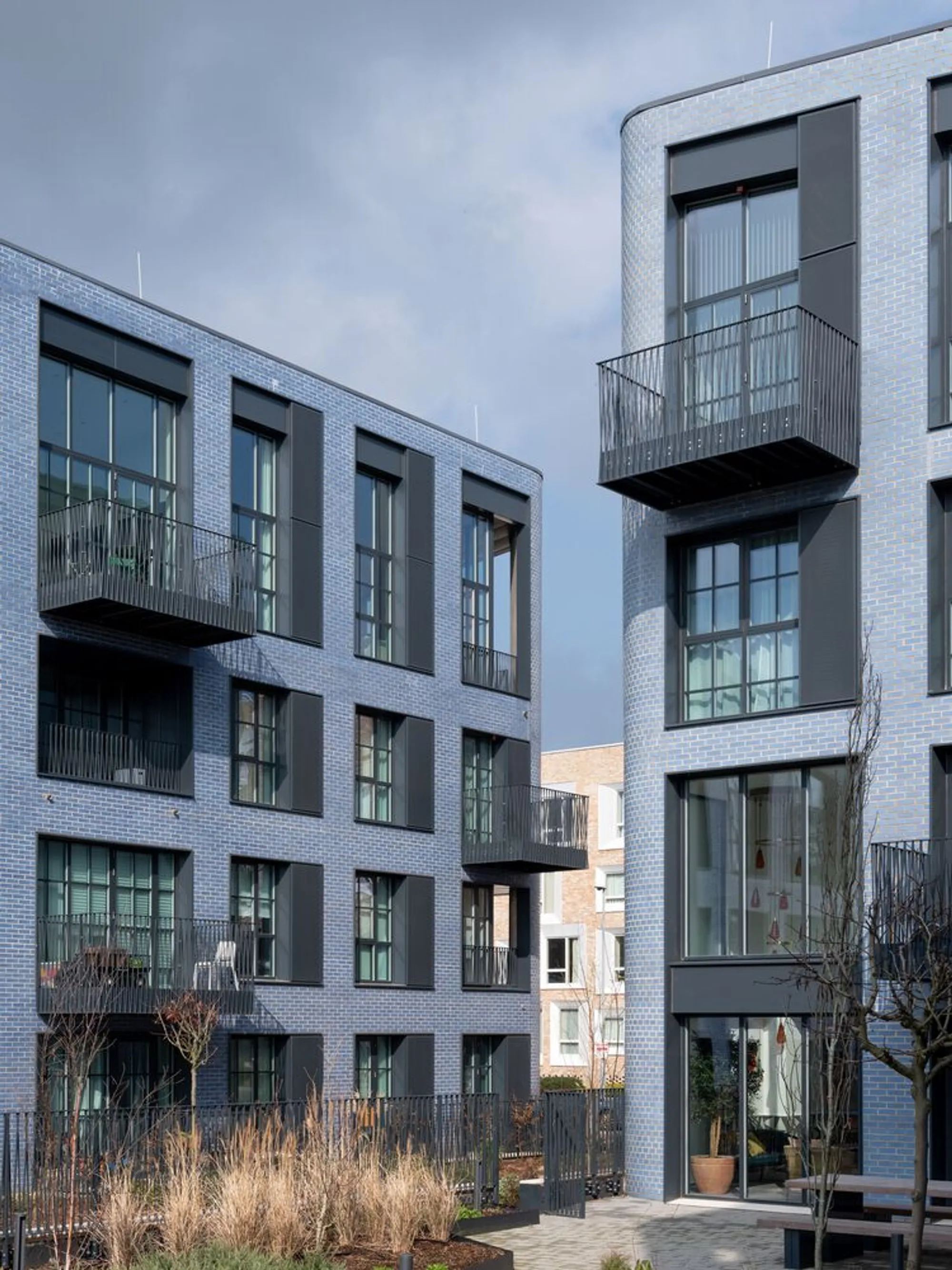
Alison Brooks Architects Merges Mill Typology and Collegiate Courts in a Net-Zero Cambridge Housing Scheme
Rubicon Sustainable Living packs 186 homes onto a narrow site at the edge of Cambridge's Eddington masterplan, rethinking density through courtyards, co-wo


Dense housing at Cambridge's northwestern fringe doesn't sound like fertile ground for architectural ambition, yet Alison Brooks Architects has managed to produce one of the most convincing low-rise, high-density residential projects in the UK in recent years. Rubicon Sustainable Living squeezes 186 homes across five interlocking buildings onto a 75-metre by 30-metre strip at the gateway to the 150-hectare Eddington masterplan, developed for the University of Cambridge and The Hill Group. The site is pinched between the M11 motorway and open wetlands, a threshold condition that the architecture takes seriously: rather than turning its back on either edge, it mediates between them with courtyards, planted bioswales, and a roofline that rises and falls like the Cambridgeshire terrain beyond.
What makes Rubicon worth paying attention to isn't just the sustainability spec sheet, though that is formidable (Code for Sustainable Homes Level 5, 82% on-site energy generation, zero-carbon operation). It's the conviction that net-zero housing can also be spatially generous, materially refined, and genuinely communal. Brooks draws on two seemingly incompatible precedents: the robust glazed-brick mills of 19th-century Britain and the intimate courtyards of Cambridge's colleges. The result is a hybrid typology that feels neither nostalgic nor generic, rooted in place while offering a transferable model for sustainable urban development.
Five Buildings on a Constrained Strip
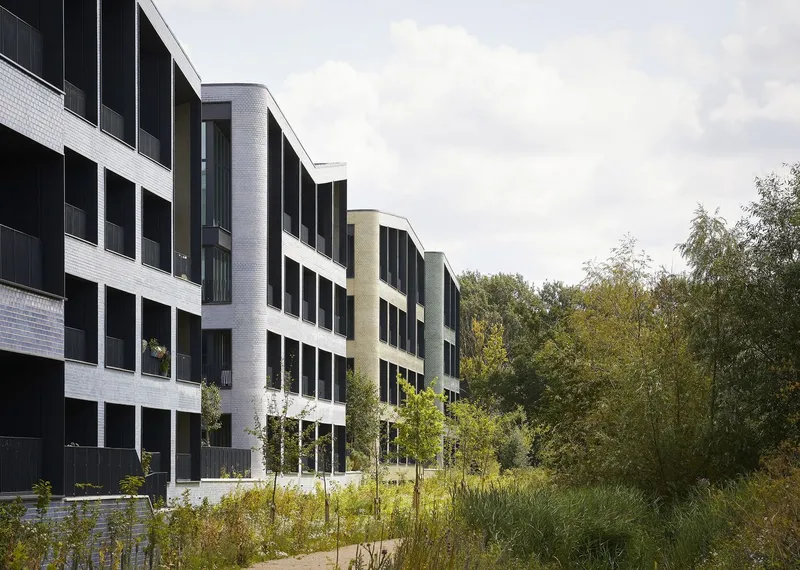
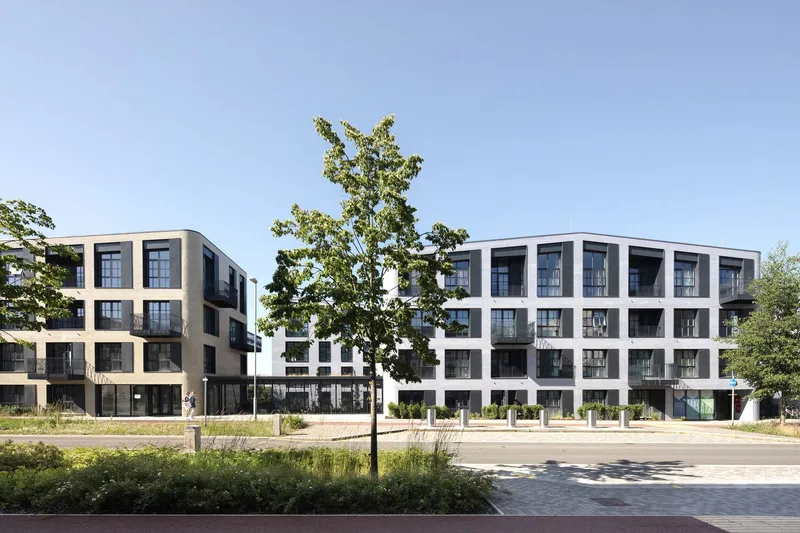
The site's extreme proportions forced a disciplined plan. Three central blocks adopt S- and Z-shaped footprints that step in plan to let daylight penetrate deep into the interiors and create pockets of south-facing garden space between them. An L-shaped block anchors the eastern end while a courtyard block closes the western edge. Seen from across the street, the massing reads as a continuous urban wall, but the reality is more porous: gaps and passageways between buildings link the public realm to a sequence of intimate courts that function as shared outdoor living rooms.
This interplay between solidity and permeability is the project's core spatial idea. The four-storey volumes hold the street edge confidently, their glazed brick facades presenting a calm, durable front. Behind them, the scale shifts to something more domestic and sheltered: timber benches, young trees, and paving that invites lingering rather than passing through.
Glazed Brick and Industrial Memory
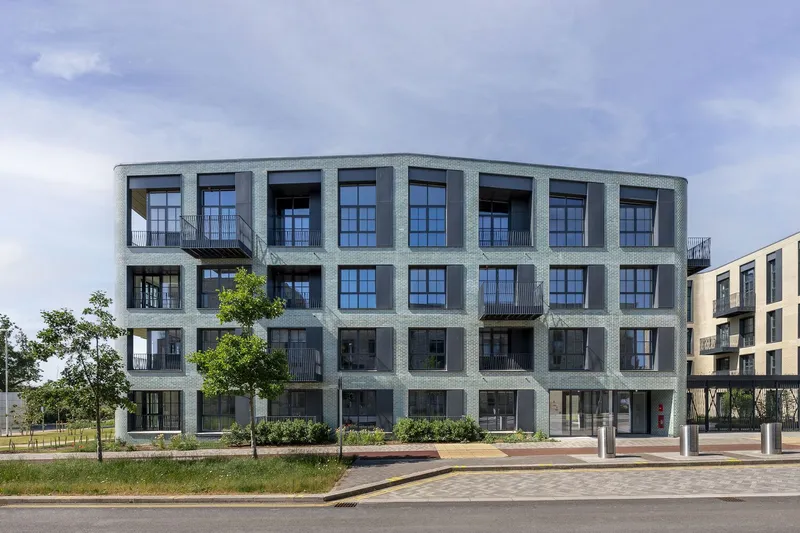
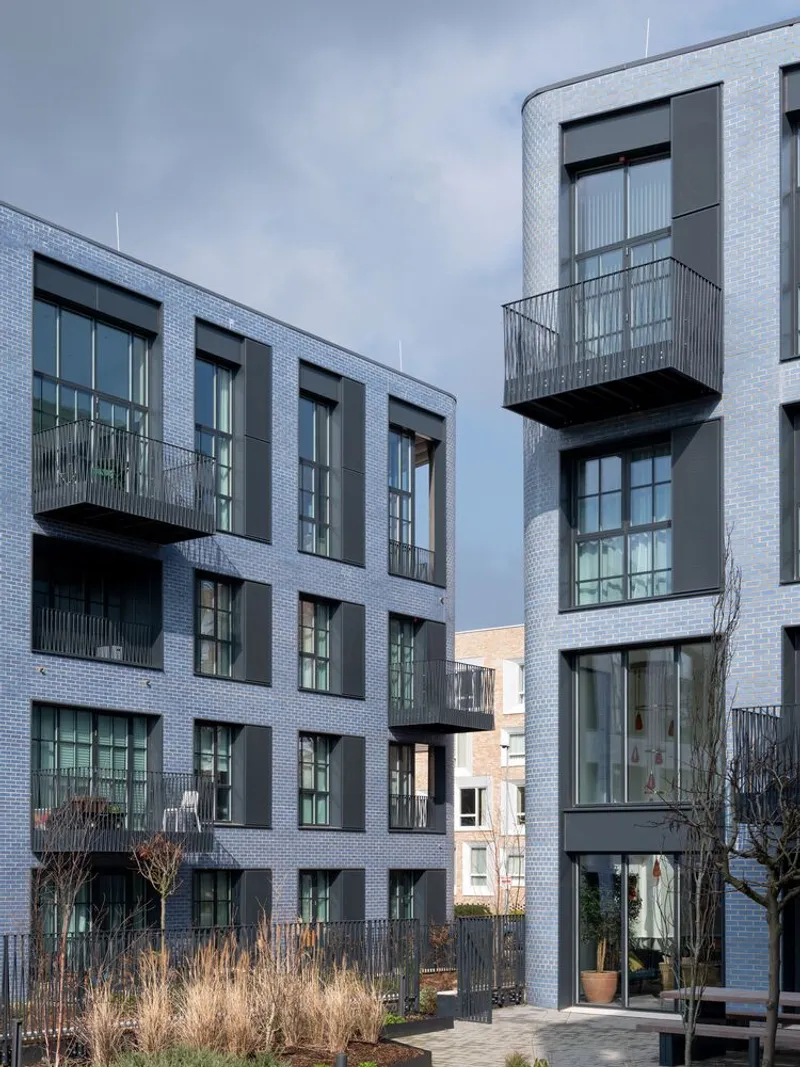
The facade treatment is where Rubicon's dual heritage becomes legible. Glazed bricks in a palette that shifts from pastel green and turquoise to silver-grey and pale blue give each block a subtly distinct identity while maintaining family resemblance. These are robust, single-fired bricks that recall the utilitarian grandeur of northern English mills rather than the polite buff brick of Eddington's neighbouring developments by Mecanoo and Mole Architects. Brooks is deliberately pushing back against contextual pastiche, opting instead for a material that signals permanence, industrial lineage, and weather resistance in equal measure.
The arched window openings visible along the street elevation reinforce the warehouse reference, lending rhythm and vertical proportion to what could have been a monotonous four-storey slab. At dusk, the projecting metal balconies and mullioned windows catch low light and shadow, giving the facades a sculptural depth that rewards close inspection. Those metal screens, which also appear on the cycle-store pavilions, allude to the filigreed balustrades of St. John's College First Court, a graceful Cambridge echo embedded in an otherwise industrial vocabulary.
Courtyards as Collegiate Common Ground
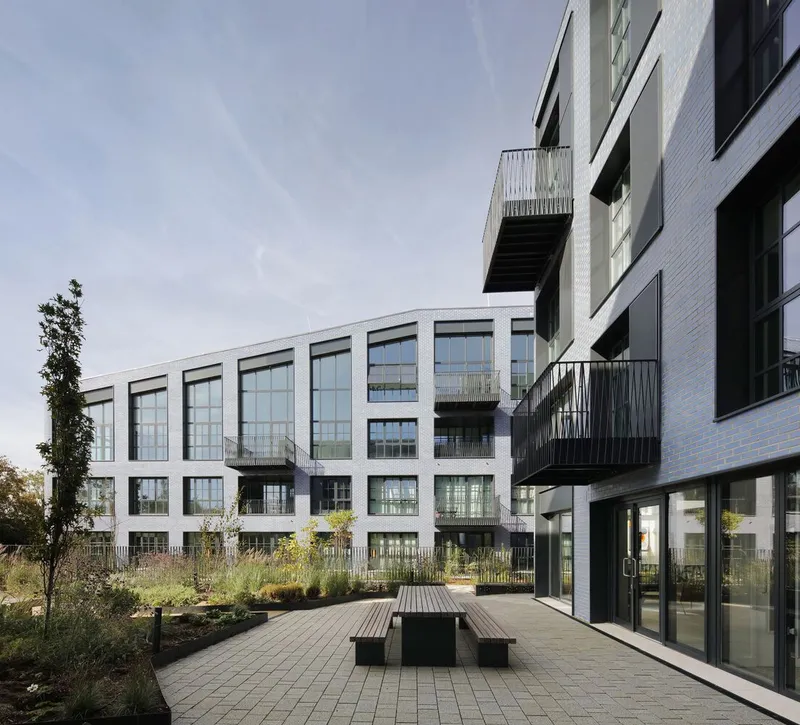
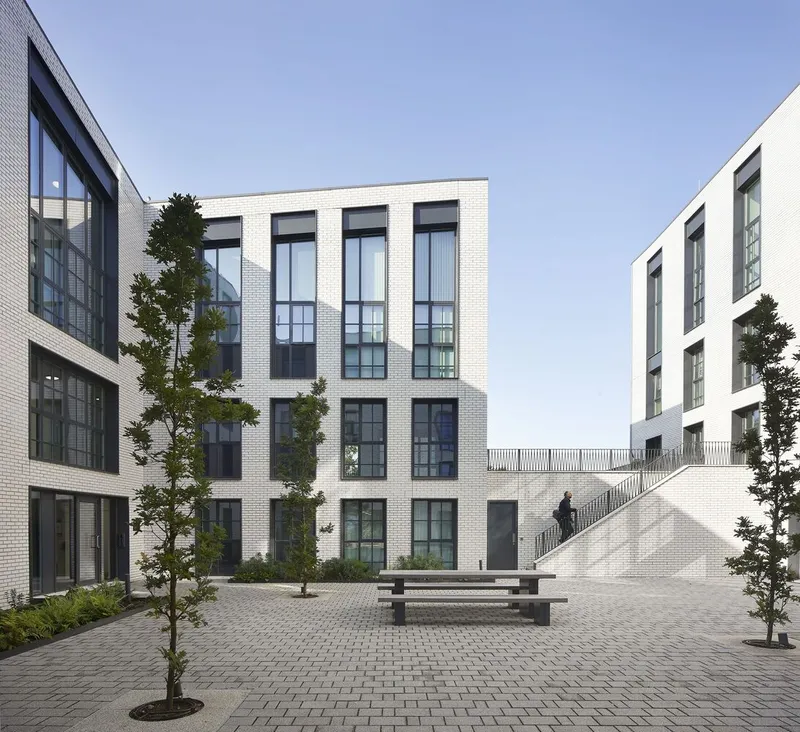
Cambridge's college courts have survived for centuries because they get something fundamental right: a defined outdoor room, shared by a community, that balances privacy with encounter. Rubicon borrows this principle directly. The courtyards between blocks are scaled for conversation, not spectacle. Paved surfaces with generous planting strips create zones for sitting, walking, and informal socializing, while cantilevered black balconies on the upper floors provide residents with a layered sense of overlooking without surveillance.
With 35% of homes allocated to university staff and key workers, and the remainder open to a mix of academics, students, professionals, and retirees, the courtyards serve as the social infrastructure that makes intergenerational living possible. They're not programmed in the heavy-handed way that many housing schemes attempt; instead, the architecture simply makes it easy and pleasant to be outside in proximity to others.
Thresholds and Passageways
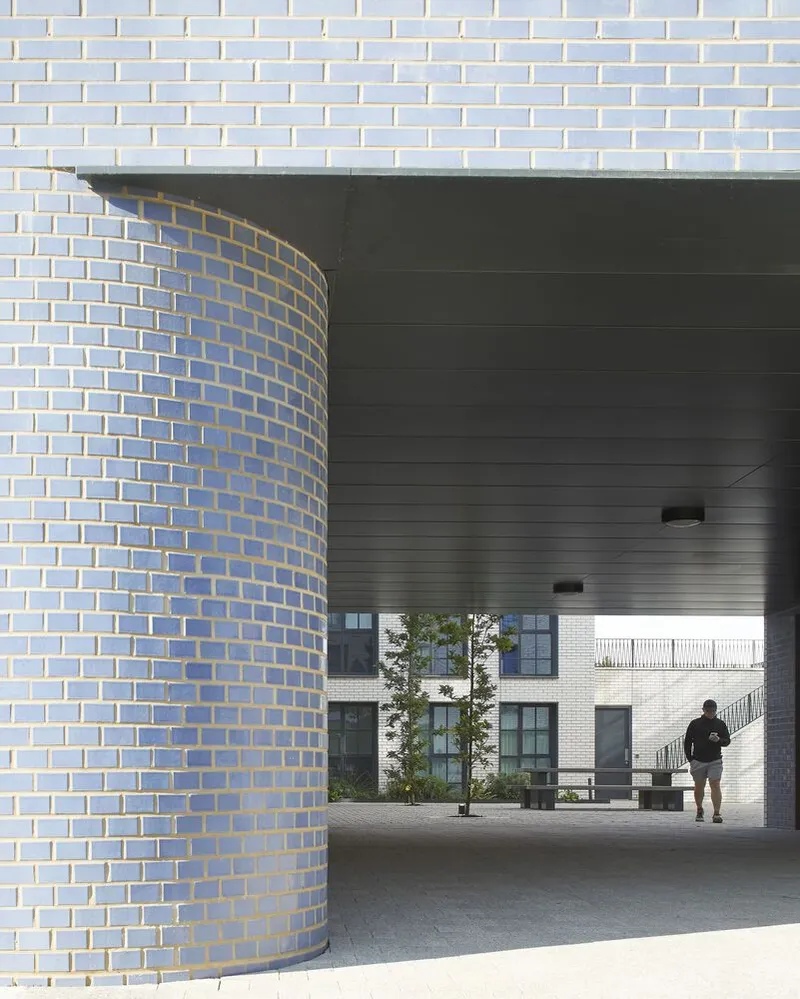
Some of Rubicon's most compelling moments happen in the spaces between inside and outside. A covered passageway framed by a curved pale brick column and a dark soffit compresses the view before releasing you into a sunlit courtyard beyond. It's a classic architectural sequence, compression followed by expansion, deployed here with quiet confidence rather than theatrical flair. The curve of the column is a small detail that does a lot of work: it softens the transition, signals a shift in atmosphere, and reminds you that these are buildings designed with physical experience in mind, not just plan efficiency.
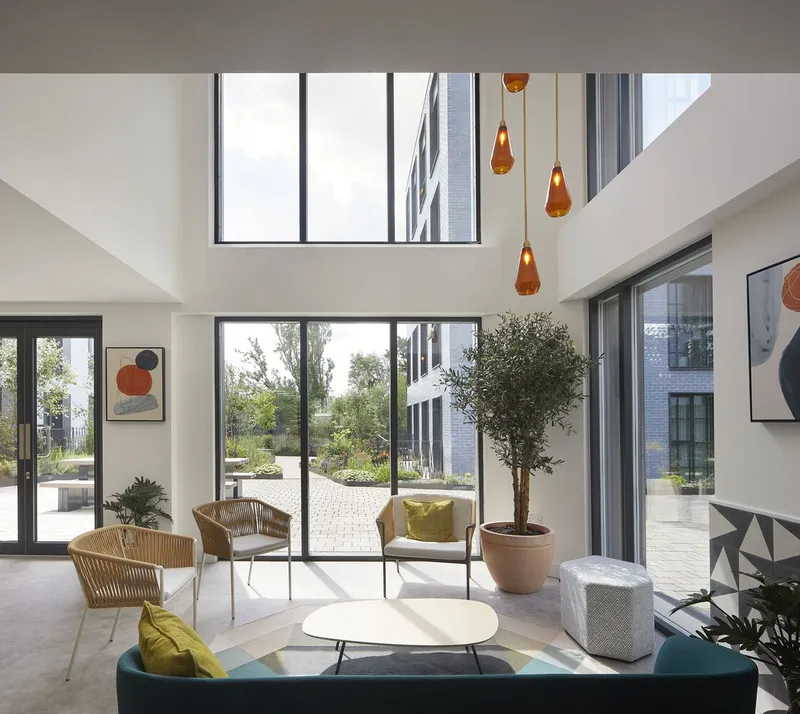
Inside, the ground-floor co-working foyers are conceived as semi-public rooms that extend the communal logic of the courtyards into the building itself. A double-height lobby lit by clerestory windows and fitted with amber pendant lights overlooks the planted garden through full-height glazing, blurring the line between shared interior and shared exterior. A potted tree in the foyer operates as a deliberate visual link to the landscape outside, a small gesture that reinforces the project's ambition to make sustainability feel generous rather than austere.
Cycle-First Mobility and Landscape Infrastructure
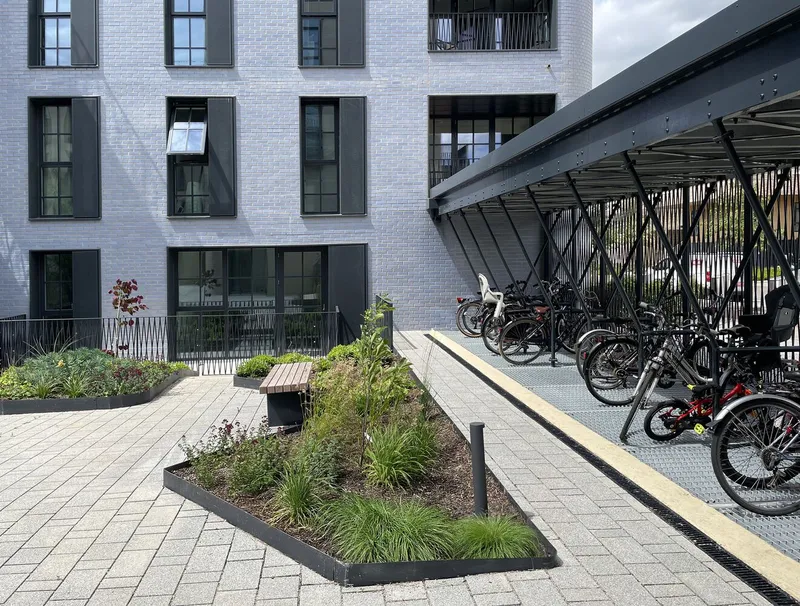
Rubicon's claim to be a cycle-centred development is not just branding. The covered cycle-parking pavilions with their diagonal steel bracing and filigreed metal screens are given the same architectural care as the residential facades, an implicit statement that the bicycle is not an afterthought but a primary piece of infrastructure. The courtyards are vehicle-free, and pedestrian pathways lace through the site, making car-free daily life not just possible but preferable.
At ground level, the landscape does serious environmental work. Rain gardens and Sustainable Urban Drainage Systems provide two-stage water filtration across the site, managing stormwater while introducing biodiversity into the public realm. The bioswales with their ornamental grasses and young trees visible from the street frontage aren't decorative planting; they're part of an engineered water management strategy that also defines the character of the place. Rainwater harvesting and an underground waste system complete a site-wide resource loop that keeps as much material as possible cycling within the development's boundaries.
The Fabric-First Envelope
Behind the glazed brick, Rubicon's real energy story is insulation and airtightness. The fabric-first strategy wraps each building in 300mm of mineral wool insulation and triple glazing, pushing U-values low enough that active mechanical systems can be kept modest. Acoustically attenuated louvres address the noise from the nearby M11 while still allowing natural ventilation, a pragmatic solution to a genuine site constraint. Deeply recessed south-facing facades double as solar shading, reducing cooling loads in summer without relying on bolt-on screens or automated blinds.
Mechanical Heat Recovery Ventilation handles the balance of fresh air, and a Combined Heat and Power district heating system supplies the thermal energy that the envelope's passive measures don't fully eliminate. Extensive rooftop PV arrays contribute to the development's headline figure: 82% of operational energy generated on-site. The combined package achieves Code for Sustainable Homes Level 5, placing Rubicon among the highest-performing residential projects delivered in the UK to date.
Why This Project Matters
Rubicon Sustainable Living matters because it refuses to accept the false choice between environmental performance and architectural quality. Too many net-zero housing projects in the UK settle for competent but unremarkable design, treating sustainability as a technical problem to be solved in the building physics rather than an opportunity to rethink how people live together. Brooks and her team have delivered a development where the energy strategy, the material palette, the spatial sequence, and the social model all reinforce one another. The result is housing that feels considered at every scale, from the city-edge massing down to the curve of a brick column framing a courtyard view.
The project also demonstrates something important about density. At 186 homes on 0.74 hectares, Rubicon is genuinely compact, yet it never feels cramped. The courtyards, passageways, co-working foyers, and cycle pavilions create a porosity that makes high density livable and even sociable. For Cambridge, it sets the tone for the rest of Eddington. For the UK more broadly, it offers a replicable model: proof that low-rise, zero-carbon, community-oriented housing is not an idealistic fantasy but a buildable, financeable reality.
Rubicon Sustainable Living by Alison Brooks Architects. Cambridge, United Kingdom. Site area: 7,400 m²; gross internal area: 14,246 m². Photography by Hufton + Crow, Ben Hughes, Ben Luxmoore, and Matthew Blunderfield.
About the Studio
Share Your Own Work on uni.xyz
If projects like this are the kind of work you want to make, uni.xyz is a place to publish your own, find collaborators, and enter design competitions.




Popular Articles
Popular articles from the community


Hill & Cross Opera: Sculptural Opera House Architecture Shaped by Tallinn’s Landscape and Identity
Hill & Cross Opera reimagines opera house architecture in Tallinn through its sculptural hill, civic plaza, glass wave and a luminous cross.

Play: Fragments of Their World
Familiar architecture becomes modular playground design, creating safe spaces where displaced children can learn, connect, imagine and play.

Lunar Spiral: Space Architecture Shaped by the Mathematics of the Universe
Lunar Spiral reimagines space architecture through Fibonacci geometry, lunar regolith, levitating habitats, and self-sustaining Moon living.

Co-Life: Senior Housing Design That Reconnects Older Adults With the City
Co-Life reimagines senior housing design through healing gardens, shared streets, workshops, and a sustainable community across generations.


Similar Reads
You might also enjoy these articles


Hodi-Mandai Geram
Project Function: Preservation and revitalization of the Intangible heritage and socio-spatial identity of the Hodi by Housing, Cultural Memory Center, Sacred Grove, landscape, local tourism economy


Olio Towers: A Mid-Rise for Performers That Fuses Housing, Rehearsal, and Stage
Located blocks from Houston's Theater District, this modular tower stacks living units around a central performance atrium.

Oasis: Modular Green Housing Carved into Dhaka's Urban Fabric
A shortlisted Plugin Housing entry reclaims unauthorized settlements in Dhaka with stepped concrete volumes, green roofs, and ventilation-driven design.

Black Hole: A Floating Megastructure for the Post-Physical Era
Emiliano Mazzarotto envisions a spherical, self-scaling arena where e-sports, digital hotels, and holographic stadiums replace traditional public space.


Explore Housing Competitions
Discover active competitions in this discipline



Challenge to reimagine the Iron Throne


Photograph architecture without architects


Illustrate the lost glory of Angkor Wat - Render Challenge


Design challenge to reuse E-waste
Comments (0)
Please login or sign up to add comments
No comments yet. Be the first to comment!