
S Squared Architects Use a Freehand Curved Wall to Split Sacred and Domestic Life in Kerala
A 2700-square-foot home in Haripad, India negotiates the presence of a sacred snake grove through one continuous curving brick wall.


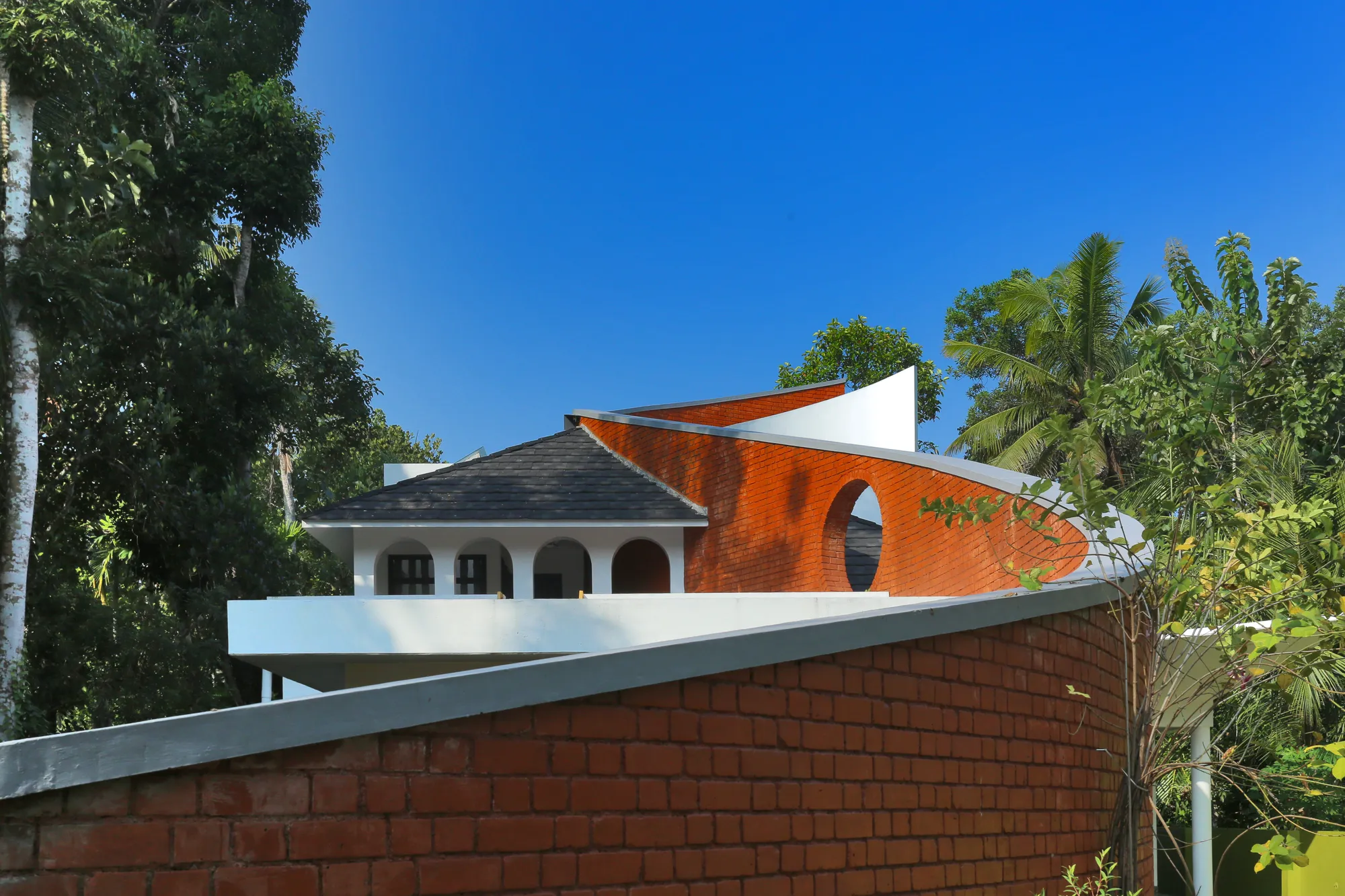
Most residential briefs begin with a wish list of rooms. The Skyward Home, designed by S Squared Architects in Haripad, Kerala, began with something far more charged: a sacred snake grove. The "Sarpa kave" sits at the southeast corner of the narrow 18-cent plot, and everything about the house, its plan, its circulation, its relationship to the garden, flows from the decision to honor that grove rather than ignore it. Lead architects Shaji V Vempanadan and Sumi Shaji responded with a single, continuous freehand curved wall that runs from the open landscape into the body of the house, dividing the site into a public zone and a silent, private zone bordering the sacred ground.
The result is a 2700-square-foot home that feels simultaneously grounded and inventive. At the scale of the site, the wall is a pragmatic divider, screening the driveway from the contemplative garden. At the scale of the interior, it becomes the spine of the architecture, shaping staircases, framing courtyards, and generating the curved roof forms that give the project its name. It is a house organized not by a grid but by a gesture, and the gesture is legible from every angle.
The Wall as Organizing Principle

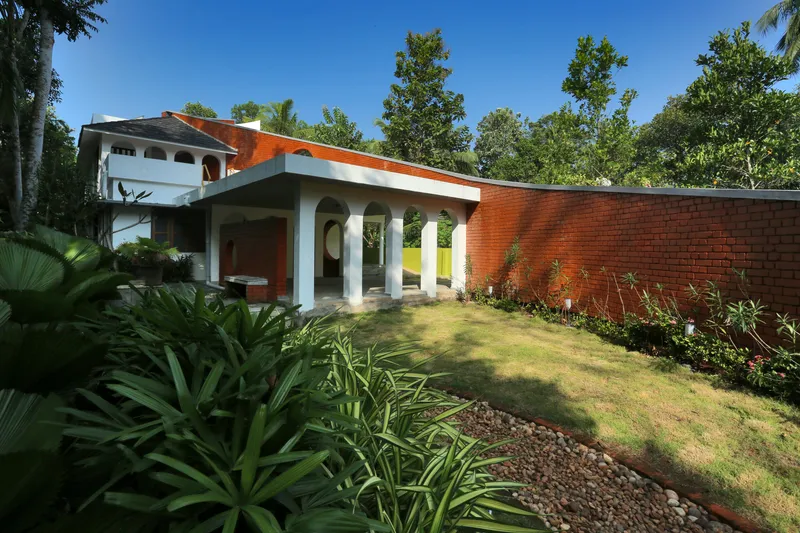
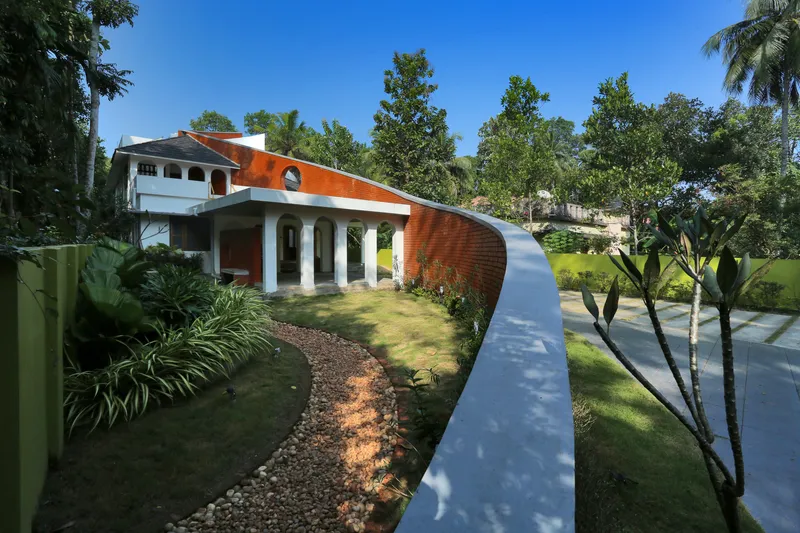
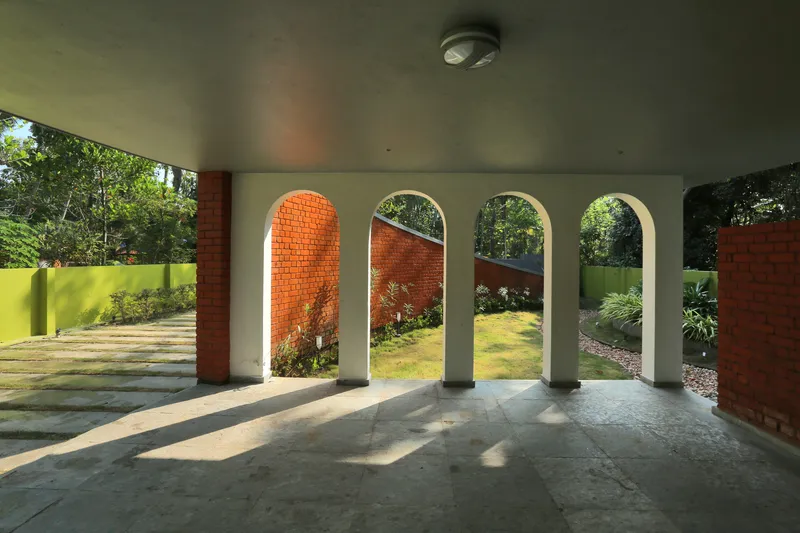
The long red brick wall announces itself well before the front door. Arriving from the east along a striped stone path, you see it running parallel to the plot's 51-meter depth, establishing a clear threshold between the driveway on one side and the sheltered garden on the other. The wall is not decorative; it is the primary spatial tool. On the public side, cars move. On the private side, tropical planting presses against brick, and the covered colonnade offers shaded passage toward the interior.
What keeps the wall from feeling oppressive is its curvature. Because it was drawn freehand rather than drafted with a compass, its bends feel organic, responding to the palm trees and garden beds rather than imposing a geometric order. The brick surface ages well in Kerala's climate, and its warmth contrasts with the white-painted colonnade that runs alongside it.
Curved Roofs and Terracotta Shells
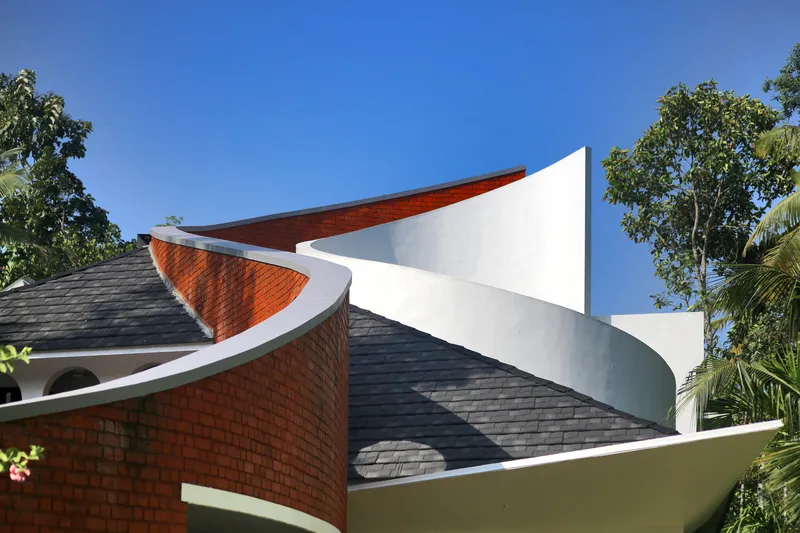
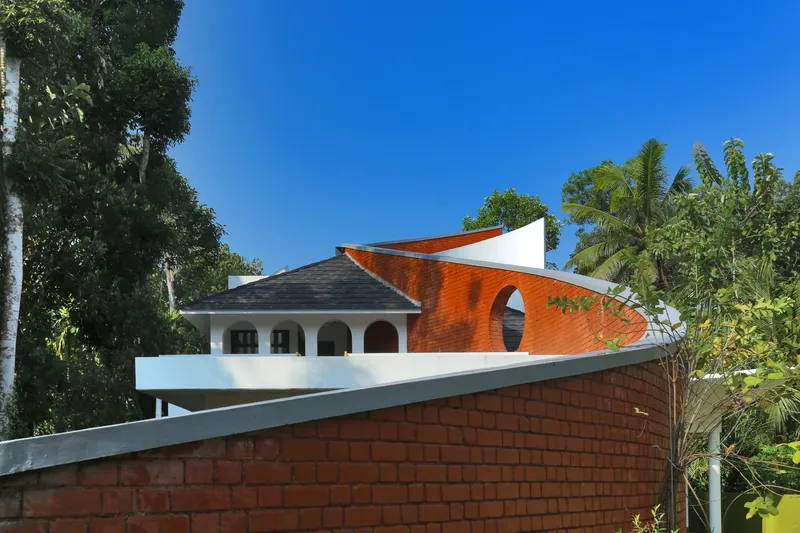
The roof is where the wall's logic lifts off the ground. Intersecting curved shells, clad in terracotta tile on the outer face and painted white on the inner face, rise above the tree line and create the skyward silhouette that names the house. The shells read as extensions of the brick wall, as if the same material vocabulary simply turned vertical and then overhead. Against the palm canopy they look almost geological, like eroded cliff faces rather than constructed surfaces.
The junction between terracotta and white plaster is sharp and deliberate. From below, the white undersides bounce daylight back into the rooms. From outside, the terracotta tiles tie the roof to the brick wall and to the tropical soil. The dual reading, heavy from the garden, light from the interior, gives the house a real tectonic argument rather than a single aesthetic register.
The Central Courtyard
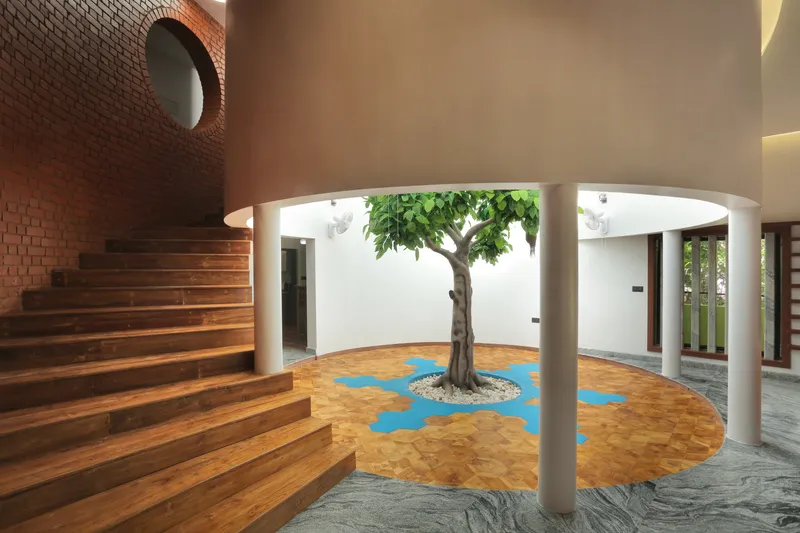
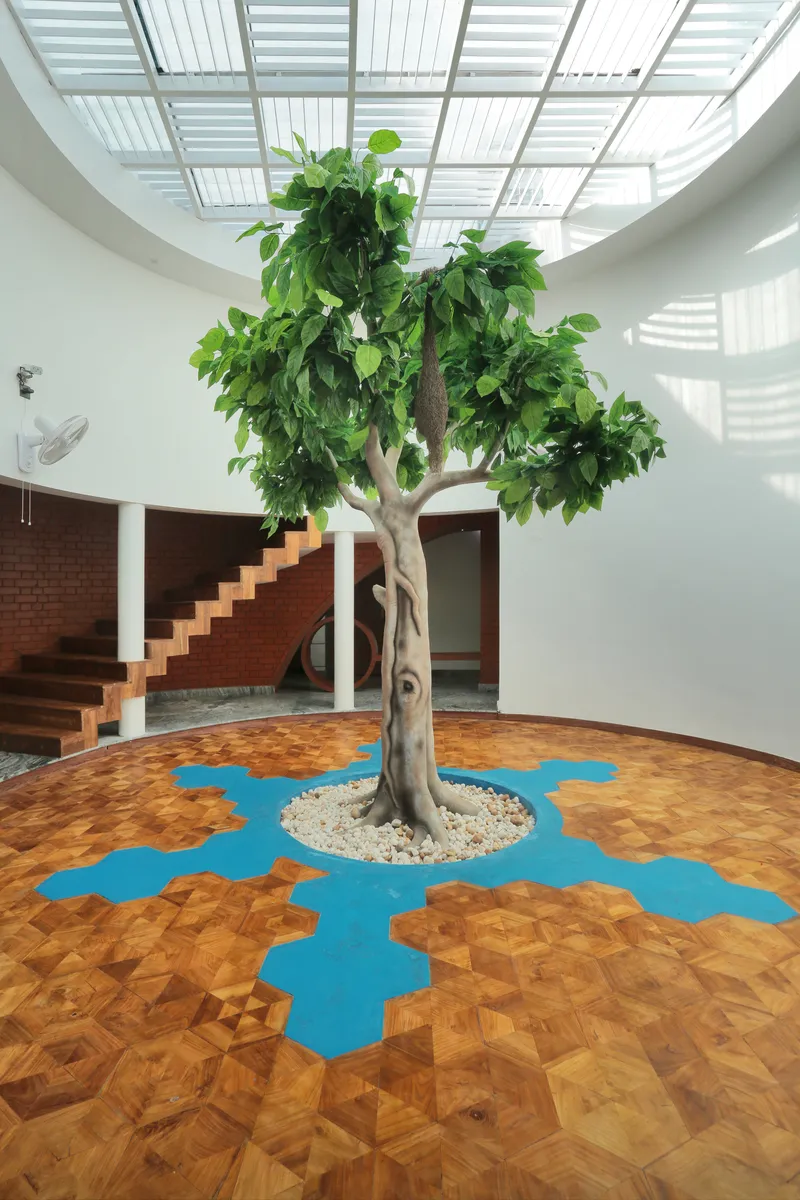
At the heart of the plan sits a circular courtyard open to the sky, anchored by a single tree planted in a bed of parquet flooring with a blue inlay border. A slatted skylight filters sunlight into dappled patterns across the floor, shifting throughout the day so the courtyard is never the same room twice. It functions as the house's lung, pulling ventilation through the surrounding spaces and connecting the ground floor living areas visually and thermally.
The courtyard is ringed by arched openings and a covered porch with brick walls and planted beds, blurring the line between inside and outside. In a humid tropical climate like Haripad's, this kind of passive cooling is essential, and the architects let the courtyard do most of the environmental work without resorting to conspicuous green-tech signaling.
The Staircase as Spatial Event
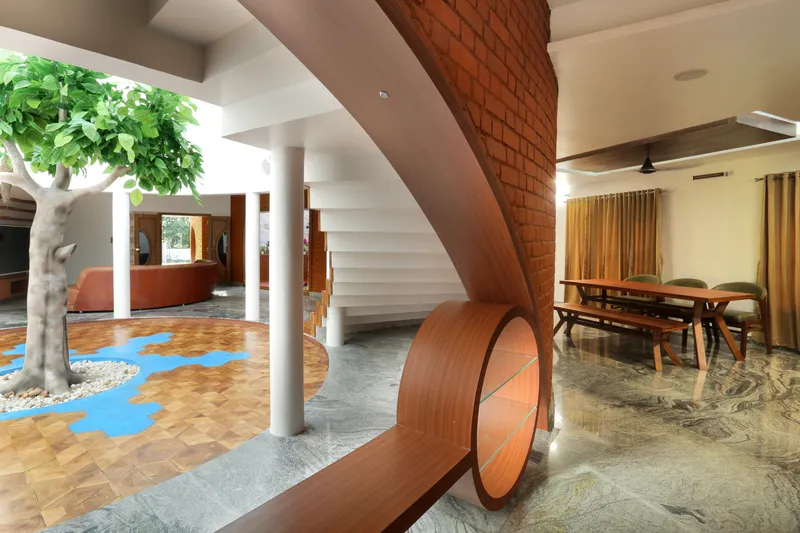
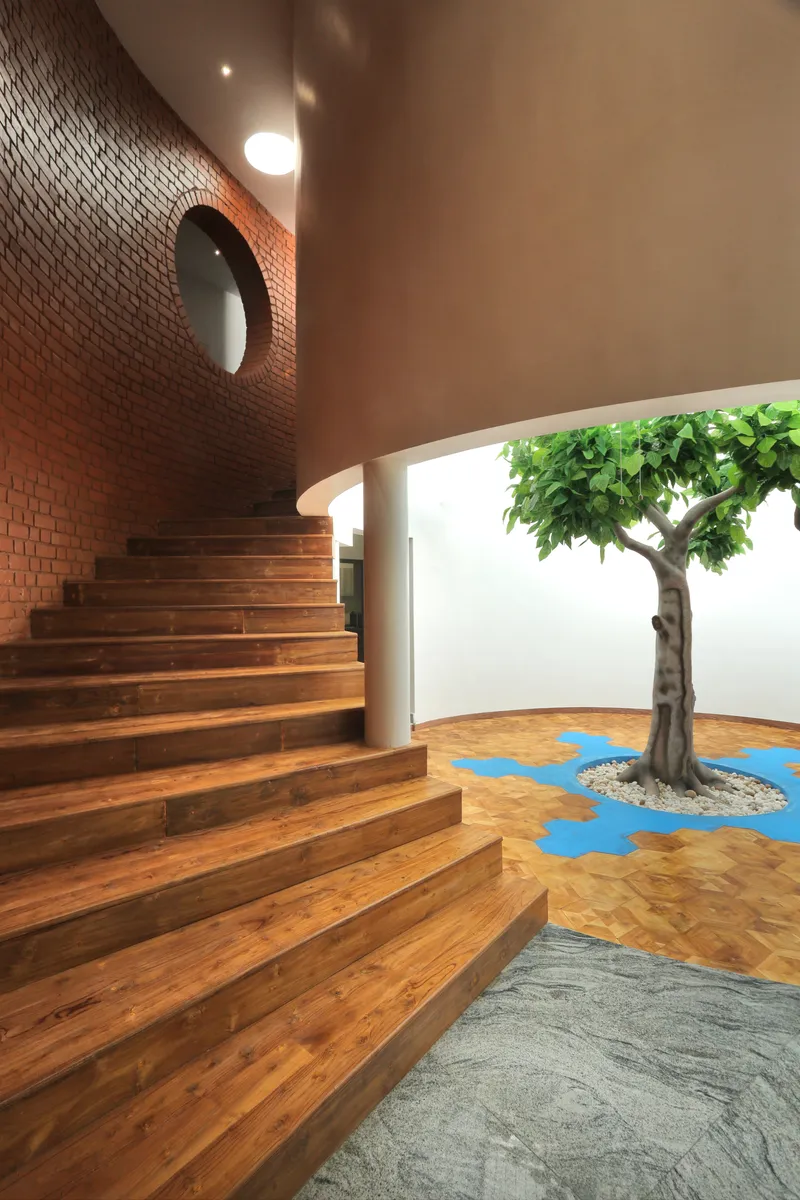
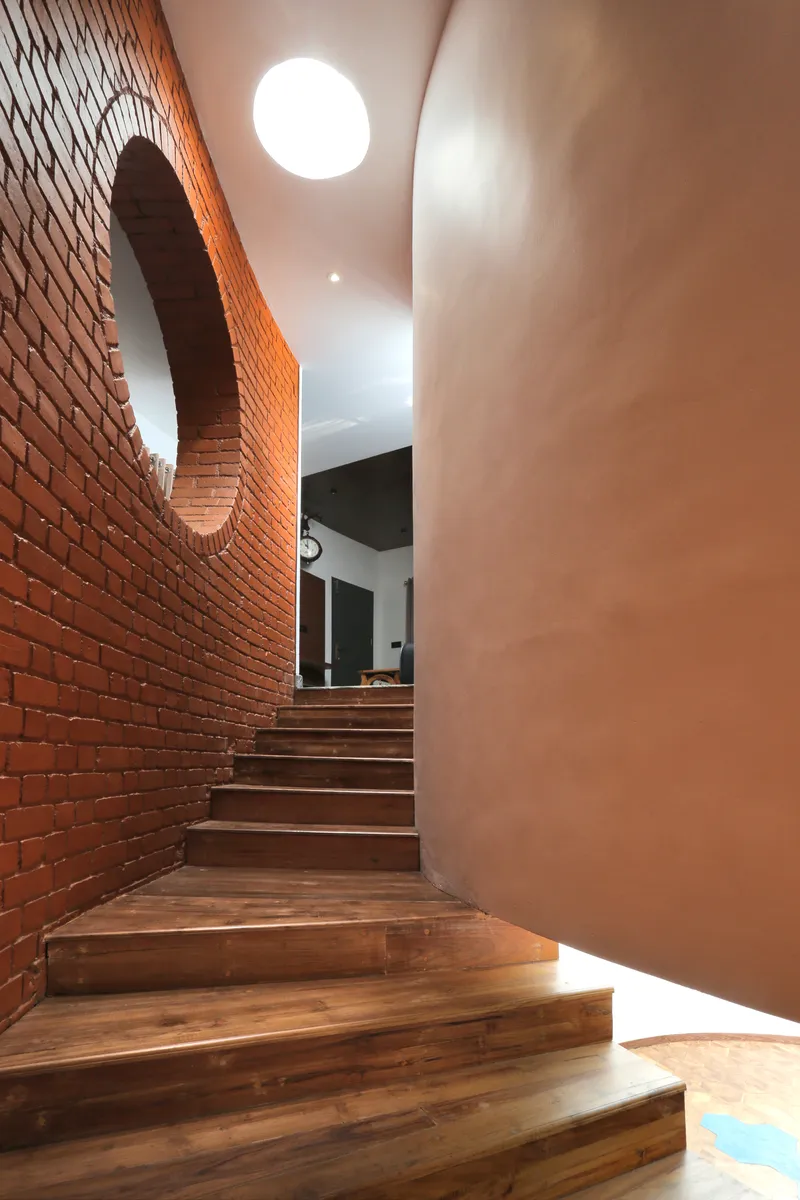
The curved brick wall does not stop at the boundary between landscape and building. Inside, it wraps upward to form the staircase enclosure, and the architects exploit the moment fully. Timber treads spiral against the exposed brick surface, lit from above by a ceiling oculus that washes the masonry in a warm column of light. A smooth plastered column stands in counterpoint to the rough brick, giving the stair a haptic variety that makes each landing feel distinct.
The staircase is the single element that most clearly expresses the project's thesis: that one continuous gesture, the curved wall, can absorb multiple roles. Outside it is a boundary. In the courtyard it is a screen. Here it is structure, enclosure, and ornament all at once, and the transition between those roles is seamless because the material never changes.
Circular Openings and Threshold Moments
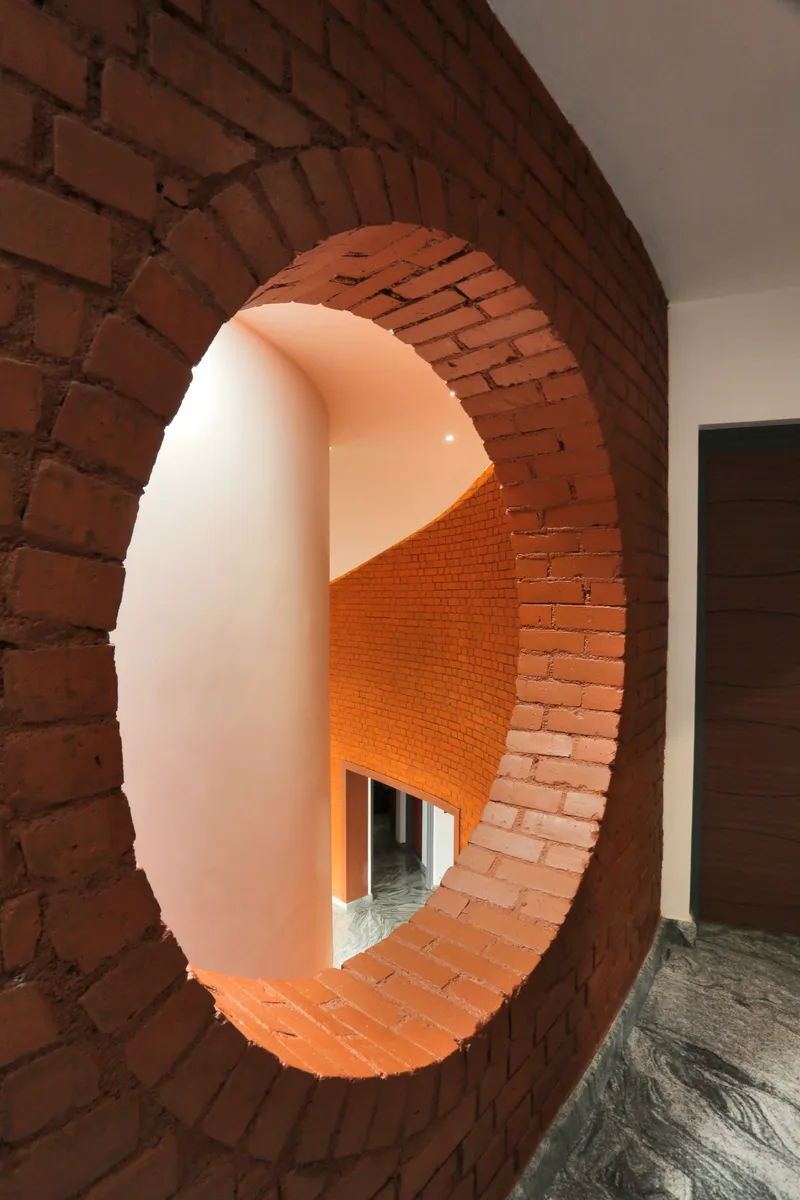
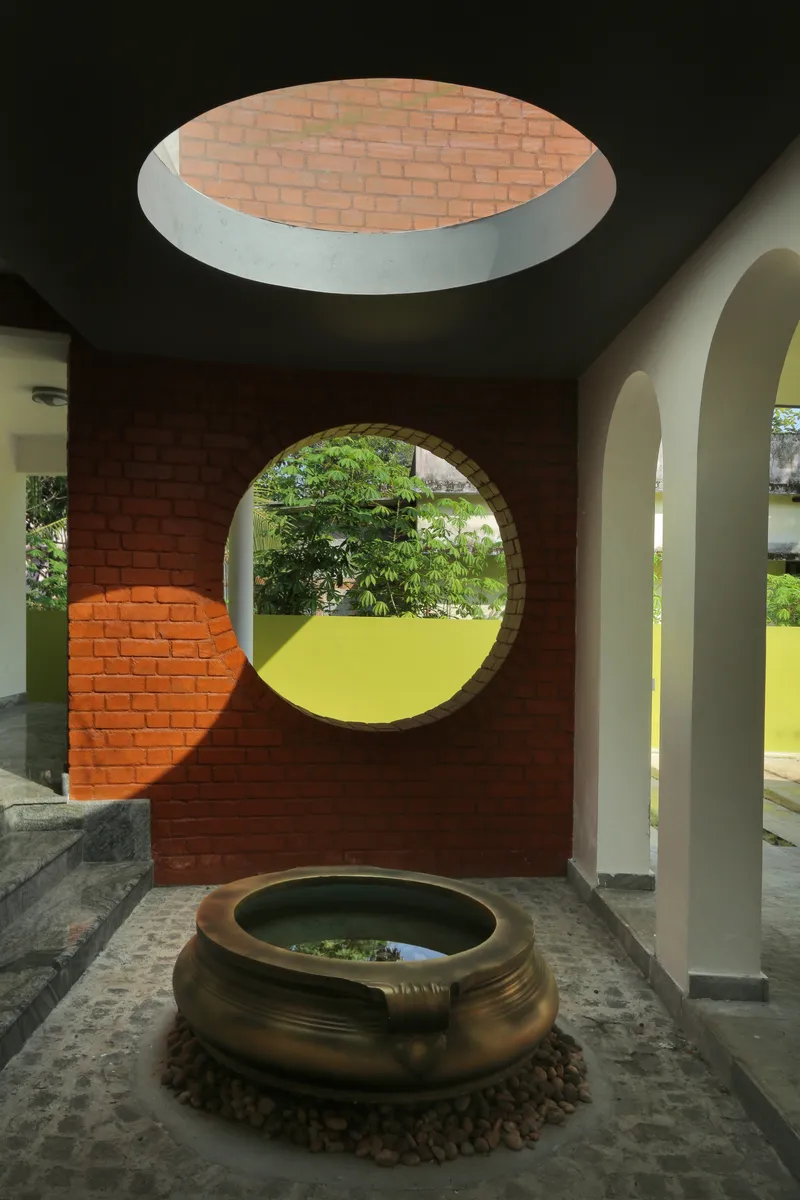
S Squared Architects use circular openings as punctuation marks throughout the house. A brick oculus in the ceiling frames a brass water vessel below and opens onto the green landscape beyond. A round portal punched through a brick partition frames the curving stairwell in warm artificial light, turning a functional passage into a composed vignette. These moments are small but they accumulate, giving the house a quality of deliberate framing that rewards slow movement.
The circles echo the plan's central courtyard and reinforce the curvilinear vocabulary without becoming repetitive. Each one offers a different relationship between viewer, surface, and light, so the motif stays fresh rather than formulaic.
Living Spaces Under the Vault
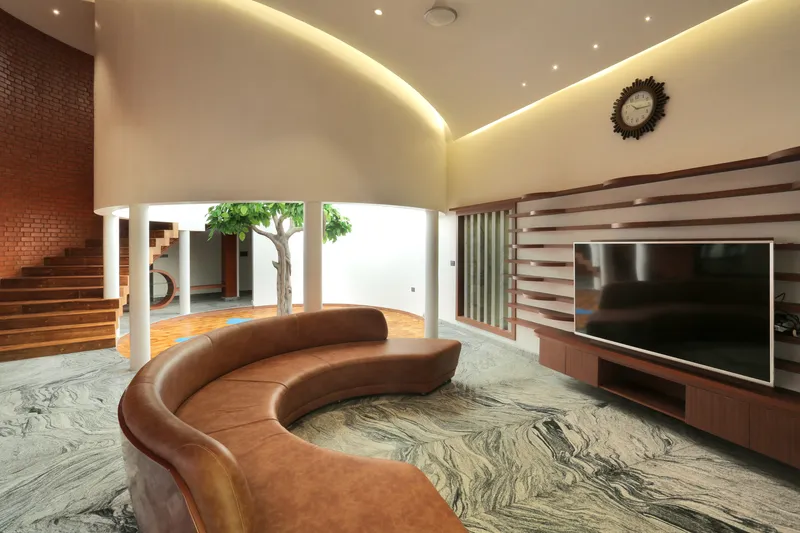
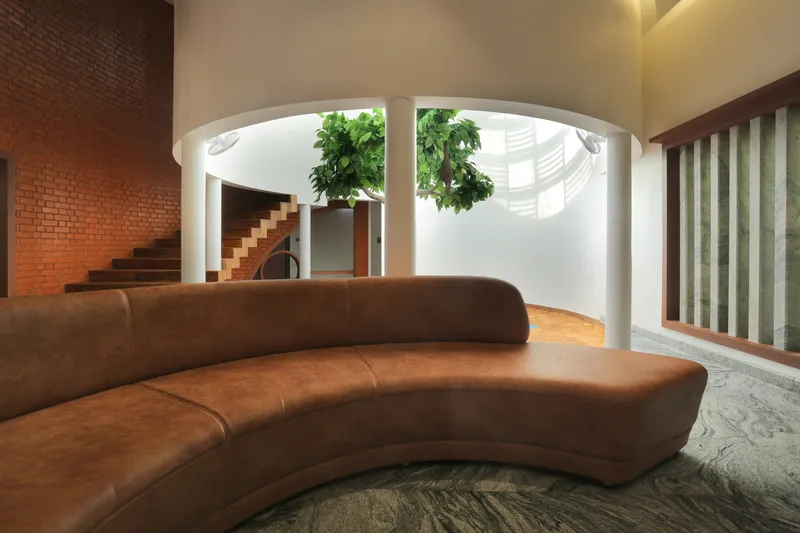
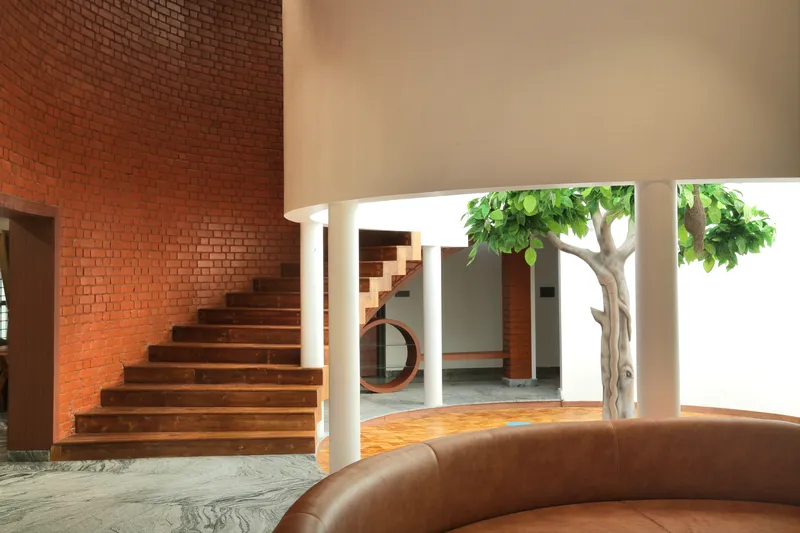
The main living area sits beneath a vaulted ceiling with concealed perimeter lighting that accentuates its curvature after dark. A generous curved leather sofa faces the central courtyard, and beyond it, white columns and the brick stair wall provide depth and layering. The palette is restrained: white plaster, warm timber, brick, leather. There is no accent wall or statement fixture competing for attention; the architecture itself is the furniture's backdrop.
Nearby, the dining zone opens directly onto the courtyard through the staircase bay, so meals happen in visual contact with the tree, the sky, and the changing light. The spatial generosity of a 2700-square-foot plan is amplified by the courtyard's borrowed volume, making the house feel considerably larger than its footprint suggests.
Plans and Drawings
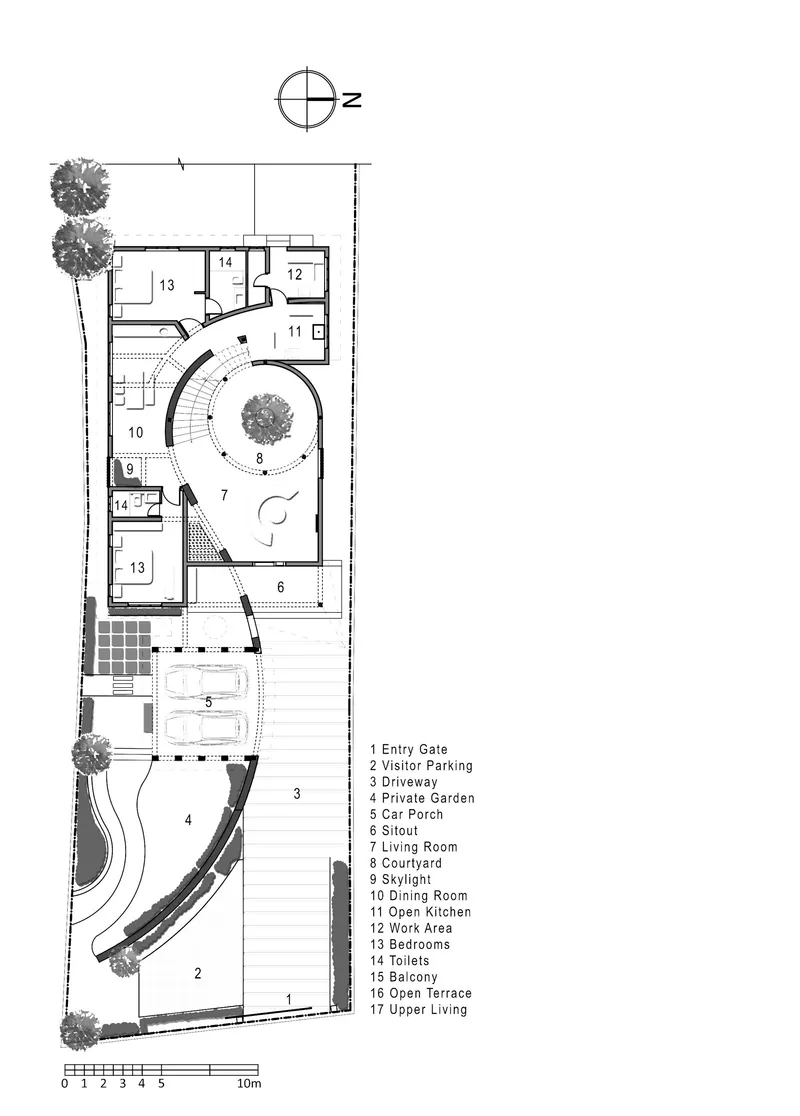
The ground floor plan reveals the full extent of the curved wall's reach: it enters the site from the east, carves the driveway out of the public zone, wraps the circular courtyard, and threads through the living, dining, and stair areas before terminating near the private garden. Rooms are arranged around the courtyard rather than along a corridor, which keeps circulation compact and daylight access universal.
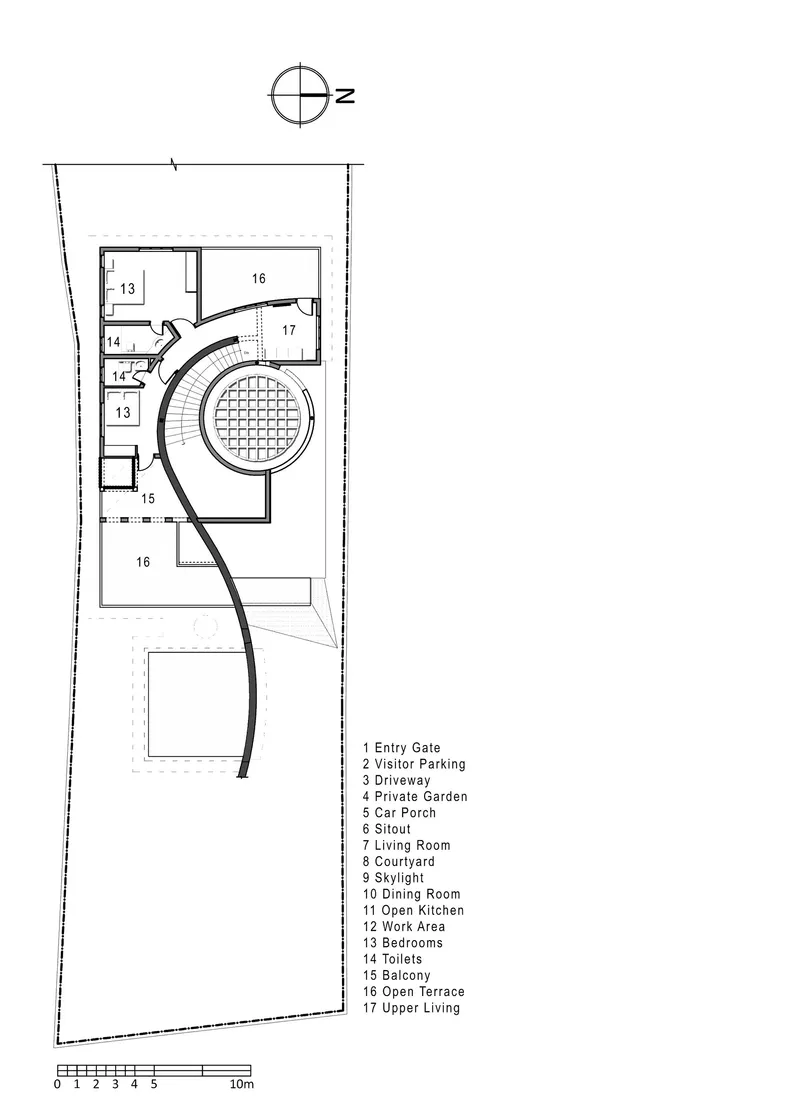
The upper floor clusters the bedrooms near the circular terrace that corresponds to the courtyard below. The plan is tighter upstairs, with less of the fluidity found on the ground level, but the curved wall continues to shape the stair enclosure and outdoor terraces. The relationship between the two levels is legible: public life below, private life above, with the courtyard linking them vertically through light and air.
Why This Project Matters
The Skyward Home is persuasive because its big idea, the single freehand curved wall, does genuine spatial work at every scale. It is not a sculptural flourish applied to a conventional plan. It organizes the site, defines the program, shapes the roof, encloses the staircase, and mediates between a sacred landscape and a domestic interior. That kind of conceptual discipline is rare in residential architecture anywhere, and rarer still in a modest 2700-square-foot house in rural Kerala.
Beyond the formal ambition, the house demonstrates that context does not have to mean pastiche. The sacred grove is respected not through imitation of temple forms but through a clear spatial strategy that keeps noise, cars, and activity on one side and quiet contemplation on the other. S Squared Architects have produced a house that is simultaneously local in its materials and rituals and contemporary in its spatial thinking, and that combination is exactly what good regional practice looks like.
The Skyward Home by S Squared Architects (lead architects Shaji V Vempanadan and Sumi Shaji), located in Haripad, Kerala, India. 2700 sq ft. Completed in 2019. Photography by Khan and Baker.
About the Studio
Share Your Own Work on uni.xyz
If projects like this are the kind of work you want to make, uni.xyz is a place to publish your own, find collaborators, and enter design competitions.




Popular Articles
Popular articles from the community

REBIRTH: Sustainable Architecture Shaped by Community, Resilience and Renewal
REBIRTH uses sustainable architecture, circular design, local materials and shared spaces to restore community, dignity and hope for widows.
A Reinforced Cocoon: Vernacular Architecture for Security, Healing and Community in Qandahar
A Reinforced Cocoon reimagines Afghan vernacular architecture as secure community space for widowed women, families, healing and resilience.

Riyadh For All: Intergenerational Urban Design for Active Aging in Rabat
Riyadh For All reimagines urban design in Rabat with intergenerational co-living, adaptive courtyards, and Moroccan cultural exchange today.
EW PARK: Sustainable Architecture Reimagines the Future of Urban Parking
EW PARK reimagines city parking as a modular wooden tower combining automation, solar energy, electric mobility, and adaptable urban design.

Similar Reads
You might also enjoy these articles

Bao Huynh Watercolor Atelier: A Serene Art Retreat in Hội An
Bao Huynh Watercolor Atelier in Hội An blends multifunctional art spaces, sustainable design, local materials, and family-friendly living in a serene environment.

Atelier Macri Concept Store Interior Design by CASE-REAL
Atelier Macri store features a "ko" counter, walnut wood details, cork displays, blending retail, gallery, and seamless customer experiences.

Manuel Vargas Izquierdo Stadium and High-Performance Sports Center: Architectural Excellence in Jalpa de Méndez
The Manuel Vargas Izquierdo Stadium blends sustainable design, inclusive sports facilities, and cultural-inspired architecture, revitalizing Jalpa de Méndez’s public spaces.

KAKR Buluh Awar Hall: Revitalizing Community and Ecology Through Bamboo Architecture
Community built bamboo hall revitalizes Buluh Awar village, empowering youth, restoring ecology, celebrating vernacular craftsmanship through sustainable architecture and culture.
Explore Residential Building Competitions
Discover active competitions in this discipline



The Global Benchmark for Architecture Dissertation Awards


Challenge to design mud housing for contemporary communities
Comments (0)
Please login or sign up to add comments
No comments yet. Be the first to comment!