

Quran Memorization Institute: Concrete, Water and Calibrated Light as the Grammar of Focus
A shortlisted Interiors '20 entry that trades religious iconography for sequence, shadow and silence, shaping a building that teaches by withdrawing.


Most sacred buildings announce themselves. Domes, minarets and ornament tell the city what happens inside before anyone crosses the threshold. The Quran Memorization Institute takes the opposite position. It asks how a religious building should feel rather than how it should look, and it answers with a reduced vocabulary of light, material, proportion and silence. For a programme built around memorization, an act that depends on sustained concentration, that restraint is less a stylistic preference than a functional necessity.
Designed by Reparametrize Studio, the proposal was shortlisted in the Interiors '20 competition. The designers describe the Institute as a fragment of the city, embedded in its context yet running at a different tempo. It combines places for individual study with larger rooms for communal learning, and it arranges them as a choreographed passage from the noise of daily life into a state of introspection.
A Hall Where Sunbeams Do the Work of Ornament
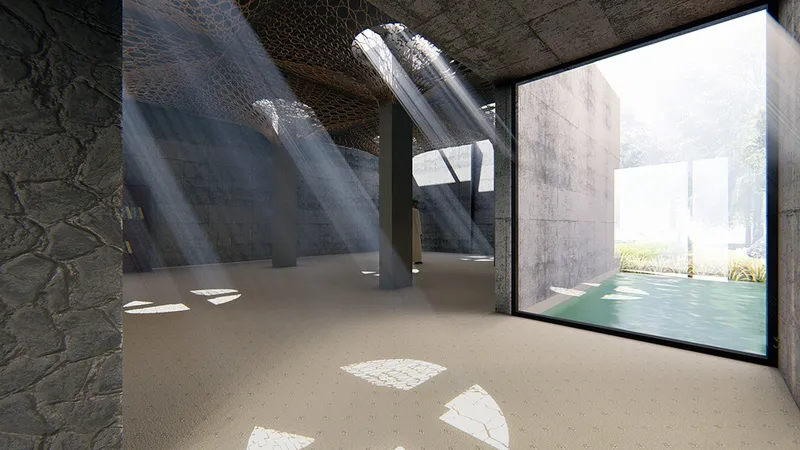
The main interior hall makes the project's argument in a single frame. Concrete columns hold up a lattice ceiling, and the lattice filters daylight into discrete beams that fall across the carpet. A corner window opens onto a pool, offering one controlled view outward instead of a wall of glass. Nothing here is decorative in the conventional sense, yet the room is far from blank: the pattern comes from sunlight moving across surfaces through the day.
That shifting pattern matters for the programme. The designers frame the moving shadows as temporal markers, a quiet clock that registers the passage of hours while keeping occupants anchored in the present. For students repeating and retaining text over long sessions, a room that changes slowly and without distraction is a well-judged environment. Light becomes an instrument for directing attention, not a fixture for general illumination.
A Washroom Treated With the Same Seriousness as the Prayer Hall
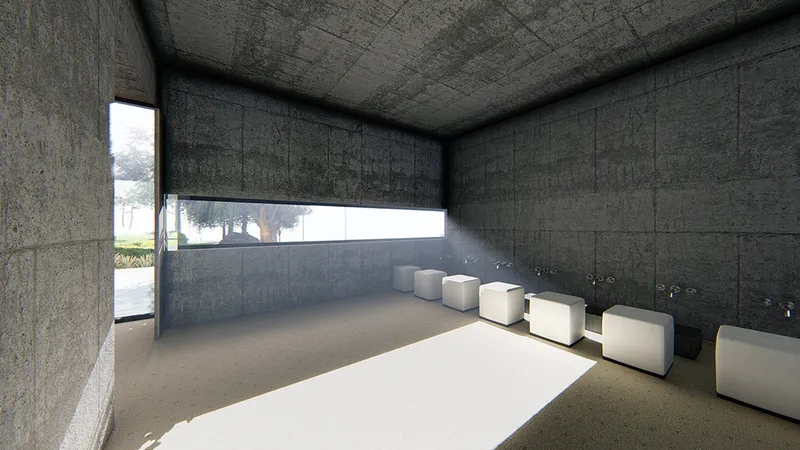
Service spaces are usually where conceptual rigour falls away. Here the washroom carries the same discipline as the hall. A row of white basins lines one concrete wall, and a long ribbon window runs above them, letting sunlight pool on the floor. The horizontal opening keeps views limited while still bringing in daylight, consistent with the project's habit of framing nature in narrow slots rather than presenting it as scenery.
The decision deserves credit. The designers describe a sequence in which every space shifts subtly in scale, light intensity and acoustic quality, and in which thresholds are deliberate rather than incidental. Extending that attention to the washroom keeps the experience continuous. Nowhere does the building drop back into the generic, and nowhere does the meditative rhythm break.
A Monolithic Front That Sits Still in Water, by Day and by Night
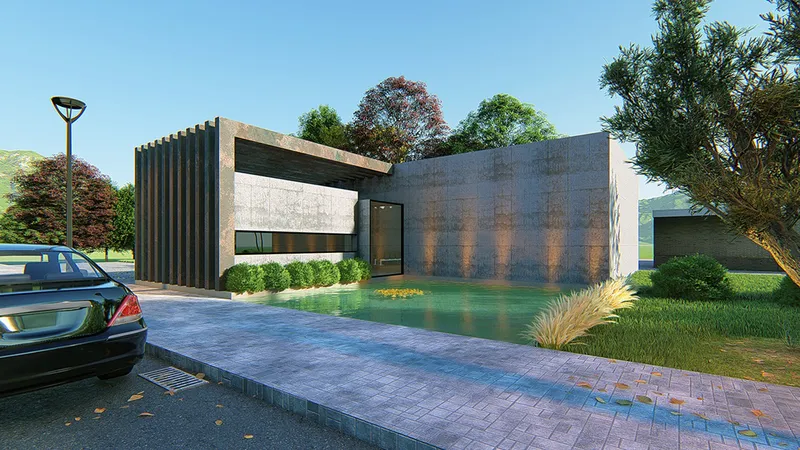
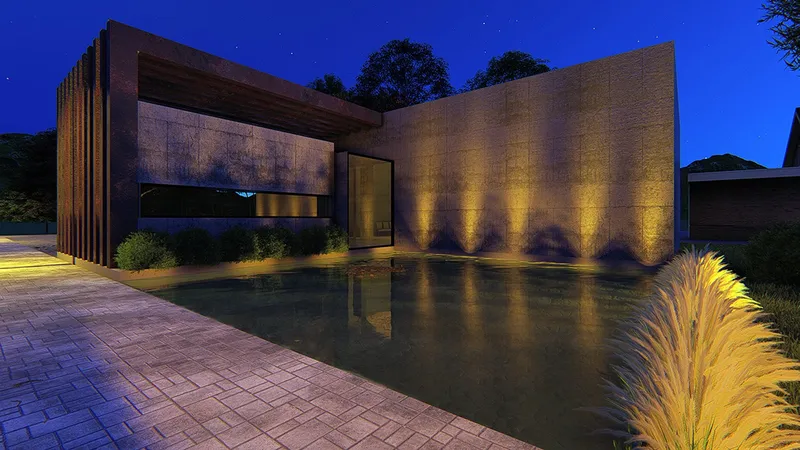
From the outside, the Institute reads as restrained and grounded. The entrance facade pairs board-formed concrete with vertical timber fins, and a shallow pond runs along its base, edged with pampas grass. The timber softens the concrete without competing with it, and the fins temper what is visible and what enters. The water sets the building slightly apart from the street, forming a first threshold before any door is reached.
At night the same composition turns inward. Uplights wash the concrete, the still pond doubles the facade, and the pampas grass glows in the foreground. The material palette, which the designers describe as raw and textured to evoke permanence and humility, holds up under both conditions. The building does not try to impress the passer-by; it offers a calm, legible surface that signals a place of quiet without resorting to symbols.
Why This Project Matters
The Quran Memorization Institute is a useful counterpoint to a discourse in which sacred architecture is often judged by its silhouette. By locating the sacred in atmosphere and sequence, Reparametrize Studio produces a building whose character depends on how it is occupied over time: how light crosses a carpet, how a view of water is rationed, how a concrete wall holds the warmth of the afternoon. The approach is tightly linked to the programme, since a place for memorization benefits directly from an architecture that removes distraction.
The proposal also demonstrates that restraint requires consistency. A reduced palette of concrete, timber, water and greenery only works if it is applied everywhere, from the main hall to the washroom to the entrance pond, and the project sustains that discipline across every image. For students and young designers working on religious or contemplative briefs, it offers a clear lesson: identity can emerge from the quality of the experience itself, without borrowed iconography.
View the Full Project
About the Designers
Designer: Reparametrize Studio
Enter a Design Competition on uni.xyz
uni.xyz runs architecture and design competitions year-round that reward proposals with spatial conviction and real site intelligence.
Project credits: Quran Memorization_ Reparametrize Studio by Reparametrize Studio Interiors '20 (uni.xyz).


Popular Articles
Popular articles from the community


David Macias Steps a Doorless Stone and Plaster House Down a Tropical Colombian Hillside
In the humid hills of Colombia, Threshold House replaces the front door with an open void and terraces its 850 m² down the slope instead of fighting it.

David Ortega Stacks a Two-Story Mexico City Penthouse Around a Steel Stair and a Pergola-Shaded Roof Terrace
In Colonia Roma, a 300 m² penthouse uses oak joinery, a planted steel stair and a slatted roof pergola to make a new-build apartment feel like a house.

Juan García Correa, John González and Claudia Rueda Sink a Circular Amphitheater into a Manizales Engineering Building
On the La Nubia campus in Manizales, Colombia, the S1 Building folds labs and offices into a hillside of ramped lawns that double as a campus route.

LT2A and OPEN Architectes Thread a Brick and Glass High School Through a Wooded Belgian Campus
In Braine-l'Alleud, a 3,000 m² wing for Collège Cardinal Mercier pairs pale brick with a glazed colonnade, deferring to a small chapel and a dense wood.

Similar Reads
You might also enjoy these articles
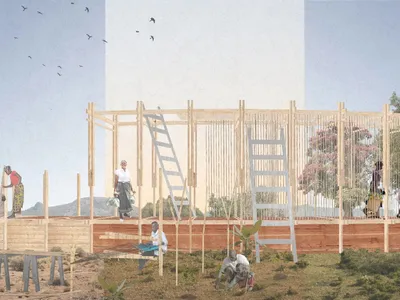
Healing Façade: A Modular Chapel System That Restores Ethiopia's Sacred Forests
Winner of the Eco-Chapel competition, this circular timber façade collects water from air to rebuild soil and reforest degraded Ethiopian landscapes.
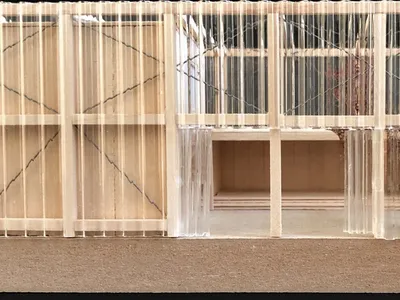
Kaffeebühnen: Where Coffee Shop Architecture Becomes a Civic Stage in Vienna
A linear sequence of timber boxes, transparent shells, and open yards turns the Viennese café tradition into a public performance space.
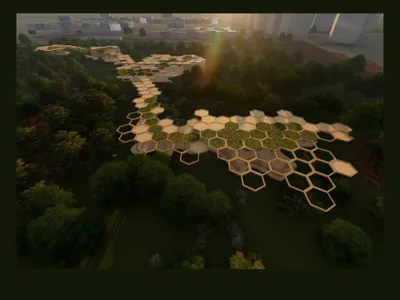
Eco Chapel: A Modular Forest Pavilion That Grows Like the Landscape It Protects
Hexagonal timber modules weave through existing trees, turning a chapel into a living system for prayer, education, and reforestation.


Urban Forest: A Vertical Ecosystem for 5,000 Workers in Singapore's Changi Business Park
Radially stacked pods and layered green decks turn a 7-acre plot into 47 acres of ecological workspace projected for 2040.

Explore Architecture Competitions
Discover active competitions in this discipline

Challenge to reimagine the Iron Throne

Photograph architecture without architects

Illustrate the lost glory of Angkor Wat - Render Challenge

Design challenge to reuse E-waste
Comments (0)
Please login or sign up to add comments
No comments yet. Be the first to comment!