

Sahara Fortopia: A Fortress City for 400,000 People
A speculative fortress-city in the Sahara combining modular construction, gene preservation, vertical farming, and classical urban form at massive scale.


Most desert architecture proposals start small: a house, a shelter, a village. Sahara Fortopia starts with a city for 400,000 people. Designed by Zixuan Lin, Yue Jia, and Chen Jiageng, the project proposes a self-sustaining fortress-city in the Sahara Desert that combines industrial modular construction with ecological systems and classical architectural references.
It received an Honorable Mention in the Extreme Habitat Challenge: Sahara competition on uni.xyz. The ambition of the entry is what sets it apart: this is not a prototype. It is a complete urban proposition with residential zones, food production, gene preservation, and energy infrastructure.
The Fort as Urban Model
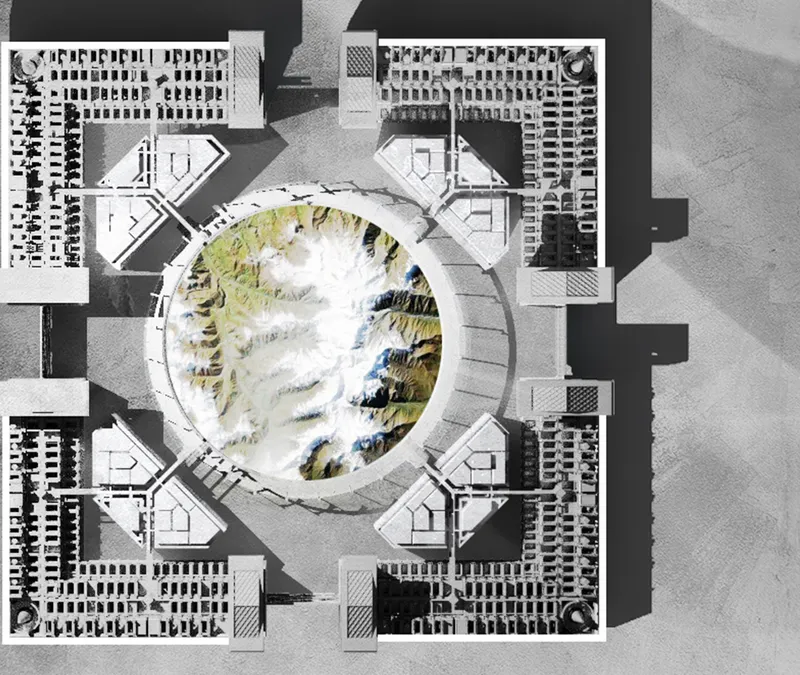
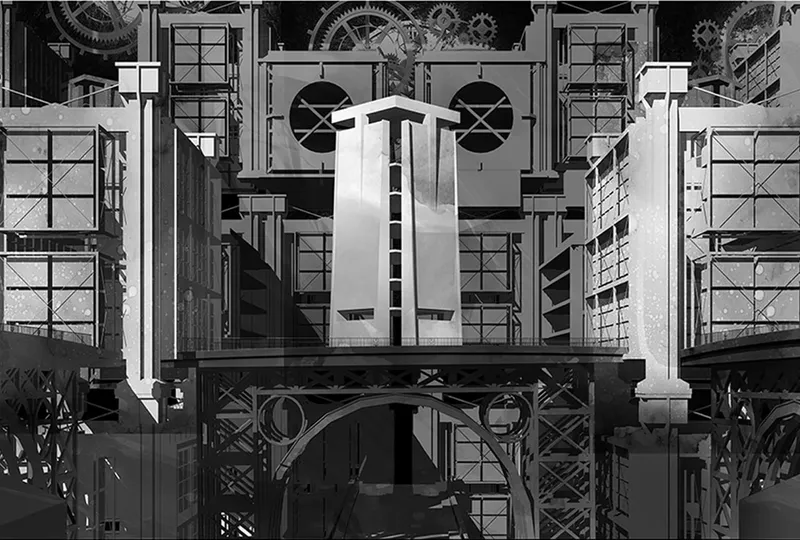
The name tells you the strategy. Fortopia is a fort: a walled, bounded, defensible enclosure that creates a controlled interior environment within a hostile exterior. This is one of the oldest urban forms in human history. Cities in hot, arid climates from North Africa to the Middle East have used it for millennia. The project reinterprets it at modern scale.
Inside the walls, the programme divides into three zones. Residential zones house the population in modular units arranged around colonnaded trading lobbies and living gardens. Producing zones contain laboratories, gene banks, and vertical farms. Ecological zones manage water, energy, and waste in closed loops. Each zone is designed to function independently but connect to the others through shared infrastructure.
Phased Construction: Temporary to Permanent
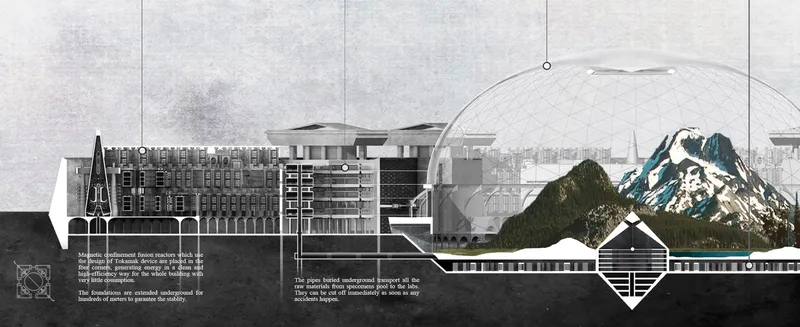
The project proposes a phased build strategy. Initial construction uses temporary structures to shelter workers while permanent zones are established. Once the core is operational, the temporary structures are dismantled or repurposed. This is the same logic used in large-scale engineering projects: build the camp first, then build the city from the camp.
The phasing matters because it addresses the biggest practical objection to megastructure proposals: you cannot build a city for 400,000 people at once. You build it in stages, each stage functional on its own, each stage enabling the next.
The Gene Pyramid and Food Security
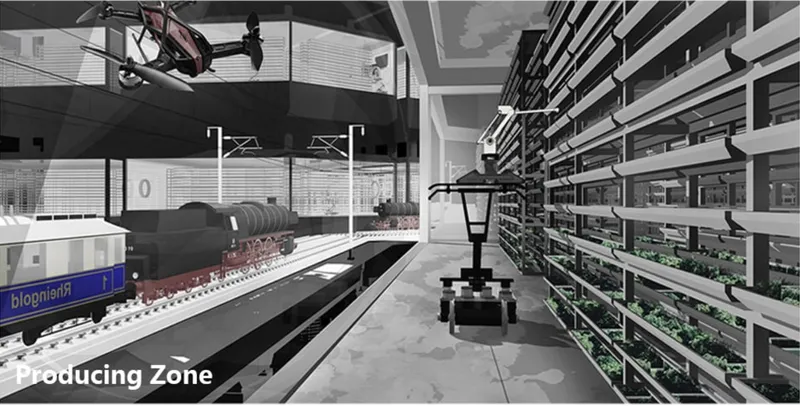
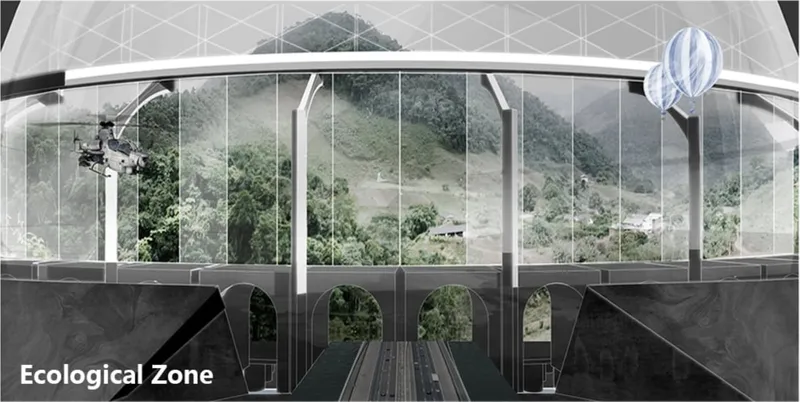
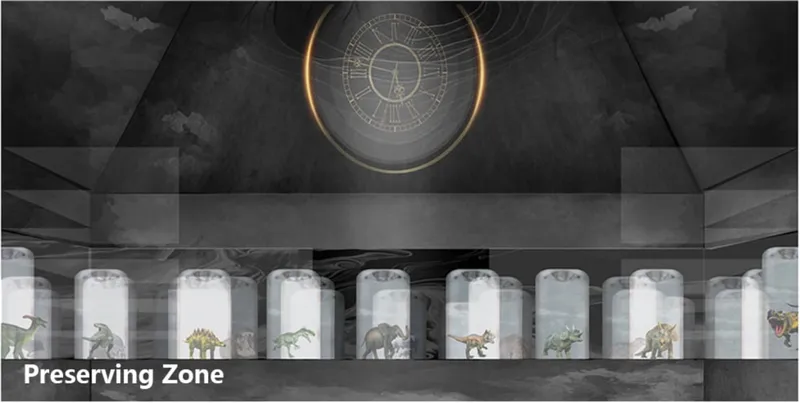
Two of the most distinctive programme elements are the Gene Pyramid, a repository preserving biodiversity through stored genetic material, and the rangeland and greenhouse laboratories that produce food year-round through advanced farming techniques.
The Gene Pyramid is more than a storage facility. It is a statement about what a desert city should value. If you are building a permanent settlement in one of the most biologically sparse environments on earth, preserving genetic diversity is not optional. It is infrastructure. The project treats it that way.
Classical Form, Modern Logic
The architectural language borrows from classical sources: pantheon-inspired symmetry, colonnaded public spaces, monumental scale. This is a deliberate choice, not a stylistic indulgence. Classical forms communicate permanence, order, and civic ambition. In a speculative project about founding a city in the desert, those signals matter. They say: this is not a camp. This is a civilisation.
The symmetrical layout also has a practical function. It simplifies management, navigation, and expansion. Identical zones can be replicated outward without redesigning the plan. The classical grid is, among other things, a modular system.
Why This Project Matters
Sahara Fortopia is a maximalist proposal in a field that tends toward minimalism. While most extreme habitat entries design for dozens or hundreds of people, this one designs for hundreds of thousands. That scale forces different questions: how do you produce enough food? How do you govern? How do you build identity in a new place?
The project does not answer all of these questions. No competition entry can. But it asks them clearly, and it provides a spatial framework in which the answers could be developed. For anyone interested in the intersection of urbanism, ecology, and speculative design, this is one of the more provocative entries the EHC competition has produced.
View the Full Project
About the Designers
Designers: Zixuan Lin, Yue Jia, Chen Jiageng
Enter a Design Competition on uni.xyz
If large-scale speculative urbanism is the kind of work that excites you, uni.xyz runs competitions year-round that reward ambitious thinking across architecture, sustainability, and urban design.
Project credits: Sahara Fortopia by Zixuan Lin, Yue Jia, Chen Jiageng. Honorable Mention, Extreme Habitat Challenge: Sahara (uni.xyz).


Popular Articles
Popular articles from the community


Cube Design Draws an Ecological Corridor Between Two Shenzhen Hills with the Nankai Building
Beside Shenzhen's container docks, the Nankai Building pairs stacked balconies with a climbing green screen to connect two hillsides across its height.


Aquadapt: An Underwater Habitat That Rewrites Its Rooms by the Hour
Curved modules ring the seabed while one shell shifts from breakfast room to cinema, farm and football pitch as residents' needs change.

David Ortega Stacks a Two-Story Mexico City Penthouse Around a Steel Stair and a Pergola-Shaded Roof Terrace
In Colonia Roma, a 300 m² penthouse uses oak joinery, a planted steel stair and a slatted roof pergola to make a new-build apartment feel like a house.

The Amber Palace Opera: A Geological Fiction Surfaces on Tallinn's Baltic Waterfront
Pierre Brillard reimagines a Baltic legend as a public landscape, opera house, and waterfront promenade rooted in Tallinn's coastal identity.

Similar Reads
You might also enjoy these articles

Vereda Arquitetos Renovates a 40-Square-Meter Apartment Inside Niemeyer's Copan Building
A compact unit in São Paulo's most iconic residential tower gets a material overhaul that pairs exposed concrete with bold blue Formica.

Shakur's House: Exposed Brick as an Interior Organiser in a 168 m² Mashhad Residence
Brick moves indoors in this Mashhad residence, where masonry walls, glass partitions and teal planes sequence a compact home without closing it off.

Day and Night Park: A Time-Based Urban Newsstand in Beijing
A temporary urban newsstand in Beijing blending travel, light, and reading through poetic colors, compact form, and community-focused design.

Modernist Patio Renovation in El Masnou, Barcelona by Oliver Segura Arquitectura + Cebrià Arquitectura
Modernist patio renovation blending tradition and innovation with a movable pool, leveled floors, and Catalan materials in El Masnou.

Comments (0)
Please login or sign up to add comments
No comments yet. Be the first to comment!