

Salam: An Interfaith Sanctuary Rising Beside Aleppo's Ancient Citadel
A synagogue, mosque, and church share one roof and a communal hall, proposing civic healing through architecture in a post-conflict city.


Place a synagogue, a mosque, and a church side by side in one of the most war-scarred cities on earth, connect them with a communal hall open to people of every belief and none, and you have a building that is less a provocation than a quiet, stubborn act of faith in coexistence. Salam does exactly that. Sited adjacent to Aleppo's ancient citadel, the project draws on the city's deep spiritual geography to propose something architecture rarely attempts with this degree of sincerity: a single structure that gives equal dignity to three Abrahamic traditions while functioning as a civic gathering space for reconciliation.
Designed by Eman Tulimat, Salam is a shortlisted entry in the Memory competition on uni.xyz. The brief asked designers to engage with collective memory, and Tulimat responded by immersing herself in Aleppo's layered urban fabric through historical research, demographic study, and the embedded symbolism of the city's religious structures, buildings that range from mosques and churches to synagogues, each narrating a particular era and belief system. The result is a project rooted not in nostalgia but in a forward-looking commitment to civic ethics: non-violence, equity, and mutual understanding.
A Dialogue Between Citadel and Sanctuary
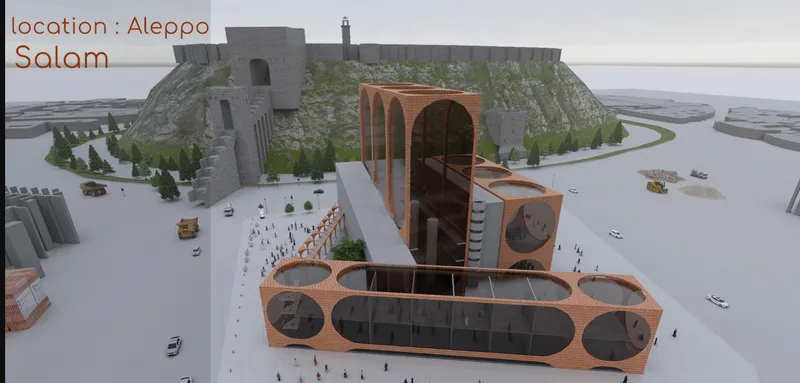
The aerial perspective immediately establishes the building's most consequential relationship: its proximity to the fortified hill of Aleppo's citadel, the dominant landmark of the old city. Tulimat positions the brick-clad volume so that it reads as both a counterpoint and a companion to the ancient fortification. Where the citadel is massive and closed, the new structure perforates its walls with large circular openings, letting light and sightlines pass through. The arched tower rises as a vertical marker, recalling the minaret, bell tower, and watchtower simultaneously without committing to any single typology. It is a deliberate visual and philosophical dialogue between past and future, memory and renewal.
Rhythmic Brick and Circular Light
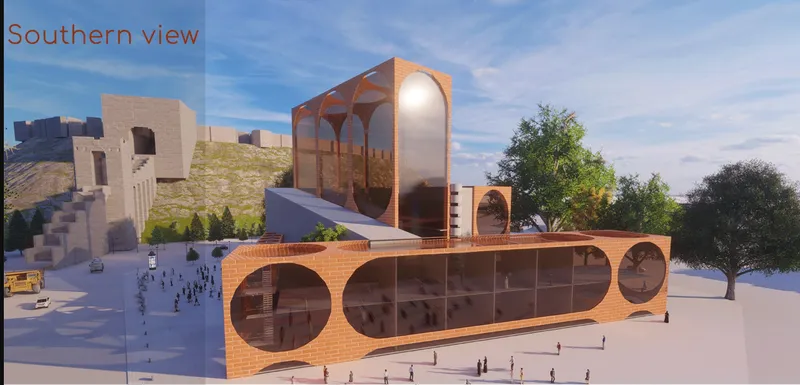
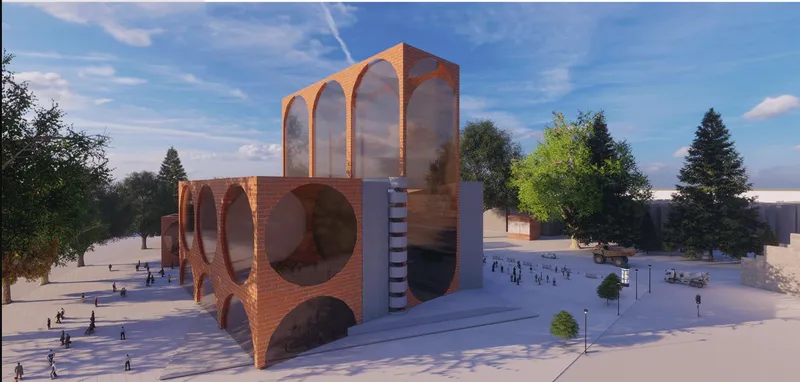
The south-facing elevation reveals the project's formal discipline: an elongated brick volume punctuated by circular glazed openings of varying scale. These apertures do double duty. They flood interior worship and gathering spaces with controlled natural light, and they give the facade a permeability that contradicts the weight of its material. Brick is the dominant cladding, chosen for its resonance with Aleppo's historic construction palette, but it is deployed with clean geometry and rhythmic structural repetition that feels distinctly contemporary. The triple-arched pavilion that rises above the main volume acts as a vertical anchor, gathering the building's identity into a single legible gesture visible from the surrounding plaza.
At ground level, the plaza fills with scattered visitors, suggesting the building's ambition to function as public infrastructure rather than a gated religious compound. Transparency here is achieved not only through glass but through the openness of spatial programming: the central communal hall is designed for interreligious dialogue, shared ceremonies, and public conversations, making the threshold between sacred and civic intentionally porous.
Tiered Forms and Shadow Play on the Plaza
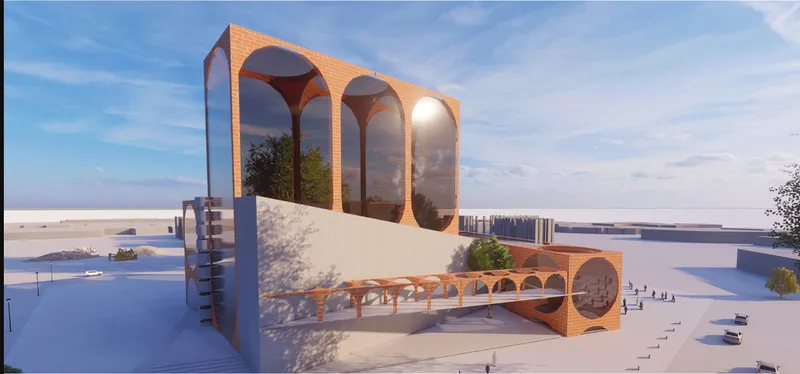
The western view exposes how the massing steps down in tiered brick forms, each level framed by arched openings that cast deep shadows across the white plaza surface. The interplay between solid brick and sharp shadow gives the composition a sculptural gravity that shifts throughout the day, a quality rooted in Aleppo's architectural traditions where arches and courtyards have always modulated light and air. By reinterpreting the historic arch with modern sensibility, Tulimat avoids pastiche while honoring the vocabulary her design inherits. The terracing also creates opportunities for roof-level gathering spaces, extending the building's social program vertically.
Why This Project Matters
Interfaith architecture risks becoming symbolic wallpaper if it treats coexistence as a branding exercise rather than a spatial commitment. Salam sidesteps that trap by giving each religious program its own distinct space while binding them through a shared communal hall that centers human encounter over doctrinal display. The adjacency is meaningful: worship happens in parallel, not in competition, and the connective tissue is a room designed for people who may not share a faith but share a city. In a post-conflict context like Aleppo, where religious sites have been targets of destruction, that spatial proposition carries real weight.
Tulimat's design also demonstrates that engaging with collective memory does not require reproducing the past. The brick materiality, arched forms, and citadel dialogue all anchor the building in Aleppo's architectural lineage, but the circular apertures, clean massing, and open programming push it firmly into a future tense. As a shortlisted entry in the Memory competition, Salam is a compelling argument that the most radical act of remembrance a building can perform is to insist, through its very structure, on the possibility of living together again.
View the Full Project
About the Designers
Designer: Eman Tulimat
Enter a Design Competition on uni.xyz
uni.xyz runs architecture and design competitions year-round that reward proposals with spatial conviction and real site intelligence.
Project credits: uni.xyz by Eman Tulimat Memory (uni.xyz).


Popular Articles
Popular articles from the community


Singing Woman: An Opera House That Performs Before the Curtain Rises
Ovidiu Cristian Pavel's conceptual opera house translates Estonia's choral identity into a sculpted waterfront landmark facing the Baltic Sea.
Cloaked Colonization: A Mobile Underwater Habitat That Moves Like a Fish
Micah Abaya's shortlisted EHC Pacific entry reimagines ocean settlement as a dispersed network of self-sustaining architectural organisms.
Extended Shell: Retrofitting Kolkata's Balconies as Living Urban Thresholds
A modular retrofit system recovers the social and environmental intelligence of Kolkata's historic verandas for contemporary Park Street residents.
Tsunami Convergenics: Turning Catastrophic Ocean Forces into Underwater Housing Infrastructure
A speculative underwater settlement off the coast of Onagawa, Japan, treats tsunamis and typhoons as energy sources rather than threats.

Similar Reads
You might also enjoy these articles

Shakur's House: Exposed Brick as an Interior Organiser in a 168 m² Mashhad Residence
Brick moves indoors in this Mashhad residence, where masonry walls, glass partitions and teal planes sequence a compact home without closing it off.

Day and Night Park: A Time-Based Urban Newsstand in Beijing
A temporary urban newsstand in Beijing blending travel, light, and reading through poetic colors, compact form, and community-focused design.

Modernist Patio Renovation in El Masnou, Barcelona by Oliver Segura Arquitectura + Cebrià Arquitectura
Modernist patio renovation blending tradition and innovation with a movable pool, leveled floors, and Catalan materials in El Masnou.

Alto Residencial Coop: Cooperative Housing Development in Santiago de Compostela by Carbajo Barrios Arquitectos
A linear cooperative housing complex blending white volumes and perforated metal façades, enhancing community living, natural light, privacy, and urban integration.

Explore Arabic Architecture Competitions
Discover active competitions in this discipline

Challenge to design locus for the upliftment of human rights

Bring back Drive In's

Design challenge to reuse E-waste
Comments (0)
Please login or sign up to add comments
No comments yet. Be the first to comment!