
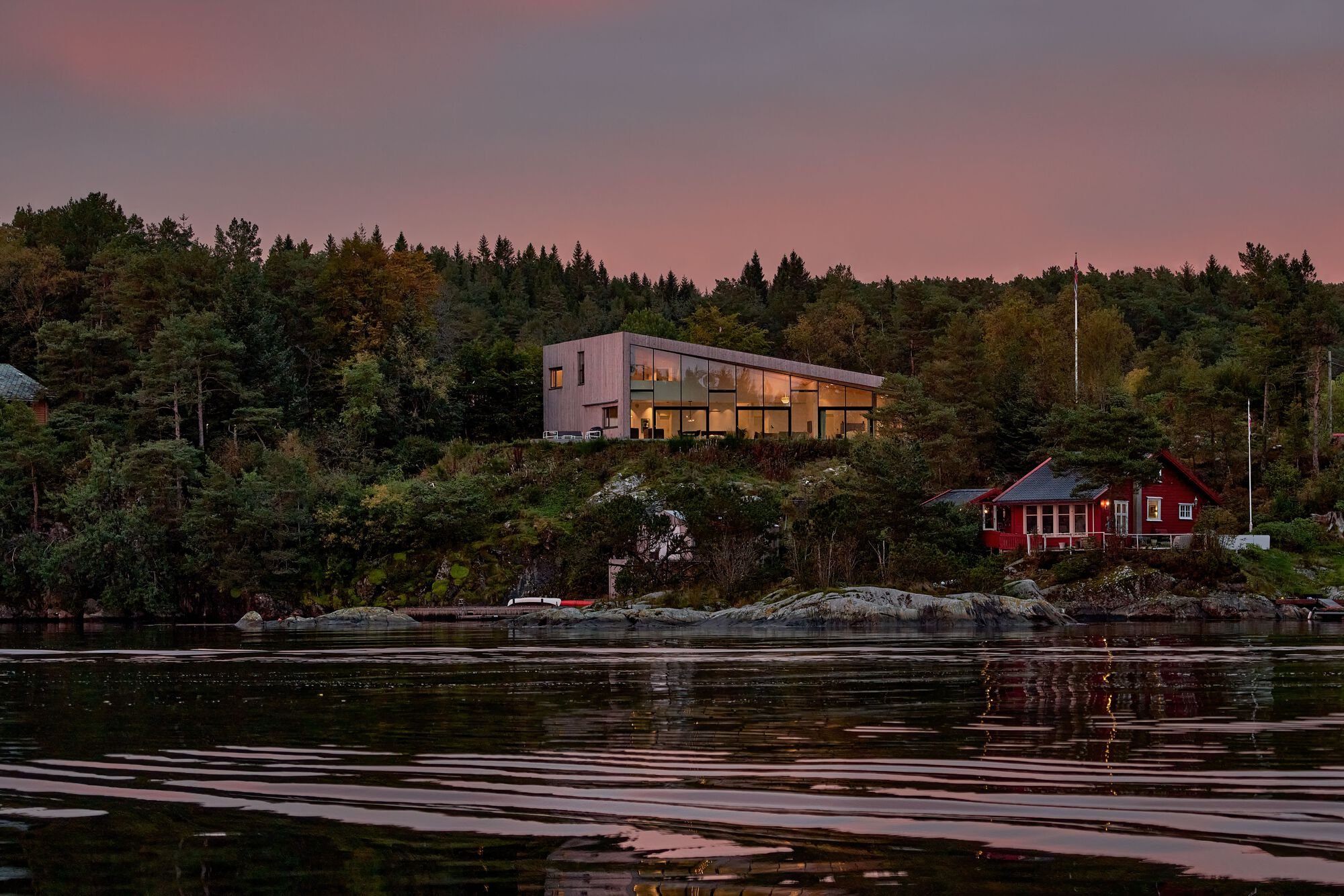
Saunders Architecture Perches a Grey Timber Villa on a Bergen Hillside Overlooking the Fjord
Villa Grimseiddalen trades square footage for specificity, giving a Norwegian family a compact home tuned to water, weather, and light.

Downsizing is rarely the narrative arc we associate with a bespoke house commission. More often, an architect is asked to maximize: more rooms, more volume, more spectacle. Villa Grimseiddalen, completed by Saunders Architecture in 2018, reverses that impulse. The clients left a larger home behind, asking Todd Saunders to design something smaller, more deliberate, and more attuned to the sloping terrain south of Bergen where the fjord meets a gentle hilltop. At 304 square meters, the result is not tiny, but it is compact enough that every decision counts.
What makes the project worth examining is the way it resolves competing demands. The house needs to face the open water and drink in the light, but it also needs to protect its inhabitants from the raw exposure of a Norwegian hillside. It needs to feel rooted in the landscape without mimicking some pastoral cliché. And it needs to accommodate change, because families grow and shift and repurpose rooms. Saunders threads all of these needles with a grey timber volume, a mono-pitch roof, and a remarkably disciplined floor plan that puts everything essential on the ground level while stacking secondary spaces above.
Sitting on the Brow
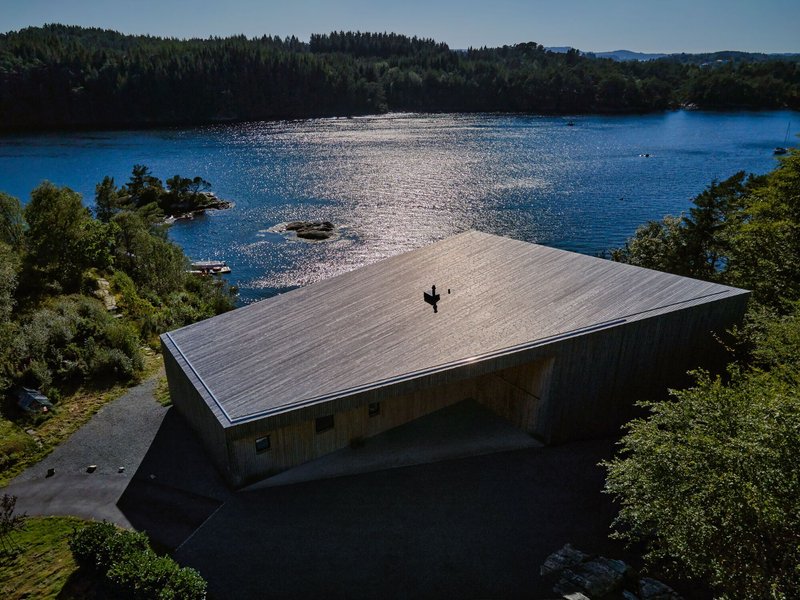
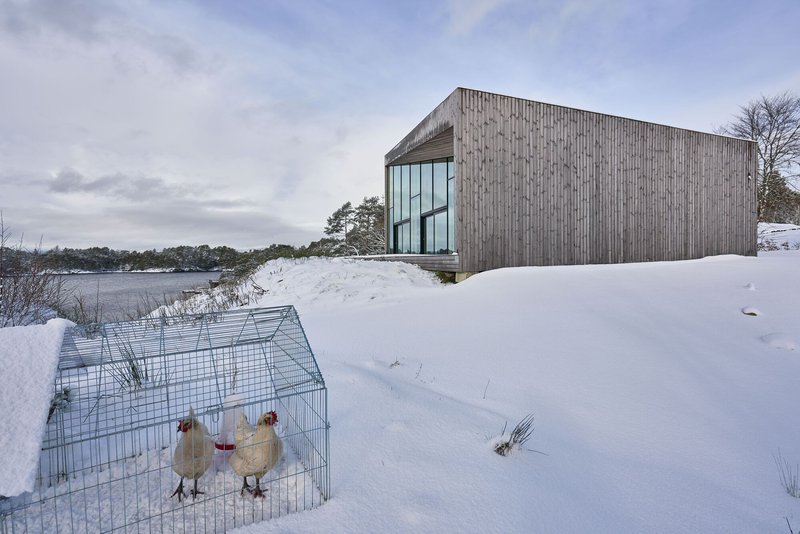
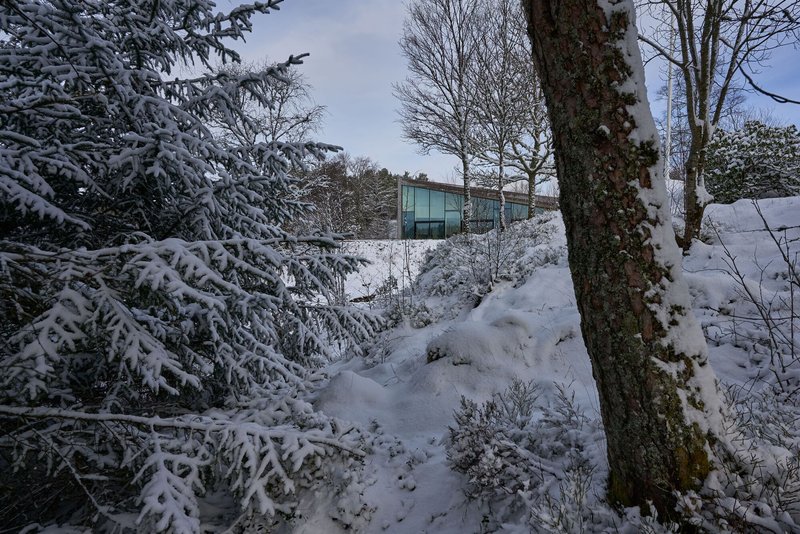
The site strategy is the backbone of the project. The house sits on the gentle brow of a hill, positioned so that its longest elevation faces the fjord while its narrower profile addresses the approach. From the air, the low-pitched roof reads as an extension of the terrain, its timber surface blending with the surrounding birch canopy. In winter, when snow blankets the slope, the building almost vanishes into the hillside, a grey wedge surfacing from white.
A separate boat house and pontoon sit at the water's edge below, establishing the property as a vertical sequence: fjord, rocky shore, slope, house, sky. The semi-rural setting balances proximity to Bergen with genuine isolation. You are close enough to a city for daily life, but the view from the living room suggests otherwise entirely.
The Grey Timber Envelope
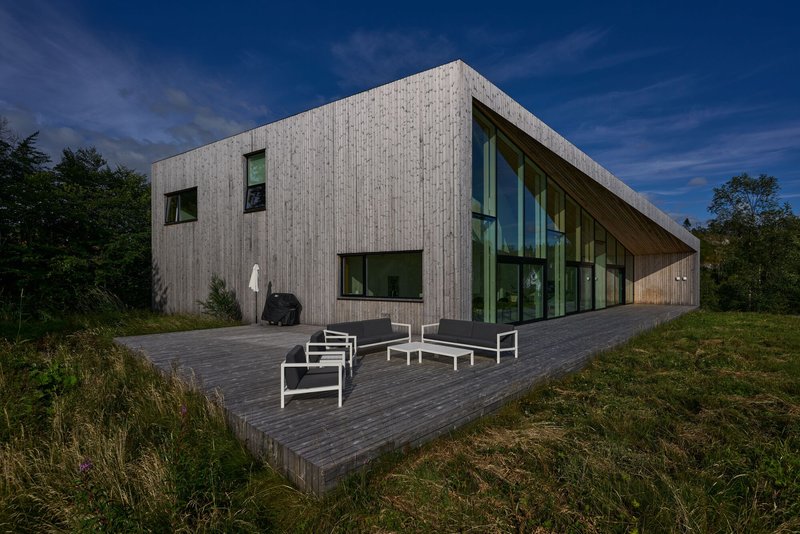
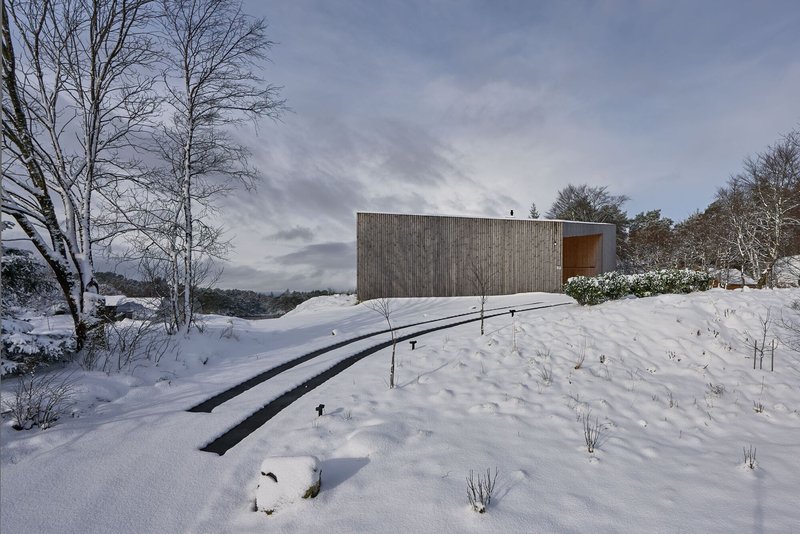
Saunders clads the entire volume in grey timber, a material that weathers convincingly in Norway's wet climate and avoids the self-conscious slickness of darker stained wood. The vertical boards run uninterrupted across the facades, with windows punched through at seemingly irregular intervals. The effect is restrained but not austere. A cantilevered timber deck pushes out from the upper level, offering an outdoor room that floats above the slope.
In snow, the grey cladding reads as a neutral midtone between the white ground and the dark trunks of leafless birches. In summer, it recedes behind the green of native grasses and wildflowers that Saunders has allowed to creep right up to the base of the building. There is no manicured lawn forming a buffer zone. The landscape meets the architecture without negotiation.
Glass Toward the Water
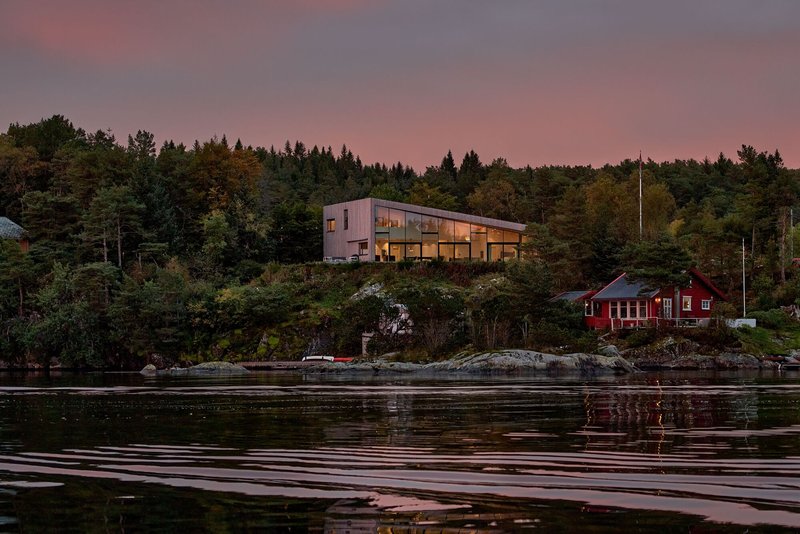
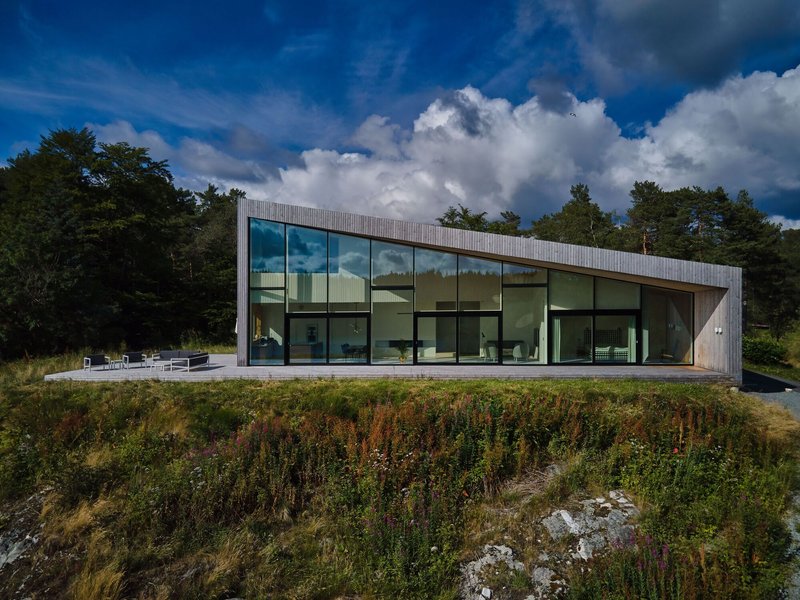
The fjord-facing elevation is almost entirely glass, a bank of floor-to-ceiling panels that transforms the living space into a viewing instrument. At dusk, the illuminated interior glows against the rocky shoreline below, and the glass facade becomes a lantern visible from the water. During the day, the reflective surface bounces clouds and sky back at the landscape, making the house alternately transparent and mirror-like depending on the angle of approach.
This is where the mono-pitch roof earns its keep. By angling the roofline upward toward the fjord, Saunders maximizes the height of the glass wall on the view side while keeping the back of the house low and sheltered. It is a familiar Scandinavian move, but the proportions here are carefully tuned. The glass never overwhelms the timber. The house looks out without feeling exposed.
Living at Ground Level
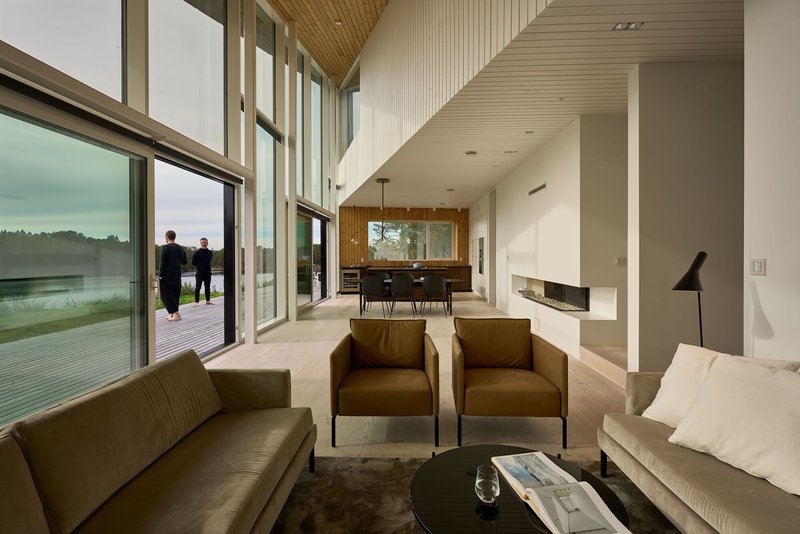
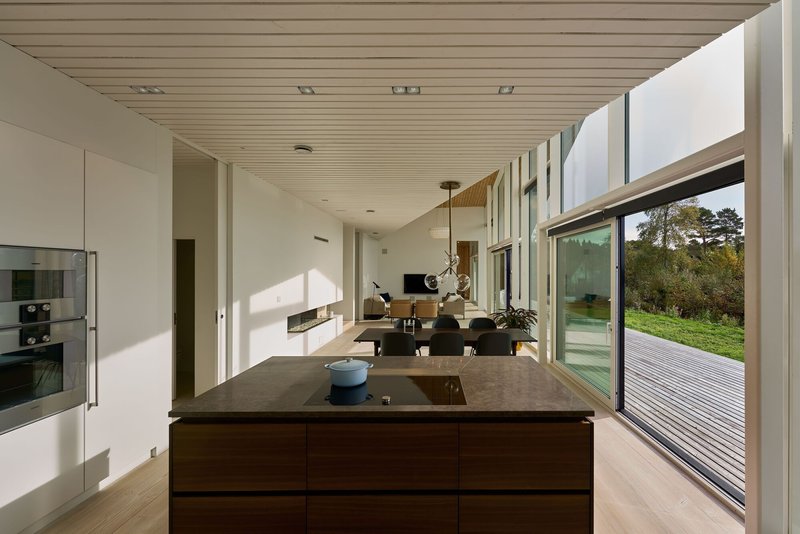
The ground floor is organized as a continuous open plan: kitchen, dining, and living areas flow together under a timber ceiling that runs the full depth of the building. The palette is warm wood and white surfaces, pared back so the fjord view does the heavy lifting. Two figures on the terrace beyond the glass wall suggest the scale: the ceiling height is generous but not lofty, and the room feels domestic rather than monumental.
The master suite also sits on this level, which means the house can function entirely on one floor if circumstances demand. That is the flexibility Saunders is known for: not mechanical gadgetry or movable walls, but a spatial logic that accommodates life stages without renovation. When the children leave, the upper floor becomes guest space or studio. The ground floor holds everything a couple needs.
Upstairs and the Timber Stair
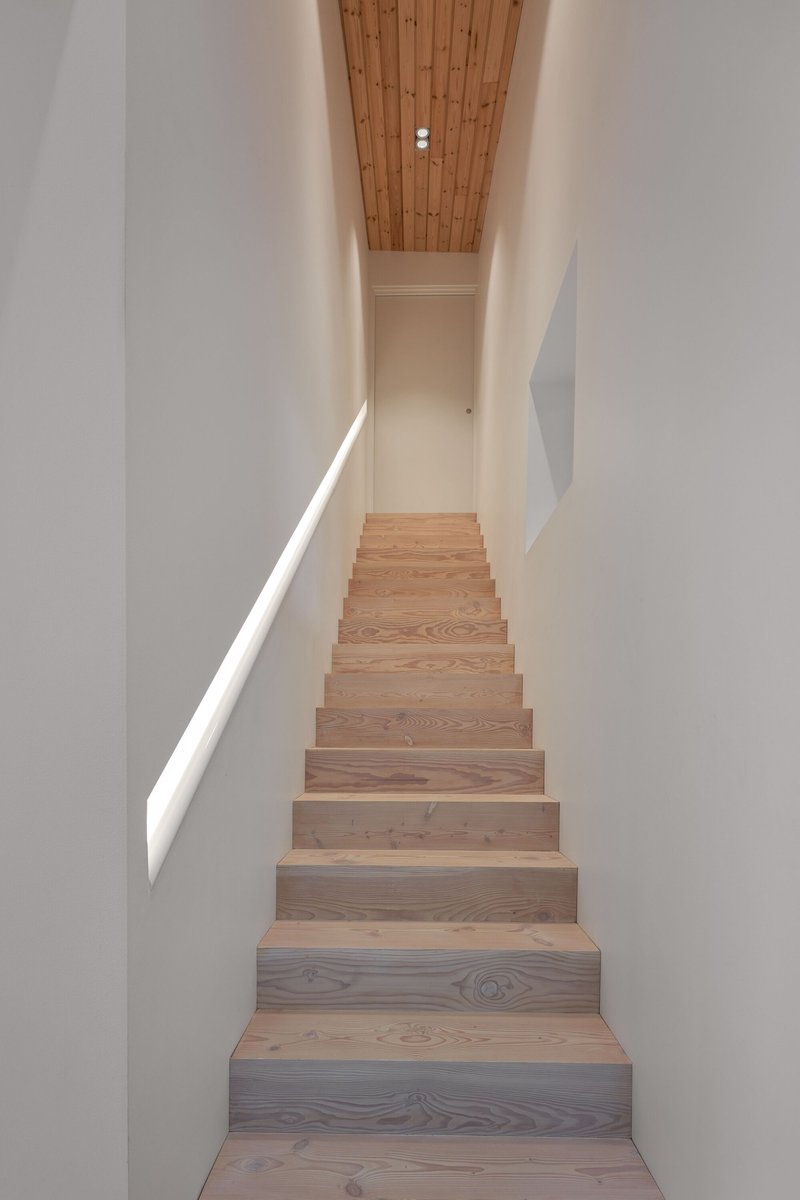
A timber staircase ascends between white walls, lit by a narrow slit window that draws a line of daylight along the climb. The wood-paneled ceiling overhead continues the material language from the ground floor, binding the two levels together. It is a tight, almost compressed transition, which makes the arrival on the upper floor feel like an expansion.
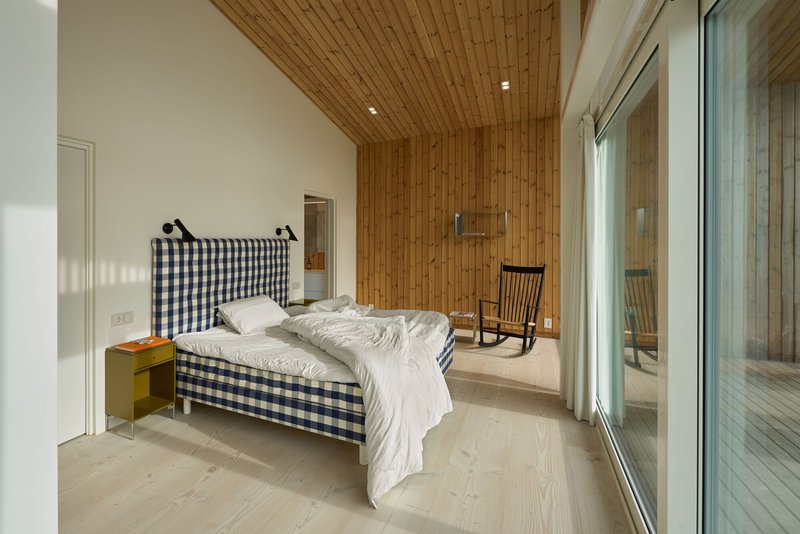
Upstairs, two children's bedrooms and a media room occupy the narrower end of the wedge-shaped plan. A bedroom with a timber accent wall opens to its own glass-walled terrace, offering an intimate, framed view of the landscape distinct from the panoramic sweep below. The upper rooms are smaller, quieter, tucked under the slope of the mono-pitch roof. They feel like a retreat within a retreat.
Plans and Drawings
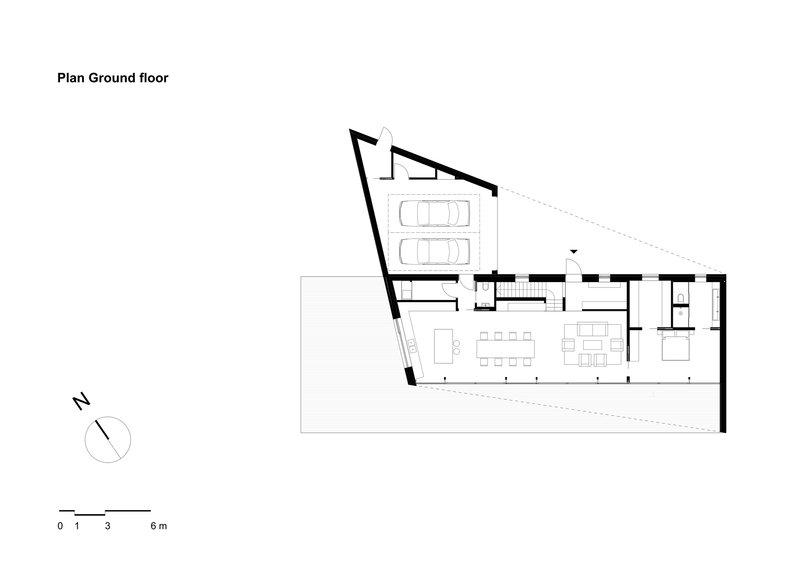
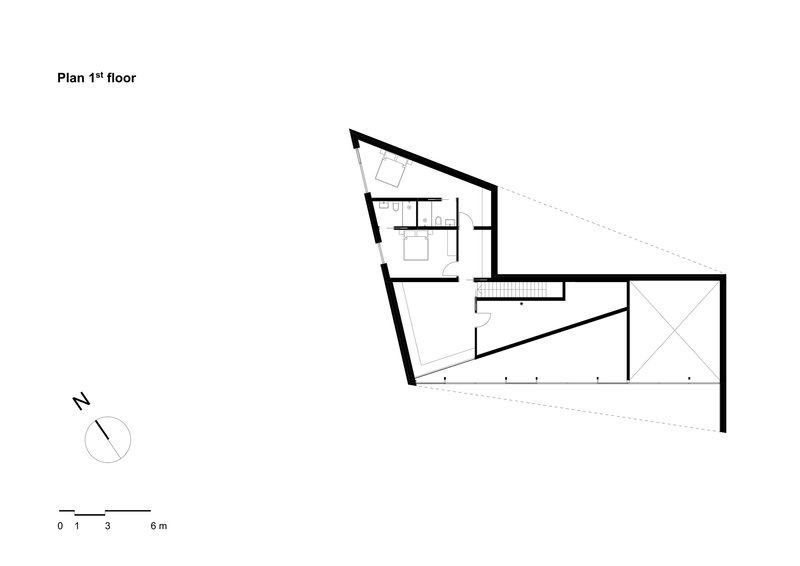
The ground floor plan reveals the angular geometry that the exterior only hints at. An angled garage wing extends from the main volume, creating a sheltered entry sequence and breaking the building into two legible parts. The open living spaces occupy the wider end of the wedge, oriented toward the terrace and the fjord beyond. Circulation is minimal: a short hallway separates public and private zones without wasting space.
The first floor plan makes the wedge shape explicit. The volume tapers toward one end, concentrating the smaller rooms (bedrooms, media space) into a compact cluster while leaving the opposite end open. It is an efficient geometry that responds to the hill's contour and keeps the building's footprint modest. Nothing in the plan is arbitrary. The angles serve the site, and the site serves the view.
Why This Project Matters
Villa Grimseiddalen matters because it demonstrates that restraint and specificity are more valuable than scale. In a culture that still equates bespoke residential architecture with excess, Saunders delivers a house built on subtraction. The clients asked for less. What they received is not less but more precise: a building that fits its hillside the way a boat fits its hull, shaped by forces rather than whim.
The project also offers a quiet rebuttal to the notion that flexibility requires complexity. There are no sliding partitions, no kinetic facades, no app-controlled anything. The flexibility is structural: a ground floor that works as a complete home, an upper floor that adapts to whoever inhabits it, and a site strategy that connects the domestic interior to the fjord without a single wasted gesture. That is what good houses do. They make the obvious move feel inevitable.
Villa Grimseiddalen by Saunders Architecture, Bergen, Norway. 304 m². Completed 2018. Photography by Bent René Synnevåg.
About the Studio
Share Your Own Work on uni.xyz
If projects like this are the kind of work you want to make, uni.xyz is a place to publish your own, find collaborators, and enter design competitions.




Popular Articles
Popular articles from the community

Takeshi Hosaka Architects Suspends a Concrete Cross Above a Yokohama Cemetery
A 28-square-meter burial renovation in Yokohama lifts the symbol of resurrection into the sky so mourners see it against heaven.
Bernardes Arquitetura Stretches a Timber Roof Along a Reservoir's Edge in Minas Gerais
Dam House in Itaúna lets a sweeping wooden canopy dissolve the boundary between hillside terrain and open water.
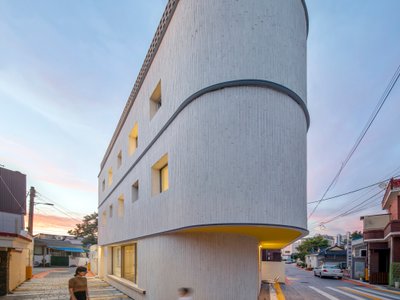
YOAP Architects Round a Corner in Yeongcheon with a Cylindrical Community Hub
A 197-square-meter brick and ribbed-clad tower turns a forgotten alley corner in South Korea into a public garden with a low threshold.
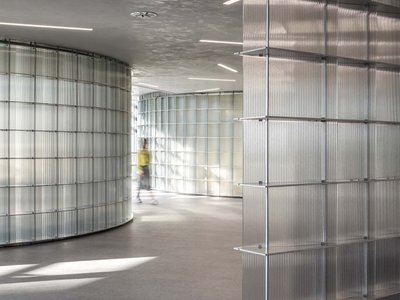
HCCH Studio Wraps a Shanghai High-Rise Office in Curved Walls of Translucent Glass
A 1,000 square meter fit-out in Lujiazui replaces the typical tech-office palette with layered glass, micro-cement, and quiet rigor.


Similar Reads
You might also enjoy these articles

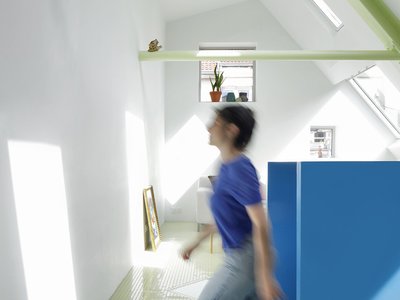
127af Flips a Tiny Bagnolet Rowhouse Upside Down with a Handcrafted Roof Extension
A 55-square-meter terraced house on the edge of Paris gains a luminous upper living floor through lightweight timber and steel.
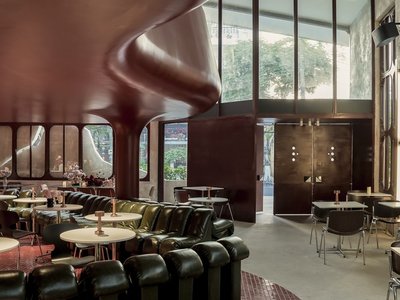
1.61 Design Workshop Wraps a 600-Square-Meter Café in Vietnam in Sculptural Burgundy Drama
Reden Café & Bistro pairs a helical staircase, mosaic floors, and deep red interiors to rethink Vietnamese hospitality space.

The Unbound Brain: A School Shaped by Cognitive Architecture
Cylindrical learning pods radiate like neurons from a central cortex, turning the floor plan into a spatial model of human thought.
Revival Vernacular Architecture: Rammed Earth Settlements for the Sahara
A modular desert community in Mauritania that fuses passive cooling techniques with earthen construction and local craftsmanship.


Explore Architecture Competitions
Discover active competitions in this discipline




The International Standard for Design Portfolios


The Global Benchmark for Architecture Dissertation Awards


The Global Benchmark for Graduation Excellence


Challenge to design mud housing for contemporary communities
Comments (0)
Please login or sign up to add comments
No comments yet. Be the first to comment!