
Scarborough Vocational: An Educational Architecture Project Shaping the Future of Applied Learning
A future-ready educational architecture project redefining vocational learning through flexible spaces, social interaction, and applied pedagogy.


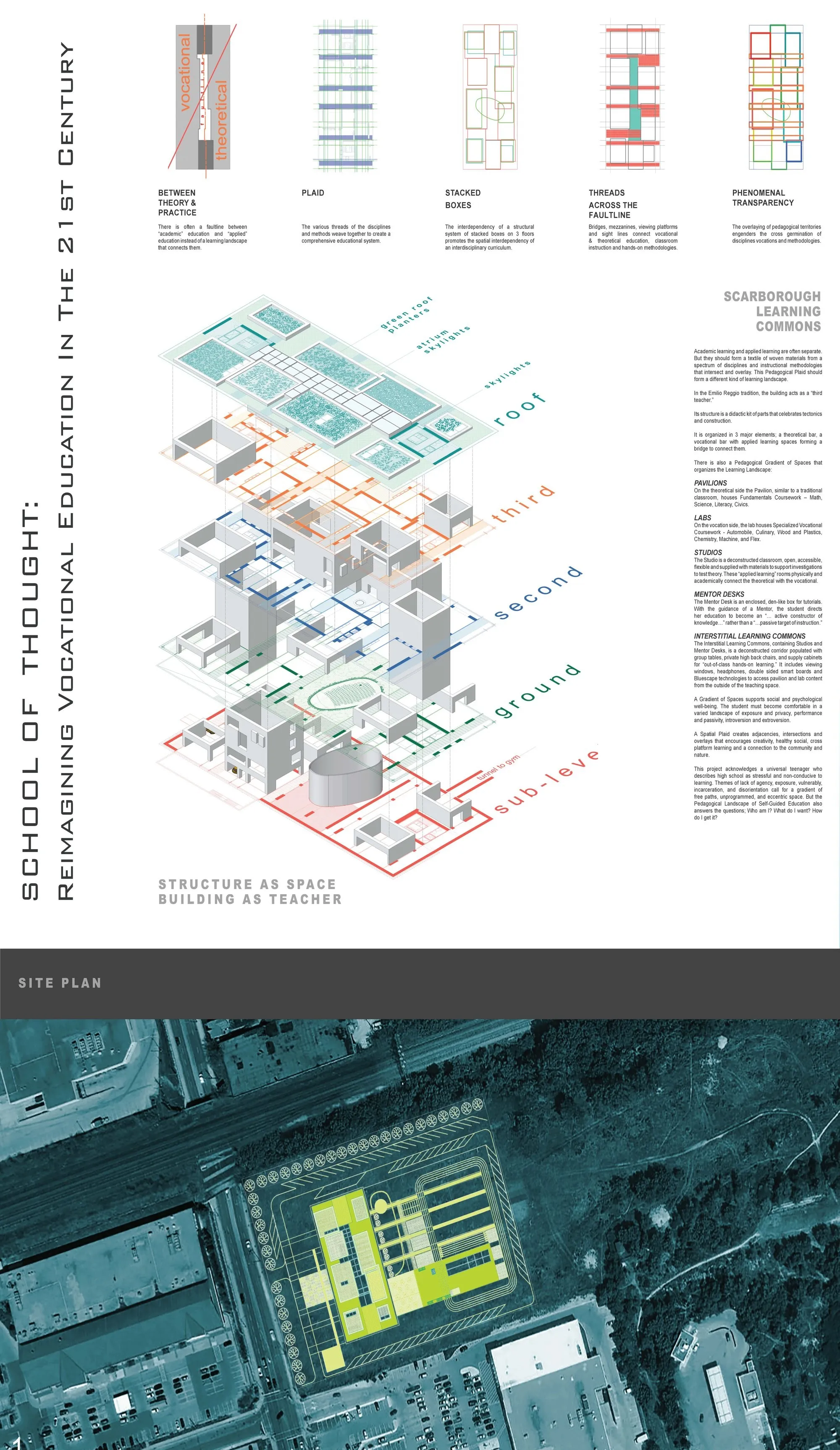
Contemporary educational architecture is evolving beyond the traditional classroom model, shifting toward environments that actively shape learning, creativity, and social interaction. Scarborough Vocational, an Editor’s Choice entry from the School Of Thought 2020 competition by Edwin Zawadzki, explores this transformation through a dynamic pedagogical landscape where architecture itself becomes an educator.
Rooted in the philosophy of the Emilio Reggio tradition, the project positions the building as a “third teacher.” Rather than functioning as a passive container for education, the architecture encourages discovery, collaboration, experimentation, and self-guided learning. The proposal responds to the growing need for educational spaces that prepare students not only academically, but socially, psychologically, and professionally.
The project introduces a layered educational architecture strategy composed of three primary elements: a theoretical learning bar, a vocational learning bar, and a connective bridge system that integrates applied learning environments between them. Together, these spatial systems create a learning ecosystem where theory and practice coexist seamlessly.
At the core of the project is the idea of the “Pedagogical Gradient of Spaces.” Instead of relying on rigid classrooms and linear circulation, the design creates a variety of environments with different levels of openness, privacy, interaction, and activity. Students move through interconnected spatial experiences that encourage autonomy and adaptability. This educational architecture model reflects contemporary learning patterns where collaboration, exploration, and interdisciplinary engagement are essential.
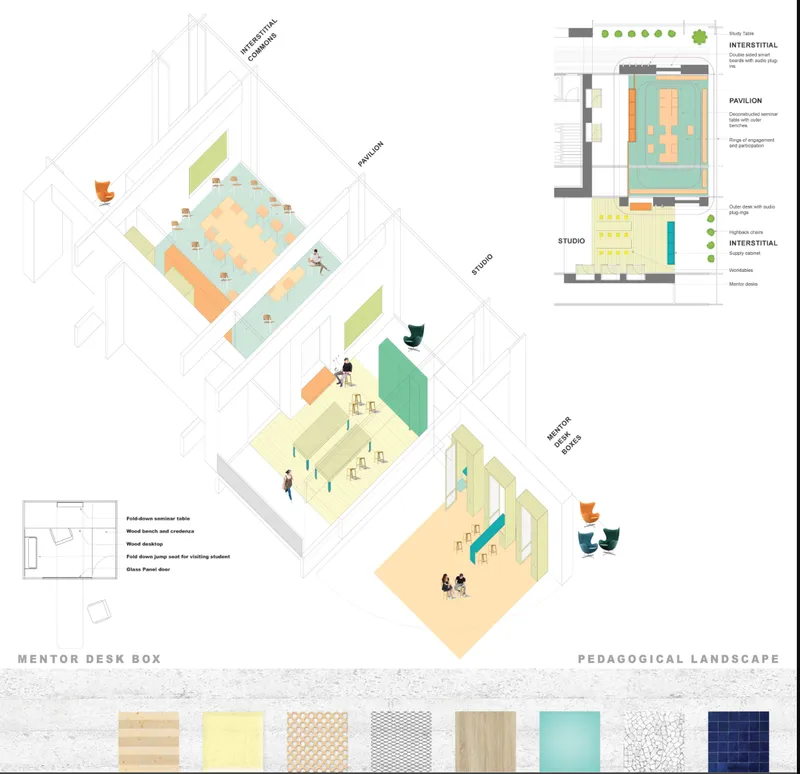
The project organizes its learning environments into five distinct spatial typologies: Pavilions, Labs, Studios, Mentor Desks, and Interstitial Learning Commons.
The Pavilions operate as spaces for foundational education. These environments resemble traditional classrooms while remaining visually open and flexible. Subjects such as mathematics, science, literacy, and civics are taught within these quieter learning zones. Their design balances familiarity with transparency, allowing students to remain connected to the broader educational landscape.
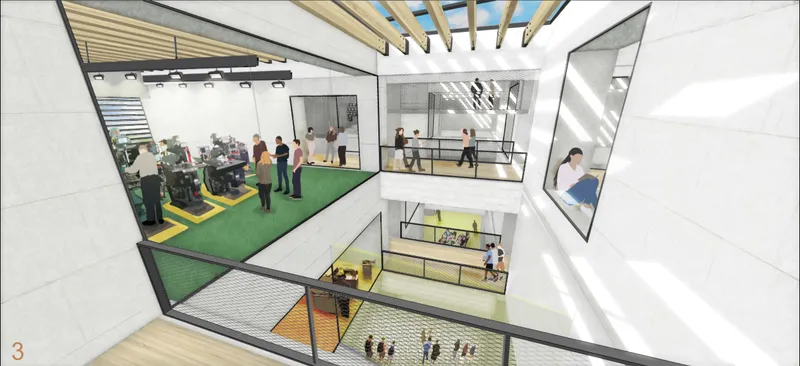
On the vocational side, the Labs accommodate specialized applied learning programs including culinary arts, automobile studies, chemistry, machine fabrication, wood and plastics, and flexible workshop spaces. These areas celebrate construction, making, and technical education through exposed tectonic systems and industrial-inspired spatial qualities. The architecture reveals how buildings are assembled, transforming structural systems into educational tools.
The Studios function as hybrid educational architecture spaces positioned between theoretical and vocational learning. Open, flexible, and material-rich, these environments encourage experimentation and project-based collaboration. Students can test ideas, build prototypes, conduct investigations, and transition fluidly between disciplines. These adaptable studios physically bridge academic and vocational education while supporting interdisciplinary creativity.
Another defining feature of the project is the Mentor Desk system. Designed as compact enclosed tutorial spaces, these learning pods provide students with individualized guidance and focused interaction with educators. Instead of reinforcing hierarchical teaching structures, the spaces support mentorship and student agency. The architecture acknowledges that learning often occurs through dialogue, reflection, and personal development rather than formal instruction alone.
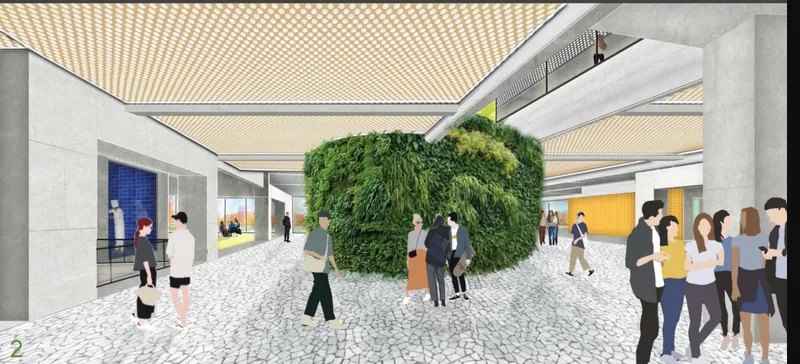
Perhaps the most compelling aspect of the proposal is the Interstitial Learning Commons. These deconstructed corridors transform circulation into active educational territory. Furnished with collaborative seating, high-back privacy chairs, technology-integrated study stations, and informal gathering areas, the commons blur the line between classroom and social space. The design encourages spontaneous interaction, peer learning, and moments of retreat within the same architectural system.
The project also addresses student well-being through spatial psychology. The design recognizes that contemporary educational environments can often feel stressful, rigid, and isolating. In response, Scarborough Vocational creates a balance between exposure and privacy, extroversion and introversion, performance and contemplation. The architecture provides students with opportunities to choose how they engage with their surroundings, supporting emotional comfort alongside intellectual growth.
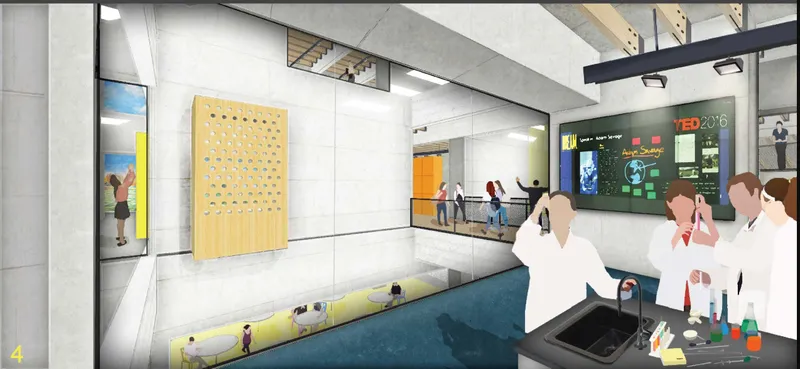
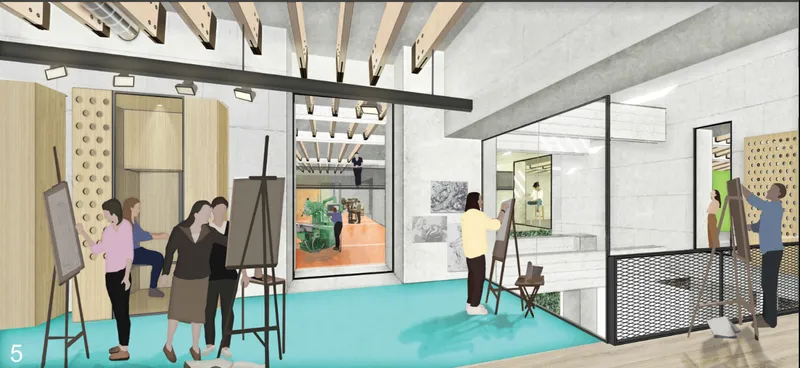
Visually, the project embraces a restrained material palette dominated by exposed concrete, glulam timber systems, perforated wood panels, expanded metal mesh, ceramic surfaces, and colorful epoxy flooring. This combination creates an atmosphere that feels industrial yet welcoming. The tectonic expression of the structure reinforces the project’s educational mission, allowing students to experience construction systems directly within their everyday environment.
Natural light, layered sectional relationships, and interconnected visual corridors further strengthen the sense of openness throughout the building. Interior atriums and bridges create dynamic sightlines between workshops, studios, and commons, encouraging transparency and cross-disciplinary curiosity. The architecture continuously reveals activity, transforming the school into a living environment of observation and participation.
The site strategy integrates athletics, agriculture, community workshops, galleries, and gathering spaces into the broader educational framework. Rather than isolating learning within enclosed rooms, the proposal expands education into the landscape itself. Outdoor environments become extensions of the curriculum, supporting hands-on engagement and social interaction.
Scarborough Vocational demonstrates how educational architecture can move beyond static institutional models toward adaptive environments that reflect the realities of contemporary learning. Through its layered pedagogical systems, flexible spatial organization, and emphasis on applied education, the project proposes a future where architecture actively shapes human development.
As an Editor’s Choice entry in School Of Thought 2020, the project by Edwin Zawadzki presents a compelling vision for schools that prioritize curiosity, collaboration, technical literacy, and emotional well-being. It reimagines the educational building not as a singular classroom structure, but as an interconnected learning commons designed to support the evolving needs of future generations.



Popular Articles
Popular articles from the community


The Earth Pod: 3D Printed Homes for Resilient Refugee Communities
The Earth Pod reimagines refugee housing through 3D printed homes made from clay, combining resilience, self-sufficiency, and rapid shelter.

Hill & Cross Opera: Sculptural Opera House Architecture Shaped by Tallinn’s Landscape and Identity
Hill & Cross Opera reimagines opera house architecture in Tallinn through its sculptural hill, civic plaza, glass wave and a luminous cross.

Play: Fragments of Their World
Familiar architecture becomes modular playground design, creating safe spaces where displaced children can learn, connect, imagine and play.

Conexión: Biophilic Design Reimagines High-Rise Living in Hong Kong
Conexión reimagines high-rise living in Hong Kong through biophilic design, green facades, shared spaces, daylight, water and nature within.


Similar Reads
You might also enjoy these articles

Eco Chapel: A Green Architecture Pavilion Designed in Symbiosis with the Forest
Eco Chapel uses green architecture to weave prayer, learning and reuse into a forest pavilion shaped by modular hexagonal canopies for life.
Kaffeebühnen: Coffee Shop Architecture Designed as a Civic Stage Between Vienna’s City and Park
Kaffeebühnen turns coffee shop architecture into a civic stage, linking Vienna’s park edge, urban life, warm timber yards, and coffee craft.
Healing Façade: Sustainable Architecture for Reforestation, Community, and Sacred Ecology in Ethiopia
Healing Façade reimagines sustainable architecture as a living wall that restores soil, catches water and renews Ethiopia's forest churches.


Urban Forest: A Vertical Ecosystem for 5,000 Workers in Singapore's Changi Business Park
Radially stacked pods and layered green decks turn a 7-acre plot into 47 acres of ecological workspace projected for 2040.


Explore Architecture Competitions
Discover active competitions in this discipline



Challenge to reimagine the Iron Throne


Photograph architecture without architects


Illustrate the lost glory of Angkor Wat - Render Challenge


Design challenge to reuse E-waste
Comments (0)
Please login or sign up to add comments
No comments yet. Be the first to comment!