
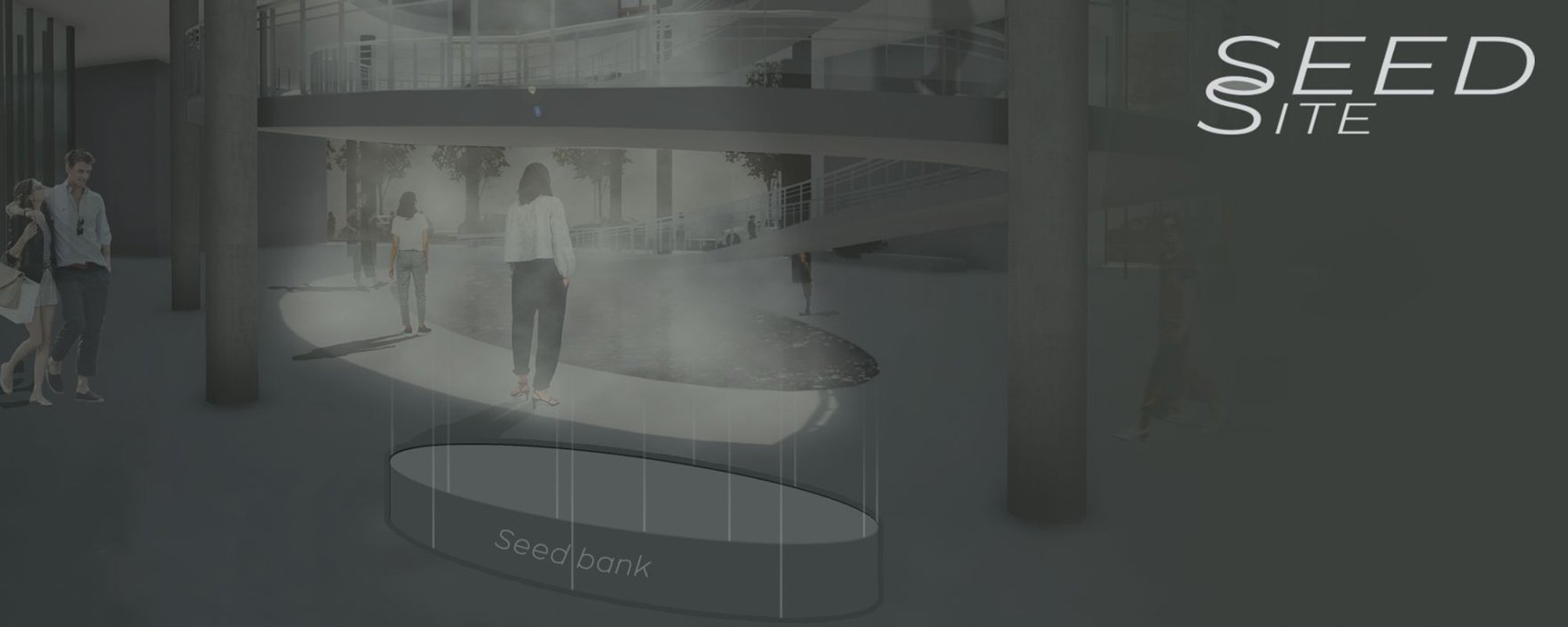
Seed Site: A Vertical Ecosystem Where Architecture Follows the Plant Cycle
In Hong Kong's dense urban fabric, a twin-tower seed bank spirals upward through hydroponic farms, flower calendars, and sunlit terraces.

What if a building could grow like a plant? Seed Site takes that question literally, organizing an entire tower around the lifecycle of a seed: storage underground, germination in labs, cultivation on hydroponic terraces, and harvest at communal food collection points. The result is a piece of architecture that reads less like a skyscraper and more like a vertical ecology, rooted in Hong Kong's hyper-dense cityscape where green space is scarce and ecological literacy is an afterthought.
Designed by Paulina Mierzwiak, Agata Woźniak, Marta Babik, and Joanna Przebięda, Seed Site was shortlisted in the Seed Bank competition on uni.xyz. The project proposes a twin-tower structure that splits from a shared base, cascading downward in planted terraces that mirror the stepped topography of the surrounding city. Below ground, a seed bank archive sits beneath an elliptical pond; above it, five levels of educational and cultivation programming give way to residential floors wrapped in seasonally blooming gardens.
An Elliptical Void Anchors the Plan
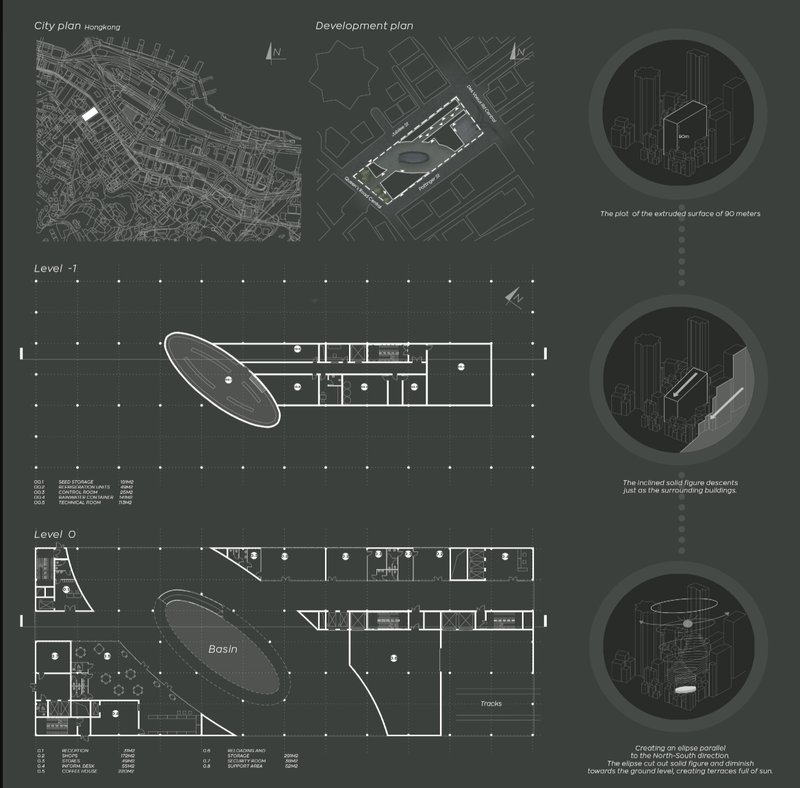
The plan drawings reveal the project's organizing geometry: a recurring elliptical void that cuts through every level. At the base, this oval takes the form of a sunken pond sitting directly above the subterranean seed bank, a symbolic gesture linking water, light, and the idea of germination. The floor plans across multiple levels show how this void shifts and opens, pulling daylight deep into the building's core. The city context map and development plan situate the tower within Hong Kong's tight urban grain, making clear just how compressed the available site is.
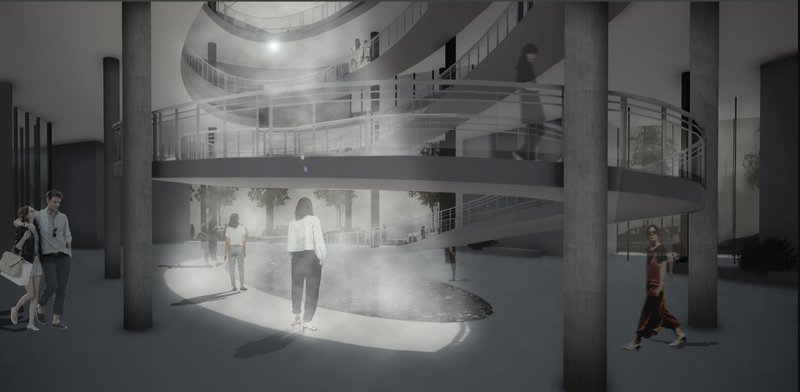
The interior view confirms what the plans suggest: the elliptical cut generates a dramatic spatial experience. Concrete columns frame a curving void where overlapping transparent floor plates create layered sightlines between levels. Figures walking through the space give a sense of the generous scale of the atrium, which serves a passive design purpose by funneling sunlight and natural ventilation into the building's middle zones, reducing energy demands while making the interior feel far more open than a typical high-rise core.
Circulation as a Vertical Garden Path
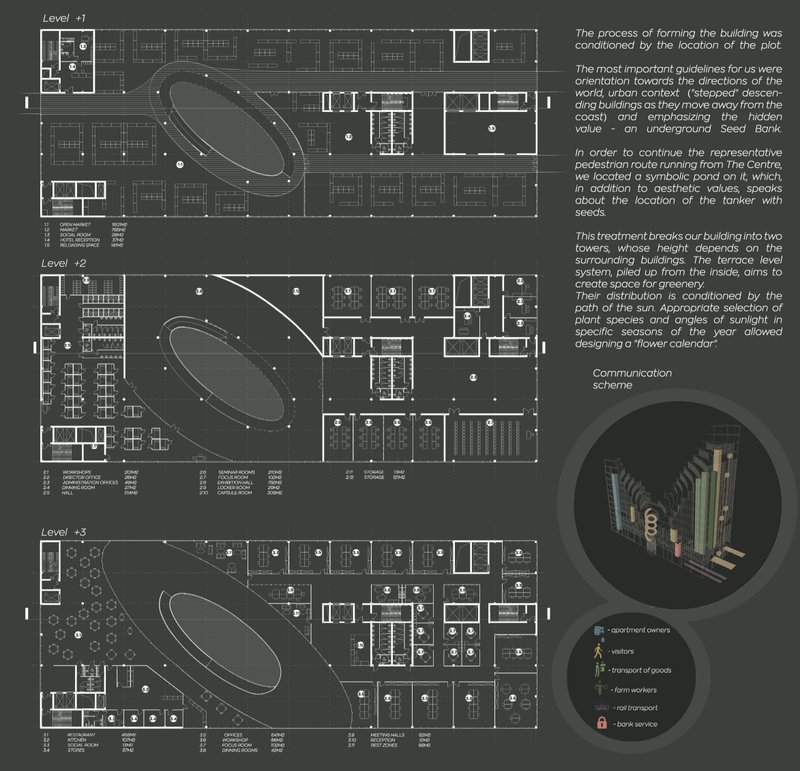
A second set of floor plans, paired with an axonometric circulation diagram, unpacks how people move through the building. The communication scheme graphics illustrate a spiraling path that connects the educational and cultivation levels (floors 0 through 4) with the residential terraces above. The oval voids reappear on each plan, acting as both lightwells and orientation devices. The axonometric drawing is particularly telling: it shows how the twin towers share a common circulatory spine at their base before branching into separate vertical routes, a move that reinforces the project's biological metaphor of a stem dividing into branches.
Terraces That Bloom on a Calendar
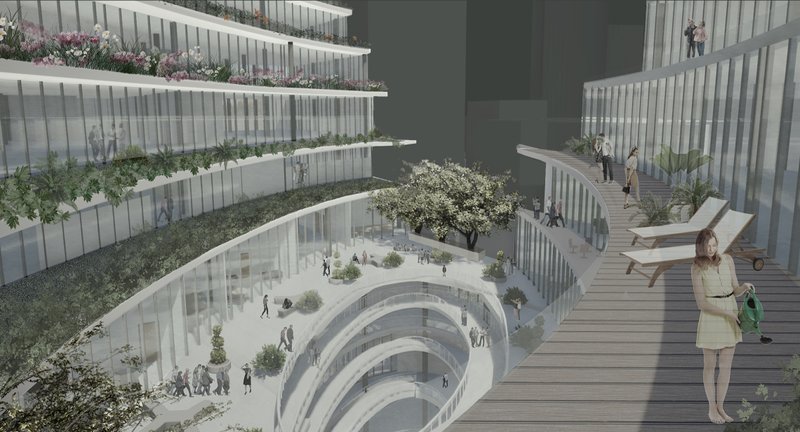
The courtyard view brings the project's most evocative idea into focus: the flower calendar. Each terrace is planted with species selected to bloom at different times of the year, from January greenery to August lilies and December arctous. The image shows layered planting balconies rising around a sunken oval plaza, with figures descending timber steps toward the basin below. The effect is of a canyon carved into vegetation rather than rock, a deliberate softening of the urban landscape that also serves measurable environmental functions like improved air quality and increased biodiversity.
The timber steps and informal gathering areas around the sunken plaza signal that this is not just ornamental landscape but programmed public space. Ecological workshops, seed cultivation labs, and food collection zones occupy the lower levels, turning the base of the tower into a community hub focused on sustainability education. Residents on upper floors get sunlit gardens and fresh produce from the hydroponic farms, making food self-sufficiency part of the architecture rather than an add-on.
Form Driven by Sun and Topography
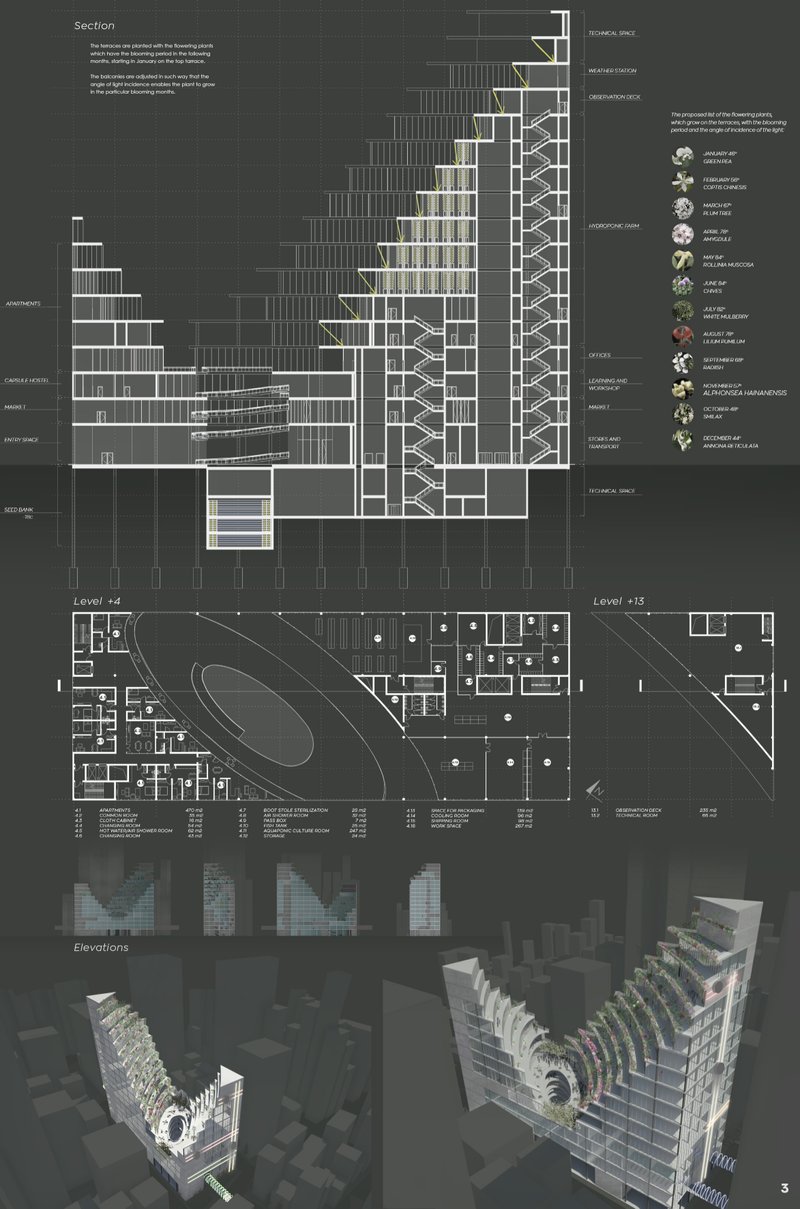
The full building section is the project's most informative drawing. It reveals the underground seed bank levels, the spiraling twin towers above, and the planted terraces that step down in response to solar orientation and the surrounding hillside topography. The elliptical cuts through the massing become legible as passive environmental devices: they channel light into the lower floors and create open atriums that reduce the need for mechanical cooling. Green terraces function as insulation layers, contributing to thermal comfort year-round. Isometric tower diagrams below the section break down the massing logic, showing how the building's silhouette was shaped by the path of the sun rather than by maximizing floor area.
Why This Project Matters
Seed Site stands out because it treats sustainability not as a checklist of green technologies bolted onto a conventional tower but as the generative logic of the architecture itself. The building's form, section, program, and even its façade planting are all derived from a single conceptual framework: the lifecycle of a seed. That kind of coherence is rare in competition entries, and it turns what could have been a generic eco-tower into something genuinely propositional.
For a city like Hong Kong, where vertical living is a fact of life and access to nature is a luxury, the project offers a credible prototype. By stacking a seed bank, educational program, hydroponic farm, and residences into a single structure, the designers argue that ecological infrastructure and urban density are not opposing forces. They can share a footprint, share sunlight, and share the same vertical trajectory. That argument, made through drawings rather than slogans, is what gives Seed Site its staying power.
View the Full Project
About the Designers
Designers: Paulina Mierzwiak, Agata Woźniak, Marta Babik, Joanna Przebięda
Enter a Design Competition on uni.xyz
uni.xyz runs architecture and design competitions year-round that reward proposals with spatial conviction and real site intelligence.
Project credits: Seed Site by Paulina Mierzwiak, Agata Woźniak, Marta Babik, Joanna Przebięda Seed Bank (uni.xyz).




Popular Articles
Popular articles from the community

20 Most Popular Office Building Projects of 2025
From biophilic workspaces in India to net-positive energy offices in New Delhi, 20 office building projects that defined architecture in 2025.

YOAP Architects Round a Corner in Yeongcheon with a Cylindrical Community Hub
A 197-square-meter brick and ribbed-clad tower turns a forgotten alley corner in South Korea into a public garden with a low threshold.
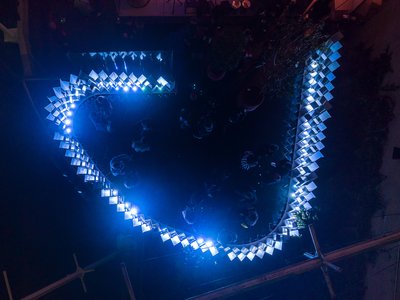
Rojkind Arquitectos and Think Parametric Build a Glueless Pavilion from 67 Interlocking Panels
A serpentine fiber-cement installation in Chapultepec Park celebrates a decade of architectural media in Mexico City.
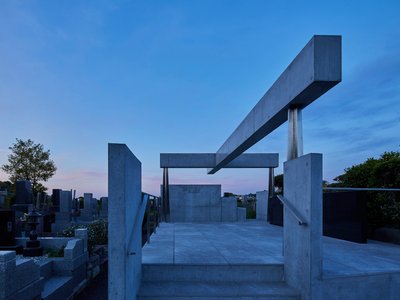
Takeshi Hosaka Architects Suspends a Concrete Cross Above a Yokohama Cemetery
A 28-square-meter burial renovation in Yokohama lifts the symbol of resurrection into the sky so mourners see it against heaven.

Similar Reads
You might also enjoy these articles

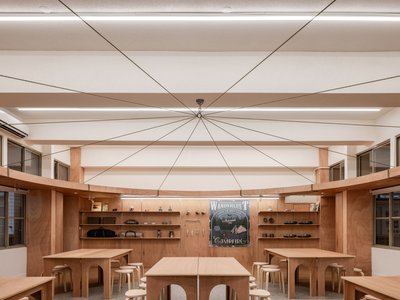
317studio Turns an 87 m² Classroom into a Forest Clearing for Scouts in New Taipei City
A rope canopy, student-made specimens, and campfire geometry replace rows of desks in this Scouting classroom in Xizhi District.
24 7 Arquitetura Builds a Timber Pavilion as a Family's First Act on a 5,000 m² Brazilian Plot
In Jaguariúna, a prefabricated glulam house nestles among mature trees as the opening move of a larger residential masterplan.
1+1>2 Architects Build a School from 900 Blocks of Hmong Stone on Vietnam's Rocky Plateau
On a barren valley in Ha Giang province, a community quarried its own stone to raise a kindergarten and primary school rooted in Hmong identity.
100A Associates Builds a Volcanic Stone Retreat on Jeju Island Rooted in Ritual and Restraint
Watarstay [Wa:Tar] in Bongseong-ri channels Jeju's basalt, reed, and hemp into a 150 m² hospitality space shaped by contemplation.

Explore Sustainable Design Competitions
Discover active competitions in this discipline




The Global Benchmark for Architecture Dissertation Awards


Design challenge to reuse E-waste
Comments (0)
Please login or sign up to add comments
No comments yet. Be the first to comment!