
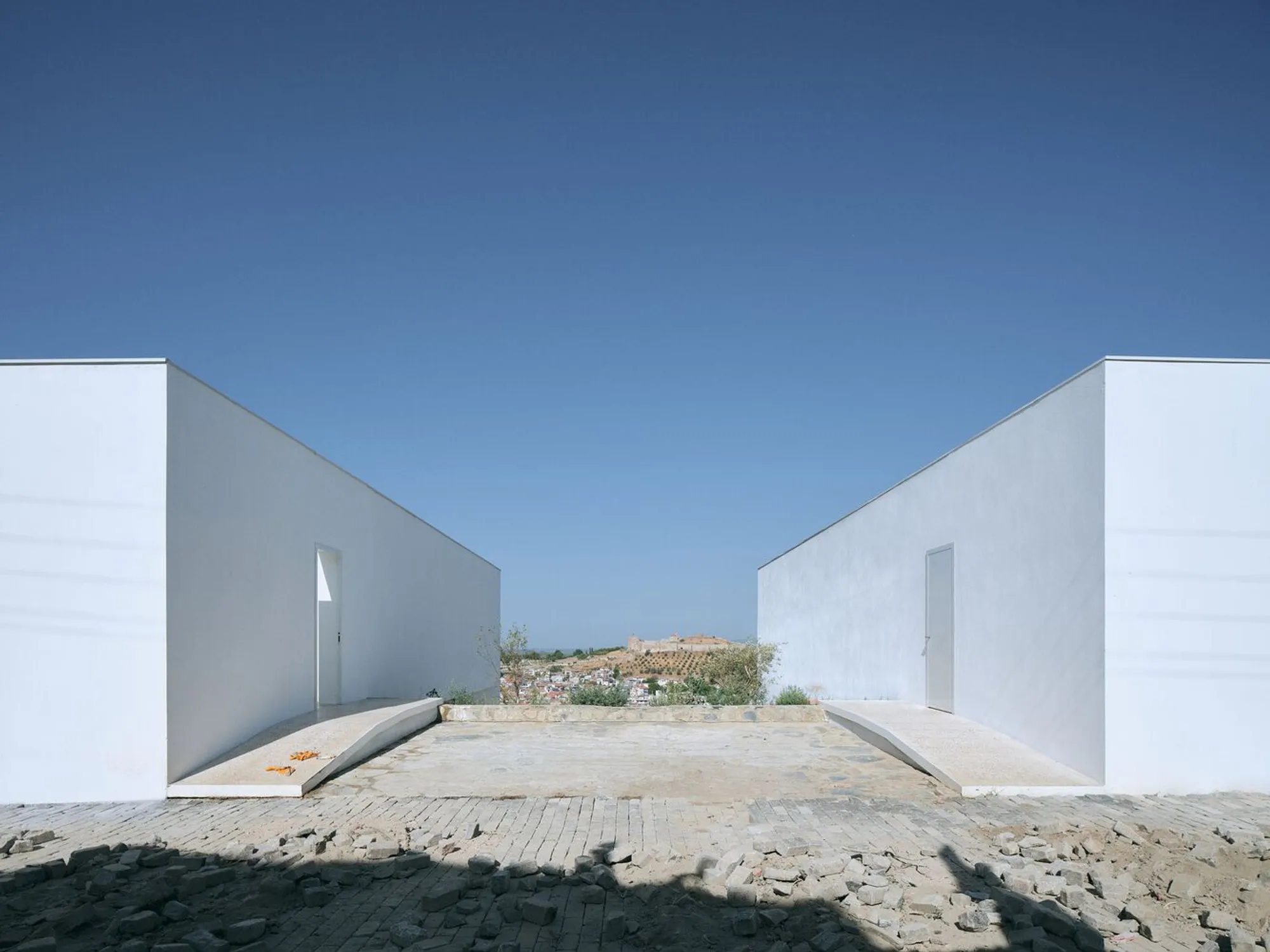
Dolmus AG Plants Twin White Volumes on a Turkish Hillside Overlooking Ayasuluk Castle
Selçuk House pairs two identical residences around a shared courtyard on Turkey's Aegean coast, calibrating openings to sun and view.


Selçuk sits at the foot of Ayasuluk Castle on Turkey's Aegean coast, a town where Roman aqueducts and Ottoman houses set the terms for what new construction must reckon with. Into this context, Zurich-based Dolmus AG has placed two identical white volumes on a sloped residential lot, completing what they call Selçuk House in 2024. The project reads as a single compound: two homes that share a cobblestone courtyard and garden while maintaining distinct domestic interiors. It is not a villa. It is closer to a miniature settlement, a pair of dwellings that negotiate between togetherness and retreat.
What makes the project worth studying is the discipline of its environmental logic. Rather than wrapping both buildings in uniform glazing, the architects split the facades into two distinct characters: south walls are largely closed and shaded by canopies, while north walls open up with generous glazing to pull in light and frame the valley beyond. The entry is at the top, the courtyard at the base, and the circulation between them is handled by a tight spiral staircase that doubles as the spatial anchor of each home. Every decision seems to follow from site topography and sun path rather than stylistic ambition, which is precisely what gives the project its clarity.
Two Volumes, One Compound
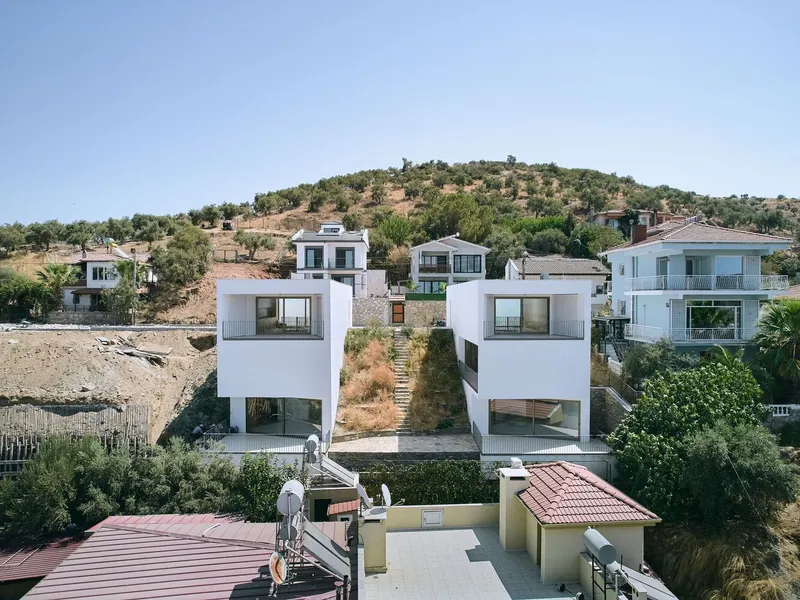
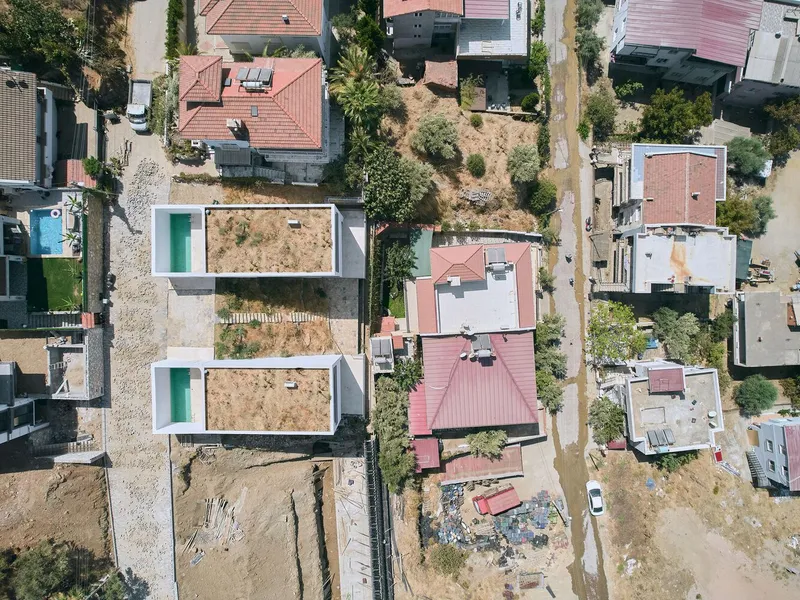
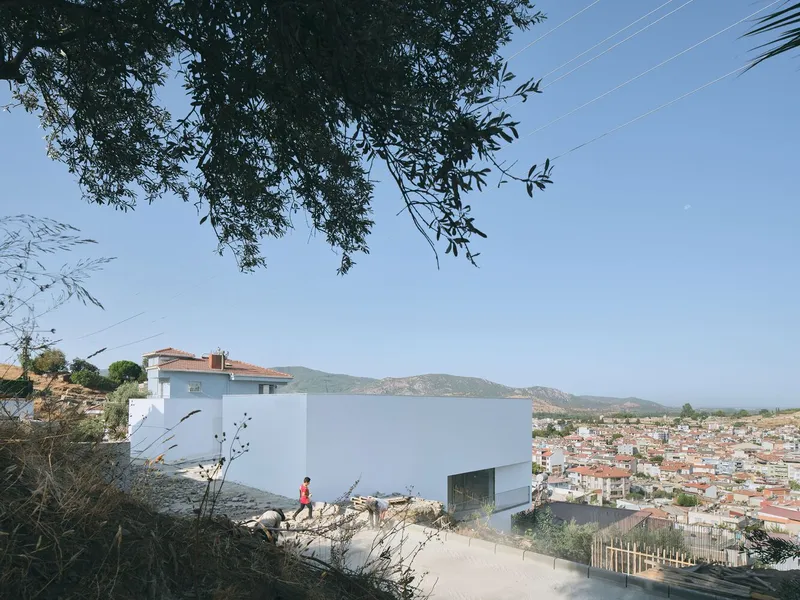
From the air, the logic is immediate. Two white rectangular prisms occupy a hillside lot, rotated just enough to create a courtyard between them while each captures its own slice of the panorama toward the castle and the plains below. The rooftops are carved out to form private terraces with small turquoise pools, a move that gives the compound a sense of domestic luxury without vertical excess. Among the surrounding pink and terracotta rooftops, the white volumes register as deliberate outliers, yet their massing and scale keep them from dominating the neighborhood.
Positioning two identical buildings rather than one larger house changes the social equation. The shared garden becomes genuine common ground, not a backyard. Each residence maintains its own perimeter and its own orientation toward the view, yet the gap between them is narrow enough to feel like a street or a passage rather than empty land. It is a strategy borrowed from vernacular settlement patterns, updated with cleaner geometry.
The Courtyard as Threshold
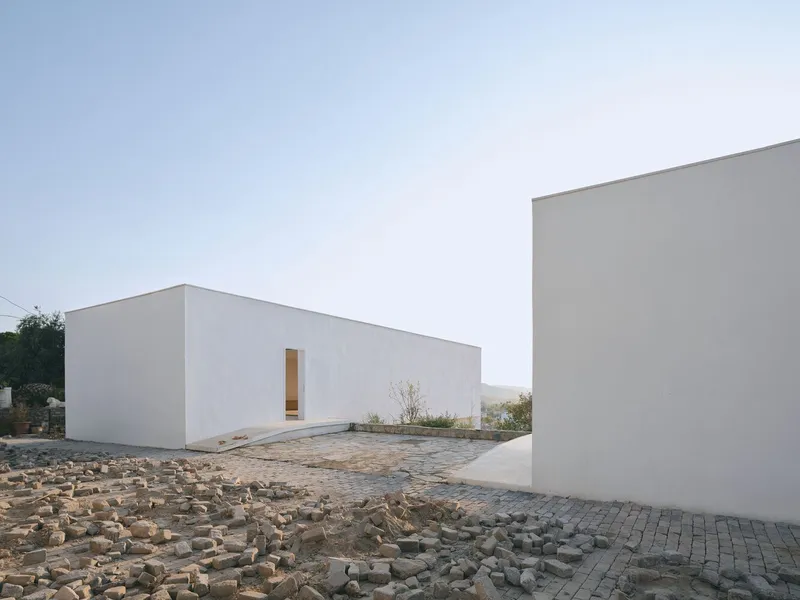
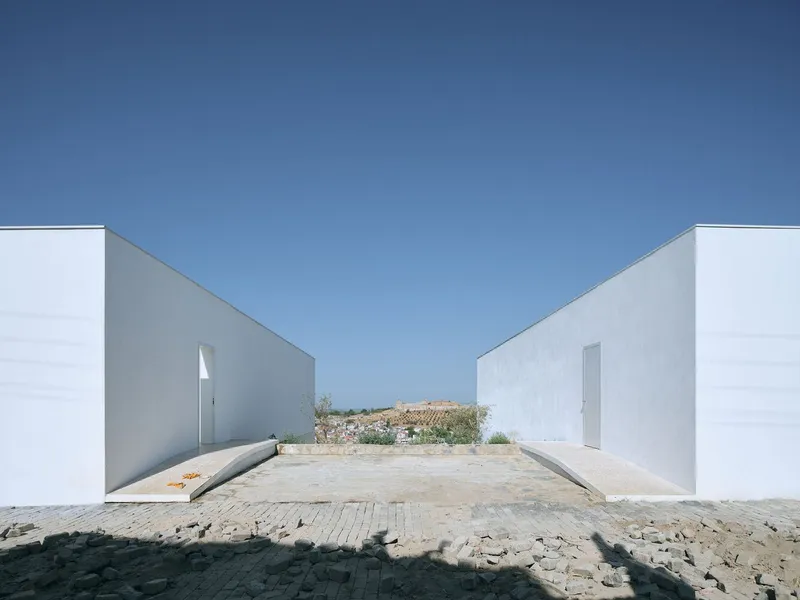
The cobblestone courtyard at the base of the two volumes is the project's social center. Framed by white rendered walls on two sides and open to the valley on the others, it functions as an outdoor room. At dusk the recessed timber doorway on one wall glows against the white plaster, a single domestic signal in an otherwise abstract composition. During the day, the courtyard captures the framed view of distant farmhouses and dry Aegean scrubland, turning the gap between buildings into a controlled panorama.
The hardscape treatment is key. Cobblestone is a material deeply embedded in Aegean town-making. Its use here grounds the project in local construction culture without resorting to pastiche. Paired with the olive tree canopy visible along the slope, the courtyard reads as a continuation of the hillside landscape rather than an imported urban plaza.
Closed South, Open North
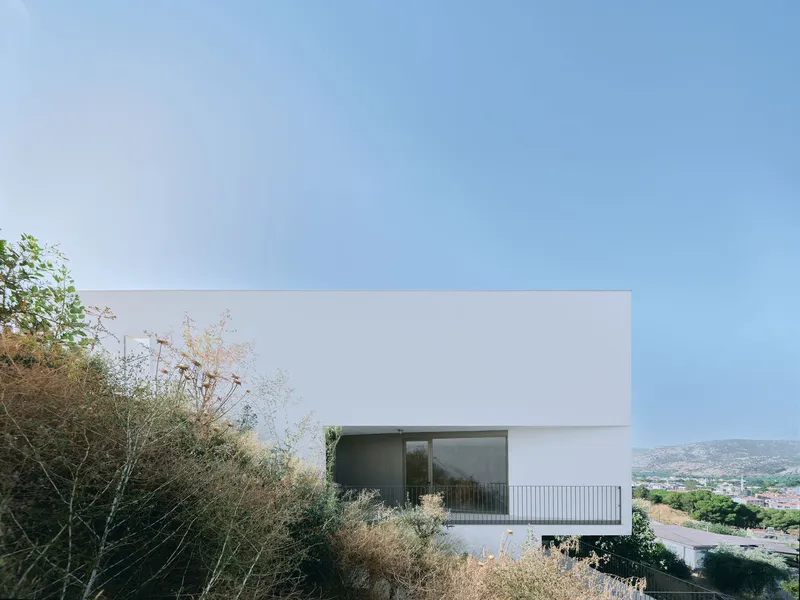
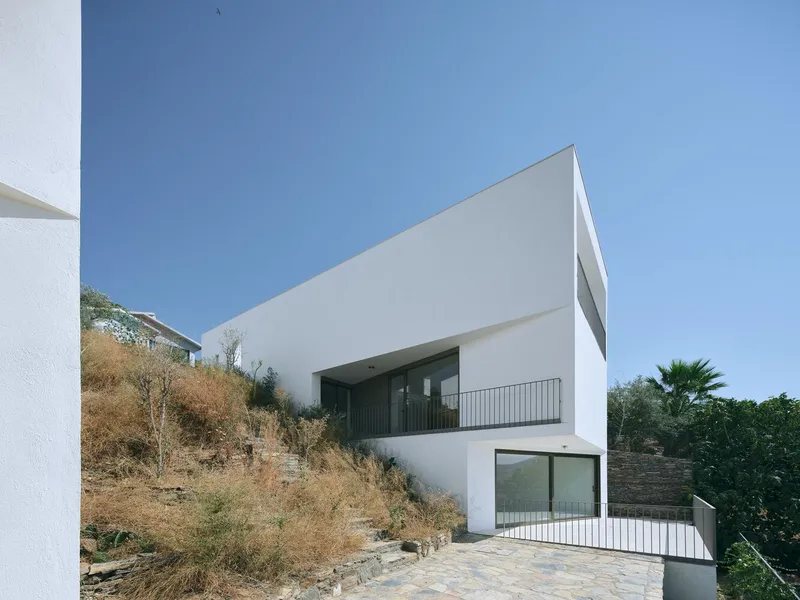
The climate strategy is legible on the facades themselves. The south elevation presents cantilevered volumes and shaded recesses, keeping direct summer sun off the interior walls. Canopies extend outward to cast shadow across the white stucco, reducing solar gain without mechanical intervention. The result is a facade that looks almost defensive, a series of deep reveals and overhangs that register the intensity of Aegean summers.
On the north side, the approach reverses. Large openings and recessed balconies with terrazzo terraces look out over dry scrubland and the town below. Because northern light in the northern hemisphere is indirect and consistent, these glazed surfaces bring daylight deep into the living spaces without overheating. It is a passive strategy executed through geometry rather than technology, and it gives the two facades genuinely different architectural personalities.
Interior Warmth Against White Walls
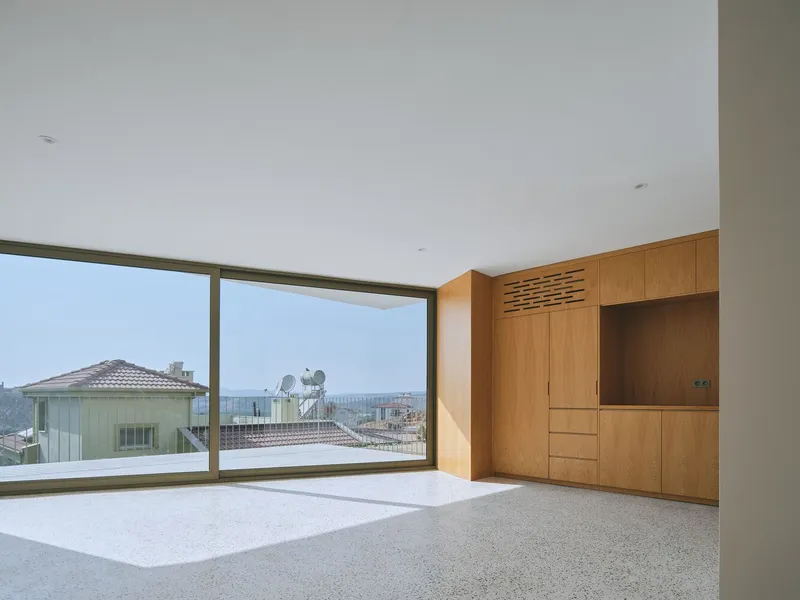
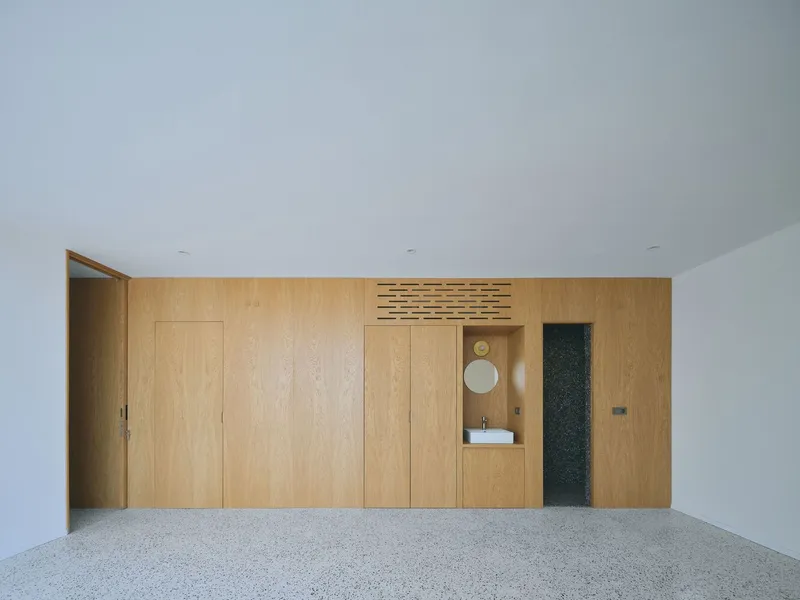
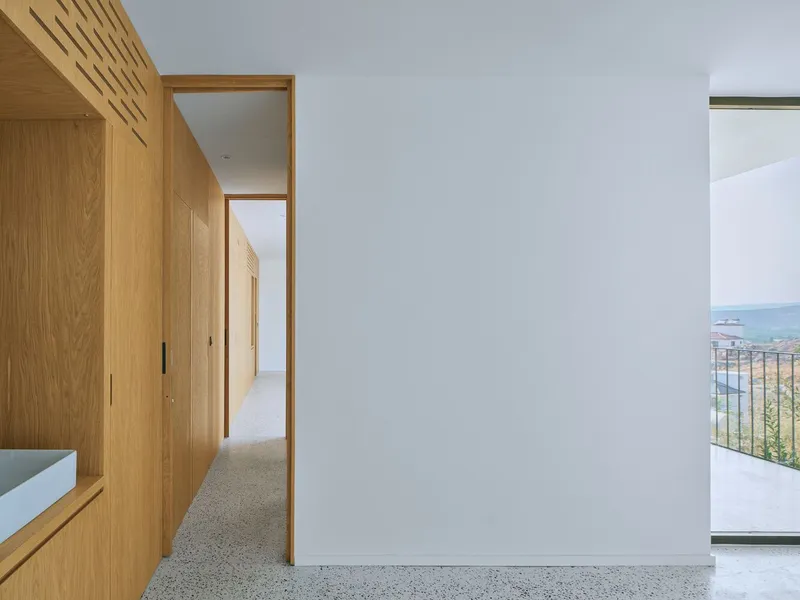
Inside, the palette shifts from white plaster to warm oak. Built-in cabinetry with louvered upper panels lines the living spaces, giving each room a sense of craft and specificity. The millwork is not decorative; it integrates storage, partitions, and even bathroom thresholds into continuous timber surfaces. A corridor framed by oak paneling and terrazzo flooring leads from the interior to the exterior terrace, dissolving the boundary between inside and out through material continuity.
The louvered panels deserve attention. They mediate between concealment and ventilation, allowing air to pass through cabinetry while keeping stored items out of sight. In a climate where cross-ventilation matters, this kind of detail carries functional weight beyond its visual warmth. The combination of terrazzo floors and oak walls sets a tonal range that feels Mediterranean without becoming a cliché.
The Spiral Core
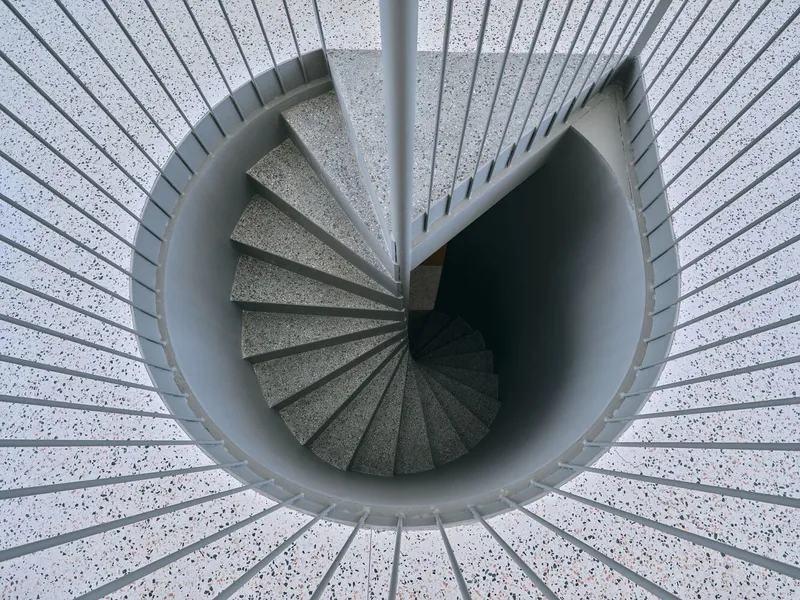
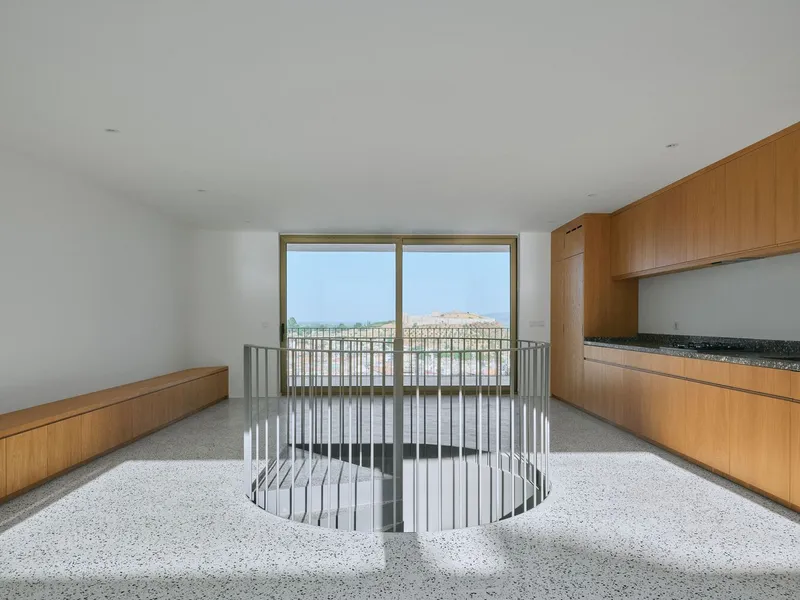
With the entrance located at the top floor, vertical circulation becomes the spine of each residence. Dolmus AG resolves this with a spiral staircase: terrazzo treads radiating from a central steel pole, wrapped by a metal balustrade that curves tightly through the floor plates. Seen from above, the staircase is a geometric event, a clean helix that contrasts with the rectilinear rooms around it. From the kitchen level, the stairwell opens outward to frame the hillside view, turning a utilitarian element into the most dramatic moment in the house.
Entering at the top and descending to the courtyard reverses the conventional domestic sequence. You arrive at the most private level and move downward toward the shared garden, a sectional inversion that reinforces the compound's social hierarchy. The spiral stair makes this descent feel deliberate rather than incidental.
Living Between Inside and Out
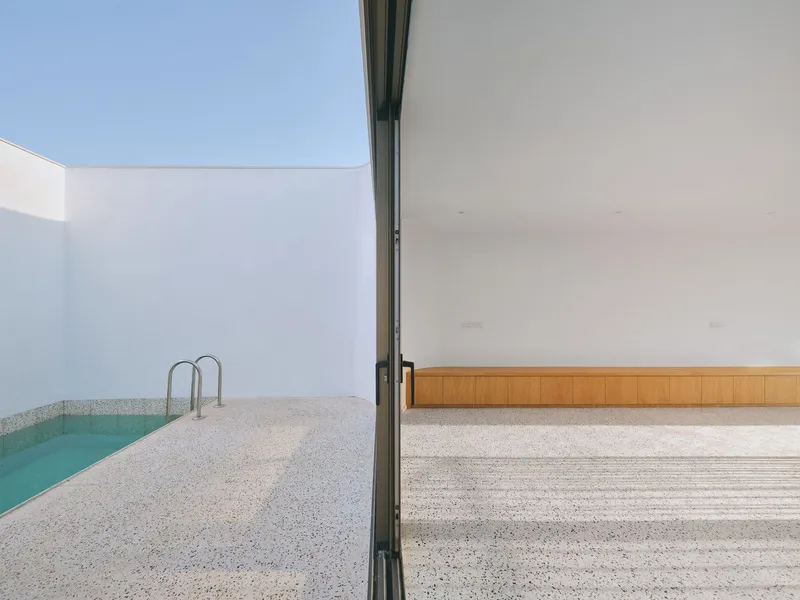
At the courtyard level, a sliding glass door connects the living space directly to the exterior pool and cobblestone terrace. The terrazzo flooring runs continuously from inside to out, erasing the threshold between conditioned and unconditioned space. When the door is open, the room simply extends into the courtyard. When closed, the glass maintains the visual connection while the deep wall section provides shade.
This indoor-outdoor fluidity is not unusual in Aegean architecture, but its execution here is notably restrained. There is no pergola, no brise-soleil assemblage, no decorative screen. The transition relies on the depth of the wall, the continuity of the floor, and the scale of the opening. It is a quiet move that works because everything around it has been kept equally quiet.
Why This Project Matters
Selçuk House offers a counterpoint to the tendency in coastal Turkish development toward maximalist resort aesthetics. By working with two small, identical volumes instead of one large gesture, Dolmus AG produces a project that is closer in grain to the town around it. The environmental logic is embedded in the architecture itself: closed south, open north, top entry, courtyard at the base. None of this requires explanation panels or sustainability certifications. It is simply legible on the building.
The project also demonstrates what a Swiss-Turkish practice can bring to a regional context. The precision of the millwork, the consistency of the material palette, and the discipline of the massing all point to a design culture that values restraint. But the cobblestone courtyard, the olive trees, and the orientation toward the castle anchor the project in Selçuk's specific geography. The result is a house that belongs to its place without pretending to have always been there.
Selçuk House by Dolmus AG, Selçuk, Turkey. Completed 2024. Photography by Egemen Karakaya.
About the Studio
Share Your Own Work on uni.xyz
If projects like this are the kind of work you want to make, uni.xyz is a place to publish your own, find collaborators, and enter design competitions.



Popular Articles
Popular articles from the community


Play: Fragments of Their World
Familiar architecture becomes modular playground design, creating safe spaces where displaced children can learn, connect, imagine and play.

The Ocean Hive: Sustainable Architecture for a Self-Sufficient Civilization at Sea
The Ocean Hive imagines sustainable architecture at sea, where modular habitats, algae, wave power and ocean waste sustain a growing colony.

Co-life: Sustainable Architecture for Age-Friendly Community Living
Co-life reimagines sustainable architecture for seniors through courtyards, rammed earth, shared gardens, and spaces designed for belonging.

The Earth Pod: 3D Printed Homes for Resilient Refugee Communities
The Earth Pod reimagines refugee housing through 3D printed homes made from clay, combining resilience, self-sufficiency, and rapid shelter.


Similar Reads
You might also enjoy these articles


Hodi-Mandai Geram
Project Function: Preservation and revitalization of the Intangible heritage and socio-spatial identity of the Hodi by Housing, Cultural Memory Center, Sacred Grove, landscape, local tourism economy


Olio Towers: A Mid-Rise for Performers That Fuses Housing, Rehearsal, and Stage
Located blocks from Houston's Theater District, this modular tower stacks living units around a central performance atrium.

Oasis: Modular Green Housing Carved into Dhaka's Urban Fabric
A shortlisted Plugin Housing entry reclaims unauthorized settlements in Dhaka with stepped concrete volumes, green roofs, and ventilation-driven design.

Black Hole: A Floating Megastructure for the Post-Physical Era
Emiliano Mazzarotto envisions a spherical, self-scaling arena where e-sports, digital hotels, and holographic stadiums replace traditional public space.


Explore Architecture Competitions
Discover active competitions in this discipline



Challenge to reimagine the Iron Throne


Photograph architecture without architects


Illustrate the lost glory of Angkor Wat - Render Challenge


Design challenge to reuse E-waste
Comments (0)
Please login or sign up to add comments
No comments yet. Be the first to comment!