
Šercel Švec Transforms a Slovak School Yard into a Color-Graded Landscape of Play and Sport
A 13,500-square-meter campus in Trnava replaces aging asphalt with zoned EPDM surfaces, gravel plazas, and open-air classrooms.

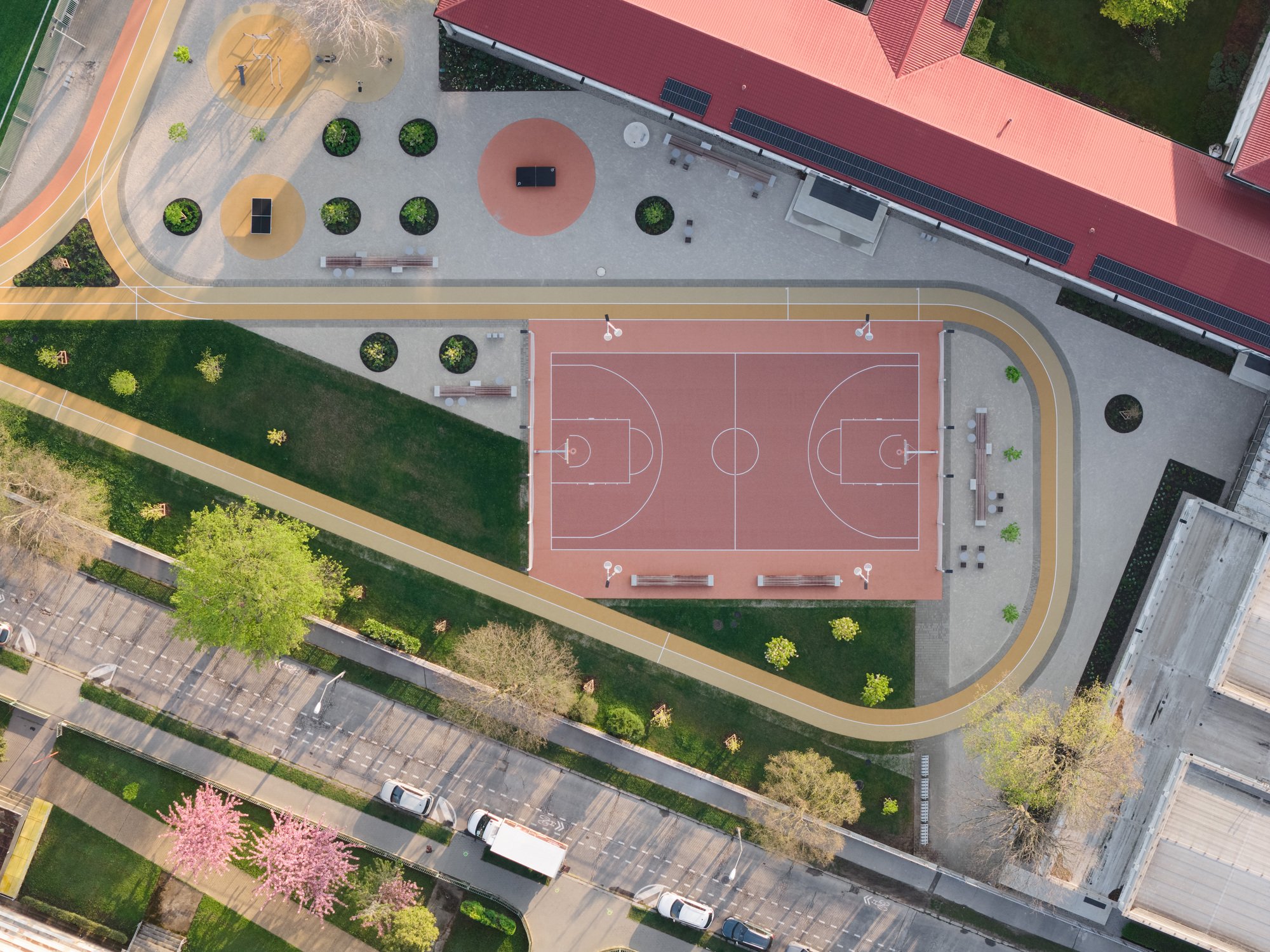
School grounds in Central Europe tend to follow a familiar formula: a rectangle of cracked asphalt, a rusted set of goalposts, and a chain-link perimeter that signals neglect rather than care. In Trnava, a city of around 65,000 in western Slovakia, Šercel Švec has rewritten that script entirely. Their reconstruction of a primary school campus, completed in 2025, strips away the old surfaces, barriers, and generic furniture and replaces them with a 13,500-square-meter ground plane that is legible, colorful, and genuinely public.
What makes the project worth studying is not one dramatic gesture but a disciplined act of zoning and material choreography. The architects organized sport, recreation, and leisure into distinct territories, then linked them through a gradient that shifts from gravel through planting to vivid EPDM rubber. The result reads clearly from the air and feels intuitive on foot. Children, joggers, and neighbors share the campus without written rules because the surfaces themselves do the talking.
A Ground Plane That Teaches Orientation
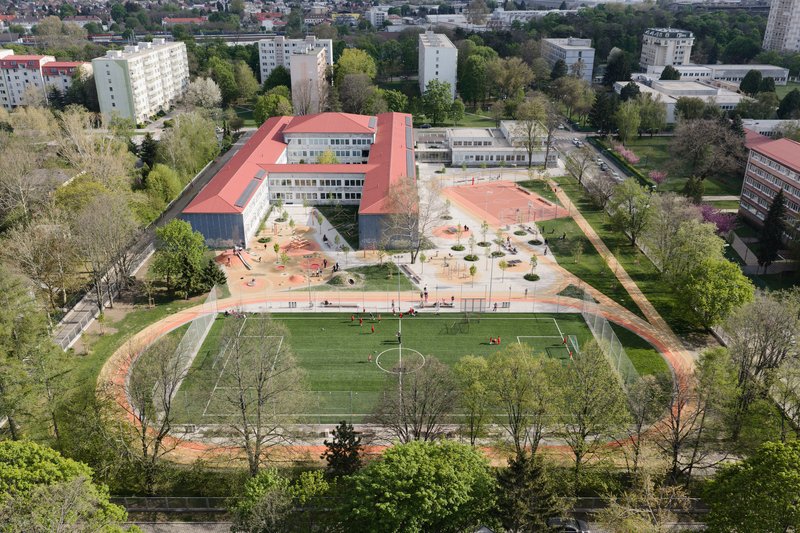
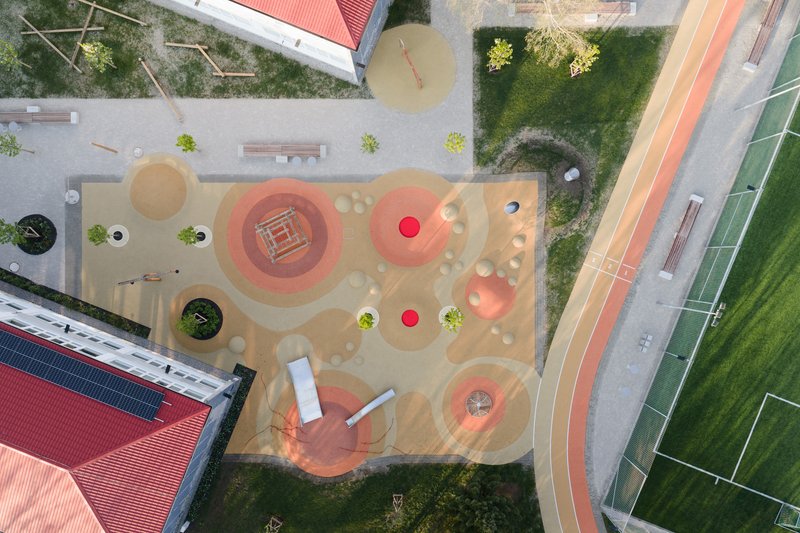
Seen from above, the campus reads like a diagram. The retained artificial-turf football pitch anchors one end; a basketball court and sprint track cluster nearby; and between them, smaller EPDM patches host teqball, table tennis, and workout stations. The color gradient, warm orange and red rubber fading through green planting into pale gravel, is not decorative wallpaper. It functions as wayfinding, giving each zone a chromatic identity that children internalize without signage.
Šercel Švec kept the terrain essentially flat, which was an honest response to the existing conditions rather than a missed opportunity. On a flat site, legibility depends on surface, not section. The architects understood this and invested their design energy where it counts: underfoot.
Topography Built from Rubber
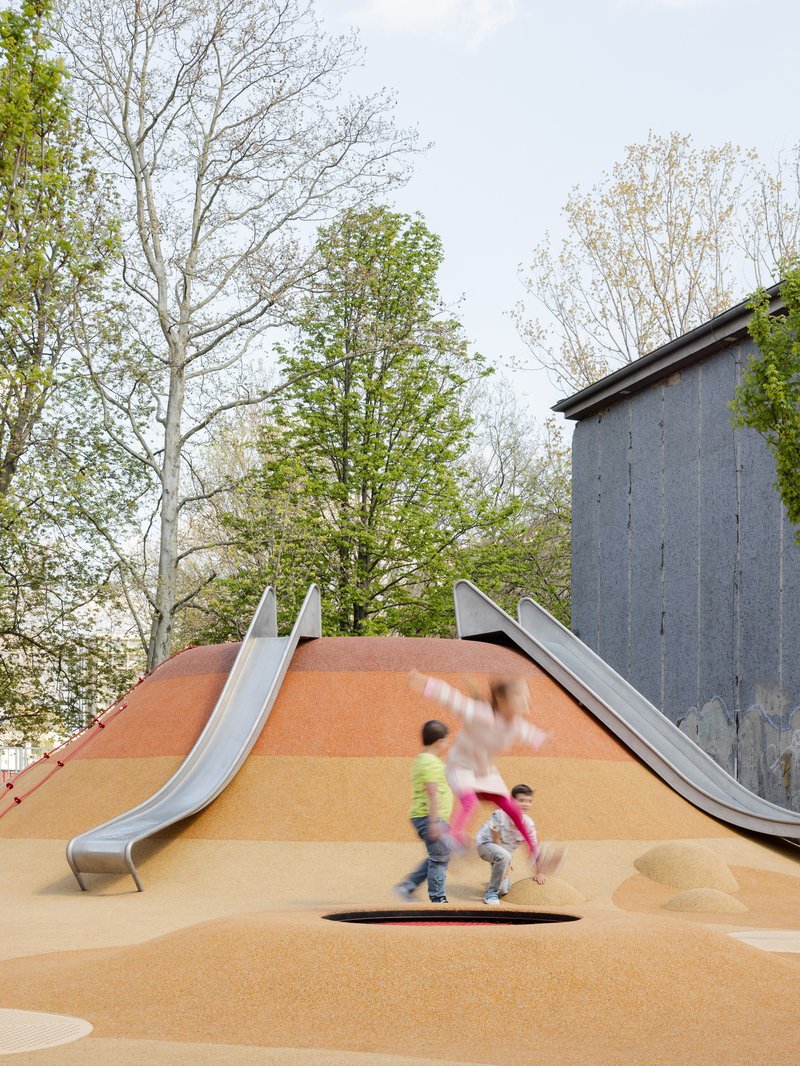
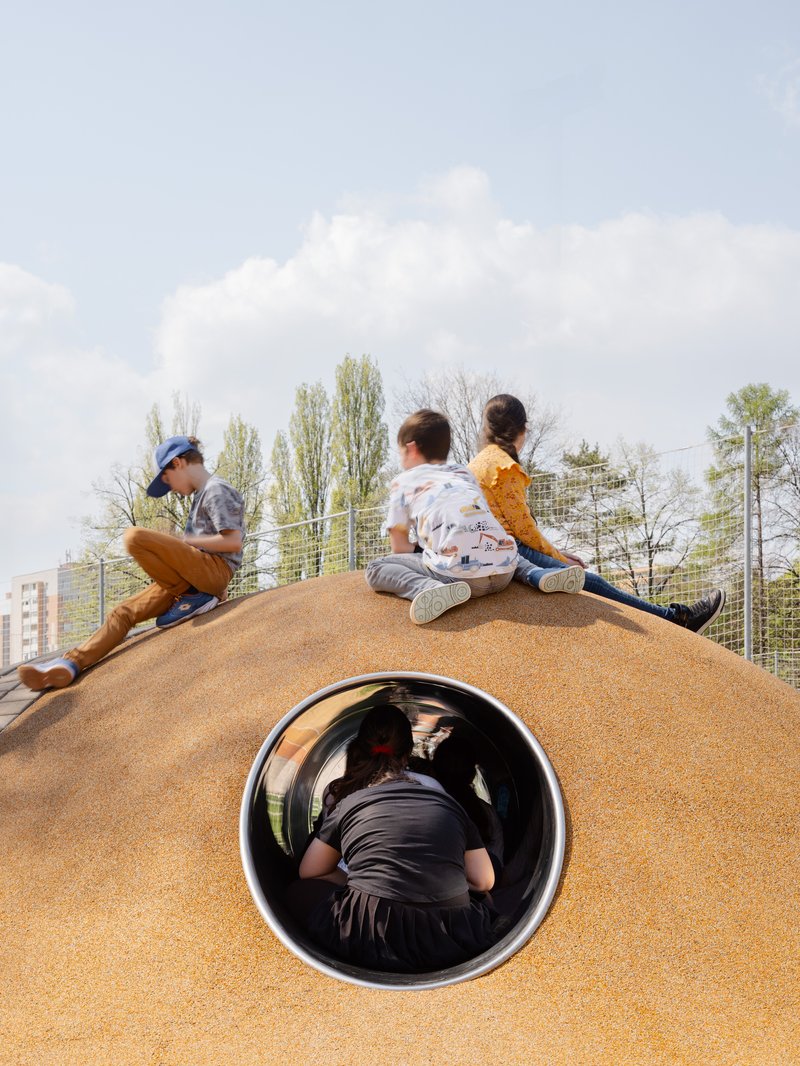
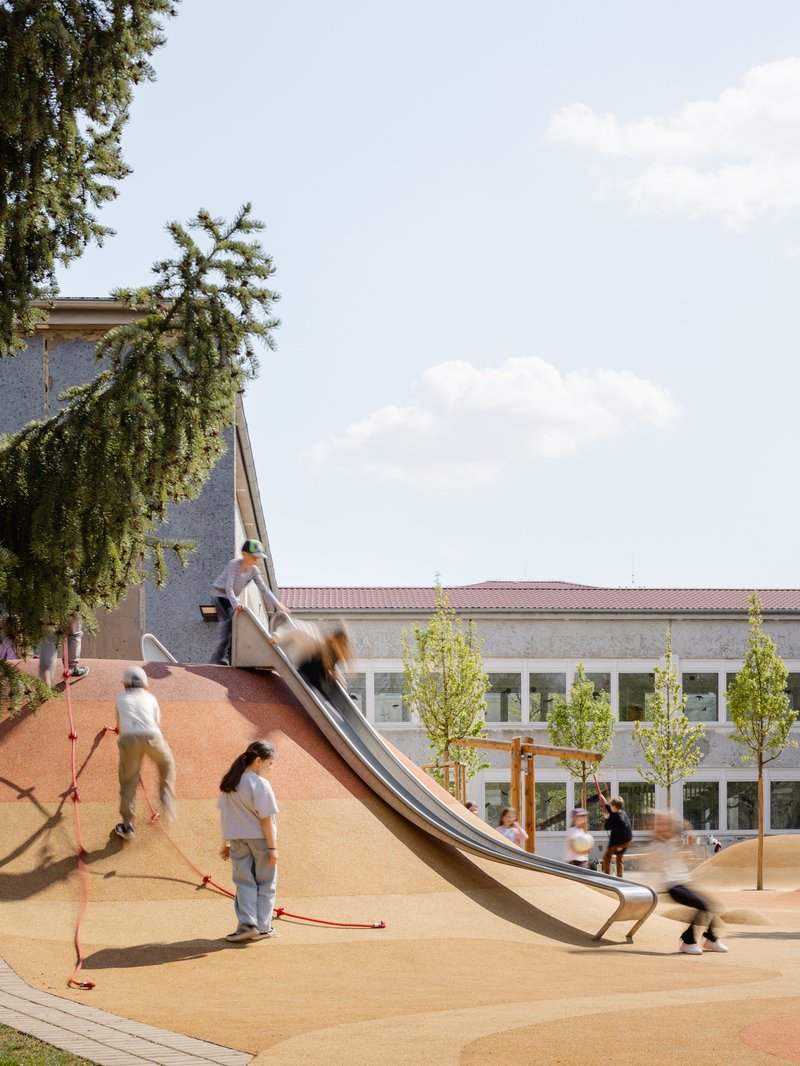
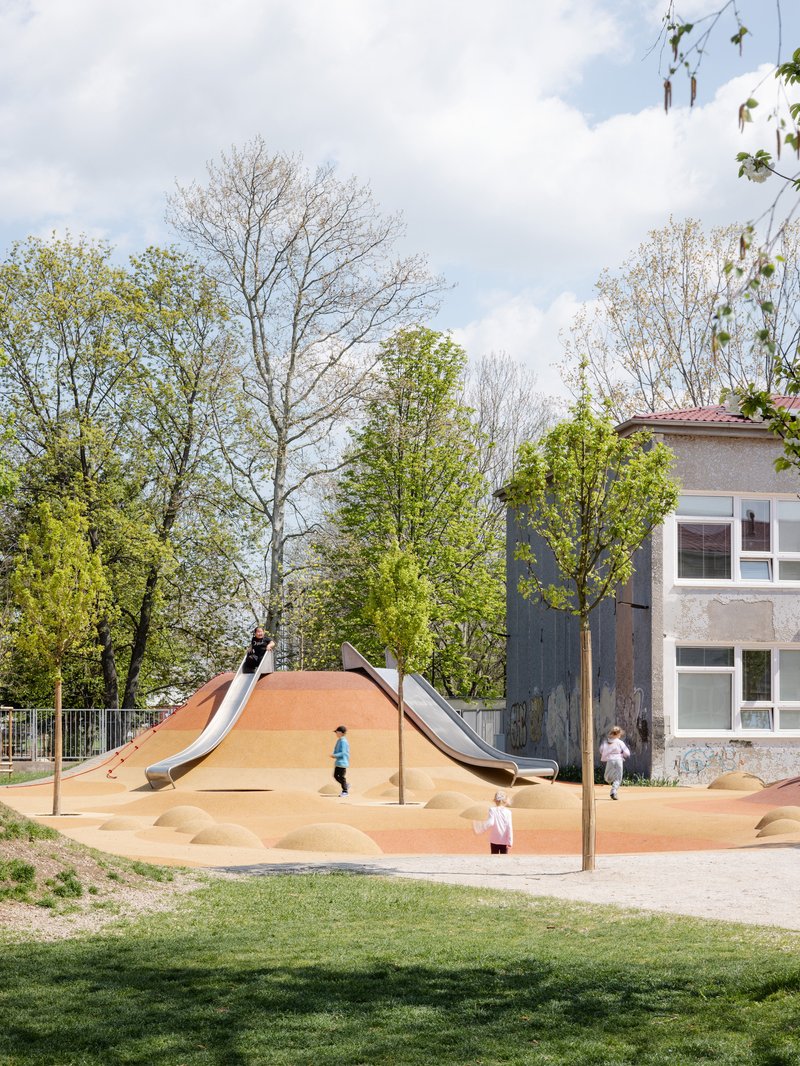
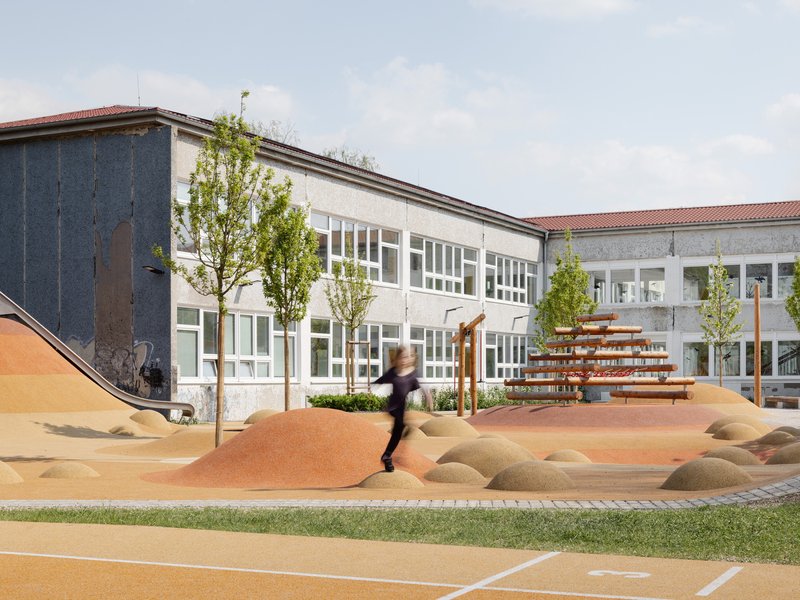
The most inventive move is the mounded EPDM play landscape that rises along the school building's edge. Sculpted hills of orange rubber embed stainless-steel slides, tunnel openings, and climbing surfaces into their contours, turning the ground itself into equipment. Children slide down slopes, crawl through tubes, and perch on ridgelines. The play structures are not objects placed on a surface; they are the surface, modeled in three dimensions.
This approach dissolves the boundary between playground and ground plane that conventional design enforces. There is no safety fence ringing a catalog climbing frame. Instead, the rubber topography absorbs impact by its geometry, rising and falling at grades that manage risk through form rather than exclusion.
Sport Zones and the Spectator's Edge
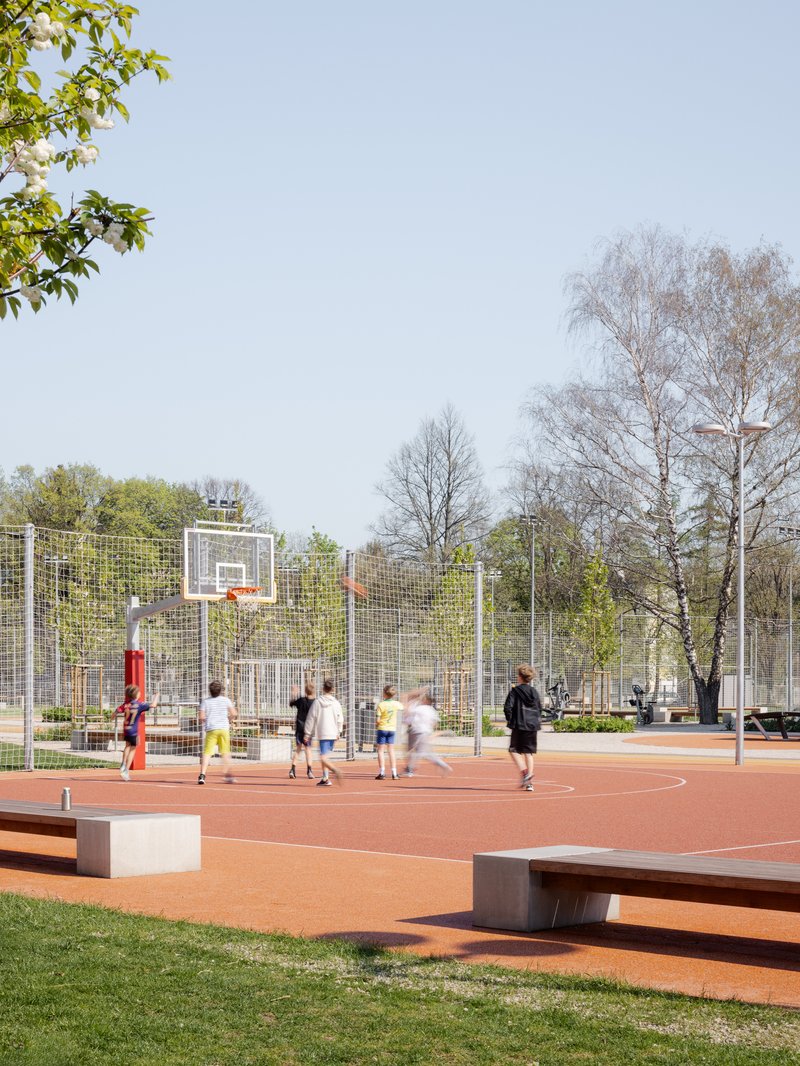
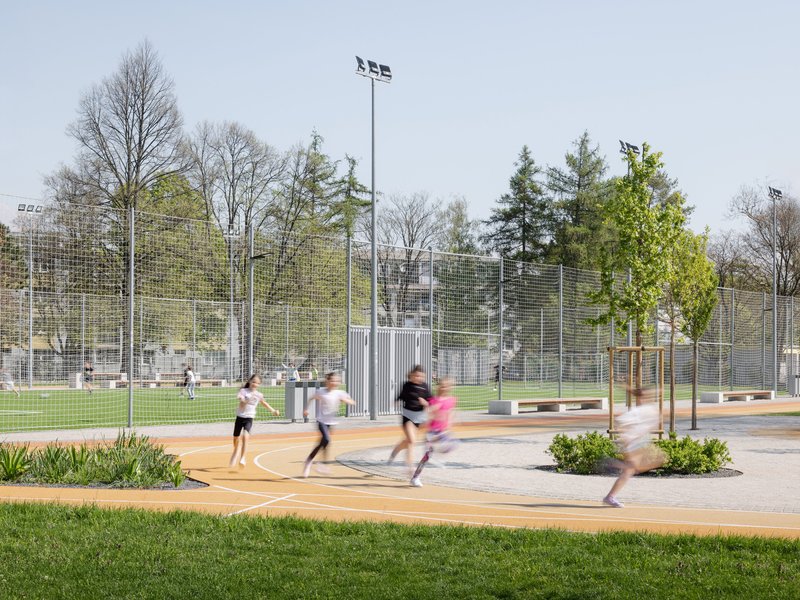
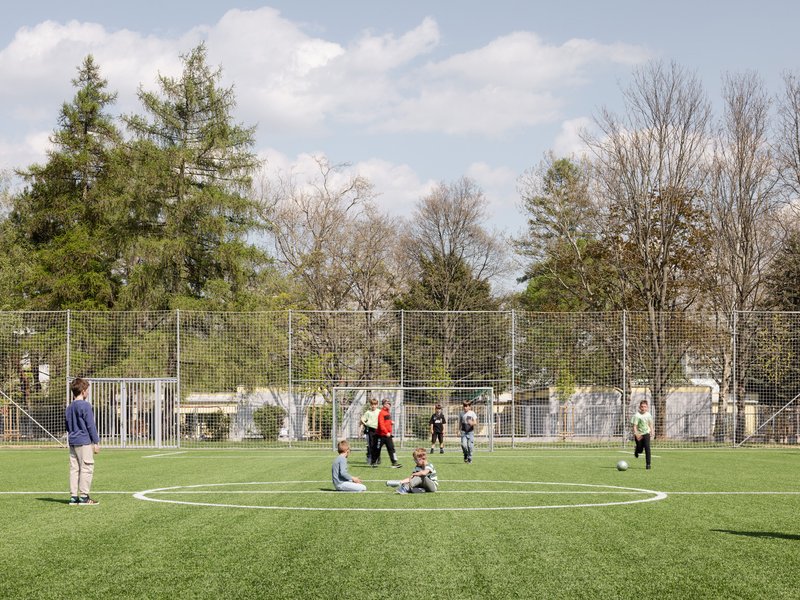
The basketball court sits inside a loop of running track, neatly doubling the utility of a single footprint. Wire-mesh fencing, tall and utilitarian, keeps balls contained without blocking sight lines. Along the football pitch, which received a surface renewal and new fencing, a two-tier concrete stand offers seating that is genuinely civic: solid, weather-resistant, and positioned so parents and passersby can watch a match without entering the field.
The fencing deserves a closer look. Rather than hiding behind hedges or pretending it doesn't exist, the design accepts mesh as a material fact of school sport and works with its transparency. Viewed through birch trunks and spring foliage, the wire becomes a textured middle ground, softened but not disguised.
Gathering and Rest Along the Gravel Spine
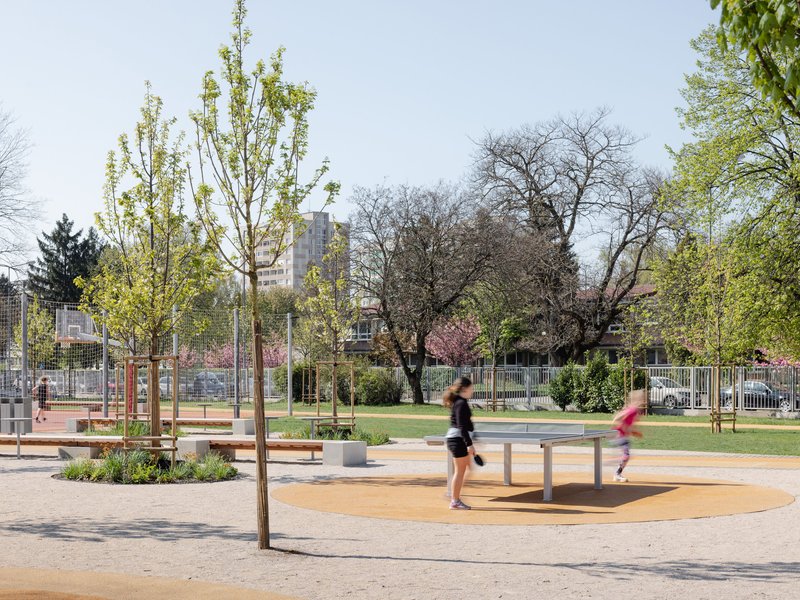
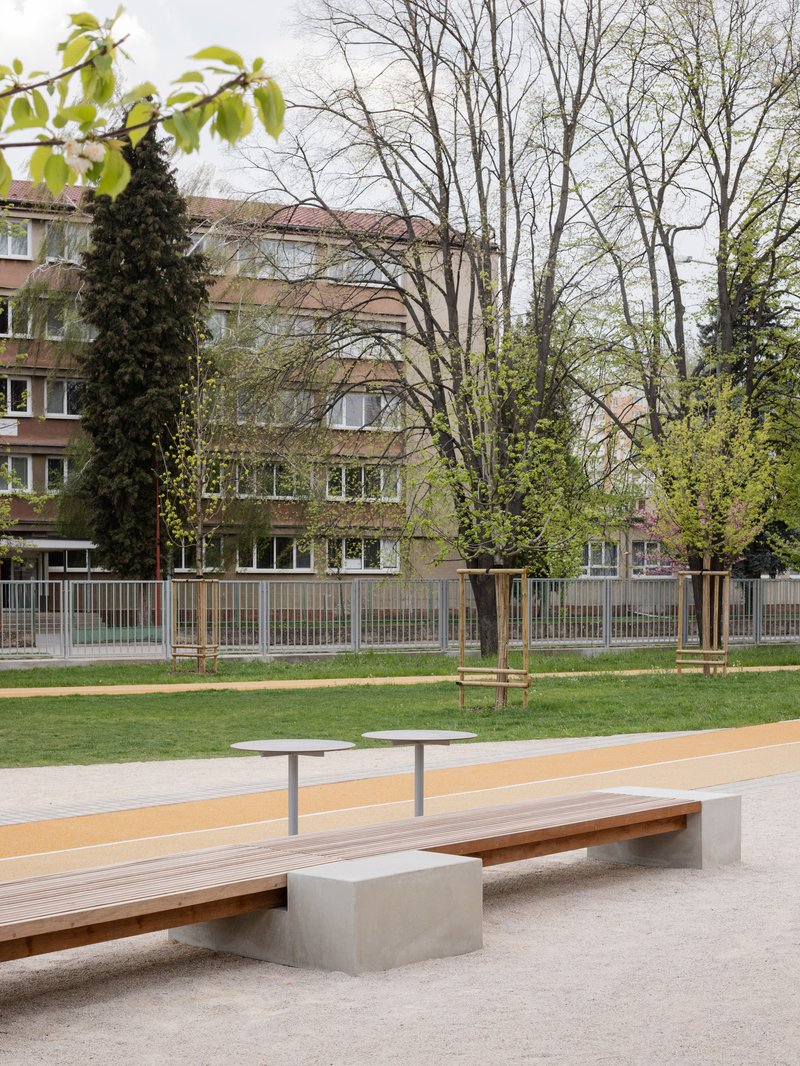
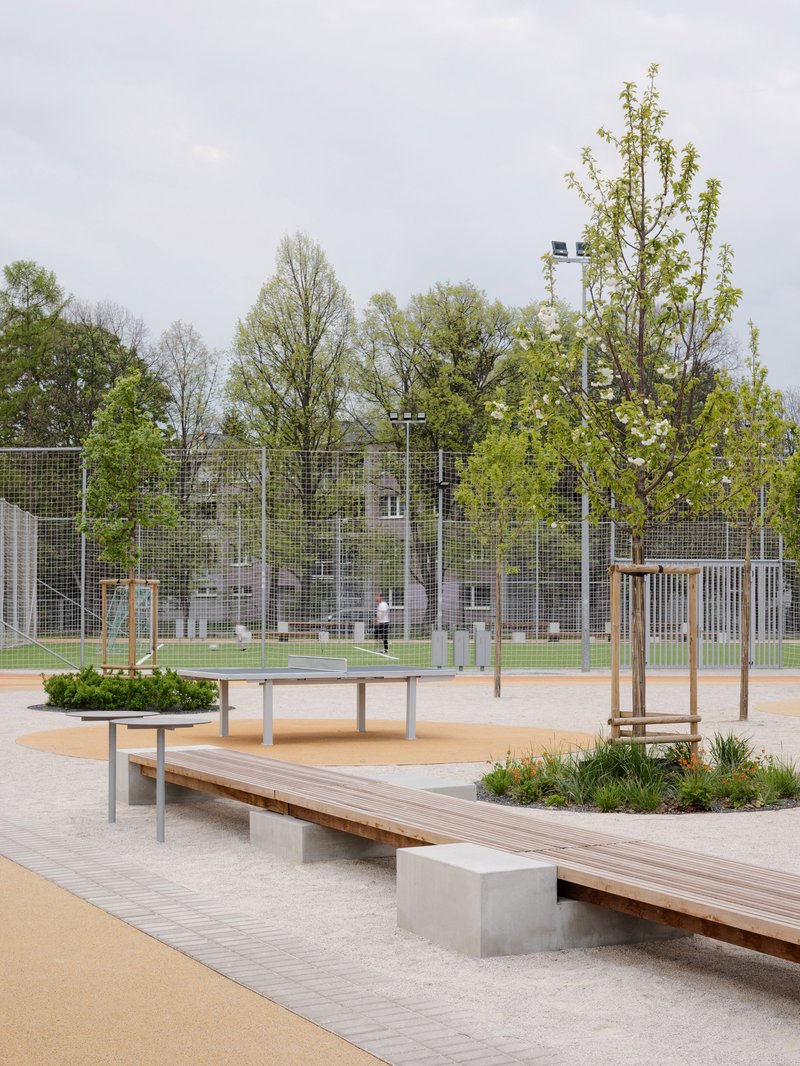
The leisure zone runs along the school facade, paved in pale gravel and furnished with timber-and-concrete benches by mmcité and Egoé. It is deliberately understated: no bright rubber, no climbing ropes. The furniture is movable enough to accommodate outdoor teaching and stable enough to survive a Slovak winter. Planted beds with young deciduous trees break the length of the run, offering shade that will thicken over the coming years.
By separating the calm zone from the sports zones with planting rather than walls, the architects keep visual continuity alive across the campus. A teacher sitting on a bench can see the basketball court, the sprint track, and the play hills in a single sweep. Supervision becomes a byproduct of spatial openness, not a surveillance apparatus.
Play Equipment as Landscape Element
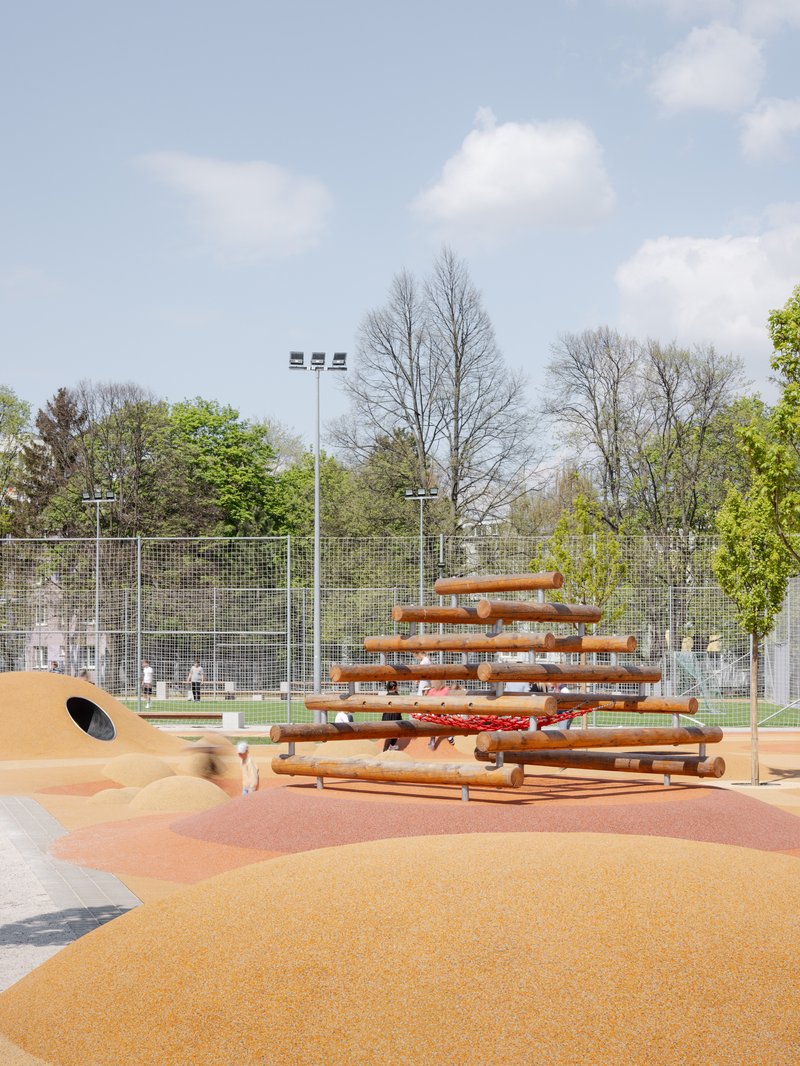
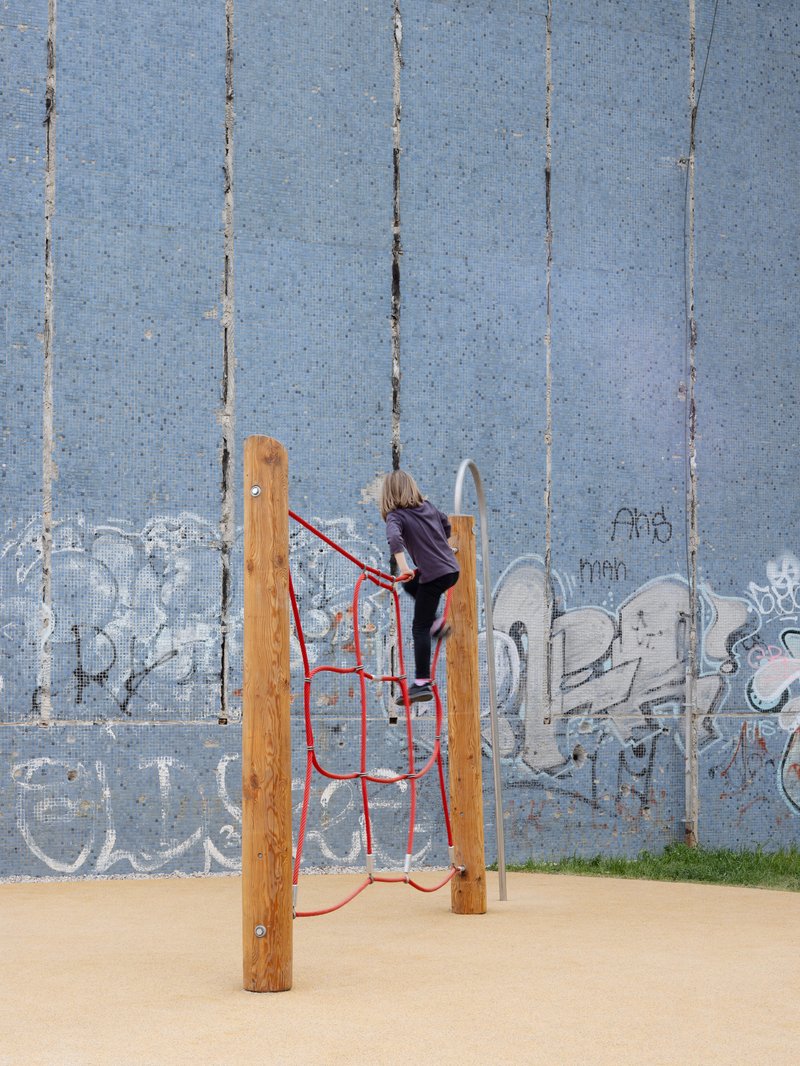
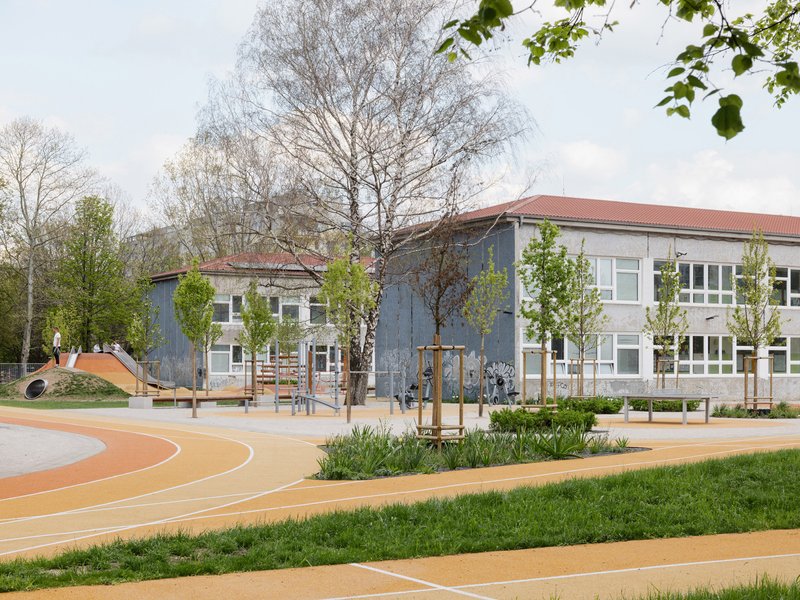
Richter Spielgeräte, KOMPAN, and Jakob Rope Systems supplied the play elements, but their installations feel integrated rather than dropped in. Timber structures with stacked horizontal slats sit on orange EPDM pads that bleed into the surrounding surface. Rope-net climbing frames are held by timber posts and set against the blue-tiled school wall, using existing architecture as a backdrop rather than ignoring it.
The slide structure near the spring trees is a good example of the integration logic at work. Its timber frame, rubberized landing zone, and adjacent planting form a single composition. Remove any one layer and the clarity breaks down. This kind of tightly knit detailing separates landscape architecture from landscape decoration.
The Outdoor Classroom and Amphitheater
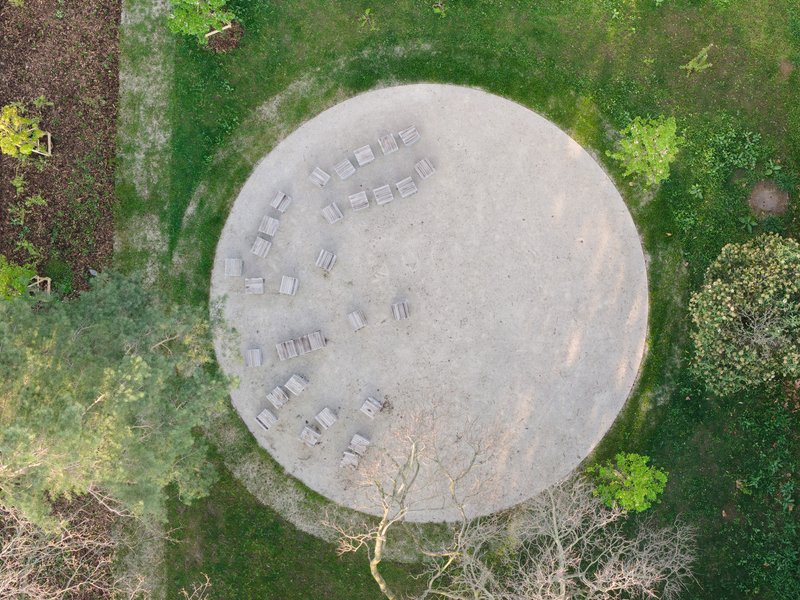
In the southern portion of the campus, a circular concrete amphitheater with timber bench inserts creates an outdoor classroom that could seat an entire class. Surrounded by deciduous trees, it reads as a small clearing: intimate in spring and exposed in winter. The geometry is simple, concentric rings stepping down, but it gives the school a gathering space that no interior room could replicate.
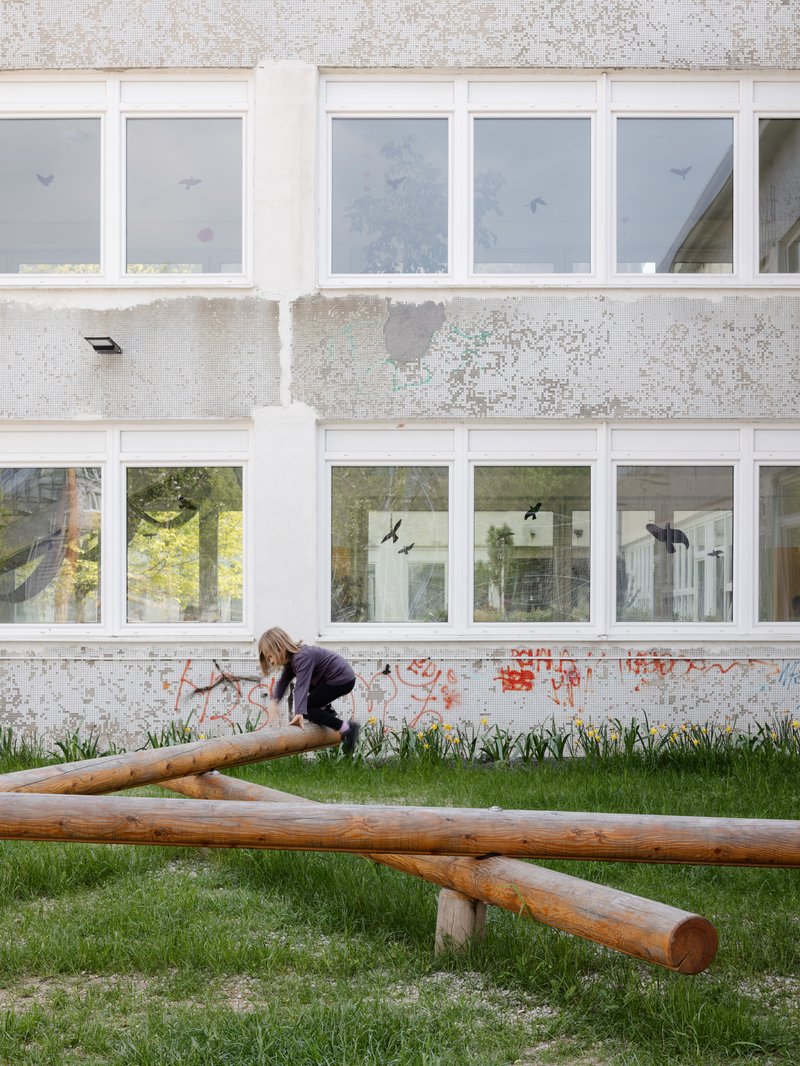
Nearby, timber balance beams on grass offer a low-key alternative to the high-energy play zones. These quieter elements acknowledge that not every child wants to sprint or climb at every break. Choice is built into the campus plan.
Opening the Forecourt to the City
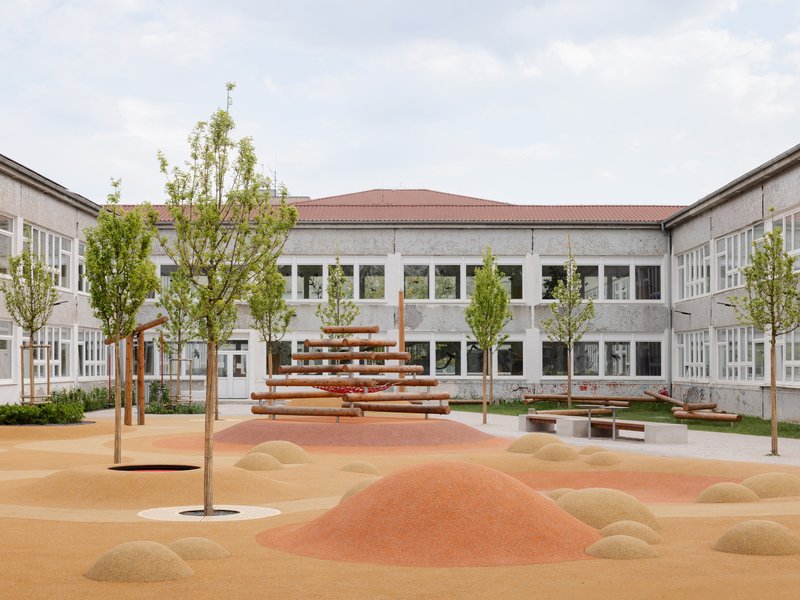
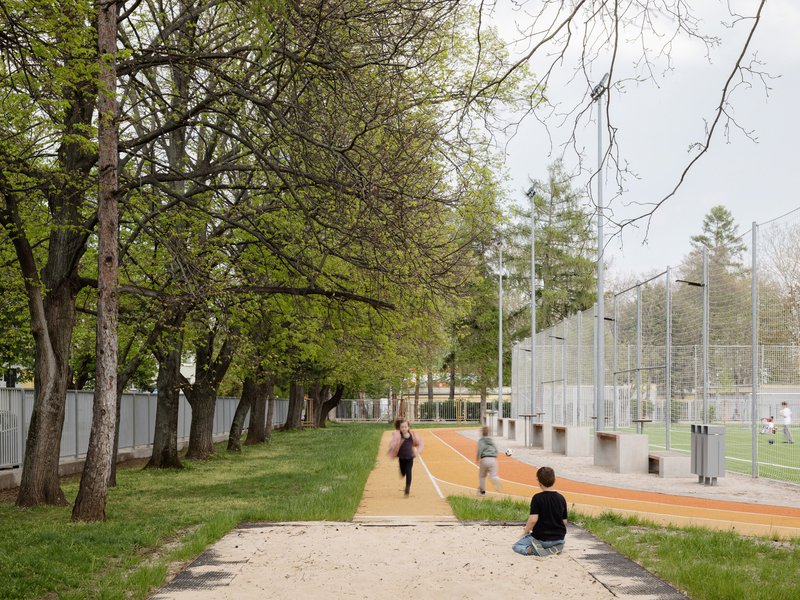
One of the simplest and most consequential decisions was removing the barriers that once sealed the school forecourt from the street. Asphalt gave way to paving and greenery, converting a leftover buffer into a genuine public threshold. The campus is now accessible to neighbors outside school hours, a policy choice that the architecture actively supports rather than merely tolerates.
The tree-lined path that runs alongside the sports courts captures this dual identity well. During school hours it is a corridor for students moving between zones; on weekends it is a jogging route for residents. The path asks nothing of its users except that they move through it, and the planting on either side makes that movement pleasant.
Plans and Drawings
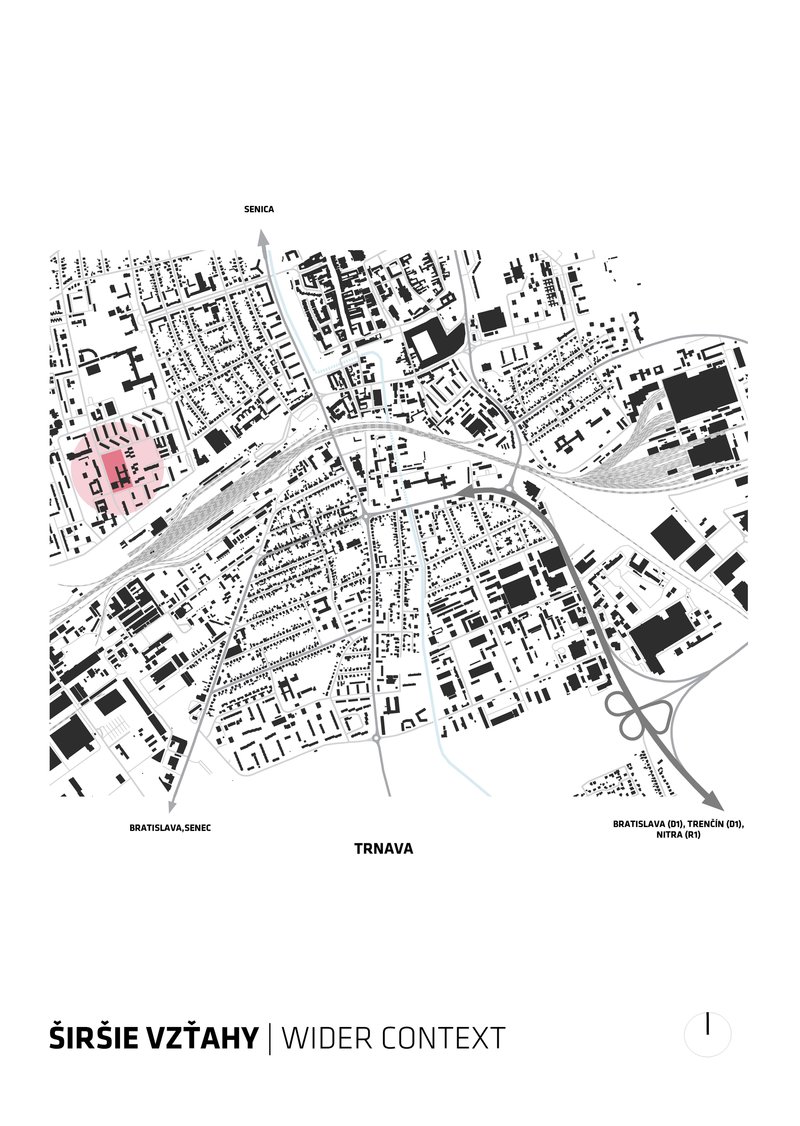
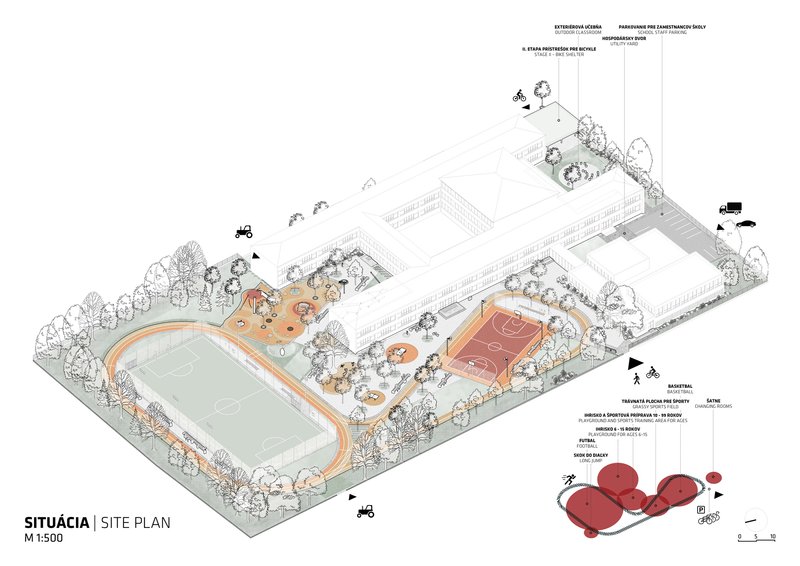
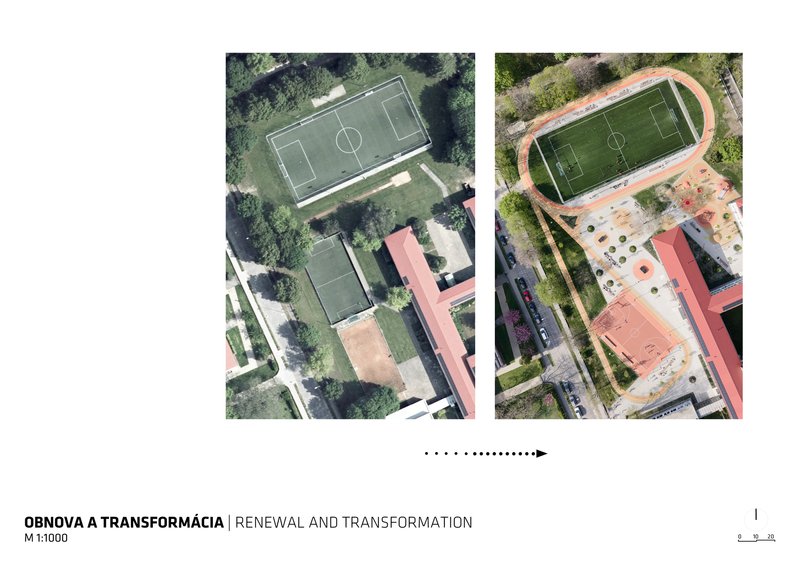
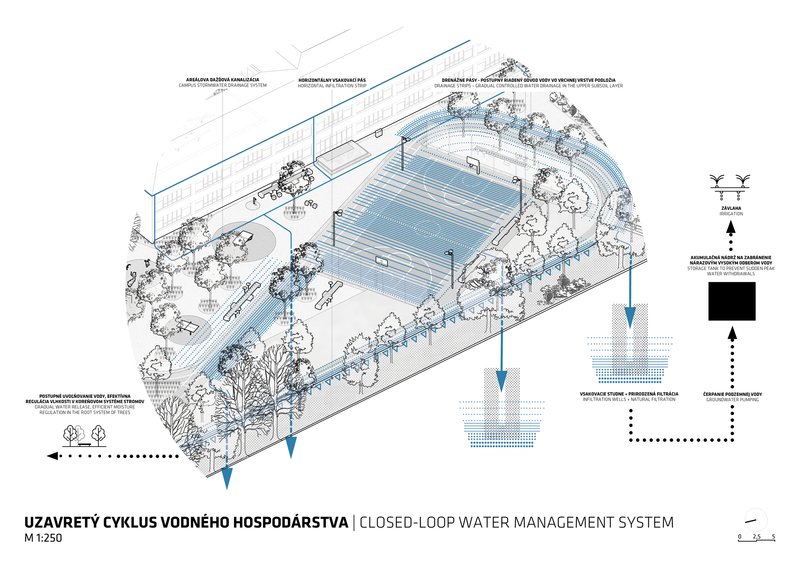
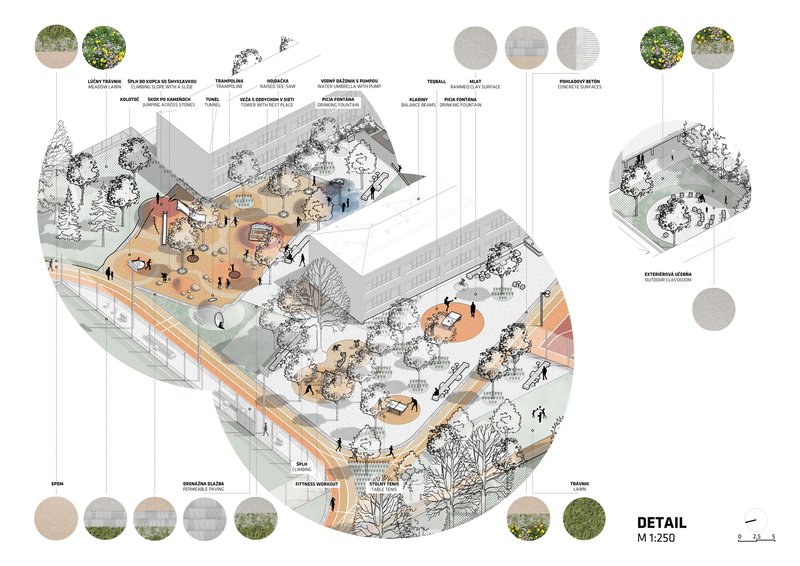
The site plan reveals the project's relationship to Trnava's urban grain: the school building sits at the center of its block, and the landscape occupies the full perimeter. The axonometric drawings are especially instructive. One details the stormwater management strategy, with blue arrows tracing runoff from paved surfaces into planted infiltration beds. Another breaks down the material palette zone by zone, showing how gravel, EPDM, artificial turf, and planting interlock across the campus. The before-and-after aerial comparison makes the scale of the intervention unmistakable: what was a patchwork of underperforming surfaces is now a coherent system.
Why This Project Matters
The Trnava campus is not a flagship cultural building or a luxury residential commission. It is a municipal schoolyard, funded by city ownership, designed for children and the community around them. That context makes the quality of the work all the more significant. Šercel Švec treated the brief with the same rigor that other firms reserve for museums and galleries, applying clear zoning, considered material transitions, and genuine landscape thinking to a project type that is routinely neglected.
The lesson is practical: when a school ground is designed as a landscape rather than decorated as an afterthought, it earns its place in the city. The color gradient orients children. The open forecourt invites neighbors. The stormwater strategy absorbs rain. None of these outcomes required exotic technology or an inflated budget. They required an architect who understood that ground is architecture too.
Trnava School Campus Reconstruction by Šercel Švec. Trnava, Slovakia. 13,500 m². Completed 2025. Photography by Matej Hakár.
About the Studio
Share Your Own Work on uni.xyz
If projects like this are the kind of work you want to make, uni.xyz is a place to publish your own, find collaborators, and enter design competitions.




Popular Articles
Popular articles from the community

Terra e Tuma Scatters Four Concrete Pavilions Through the Atlantic Forest in Mairiporã
A fragmented compound of music studio, art studio, chapel, and living quarters preserves every tree on a steep forested hillside near São Paulo.

POP ART: Adaptive Reuse Architecture as a Cultural Intervention in Sydney
POP ART reimagines an unused Sydney warehouse through adaptive reuse architecture, creating a bold cultural landmark above the city streets.
DIM Architecture Studio Revives the Iranian Courtyard Inside a Mashhad Apartment Building
A 2,500-square-meter mid-rise infill project reinterprets the traditional hashti and central courtyard within the dense urban fabric of Mashhad, Iran.

UNA Barbara e Valentim Plants Four CLT Bungalows in a Fragile Ceará Landscape
Prefabricated eucalyptus timber cabins touch down lightly on the sandy, biodiverse coast of Barroquinha, Brazil.


Similar Reads
You might also enjoy these articles
School Group Samuel Paty in Béziers: A Contemporary Educational Campus by Ateliers O-S Architectes and NAS Architecture
Samuel Paty School in Béziers features concrete massing, porous courtyards, metal structures, and landscaped playgrounds, creating a child-scaled, light-filled learning environment.
Four Public Pavilions in Beijing by Aurélien Chen and CSCEC
Four park pavilions in Beijing combine public services with floating roofs, acting as subtle urban signals integrated into landscape contextually.
LÁ-SÁCH House by Atelier tho.A
Compact tropical tube house-library with polycarbonate louvers, flexible interiors, concrete core, crafted materials, and community-focused alley setback.
Luxelakes Tianfu Food Island Phase II: A Contemporary Lakeside Commercial Hub in Chengdu
Lakeside commercial complex in Chengdu featuring cascading terraces, sloped roofs, and public waterfront spaces, blending restaurants, retail, and community interaction.


Explore Landscape Design Competitions
Discover active competitions in this discipline




The Global Benchmark for Architecture Dissertation Awards


Challenge to design public laboratory
Comments (0)
Please login or sign up to add comments
No comments yet. Be the first to comment!