
Šercel Švec Transforms a Slovak Schoolyard into a Landscape of Play, Sport, and Ecology
A 13,500-square-meter campus in Trnava replaces aging asphalt with nature-based recreation zones and closed-loop water systems.

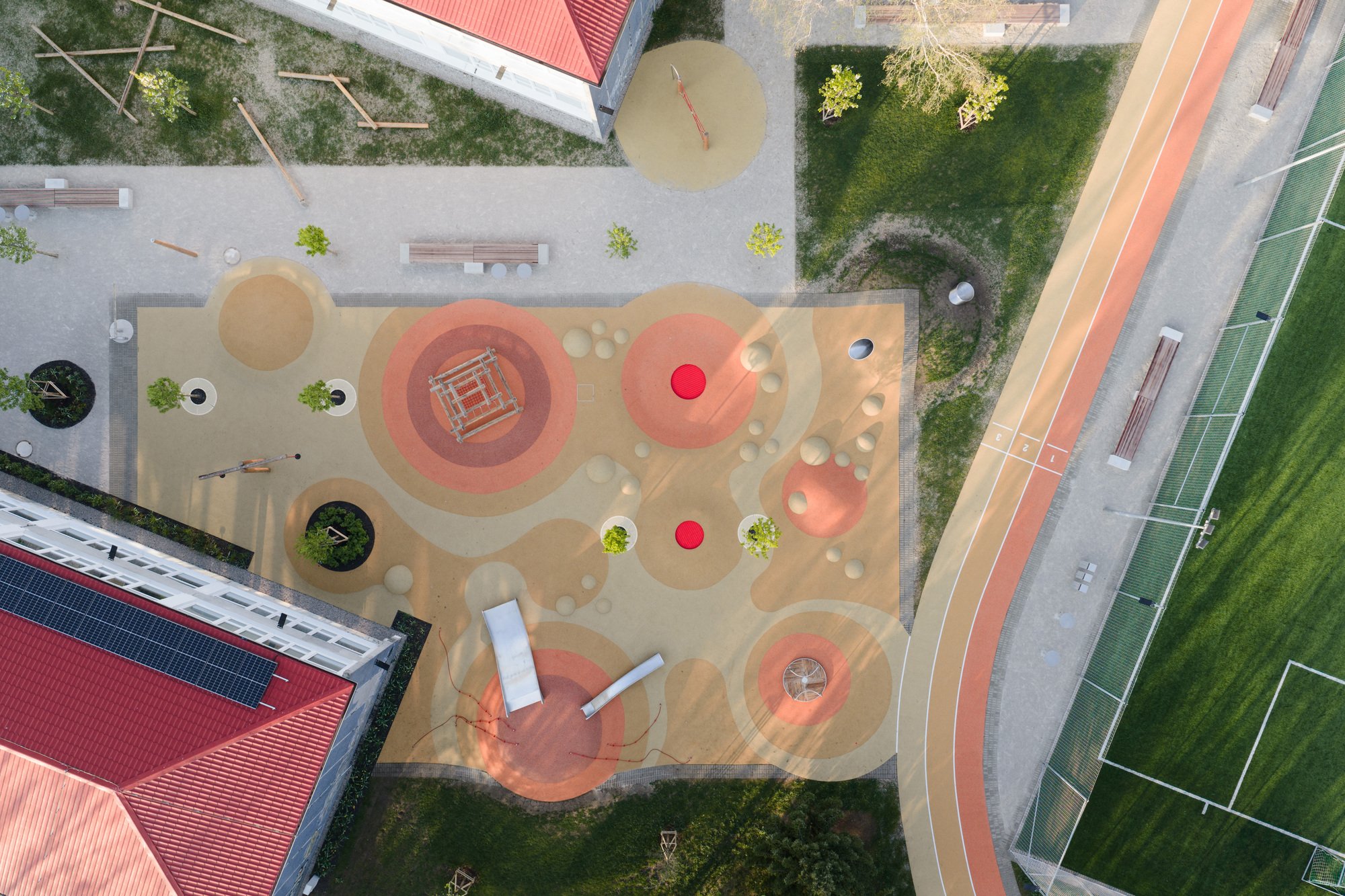
School campuses are, by default, some of the most heavily used public landscapes in any city, yet they rarely receive the design attention that parks or plazas enjoy. In Trnava, Slovakia, the studio Šercel Švec has completed a 13,500-square-meter overhaul of an existing school campus that does something genuinely rare: it treats the schoolyard as a full-blown landscape architecture problem, not just a facilities upgrade. The old asphalt, worn-out sports surfaces, and cluttered urban furniture are gone. In their place, a carefully zoned terrain of sculpted play mounds, native plantings, differentiated lawn types, and closed-loop water management offers a convincing argument that the ground beneath children's feet deserves as much design rigor as the buildings around them.
What makes the project worth studying is its refusal to treat recreation, ecology, and infrastructure as separate budget lines. The landscape architect Andrea Prievalská worked with the studio to layer each zone so that stormwater capture, planting strategy, and programmatic use reinforce one another. The retained artificial turf football pitch anchors the athletic core while everything else, from workout pads to balance beams to a circular gathering plaza, is rebuilt from scratch with a material and planting palette tuned to the flat, continental site. The result reads less like a renovated schoolyard and more like a small urban park that happens to serve two schools.
Terrain as Toy
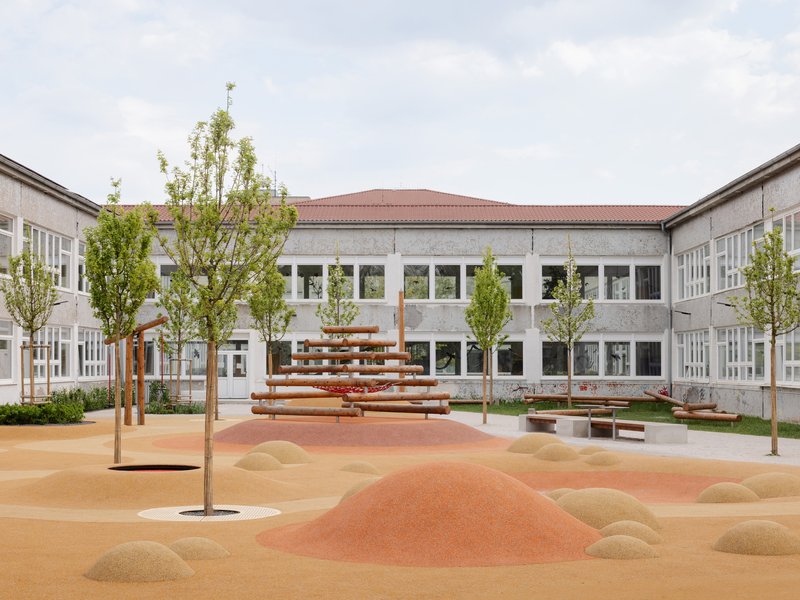
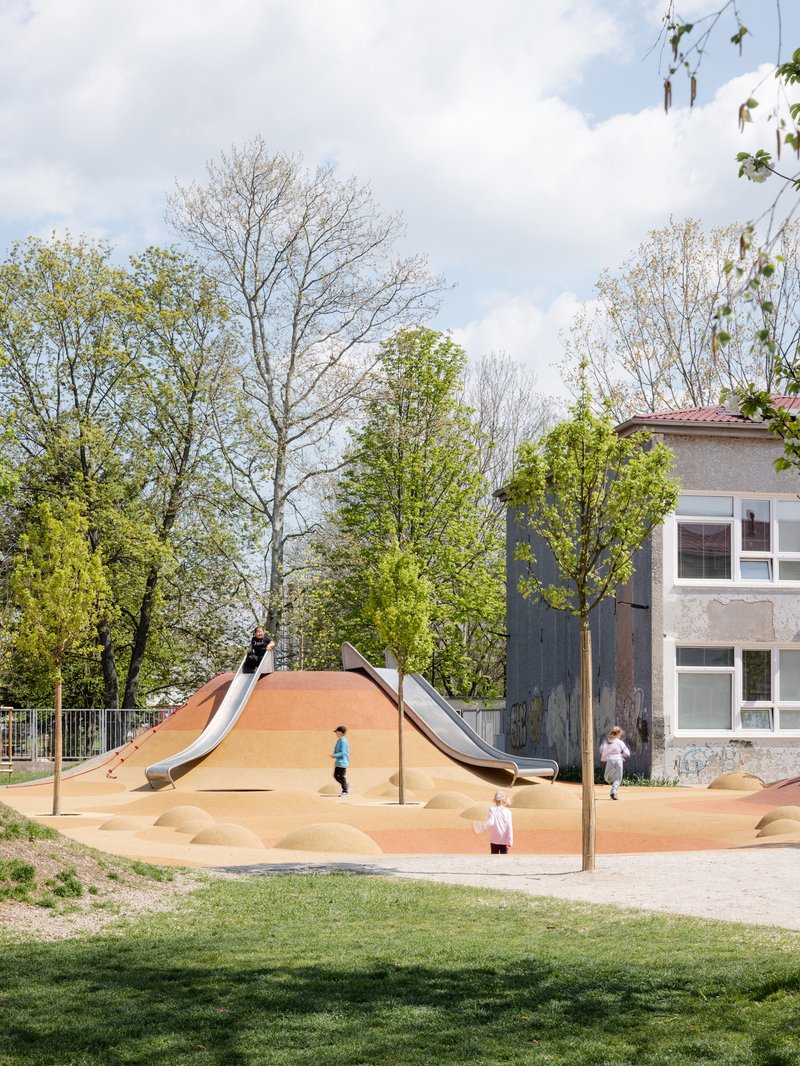
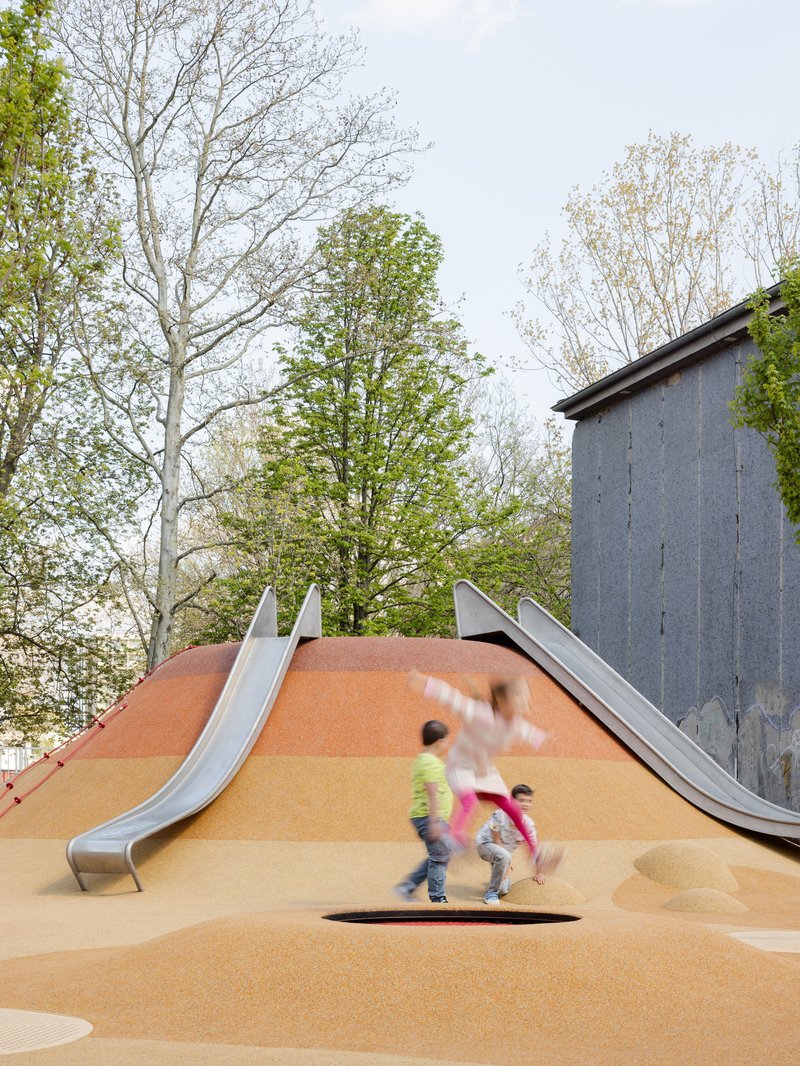
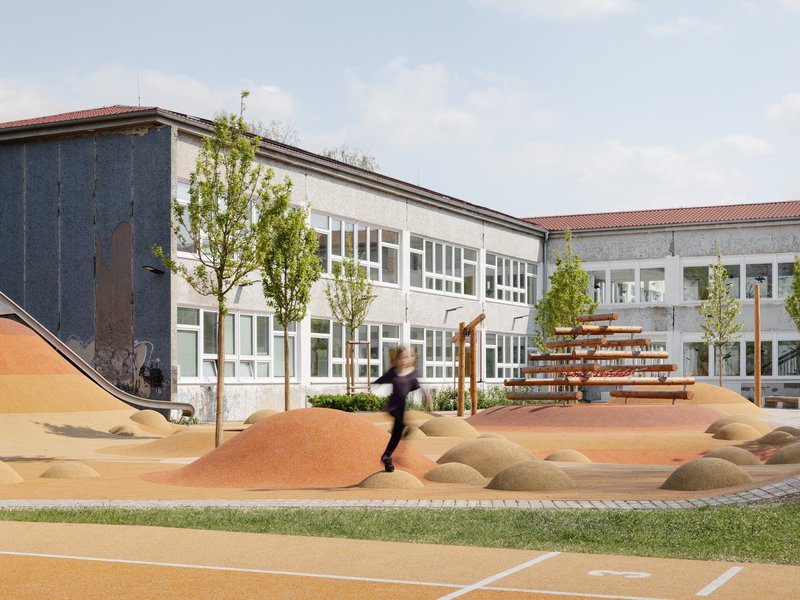
The most arresting move is the sculpted topography. Coral and ochre EPDM mounds rise from the otherwise flat site, creating a terrain that children climb, slide down, and tunnel through. These are not appliqué play structures bolted to a rubber mat; they are landforms. Stainless steel slides are embedded into their slopes, and tunnel openings perforate their bases. The mounds give the campus a legible silhouette that breaks the monotony of the surrounding flat courtyard, and they accomplish this without importing any building volume.
The sand dune with twin slides captures this logic at its clearest: the play element is the ground itself. Children navigate the slope, not a piece of equipment, and the young trees planted into the mound's perimeter will, in a few seasons, shade the surface and further blur the line between playground and garden.
Sport Zones in Sequence
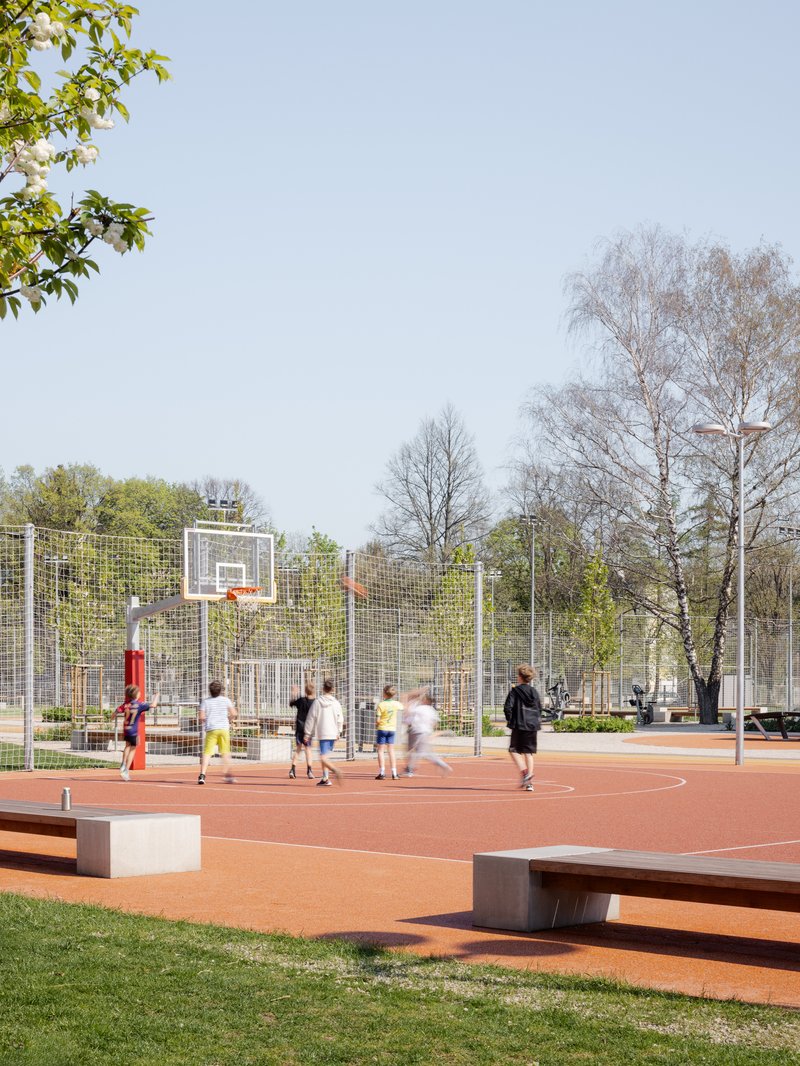
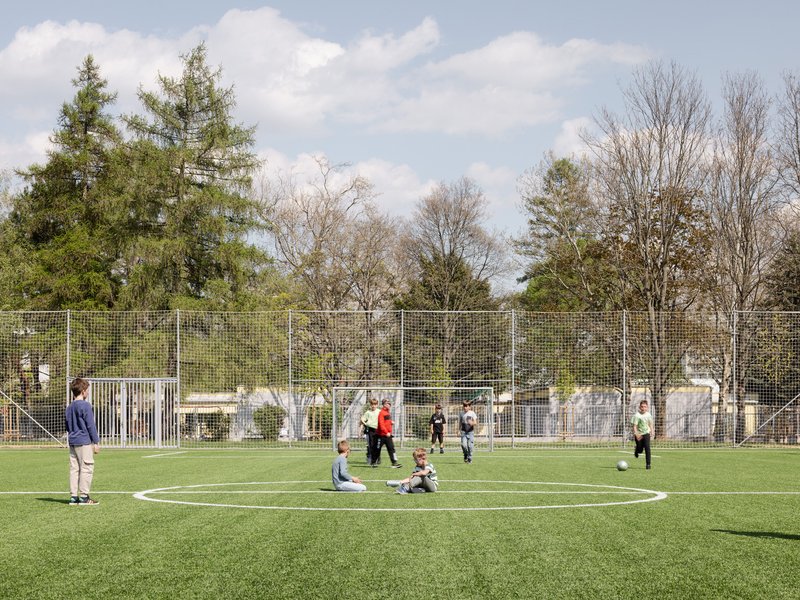
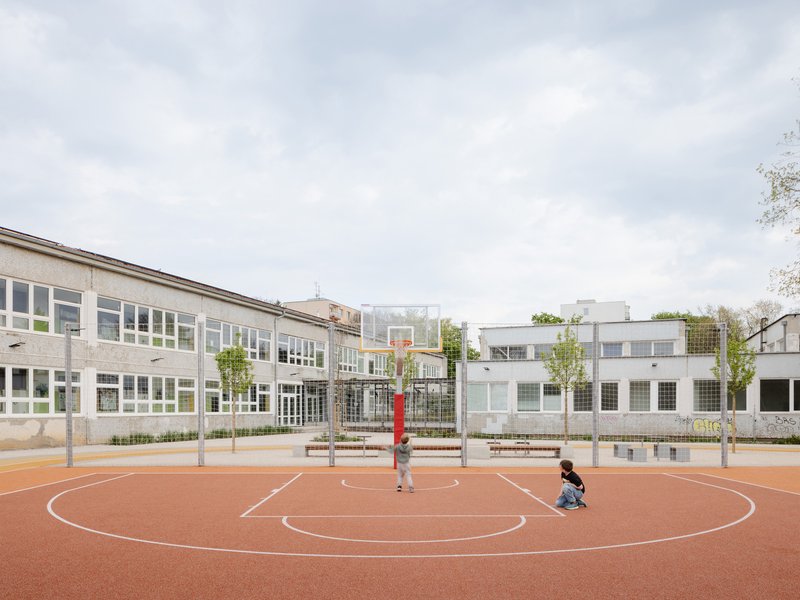
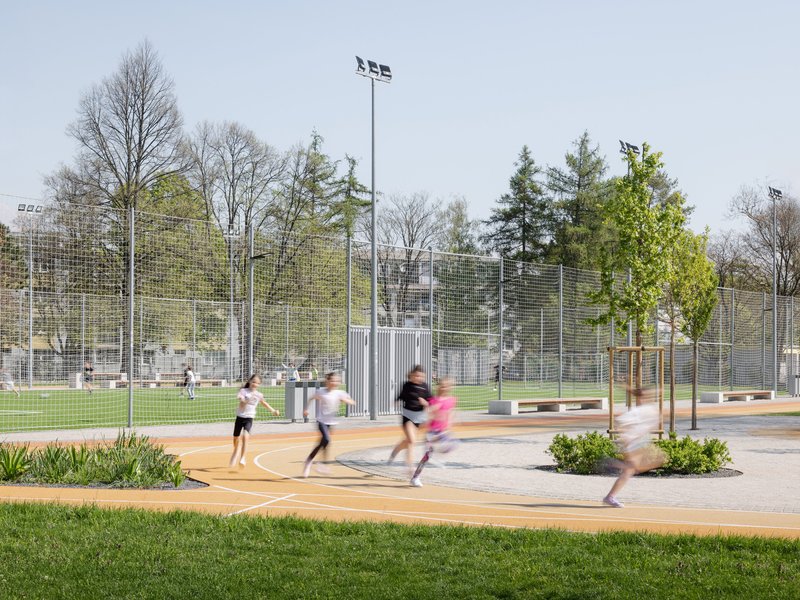
The athletic program is laid out in a clear sequence that separates ball sports from running from individual fitness. A wire-mesh-enclosed basketball court sits on orange rubber surfacing, its proportions compact enough for a half-court game but generous enough for full play. Adjacent to it, the retained artificial turf pitch handles football. A curved running track wraps the perimeter, its mesh fence low enough to maintain sightlines across the campus while keeping balls contained.
This zoning is practical rather than decorative. By giving each sport its own enclosure and surface type, the design reduces scheduling conflicts and lets multiple groups use the campus simultaneously. The wire mesh fencing, consistent across all courts, acts as a unifying datum that ties disparate activities into a single visual system.
A Planting Strategy Built on Sociability
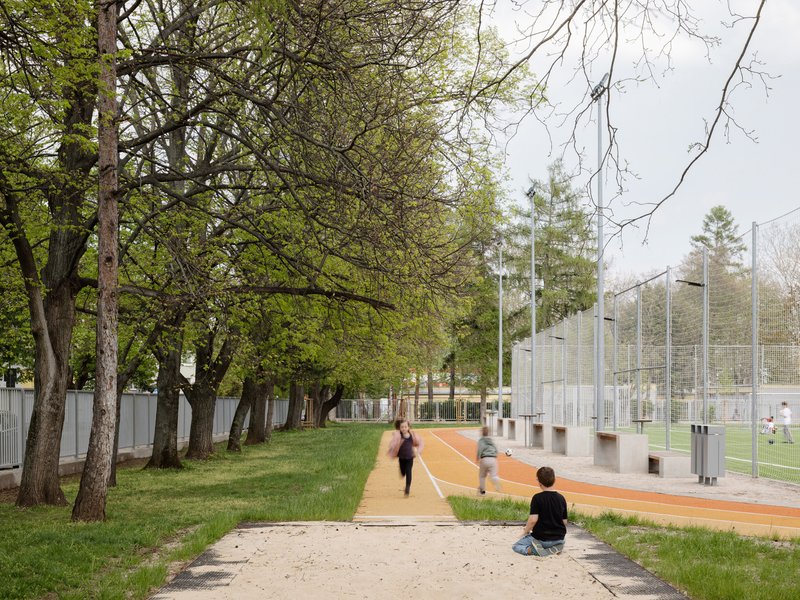
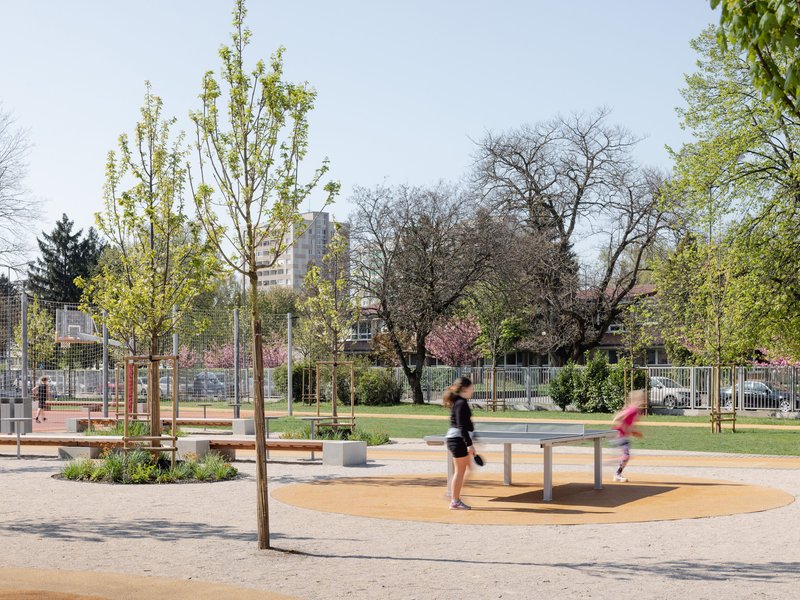
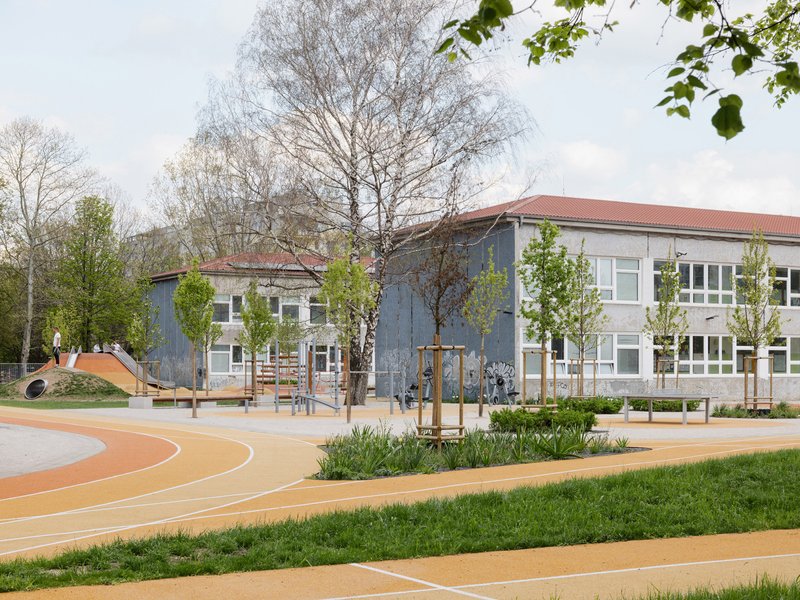
The planting approach deserves attention for its precision. The tree layer supplements existing perimeter vegetation with native and well-adapted species, planted systematically rather than scattered for ornament. Shrubs are used selectively to maintain visibility and safety, a decision that acknowledges the reality of supervising hundreds of children across a large open site. The herbaceous layer combines perennial beds, ornamental grasses, and bulb plants according to principles of plant sociability and self-regulation, meaning the planting communities are designed to coexist and self-seed with minimal maintenance input.
Lawns are differentiated by use intensity: high-traffic recreational lawns where children run, extensive meadow lawns in quieter zones, and gravel lawns in transition areas. This gradient is a quietly radical idea in school design, where the default is usually a single species of turf mowed to a uniform height. Here, the ground cover itself communicates where you are and what you can do.
Furniture and Edges
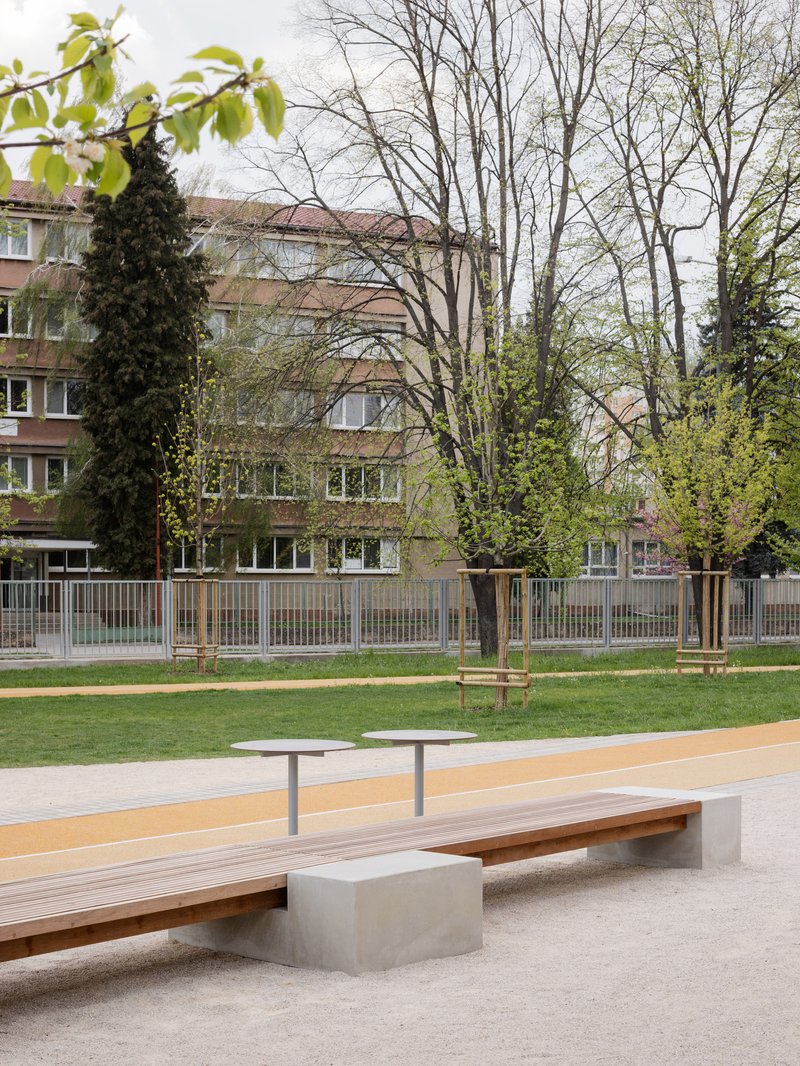
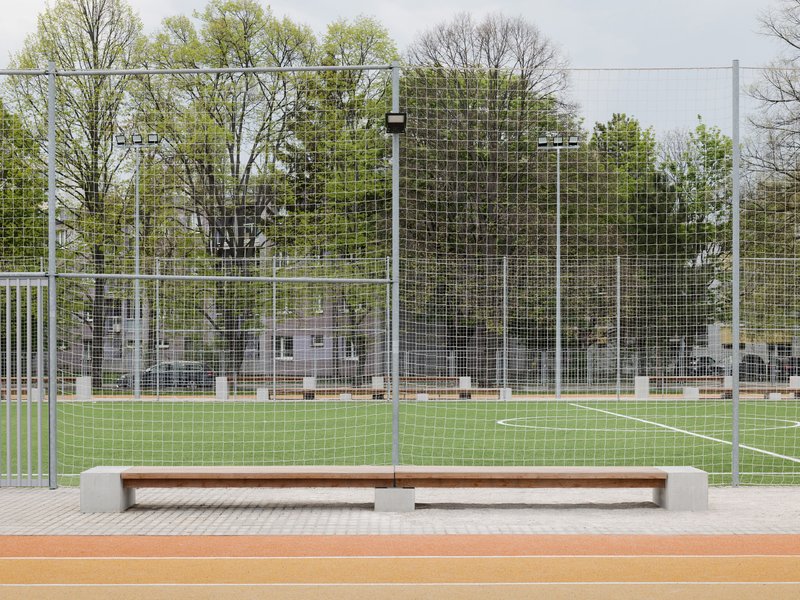
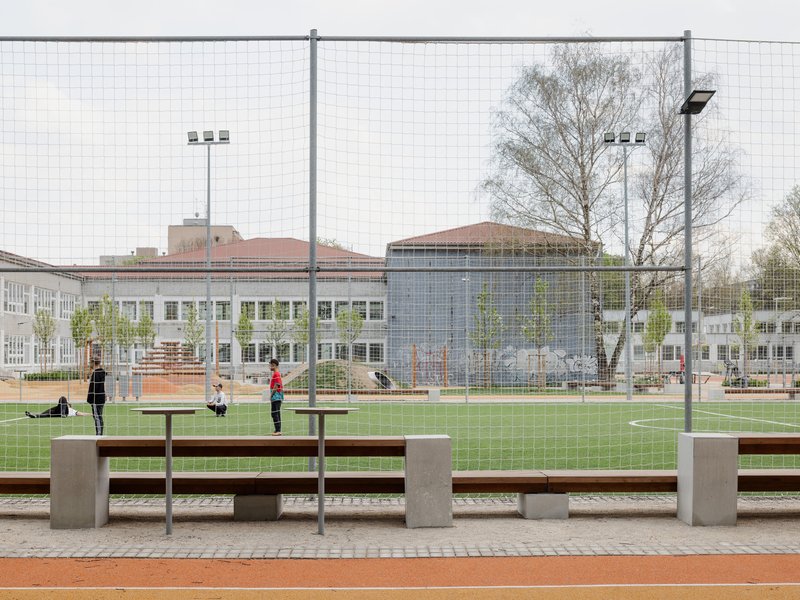
The site furniture is restrained and consistent: concrete-and-timber benches with clean endcaps line the courts and pathways. They serve double duty as spectator seating for sports and informal gathering spots during breaks. The palette, sourced from manufacturers including mmcité and Egoé, avoids the bright primary colors that typically plague school furniture, opting instead for materials that will weather gracefully alongside the maturing plantings.
Edges matter here. The transition from orange EPDM to planted bed to paved path is handled with tight detailing, and the removal of barriers at the school forecourt, replaced with paving and greenery, opens the campus to its urban context. The campus no longer reads as a walled compound but as a permeable piece of the city.
Rope, Timber, and the Body
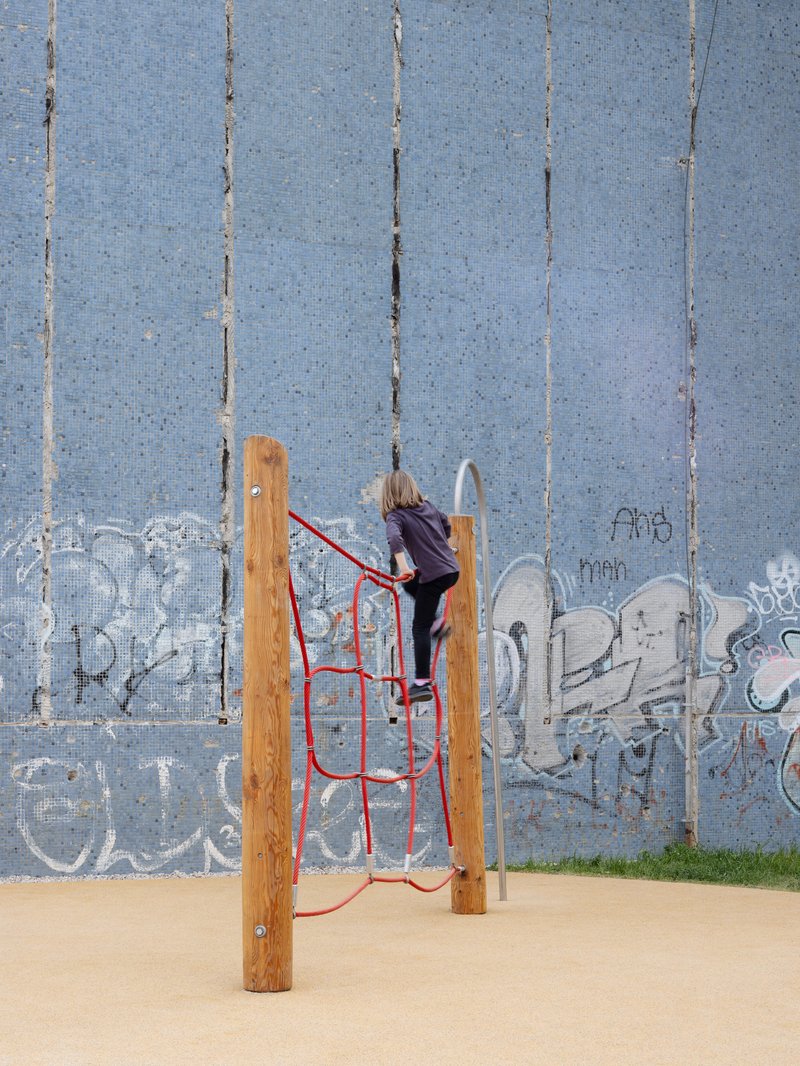
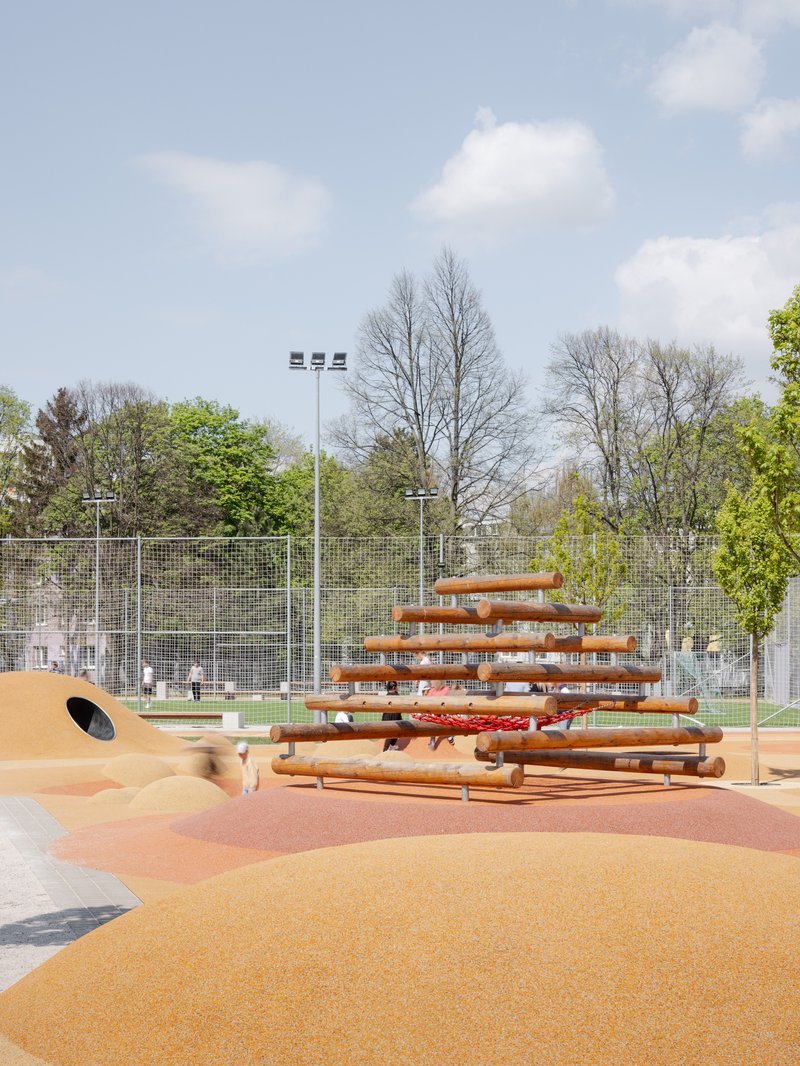
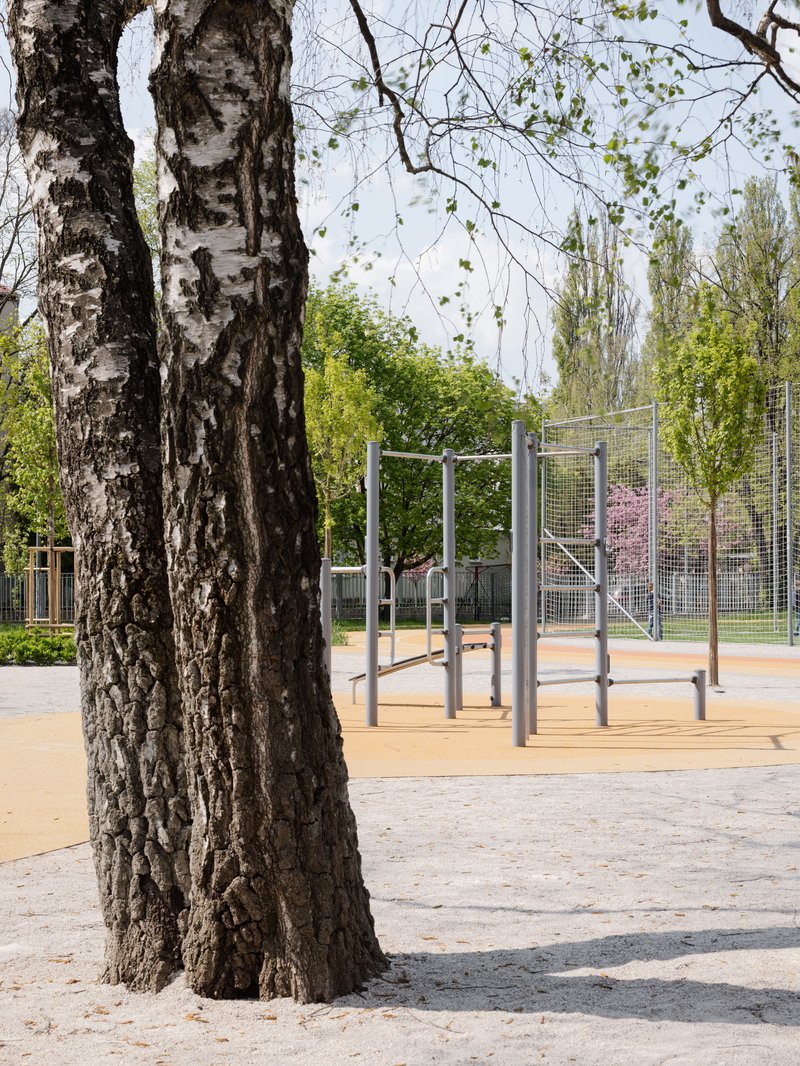
Beyond the sculpted mounds, the campus deploys a secondary layer of play structures: rope climbing nets on timber posts, timber climbing frames, and steel exercise equipment. These elements are positioned against existing building facades, turning dead wall surfaces into climbing walls and balance challenges. A red rope net strung against a weathered blue tile wall is a standout moment, a collision of texture and color that feels accidental but is clearly composed.
The exercise frames, from suppliers like Jakob Rope Systems, KOMPAN, and Richter Spielgeräte, are distributed across the campus rather than clustered in a single playground. This dispersal encourages movement through the site and ensures that play is encountered everywhere, not cordoned off in a single zone.
The Circular Plaza and Gathering Logic
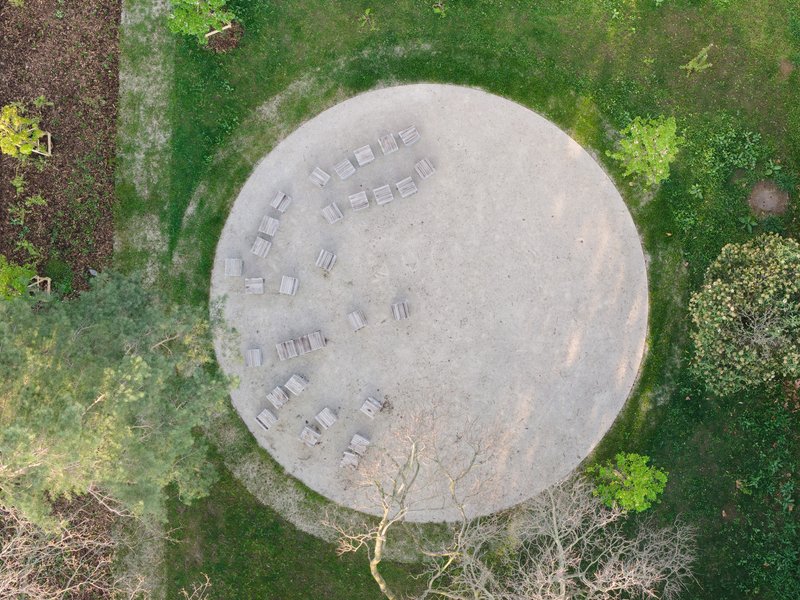
A circular concrete plaza with perimeter seating anchors the social center of the campus. Its geometry is deliberately distinct from the organic curves of the play mounds and the orthogonal lines of the sports courts. It reads as a civic space within a school landscape, a place for assembly, conversation, or simply sitting in the sun. The surrounding grass and tree canopy frame it as a clearing, lending it a gravity that its modest size might not otherwise support.
The undulating EPDM surfaces that connect the plaza to adjacent zones reinforce a pedestrian logic: the ground itself tells you where to walk, where to pause, and where to play. No signage required.
Plans and Drawings
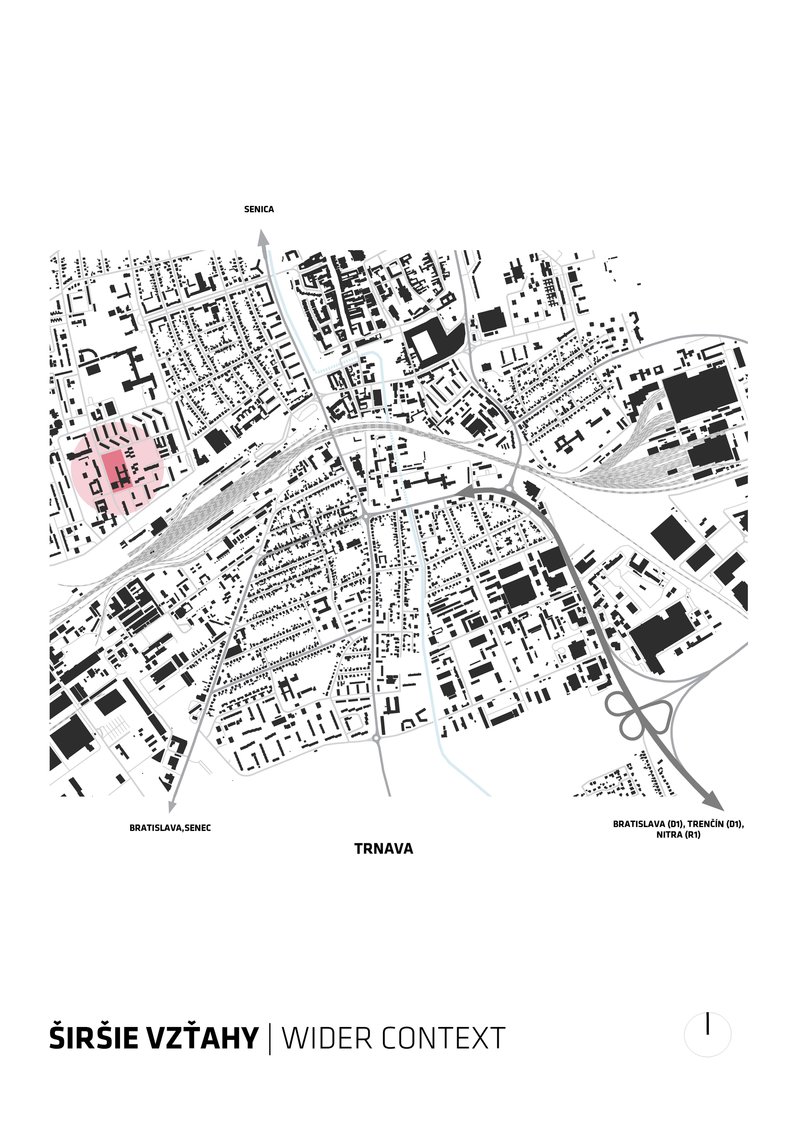
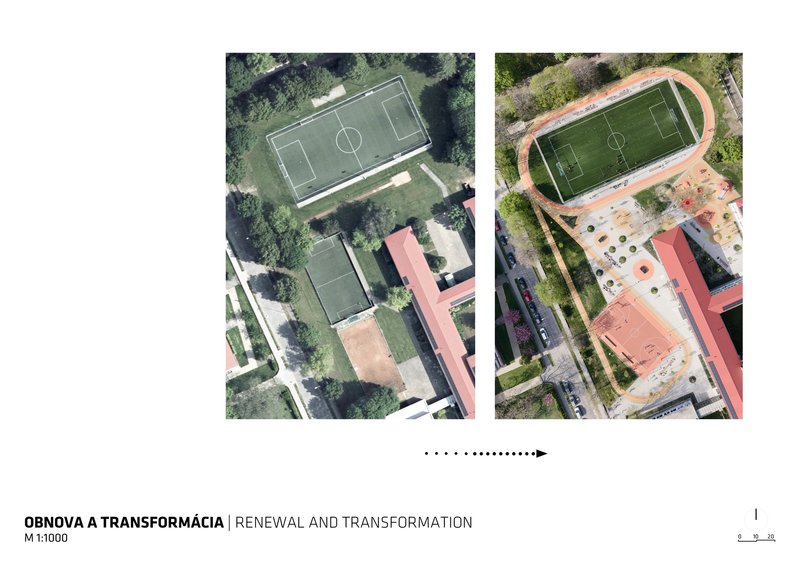
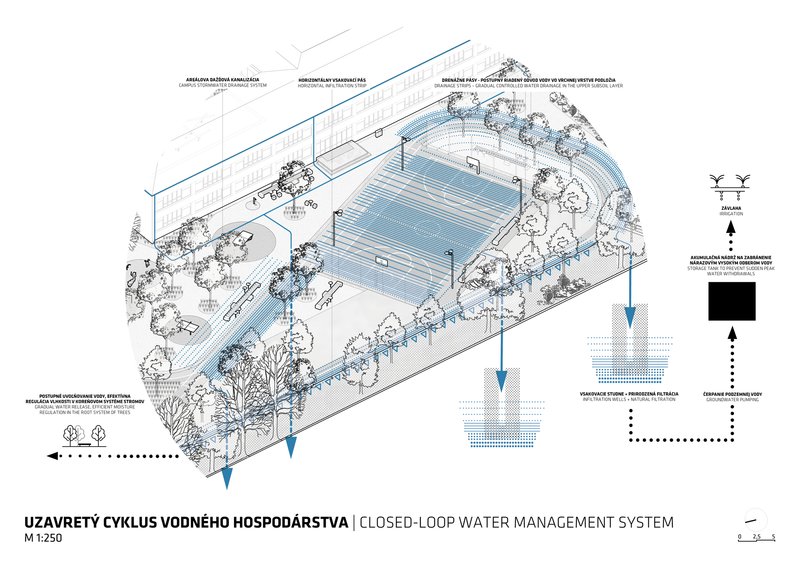
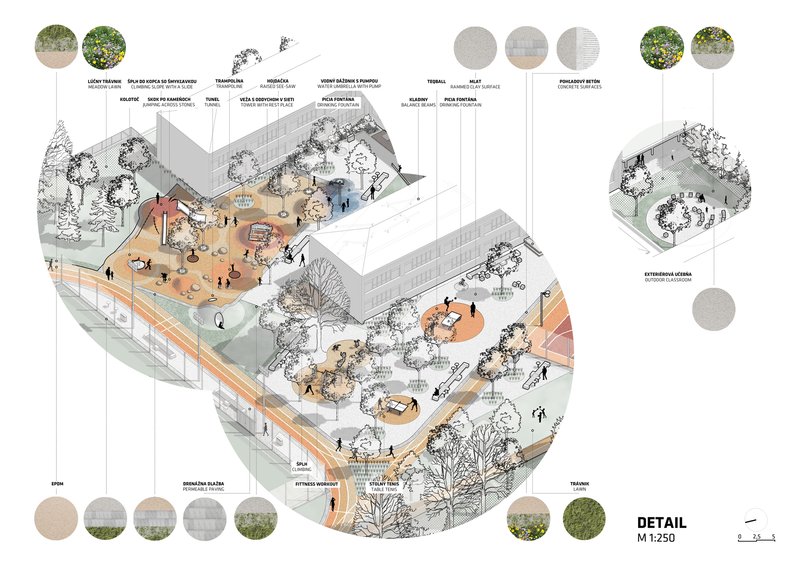
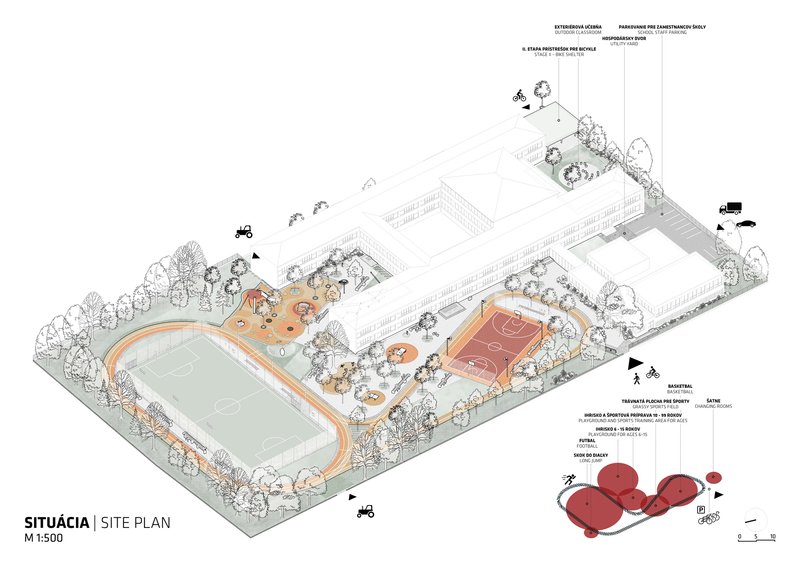
The site plan reveals the project's organizational clarity: building footprints frame a series of outdoor rooms, each with its own surface, program, and planting strategy. A before-and-after aerial comparison shows just how much territory was reclaimed from formless asphalt and ad hoc sports surfaces. The axonometric drawings are particularly instructive. One illustrates the closed-loop water management system, showing how rainwater is captured, directed through planted zones, and infiltrated on site rather than piped to municipal drains. Another breaks down the material palette and spatial hierarchy of the outdoor areas, from gathering spaces to play zones to quiet planted edges.
These drawings make the ecological argument legible in a way the photographs alone cannot. The water management diagram, in particular, reveals that the project's nature-based approach is not just horticultural but hydrological: every surface, from EPDM mound to gravel lawn, plays a role in slowing and absorbing runoff.
Why This Project Matters
The Trnava campus reconstruction matters because it demonstrates that a schoolyard renovation can operate at the ambition level of a public park without losing its pedagogical focus. Every design decision, from the differentiated lawn types to the dispersed play structures to the closed-loop water system, serves both the immediate needs of students and the longer-term ecological health of the site. The project avoids the trap of treating sustainability and fun as competing objectives: the sculpted mounds are simultaneously stormwater features and the most popular play elements on the campus.
For cities looking to upgrade their school infrastructure, Trnava offers a replicable model. The strategy is not dependent on exotic materials or heroic engineering. It relies instead on careful zoning, native planting, honest surface materials, and a willingness to treat the ground between buildings as the real project. Šercel Švec and landscape architect Andrea Prievalská have shown that when you design the terrain with the same care you bring to a building, the result is a campus that children actually want to inhabit.
Trnava School Campus Reconstruction by Šercel Švec, with landscape architecture by Andrea Prievalská. Trnava, Slovakia. 13,500 m². Completed 2025. Photography by Matej Hakár.
About the Studio
Share Your Own Work on uni.xyz
If projects like this are the kind of work you want to make, uni.xyz is a place to publish your own, find collaborators, and enter design competitions.




Popular Articles
Popular articles from the community

Kawasaki Olympic Sports Center: Sports Complex Architecture Rooted in Community, Tradition, and Movement
Kawasaki Olympic Sports Center reimagines sports complex architecture as a civic park where tradition, training, and community meet locally.

DIM Architecture Studio Revives the Iranian Courtyard Inside a Mashhad Apartment Building
A 2,500-square-meter mid-rise infill project reinterprets the traditional hashti and central courtyard within the dense urban fabric of Mashhad, Iran.
POP ART: Adaptive Reuse Architecture as a Cultural Intervention in Sydney
POP ART reimagines an unused Sydney warehouse through adaptive reuse architecture, creating a bold cultural landmark above the city streets.
Community Library in Girona: A Replicable Model for Inclusive Library Architecture
A modular community library in Girona transforms learning, culture, and climate-responsive design into a shared civic network for all users.


Similar Reads
You might also enjoy these articles
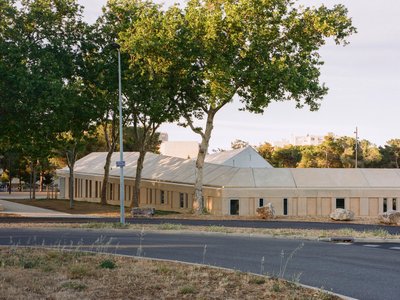
School Group Samuel Paty in Béziers: A Contemporary Educational Campus by Ateliers O-S Architectes and NAS Architecture
Samuel Paty School in Béziers features concrete massing, porous courtyards, metal structures, and landscaped playgrounds, creating a child-scaled, light-filled learning environment.
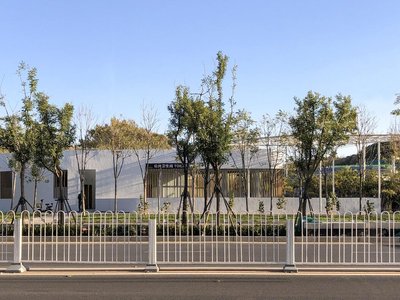
Four Public Pavilions in Beijing by Aurélien Chen and CSCEC
Four park pavilions in Beijing combine public services with floating roofs, acting as subtle urban signals integrated into landscape contextually.
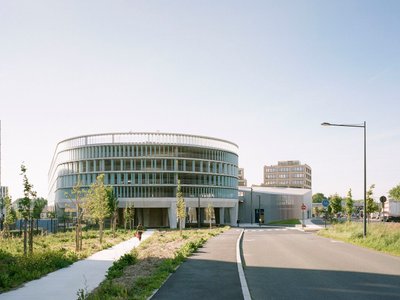
LÁ-SÁCH House by Atelier tho.A
Compact tropical tube house-library with polycarbonate louvers, flexible interiors, concrete core, crafted materials, and community-focused alley setback.
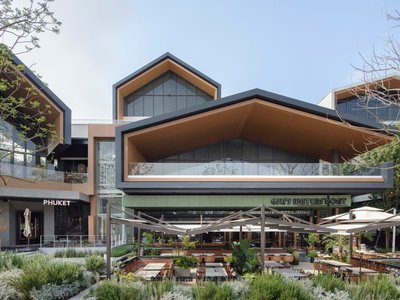
Luxelakes Tianfu Food Island Phase II: A Contemporary Lakeside Commercial Hub in Chengdu
Lakeside commercial complex in Chengdu featuring cascading terraces, sloped roofs, and public waterfront spaces, blending restaurants, retail, and community interaction.


Explore Landscape Design Competitions
Discover active competitions in this discipline




The Global Benchmark for Architecture Dissertation Awards


Challenge to design public laboratory
Comments (0)
Please login or sign up to add comments
No comments yet. Be the first to comment!