

Serpentine Project: A Yellow Parametric Path That Turns a Linear Corridor into a Place to Linger
A meandering yellow installation, modular metal-and-timber market stalls and sensory walls reframe a passive linear site as an adaptive public room.


Linear urban sites have a habit of telling people to keep moving. They are corridors by nature, efficient and forgettable, and most interventions on them simply decorate the edges. The Serpentine Project refuses that logic. It draws a single continuous yellow line that bends, rises and doubles back across the site, and it asks a simple question: what happens to a passage when the path itself stops being straight?
Designed by Klaudia K and shortlisted in the Salut Paris competition, the proposal takes an overlooked linear site and treats it as a public environment that evolves with its users. Its organizing metaphor is the "path of life," a route defined by variation, movement and chance encounters rather than a fixed destination. Instead of a finished architectural object, Klaudia offers a responsive system: a parametric installation, a kit of modular market units, sensory walls and planted zones that together give the corridor reasons to be inhabited.
A Yellow Line That Interrupts the Corridor
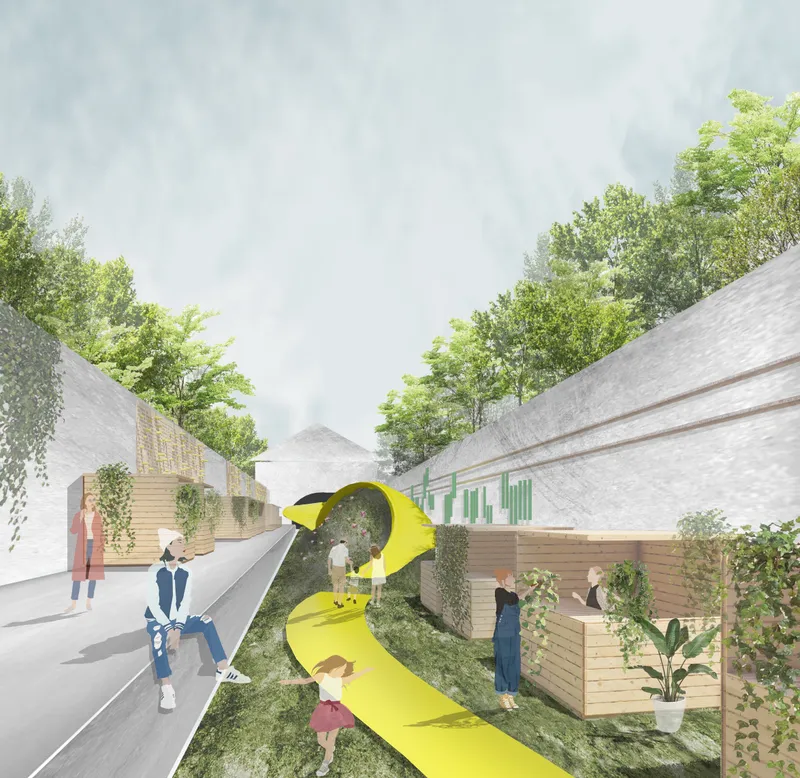
The serpentine gesture does two jobs at once. Symbolically, it carries the path-of-life narrative, a route that never resolves into a straight answer. Functionally, it cuts across the site's existing linearity and breaks it into a sequence of spatial moments, each slightly different from the last. Where a straight corridor offers one view stretched out to the vanishing point, the curving form keeps reframing what lies ahead, which is precisely what invites people to explore rather than pass through.
The choice of yellow is deliberate and worth defending. Klaudia uses it as a psychological catalyst, a colour meant to provoke optimism and curiosity in a place that previously gave neither. It also makes the installation legible as one connected device: the yellow form reads as the thread that ties programmes, people and experiences together, so the site holds together as a single idea even as its uses multiply.
Parametric Curvature as a Tool for Slowing Down
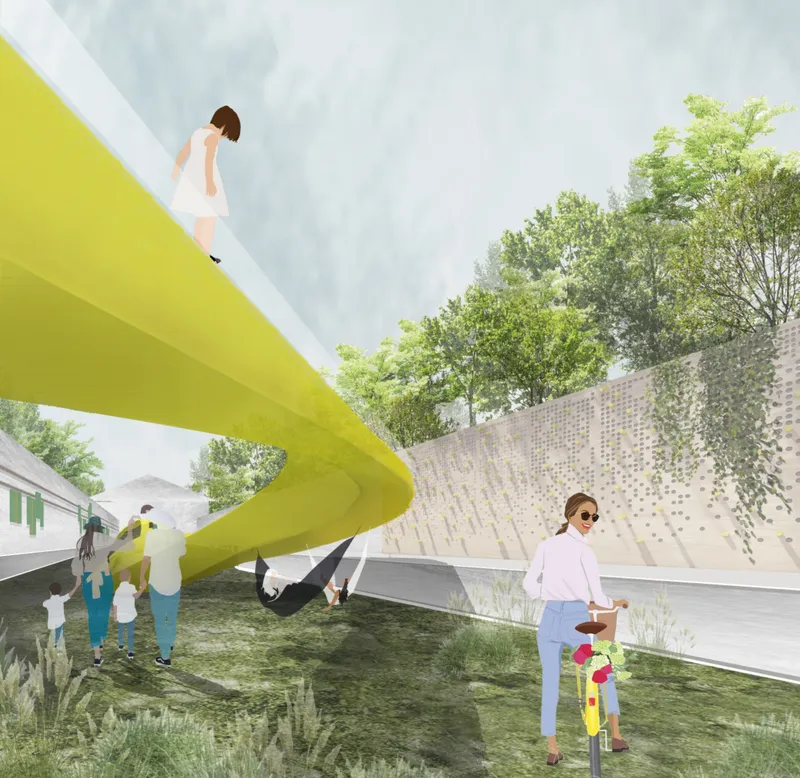
The project is driven by parametric principles, and the strength of that approach here is not formal novelty but adaptability. The serpentine structure is conceived as a flexible system that can be scaled, modified and adjusted to context and use. That matters on a competition site, where the design has to anticipate conditions it cannot fully control. A rule-based form can stretch or tighten along the corridor without losing its character.
Spatially, the flowing geometry produces pockets of activity, varying elevations and shifting perspectives. These are the moments that convert a transitional strip into a destination. A bend creates a sheltered edge; a change in level creates a place to sit or watch; a turn hides the next space until you reach it. The design's real ambition is behavioural: it wants people to slow down and occupy the site, and the curvature is the instrument for doing so.
Movable Markets, Sensory Walls and a Planted Micro-Ecosystem

Around the central installation, Klaudia adds a modular market system of lightweight, movable units built from a metal frame and wooden panels. The construction is intentionally plain, and that restraint is the point: simple modules can be assembled, reconfigured and reused by local communities, putting part of the site's organization in their hands. The market gives the serpentine a daily economic and social pulse that a sculptural intervention alone could not sustain.
Inclusivity is built into the programme through "creative walls" that engage visitors through touch, sound and visual interaction, opening the space to people with different sensory abilities. The site is organized into multiple zones for diverse groups, from tourists to local residents and marginalized communities, keeping it active across the day. Vegetation, herbs and seasonal planting soften the hard urban ground and form a micro-ecosystem within the corridor, so the space changes not only with its users but with the calendar.
Why This Project Matters
Many proposals for neglected urban strips arrive as a single bold object. The Serpentine Project is more useful because it arrives as a system: a parametric spine that can adapt, modules that communities can rearrange, sensory surfaces that widen access and planting that ties the site to the seasons. Each layer answers a different weakness of the linear corridor, and together they turn a space of passage into a space of staying.
Its shortlisting in Salut Paris reflects a broader shift in how young designers are approaching public space, less as finished composition and more as framework for use. The yellow line is memorable, but the lasting lesson is in what it enables: curvature that slows movement, simple construction that invites participation, and a programme generous enough to hold many kinds of people. It is a reminder that a single well-judged gesture, backed by flexible parts, can change how a whole street behaves.
View the Full Project
About the Designers
Designer: Klaudia K
Enter a Design Competition on uni.xyz
uni.xyz runs architecture and design competitions year-round that reward proposals with spatial conviction and real site intelligence.
Project credits: Serpentine Project by Klaudia K Salut Paris (uni.xyz).


Popular Articles
Popular articles from the community


Jaramillo Van Sluys Arquitectura and Urbanismo Turn a Demolished Registry Lot in Quito into an Orchard Plaza
In Quito's Centro Histórico, a 2,800 m² plaza exposes the San Agustín convent wall and redraws its lost Augustinian orchard in volcanic stone.

Cube Design Draws an Ecological Corridor Between Two Shenzhen Hills with the Nankai Building
Beside Shenzhen's container docks, the Nankai Building pairs stacked balconies with a climbing green screen to connect two hillsides across its height.

longwave studio Reorganizes a 112 m² Tainan Apartment Around the Daily Routines of a Family and Two Cats
In Tainan, Taiwan, birch plywood, rust-red furniture and a freestanding plaster wall link arrival, storage, work and family life in one apartment.

Architekt Andreas Gruber Scatters 23 Dark Timber Chalets Across a South Tyrolean Forest Edge
In Molini di Tures, Amonti Chalets breaks a resort into a hamlet of gabled timber houses, with parking, storage and services pushed into the slope.

Similar Reads
You might also enjoy these articles
Healing Façade: A Modular Chapel System That Restores Ethiopia's Sacred Forests
Winner of the Eco-Chapel competition, this circular timber façade collects water from air to rebuild soil and reforest degraded Ethiopian landscapes.
Kaffeebühnen: Where Coffee Shop Architecture Becomes a Civic Stage in Vienna
A linear sequence of timber boxes, transparent shells, and open yards turns the Viennese café tradition into a public performance space.
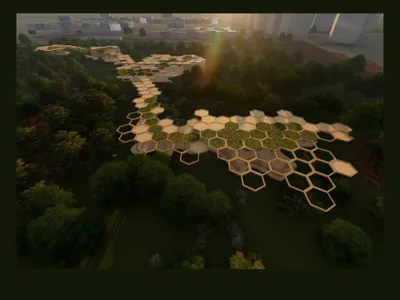
Eco Chapel: A Modular Forest Pavilion That Grows Like the Landscape It Protects
Hexagonal timber modules weave through existing trees, turning a chapel into a living system for prayer, education, and reforestation.

Urban Forest: A Vertical Ecosystem for 5,000 Workers in Singapore's Changi Business Park
Radially stacked pods and layered green decks turn a 7-acre plot into 47 acres of ecological workspace projected for 2040.

Explore Architecture Competitions
Discover active competitions in this discipline

Challenge to reimagine the Iron Throne

Photograph architecture without architects

Illustrate the lost glory of Angkor Wat - Render Challenge

Design challenge to reuse E-waste
Comments (0)
Please login or sign up to add comments
No comments yet. Be the first to comment!