

Nikken Sekkei Sculpts Shanghai's West Bund Towers Around the Flow of Wind
On the site of a former airport in Xuhui District, four buildings and 70,000 square meters of public space are shaped by aerodynamic simulation.


Architecture often claims to respond to climate; rarely does a project make that claim legible at every scale. The West Bund AI Tower & Plaza in Shanghai, designed by Nikken Sekkei, does exactly that. Sited on the former Longhua Airport runway along the Huangpu River's west bank, the 510,000 square meter complex of four buildings, two of them skyscrapers reaching 235 and 200 meters, treats wind not as a problem to overcome but as the primary organizing principle of form, orientation, and public space.
What makes the project worth studying is the rigor behind the rhetoric. Selected through an international competition in 2009, Nikken Sekkei spent over a decade integrating fluid dynamics simulation into every phase of design, from massing to curtain wall detailing. The rounded tower corners, the elongated floor plates, the 500mm deep vertical fins, and the sweeping canopied bases are all direct outputs of that process. The result is a development where roughly 60% of the city block is left unbuilt, turned over to parkland and public plazas, and where the towers themselves act as instruments that channel air into the urban fabric behind them, measurably reducing the heat island effect.
Towers as Aerodynamic Bodies
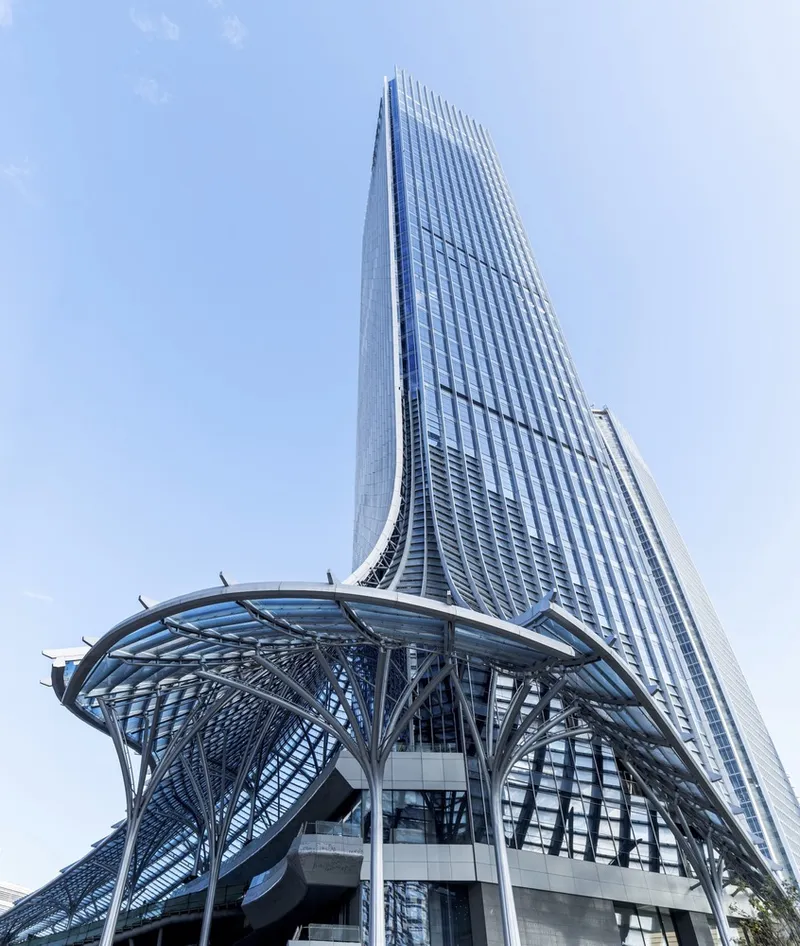
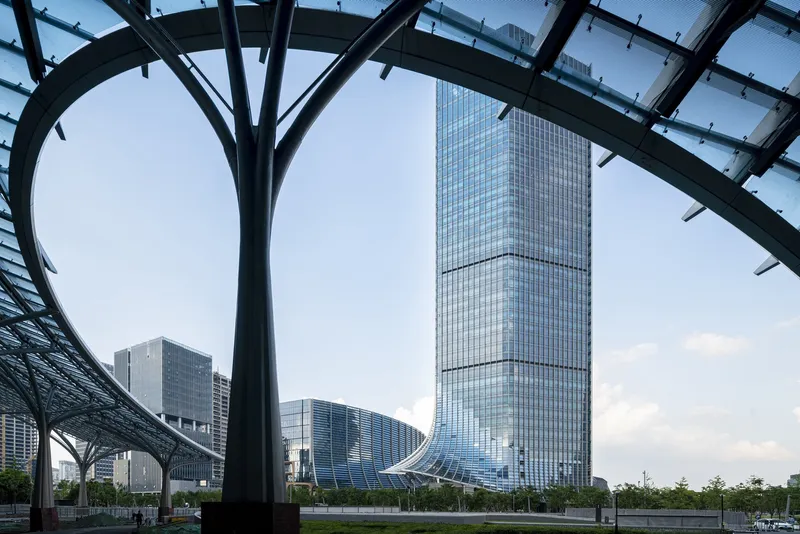
Seen from street level, the towers don't read as conventional glass extrusions. They taper, round off, and swell at their bases in ways that look sculptural but are fundamentally functional. Early wind simulations dictated the curvature of corners and the elongation of floor plans so that prevailing currents slide past rather than slam down, minimizing the downdraught effect that plagues most supertall clusters. The vertical fins on the facades, each 500mm deep, are positioned to avoid obstructing panoramic river views while still modulating solar gain on the east and west exposures.
The concept of wind here has a layered meaning. It references the site's aviation heritage and the aeronautical industry that once defined Xuhui. But it also describes a literal design methodology: shaping architecture by the invisible forces that move through it. That double reading gives the towers a narrative coherence that pure formalism rarely achieves.
The Canopy and the Porch
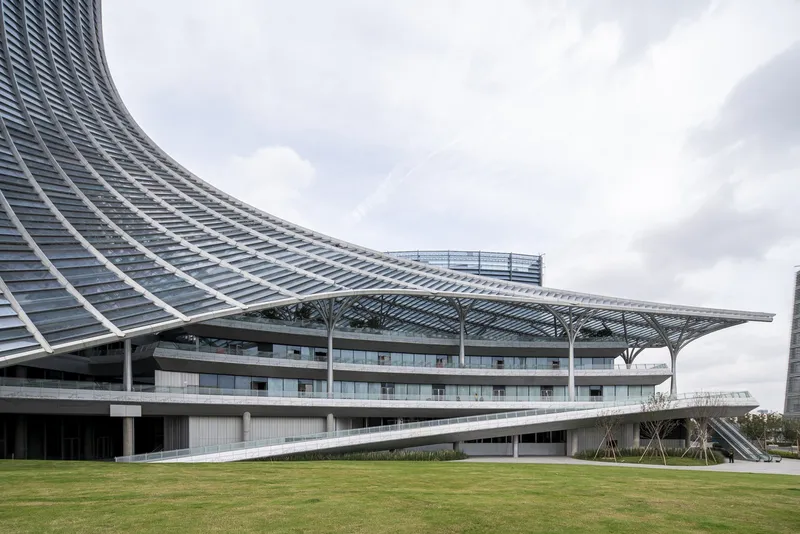
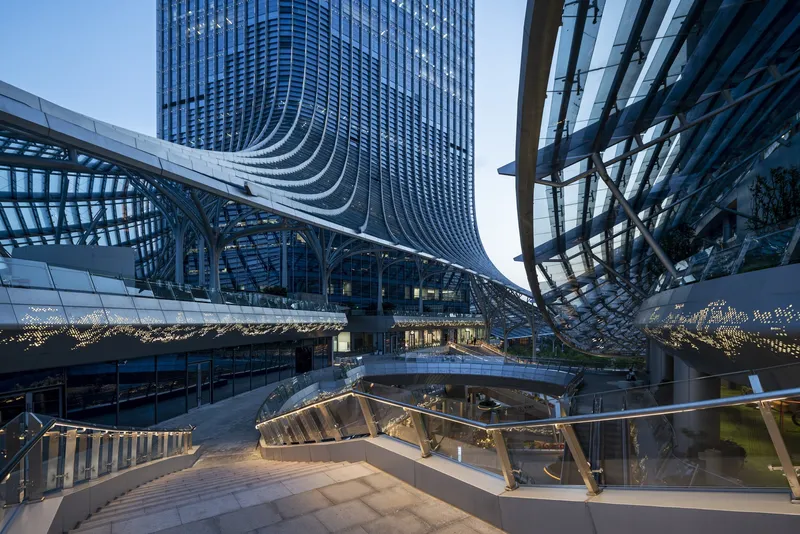
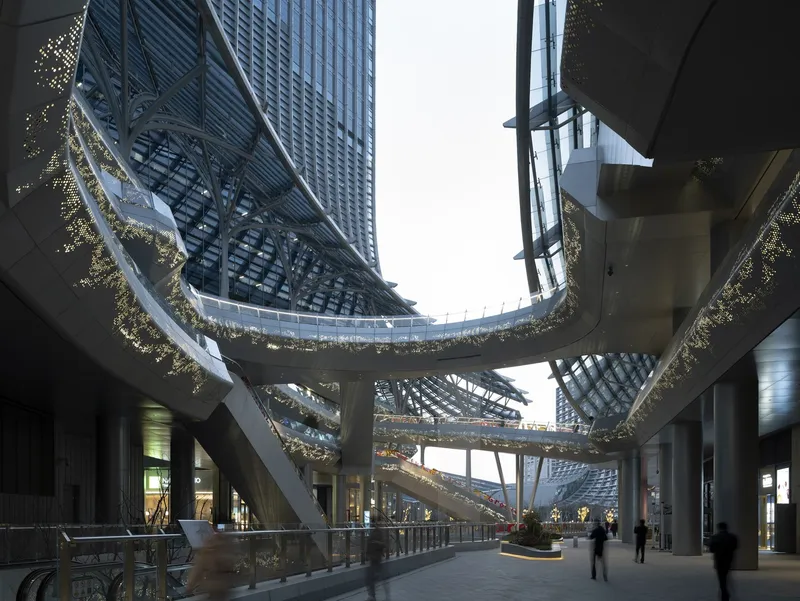
At ground level, the towers spread outward into broad canopied bases that Nikken Sekkei describes as modern reinterpretations of traditional Asian porches and eaves. The analogy is apt. These expansive rooflines block direct rain and strong sunlight while keeping airflow moving beneath them, creating semi-outdoor zones that stay comfortable through Shanghai's humid summers and soggy springs. The sweeping steel and glass canopy structures extend horizontally over low-rise retail volumes and plazas, establishing a public realm that feels sheltered without feeling enclosed.
The gesture also serves a civic function. By pulling the building mass outward at the base, the towers generate covered public territory at the point where pedestrians actually interact with them. It's a simple idea executed at a scale large enough to transform the microclimate of an entire block.
Interior Landscapes
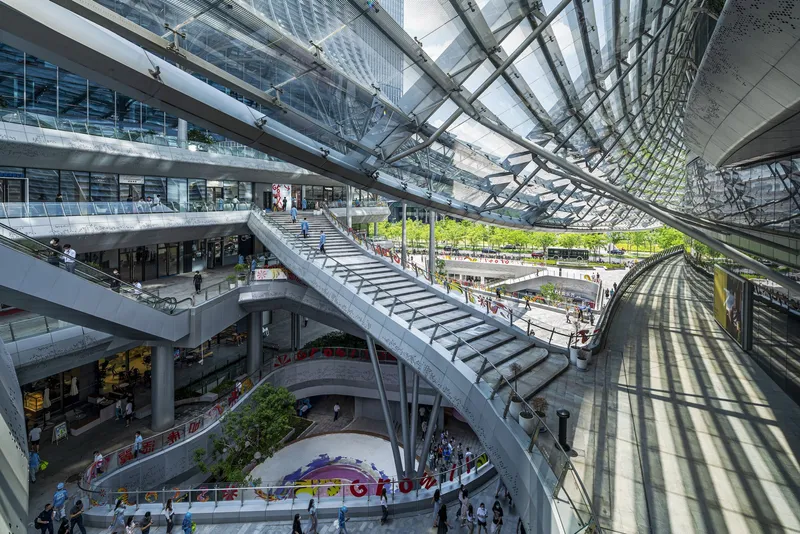
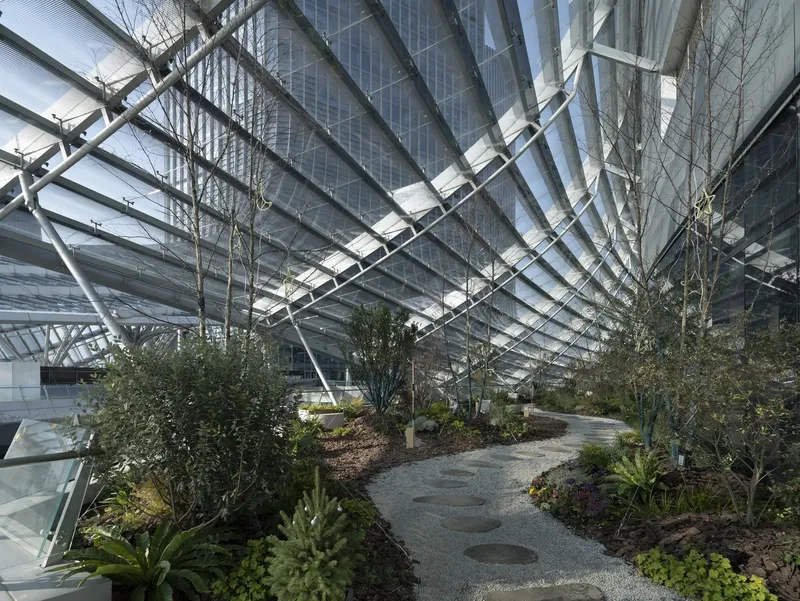
Inside, the environmental agenda continues. A multi-story atrium rises through planted terraces beneath a glass skylight, bringing daylight deep into the building core while blurring the boundary between conditioned interior and landscape. Enclosed garden paths with planted beds and trees run beneath the diagonal steel and glass roof structures, creating routes that feel more like park promenades than commercial corridors.
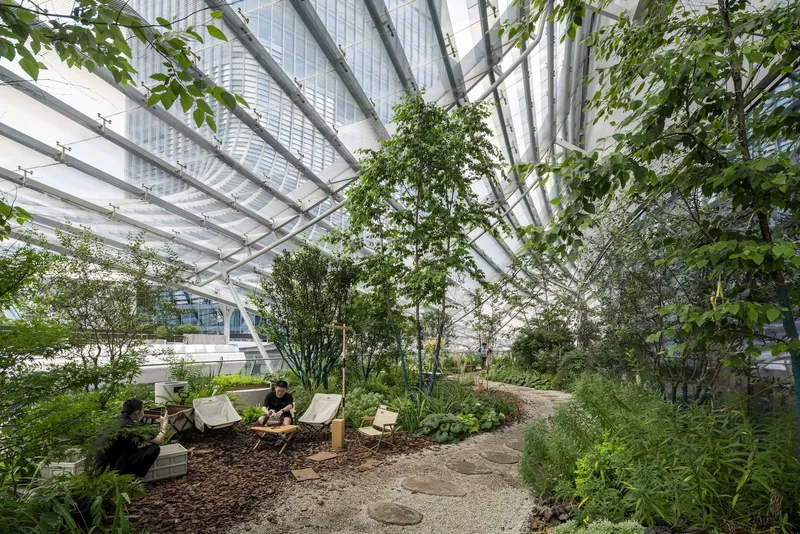
On the rooftop, gravel paths and lounge chairs sit among mature trees beneath the same diagonal canopy system seen at ground level, extending the public landscape vertically. Daylight and occupancy sensors throughout the complex maximize the use of natural light and fresh air, while an ice storage and ground source heat pump system targets energy savings of over 35% compared to a standard building of comparable size. These numbers earned the project both LEED Gold and China's 3-star sustainability rating.
The Plaza as Connector
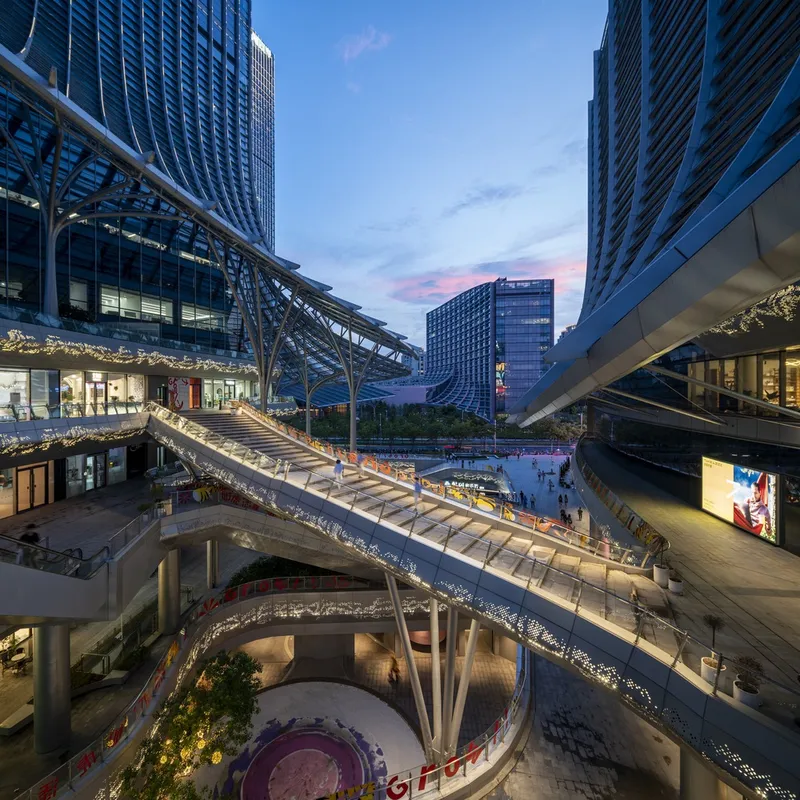
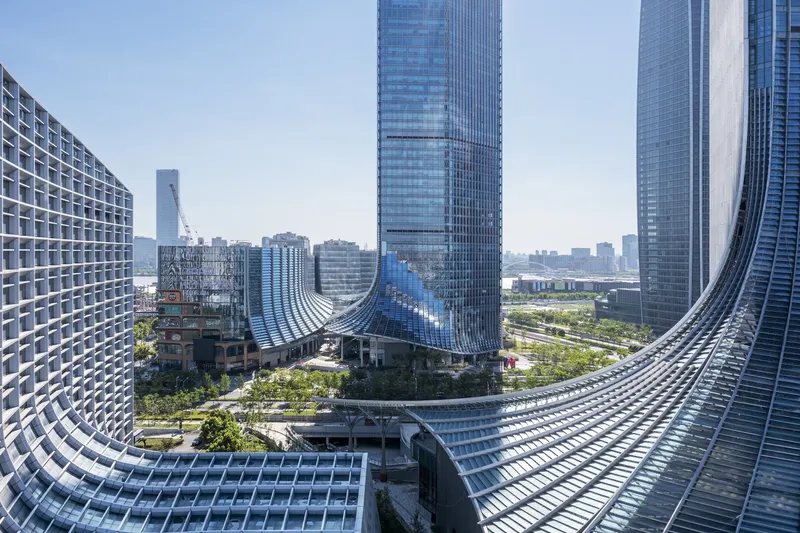
The long north-to-south park that occupies the old runway alignment is the project's infrastructural spine. A subway line runs directly beneath it, with two stations serving as transportation hubs. An underground tunnel running east to west connects all four buildings to the metro and an underground retail mall, keeping vehicular traffic out of the park entirely. At dusk, multi-level pedestrian bridges and curved walkways linking the tower buildings become the most visually striking element of the complex, their layered silhouettes framing the towers and opening up sightlines toward the river.
The decision to leave 60% of the block unbuilt is perhaps the project's boldest move. In a city where land value per square meter ranks among the highest in the world, dedicating 70,000 square meters to public parkland and plazas represents a genuine commitment to long-term urban quality over short-term density maximization.
Lobby and Ground Plane
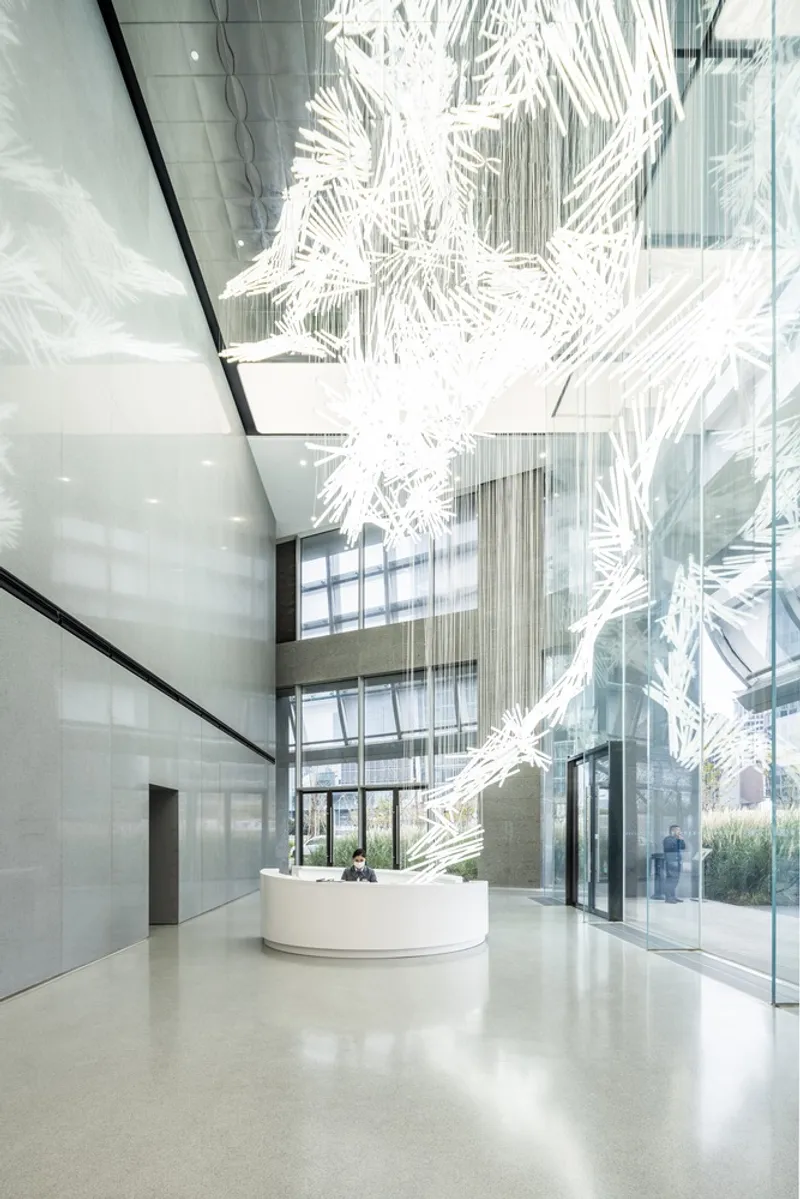
The double-height lobby, finished in terrazzo with a white sculptural installation and reception desk beneath a fully glazed curtain wall, announces a certain restraint. Materials are light, surfaces are hard, and the geometry is clean. The effect is to let the surrounding landscape and canopy architecture remain the dominant visual experience even from inside. It's a lobby that serves its building without competing with the public realm outside its glass walls.
Plans and Drawings
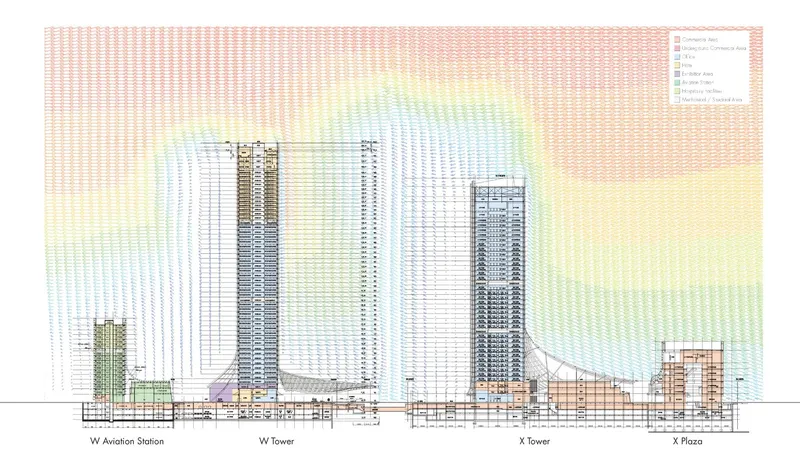
The section drawing reveals what the photographs only hint at: the wind flow diagram overlaid on the building profiles shows how air is directed over, around, and between the towers before being channeled into the urban blocks behind. The low-rise structures between the two skyscrapers sit within the aerodynamic shadow of the taller volumes, receiving tempered airflow rather than turbulent gusts. This drawing alone justifies the project's claim that its form is not arbitrary but generated by environmental data.
Why This Project Matters
The West Bund AI Tower & Plaza matters because it demonstrates what happens when computational environmental analysis is given genuine authority over architectural form. Too many large-scale developments treat sustainability as an engineering overlay, something applied after the geometry is fixed. Here, the geometry is the sustainability strategy. The rounded corners, the tapered bases, the canopy orientations, and the tower spacing all derive from fluid simulation. That integration, sustained across a 510,000 square meter program from schematic design through construction, is rare at any scale.
It also offers a compelling model for post-industrial site transformation. Longhua Airport was a runway, a flat slab of infrastructure. Nikken Sekkei's response was to keep the linearity but invert its purpose, turning a surface for machines into a park for people, with towers that treat the atmosphere not as a void to be filled but as a medium to be shaped. Twelve years from competition to completion is a long arc, but the result is a district that feels inevitable rather than imposed, as if the wind itself had drawn it.
Shanghai West Bund AI Tower & Plaza by Nikken Sekkei. Xuhui District, Shanghai, China. 510,000 m². Completed 2021.
About the Studio
Share Your Own Work on uni.xyz
If projects like this are the kind of work you want to make, uni.xyz is a place to publish your own, find collaborators, and enter design competitions.




Popular Articles
Popular articles from the community


Co-Life: Senior Housing Design That Reconnects Older Adults With the City
Co-Life reimagines senior housing design through healing gardens, shared streets, workshops, and a sustainable community across generations.

Co-life: Sustainable Architecture for Age-Friendly Community Living
Co-life reimagines sustainable architecture for seniors through courtyards, rammed earth, shared gardens, and spaces designed for belonging.

Riyadh For All: Intergenerational Urban Design for Active Aging in Rabat
Riyadh For All reimagines urban design in Rabat with intergenerational co-living, adaptive courtyards, and Moroccan cultural exchange today.

The Ocean Hive: Sustainable Architecture for a Self-Sufficient Civilization at Sea
The Ocean Hive imagines sustainable architecture at sea, where modular habitats, algae, wave power and ocean waste sustain a growing colony.

Similar Reads
You might also enjoy these articles


Hodi-Mandai Geram
Project Function: Preservation and revitalization of the Intangible heritage and socio-spatial identity of the Hodi by Housing, Cultural Memory Center, Sacred Grove, landscape, local tourism economy


Olio Towers: A Mid-Rise for Performers That Fuses Housing, Rehearsal, and Stage
Located blocks from Houston's Theater District, this modular tower stacks living units around a central performance atrium.

Oasis: Modular Green Housing Carved into Dhaka's Urban Fabric
A shortlisted Plugin Housing entry reclaims unauthorized settlements in Dhaka with stepped concrete volumes, green roofs, and ventilation-driven design.

Black Hole: A Floating Megastructure for the Post-Physical Era
Emiliano Mazzarotto envisions a spherical, self-scaling arena where e-sports, digital hotels, and holographic stadiums replace traditional public space.


Explore Shanghai Competitions
Discover active competitions in this discipline



Challenge to reimagine the Iron Throne


Photograph architecture without architects


Illustrate the lost glory of Angkor Wat - Render Challenge


Design challenge to reuse E-waste
Comments (0)
Please login or sign up to add comments
No comments yet. Be the first to comment!