
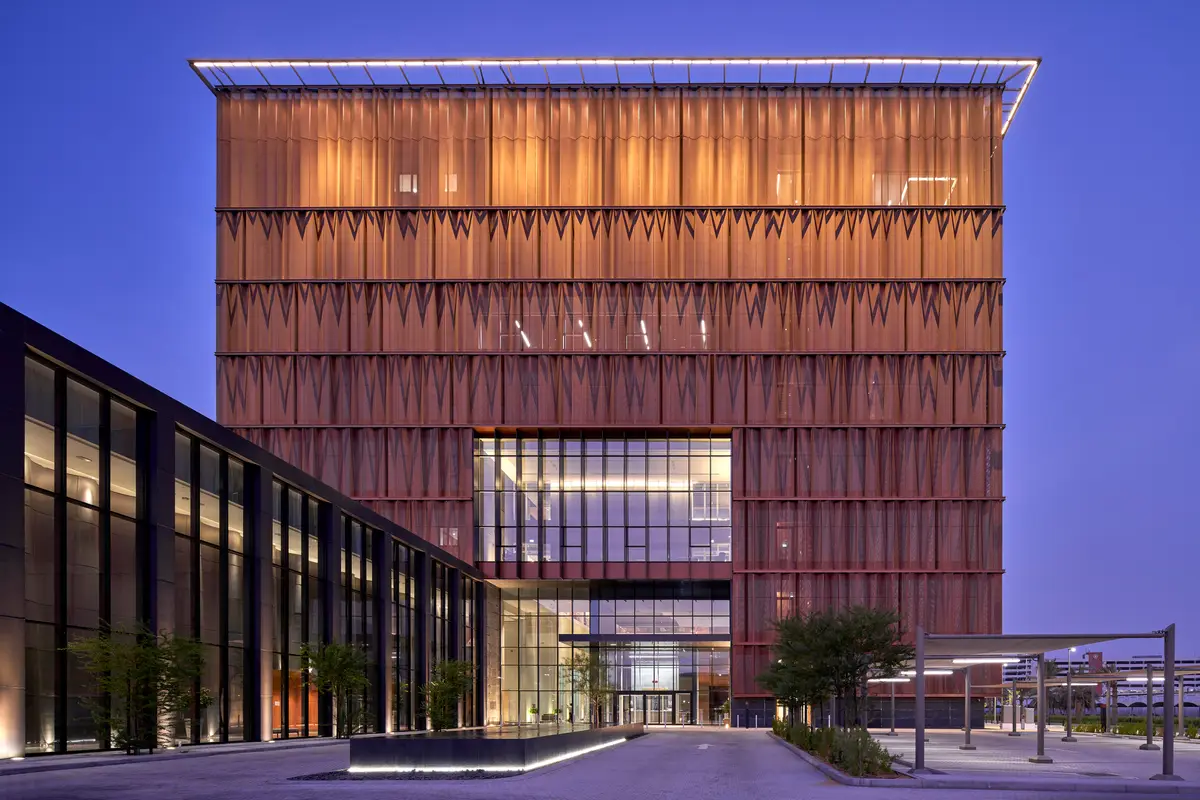
Shape Architecture Practice Wraps Abu Dhabi's Diplomatic Academy in a Veil of Perforated Aluminum
An 18,000 square meter academy in Abu Dhabi's diplomatic quarter trades boundary walls for native landscaping and filtered light.


Among the embassies of Abu Dhabi's diplomatic district, every compound is walled off. The Anwar Gargash Diplomatic Academy, designed by Shape Architecture Practice + Research, does the opposite. The 18,000 square meter facility, completed in 2021, forgoes a boundary wall entirely, using native landscaping to define its edges. The result is an institution that reads as open to the city while keeping its interior life private, a duality that plays out across every design decision: opaque aluminum screens on the outside, generous transparency within.
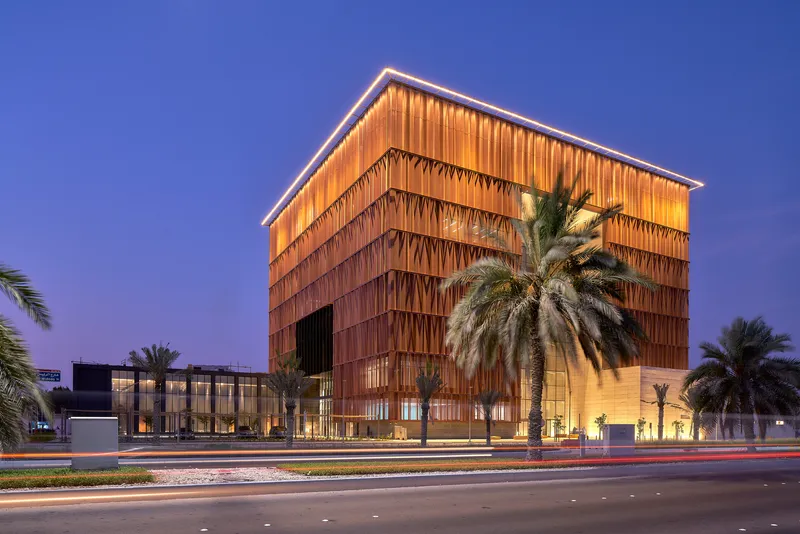
The building's most compelling move is its double skin facade. A high-performance glazing layer serves as first defense against Abu Dhabi's brutal solar heat gain, while a second skin of perforated aluminum panels sits outboard, diffusing sunlight into soft, shifting patterns. Each face of the building carries a different fold pattern in its panels, so the rhythm of shadow and light changes not only with the hour but with the direction you approach. It is a building that looks different every time you see it, which is a rare quality in a region where facade systems tend toward repetition.
A Cube with Open Arms
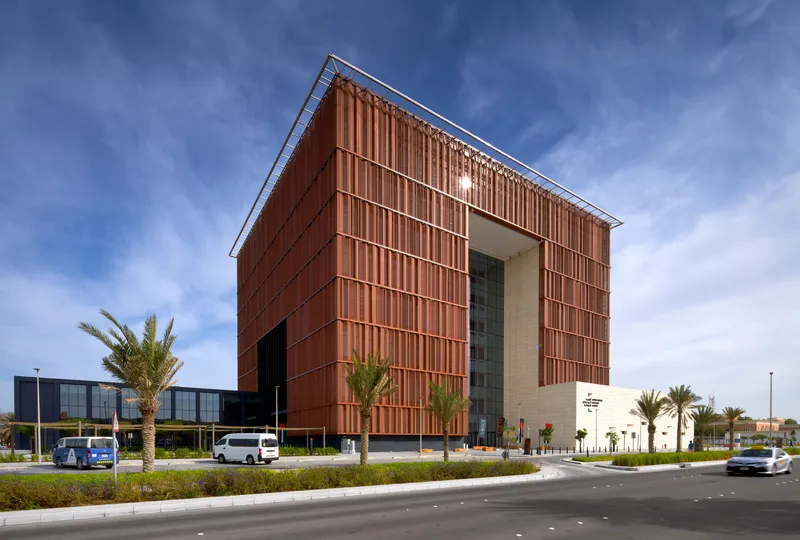
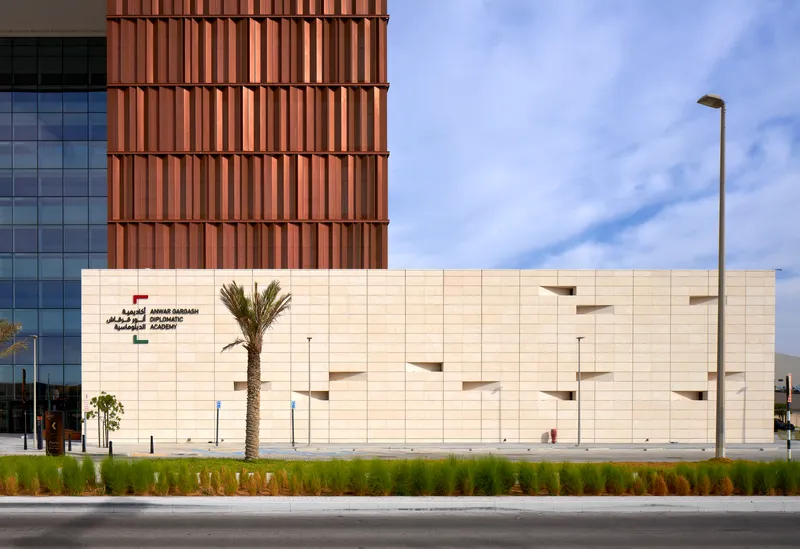
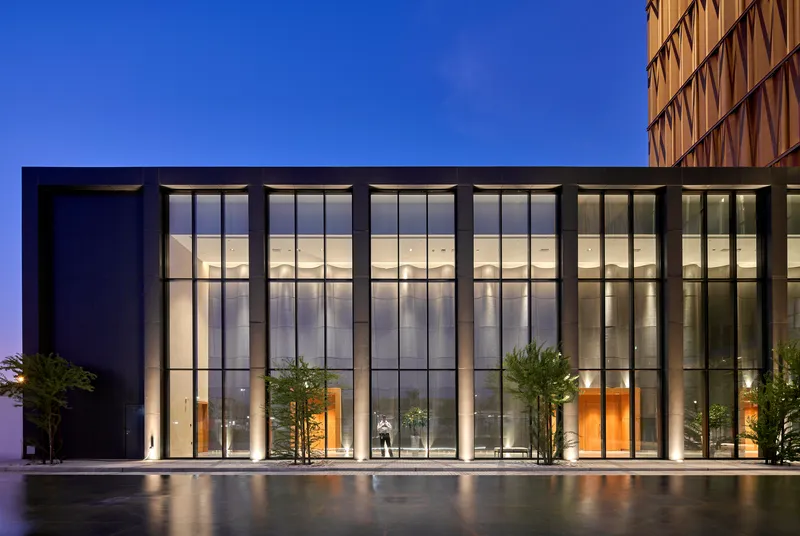
The massing is deceptively simple: a cubic volume clad in copper-toned aluminum louvers, with three portions of the mass extending outward to define the program. Where the cube could feel fortified, large glazed portals puncture two sides of the form, signaling entry and drawing the eye inward. The stone-clad lower volume sits quietly beside the screened tower, grounding the composition while the metal skin above catches light and reflects palm shadows.
That interplay of opacity and transparency is the building's central motif. Rooted in Arab architectural tradition, where the mashrabiya screen mediates between public and private, the facade operates on the same principle at institutional scale. From the street, the building appears solid and composed. Step through the curtain wall entrance, and the interior opens into a world of daylight, timber, and visible circulation.
The Filtered Skin
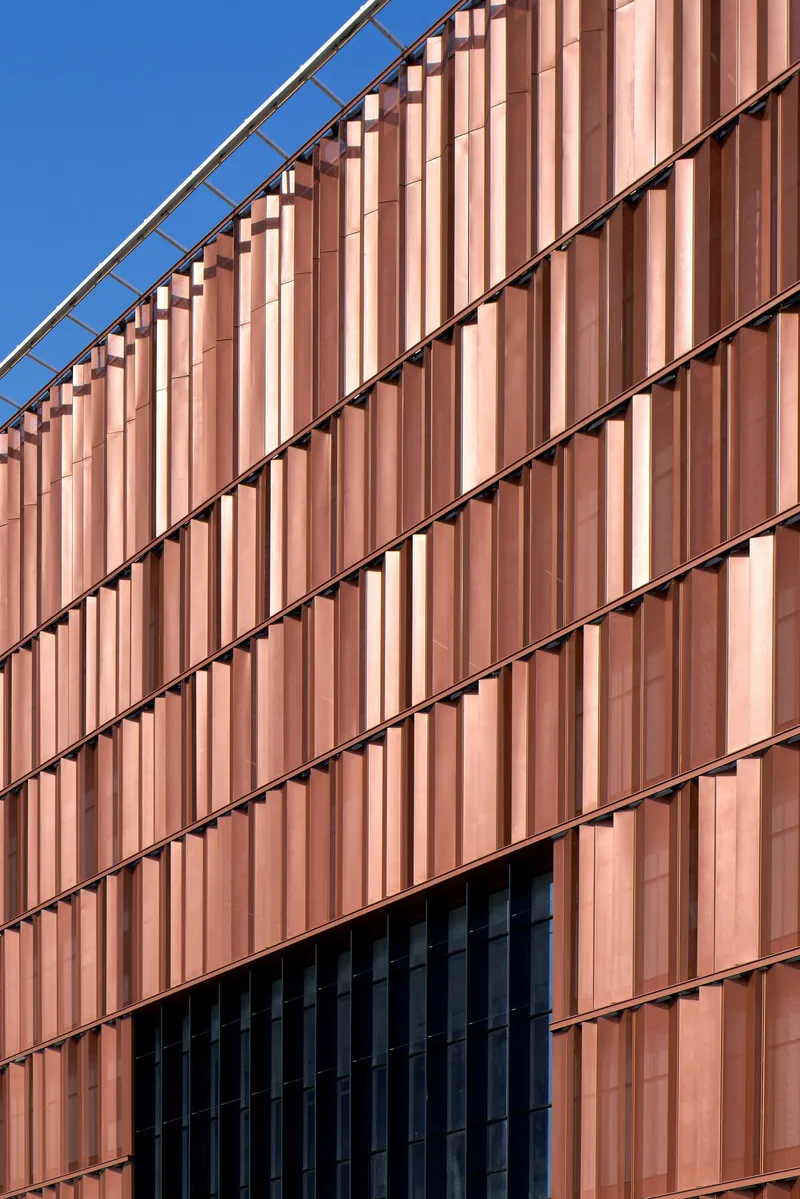
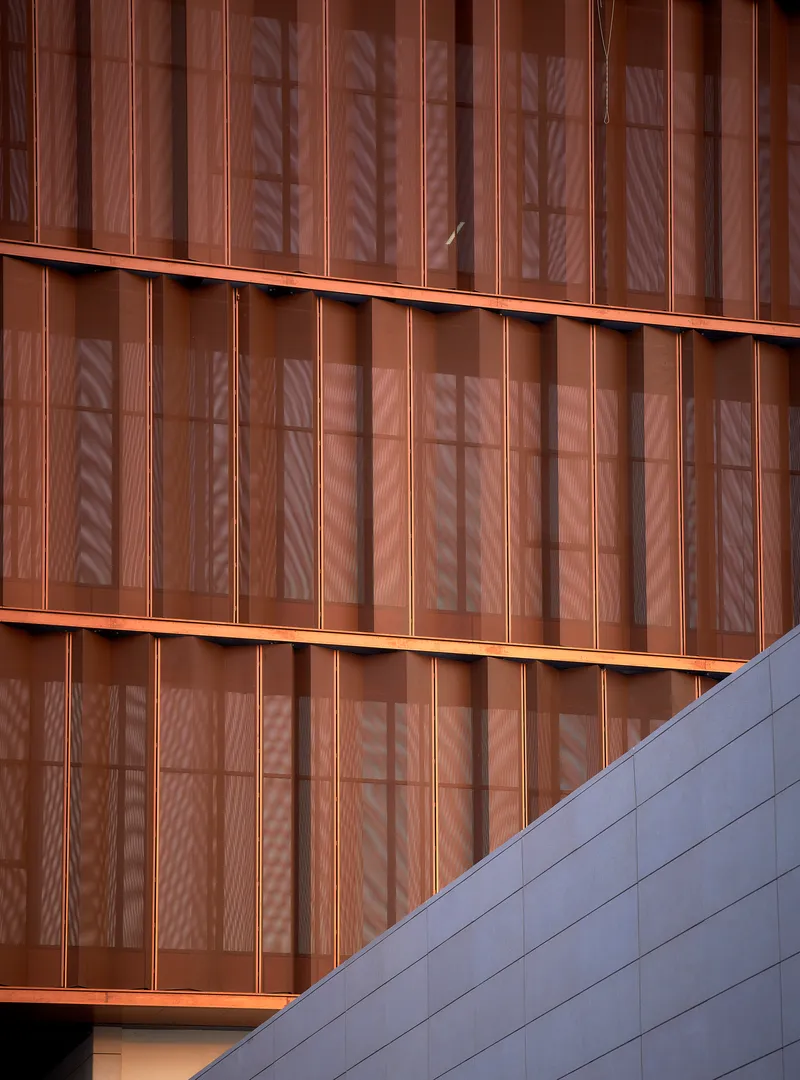
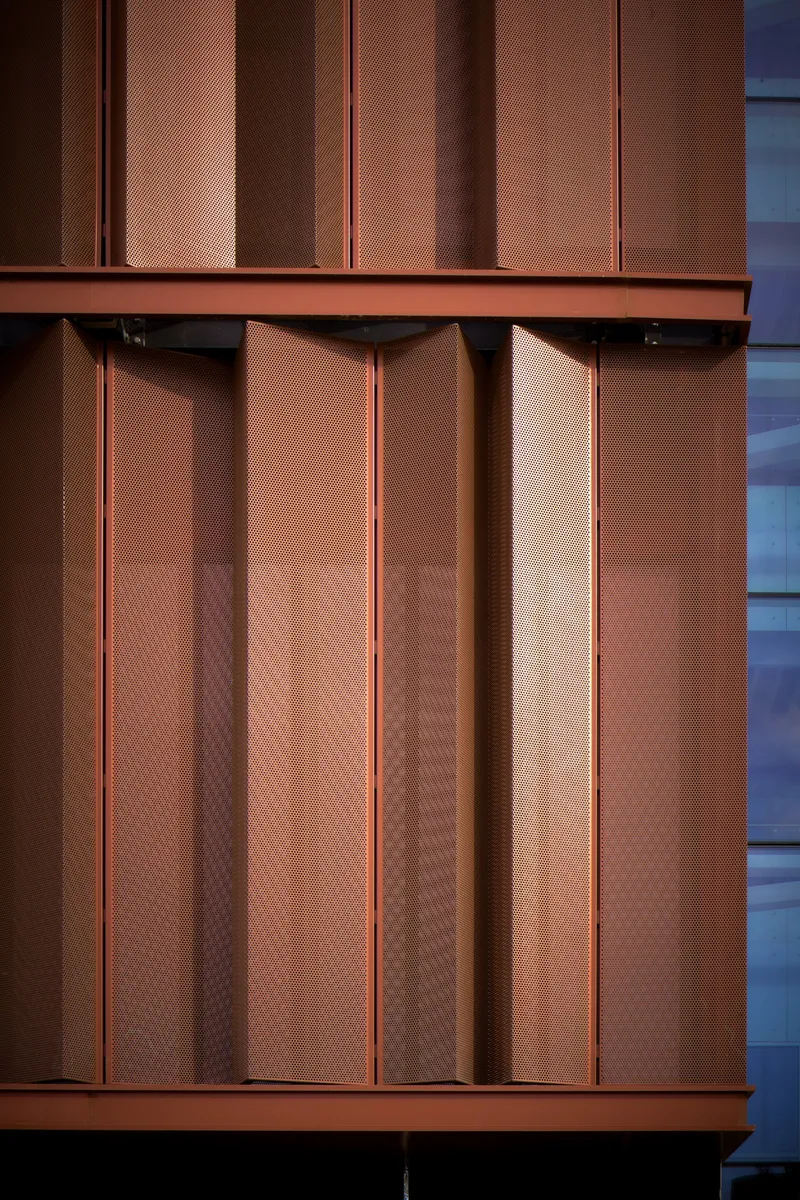
Close up, the facade earns its keep. The perforated panels are not decorative; they are calibrated to reduce solar heat gain while allowing natural light to reach every floor. The vertical fins create depth, catching diagonal shadow lines that shift continuously. Translucent panels between the fins glow softly with reflected palm foliage, turning the skin into something alive rather than static.
The fact that each elevation carries its own fold pattern is a detail that rewards attention. Viewed in the round, the academy presents four distinct textures rather than a single repeated module. At dusk, when interior lighting spills through the screens, the building inverts: the opaque cube becomes a lantern, broadcasting warmth outward. The project earned a 2 Pearl Estidama sustainability rating, a validation that the environmental ambitions of the skin go beyond aesthetics.
The Central Atrium as Commons
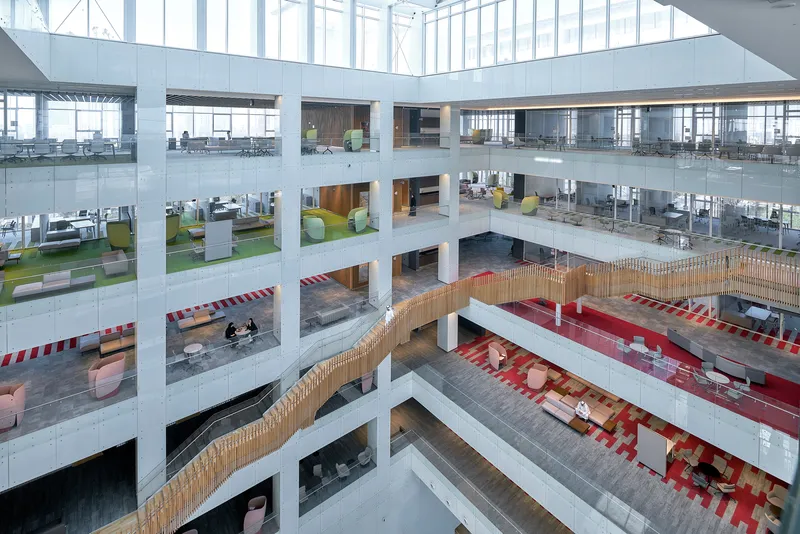
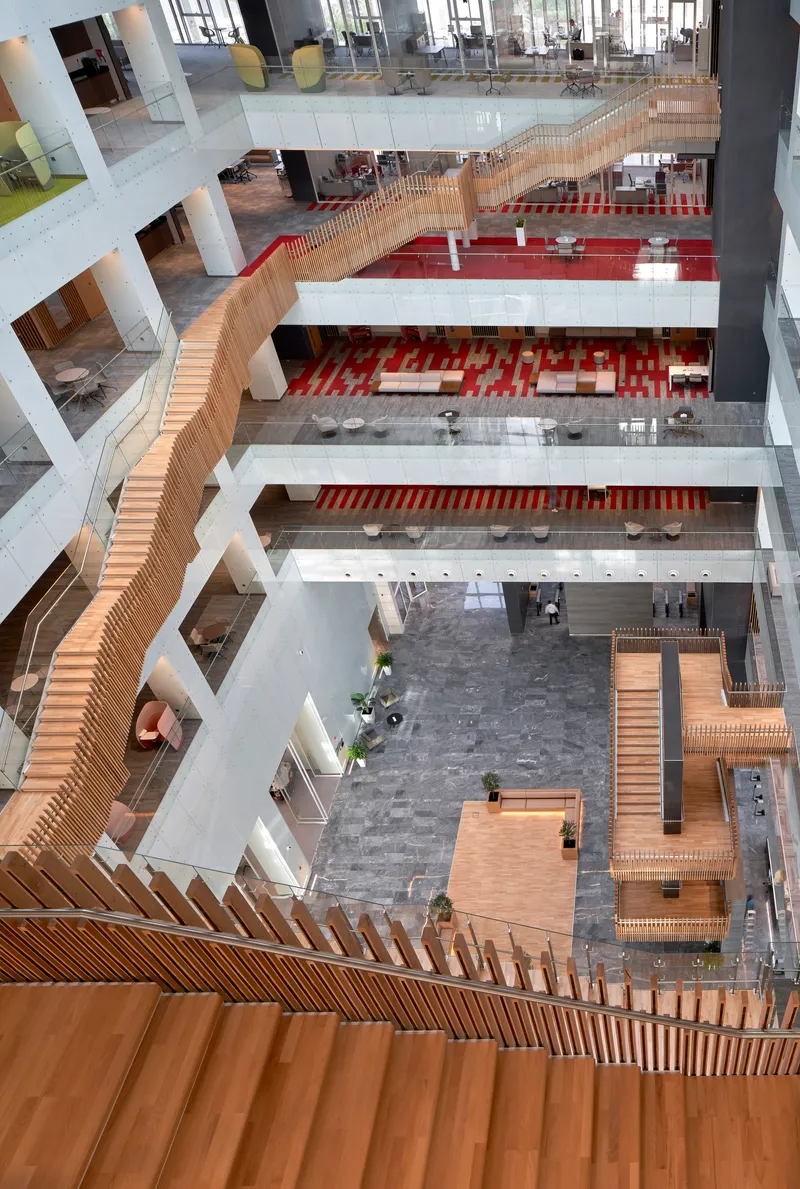
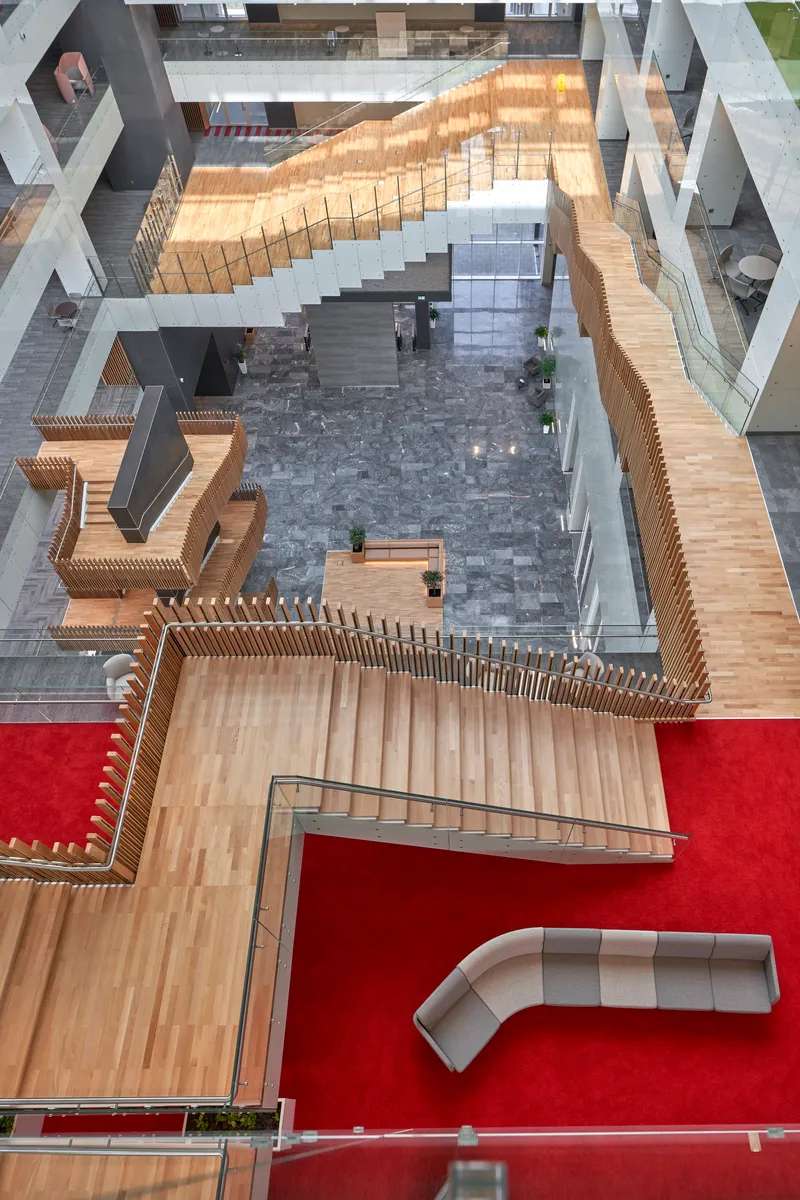
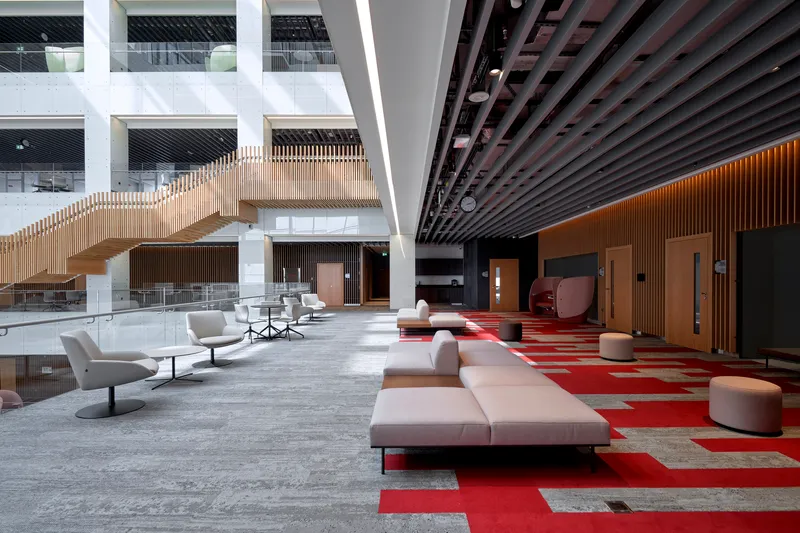
If the exterior is introverted, the interior is anything but. A multi-story atrium runs through the heart of the building, connecting every level with daylight from overhead glazing. Open floor plates ring the void, and timber-slatted balustrades wrap the stair flights in a warm, tactile material that contrasts sharply with the aluminum outside. Looking down from upper levels, you read the entire social life of the academy at a glance: students on tiered seating, faculty crossing bridges, clusters of conversation on red-carpeted platforms.
The atrium functions as the academy's agora. It is the organizational spine, the primary source of natural light, and the social condenser. The design proliferates communal and collaborative spaces at every level, with study areas ranging from open tables to more enclosed rooms, all modifiable. The message is clear: diplomacy is a collective practice, and the architecture should rehearse that collectivity daily.
Timber, Carpet, and the Warmth Below
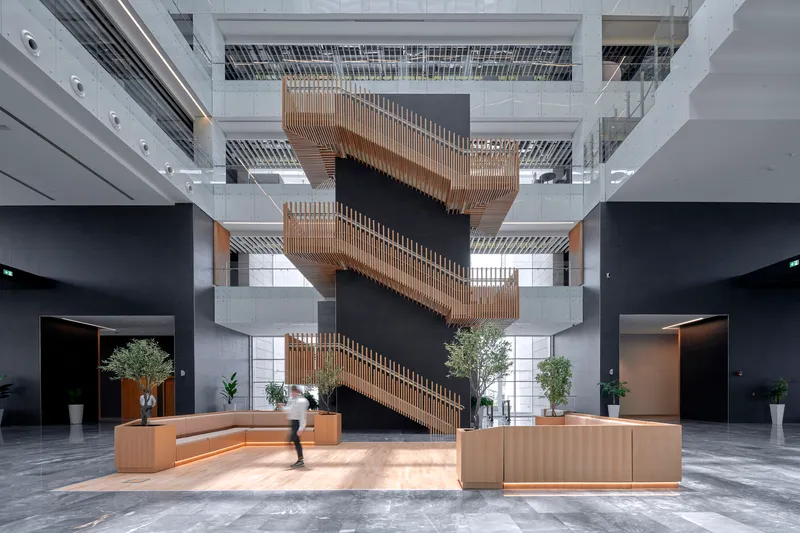
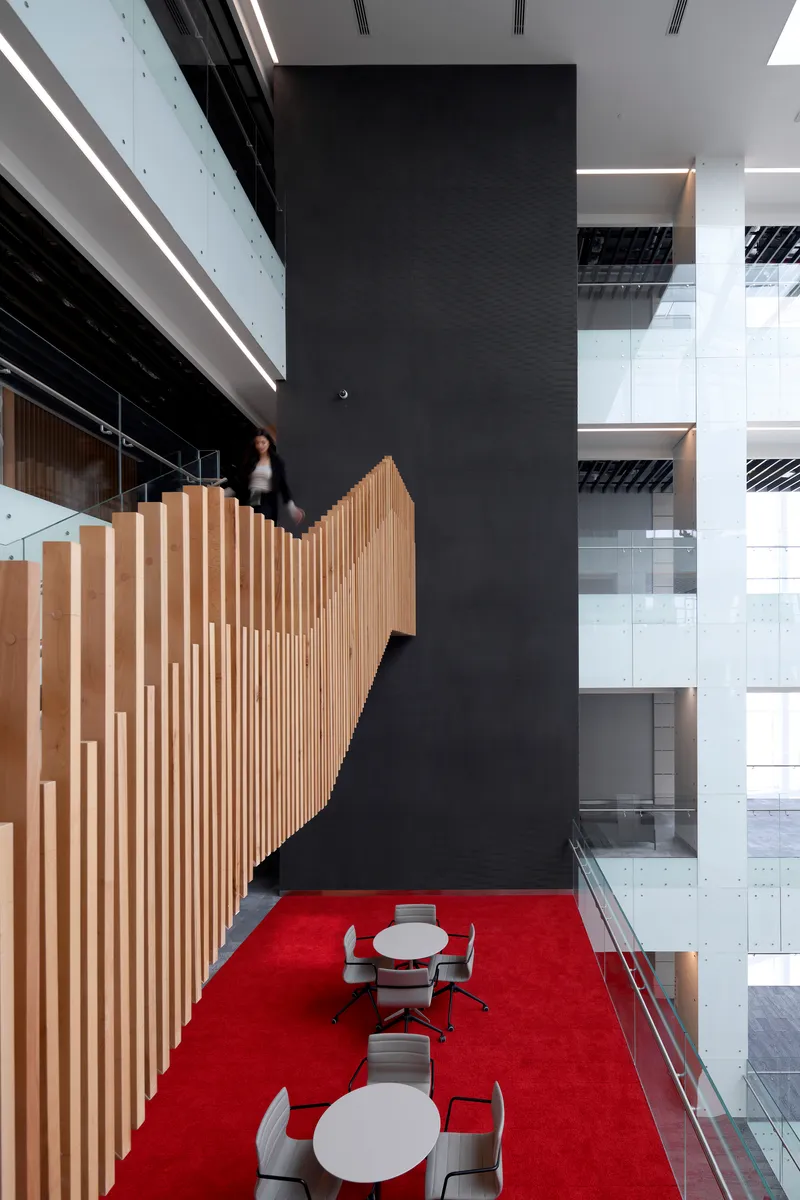
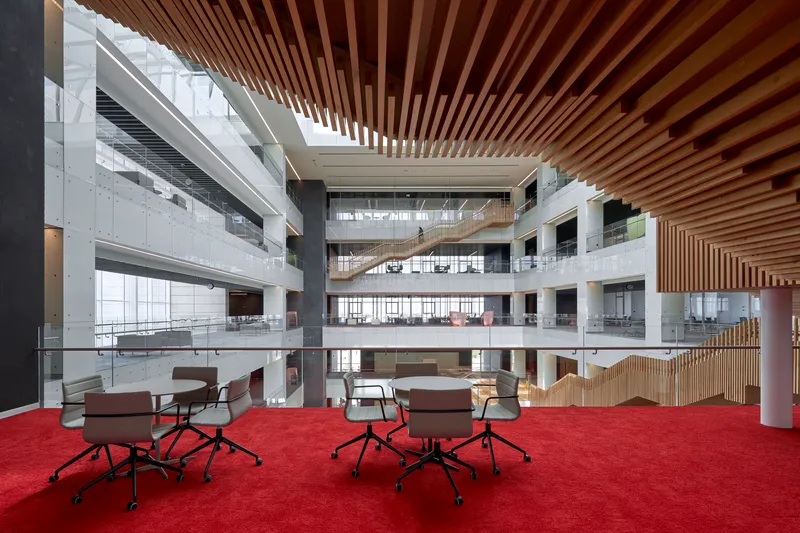
The material palette inside pivots from the metallic cool of the facade to a deliberate warmth. Wood-clad staircases wrap around the perimeter, their slatted surfaces lending rhythm and grain to what could easily have been generic circulation. Near the student lounge, the main staircase widens to accommodate informal assembly, turning a piece of infrastructure into a piece of furniture. People sit on it, gather beside it, and orient themselves by it.
Underfoot, red and grey carpets demarcate zones without walls, a soft way to signal program shifts. The lounge at ground level uses modular seating and planters with actual trees, lending a domesticity that feels intentional in a building dedicated to the nuanced human work of foreign affairs.
Formal Spaces and Quiet Rooms
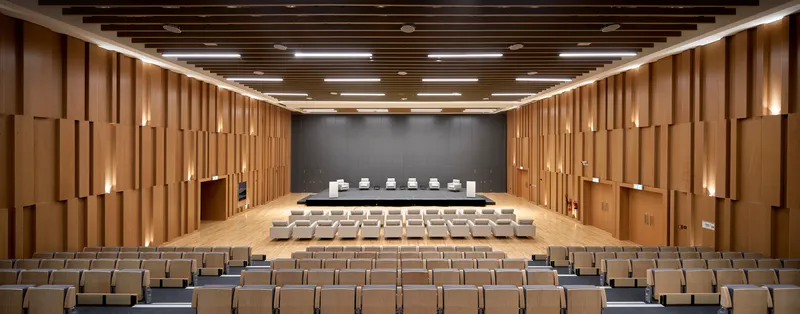
Not everything here is open plan. The auditorium, with tiered seating and a dark grey stage wall flanked by articulated timber side panels, channels attention toward the speaker with precision. Lighting, color, and texture all converge on the stage. It is a room designed to give weight to a single voice, an appropriate quality for an institution training diplomats.
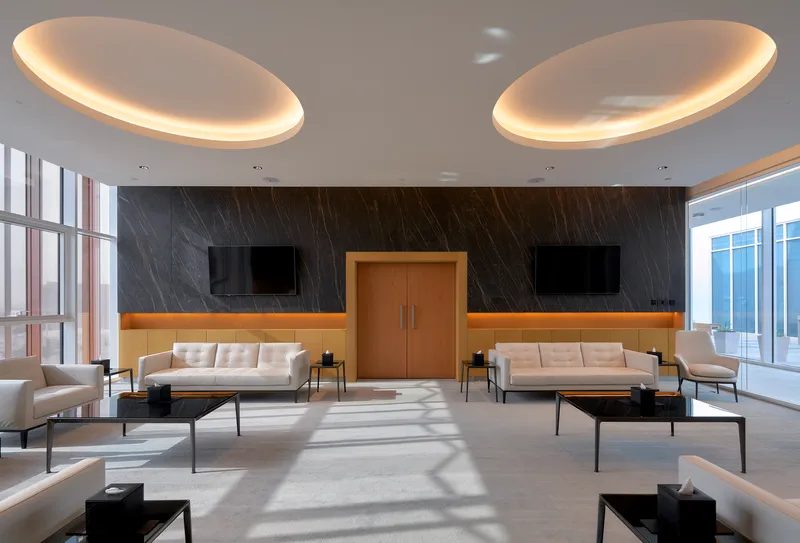
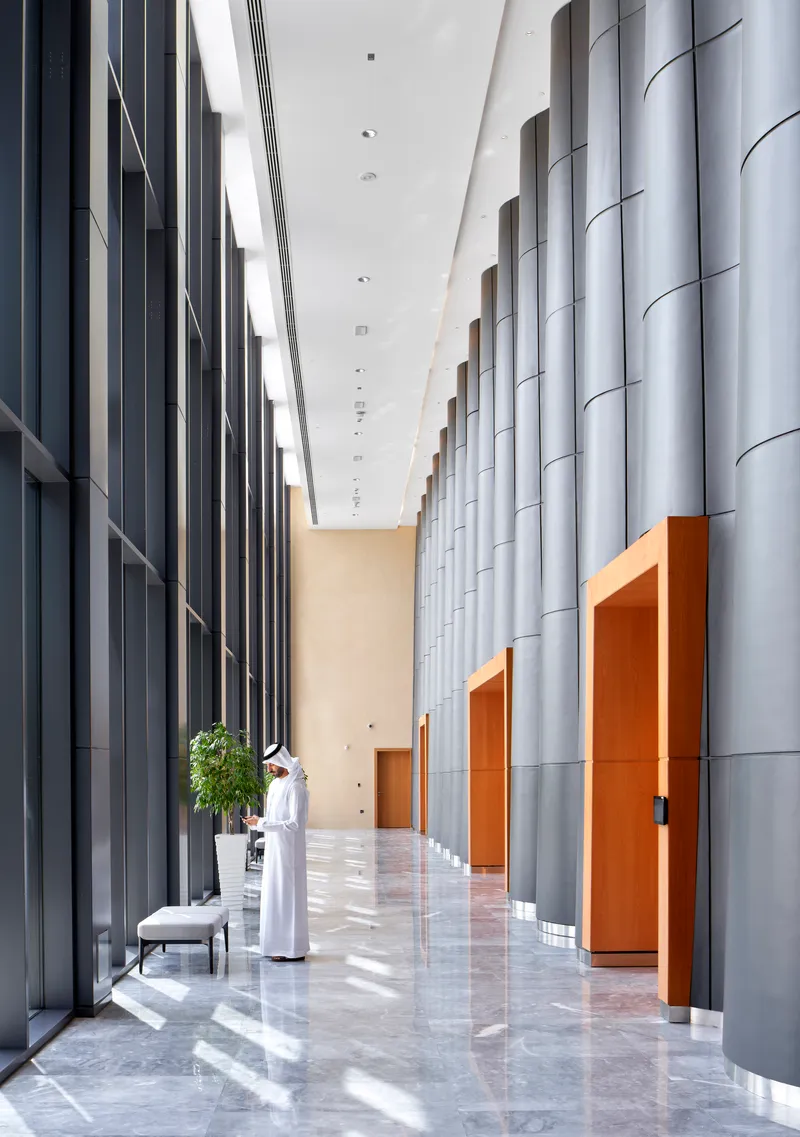
Elsewhere, the reception lounge deploys dark marble and paired oval ceiling lights to create a more ceremonial register. Sunlight patterns the stone floor through the perforated screen, a reminder that even in the most formal spaces, the facade is still at work. The entrance corridor, lined with fluted metal columns and polished marble, operates at a civic scale: tall, axial, and quietly grand.
Corridors, Libraries, and Gradient Color
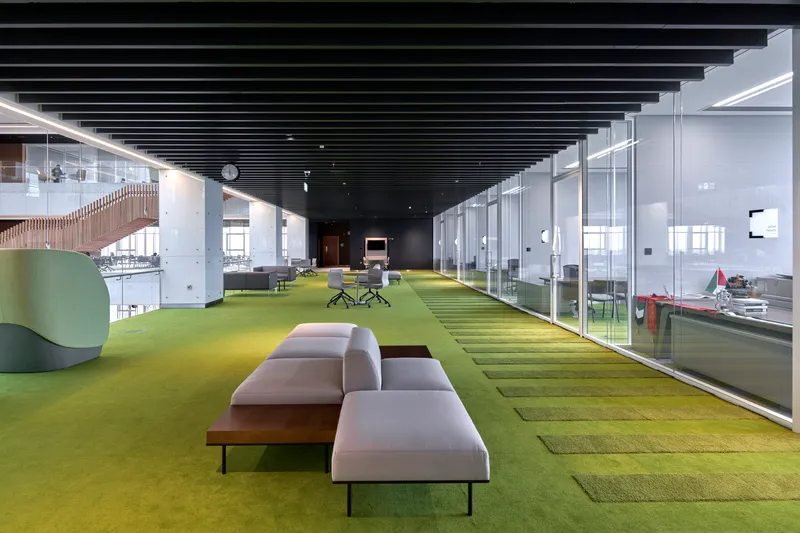
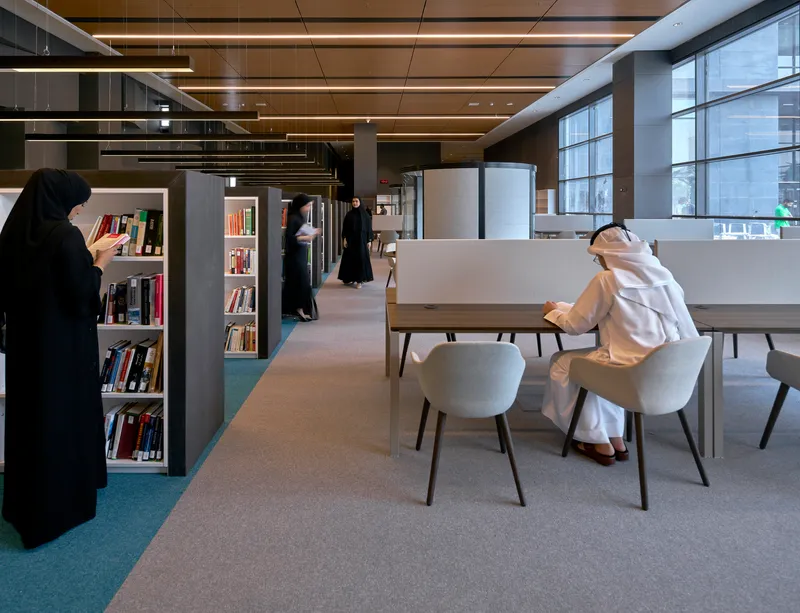
A corridor with graduated yellow and green carpet tiles running beneath a black slatted ceiling is the kind of detail that separates a good institutional building from a forgettable one. It signals that the designers thought about the experience of moving between rooms, not just the rooms themselves. The library reading area is restrained: grey shelving, linear ceiling lights, and enough visual calm to let concentration happen.
These quieter spaces balance the energy of the atrium. The building offers study spaces at all levels of privacy, and the ease with which one can move between open collaboration and solitary focus is one of its strongest programmatic achievements.
Landscape Without Walls
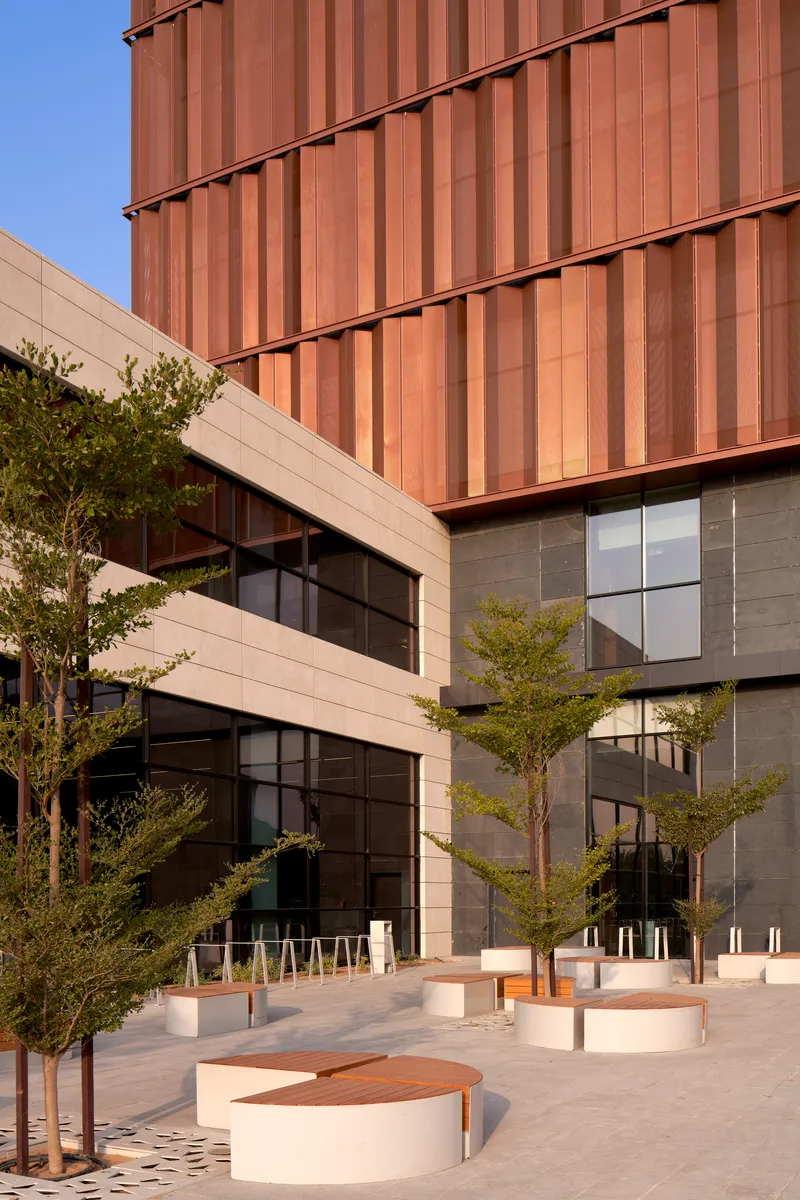
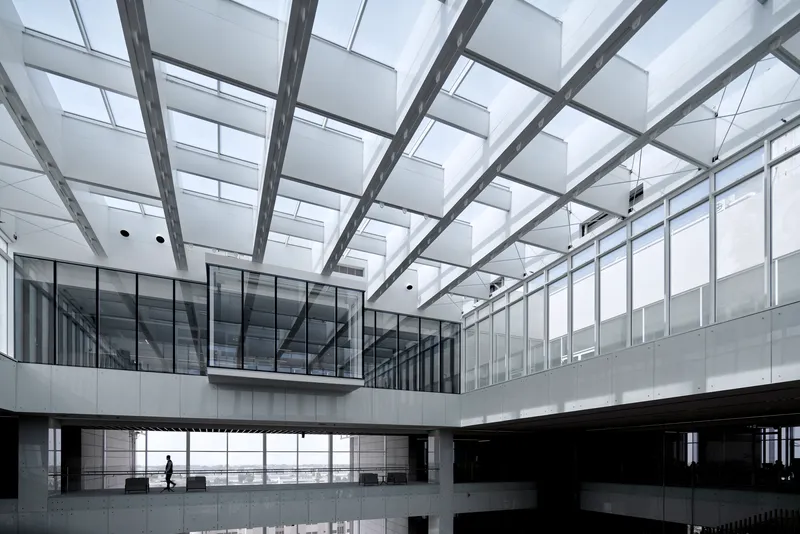
The courtyard, with curved stone benches and young trees framed by copper-clad and glass facades, demonstrates what happens when a building designed for diplomacy actually practices it at the site level. Neighboring embassies hide behind fences; the academy lets native planting do the work of defining its territory. A rooftop garden adds usable green space above the program. Even the interior courtyard beneath the structural grid skylight feels generous, with upper-level bridges offering views across planted voids.
The landscape strategy, developed with consultants I-CON, makes the borderless condition legible without signage or barriers. It is a quiet rebuke to the security-driven urbanism that dominates most diplomatic precincts.
Plans and Drawings
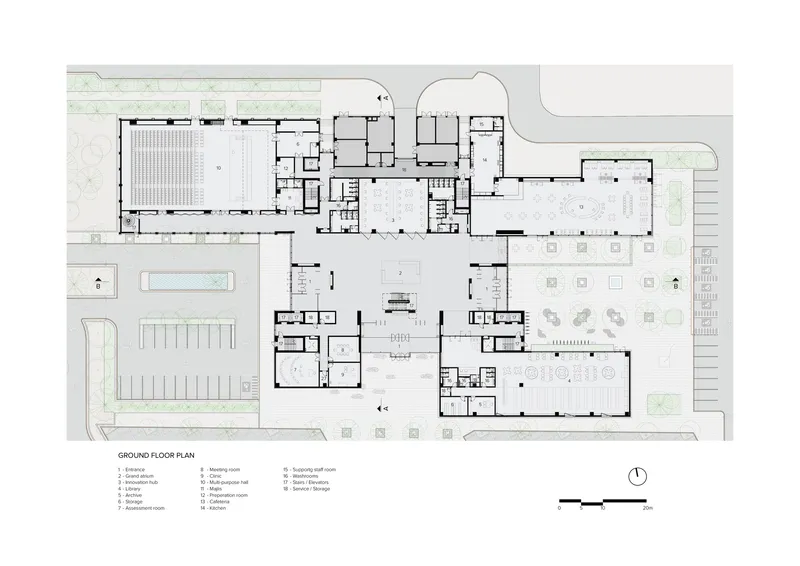
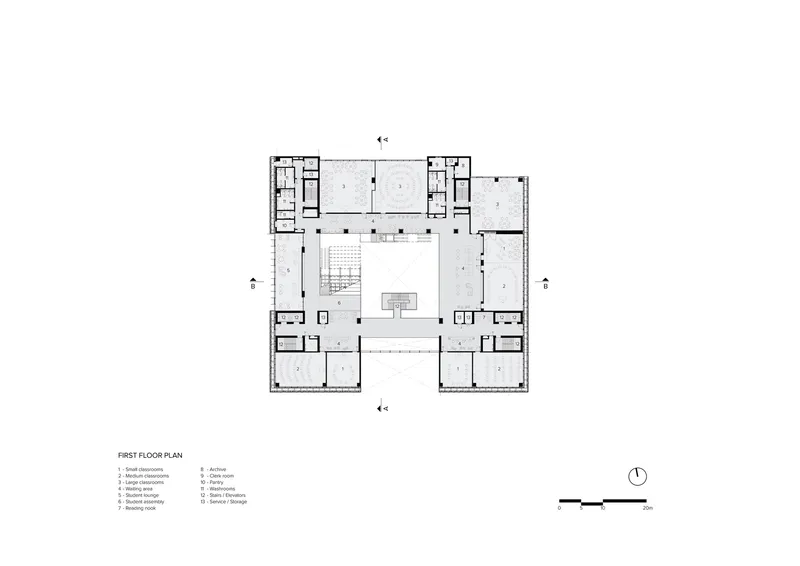
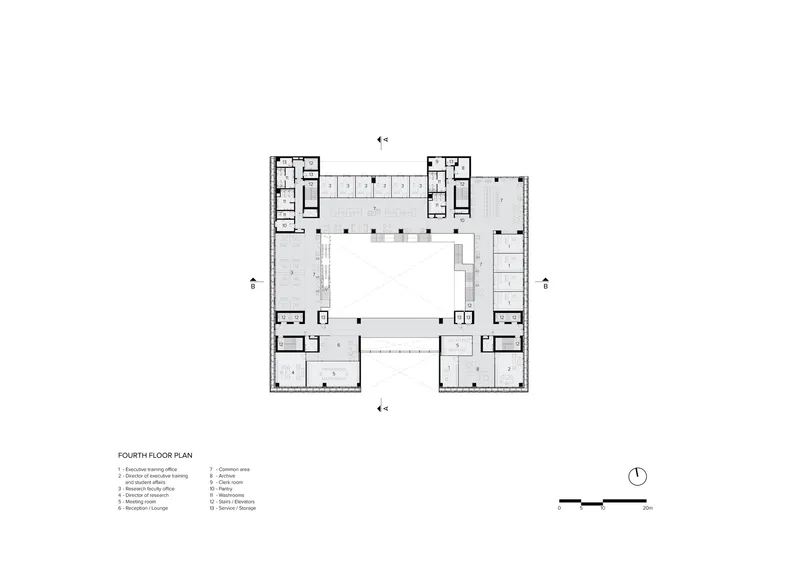
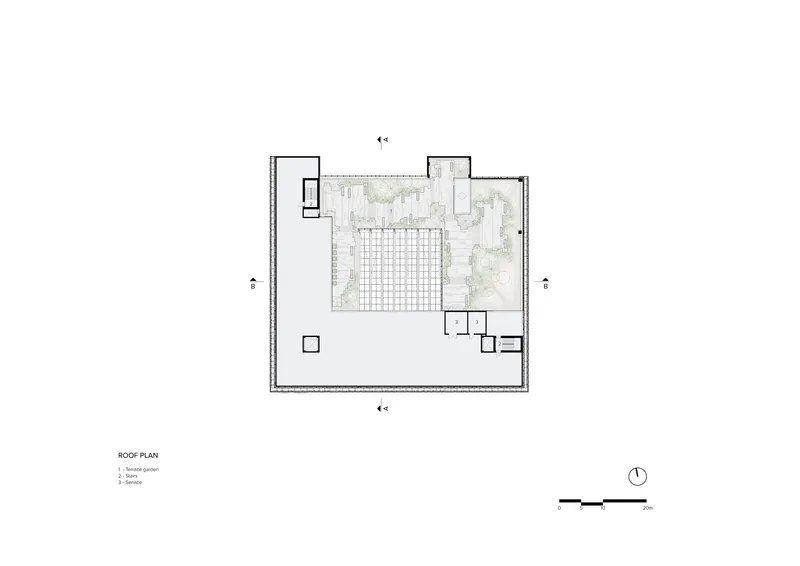
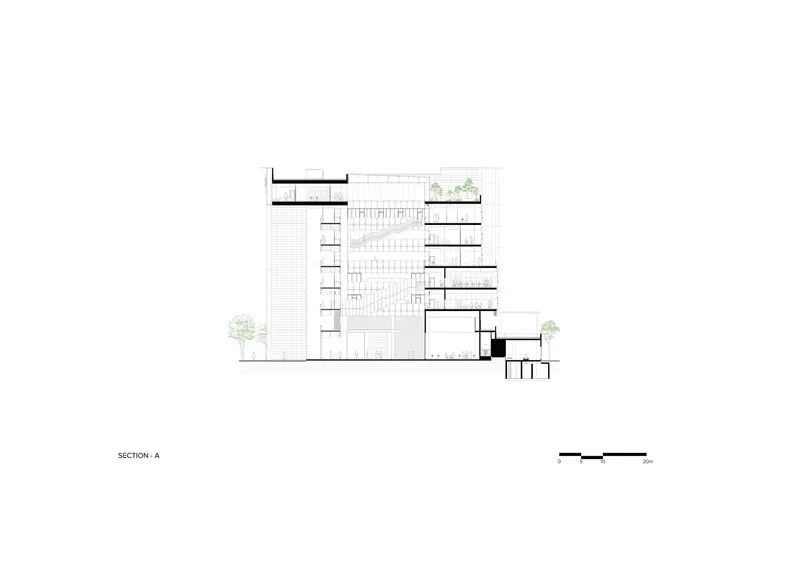
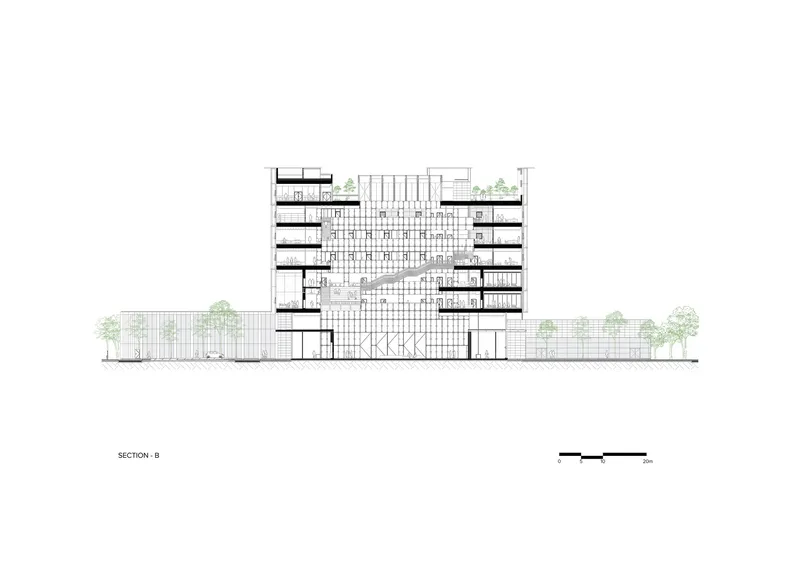
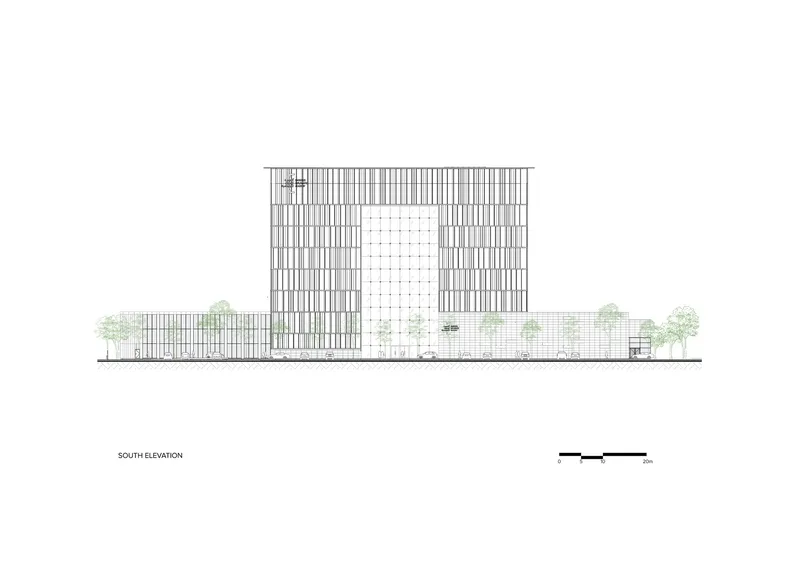
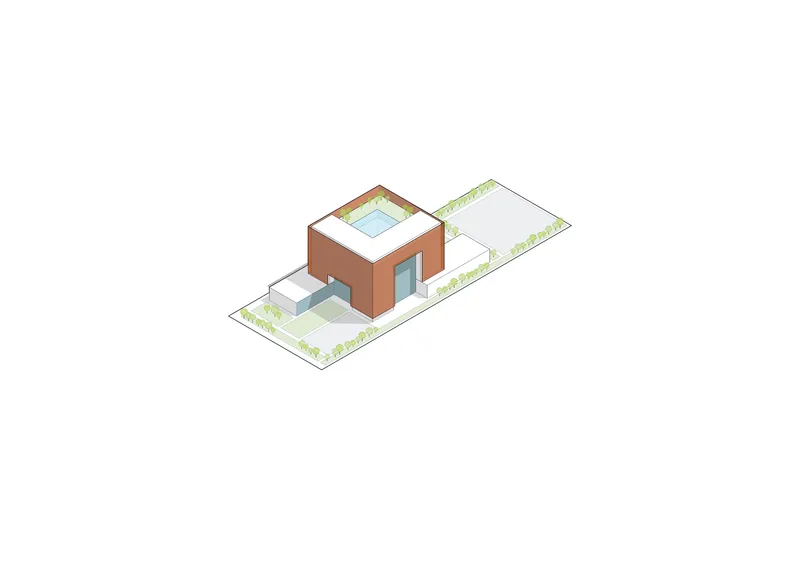
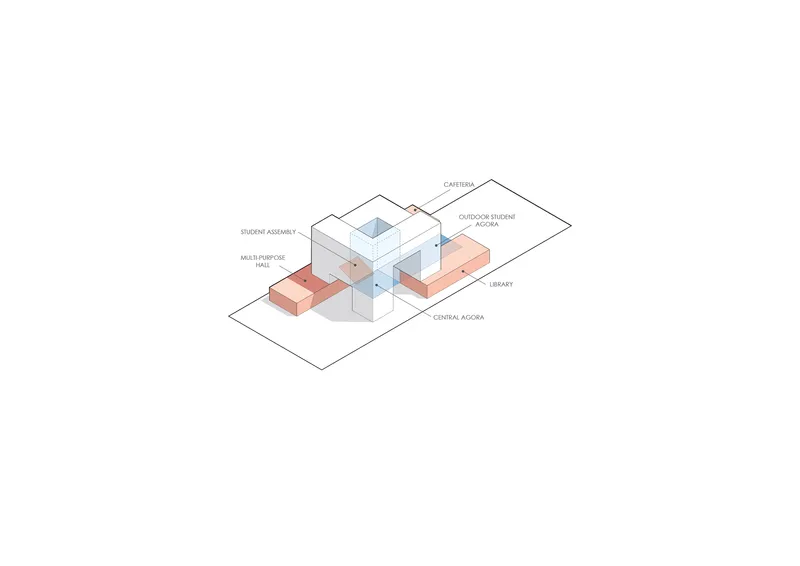
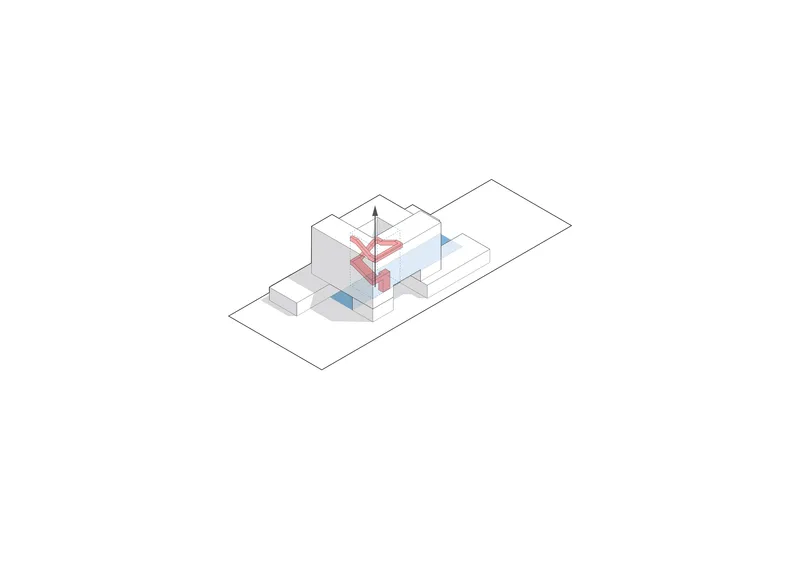
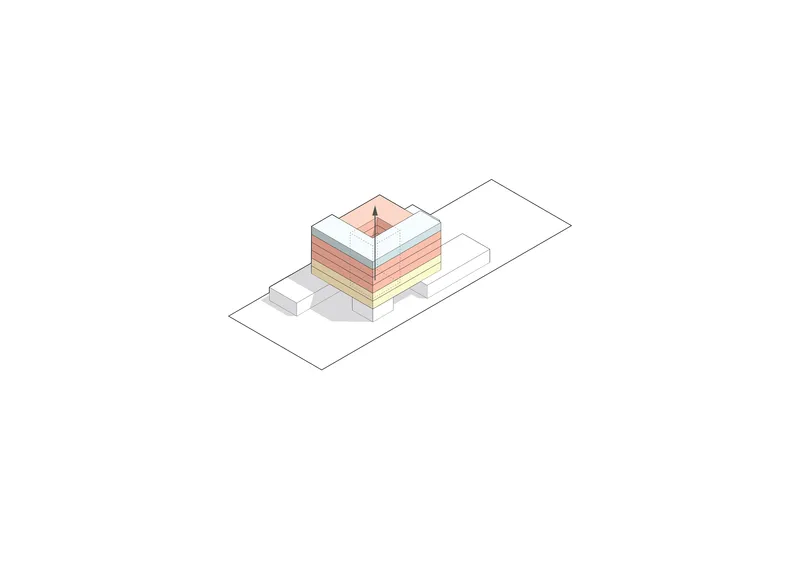
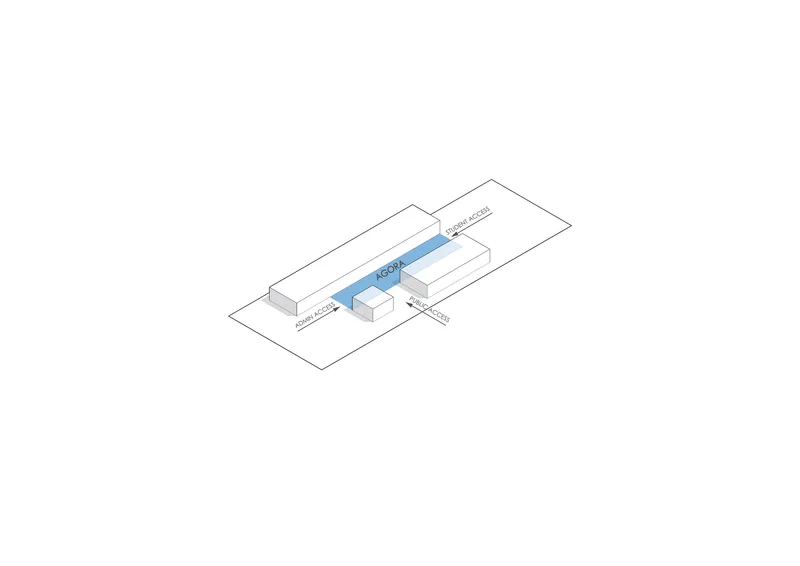
The ground floor plan reveals how the program distributes around central courtyards, with parking and landscaping integrated rather than isolated. Upper floors show the courtyard as the organizing constant, with rooms and meeting spaces wrapping its edges. The roof plan confirms the planted terrace, and the sections expose the staggered floor plates and the grand staircase as the building's spatial engine.
The axonometric diagrams are particularly revealing. One illustrates programmatic distribution across interconnected volumes organized around what the architects call a central agora. Another color-codes the circulation paths through the core, making visible the intentional redundancy of routes: there is no single way through this building, which seems exactly right for a school that teaches negotiation. The isometric of the long linear corridor connecting perpendicular program bars reads almost like a small campus condensed into a single footprint.
Why This Project Matters
Educational buildings in the Gulf too often default to either corporate blandness or ornamental excess. The Anwar Gargash Diplomatic Academy avoids both. Its perforated double skin is an environmental strategy first and a visual identity second, which is the right order of priorities in a climate where facade performance determines whether a building can even be occupied comfortably. The fact that the skin varies on each elevation shows a design team willing to invest complexity where it counts, at the interface between building and sun.
More fundamentally, the decision to eliminate the boundary wall is the project's defining act. In a district where enclosure signals status and security, openness becomes a statement of institutional confidence. Shape Architecture Practice + Research have produced a building that performs diplomacy before anyone steps inside: welcoming, legible, and deliberate about what it reveals and what it holds back.
Anwar Gargash Diplomatic Academy, designed by Shape Architecture Practice + Research. Abu Dhabi, United Arab Emirates. 18,000 m². Completed 2021. Photography by Phil Handforth.
About the Studio
Share Your Own Work on uni.xyz
If projects like this are the kind of work you want to make, uni.xyz is a place to publish your own, find collaborators, and enter design competitions.


Popular Articles
Popular articles from the community


The Amber Palace Opera: A Geological Fiction Surfaces on Tallinn's Baltic Waterfront
Pierre Brillard reimagines a Baltic legend as a public landscape, opera house, and waterfront promenade rooted in Tallinn's coastal identity.

Singing Woman: An Opera House That Performs Before the Curtain Rises
Ovidiu Cristian Pavel's conceptual opera house translates Estonia's choral identity into a sculpted waterfront landmark facing the Baltic Sea.

Cloaked Colonization: A Mobile Underwater Habitat That Moves Like a Fish
Micah Abaya's shortlisted EHC Pacific entry reimagines ocean settlement as a dispersed network of self-sustaining architectural organisms.

Opera on the Sea: Driftwood Logic Shapes a Timber Opera House on Estonia's Coast
Trevor Orgill's opera house translates the entangled drift of floating timber into a civic building where wood, water, and music converge.

Similar Reads
You might also enjoy these articles

Pixel Gardens: One Repeated Module Stacked Into a Terraced Social Housing Tower for Famagusta
Salem Bader's shortlisted housing tower builds a vertical neighbourhood from one repeated module, offsetting units to carve terraces, light and air.

Bao Huynh Watercolor Atelier: A Serene Art Retreat in Hội An
Bao Huynh Watercolor Atelier in Hội An blends multifunctional art spaces, sustainable design, local materials, and family-friendly living in a serene environment.

Atelier Macri Concept Store Interior Design by CASE-REAL
Atelier Macri store features a "ko" counter, walnut wood details, cork displays, blending retail, gallery, and seamless customer experiences.

Manuel Vargas Izquierdo Stadium and High-Performance Sports Center: Architectural Excellence in Jalpa de Méndez
The Manuel Vargas Izquierdo Stadium blends sustainable design, inclusive sports facilities, and cultural-inspired architecture, revitalizing Jalpa de Méndez’s public spaces.

Explore Dubai Competitions
Discover active competitions in this discipline

Challenge to design public laboratory

Challenge to reimagine the Iron Throne

Photograph architecture without architects

Illustrate the lost glory of Angkor Wat - Render Challenge
Comments (0)
Please login or sign up to add comments
No comments yet. Be the first to comment!