

Shay Cleary Architects Lifts Ireland's Tallest Office Building on a Blue Steel Exoskeleton in Dublin
The Exo Building hovers seven meters above the Docklands, channeling the industrial memory of port cranes into a 17-storey commercial tower.


There is a particular kind of ambition that shows up when a commercial office building refuses to behave like one. Shay Cleary Architects designed The Exo Building not as a speculative box but as a structural event: a 17-storey, 112-meter-long bar of glass and steel raised seven meters off the ground on a painted blue exoskeleton that openly references the gantry cranes of Dublin's working port. At 20,784 square meters, it is the tallest commercial office structure in Ireland, yet its most compelling gesture is the void beneath it, a ground plane left open so that crowds of up to 13,000 people can flow freely under the building to reach the 3Arena and Point Square.
Completed in 2022 on a long, narrow plot wedged between the former Point Depot and East Wall Road, The Exo sits at the threshold between Dublin's historic city fabric and its industrial port. That liminal condition is the project's engine. Rather than turning away from context or defaulting to a neutral corporate skin, Cleary's team adopted a constructivist vocabulary. Diagonal mega trusses, painted the same blue as the dockside cranes, span between just three elliptical mega columns on each side, delivering column-free floor plates that stretch 18 meters wide. The building is simultaneously sculpture, infrastructure, and workplace. It earned LEED V3 Platinum certification before practical completion, a first in Europe, which suggests the structural bravado is backed by rigorous performance.
Lifting the Building Off the Ground
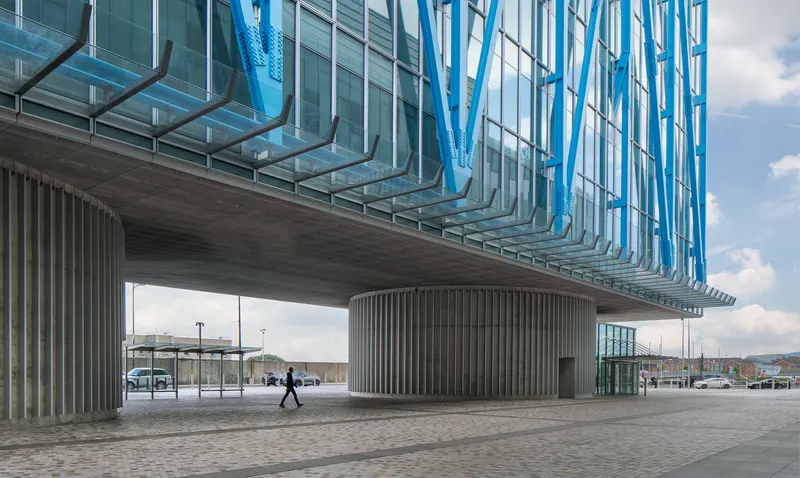
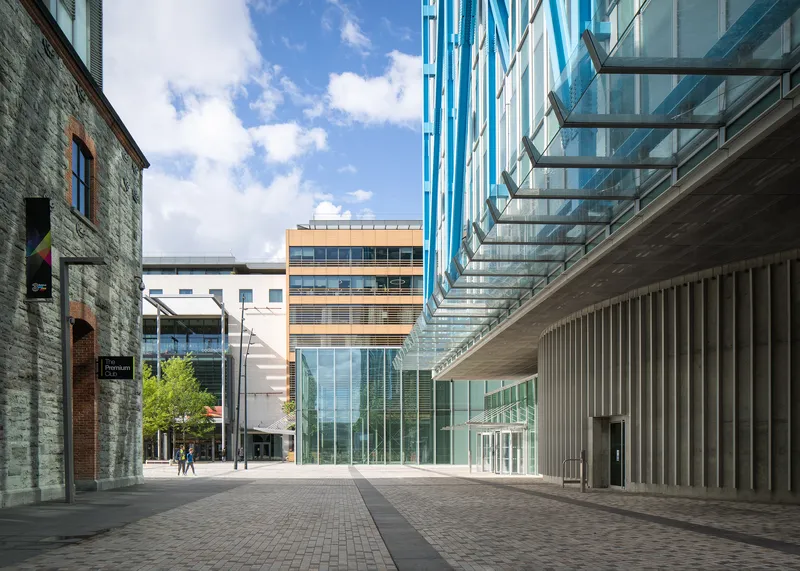
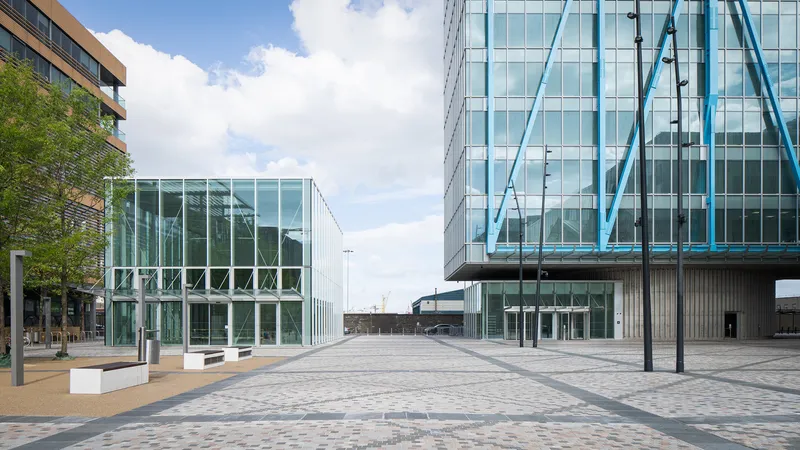
The decision to raise the entire volume seven meters is not decorative. Point Square regularly hosts large-scale events, and the site needed to remain permeable. By elevating the mass, Shay Cleary created a covered public passage between the arena, the waterfront, and the wider Docklands. Vertical concrete fins articulate the underside, channeling pedestrians through a sheltered zone that reads as civic infrastructure rather than private lobby.
The setback along the river frontage is equally deliberate. The protected masonry facade of the original Point Depot demanded deference, and the new building pulls away just enough to let the older structure breathe. The gap between them becomes a generous pedestrian corridor, a threshold negotiated with care rather than entitlement.
The Exoskeleton as Identity

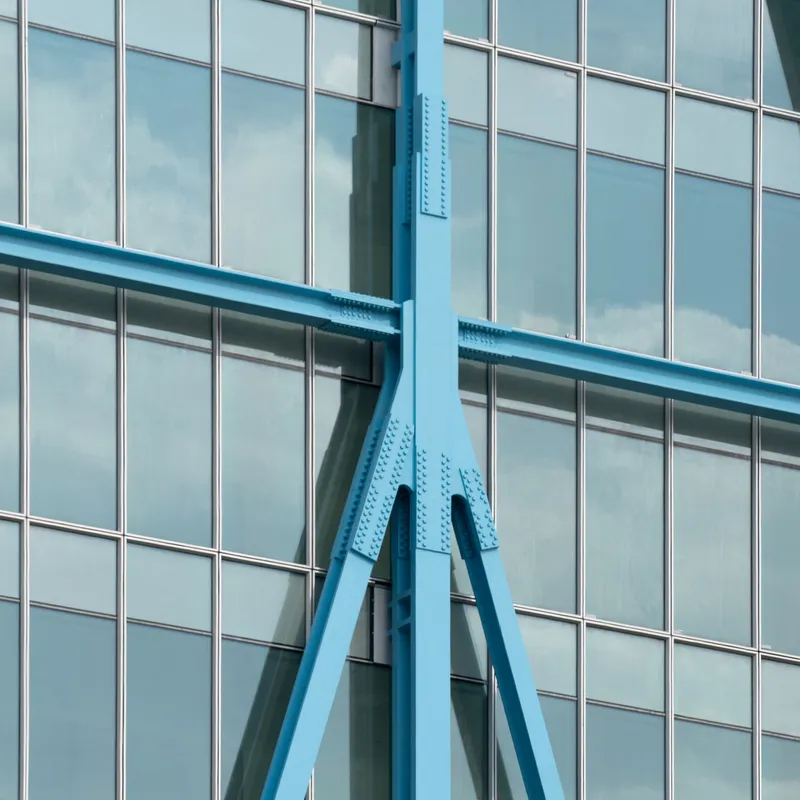

Most commercial towers in Dublin, or anywhere, conceal their structure behind unitised curtain wall. The Exo does the opposite. Two mega trusses run the full length and height of the building, their diagonal members crossing in front of the glazing in a zigzag pattern that is impossible to miss. The blue paint is not an afterthought. It directly invokes the dockside cranes that have defined the visual identity of the port for decades. For a city that has occasionally struggled with the placelessness of its new commercial quarter, this is a pointed statement: the building knows where it is.
Each truss is supported at only three positions, located at the midpoints of elliptical mega columns embedded within reinforced concrete cores. This economy of bearing points is what frees the floor plates, but it also gives the facade its striking rhythm. The diagonal members change scale and density as the building rises from 8 storeys at its southern end to 17 storeys at the Point Square face, and that graduation lends a sense of directional energy, as if the building were leaning forward into the public square.
Old Fabric, New Frame


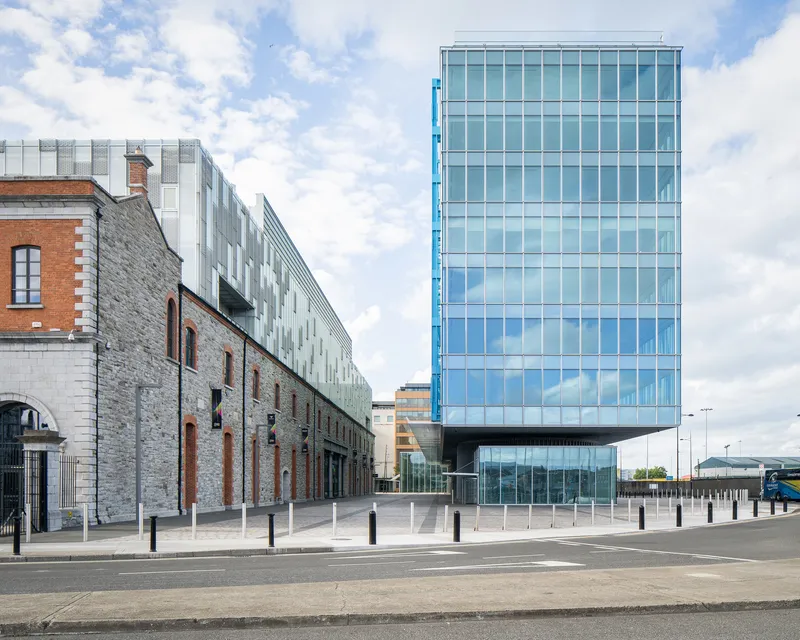
Context in the North Docks SDZ is not uniform. There are restored brick warehouses with arched openings, the solid stone mass of the Point Depot, and the generic commercial blocks that have arrived in waves since the early 2000s. The Exo sits comfortably among all of them because it operates on its own terms rather than mimicking any single neighbor. The blue steel diagonal reads as industrial, the glazed curtain wall reads as corporate, and the careful proportioning of the base volume reads as civic. The sum is a building that doesn't defer to its surroundings but doesn't shout over them either.
From the waterfront, the tower rises behind the brick warehouses in a composition that layers eras of Dublin's relationship with the Liffey. Sailboats, stone quays, arched masonry, and diagonal steel bracing all coexist in a single frame. That layering is not accidental. It was earned by the building's willingness to pull back, lift up, and let the existing fabric hold its place in the foreground.
Interior Logic: Open Plates and Honest Structure


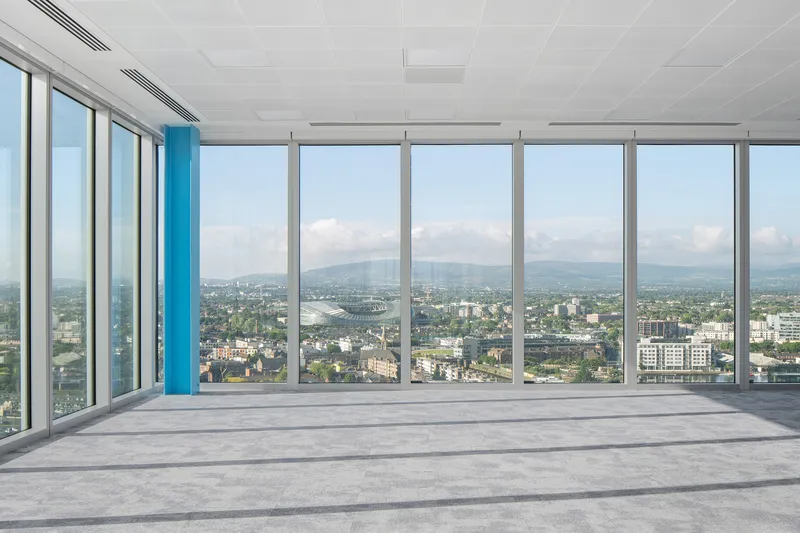
Inside, the exoskeleton's dividend is immediately legible. Floor plates are predominantly column-free, stretching 18 meters wide with 2.9-meter-tall workspaces flooded by floor-to-ceiling glazing. The blue structural members continue through the interior at certain points, appearing as diagonal columns in lobby spaces where they support coffered white ceilings. This honesty is refreshing. The structure is not hidden behind plasterboard; it is on display, painted the same blue inside as out.
Three dedicated cores serve the building's varied functions, distributing vertical circulation so that no point on the 112-meter-long floor plate is far from a stair or lift. The ground floor lobby deploys polished stone floors, glass revolving doors, and pendant lighting to establish a hospitality tone, but the real luxury is spatial: panoramic views of the port and city from every workspace, uninterrupted by columns.
Thresholds and Lobbies
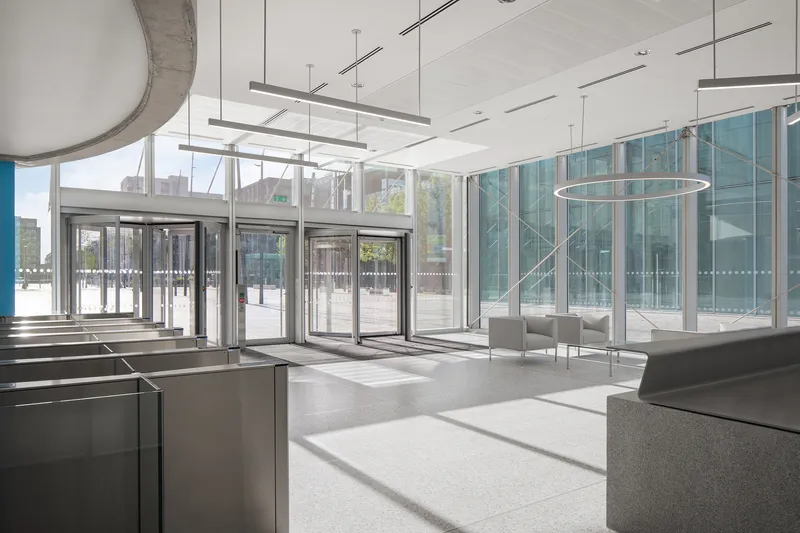


The transition from public ground to private workspace is handled with precision. Security turnstiles sit beneath a curved concrete soffit flanked by blue columns, a moment where the building announces itself without intimidation. The long corridor with floor-to-ceiling windows on one side and concrete panels on the other creates a processional pause, a moment to absorb the scale of what you are entering before you arrive at the open floor plates above.
Waterfront and Skyline

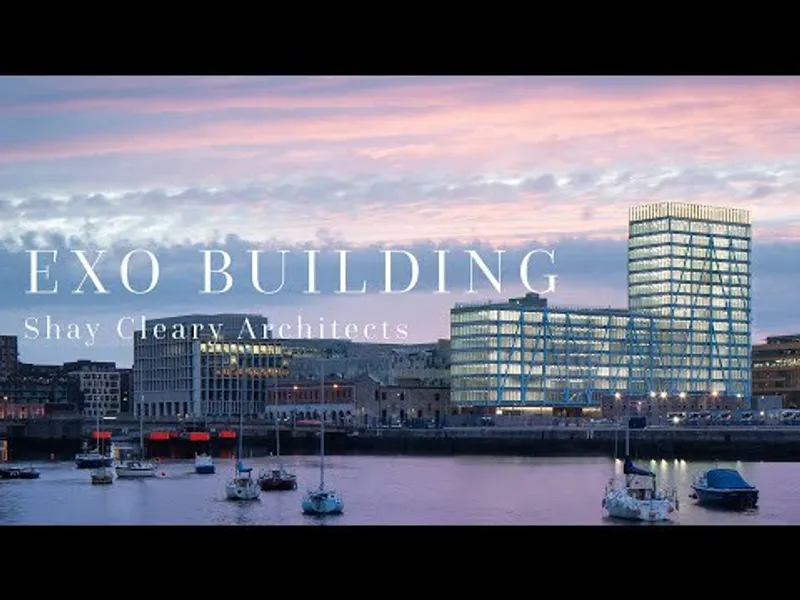
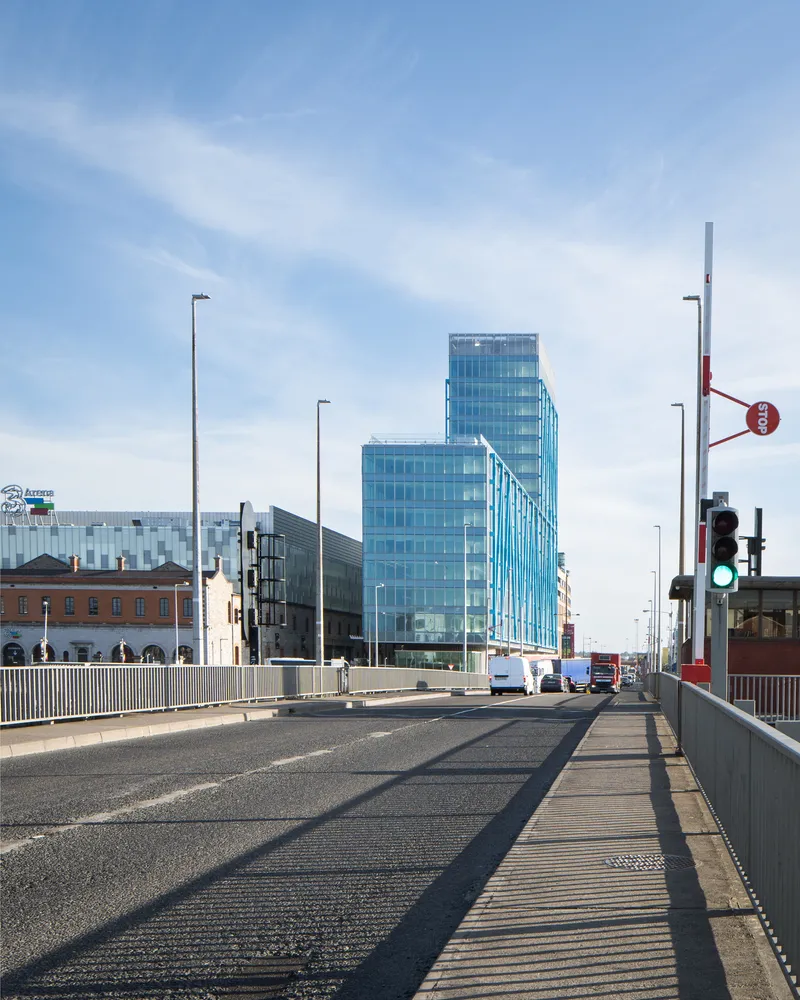
The Exo's relationship to water is essential. From across the harbour, the diagonal bracing reflects in the calm surface at sunset, doubling the zigzag pattern and tying the building to the liquid plane from which Dublin's docklands draw their character. At dusk, the glazed volume glows, and the blue steel darkens to silhouette, reversing the daytime reading where structure leads and glass follows.
From the stepped profile visible on approach bridges, the building reads as a topographic event: rising from 8 to 17 storeys, it creates a skyline marker for Point Square that is recognizable from considerable distance. The 1,000-square-meter landscaped roof garden at the top adds a human-scale amenity to what could otherwise be a purely corporate gesture, giving occupants a planted outdoor space facing the port.
Night Reading


At twilight, the building reveals its second life. The ribbed concrete base volume, nearly invisible during the day, becomes a lantern. The cantilevered glass mass above it seems to float, and the blue bracing dissolves into the darkening sky. The tram lines in the foreground, the pedestrian crossings below, the warm glow of the lobby: these elements conspire to make The Exo feel like a piece of urban infrastructure rather than a corporate headquarters. That is the building's real achievement. For all its structural ambition, it reads as part of the city, not a monument to its tenant.
Plans and Drawings
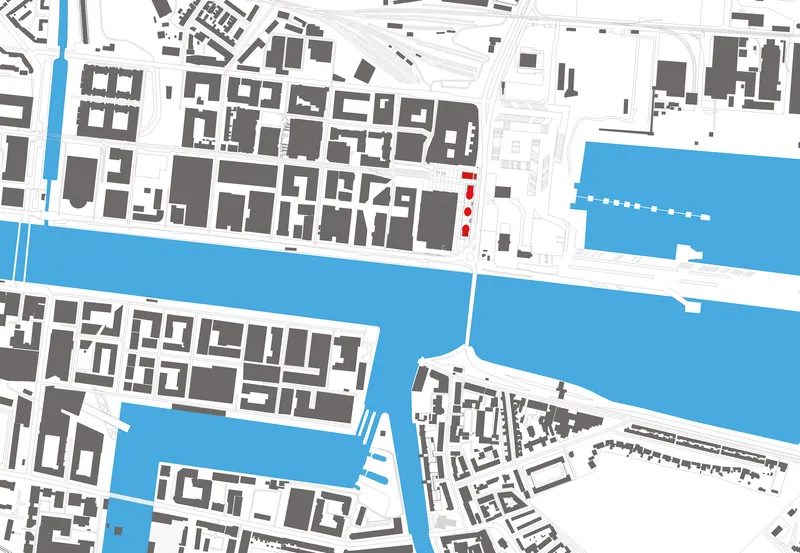

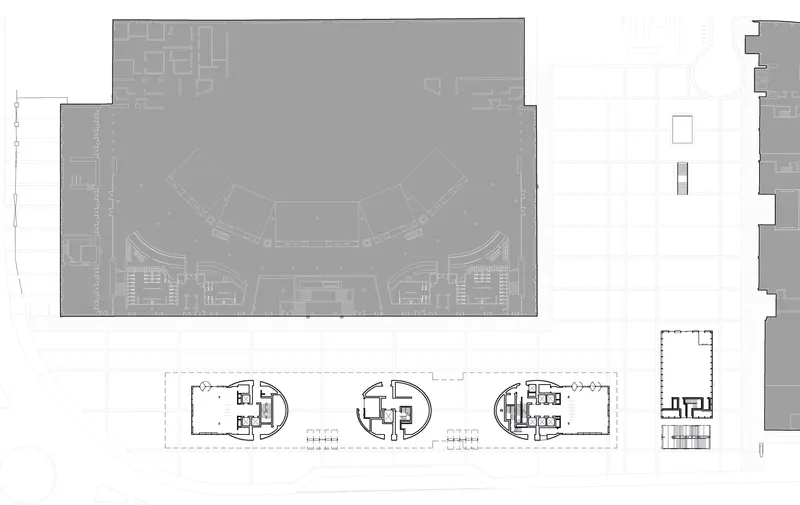
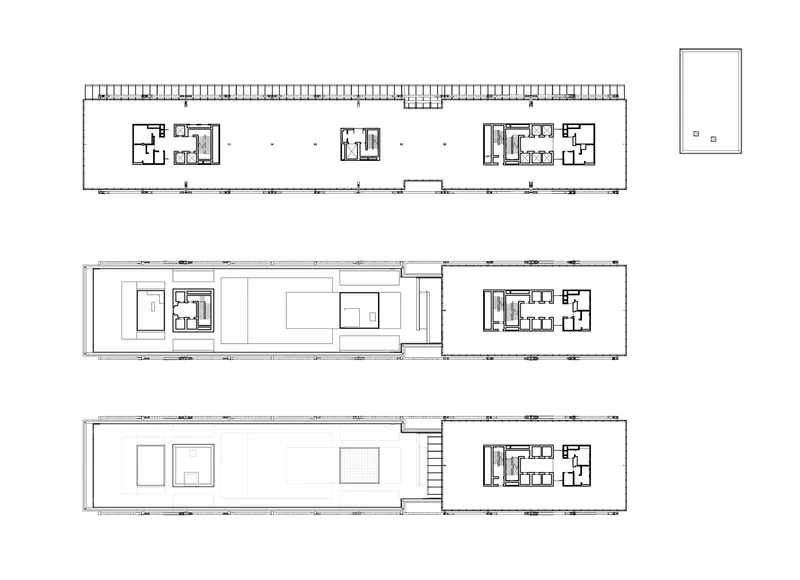
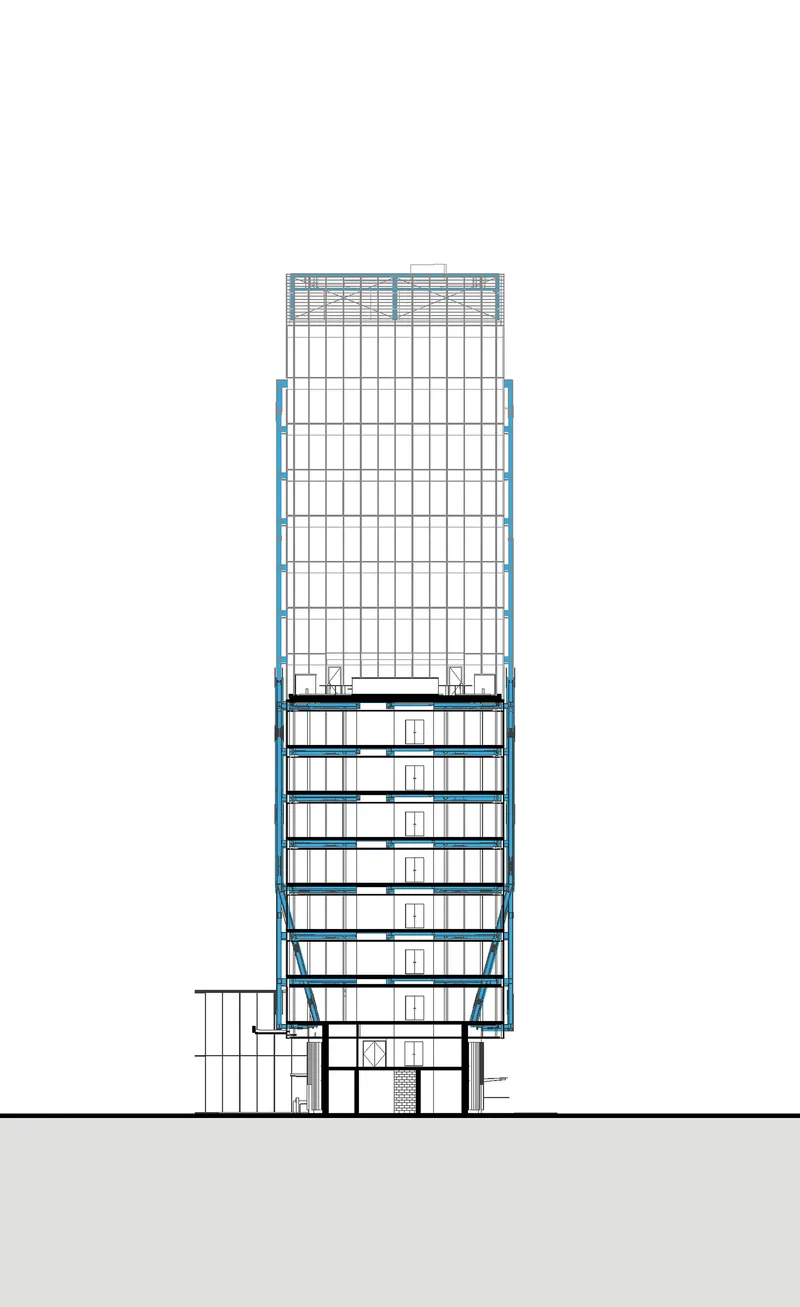
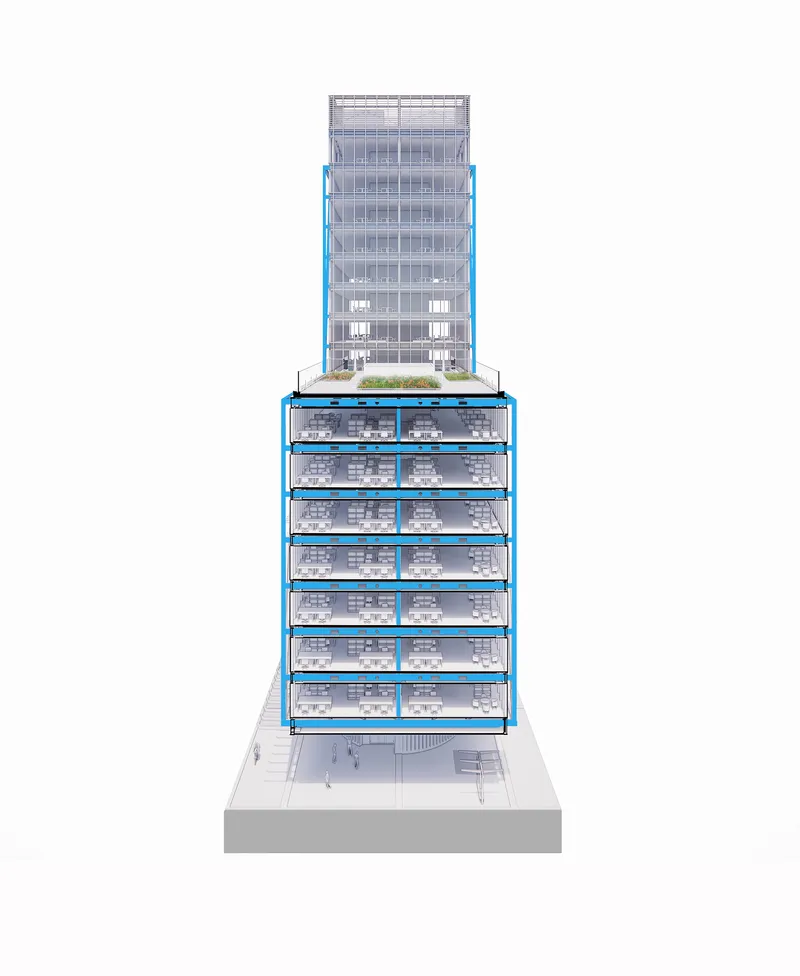

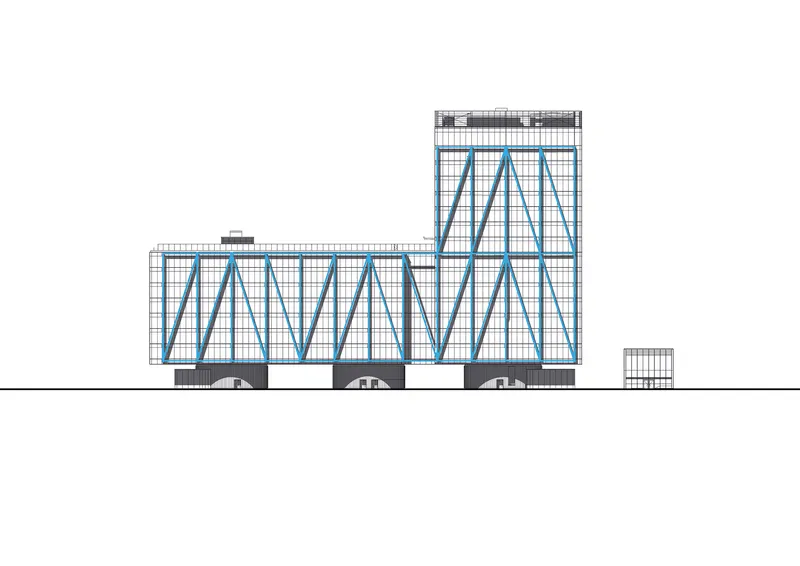


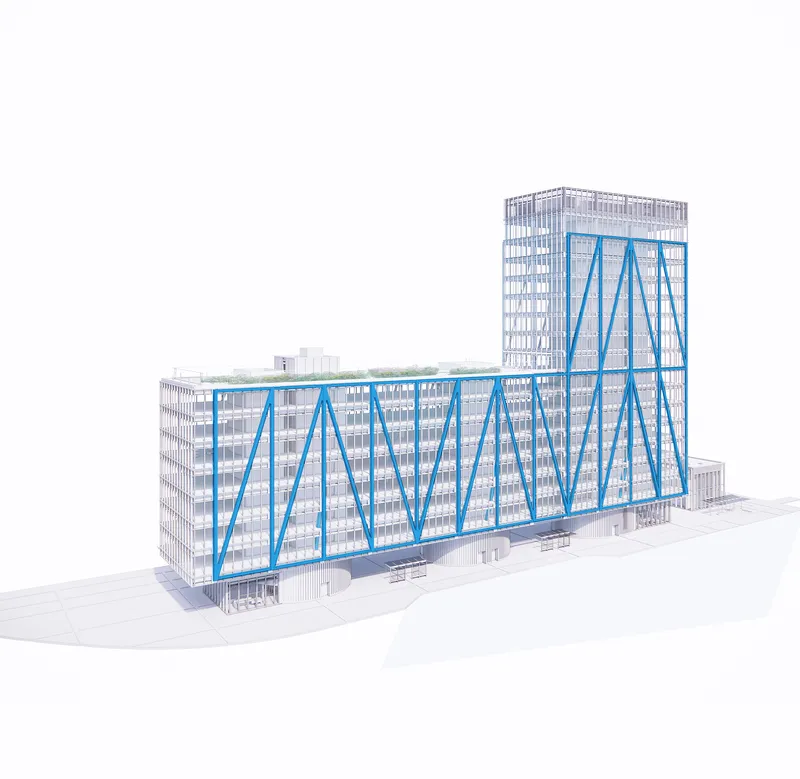
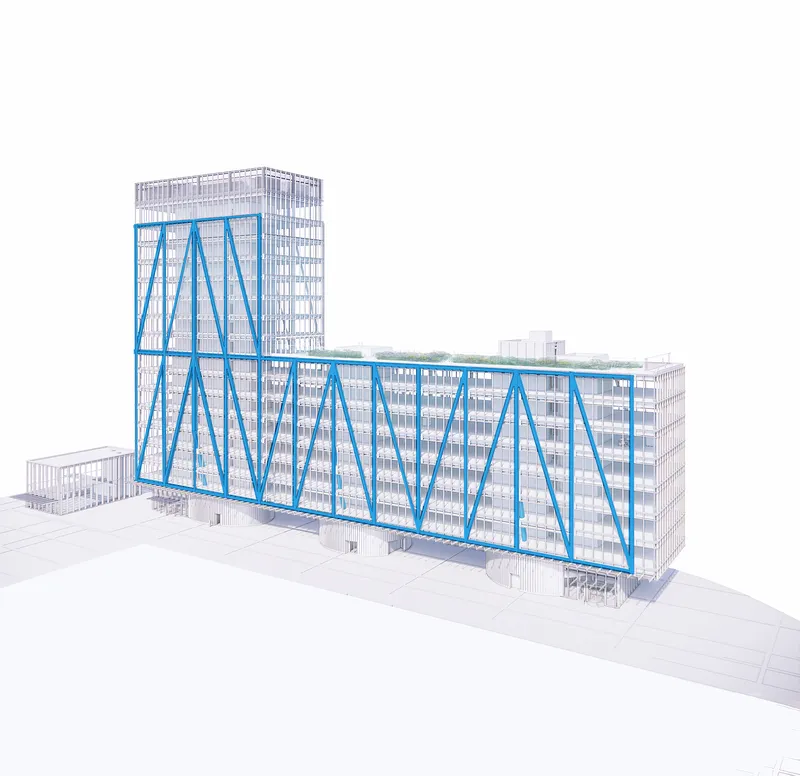
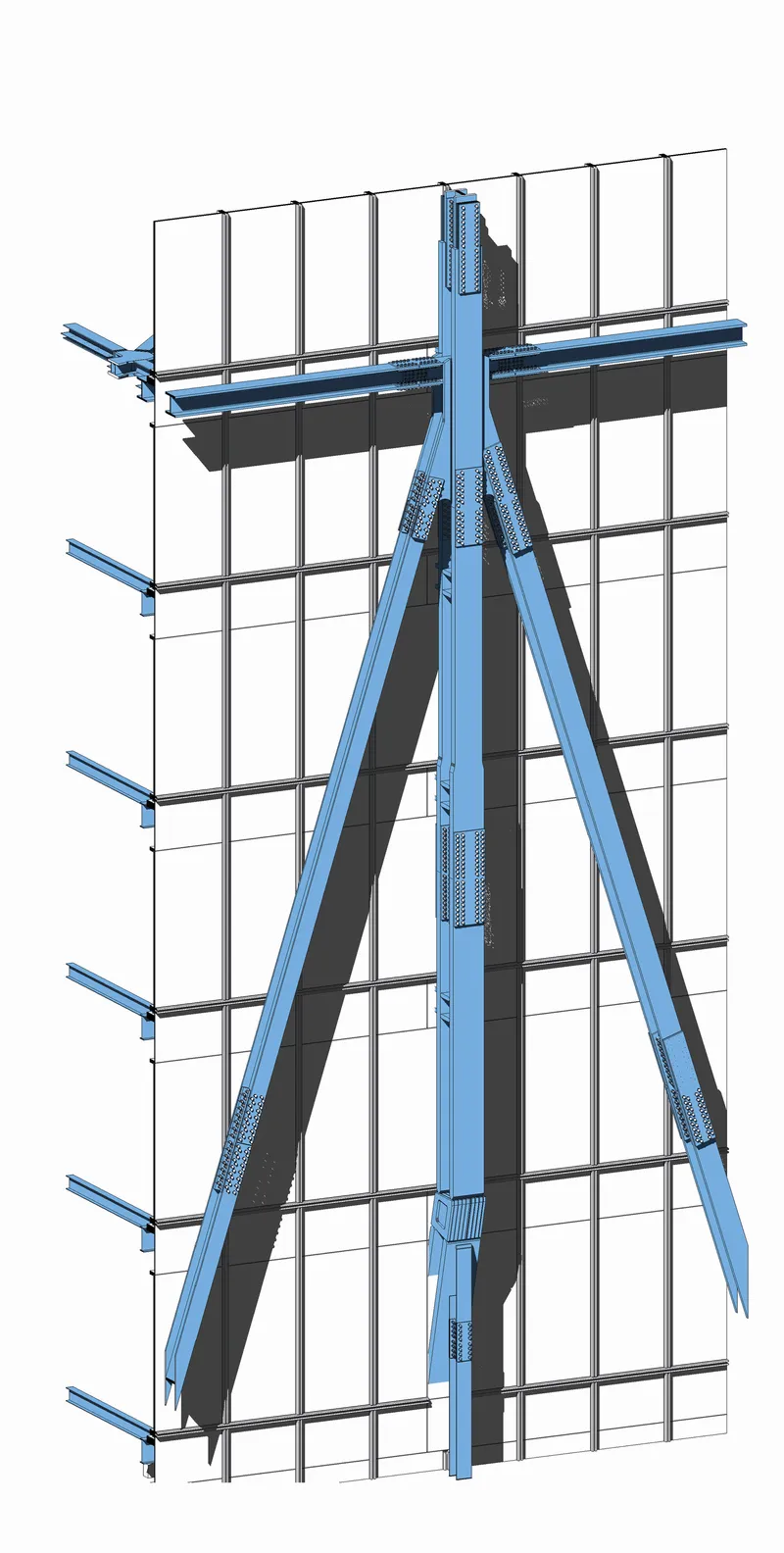


The drawings confirm what the photographs suggest: the structural system is the architecture. The site plan shows the narrow plot running parallel to the waterfront, with the building volume set back from the protected Point Depot frontage. Sections reveal how the mega trusses span the full height, bearing on only three column positions per side, while floor plates cantilever outward from the cores. The elevations document the diagonal bracing pattern in its full zigzag extent, demonstrating how the rhythm shifts as the building steps from its lower southern end to its full 17-storey height at the north. The axonometric views, particularly those showing the three curved ground-floor lobby volumes tucked beneath the lifted mass, clarify the spatial generosity of the public realm strategy.
The floor plans reveal a discipline that commercial buildings rarely achieve. Three cores are distributed along the 112-meter length, each serving distinct zones and allowing the remainder of the plate to remain open. The typical floor is just 18 meters wide, ensuring that no desk is far from natural light or a panoramic view. The detail drawing of the bracing intersection shows the precision required where diagonal steel meets horizontal slab and unitised glazing, a junction that is repeated hundreds of times across the facade and must perform structurally, thermally, and visually at once.
Why This Project Matters
The Exo Building is that rare commercial project where the structural ambition is not a stunt. Lifting the volume off the ground, exposing the exoskeleton, and painting it the blue of dockside cranes are all moves that serve the urban and civic context as much as the workplace within. Shay Cleary Architects understood that a 20,784-square-meter office block on this particular site could either wall off the waterfront or become part of the city's connective tissue. They chose the latter, and the building delivers on the promise: permeable at ground level, structurally legible from every angle, and integrated into the docklands' industrial memory.
For a country where commercial office architecture has often defaulted to the anonymous, The Exo is a corrective. It proves that a speculative workplace can have a specific identity rooted in place, that structural expression and environmental performance can coexist (LEED V3 Platinum, before completion), and that the most generous thing a large building can do is get out of the way at ground level. It is Ireland's tallest commercial office structure, but its most important dimension is the seven meters of clear air between its belly and the pavement.
The Exo Building by Shay Cleary Architects, Dublin, Ireland. 20,784 m². Completed 2022. Photography by Jamie Hackett Photography.
About the Studio
Share Your Own Work on uni.xyz
If projects like this are the kind of work you want to make, uni.xyz is a place to publish your own, find collaborators, and enter design competitions.


Popular Articles
Popular articles from the community


Opera on the Sea: Driftwood Logic Shapes a Timber Opera House on Estonia's Coast
Trevor Orgill's opera house translates the entangled drift of floating timber into a civic building where wood, water, and music converge.
Extended Shell: Retrofitting Kolkata's Balconies as Living Urban Thresholds
A modular retrofit system recovers the social and environmental intelligence of Kolkata's historic verandas for contemporary Park Street residents.

Opera by the Sea Estonia: Three Shells Dissolving Architecture into Tallinn's Coastline
A winning opera house proposal replaces monumental form with interconnected shells that blur the boundary between building, park and Baltic Sea.

Faces of the Soviet Avant-Garde: Turning Moscow's Street Names into an Open-Air Museum
A network of sculptural installations across a Moscow residential district transforms forgotten architect names into spatial encounters with cultural memor

Similar Reads
You might also enjoy these articles

Pixel Gardens: One Repeated Module Stacked Into a Terraced Social Housing Tower for Famagusta
Salem Bader's shortlisted housing tower builds a vertical neighbourhood from one repeated module, offsetting units to carve terraces, light and air.

Bao Huynh Watercolor Atelier: A Serene Art Retreat in Hội An
Bao Huynh Watercolor Atelier in Hội An blends multifunctional art spaces, sustainable design, local materials, and family-friendly living in a serene environment.

Atelier Macri Concept Store Interior Design by CASE-REAL
Atelier Macri store features a "ko" counter, walnut wood details, cork displays, blending retail, gallery, and seamless customer experiences.

Manuel Vargas Izquierdo Stadium and High-Performance Sports Center: Architectural Excellence in Jalpa de Méndez
The Manuel Vargas Izquierdo Stadium blends sustainable design, inclusive sports facilities, and cultural-inspired architecture, revitalizing Jalpa de Méndez’s public spaces.

Comments (0)
Please login or sign up to add comments
No comments yet. Be the first to comment!