

SHELLTER: A Spiral Seashell Habitat That Turns the Pacific Ocean Into Life Support
A shortlisted EHC - Pacific entry that splits a pressure-resistant cylinder into spiraling floors, drawing energy, food and oxygen from Carnegie Ridge.


Most underwater habitat proposals treat the ocean as an enemy to be held back by steel and pumps. SHELLTER starts from the opposite assumption: the sea can serve as the habitat's infrastructure, supplying energy, food, water and oxygen. The project wraps that idea in the most familiar marine form there is, the seashell. It then uses the shell's spiral as a working device that organises structure, circulation and daily life, rather than as decoration.
Designed by Mauricio H. de la Cueva, Daniela Miyoko Yesaki Serrato, Sofía Contreras Sánchez and Francisco Canche, SHELLTER was a shortlisted entry in EHC - Pacific. The team sited their modular dwelling near Carnegie Ridge, the tectonic extension that runs between the Galápagos Islands and Ecuador. The site offers climatic stability, dense marine biodiversity, strong equatorial sunlight and access to hydrothermal activity. Each of these conditions becomes an active input to the design, and none of them is just background scenery.
A Moored Spiral That Reads as Native to the Seabed
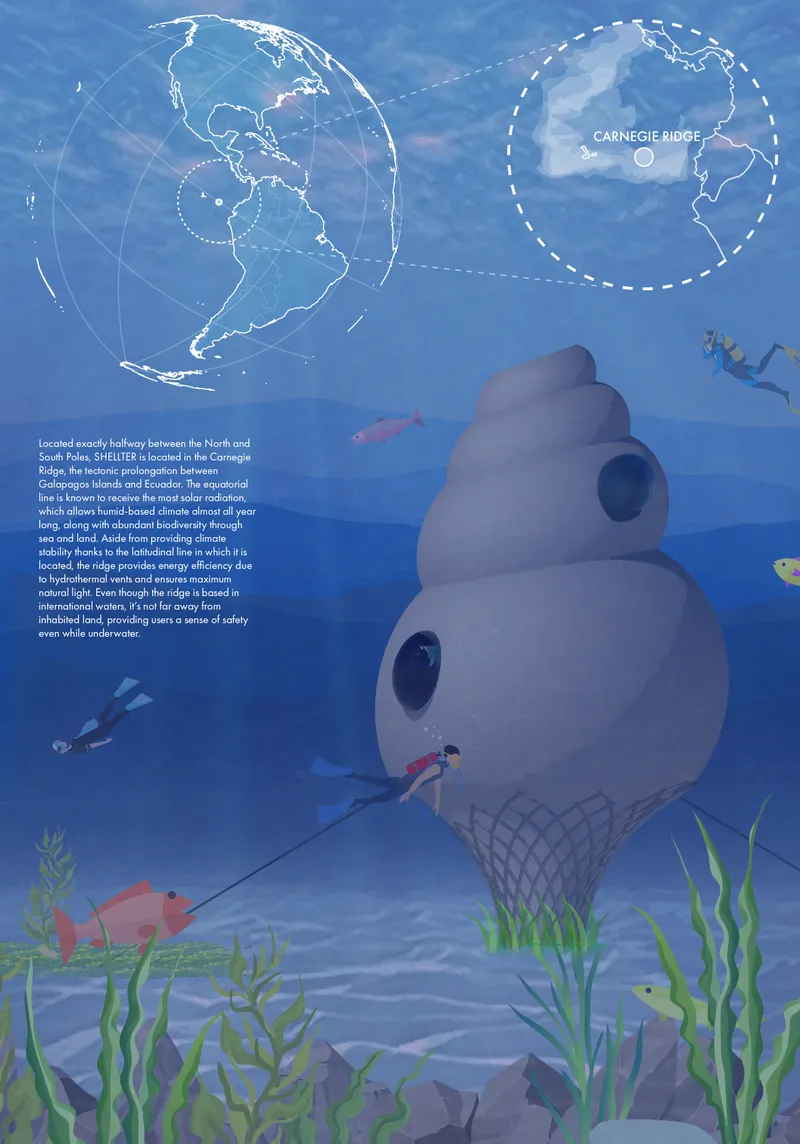
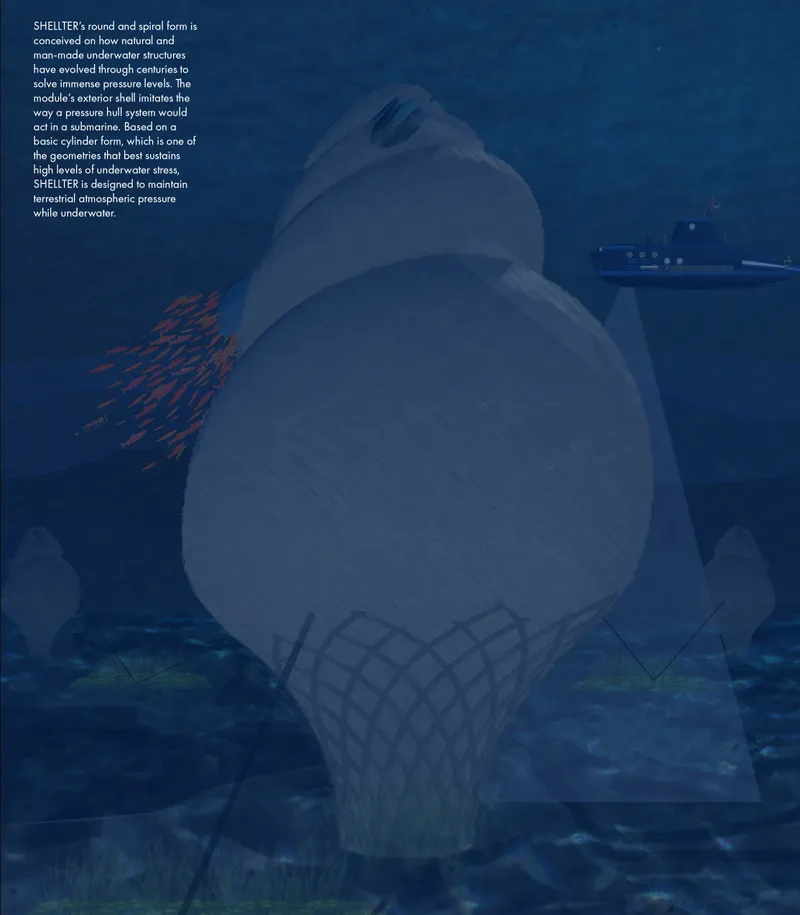
The opening illustrations do important persuasive work. In the first, the spiral module sits tethered to the seabed among kelp, fish and a passing diver, lit by sunlight filtering down from above. In the second, the scene drops into dimmer water and shows the rounded hull and netted base, with a submarine and a school of red fish nearby. Seen together, the two images present the habitat as part of the ecosystem rather than a foreign object dropped into it. The shell geometry carries much of that argument, because its curves borrow the visual language of the organisms around it.
The team presents Carnegie Ridge's remoteness as protection rather than isolation, and this is one of the proposal's sharper reframings. Distance from inhabited land becomes a source of safety and self-sufficiency. In these images the ocean stops being merely the site and becomes, in the designers' words, the life-support infrastructure.
From Pressure Cylinder to Stacked, Lobed Section
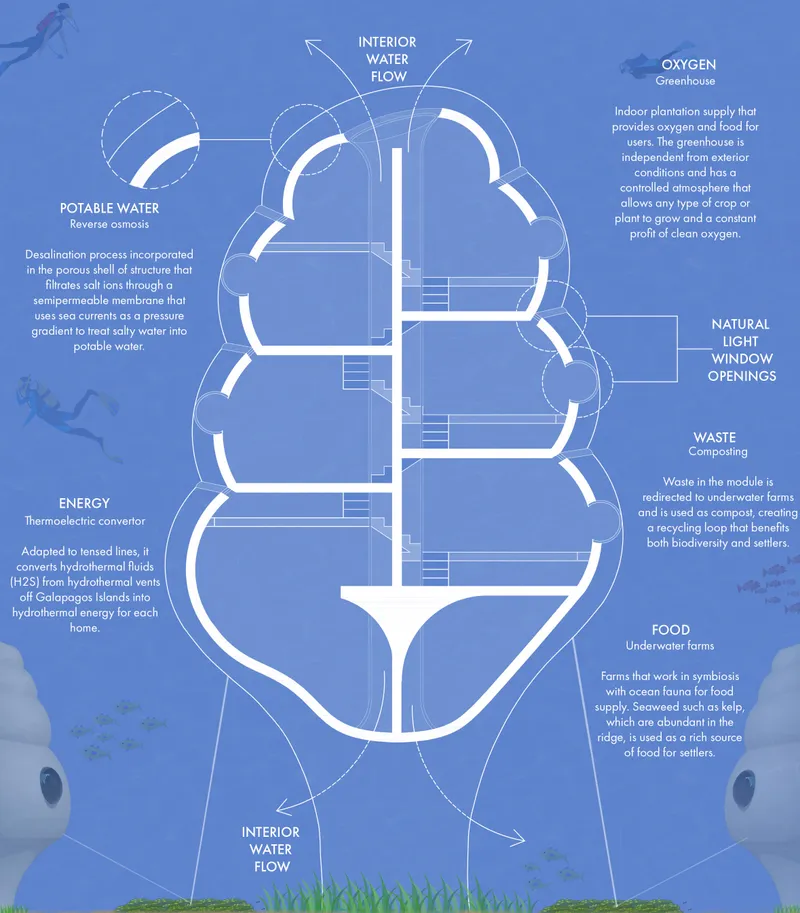
The section reveals the logic underneath the organic silhouette. SHELLTER begins as a basic cylinder, one of the most effective forms for resisting underwater pressure. The team divides this cylinder into levels, reduces it in section, and modifies it with platforms that improve privacy. The lobed profile is therefore what is left after a rational form has been carved and offset, not a shell shape traced from nature. A central stair core ties the floors together. Round windows are positioned to bring controlled natural light into the interior, and labeled water, energy and food systems sit within the same drawing.
The interior works as a vertical sequence of atmospheres for live, work and play. Lower areas hold circulation, gathering and more active shared functions, and each floor above shifts the balance between social interaction, privacy and connection to the sea. The spiral encourages movement and physical activity, which matters in a sealed environment where residents could easily become sedentary. It also stages gradual transitions between work, social life, rest and contemplation, avoiding the flat, mechanical feel of a submarine corridor.
The Porthole as the Point of Contact
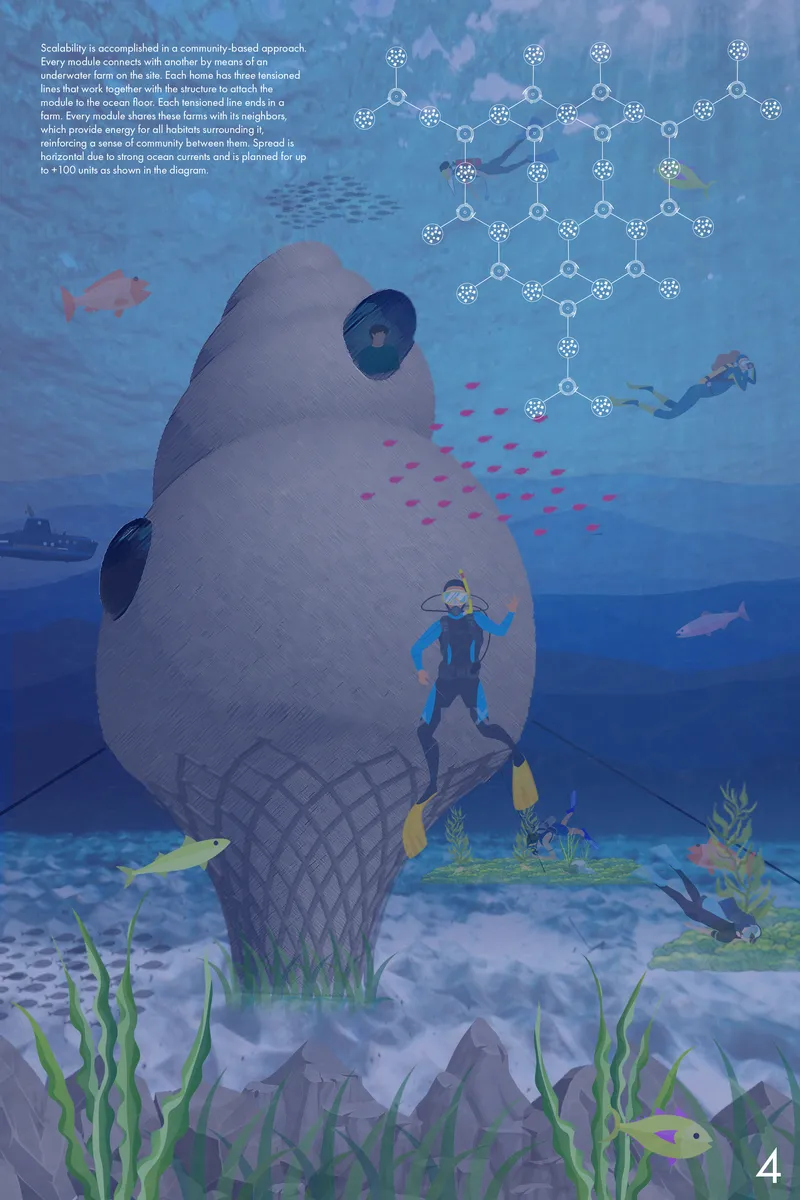
The final illustration narrows to the human scale: a diver beside the module's porthole, fish drifting past, and a molecular lattice diagram floating above. The porthole is where SHELLTER's ambitions meet the occupant. Through these openings the project's promise of wellbeing becomes concrete as daylight and a direct view of the reef. By setting the lattice diagram over the scene, the drawing signals that the habitat's material and environmental thinking extends down to a finer scale than the dwelling alone.
The team's systems thinking supports the image. Equatorial solar exposure, hydrothermal vents offering energy through thermal conversion, and surrounding biodiversity enabling symbiotic food production all point toward a community that relies on its immediate context rather than imported supply chains.
Why This Project Matters
SHELLTER does not solve underwater habitation, and as a speculative competition entry it does not need to. What it does well is align form, site and programme around one coherent idea. The pressure-resistant cylinder, the spiraling sequence of floors and the reliance on Carnegie Ridge's sun, vents and biodiversity all point in the same direction. That consistency is rarer in speculative work than it should be.
The larger question the team poses is whether sustainable architecture can move beyond land and become a framework for long-term life underwater. By treating the ocean as habitable ecological territory rather than a hostile frontier, SHELLTER makes a case worth taking seriously: the most resilient habitats may be the ones that let their surroundings do the heavy lifting, rather than the ones that seal themselves off most completely.
View the Full Project
About the Designers
Designers: Mauricio H. de la Cueva, Daniela Miyoko Yesaki Serrato, Sofía Contreras Sánchez, Francisco Canche
Enter a Design Competition on uni.xyz
uni.xyz runs architecture and design competitions year-round that reward proposals with spatial conviction and real site intelligence.
Project credits: SHELLTER by Mauricio H. de la Cueva, Daniela Miyoko Yesaki Serrato, Sofía Contreras Sánchez, Francisco Canche EHC - Pacific (uni.xyz).


Popular Articles
Popular articles from the community


Cube Design Draws an Ecological Corridor Between Two Shenzhen Hills with the Nankai Building
Beside Shenzhen's container docks, the Nankai Building pairs stacked balconies with a climbing green screen to connect two hillsides across its height.

GROUP A Strips a 1969 Rotterdam Harbor Headquarters to Its Frame and Wraps It in Timber Louvers
In Rotterdam's M4H harbor district, Ferro Offices reuses a 1969 frame, adds one timber storey and reaches BREEAM-NL Outstanding.

David Macias Steps a Doorless Stone and Plaster House Down a Tropical Colombian Hillside
In the humid hills of Colombia, Threshold House replaces the front door with an open void and terraces its 850 m² down the slope instead of fighting it.

Juan García Correa, John González and Claudia Rueda Sink a Circular Amphitheater into a Manizales Engineering Building
On the La Nubia campus in Manizales, Colombia, the S1 Building folds labs and offices into a hillside of ramped lawns that double as a campus route.

Similar Reads
You might also enjoy these articles
Healing Façade: A Modular Chapel System That Restores Ethiopia's Sacred Forests
Winner of the Eco-Chapel competition, this circular timber façade collects water from air to rebuild soil and reforest degraded Ethiopian landscapes.
Kaffeebühnen: Where Coffee Shop Architecture Becomes a Civic Stage in Vienna
A linear sequence of timber boxes, transparent shells, and open yards turns the Viennese café tradition into a public performance space.
Eco Chapel: A Modular Forest Pavilion That Grows Like the Landscape It Protects
Hexagonal timber modules weave through existing trees, turning a chapel into a living system for prayer, education, and reforestation.


Urban Forest: A Vertical Ecosystem for 5,000 Workers in Singapore's Changi Business Park
Radially stacked pods and layered green decks turn a 7-acre plot into 47 acres of ecological workspace projected for 2040.


Comments (0)
Please login or sign up to add comments
No comments yet. Be the first to comment!