

Shenzhen Middle School by Huayi Design: A High-Density Campus That Redefines Learning in Shenzhen
A high-density, multi-level campus integrating terraced libraries, layered functions, and interactive spaces, redefining urban education in Shenzhen.


Architects: Huayi Design

Reimagining Education Infrastructure in Shenzhen
Amid Shenzhen’s rapid urban development, Huayi Design undertook the ambitious task of transforming the junior high school campus of Shenzhen Middle School—one of the city’s most prestigious educational institutions—into a vibrant, high-density learning environment. Completed in 2022, this project aligns with the city's strategic goal of enhancing the quality of basic education by building modern, innovative, and people-centered schools.
This comprehensive demolition and expansion effort serves not only to increase capacity but to redefine what a dynamic and ecologically sensitive urban campus can look like. The result is a state-of-the-art educational facility that blends architectural innovation with pedagogical flexibility.
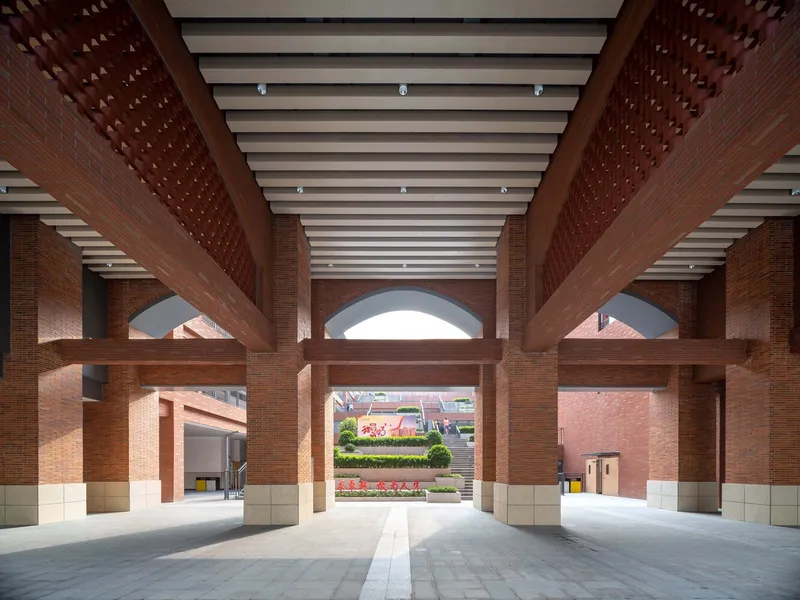
Project Challenges: Dense Site, Limited Land, and Topographic Constraints
The 63,000-square-meter site came with a series of complex design challenges:
- High plot ratio and limited footprint
- 4-meter elevation difference within the plot
- A centrally located retained structure, complicating site planning
- Half of the site dedicated to a sports field, restricting flexible circulation
- Heavy traffic on Baili South Road affecting pick-up/drop-off logistics
Huayi Design responded with a high-concept strategy that combines vertical spatial organization, integrated circulation, and multifunctional zones—effectively overcoming the spatial and urban constraints while delivering a future-oriented academic environment.
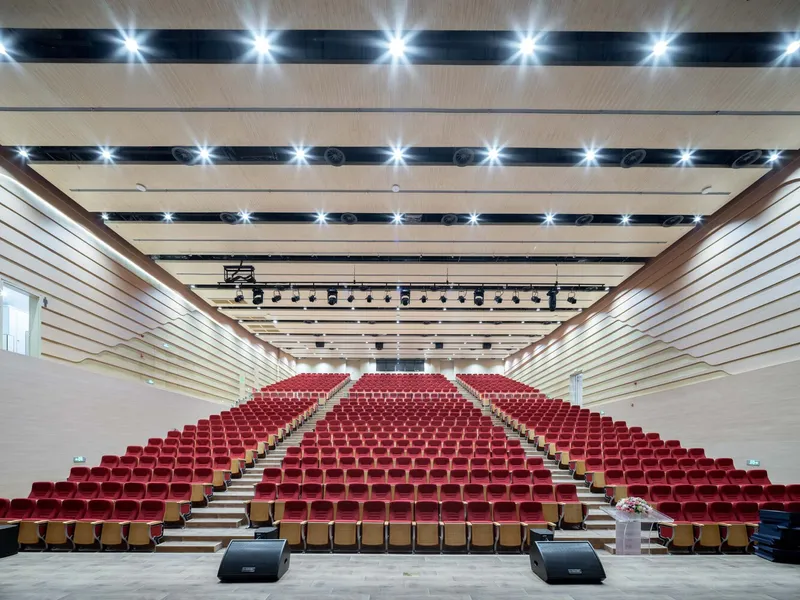
Design Concept: Multiple First Floors, Superimposed Programs, and the "Knowledge Ladder"
The architectural solution is defined by three interlocking design principles:
- Multiple First-Floor Connections
- Superposition of Functions
- The Knowledge Ladder
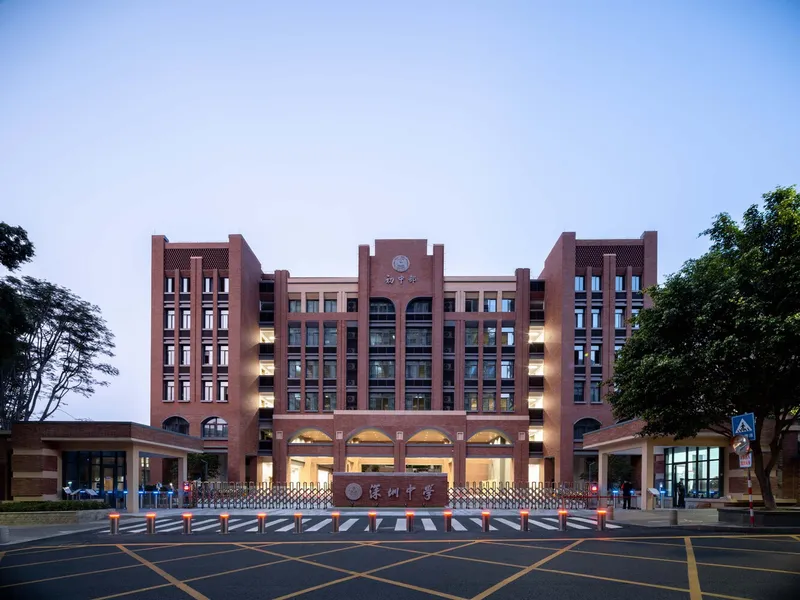
1. Multiple First-Floor Connections
Leveraging the site’s elevation change, the design creates multiple ground-level zones that connect vertically and horizontally across the campus. This terracing strategy enables the development of semi-outdoor gathering spaces, shaded interaction zones, and transitional areas that enhance ventilation, daylight, and social exchange.
A covered corridor network ensures seamless movement between the teaching building, comprehensive building, and sports zones. Notably, a subterranean parent pick-up/drop-off area eliminates surface-level congestion and improves campus security and accessibility during rush hours.

2. Superposition of Functions
To address spatial scarcity, Huayi Design vertically layers primary teaching functions with auxiliary facilities. The teaching and comprehensive buildings are designed as independent but interconnected volumes, with overhead floors and outdoor platforms forming bridges between them.
Features like the library, rooftop garden, and linking corridors serve both connective and pedagogical purposes—promoting flexibility, community, and cross-disciplinary engagement throughout the school day.

3. The Knowledge Ladder
At the heart of the design is the signature “Knowledge Ladder”, a stepped, multi-level library atrium that anchors the entire campus. Acting as both a spatial landmark and social hub, the cascading library tiers expand student access to reading areas, informal learning spaces, and collaborative zones across all floors.
Integrated with “floating boxes”—perch-like pods for rest, interaction, or reflection—the atrium becomes an active and ever-visible core of campus life. This spatial sequencing between "seeing and being seen" enhances passive engagement and intuitive movement across the academic zones.


Materiality and Architectural Expression
The new campus architecture retains visual continuity with the existing senior high school complex. The facade is articulated with a classic tripartite composition, updated using modern construction techniques and materials such as exposed brick, steel detailing, and high-performance glazing. These choices balance traditional scholastic imagery with contemporary sustainability and durability goals.

Completion and Impact
After two years of intensive construction, the Shenzhen Middle School junior high campus reopened in September 2022, just in time for students to celebrate a “new beginning” on their return to school. The upgraded facility supports a wide range of academic and extracurricular programs while positioning itself as a model of future-ready education infrastructure in China.




Popular Articles
Popular articles from the community

AL-JANNAH: Sustainable Architecture and Permaculture for Afghan Widows
AL-JANNAH uses sustainable architecture and permaculture to create resilient oasis of housing, learning, work and renewal for Afghan widows.

Conexión: Biophilic Design Reimagines High-Rise Living in Hong Kong
Conexión reimagines high-rise living in Hong Kong through biophilic design, green facades, shared spaces, daylight, water and nature within.

The Earth Pod: 3D Printed Homes for Resilient Refugee Communities
The Earth Pod reimagines refugee housing through 3D printed homes made from clay, combining resilience, self-sufficiency, and rapid shelter.

Co-life: Sustainable Architecture for Age-Friendly Community Living
Co-life reimagines sustainable architecture for seniors through courtyards, rammed earth, shared gardens, and spaces designed for belonging.


Similar Reads
You might also enjoy these articles


Hodi-Mandai Geram
Project Function: Preservation and revitalization of the Intangible heritage and socio-spatial identity of the Hodi by Housing, Cultural Memory Center, Sacred Grove, landscape, local tourism economy


Olio Towers: A Mid-Rise for Performers That Fuses Housing, Rehearsal, and Stage
Located blocks from Houston's Theater District, this modular tower stacks living units around a central performance atrium.

Oasis: Modular Green Housing Carved into Dhaka's Urban Fabric
A shortlisted Plugin Housing entry reclaims unauthorized settlements in Dhaka with stepped concrete volumes, green roofs, and ventilation-driven design.

Black Hole: A Floating Megastructure for the Post-Physical Era
Emiliano Mazzarotto envisions a spherical, self-scaling arena where e-sports, digital hotels, and holographic stadiums replace traditional public space.


Explore Educational Building Competitions
Discover active competitions in this discipline



Challenge to design public laboratory


Challenge to reimagine the Iron Throne


Photograph architecture without architects


Illustrate the lost glory of Angkor Wat - Render Challenge
Comments (0)
Please login or sign up to add comments
No comments yet. Be the first to comment!