

Simple Architecture Builds Rammed Earth Classrooms for Burmese Migrant Children on the Thai Border
In the border town of Mae Sot, a compact learning center made of local earth and timber gives displaced communities a place to grow.


Mae Sot sits at the edge of Thailand, pressed up against Myanmar. Since the military coup of February 2021, the town has absorbed wave after wave of Burmese refugees and migrant families. New Day School is a migrant learning center that serves these communities, and it needed more space. Simple Architecture, led by Jan Glasmeier, was tasked with designing 175 square meters of new classrooms on a tight budget, using local labor and materials. The result is a compact campus of rammed earth pavilions under corrugated metal roofs, built not just by professional workers but also by architecture students and schoolchildren who joined the construction as part of a hands-on scholarship program.
What makes these classrooms worth studying is how precisely they respond to their constraints. The project was constructed by 15 local workers alongside participants from Harrow International School Bangkok and King Mongkut's Institute of Technology Ladkrabang, turning the build itself into an educational act. The architecture is direct: rammed earth walls made from site-adjacent soil, timber post-and-beam framing, and metal sheet roofing. None of these materials are exotic. But the way they are assembled, with curving walls, circular brass portholes, and generous covered thresholds, turns economy into generosity. The building feels considered, not compromised.
Earth Walls as Identity

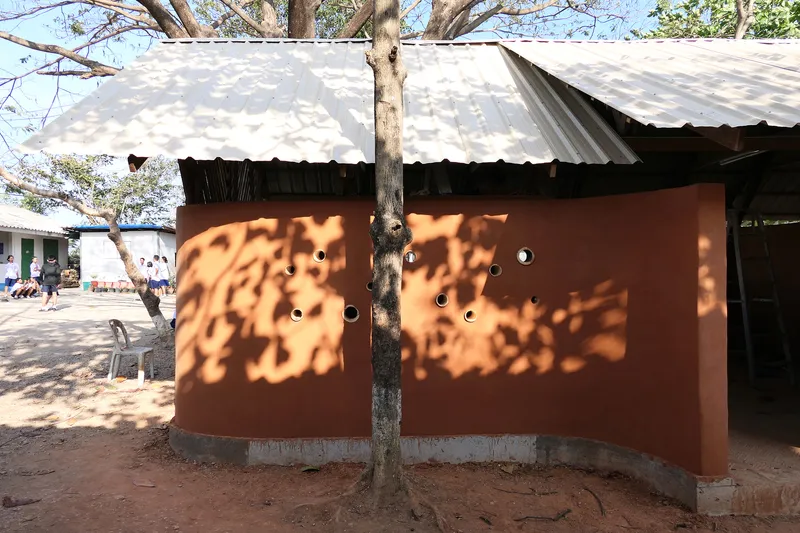
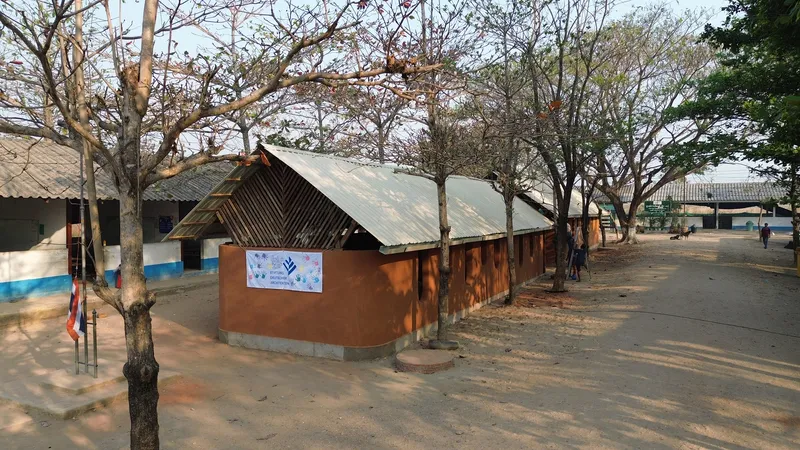
The rammed earth walls are the dominant visual and structural gesture. Their red-ochre color comes directly from the local soil, and their surface carries the horizontal striations of the formwork, giving each panel a geological quality. The walls curve in plan, softening what could have been a rigid box into something more organic and inviting. Circular perforations puncture the earth at various heights, letting light and air pass through while maintaining privacy and enclosure.
These openings are not decorative afterthoughts. In a climate that oscillates between intense dry heat and monsoon humidity, cross-ventilation is essential. The circular apertures, some fitted with brass porthole frames, create a playful rhythm across the facade while performing real environmental work. Dappled shadows from surrounding trees land on the earth surface and shift through the day, making the walls feel alive rather than static.
A Facade That Speaks to Children


The front elevation tells you immediately that this building is for young people. Two trees frame a central doorway, and the wall on either side is punched with brass-ringed portholes at varying heights, some at adult eye level, others at a child's. The composition is symmetrical but loose, almost nautical. Children running past the facade in midday sun turn the architecture into a backdrop for daily life, which is exactly the right relationship for a school.
There is a temptation in humanitarian architecture to either over-design, treating the project as a portfolio piece, or under-design, treating it as mere shelter. Simple Architecture avoids both traps. The facade has personality without pretension. It gives the school a recognizable face in a town where migrant institutions often lack visible presence.
Timber Structure and Interior Atmosphere
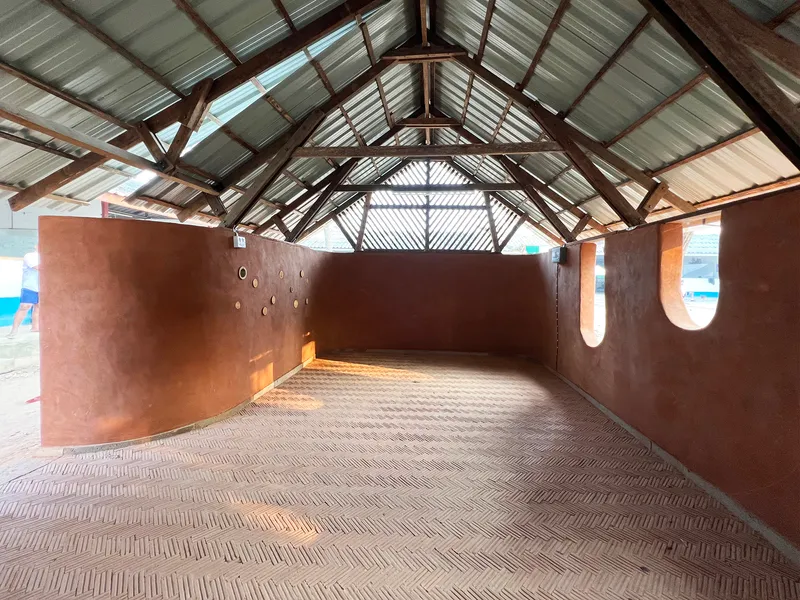


Inside, the corrugated metal roof is fully exposed, supported by a clean timber truss system. The gabled profile creates a tall central volume that pulls hot air upward and away from the occupants below. Herringbone brick flooring adds thermal mass and a sense of craft to the ground plane. The palette is restrained: warm earth tones on the walls, natural wood overhead, grey metal above. Nothing competes for attention.
The classrooms themselves are straightforward. Students sit at desks beneath the sloped ceiling, with enough headroom and airflow to make the space comfortable during hot months. A timber bench set against a red ochre wall with circular apertures doubles as a social perch, a place to sit between classes. These small spatial decisions, the bench at the right height, the porthole at the right position, reveal a design process attentive to how children actually use space.
Thresholds and Covered Ground


The transition from outside to inside is handled through a series of covered passageways with exposed timber rafters and potted palms at the edges. These thresholds are generous for a building of this size, suggesting that the architects understood how much time in a Thai school is spent outdoors or in the shade rather than sealed inside a room. The covered entry pavilion frames a view through the compound, giving the small campus a sense of depth and sequence.
Students gather at marked entries beneath the sloping roof, grade numbers painted on posts or walls. The informality of the arrival sequence, no gates, no security theater, just shade and a number, reflects the school's ethos. It is a place that welcomes rather than sorts.
Courtyard and Landscape


The sandy courtyard functions as the school's main outdoor room. Bare deciduous trees provide seasonal canopy, and the rammed earth pavilions sit loosely within this landscape rather than dominating it. Students in red uniforms animate the open ground, and the dry-season photographs show a terrain that is dusty and unmanicured, honest about the climate and context. There is no artificial turf here, no Instagram-ready courtyard garden. Just ground, trees, and buildings arranged to create a place.
Visitors and staff gather informally around the edges, suggesting that the courtyard works equally well for assembly, play, and socializing. For a school serving displaced families, this kind of shared outdoor space is not a luxury. It is essential infrastructure.
Plans and Drawings


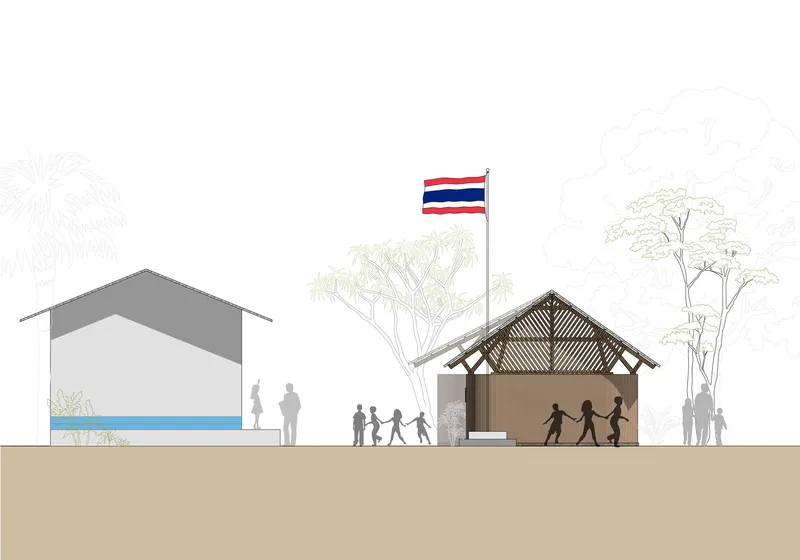


The site plan reveals three connected classroom pavilions arranged in a loose linear sequence, their curved edges softening the overall footprint. Trees are dispersed across the property, integrated into the plan rather than pushed to the perimeter. The floor plan confirms the simplicity of the layout: each pavilion is essentially one room, with circulation handled through the covered passageways between them.
The section drawing exposes the elegant logic of the gabled roof structure: timber trusses span the full width, with no interior columns to obstruct the teaching space. The exploded axonometric is particularly revealing, showing how the building breaks down into discrete layers: a stone and concrete foundation, rammed earth walls, timber framing, and corrugated metal cladding. Each layer uses a different material system, and each could be built by a different skill set, which matters enormously when your construction crew includes architecture students on their first build.
Why This Project Matters
The most instructive thing about New Day School's classrooms is the alignment between process and product. A building made by students, refugees, and local workers looks like what it is: handmade, specific, grounded in its place. The rammed earth carries the labor of its construction in its surface. The timber trusses are sized for what local mills can produce. The corrugated metal is the cheapest available roof material in Southeast Asia. Nothing here is imported to make a point. Everything is sourced to solve a problem.
Simple Architecture demonstrates that working within severe constraints does not require aesthetic surrender. The circular portholes, the curving walls, the herringbone brick: these are design moves that cost almost nothing extra but transform the experience of the space. In a context where migrant children are often taught in repurposed sheds or under tarps, a building that takes their learning environment seriously is itself a political statement. Architecture cannot fix displacement, but it can insist that displaced people deserve real rooms, real light, and real care in how their spaces are made.
Classrooms for New Day School, designed by Simple Architecture (Jan Glasmeier), Tha Sai Luat (Mae Sot), Thailand. 175 m², completed 2024. Photography by Oliver Giebels, Isabel Goertz, and Alessandra Esposito.
About the Studio
Share Your Own Work on uni.xyz
If projects like this are the kind of work you want to make, uni.xyz is a place to publish your own, find collaborators, and enter design competitions.


Popular Articles
Popular articles from the community


Extended Shell: Retrofitting Kolkata's Balconies as Living Urban Thresholds
A modular retrofit system recovers the social and environmental intelligence of Kolkata's historic verandas for contemporary Park Street residents.

Singing Woman: Contemporary Architecture Inspired by Estonia’s Voice and the Sea
Singing Woman turns Estonia’s song culture into flowing opera house architecture, blending public life, landscape, sea, and national memory.

The Amber Palace Opera: A Geological Fiction Surfaces on Tallinn's Baltic Waterfront
Pierre Brillard reimagines a Baltic legend as a public landscape, opera house, and waterfront promenade rooted in Tallinn's coastal identity.

Cloaked Colonization: A Mobile Underwater Habitat That Moves Like a Fish
Micah Abaya's shortlisted EHC Pacific entry reimagines ocean settlement as a dispersed network of self-sustaining architectural organisms.

Similar Reads
You might also enjoy these articles

Bao Huynh Watercolor Atelier: A Serene Art Retreat in Hội An
Bao Huynh Watercolor Atelier in Hội An blends multifunctional art spaces, sustainable design, local materials, and family-friendly living in a serene environment.

Atelier Macri Concept Store Interior Design by CASE-REAL
Atelier Macri store features a "ko" counter, walnut wood details, cork displays, blending retail, gallery, and seamless customer experiences.

Manuel Vargas Izquierdo Stadium and High-Performance Sports Center: Architectural Excellence in Jalpa de Méndez
The Manuel Vargas Izquierdo Stadium blends sustainable design, inclusive sports facilities, and cultural-inspired architecture, revitalizing Jalpa de Méndez’s public spaces.

KAKR Buluh Awar Hall: Revitalizing Community and Ecology Through Bamboo Architecture
Community built bamboo hall revitalizes Buluh Awar village, empowering youth, restoring ecology, celebrating vernacular craftsmanship through sustainable architecture and culture.

Explore Classroom Competitions
Discover active competitions in this discipline

Challenge to design public laboratory

Design challenge to reuse E-waste
Comments (0)
Please login or sign up to add comments
No comments yet. Be the first to comment!