
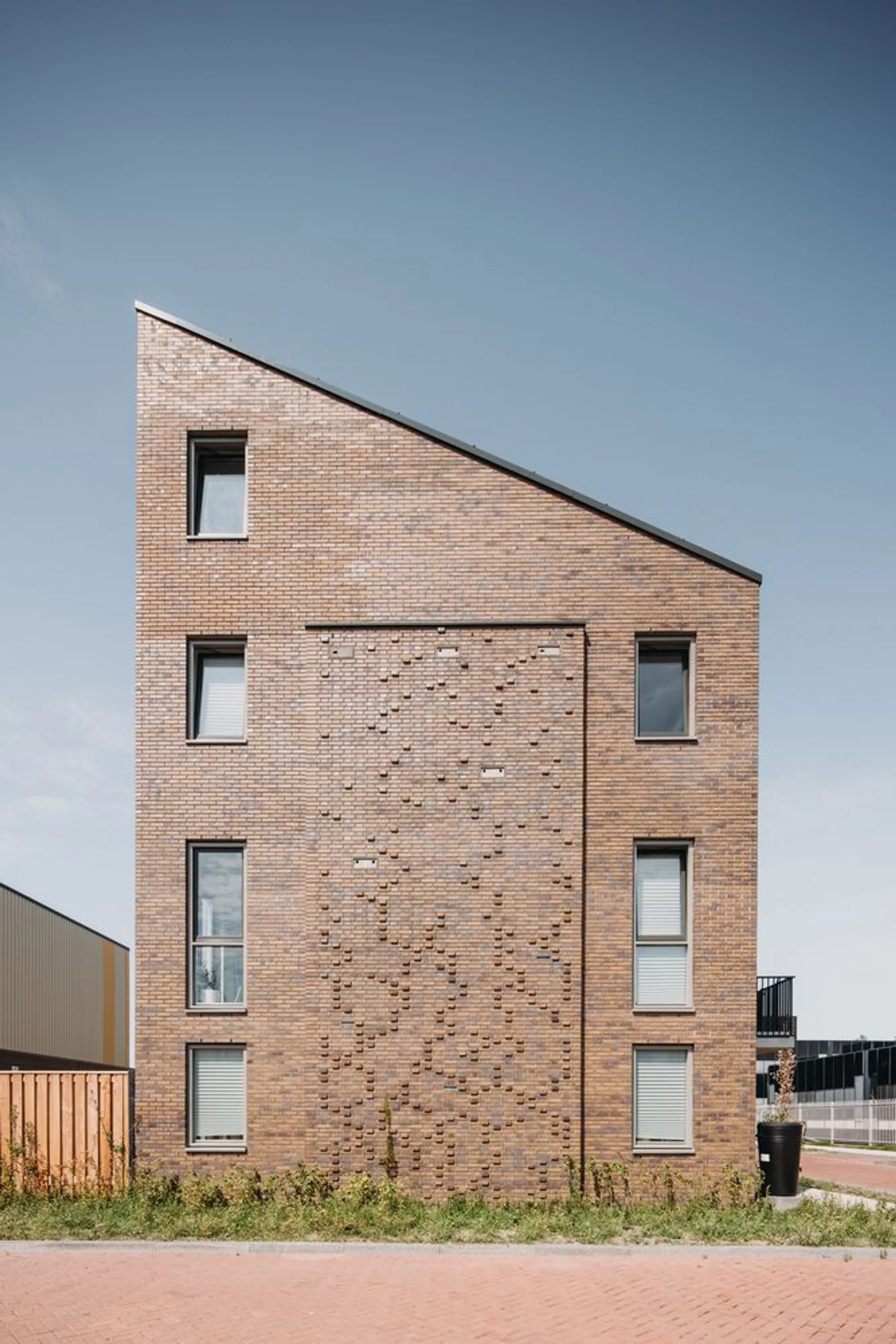
vanOmmeren-architecten Transforms a Haarlem Slaughterhouse District into a Brick Neighborhood
On the site of a former abattoir in Haarlem, variegated brickwork and careful urban design stitch new housing into the city's industrial memory.


Former industrial sites carry a specific weight. They are large enough to reshape a neighborhood, loaded with material history, and politically fraught because every stakeholder wants something different from the blank canvas they seem to offer. At the Slachthuisdistrict in Haarlem, vanOmmeren-architecten chose not to erase that weight but to channel it, designing a residential development that takes its cues from the old slaughterhouse precinct's robust brick character and the city's broader tradition of dense, livable urban fabric.
What makes this project worth studying is the discipline of its restraint. The architecture does not shout. Instead, it relies on a limited palette of variegated brick, green steel, and timber to create a neighborhood that feels both new and deeply embedded in its context. The result is a series of housing blocks organized around courtyards, pedestrian lanes, and mature trees, a layout that prioritizes collective outdoor life over the typical developer formula of maximum footprint and minimum shared space.
Brick as Connective Tissue
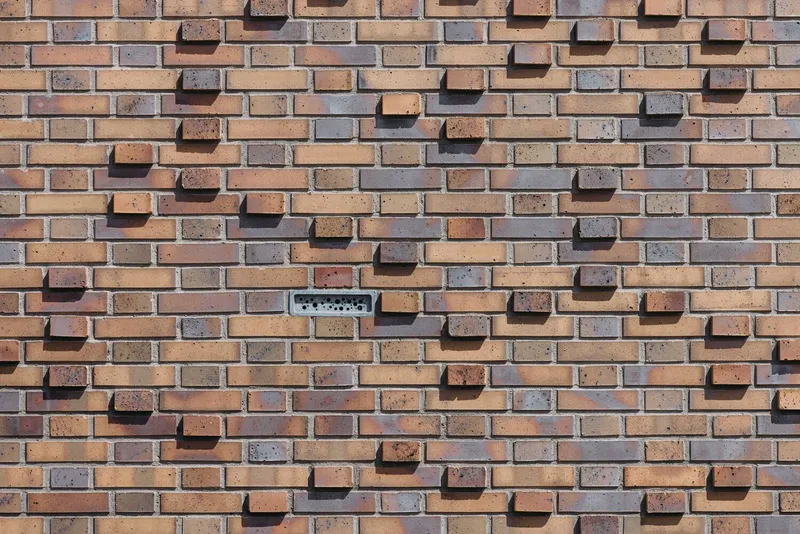


The brick here is not decorative wallpaper. The variegated mix of orange, grey, and burnt tones shifts across each facade, giving walls an almost geological depth. Up close, the masonry reads as tactile and specific. At distance, the muted variation ties the different building volumes together into a cohesive neighborhood without making them identical. The gable ends, with their irregular window patterns and sloped rooflines, nod directly to the pitched silhouettes common across older Haarlem districts.
The choice to commit so fully to brick is both aesthetic and strategic. It connects the new buildings to the preserved brick water tower visible at the end of the main pedestrian axis, creating a material continuity between the industrial past and the residential present. That kind of thoughtfulness, linking old and new through material rather than pastiche, is what separates genuine contextual design from its many imitators.
Courtyards and the Choreography of Shared Ground
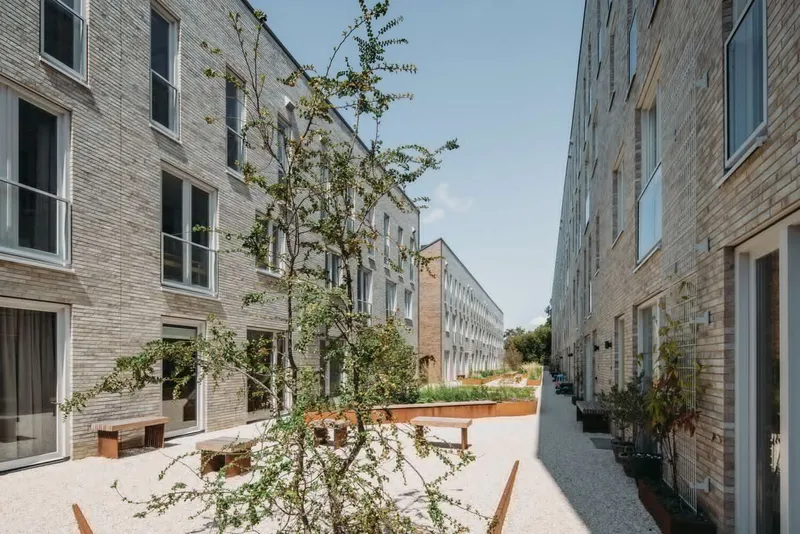
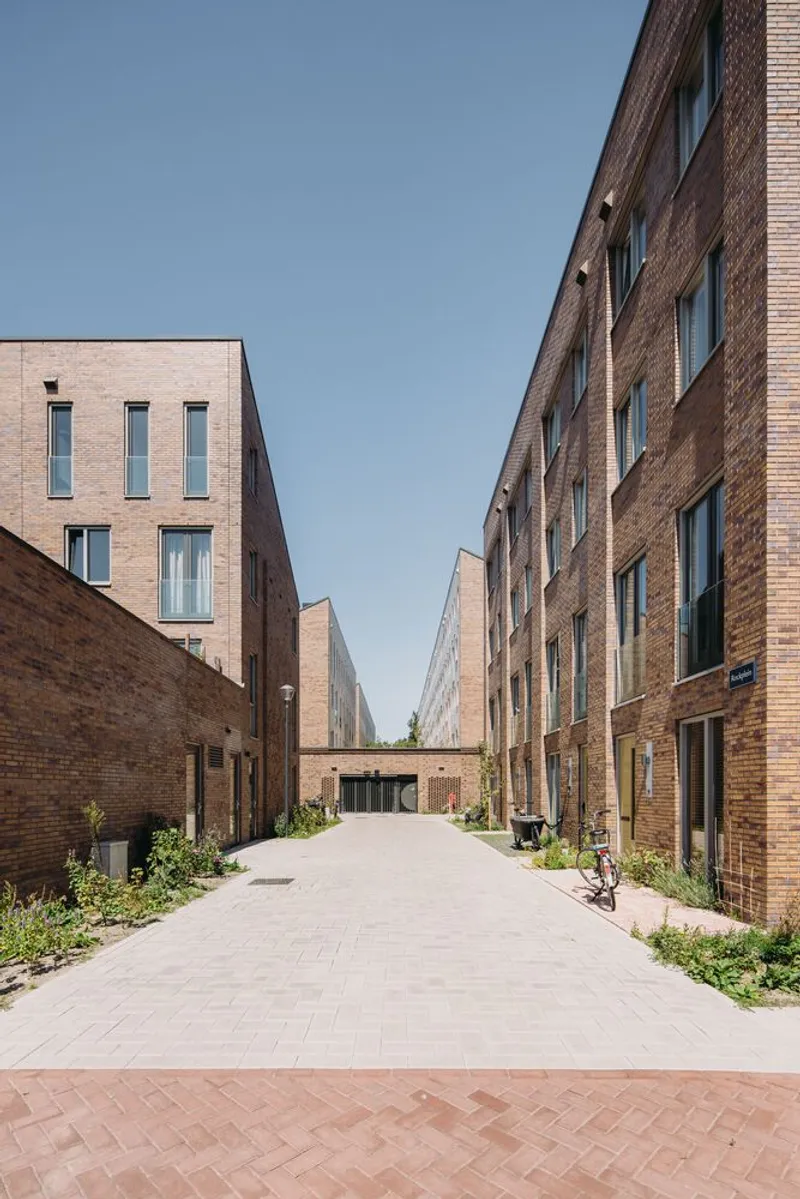

The plan organizes housing blocks around a sequence of courtyards that feel neither private nor fully public but exist in that productive middle territory where neighbors actually encounter each other. Young trees, timber benches, planted beds on gravel: the landscape design is deliberately understated, as though the architects trusted that people would eventually fill these spaces with life rather than relying on expensive hardscape to signal "community."
One courtyard wraps a curved path around a mature tree that was clearly retained from the site's previous life. Keeping an established tree is a small gesture with outsized impact. It gives a new development the one thing money cannot buy: the sense that time has already passed here, that the place was not conjured overnight.
The Green Steel Frame and Street Edge
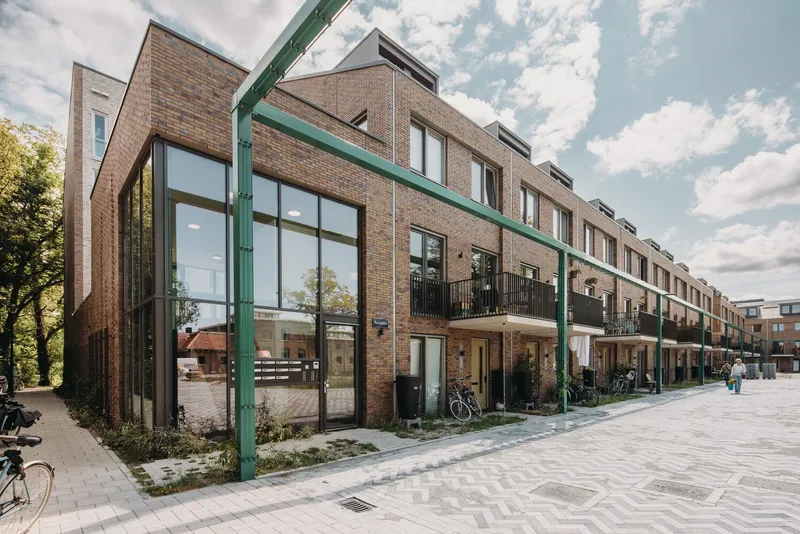


Green steel columns and canopies appear at the ground level of several blocks, marking entries and sheltering the transition between street and dwelling. The color choice is deliberate: green steel against warm brick creates just enough contrast to signal something civic, a shared threshold rather than a private door. The cantilevered balconies above reinforce this reading, projecting domestic life outward toward the shared lanes and plazas.
The paired yellow entry doors, visible beneath balconies and flanked by planted beds, are a small but telling detail. In a market where residential architecture defaults to grey and glass, the decision to use saturated color at the point of arrival is generous. It gives individual addresses personality within a unified block, solving the perennial problem of large-scale housing that looks monolithic from the street.
Memory and the Water Tower Axis
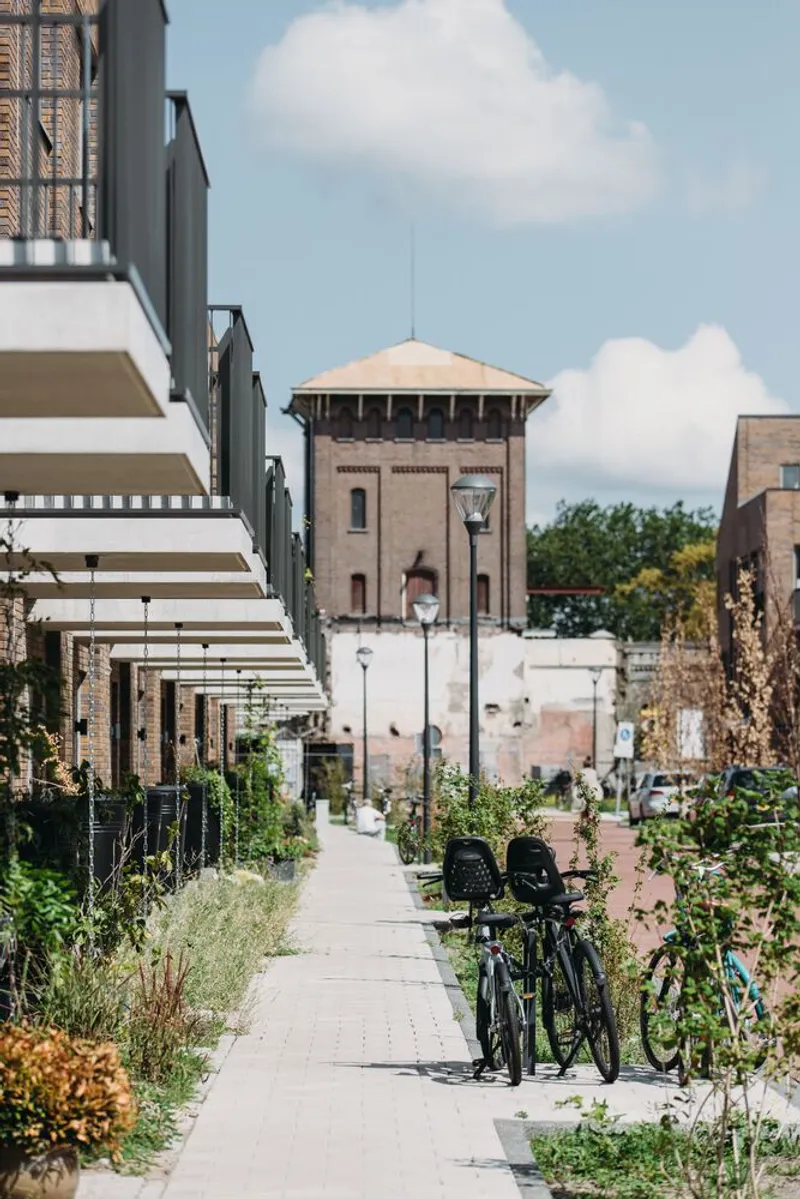
The preserved brick water tower anchors the main pedestrian route, turning an industrial relic into a neighborhood landmark. The view down this pathway, lined with planted beds and parked bicycles, terminates at the tower under an open sky. It is the kind of compositional move that city builders used to make instinctively and that contemporary development routinely ignores: give a street a destination, and people will walk it.
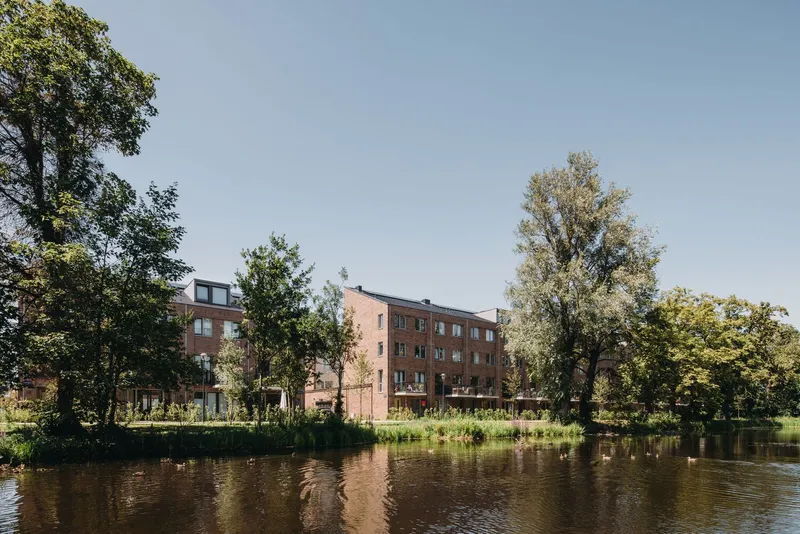
From the waterway to the south, the apartment buildings emerge beyond a line of dense trees, their brick volumes settling into the landscape as though they have always been part of the canal's edge. This relationship between water, vegetation, and built form is one of the quieter achievements of the project and one of its most durable.
Threshold and Interior
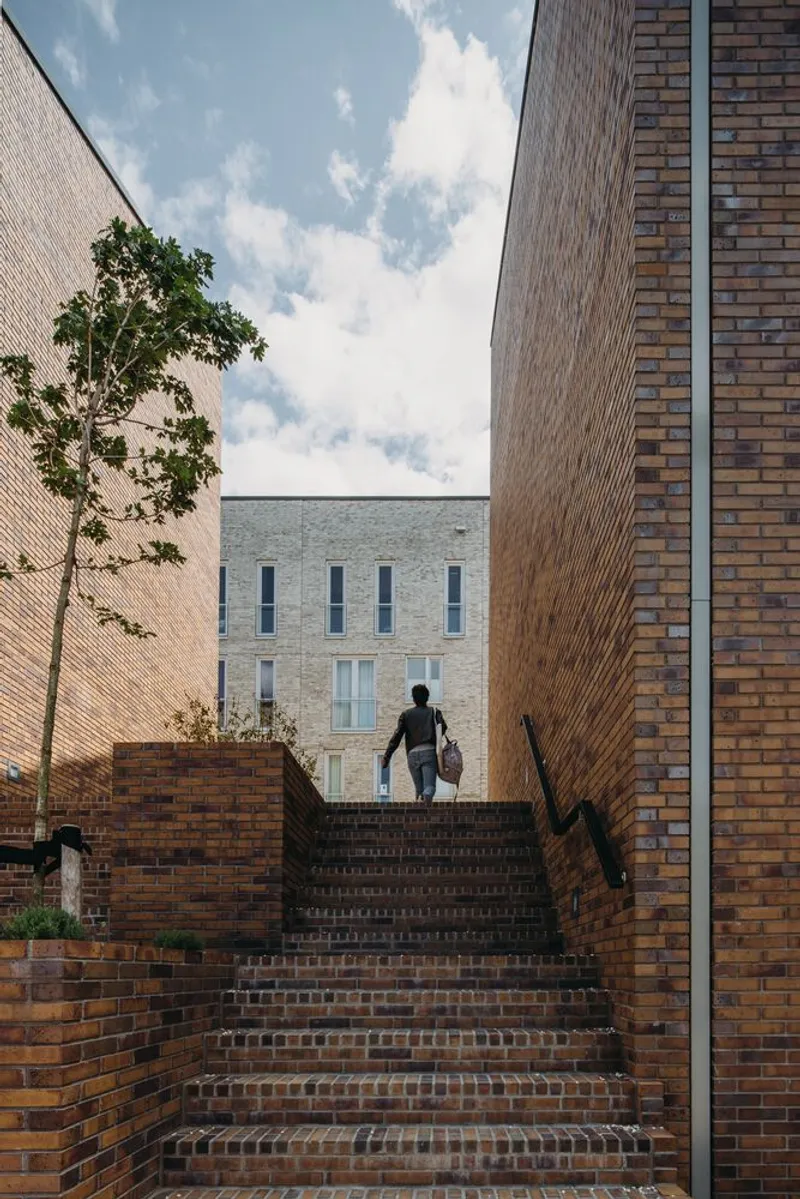

A brick staircase ascending between two walls captures the project's commitment to material consistency. Even the circulation spaces are given the same masonry attention as the facades, turning a functional route into a sensory experience. The triangular steel-framed window, seen from inside a unit, frames the courtyard and autumn foliage like a camera lens. It is a reminder that window geometry matters: the angle of the frame directs the eye and shapes the mood of a room in ways that a standard rectangle never could.
Why This Project Matters
The Slachthuisdistrict development is not flashy. It will not win awards for parametric innovation or material experimentation. What it does, and does well, is demonstrate that residential architecture on a former industrial site can be both economically viable and culturally responsible. The brick palette, the courtyard typology, the retention of the water tower, and the careful calibration of public and private ground add up to a neighborhood that feels considered at every scale.
For cities across the Netherlands and beyond that are converting post-industrial land into housing, this project offers a credible model. Not every brownfield needs a signature tower or a starchitect master plan. Sometimes the most radical move is to build with the patience and material seriousness of the structures that came before, and to trust that a well-made brick wall, a good tree, and a generous courtyard are enough.
Slachthuisdistrict Haarlem Apartments by vanOmmeren-architecten, Haarlem, the Netherlands. Photography by Eva Bloem.
About the Studio
Share Your Own Work on uni.xyz
If projects like this are the kind of work you want to make, uni.xyz is a place to publish your own, find collaborators, and enter design competitions.



Popular Articles
Popular articles from the community


Co-Life: Senior Housing Design That Reconnects Older Adults With the City
Co-Life reimagines senior housing design through healing gardens, shared streets, workshops, and a sustainable community across generations.

Riyadh For All: Intergenerational Urban Design for Active Aging in Rabat
Riyadh For All reimagines urban design in Rabat with intergenerational co-living, adaptive courtyards, and Moroccan cultural exchange today.

The Earth Pod: 3D Printed Homes for Resilient Refugee Communities
The Earth Pod reimagines refugee housing through 3D printed homes made from clay, combining resilience, self-sufficiency, and rapid shelter.

The Ocean Hive: Sustainable Architecture for a Self-Sufficient Civilization at Sea
The Ocean Hive imagines sustainable architecture at sea, where modular habitats, algae, wave power and ocean waste sustain a growing colony.


Similar Reads
You might also enjoy these articles


Hodi-Mandai Geram
Project Function: Preservation and revitalization of the Intangible heritage and socio-spatial identity of the Hodi by Housing, Cultural Memory Center, Sacred Grove, landscape, local tourism economy


Olio Towers: A Mid-Rise for Performers That Fuses Housing, Rehearsal, and Stage
Located blocks from Houston's Theater District, this modular tower stacks living units around a central performance atrium.

Oasis: Modular Green Housing Carved into Dhaka's Urban Fabric
A shortlisted Plugin Housing entry reclaims unauthorized settlements in Dhaka with stepped concrete volumes, green roofs, and ventilation-driven design.

Black Hole: A Floating Megastructure for the Post-Physical Era
Emiliano Mazzarotto envisions a spherical, self-scaling arena where e-sports, digital hotels, and holographic stadiums replace traditional public space.


Explore Housing Competitions
Discover active competitions in this discipline



Challenge to reimagine the Iron Throne


Photograph architecture without architects


Illustrate the lost glory of Angkor Wat - Render Challenge


Design challenge to reuse E-waste
Comments (0)
Please login or sign up to add comments
No comments yet. Be the first to comment!