

SLASH
Tea Jungle

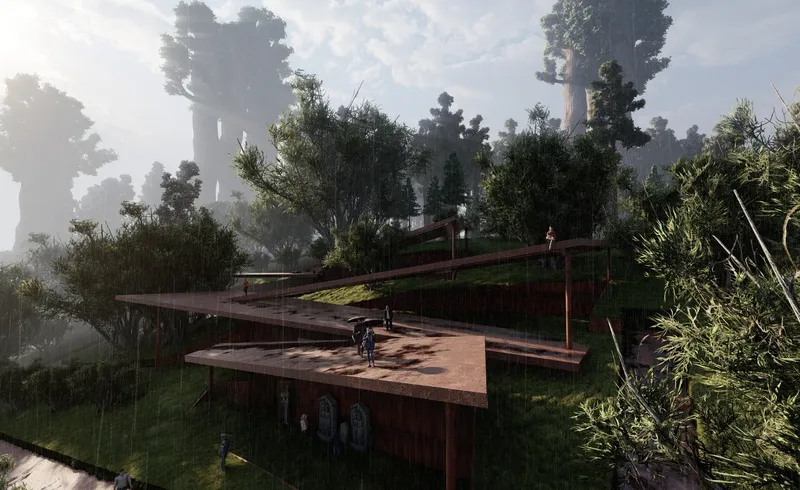
Tea culture has existed at different times in human history with different meanings and events. Tea culture should be defined and addressed by the way tea is made and consumed, the way people interact with tea, and the aesthetics surrounding drinking tea. Besides communication, tea has deep meanings, social and cultural roles that meet concepts such as soul bath, infusion, and self-reach, ritual, and healing. The equivalents of these different concepts can be found in the meanings of tea in different cultures in history. For example, drinking or serving tea in China involves a ritual that is part of daily life, while in Japan these rituals are organized for healing purposes. In the Buddhism faith, Buddhists consume to empty their minds and become isolated from the world and reach spiritual maturity when starting meditation. When looking at the Tao belief, tea is a substance that provides harmony, which is one of the basic components of the potion of immortality.The drinking places of this tea, which is drunk for different purposes, have also changed in history and cultures. While Asian culture has tea rooms and tea houses, in England this has become more ostentatious, served at palaces or in its magnificent gardens. Tea shops have been established in Turkey and the Middle East and new places have been produced where people come together. Looking back on the present, it proves that drinking tea is no longer needed in such sharp places, even on the street in India. It has been a drink that can adapt to different cultures as well as different venues.Tea is a culture that distinguishes it from other beverages; rituals are caused by its use for different purposes and, most importantly, because it is a drink with high interaction with human beings. Today, the fact that tea is being looked at from such a superficial point and reducing its interaction with human beings causes it to lose its deep meaning. Tea is a phenomenon that can maintain its essence and gain meaning if it meets people. This drink, which is brewed with rituals and rests the soul, loses its meaning when its interaction with people decreases. However, it is not possible and realistic that past rituals are still strictly preserved and presented to humans in today’s world.Designing began by combining programs and venues to break down the perception of a modern tea place with limitations and old rituals. For this reason, the tears, and the openings to each other are the conditions that will provide this fusion. When a venue is entered, it is not desirable for that place to stand out with a single function, so the programs are grouped and they have brought functionality to the space together.In addition, it is aimed to include landscape and tea in the places and to maintain its interaction with human beings. The main decisions of the design were that the context had never been touched before and that it remained quite bare next to the surrounding green textures. When looking at the tree population around Ooty, it was also tried to reflect the green wave design area around the long-bodied and thorny trees, short-bodied and densely leafy tea trees. The tea plant, which is kept at an average of 120 cm for production, was freed in this design, left to its natural state, helping to integrate the structure located on this bare land with the land and to melt the structure in the land.The indoor spaces of the design aimed at melting in the land are positioned underground with favorable conditions.” With these strategies, TEA JUNGLE has created a tea experience center that references more landscapes by moving away from only structural interventions and allows us to experience the natural form of tea that we have not encountered before on-site.When viewed in the situation plan, only fringes and landscaping elements are visible. In this way, instead of an alienated structure in the binding, a design that belongs there and does not stand mass was made. Indoors are entered through openings under the eaves and hidden under the ground.To ensure the continuity of the spaces constructed inside with each other and not to narrow the circulation area, non-independent spaces are constructed.Design that argues that tea cannot be experienced in a single place in a single way; It also supports in-out relationships by providing connections between each other.
References (1)

Popular Articles
Popular articles from the community


Opera by the Sea Estonia: Three Shells Dissolving Architecture into Tallinn's Coastline
A winning opera house proposal replaces monumental form with interconnected shells that blur the boundary between building, park and Baltic Sea.

Temporary Home for Dogs: A Reversed Zoo Rethinks Animal Shelter Architecture
In Bucharest, a sinuous corridor and freed landscape flip the logic of containment, designing a shelter that works to make itself unnecessary.
Extended Shell: Retrofitting Kolkata's Balconies as Living Urban Thresholds
A modular retrofit system recovers the social and environmental intelligence of Kolkata's historic verandas for contemporary Park Street residents.

Opera on the Sea: Driftwood Logic Shapes a Timber Opera House on Estonia's Coast
Trevor Orgill's opera house translates the entangled drift of floating timber into a civic building where wood, water, and music converge.

Similar Reads
You might also enjoy these articles

Shakur's House: Exposed Brick as an Interior Organiser in a 168 m² Mashhad Residence
Brick moves indoors in this Mashhad residence, where masonry walls, glass partitions and teal planes sequence a compact home without closing it off.

Day and Night Park: A Time-Based Urban Newsstand in Beijing
A temporary urban newsstand in Beijing blending travel, light, and reading through poetic colors, compact form, and community-focused design.

Modernist Patio Renovation in El Masnou, Barcelona by Oliver Segura Arquitectura + Cebrià Arquitectura
Modernist patio renovation blending tradition and innovation with a movable pool, leveled floors, and Catalan materials in El Masnou.
Alto Residencial Coop: Cooperative Housing Development in Santiago de Compostela by Carbajo Barrios Arquitectos
A linear cooperative housing complex blending white volumes and perforated metal façades, enhancing community living, natural light, privacy, and urban integration.

Explore Landscape Architecture Competitions
Discover active competitions in this discipline


Challenge to reimagine the Iron Throne

Photograph architecture without architects

Illustrate the lost glory of Angkor Wat - Render Challenge

Design challenge to reuse E-waste
Comments (0)
Please login or sign up to add comments
No comments yet. Be the first to comment!