

Parking Lot in Reef Residence Sochi: Subterranean Parking as Urban Architecture
A 57-vehicle underground parking facility on the Black Sea Riviera rethinks wayfinding, materiality, and spatial psychology beneath a resort hotel.


Parking garages rarely earn a second glance, let alone architectural praise. The subterranean parking facility at Reef Residence Sochi asks what happens when you treat a 57-vehicle underground lot not as leftover space beneath a building but as a designed environment in its own right. Diagonal turquoise-and-black striped column wraps, suspended linear lighting, and a legible circulation spine turn a concrete box into something closer to an inhabited graphic field, one that prioritizes wayfinding and psychological comfort in an enclosed setting.
Designed by Anton Evstigneev and Anton Spotify, the project was shortlisted in the Yo Parking 2019 competition. Sited beneath a curved glass-facade resort hotel on the Black Sea Riviera, the facility sits at the intersection of resort hospitality and urban infrastructure, a context that demands the parking experience feel continuous with the quality of the building above rather than a jarring descent into utilitarian gloom.
Graphic Identity Below Ground
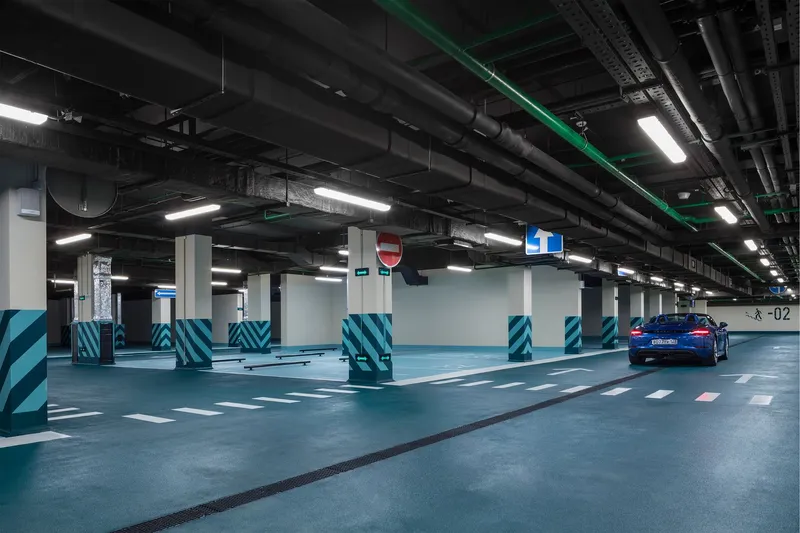
The strongest move in the project is its treatment of structure as wayfinding device. Columns are wrapped in bold diagonal stripes of turquoise and black, transforming repetitive structural bays into visual landmarks. Exposed ceiling ducts and conduit runs are left visible but organized, creating a raw industrial ceiling plane that contrasts sharply with the precision of the striped barriers. The result is a space that reads immediately: you know where you are, which direction you're moving, and where the exit is.
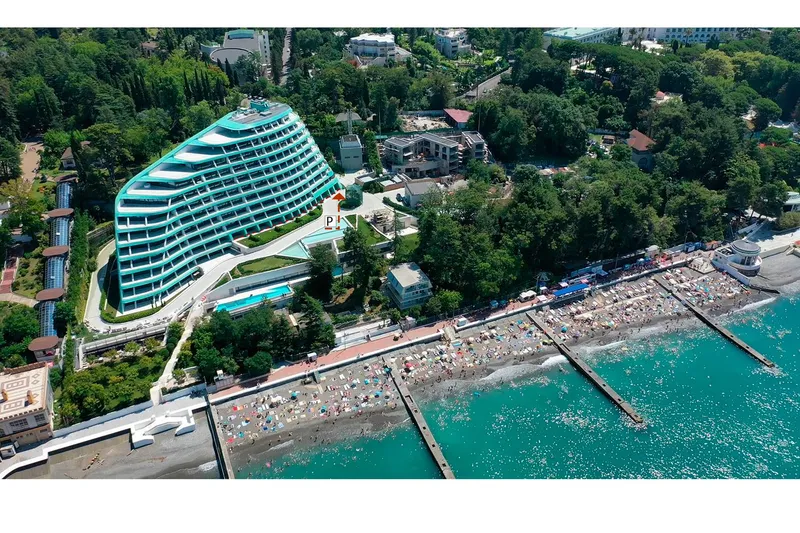
Above ground, the Reef Residence presents a sweeping curved glass facade overlooking a waterfront beach. The contrast between the resort's polished exterior and the garage's graphic interior is deliberate. Rather than attempting to replicate luxury finishes underground, the designers developed a distinct identity for the parking level, one rooted in bold color and pattern rather than expensive cladding.
A Central Spine Organizing 57 Bays
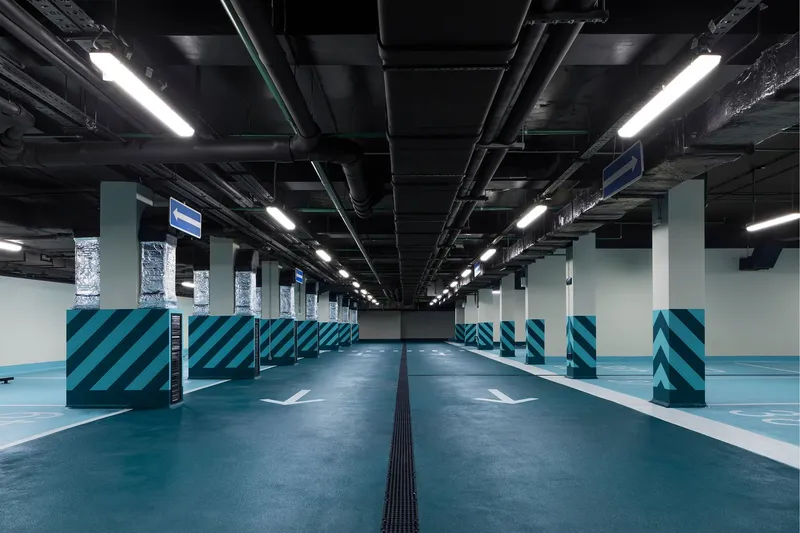
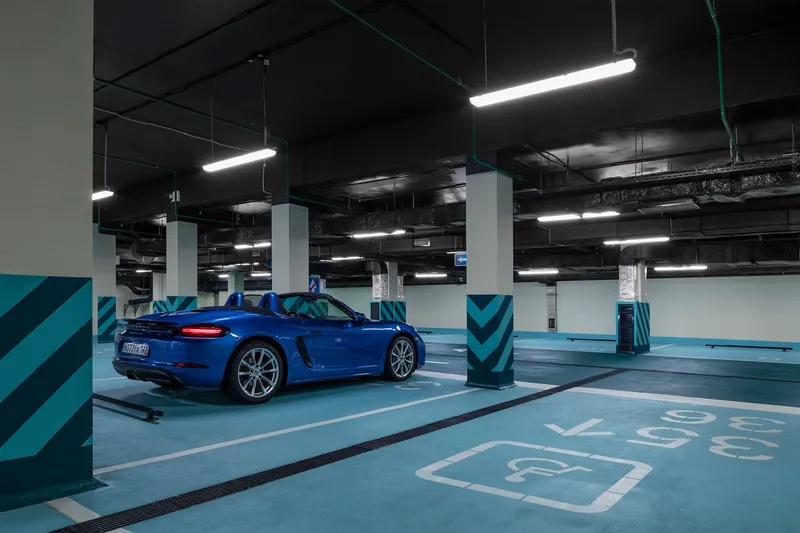
Looking down the length of the parking level, the repeating rhythm of striped columns and barriers creates a strong perspectival depth. Suspended linear lights run parallel to the circulation route, reinforcing directionality and providing even illumination across the long floor plate. Green conduit runs along the ceiling add a secondary color layer that complements the turquoise accents below, keeping the palette cohesive without being monotonous.
The design treats the central circulation spine as the organizing principle of the plan. Vehicles enter, navigate a clear primary route, and slot into bays arranged perpendicular to it. There is no ambiguity about hierarchy: the spine is wide, brightly lit, and visually differentiated from the parking bays themselves. For a facility accommodating 57 vehicles, this clarity matters; it reduces congestion, shortens search time, and lowers the ambient stress that poorly organized garages produce.
Plan Logic and Site Context
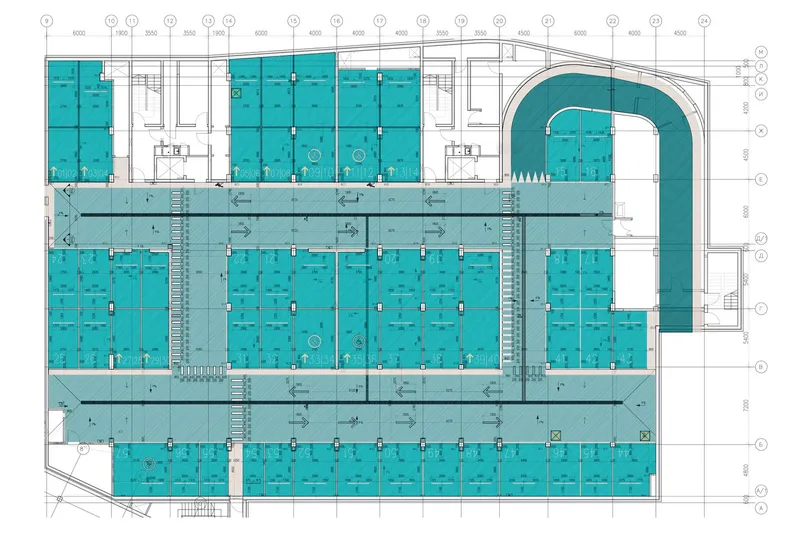
The floor plan reveals a rectangular arrangement of parking bays flanking a central circulation spine, with a curved volume at one edge that corresponds to a pool structure above. This curved intrusion into the parking footprint is a constraint the designers turned into an asset, using it to define the edge of the parking zone and create a natural terminus for the circulation route. The plan is compact and avoids dead-end corridors, which is critical for both operational flow and emergency egress.
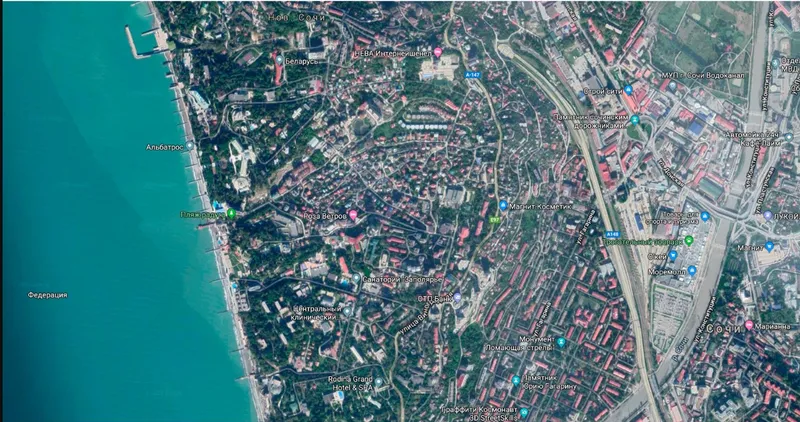
The satellite view places the building in its broader context: adjacent to wooded residential neighborhoods on one side and the turquoise waters of the Black Sea on the other. The site's coastal location explains the resort typology and the premium placed on every square meter of buildable area. Burying 57 parking spaces underground frees the ground plane for landscape, pools, and beachfront access, a trade-off that only works if the underground space itself is well designed enough that users don't resent descending into it.
Why This Project Matters
Underground parking is one of the most common building types in dense coastal cities, and one of the least designed. Evstigneev and Spotify demonstrate that a limited palette of interventions, bold graphic wrapping on columns, strategic lighting, and a legible circulation plan, can shift the experience from disorienting to intuitive. None of these moves require exotic materials or inflated budgets; they require attention.
As a shortlisted entry in Yo Parking 2019, the project contributes to a growing argument that infrastructure deserves the same design rigor applied to the buildings it serves. When a parking garage beneath a Black Sea resort hotel can hold its own as a designed environment, the disciplinary boundary between architecture and infrastructure starts to dissolve. That dissolution is exactly where the interesting work happens.
View the Full Project
About the Designers
Designers: Anton Evstigneev, Anton Spotify
Enter a Design Competition on uni.xyz
uni.xyz runs architecture and design competitions year-round that reward proposals with spatial conviction and real site intelligence.
Project credits: Parking lot in Reef Residence Sochi by Anton Evstigneev, Anton Spotify Yo Parking 2019 (uni.xyz).


Popular Articles
Popular articles from the community


Opera on the Sea: Driftwood Logic Shapes a Timber Opera House on Estonia's Coast
Trevor Orgill's opera house translates the entangled drift of floating timber into a civic building where wood, water, and music converge.
Temporary Home for Dogs: A Reversed Zoo Rethinks Animal Shelter Architecture
In Bucharest, a sinuous corridor and freed landscape flip the logic of containment, designing a shelter that works to make itself unnecessary.

Opera by the Sea Estonia: Three Shells Dissolving Architecture into Tallinn's Coastline
A winning opera house proposal replaces monumental form with interconnected shells that blur the boundary between building, park and Baltic Sea.

The Amber Palace Opera: A Geological Fiction Surfaces on Tallinn's Baltic Waterfront
Pierre Brillard reimagines a Baltic legend as a public landscape, opera house, and waterfront promenade rooted in Tallinn's coastal identity.

Similar Reads
You might also enjoy these articles

Shakur's House: Exposed Brick as an Interior Organiser in a 168 m² Mashhad Residence
Brick moves indoors in this Mashhad residence, where masonry walls, glass partitions and teal planes sequence a compact home without closing it off.

Day and Night Park: A Time-Based Urban Newsstand in Beijing
A temporary urban newsstand in Beijing blending travel, light, and reading through poetic colors, compact form, and community-focused design.

Modernist Patio Renovation in El Masnou, Barcelona by Oliver Segura Arquitectura + Cebrià Arquitectura
Modernist patio renovation blending tradition and innovation with a movable pool, leveled floors, and Catalan materials in El Masnou.

Alto Residencial Coop: Cooperative Housing Development in Santiago de Compostela by Carbajo Barrios Arquitectos
A linear cooperative housing complex blending white volumes and perforated metal façades, enhancing community living, natural light, privacy, and urban integration.

Comments (0)
Please login or sign up to add comments
No comments yet. Be the first to comment!