
SOCIAL_PATCH
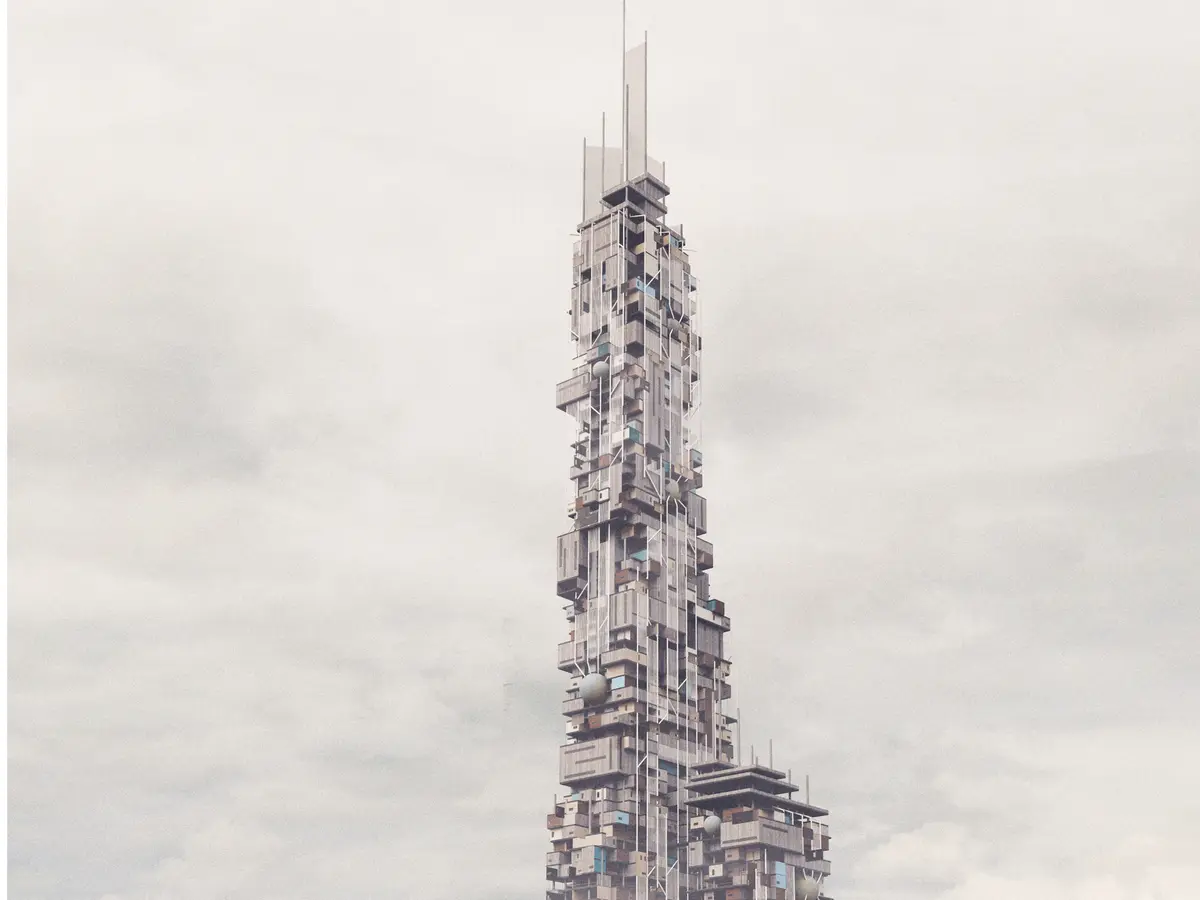
Skyscraper on the Slum
● What was the concept behind the project?
It was to create vertically established community that would reduce the segregation of high-rise buildings by providing the flexibility to repeat the habitual life without interrupting it. Design centered on social and cultural sustainability. Of course we also worked on infrastructure and architectural solutions that can help with physical sustainability problems such as water scarcity and pollution.
● What was the intent behind the organization of elements across various levels (Architectural, Site,
Urban)?
Although the chosen site was very problematic both in terms of economy and infrastructure. It also had a lot of potential in terms of the colorfulness of the life. Makoko, a slum settlement that started to spread due to population growth and lack of land. This settlement was almost in a state of detached from the city. A proposal was made for a light rail system extending to the skyscraper with the railway forming an urban scale axis that will enable this region to reconnect with the city. The vacant land was left to the public green space. When we descended to the scale of a single structure, the mass was built on the unity created by adding small and large units. The purpose of this unity was to reflect the colorful texture of the environmental life on the building.
● How many iterations were tried to arrive at the final outcome?
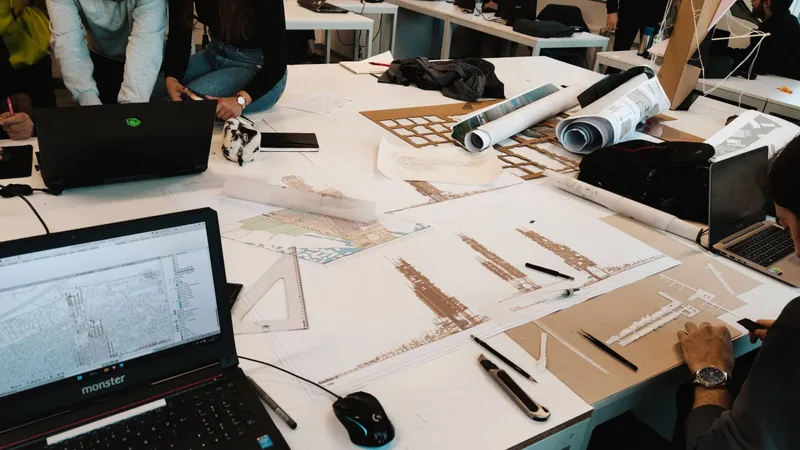
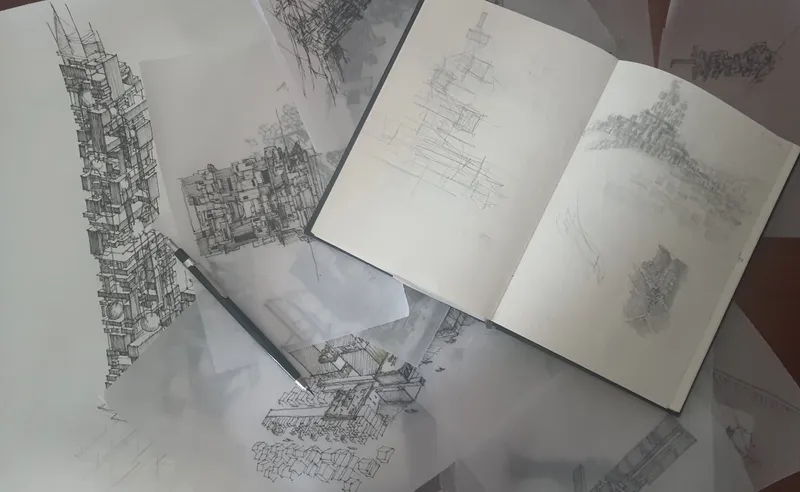
While preparing for the competition, we worked on numerous sketches and concept models. The abstract works made at the beginning have similarities as the stages of reaching the final product. However, during these studies, we tried to reach a result that would respond to the discussion made in the context of sustainability, such as a mass containing only public spaces or a technical structure that tried to respond to problems only mechanically. As a result of these trials we reached the final product that we can combine these trials, which consider the primary problem of the place in a single structure.
● How was the programme condensed into final?
The program was formed with the idea that it will not interfere with the life of the people around, and that these people can continue their community life in this structure. The program shaped according to a scenario where certain large spaces were built together with the structure, and the floors offered were provided with the spaces that allow the people living in this region to build their own living spaces according to their situation, in which they would not cut off from their own communal life, ground and city.
In the given structure there are large spaces in public use such as workshops, co-kitchens, conference hall, education units, community center, library and additionally water collecting units like water tanks, water floors and collector meshes.
● What/How were the materials chosen?
Makoko, is a wood intensive shantytown on the water. But it is envisaged that the elements such as covers and metal parts used in the surrounding structures will be used as a building material again in order to contribute to recycling. In addition, it is foreseen that the end product can be reached more easily because it does not create a contrast to the crafting techniques of the local people and allows local methods. Furthermore, it is planned to recycle plastics that pollute the environment and take place as water collection elements in this structure.
● How was a specific objective attempted to be met?
We sought the answer to the question of whether raising a building would not only increase human density but could we use this height as a potential solution to the problem of water scarcity caused by water pollution. As a result of our research, we examined the meshes that harvest water from moisture, fog and air in humid areas. If we talk about the technical data, these meshes,1m2 of which can collect 12-15 L per day in humid areas like here. Meshes will be stretched in certain areas around the skyscraper, and will both protect public spaces against the harsh weather conditions of the high altitude and create a solution against the water problem and supply.
On the other hand, we determined a scenario that does not disturb the community life created by the people here and allows them to carry the flexible and non-hierarchical structure of life. Unlike any building that is built today, which cuts the relationship between interior and exterior, a design that almost does not touch people and the fused life of different cultures will support social cultural and also economic sustainability.
● What is the expansion plan of the project?
The expansion plan of the design is divided into two as a single structural scale and urban scale. At the scale of a single building, it is an empty structure with given infrastructure and community spaces, there is a flexible expansion left to people, taking into account their own lifestyles and high craft skills.
When we look at the urban scale, the structure established here will serve as a blueprint for the tall buildings to be implemented in the future. High-rise buildings that will come to certain points of the city as prosthetic structures in the coming years will play an active role in rehabilitating and rearranging the city.
● How will the project transform with the passing time? etc.
Although the project itself changes over time, it is actually a model that will transform its environment.
The scenario of the project is based on flexibility, the design to be made here is actually an empty structure that can help solve the water and infrastructure problem, ıt will stop the non-infrastructure sprawl on water and will help with physical sustainability
The design has a flexible scenario that allows the people of the region to repeat their own lives, so the colorful and active life here will be reflected in the given structure and will multiply in units and spaces but will also contain the pleasant uncertainty of life.



Popular Articles
Popular articles from the community


Faces of the Soviet Avant-Garde: Turning Moscow's Street Names into an Open-Air Museum
A network of sculptural installations across a Moscow residential district transforms forgotten architect names into spatial encounters with cultural memor

Opera by the Sea Estonia: Three Shells Dissolving Architecture into Tallinn's Coastline
A winning opera house proposal replaces monumental form with interconnected shells that blur the boundary between building, park and Baltic Sea.

Opera on the Sea: Driftwood Logic Shapes a Timber Opera House on Estonia's Coast
Trevor Orgill's opera house translates the entangled drift of floating timber into a civic building where wood, water, and music converge.

Cloaked Colonization: A Mobile Underwater Habitat That Moves Like a Fish
Micah Abaya's shortlisted EHC Pacific entry reimagines ocean settlement as a dispersed network of self-sustaining architectural organisms.

Similar Reads
You might also enjoy these articles


Creating evolutionary co-working spaces
Co-Design Milan Juror's interview
Enhancing the self-learning experience - Juror's opinion
A discussion on libraries of future
Plugin Housing Challenge - Jury panel interview
Future of Urban-Housing

the house for living: A Courtyard Complex That Treats Shelter, Learning and Belonging as One Plan
Three principles of living, growth and interaction shape a white, courtyard-laced complex where homeless teenagers find a home, skills and each other.


Comments (0)
Please login or sign up to add comments
No comments yet. Be the first to comment!