

Space Invaders: A Von Braun Wheel Rebuilt with Inflatable, Regolith-Shielded Habitats
Jiri Vele's Orion Station spins once a minute at 1,400 km, hanging regolith-filled inflatable modules on a bicycle wheel frame for 2,000 people.


Most speculative space stations borrow the look of the future. This one borrows a bicycle wheel. Space Invaders returns to Wernher von Braun's rotating station and treats it as an engineering brief rather than a nostalgic image: a hub, a set of spokes and a rim that turns once every 60 seconds so that rotation stands in for gravity. The wheel is not decoration. It organises the station, setting its structure, its circulation and its way of growing outward.
The project by Jiri Vele received an Honorable Mention in Origyn. Vele calls the station Orion and places it 1,400 km above Earth in low Earth orbit. It is built from three nested parts, a central core, an inner ring and an outer ring, and it is designed for long-term habitation rather than short rotations of crew. At completion it holds up to 2,000 people, and the design leaves room to expand beyond that.
Hub, Spokes and Rim as a Gravity Gradient
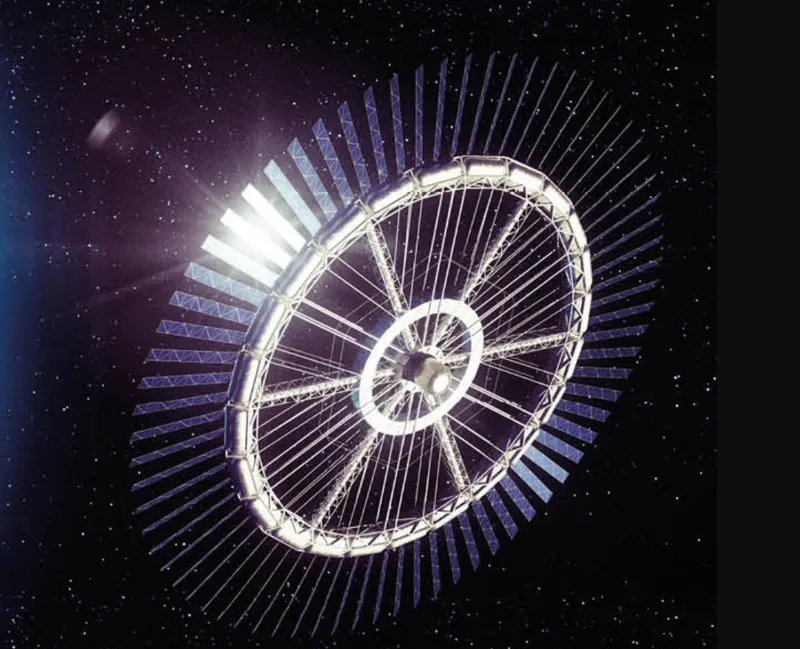
The opening render shows the station as a pure diagram of rotation. The truss rim carries the habitats and the solar panels radiate outward like fins. The real argument is in how the programme sits along the radius. The central core, close to the axis, holds the zero-gravity uses: laboratories, entertainment spaces, docking systems and storage for long journeys such as missions to Mars. The inner ring takes storage and further lab space. The outer ring, where rotation produces the strongest artificial gravity, is where people live.
Vele turns a physical gradient into a zoning plan. Uses that benefit from weightlessness stay at the centre, and bodies that need a floor move to the edge. Six elevator shafts run along the spokes and tie the three zones together, so moving through the station also means moving between gravity conditions. Few orbital concepts make a commute part of the design, and this one does.
Three Floors Inside an Inflated Shell
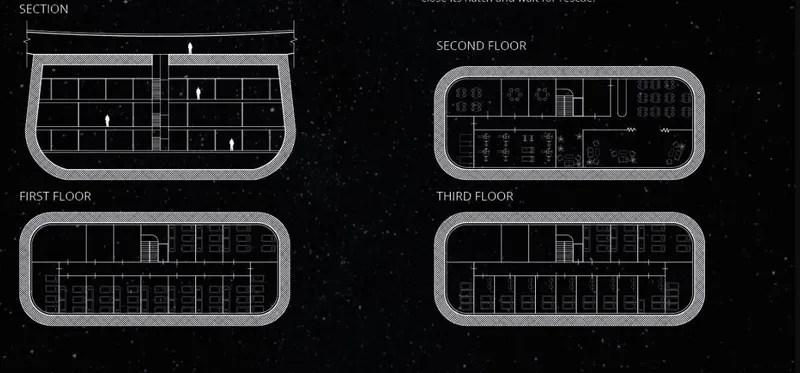
The section and plan drawings narrow the view to a single outer-ring module: a rounded, rectangular volume stacked into three levels. These are inflatable modules, and Vele shields them with Moon regolith for radiation protection. Each module accommodates up to 150 people. That is a density closer to a mid-rise apartment block than to the cramped racks of current orbital crew quarters.
The more consequential decision is resilience at the scale of the module. Every unit has its own life-support systems and can run independently for 14 days in an emergency. That turns the outer ring from one continuous habitat into a chain of lifeboats, and it is a sensible response to the obvious weakness of any inflatable structure.
A Station That Assembles Itself in Sequence
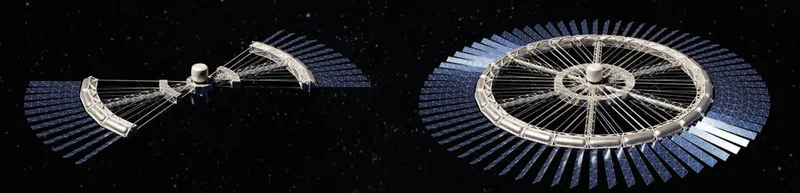
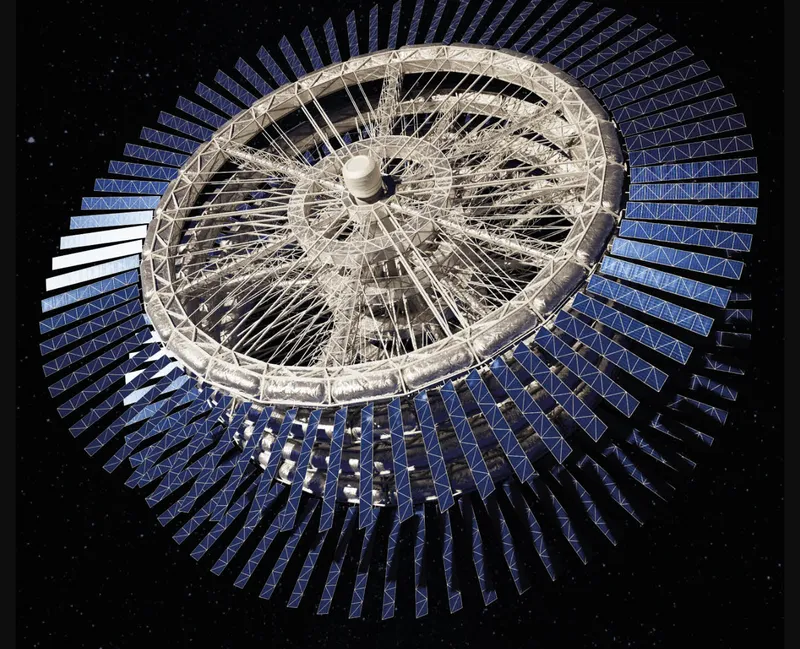
The paired renders show the wheel half-built, with a few spokes reaching toward an incomplete rim, and then closed into a full ring. The tilted view adds the central hub, a tangle of cable spokes and blue solar arrays fanned around the perimeter. Vele sets out construction as a nine-step sequence. A rocket delivers the core structure, the core inflates to house supplies and basic living quarters, and oxygen and regolith follow as building material. Truss segments go up next, then the outer ring framework, then elevators and corridors that link the segments. The inflatable modules are filled with regolith for shielding, the solar panels unfold to power the station, and the wheel is complete.
Each stage leaves behind something usable. The inflated core provides shelter before the ring exists, which gives the build a logic of occupation and not only of assembly. The images show a station that is never fully finished, since the design allows for further expansion once the 2,000-person capacity is reached.
Supply Lines from Earth and Moon
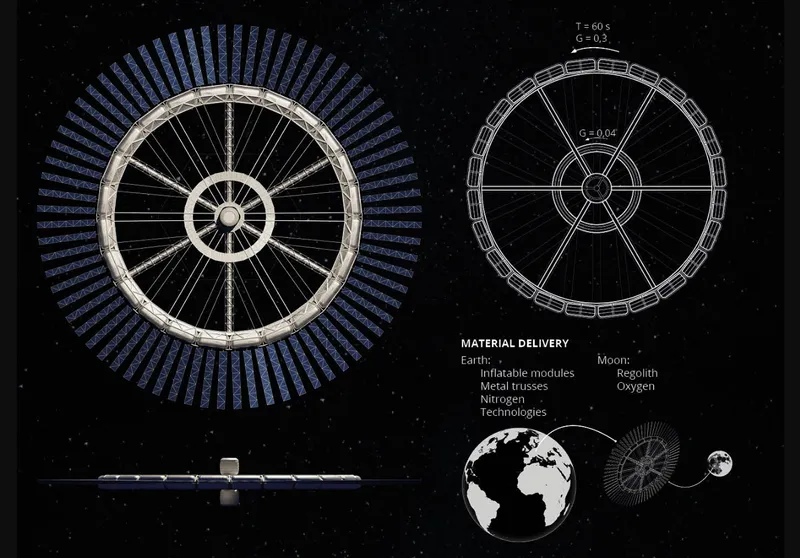
The diagram sheet brings together the plan and side elevation of the wheel, a gravity schematic and a delivery route for materials from both Earth and the Moon. That last element carries the most weight. Regolith shielding only works if the regolith arrives, and by drawing the supply chain Vele makes clear that the station depends on lunar material as much as on Earth-launched hardware.
The sector breakdown is just as deliberate. The commercial sector covers 16,560 m² across 12 modules for accommodation, sports and entertainment. The crew sector occupies 11,040 m² for hydroponics, food storage and fuel storage. The scientist sector takes 5,520 m² for accommodation and research laboratories. The areas follow a clean 3:2:1 ratio, which suggests a modular system scaled by repetition. It also reveals the station's priorities: leisure and visitors take the largest share, and research takes the smallest.
Why This Project Matters
Space Invaders reflects a growing understanding that orbital architecture will be judged on logistics, phasing and failure modes as much as on form. Vele's wheel carries its argument in its geometry. Programme is sorted by gravity, circulation runs along the spokes, and growth happens at the rim. It is a building whose section and structural diagram are the same drawing.
The project's ambitions open up useful questions. A station led by its commercial sector raises the issue of who orbital space is built for, and the dependence on lunar regolith ties the station's future to a working supply line from the Moon. These are the right questions for a competition like Origyn, and the Honorable Mention rewards a scheme that takes a 70-year-old idea and gives it a credible construction sequence, a measurable programme and a plan for when things go wrong.
View the Full Project
About the Designers
Designer: Jiri Vele
Enter a Design Competition on uni.xyz
uni.xyz runs architecture and design competitions year-round that reward proposals with spatial conviction and real site intelligence.
Project credits: Space Invaders by Jiri Vele Origyn (uni.xyz).


Popular Articles
Popular articles from the community


Extended Shell: Retrofitting Kolkata's Balconies as Living Urban Thresholds
A modular retrofit system recovers the social and environmental intelligence of Kolkata's historic verandas for contemporary Park Street residents.

Manzana Morphosis: Stretching Barcelona's Grid into a Living Landscape for 2050
A radical reworking of the Eixample manzana turns density into a tool for generous public space, vertical ecology, and environmental performance.
Cloaked Colonization: A Mobile Underwater Habitat That Moves Like a Fish
Micah Abaya's shortlisted EHC Pacific entry reimagines ocean settlement as a dispersed network of self-sustaining architectural organisms.

Singing Woman: An Opera House That Performs Before the Curtain Rises
Ovidiu Cristian Pavel's conceptual opera house translates Estonia's choral identity into a sculpted waterfront landmark facing the Baltic Sea.

Similar Reads
You might also enjoy these articles

Healing Façade: A Modular Chapel System That Restores Ethiopia's Sacred Forests
Winner of the Eco-Chapel competition, this circular timber façade collects water from air to rebuild soil and reforest degraded Ethiopian landscapes.
Kaffeebühnen: Where Coffee Shop Architecture Becomes a Civic Stage in Vienna
A linear sequence of timber boxes, transparent shells, and open yards turns the Viennese café tradition into a public performance space.
Eco Chapel: A Modular Forest Pavilion That Grows Like the Landscape It Protects
Hexagonal timber modules weave through existing trees, turning a chapel into a living system for prayer, education, and reforestation.


Urban Forest: A Vertical Ecosystem for 5,000 Workers in Singapore's Changi Business Park
Radially stacked pods and layered green decks turn a 7-acre plot into 47 acres of ecological workspace projected for 2040.

Comments (0)
Please login or sign up to add comments
No comments yet. Be the first to comment!