
RAD+ar Wraps Five 30-Meter Trees in Tensile Fabric to Create a Bar in Central Jakarta
A parametric membrane canopy hugs existing trees in Jakarta's busiest business district, turning shadow and wind into architecture.


There is a particular audacity in telling a client that five 30-meter trees on a prime commercial plot in Jakarta's SCBD district are not obstacles but the project's primary structural and experiential assets. That is exactly what RAD+ar (Research Artistic Design + Architecture) did with the Stalk Tree-Hugger Bar, a 900-square-meter hospitality venue completed in 2023. Rather than clearing the site, lead architect Antonius Richard Rusli and his team treated the existing canopy as infrastructure, draping bell-shaped tensile membranes around the trunks and letting wind, light, and growth dictate the spatial character of the place.
What makes this project genuinely interesting is not the preservation gesture itself, which is becoming fashionable enough to border on cliché. It is the technical and formal consequences of that decision. The parametric Serge Ferrari fabric tents are left open at their apex so the trees can keep growing, which means the architecture literally cannot be finished. It is a building that acknowledges its own temporariness relative to the organisms it serves. That inversion of hierarchy, trees as permanent structure and architecture as flexible wrapper, produces a bar that changes minute by minute as shadows rotate, branches sway, and leaves filter the equatorial sun.
Hidden in Plain Sight
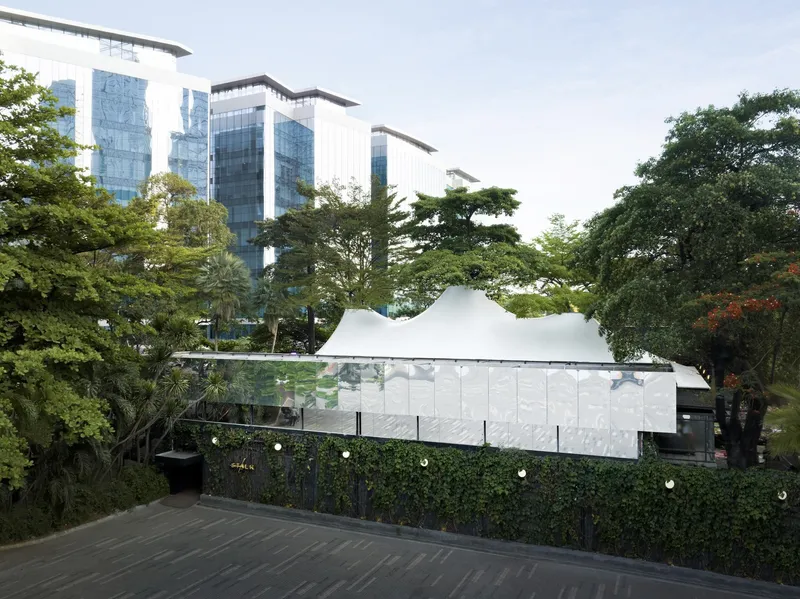
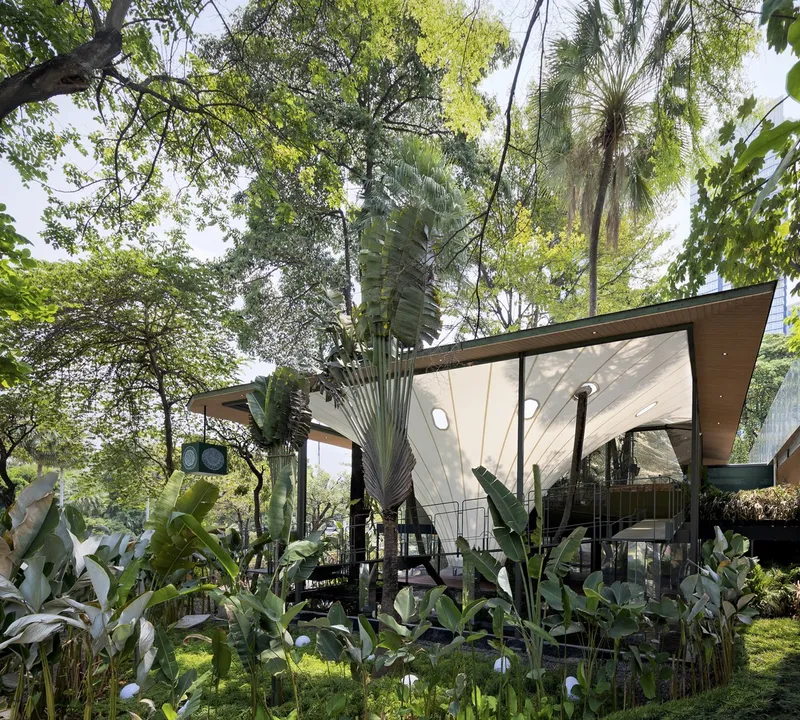
The approach to the Stalk Tree-Hugger Bar is deliberately disorienting for a commercial venue in one of Jakarta's densest districts. A planted hedge wall and vertical greenery conceal the entrance, so the building reads from the street as little more than an undulating white roof hovering behind foliage. At dusk, the illuminated path hints at something beyond, but there is no signage-scale announcement. You have to know it is there, or be curious enough to find out.
Once past the concealed threshold, a narrow foyer surrounded by banana palms and mature trees filters the noise of the city before delivering guests to the upper bar and restaurant. The Asahi glass walls allow full visual continuity with the landscape, so the transition from exterior to interior feels less like entering a building and more like moving deeper into a garden that happens to serve cocktails.
The Canopy as Architecture
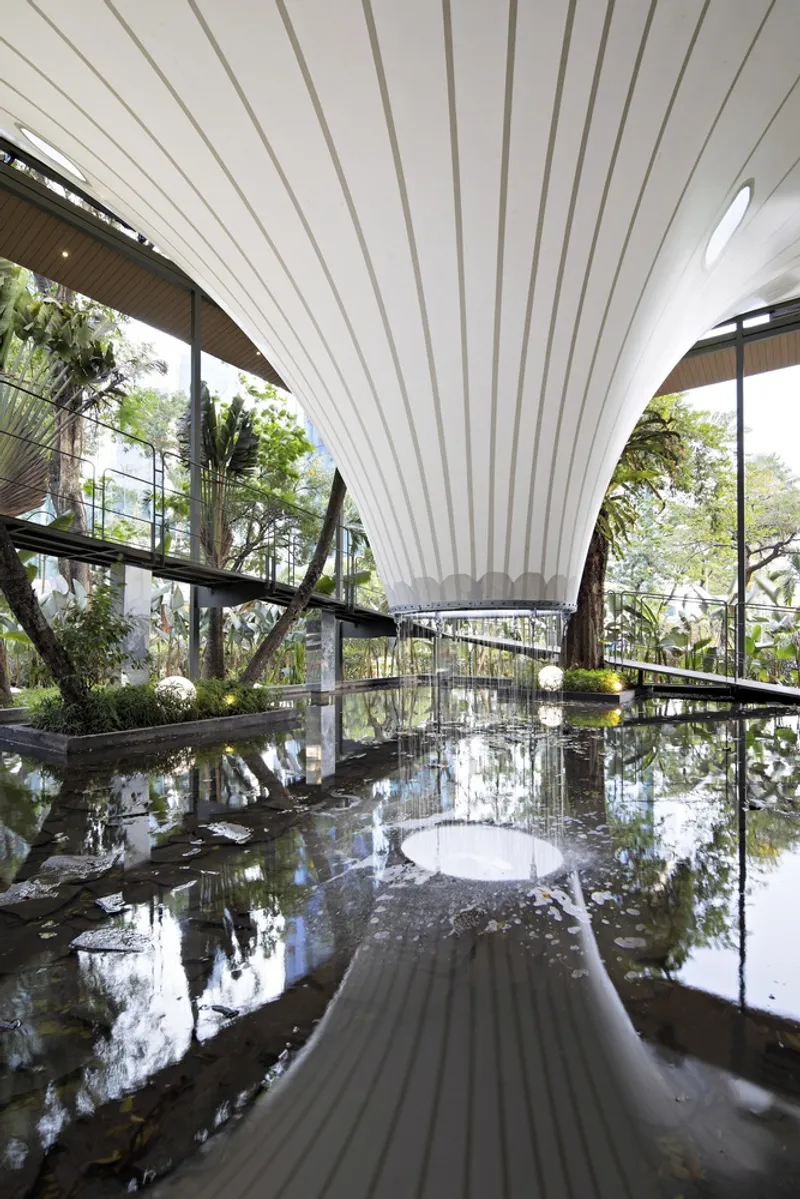
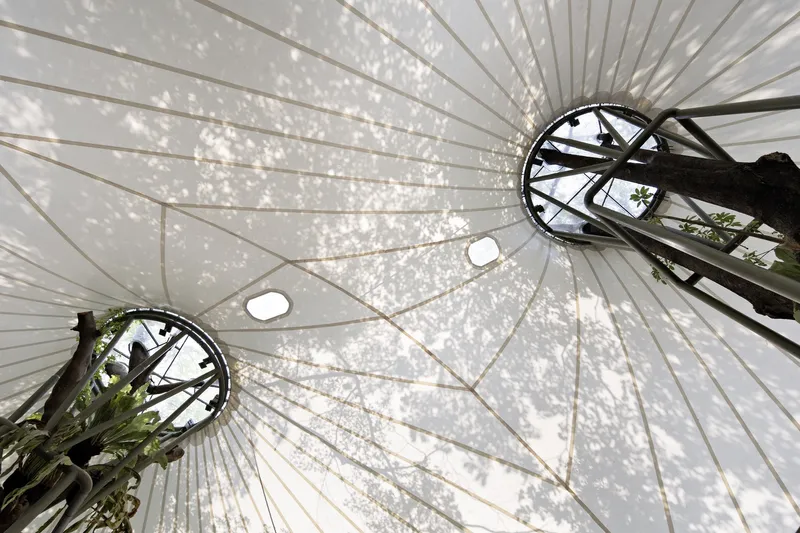
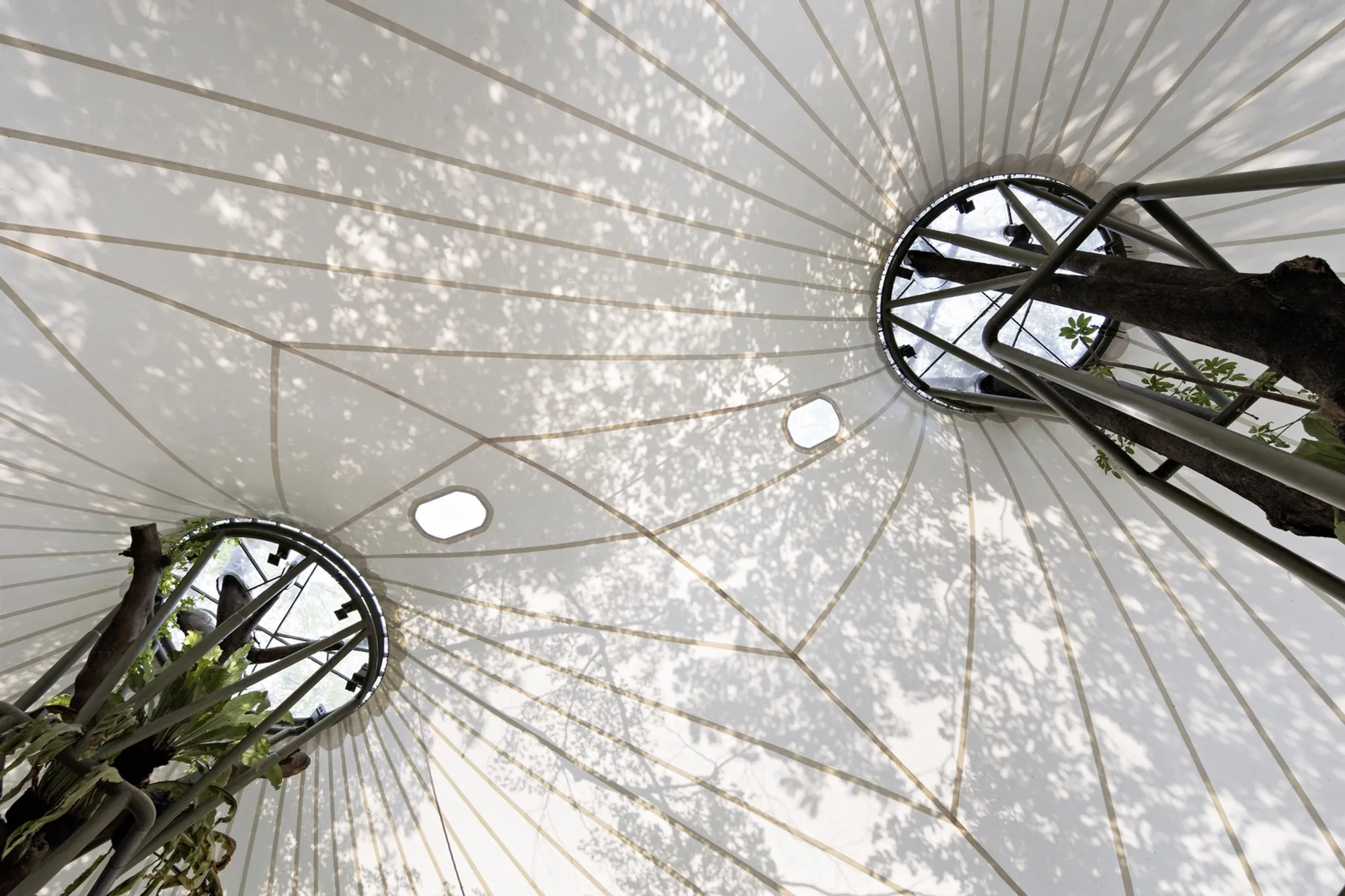
Look up inside the bar and the structural logic becomes immediately legible. Radial steel ribs fan outward from the tree trunks, supporting the tensile membrane in a series of bell-shaped forms. The fabric is taut where it needs to resist wind loads and loose enough elsewhere to billow slightly, creating a ceiling that breathes. Dappled light passes through the membrane and mixes with the shadows cast by the real canopy above, producing a layered optical effect that no fixed ceiling could replicate.
The light steel and timber thatch roof frame anchors the parametric tensile structure while doubling as a thermal buffer. It shades the glass walls during the day, reducing heat gain in Jakarta's relentless equatorial climate, and at night it glows from within, turning the entire roof into a lantern visible from the surrounding towers. The roof is simultaneously facade, varied interior ceiling, and urban signal. That kind of triple duty from a single element is where the design earns its complexity.
Trees as Structural Members
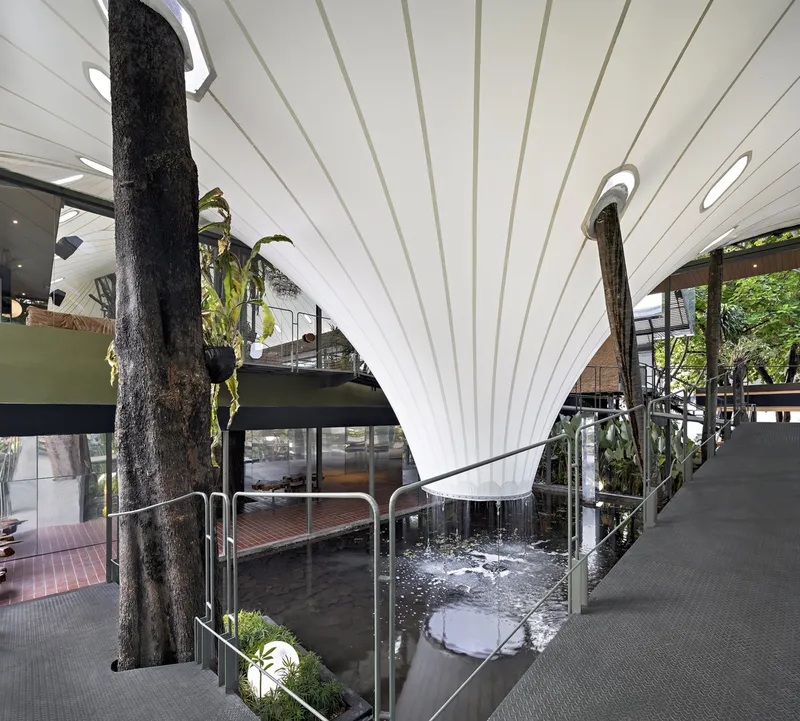
The most striking interior moments occur where the preserved trunks pierce through the ribbed white ceiling and stand beside reflecting pools. These are not decorative insertions. The trees carry real structural and environmental loads: they anchor the tensile forms, they shade the dining areas, and the wind passing through their branches drives natural ventilation across the 750-square-meter upper level. RAD+ar essentially drafted the trees into service as columns, air conditioners, and mood lighting all at once.
The water features at the base of the trunks serve a practical function beyond aesthetics. They protect the root zones from foot traffic and hardscape compaction, giving the trees room to continue absorbing water in what is otherwise a heavily urbanized site. It is a small detail, but it signals that the preservation ethic here extends below grade, not just to the photogenic canopy.
Climate Without Machinery
Jakarta is hot, humid, and still for long stretches. A conventional bar in this district would seal itself behind glass and let Gree split units do all the work. RAD+ar takes a different stance: the tensile openings at each apex create a stack effect, drawing warm air upward and out while the tree canopy above reduces solar gain on the membrane itself. Wind moving through the branches generates turbulence that shifts the fabric, creating pressure differentials that aid cross-ventilation. The Gree HVAC system is present, but it operates as backup rather than primary conditioning.
The thatch roof layer adds another passive mechanism, absorbing radiant heat before it reaches the glass. Combined with the ever-shifting tree shadows, the result is a space that stays considerably cooler than its context without relying entirely on mechanical systems. For a commercial venue that needs to remain comfortable during Jakarta's peak afternoon hours, this layered passive strategy is both brave and pragmatic.
Plans and Drawings
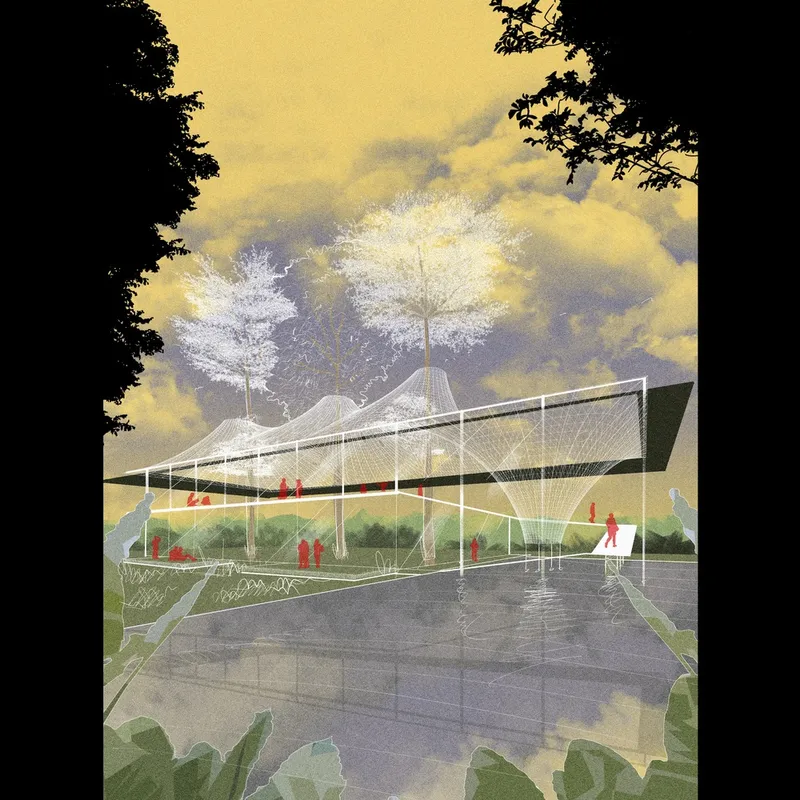
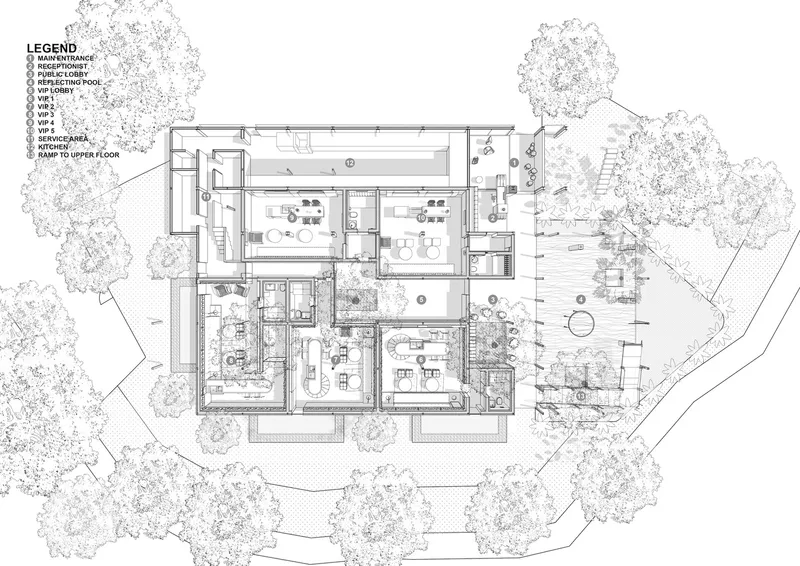
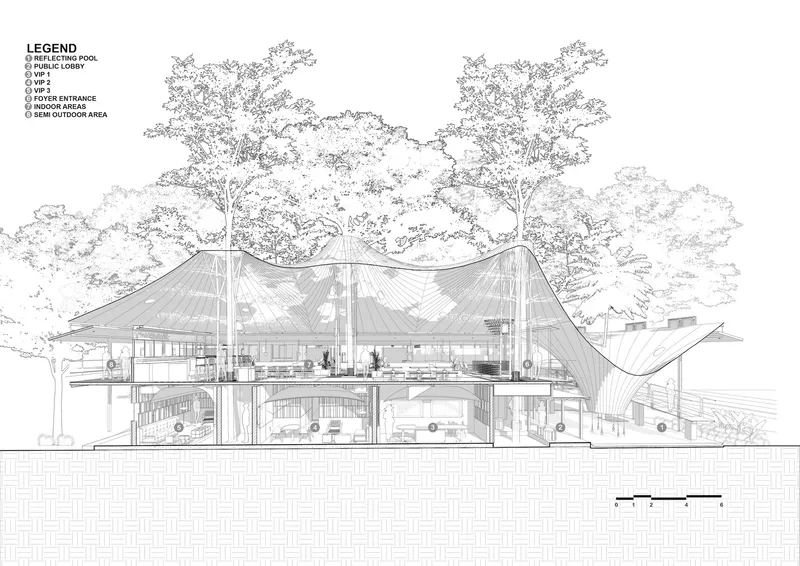
The floor plan reveals the spatial logic that the photographs can only hint at. Library and dining zones are arranged around courtyards defined by the existing tree positions, so the plan is essentially a negotiation between program and root zones. No tree was moved; the rooms were. The section drawing is even more telling: the flowing roof structure dips and rises to accommodate the canopy heights of different species, creating varied ceiling conditions on the upper level while the ground floor VIP rooms tuck beneath in lower, more intimate volumes.
The twilight rendering confirms the design intent for the building's nighttime identity. The membrane glows from interior lighting, and the trees read as dark silhouettes against the luminous fabric, reversing the daytime relationship where the trees provide shade and the architecture recedes. It is a clever inversion that gives the venue two distinct characters across a 24-hour cycle.
Why This Project Matters
The Stalk Tree-Hugger Bar matters because it confronts a real tension in rapidly developing Southeast Asian cities: the economic pressure to maximize commercial floor area versus the ecological and experiential value of mature urban trees. RAD+ar's answer is not sentimental. The trees are not preserved as a gesture of guilt; they are instrumentalized as structure, climate devices, and spatial generators. The project proves that minimum intervention can produce maximum commercial atmosphere, which is the only argument that will persuade developers in districts like SCBD.
More broadly, the parametric tensile approach offers a replicable model. The bell-shaped membranes with open apexes can accommodate different tree species, trunk diameters, and growth rates. The system is not site-specific in the way a bespoke concrete shell would be. It is an adaptable kit of parts for wrapping architecture around nature rather than the reverse. If this prototype leads to even a handful of similar projects in Jakarta or beyond, it will have shifted the default assumption that trees on a commercial site are liabilities. They are, in fact, the most valuable assets money cannot buy and time cannot replace.
Stalk Tree-Hugger Bar by RAD+ar (Research Artistic Design + Architecture), led by Antonius Richard Rusli with Melanie Regina Hutany, Alifi Muhammad Arief, and Michellin Sonia Wibowo. Jakarta, Indonesia. 900 square meters. Completed 2023. Photography by Mario Wibowo.
About the Studio
Share Your Own Work on uni.xyz
If projects like this are the kind of work you want to make, uni.xyz is a place to publish your own, find collaborators, and enter design competitions.




Popular Articles
Popular articles from the community


Play: Fragments of Their World
Familiar architecture becomes modular playground design, creating safe spaces where displaced children can learn, connect, imagine and play.

Co-life: Sustainable Architecture for Age-Friendly Community Living
Co-life reimagines sustainable architecture for seniors through courtyards, rammed earth, shared gardens, and spaces designed for belonging.

The Ocean Hive: Sustainable Architecture for a Self-Sufficient Civilization at Sea
The Ocean Hive imagines sustainable architecture at sea, where modular habitats, algae, wave power and ocean waste sustain a growing colony.

The Musturak Paradise: Senior Living Architecture for a Connected Future in Temara, Morocco
The Musturak Paradise reimagines senior living architecture in Temara via private homes, social spaces, culture, community, and shared care.

Similar Reads
You might also enjoy these articles


Hodi-Mandai Geram
Project Function: Preservation and revitalization of the Intangible heritage and socio-spatial identity of the Hodi by Housing, Cultural Memory Center, Sacred Grove, landscape, local tourism economy


Olio Towers: A Mid-Rise for Performers That Fuses Housing, Rehearsal, and Stage
Located blocks from Houston's Theater District, this modular tower stacks living units around a central performance atrium.

Oasis: Modular Green Housing Carved into Dhaka's Urban Fabric
A shortlisted Plugin Housing entry reclaims unauthorized settlements in Dhaka with stepped concrete volumes, green roofs, and ventilation-driven design.

Black Hole: A Floating Megastructure for the Post-Physical Era
Emiliano Mazzarotto envisions a spherical, self-scaling arena where e-sports, digital hotels, and holographic stadiums replace traditional public space.

Explore Architecture Competitions
Discover active competitions in this discipline



Challenge to reimagine the Iron Throne


Photograph architecture without architects


Illustrate the lost glory of Angkor Wat - Render Challenge


Design challenge to reuse E-waste
Comments (0)
Please login or sign up to add comments
No comments yet. Be the first to comment!