

STARH Wraps 420 Rooms in Flattened Arches to Preserve a Century-Old Pine Forest on the Black Sea
A 39,000-square-meter resort in Bulgaria's oldest seaside retreat defers to its inherited landscape of black pines and mineral springs.


Saints Constantine and Helena, ten kilometers north of Varna on Bulgaria's Black Sea coast, has been a resort since 1908, when greenery species were imported from France and seven mineral water springs were discovered nearly two kilometers below the surface. Over the decades, hotels rose, aged, and were eventually demolished, leaving behind something more valuable than the buildings themselves: dozens of mature black pines that had grown tall enough to define the character of the entire coastline. When STARH, led by Svetoslav Stanislavov, took on the commission for the Aquahouse Hotel & SPA, the first design move was not architectural. It was cartographic. The firm mapped every significant tree on the site and committed to keeping the new building's footprint within the exact margins of the structures it replaced.
The result, completed in 2022, is a 39,315-square-meter, four-storey resort that curves around and between its inherited pines rather than displacing them. The architectural language is deliberately restrained: sand-toned plaster and limestone, a single repeated motif of flattened arches that references the natural sea arches eroded into the nearby coastline, and maximized glazing behind each arch to pull daylight deep into 420 rooms and apartments. The building aspires to be a backdrop, not a spectacle, and that discipline is what makes it genuinely interesting.
A Footprint Dictated by Trees
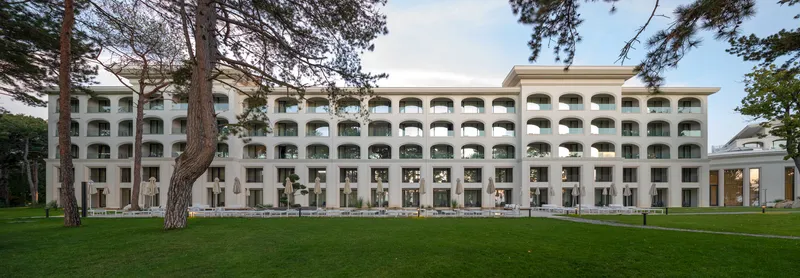
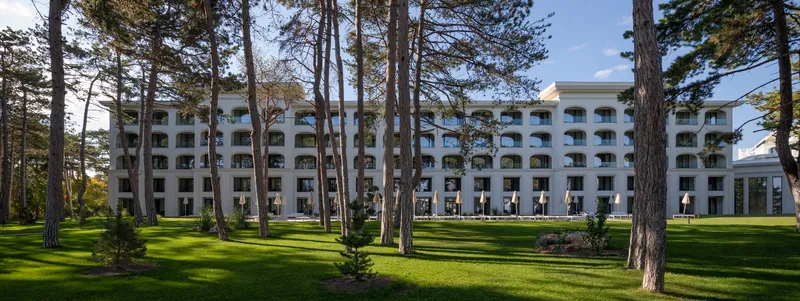
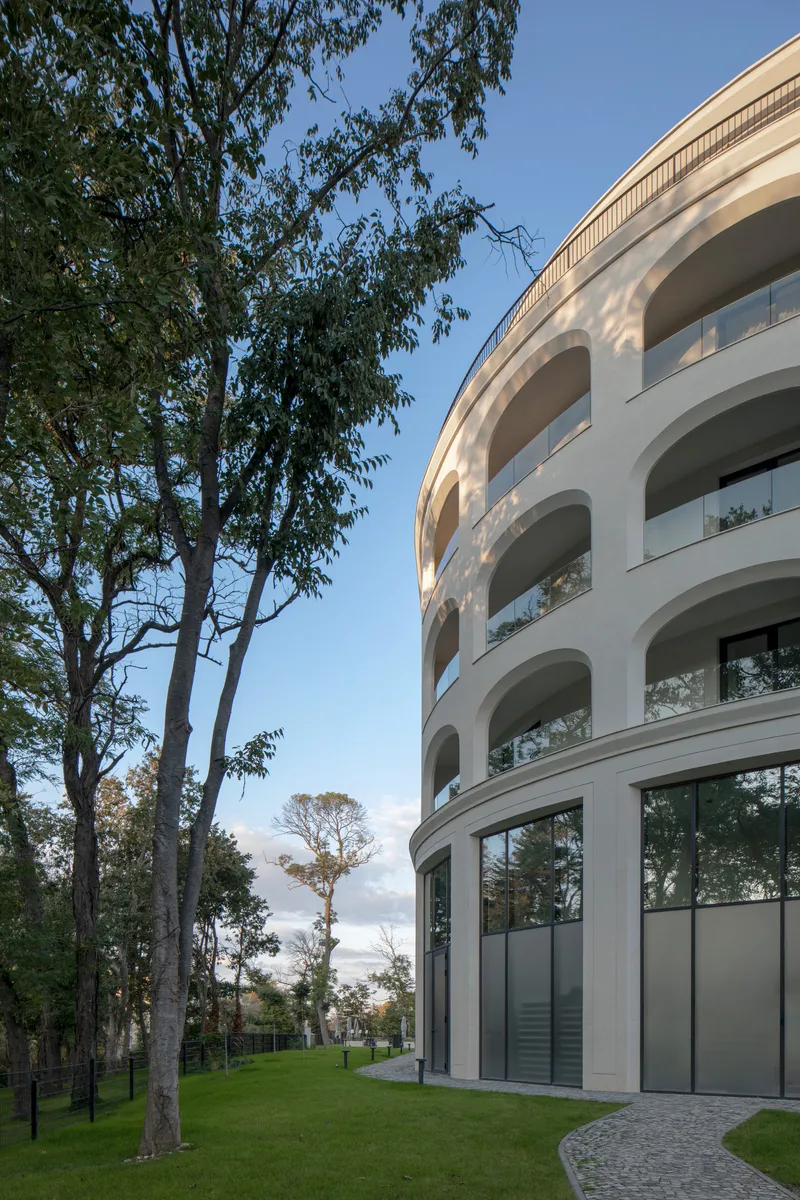
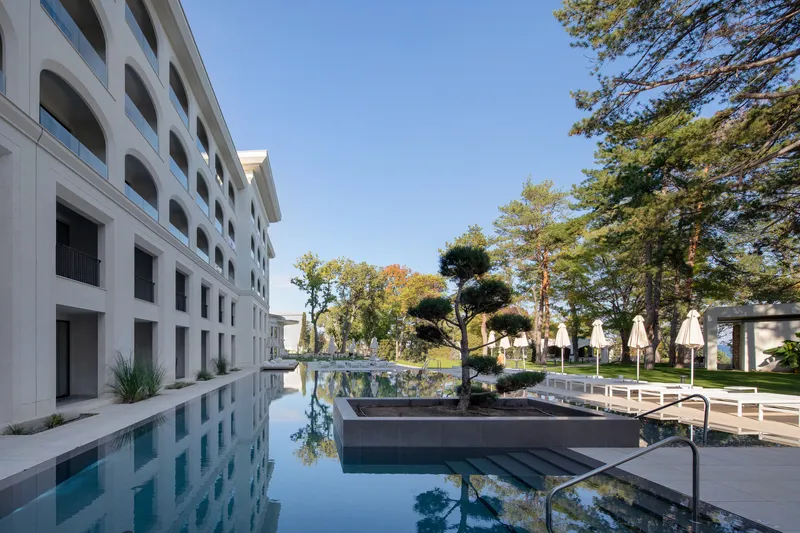
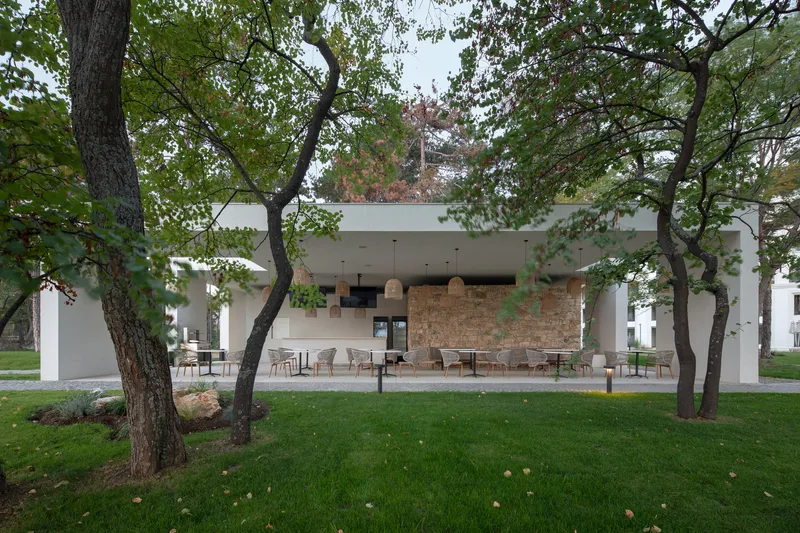
Most resort projects of this scale treat landscaping as an afterthought: something to plant around the perimeter once the concrete has cured. STARH inverted that sequence. The masterplan was shaped by existing vegetation, with the building's curving wings threading between stands of black pine so that trees appear in front of, beside, and occasionally above the roofline. Walking the grounds, you encounter moments where a mature pine trunk stands only a few meters from a facade of stacked arches, its dark bark and horizontal branches offering a biological counterpoint to the building's pale geometry.
The soft sand tones of the plaster and limestone reinforce this hierarchy. Against the deep green canopy, the hotel reads almost as a limestone cliff: present, solid, but recessive. It is a strategy that costs relatively little in material terms but demands genuine discipline in planning, because every shift in the building's curve and every setback in its massing had to be negotiated with roots that were already a century old.
The Flattened Arch as Structural Motif
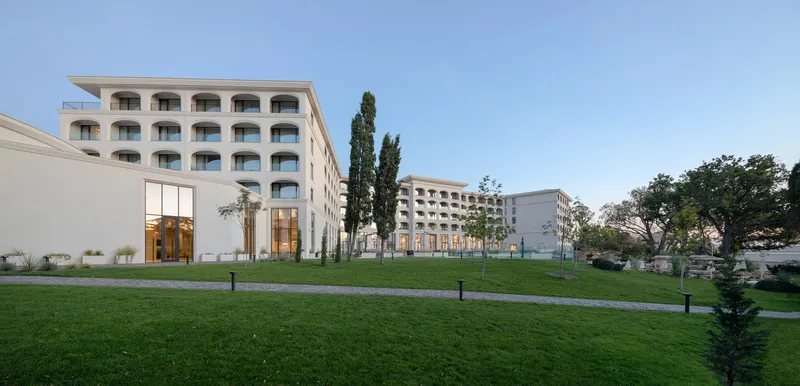
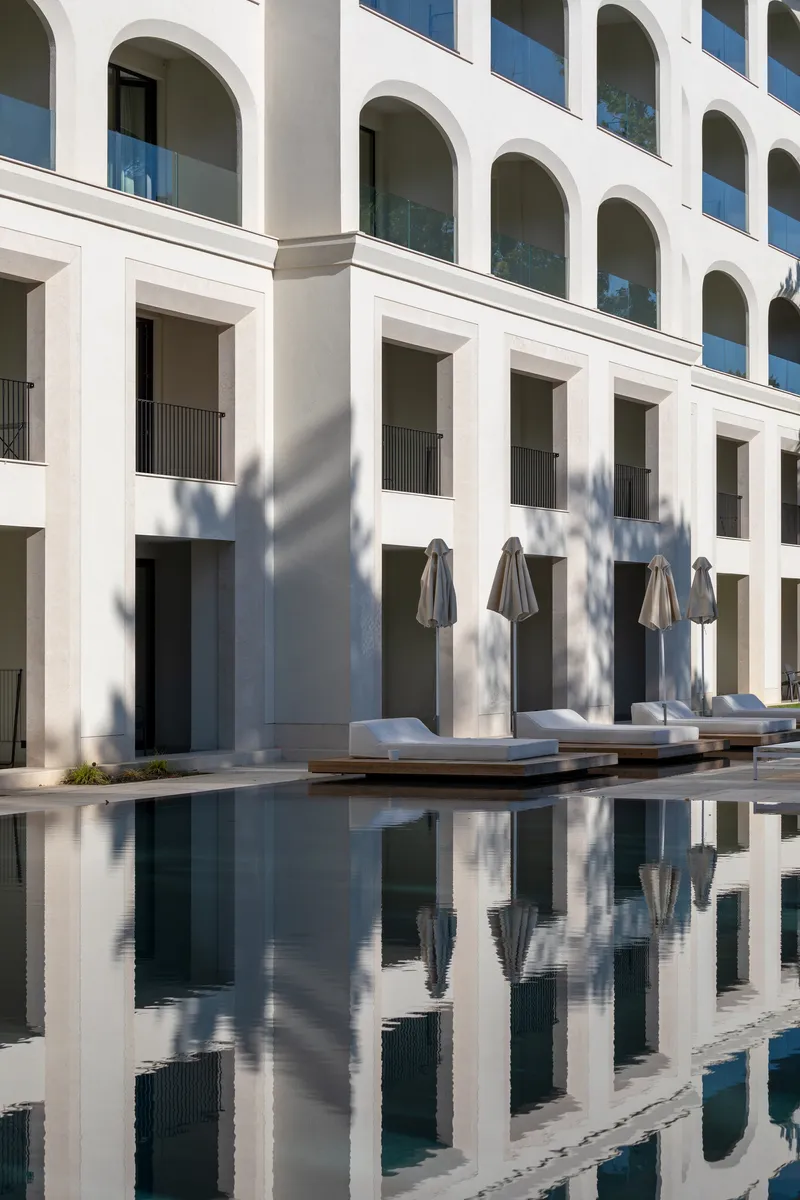
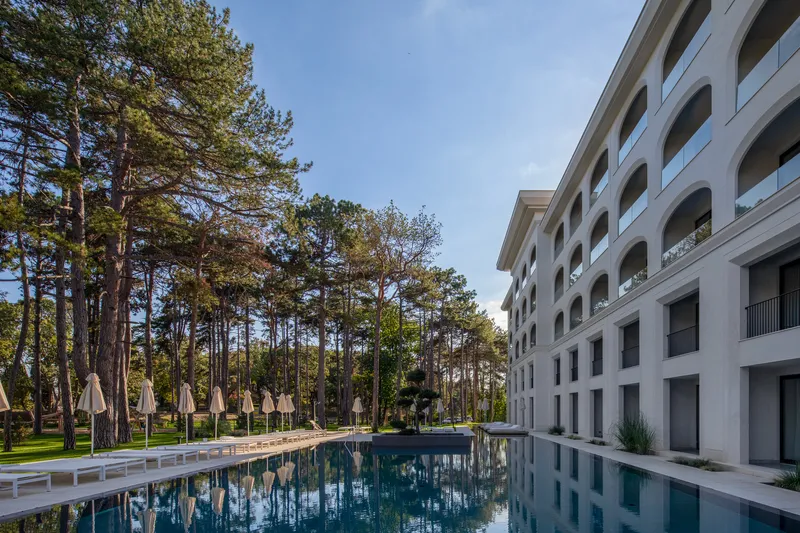
STARH's decision to base the entire facade language on a single, flattened arch is both a formal and a contextual argument. The motif is not a Roman arch, not a pointed Gothic one, but a compressed, wide curve that echoes the natural sea arches worn into the rocky shoreline nearby. Repeated across four storeys and hundreds of meters of facade, it creates a rhythm that is legible from a great distance, as you can see from the aerial views, yet intimate at balcony scale, where each arch frames a view of pine canopy, sea, or courtyard.
Critically, the arch is not decorative appliqué. Behind every opening sits floor-to-ceiling glazing, maximizing daylight and view for each guest room. The result is a facade that works double duty: from outside, it gives the building a classical solidity; from inside, it dissolves into panoramic glass. The reflecting pools that run alongside certain wings amplify this effect, doubling the arches in still water and blurring the boundary between architecture and landscape.
Curving Through the Canopy
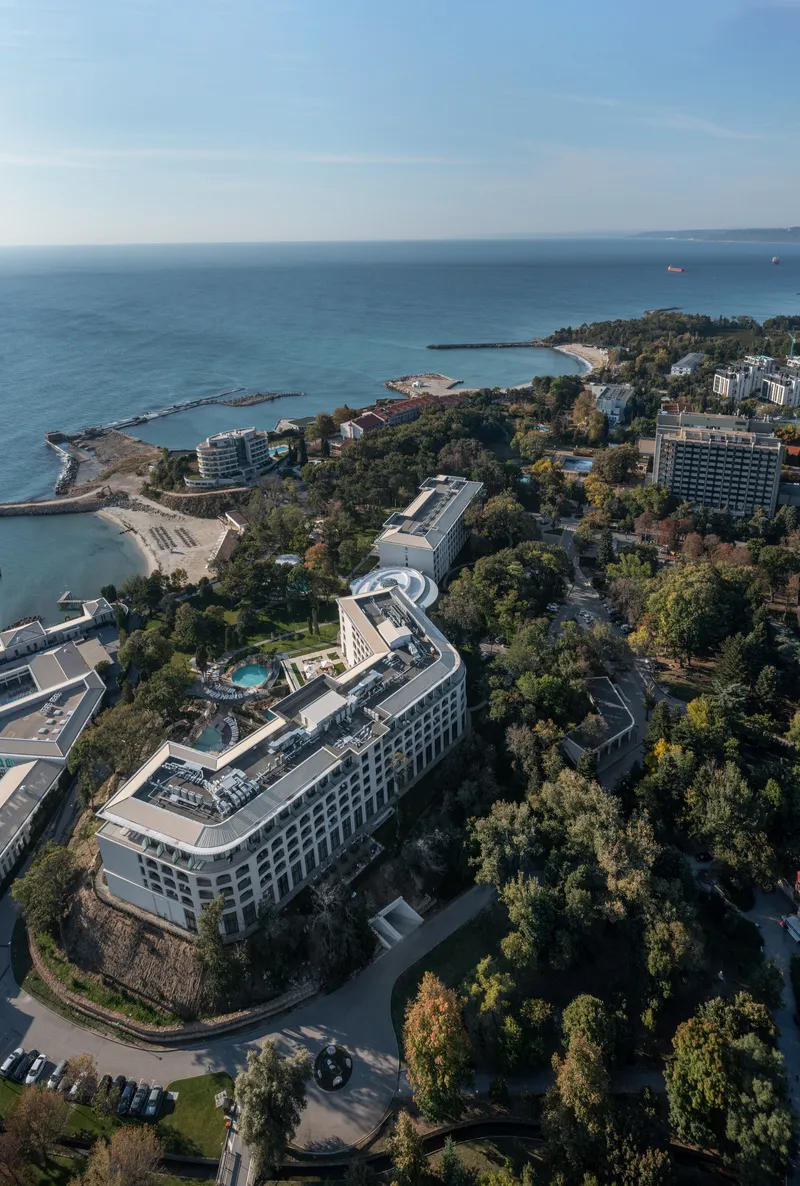
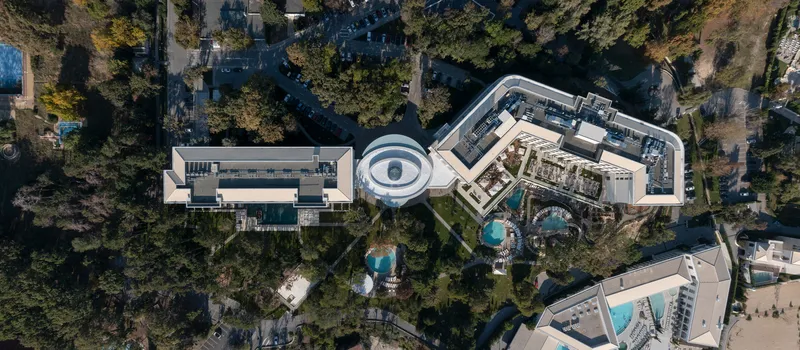
The aerial views reveal what cannot be understood from ground level: the building is not one block but a series of curved wings that snake through the forest, enclosing a circular courtyard and opening toward the sea. Two piers extend into the water, anchoring the composition to the coastline. From above, the rooftop pools and terraces read as clearings in a continuous canopy, reinforcing the impression that the forest was here first and the architecture arrived as a careful guest.
This curvilinear plan also solves a practical problem. A straight bar of 420 rooms would have been oppressively long and would have required the removal of far more trees. By bending the wings, STARH shortened perceived corridor lengths, created varied orientations for different room types, and generated sheltered outdoor spaces, the courtyard gardens, the pool decks, that feel enclosed without being claustrophobic.
Arrival and the Lobby Rotunda
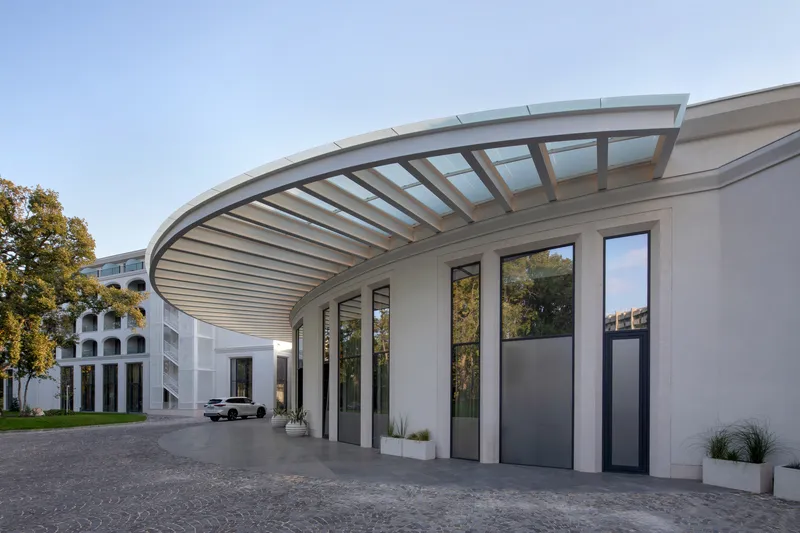
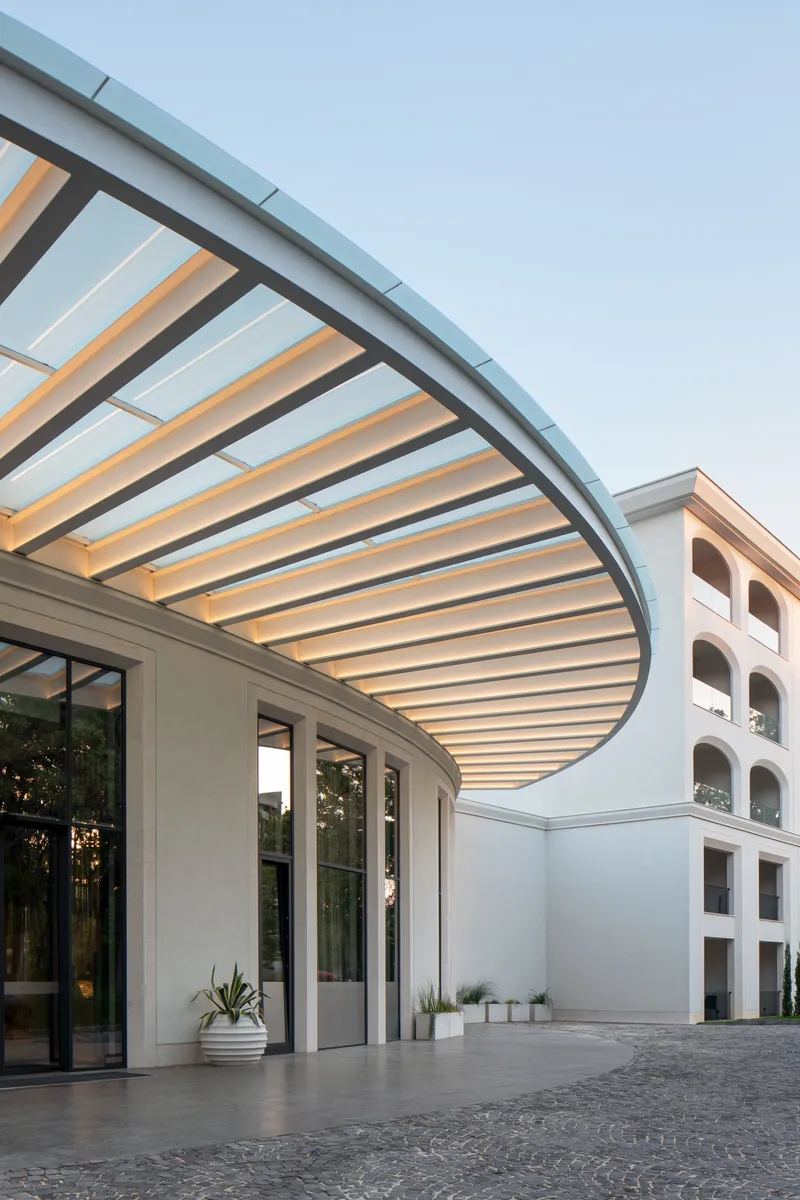
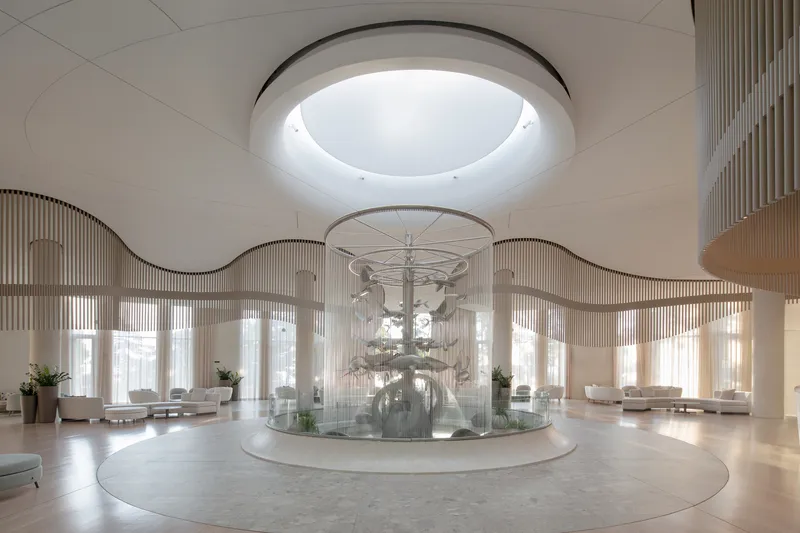
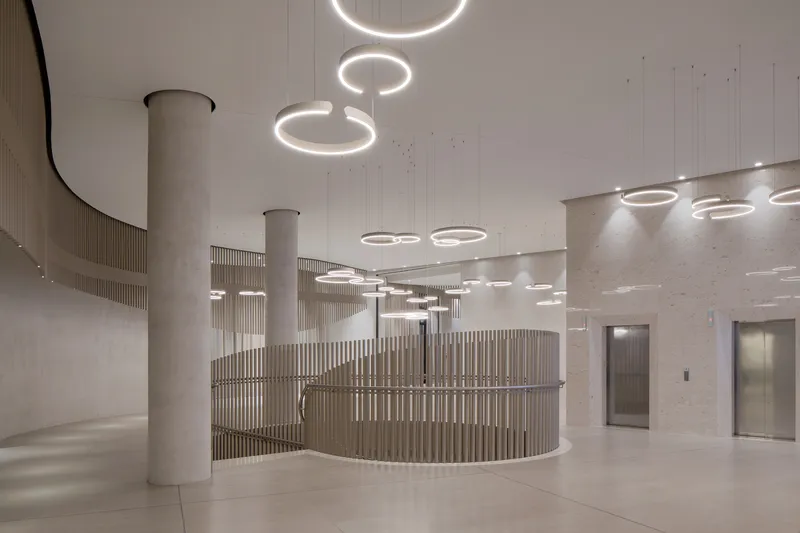
Guests enter through a canopy of curved timber and metal ribs that fans outward above tall glass doors, a gesture that is simultaneously generous and structurally transparent. The ribs are exposed on the underside, their rhythm previewing the arched language of the main facades. Beyond the threshold, the lobby opens into a circular volume organized around a central fountain beneath a ring skylight. An undulating slatted screen wraps the perimeter, filtering light and softening acoustics without closing the space off from the reception areas beyond.
The circular plan of the lobby is a deliberate spatial decompression point. After the horizontal procession through the entry canopy, guests step into a vertical cylinder of light. It is a classical sequence, compression then release, executed in contemporary materials: concrete columns, slatted timber, and pendant rings that echo the skylight above.
Interiors: Texture over Ornament
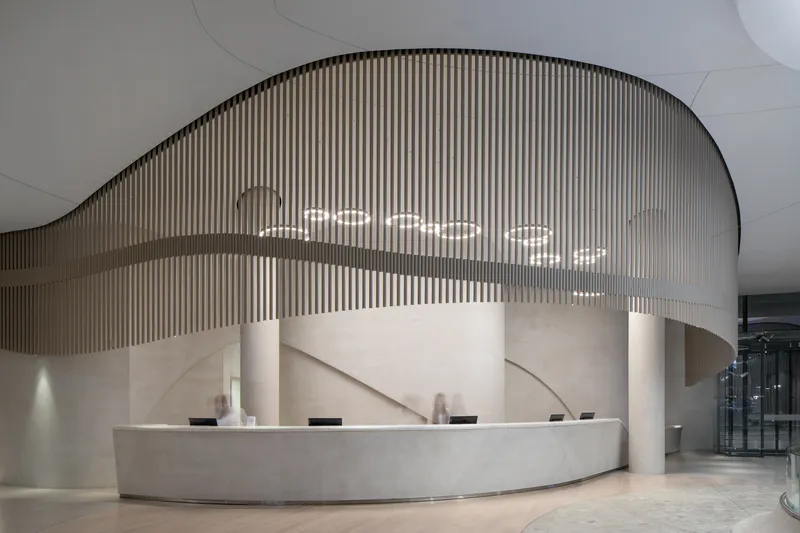
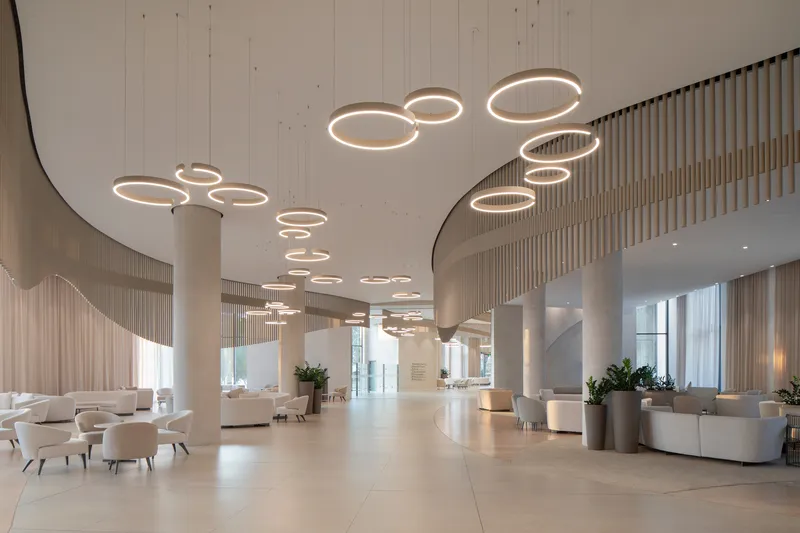
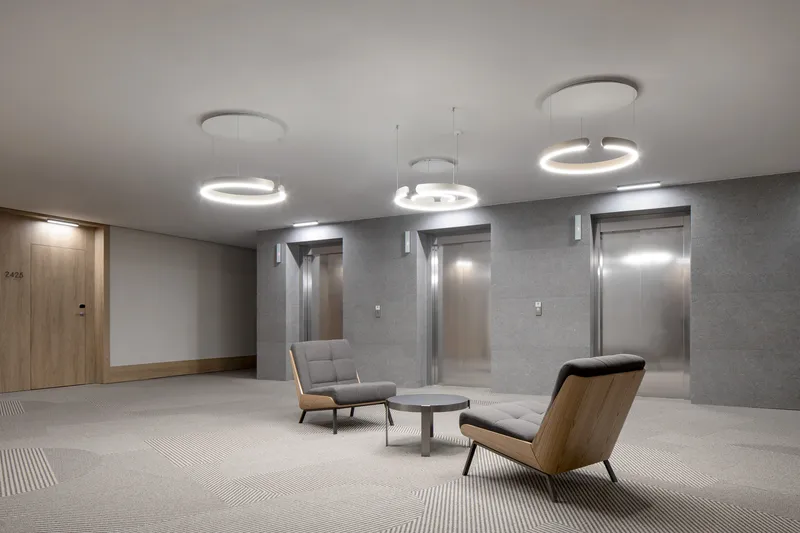
The interior palette is deliberately muted: grey textured walls, warm timber accents, stone-clad reception desks, and cascading ring chandeliers that provide ambient light without visual noise. The curved slatted timber enclosure at the reception desk is a standout detail, its flowing form recalling the canopy outside and the lobby screen above. Cylindrical columns and circular pendant lights recur throughout the public spaces, maintaining a geometric consistency that ties elevator lobbies, corridors, and lounges into a coherent sequence.
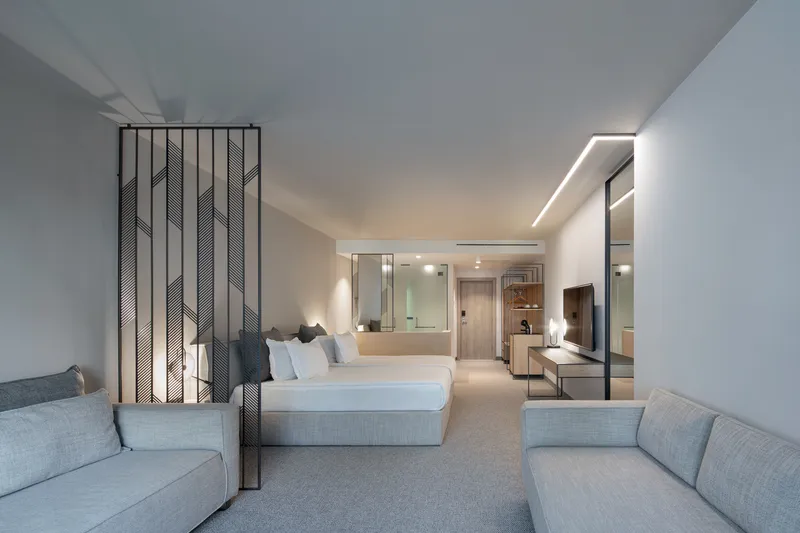
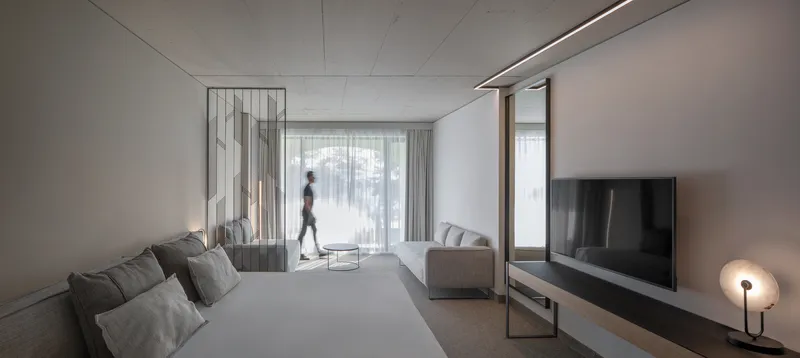
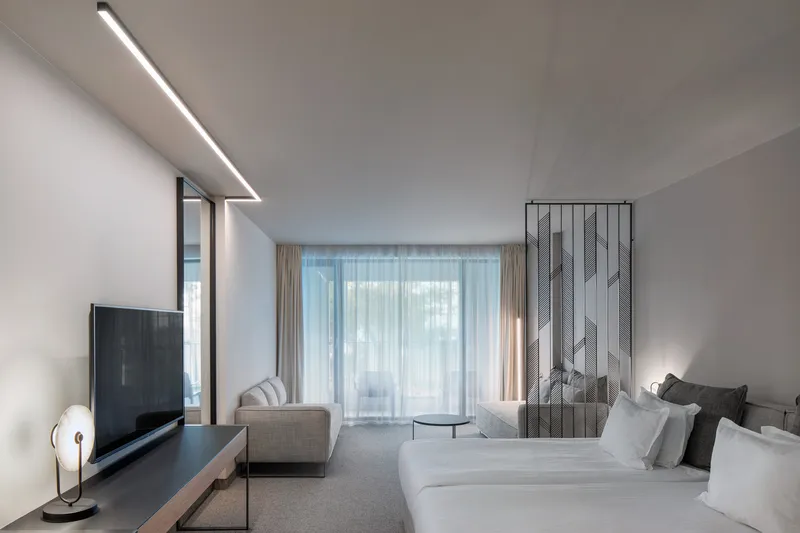
Guest rooms deploy a perforated metal room divider as their signature element, separating sleeping areas from lounge zones without sacrificing openness. The perforation pattern admits filtered light and maintains visual connection across the room, while the metal surface introduces a cooler material note against the warm grey textiles. Superior rooms at 47 square meters are generous by resort standards, and the floor-to-ceiling windows behind each facade arch ensure that the view, whether pine canopy or sea, is always the dominant interior feature.
Spa, Pools, and the Mineral Water Legacy
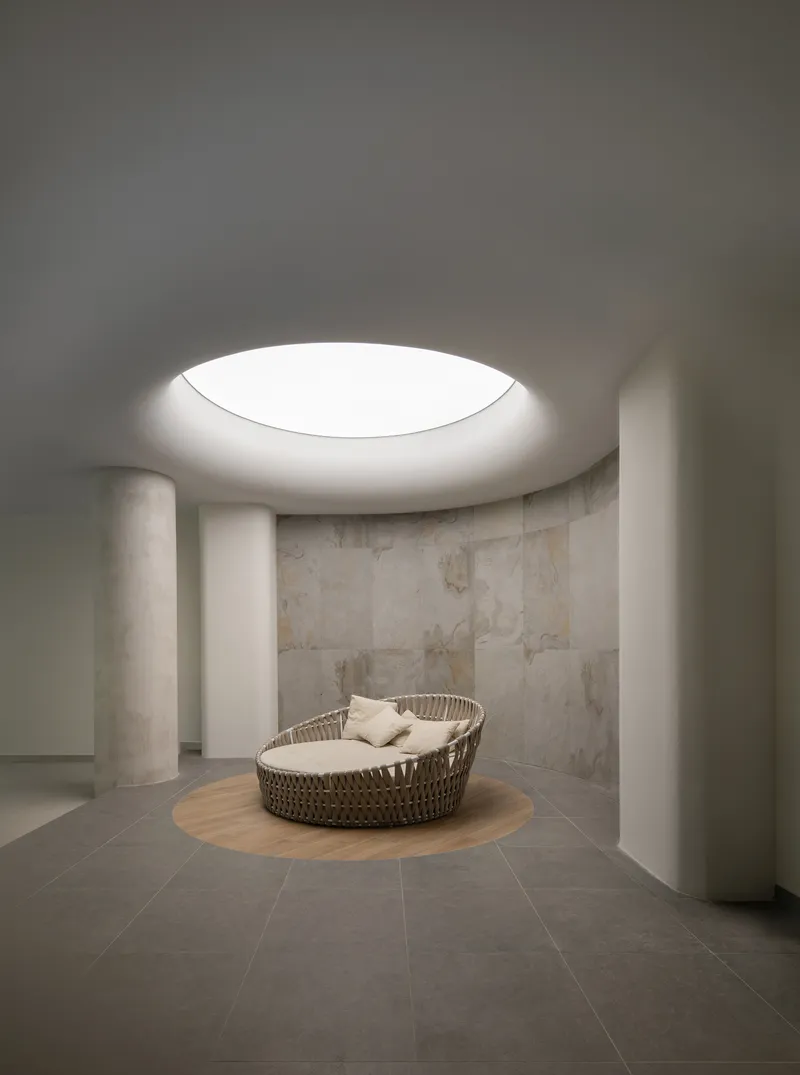
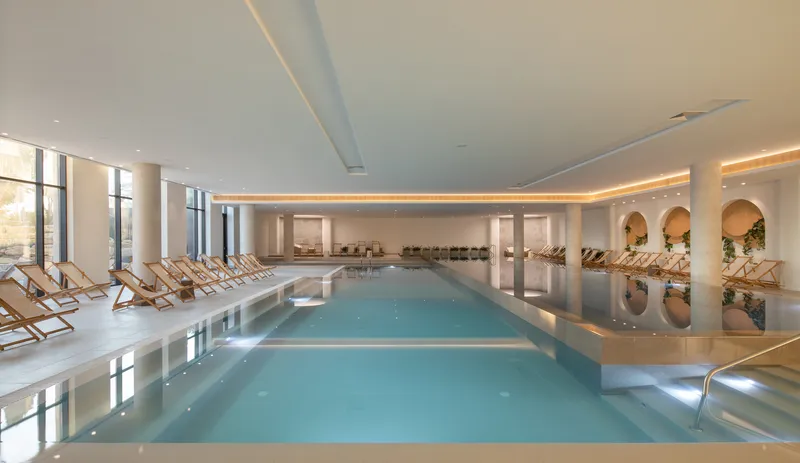
The resort's 6,000-square-meter thermal complex, with 14 pools fed by seven mineral water springs, is housed on level minus one. The indoor pool hall lines its walls with arched niches that mirror the exterior facade, creating a subterranean echo of the aboveground architecture. Rows of loungers reflected in the still water give the space a meditative calm. A circular spa room with a glowing oculus skylight and limestone walls distills the building's formal language to its purest expression: a single curve of stone, a single circle of light.
Five outdoor pools are distributed across the grounds, and covered terraces with stone accent walls extend the social program into the landscape. The access to hot mineral water, drawn from depths of 1,800 to 2,050 meters, is not merely a marketing point. It is a genuine site resource that shaped the brief and justified the scale of the wellness program. Few resort projects can claim that the water itself is as site-specific as the architecture.
Corridors and Thresholds
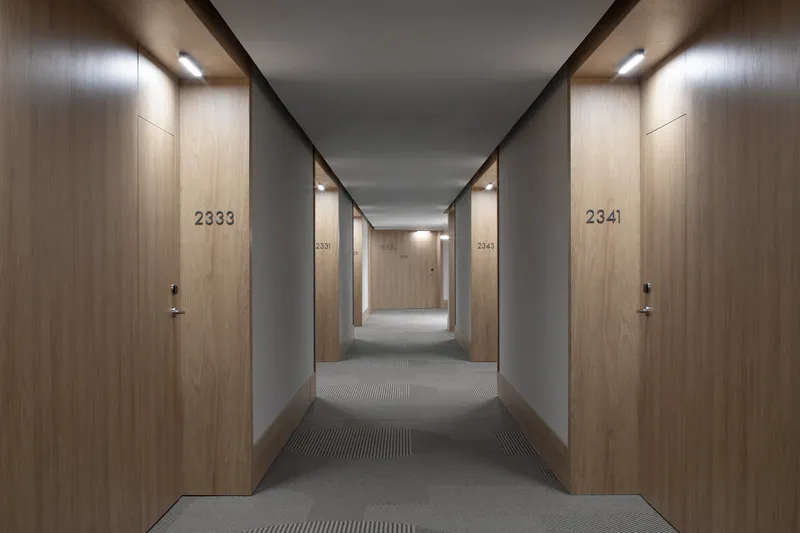
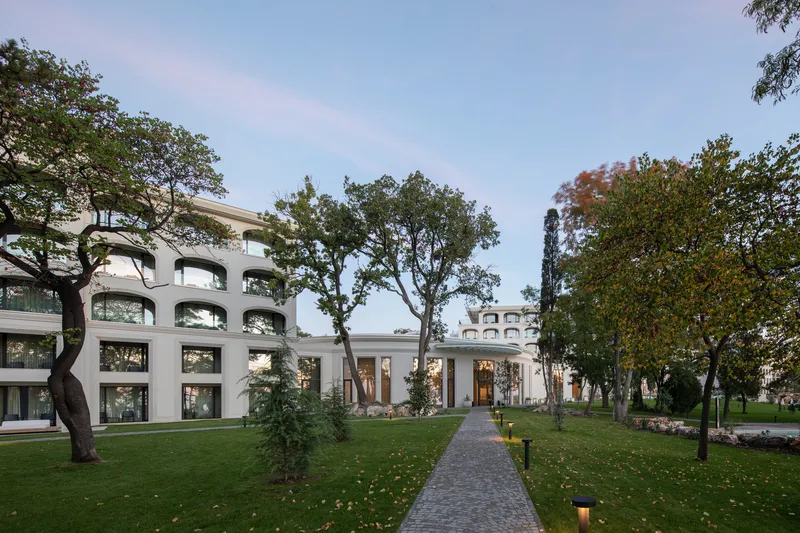
Hotel corridors are notoriously thankless spaces, but STARH handles them with quiet precision: recessed linear lighting, numbered timber doors, and grey walls that avoid the pattern-heavy carpet-and-wallpaper clichés of conventional hospitality design. The courtyard garden paths, lit warmly at dusk, continue this restrained material language outdoors, with stone paving leading toward illuminated porticos that frame the transition between landscape and interior.
Plans and Drawings
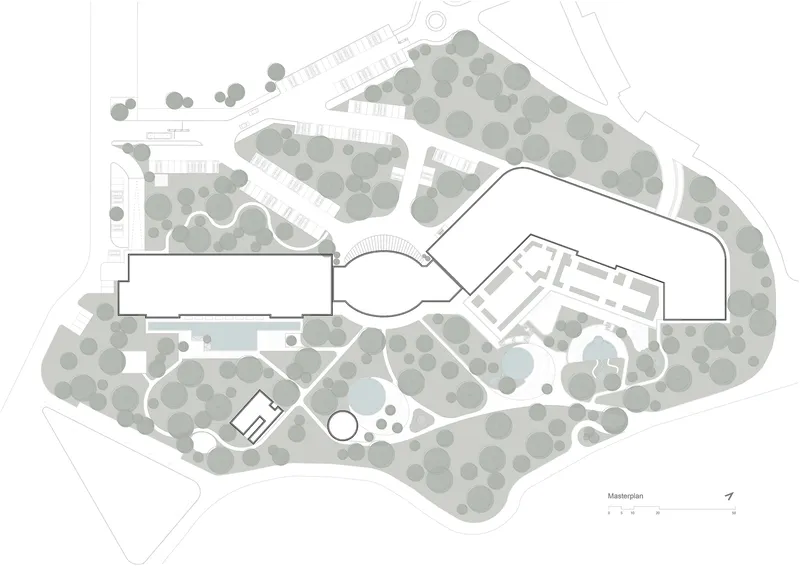
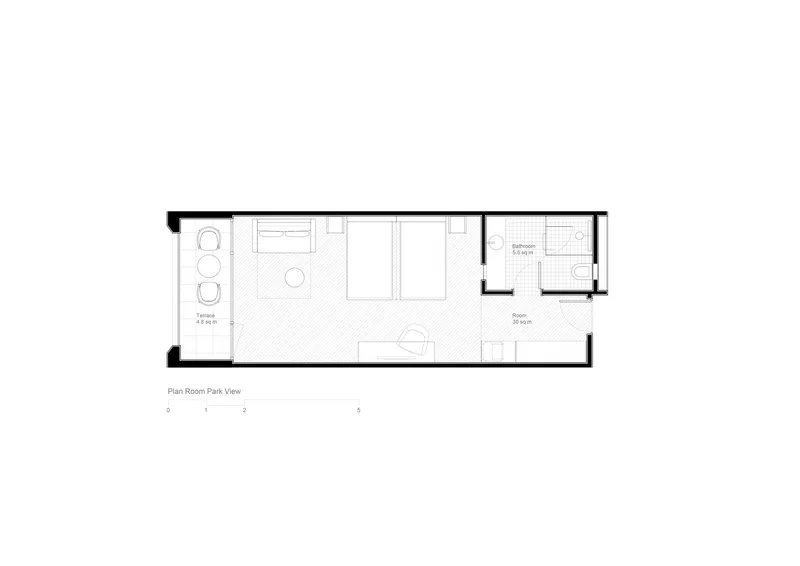
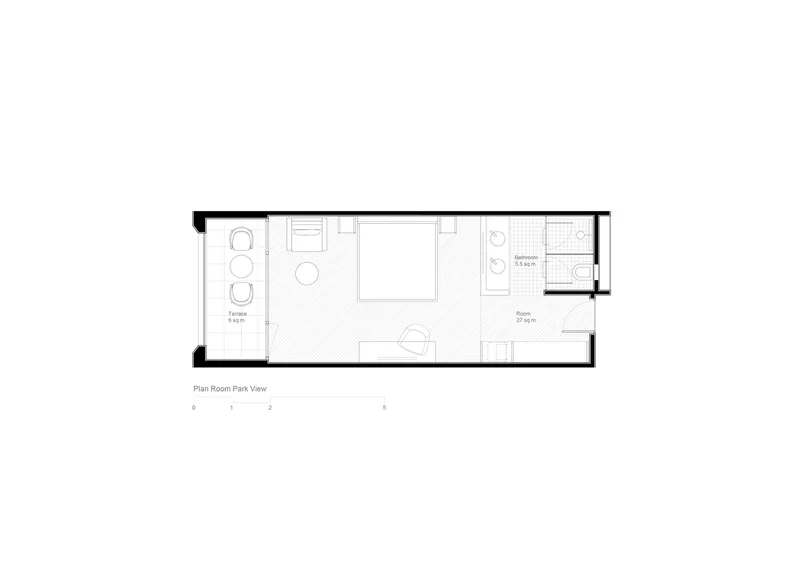
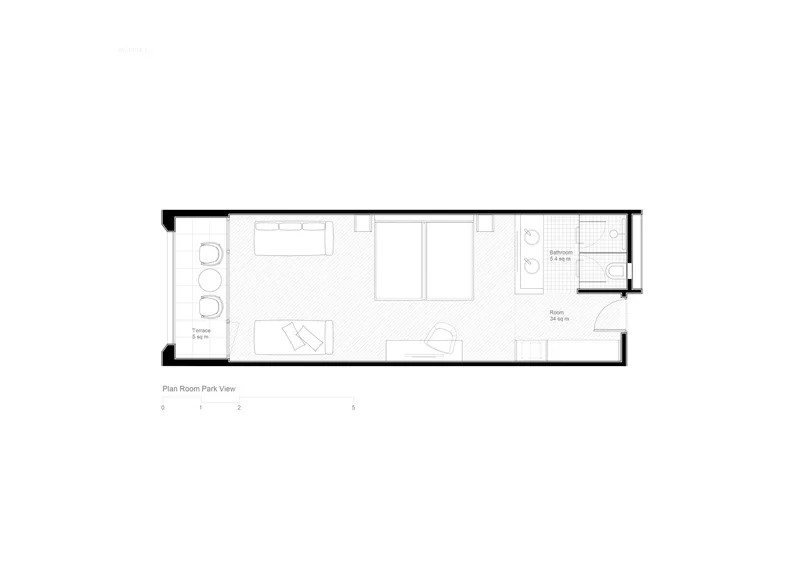
The site plan confirms what the aerial photographs suggest: the building's wings wrap sinuously around clusters of existing trees, with landscaped pathways connecting the various outdoor spaces. Three room plan variations, types A, B, and C, accommodate different unit sizes and orientations, each organized around the same basic logic of an entry zone, a wet core, a sleeping area, and a terrace framed by the flattened arch. The plans reveal that the perforated metal divider seen in photographs is a consistent spatial device across all room types, not a bespoke one-off.
Why This Project Matters
Resort architecture at this scale, nearly 40,000 square meters and 420 keys, almost never manages to be genuinely deferential to its site. The economics push toward maximum footprint, minimum setback, and clear-cut landscapes replanted with ornamental palms. Aquahouse makes the opposite bet: that preserving the existing black pines and constraining the building to the footprint of demolished predecessors would produce a more compelling environment than any amount of new landscaping could achieve. The bet pays off. The trees give the project a maturity and rootedness that a newly opened hotel has no right to possess.
STARH's formal restraint, one arch motif, one material palette, one tonal range, is equally significant. In a coastal market saturated with pastiche historicism and glass-curtain-wall modernism, Aquahouse charts a middle path: classical in rhythm, contemporary in execution, and specific enough in its references to natural sea arches and site geology to avoid feeling generic. It is a building that knows exactly what it wants to be, and, more importantly, what it does not.
Aquahouse Hotel & SPA, designed by STARH (lead architect: Svetoslav Stanislavov), Saints Constantine and Helena, Bulgaria. 39,315 m², completed 2022. Photography by Dian Stanchev.
About the Studio
Share Your Own Work on uni.xyz
If projects like this are the kind of work you want to make, uni.xyz is a place to publish your own, find collaborators, and enter design competitions.


Popular Articles
Popular articles from the community

Faces of the Soviet Avant-Garde: Turning Moscow's Street Names into an Open-Air Museum
A network of sculptural installations across a Moscow residential district transforms forgotten architect names into spatial encounters with cultural memor

The Amber Palace Opera: A Geological Fiction Surfaces on Tallinn's Baltic Waterfront
Pierre Brillard reimagines a Baltic legend as a public landscape, opera house, and waterfront promenade rooted in Tallinn's coastal identity.

Singing Woman: An Opera House That Performs Before the Curtain Rises
Ovidiu Cristian Pavel's conceptual opera house translates Estonia's choral identity into a sculpted waterfront landmark facing the Baltic Sea.

Manzana Morphosis: Stretching Barcelona's Grid into a Living Landscape for 2050
A radical reworking of the Eixample manzana turns density into a tool for generous public space, vertical ecology, and environmental performance.

Similar Reads
You might also enjoy these articles

Pixel Gardens: One Repeated Module Stacked Into a Terraced Social Housing Tower for Famagusta
Salem Bader's shortlisted housing tower builds a vertical neighbourhood from one repeated module, offsetting units to carve terraces, light and air.

Bao Huynh Watercolor Atelier: A Serene Art Retreat in Hội An
Bao Huynh Watercolor Atelier in Hội An blends multifunctional art spaces, sustainable design, local materials, and family-friendly living in a serene environment.

Atelier Macri Concept Store Interior Design by CASE-REAL
Atelier Macri store features a "ko" counter, walnut wood details, cork displays, blending retail, gallery, and seamless customer experiences.

Manuel Vargas Izquierdo Stadium and High-Performance Sports Center: Architectural Excellence in Jalpa de Méndez
The Manuel Vargas Izquierdo Stadium blends sustainable design, inclusive sports facilities, and cultural-inspired architecture, revitalizing Jalpa de Méndez’s public spaces.

Comments (0)
Please login or sign up to add comments
No comments yet. Be the first to comment!