

Start: SenseScape
StarSenseScape is a visitor centre where Indonesia’s five regions are explored through the five senses. Visitors walk through 25 pavilions, each offering a unique sight, sound, smell, touch, or taste. The platforms and pavilions rise above the water, with a floating market below, turning architecture into a personal journey.

Concept
Start: SenseScape started from a simple but complex question: how can one architectural project represent a country as diverse as Indonesia? Indonesia is not a single culture or identity. It is an archipelago of more than 17,000 islands with hundreds of ethnic groups, languages, rituals, and architectural traditions. Any attempt to reduce this complexity into one form inevitably becomes incomplete.
Because of that, the intention was not to simplify, but to structure diversity. Instead of one dominant narrative, the project builds a system of multiple experiences. Indonesia is understood through fragmentation and accumulation rather than a single image.
From the beginning, it was clear that a traditional exhibition approach would not be enough. A purely visual representation stays on the surface. Indonesia is experienced through atmosphere, sound, smell, material, and ritual. This shifted the project toward a sensory-based architecture.
Framework: Five Regions and Five Senses

The concept is based on two overlapping systems. The first is geographical: five main regions of Indonesia: Java, Sumatra, Kalimantan, Sulawesi, and Papua. Each region has its own cultural identity and material language.
The second system is perceptual, the five senses: sight, hearing, smell, touch, and taste. These are universal and shared by all people, which makes them a neutral way of experiencing difference.
When combined, these two systems form a matrix. Five regions multiplied by five senses create twenty-five spatial conditions. Each condition becomes a pavilion. Each pavilion represents one intersection between place and perception.
No pavilion is more important than another. All are equal fragments of one larger system.
Spatial Experience
The visitor does not follow a fixed path. There is no linear sequence. Movement is open and self-directed. Each person constructs their own journey through the system.
Architecture here is not an object but a medium for experience. Each pavilion isolates one sense and intensifies it. Sight is shaped through light and layered materials. Hearing is defined by spatial acoustics and localized sound. Smell is introduced through diffused natural scents. Touch comes through direct material contact. Taste completes the experience through regional food and tea.
These sensory elements are not decorative. They define space itself. Each pavilion becomes a focused fragment of memory.
Design Strategy
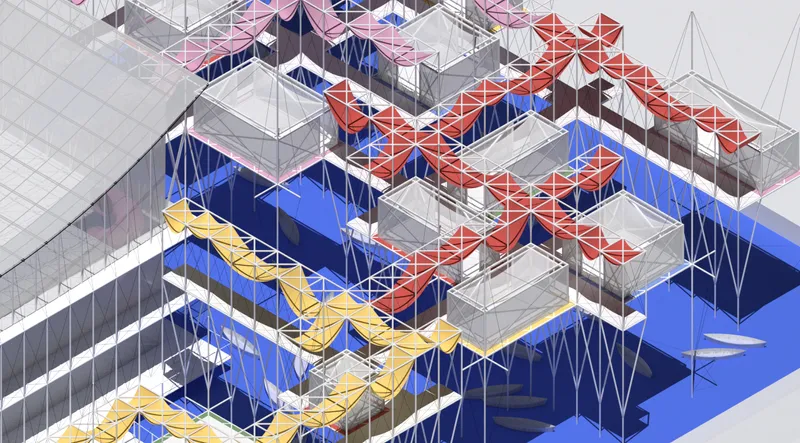
The project is developed through fragmentation. Instead of one continuous building, it is a system of independent units. Each pavilion has its own internal logic, atmosphere, and material expression.
At the same time, all units are connected through a shared structural grid. This creates consistency within diversity. The system is unified, but not uniform.
The result is a spatial structure that behaves like a network. Each part can be read separately, but also as part of a larger whole.
Site and Water Context

The site is located on the northwest coast of Java, facing the Java Sea. Water is not treated as a background, but as a key structural element.
In Indonesia, water defines geography, culture, and daily life. It connects islands and supports movement and trade. It also shapes traditional settlements such as stilt villages and floating markets.
For this reason, the entire structure is lifted above a flooded landscape. The pavilions are placed on elevated platforms, creating a floating system.
The ground level becomes a public layer in the form of a floating market. Boats function as temporary stalls, and water becomes a space of exchange. This introduces everyday life into the project and activates the site continuously.
Architectural Reference: Kalimantan Water Villages
A key reference is the vernacular architecture of Kalimantan, especially the Bajau communities. These settlements exist directly on water, built on stilts or floating structures.
Life in these villages is shaped by movement and environmental conditions. Architecture is flexible and adaptive, not fixed to land.
This logic is translated into the project through elevation and lightness of structure. The aim is not to copy traditional forms, but to continue their spatial principles in a new context.
Sensory Pavilions

Each pavilion is defined by one sense and one region.
In Java, sight is expressed through suspended batik patterns and layered light. Hearing is centered around gamelan sound. Smell is defined by incense. Touch is experienced through volcanic stone surfaces. Taste comes from traditional herbal tea.
In Sumatra, visual identity is formed through buffalo horn installations. Sound comes from Hasapi music. Smell is dominated by coffee. Touch is expressed through textile and hats. Taste is black tea.
Kalimantan focuses on rainforest atmospheres, bamboo structures, and forest sounds.
Sulawesi introduces ritual objects, rattan surfaces, and herbal scents.
Papua is defined by wooden figures, smoke, feathers, and pandan tea.
Each pavilion creates a distinct sensory environment, but all belong to the same system.
Conclusion
SenseScape treats architecture as a tool for perception rather than representation. It does not aim to present Indonesia as a fixed image.
Instead, it constructs a framework where complexity can be experienced directly. Understanding emerges through movement, sensation, and memory.
The project suggests that a place is not understood at once. It is built gradually, through fragments of experience collected over time.

Popular Articles
Popular articles from the community

Cloaked Colonization: A Mobile Underwater Habitat That Moves Like a Fish
Micah Abaya's shortlisted EHC Pacific entry reimagines ocean settlement as a dispersed network of self-sustaining architectural organisms.
Faces of the Soviet Avant-Garde: Turning Moscow's Street Names into an Open-Air Museum
A network of sculptural installations across a Moscow residential district transforms forgotten architect names into spatial encounters with cultural memor

Extended Shell: Retrofitting Kolkata's Balconies as Living Urban Thresholds
A modular retrofit system recovers the social and environmental intelligence of Kolkata's historic verandas for contemporary Park Street residents.

The Amber Palace Opera: A Geological Fiction Surfaces on Tallinn's Baltic Waterfront
Pierre Brillard reimagines a Baltic legend as a public landscape, opera house, and waterfront promenade rooted in Tallinn's coastal identity.

Similar Reads
You might also enjoy these articles

The Rhythm of Seasons
A Farmers' Market Connecting Nature and the City

More Than a Building-Designing a Living System
More Than a Building-Designing a Living System
Base Beyond
DESERT COMPOUND ARID: TOURISM OF ABSENCE AND ABUNDANCE

Explore Architecture Competitions
Discover active competitions in this discipline


Challenge to reimagine the Iron Throne

Photograph architecture without architects

Illustrate the lost glory of Angkor Wat - Render Challenge

Design challenge to reuse E-waste
Comments (0)
Please login or sign up to add comments
No comments yet. Be the first to comment!