

Studio Motif Carves Warmth from Concrete in a 76-Square-Meter Seoul Coffee Shop
Komfortabel Anguk Coffee trades interior space for atmospheric depth in Seoul's historic Jongno-gu district.


Seventy-six square meters is barely enough room to swing a portafilter, let alone build a convincing argument about atmosphere. Yet Studio Motif, led by Park Sung Ho, uses that constraint as the entire premise of Komfortabel Anguk Coffee, a specialty café in Seoul's Jongno-gu district that deliberately surrenders roughly three square meters of already-tight interior floor area to create cantilevered eaves and a sliver of outdoor threshold. The sacrifice sounds negligible on paper. In person, it redefines the building's relationship with the street.
The project belongs to GRANHAND, a brand rooted in fragrance culture, and the brief centered on scent: coffee as an olfactory experience first, a beverage second. Studio Motif responded not with gimmickry but with material honesty. A cold, rough concrete exterior cracks open into a warm timber interior, creating a tonal shift that mirrors the transformation of a raw green bean into a roasted one. The counter, assembled from walnut hardwood blocks with their end grain facing outward and each edge sanded by hand, is the spatial and conceptual anchor, a sculptural heap evoking the pile of roasted beans that the whole enterprise orbits around.
A Concrete Portal

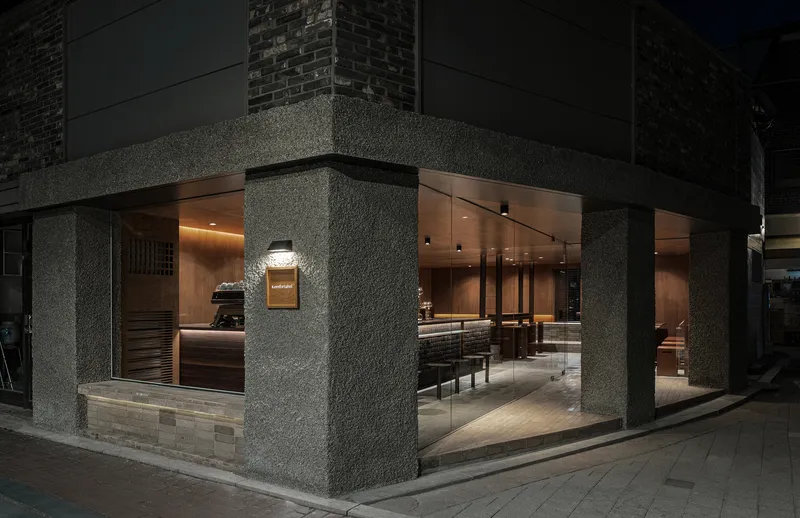
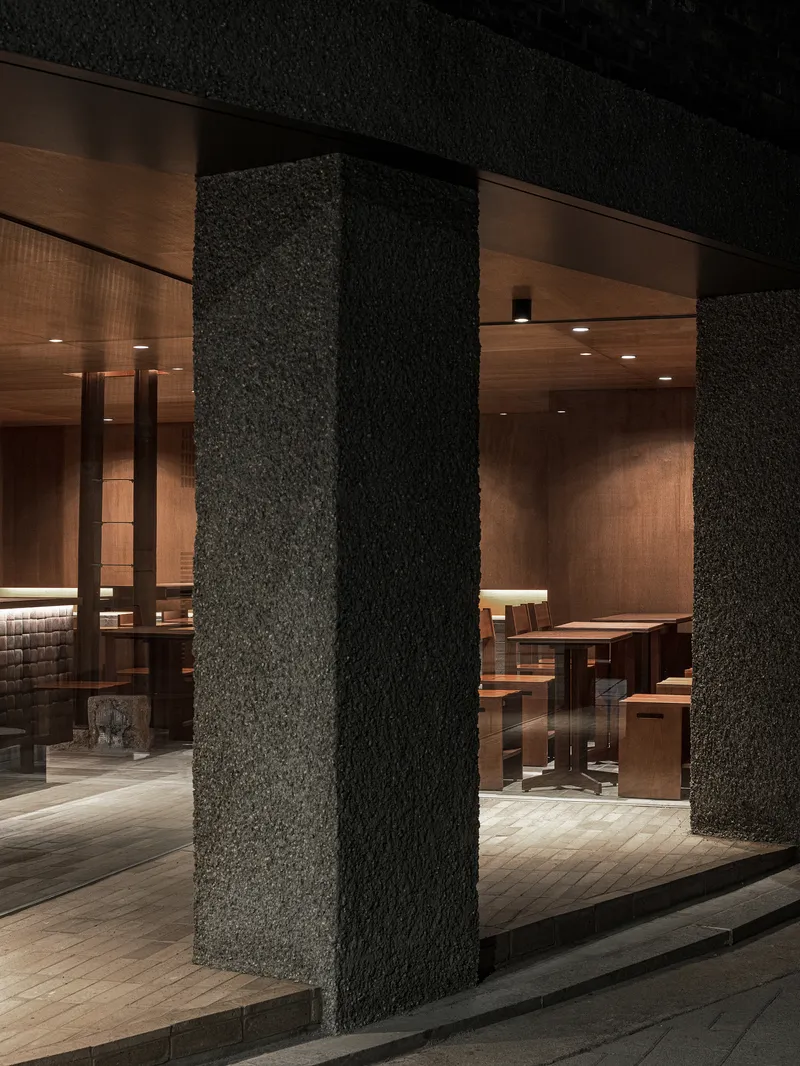
The building's exterior is a study in selective roughness. Textured concrete columns, their surfaces left deliberately unfinished, frame floor-to-ceiling glass at the corner. At night the effect is theatrical: the raw stone portal becomes a proscenium, and the warm interior glows through it like a lantern set into a quarry wall. By demolishing portions of the original outer wall, Studio Motif added a three-dimensional quality to what was once a flat boundary between inside and out.
Load-bearing walls sit extremely close to the property's architectural boundary line, a consequence of the original building's push to maximize gross floor area. Rather than fight that envelope, the design peels it apart selectively. Glass partitions replace solid wall wherever structurally possible, dissolving the hard division between interior and street and allowing natural light deep enough into the plan that internal lighting can be kept minimal.
Cold Shell, Warm Core


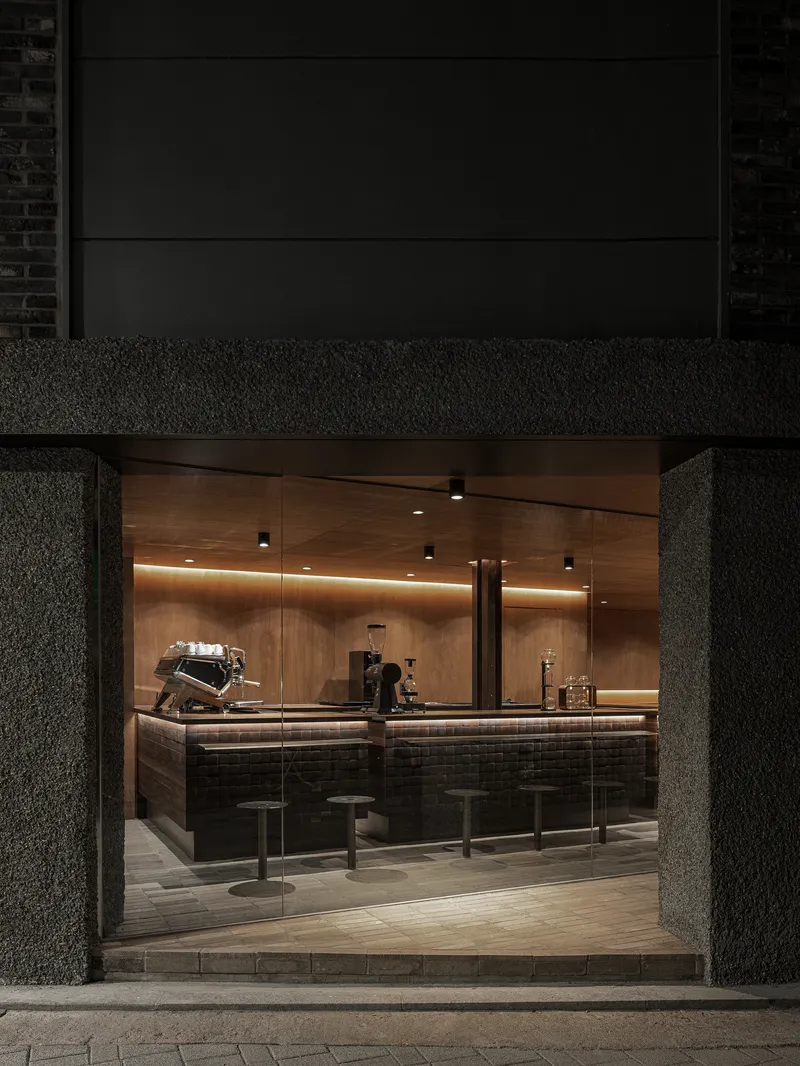
The transition from exterior to interior is the project's most deliberate move. Outside, exposed aggregate concrete and brick panels communicate an almost geological indifference to comfort. Step past the threshold and lawang plywood lines the ceiling and walls in a continuous warm skin. The contrast is not subtle, and it is not meant to be. It is a sensory cue, engineered to make you register the change in temperature, acoustics, and light the instant you cross the glass boundary.
Cement brick paving on the floor sits somewhere between these two material poles, keeping a foot in the building's harder exterior language while softening enough to feel domestic underfoot. The material palette is short and specific: concrete, cement brick, lawang plywood, birch plywood, walnut, glass. Nothing decorative makes the list.
The Counter as Roasted Landscape

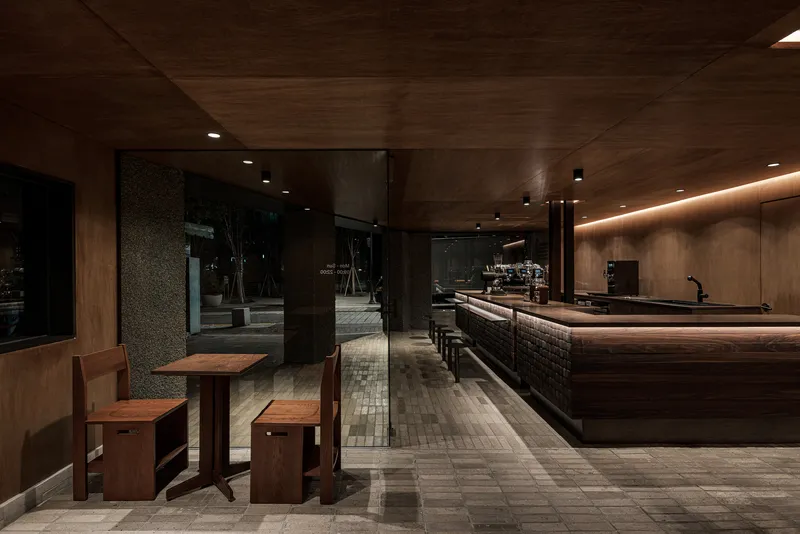
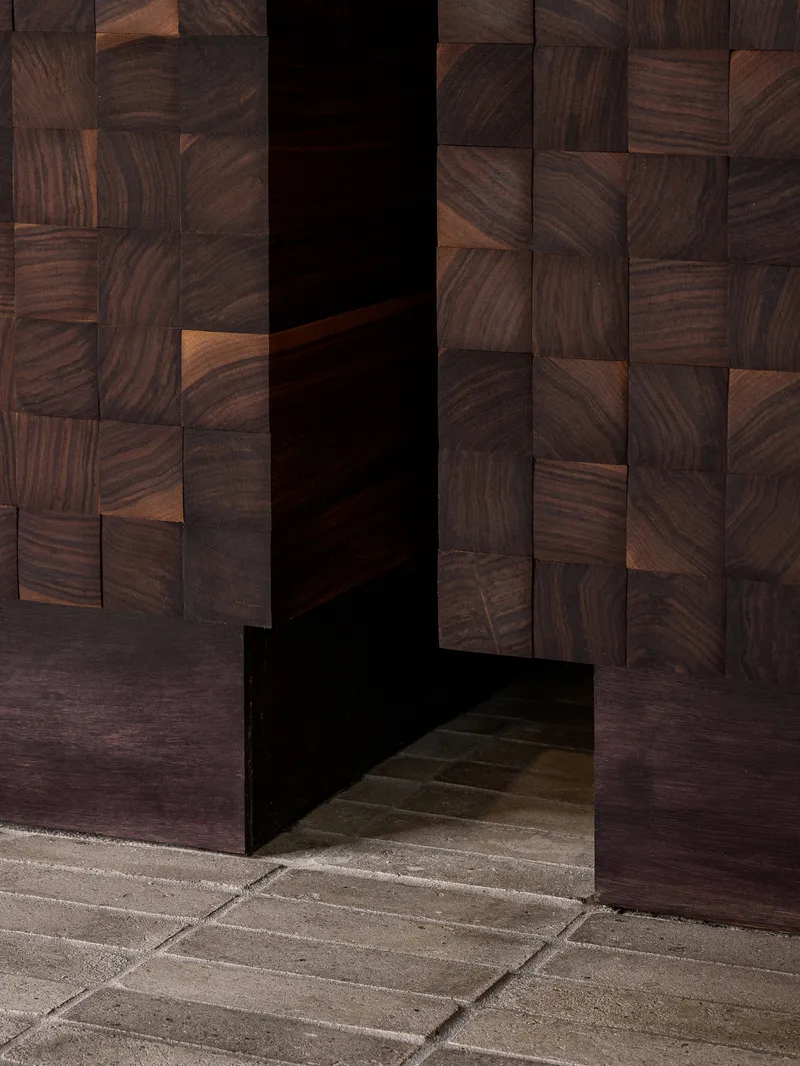
The coffee bar counter is where the design's conceptual ambition is most legible. Walnut hardwood blocks are stacked so their end grain faces forward, and each block edge has been individually sanded with a hand grinder. The result is a surface of slight misalignments, a topography of tiny ridges and shadows that reads as organic rather than machined. Up close, it recalls the cracked, uneven surface of roasted coffee beans. It is a detail that would be invisible in a photograph from across the room but becomes unmistakable when you lean against the counter waiting for an espresso.
Ribbed tile cladding wraps the counter's lower body, its vertical rhythm creating a visual base that grounds the walnut texture above. The espresso machine and bar tools occupy a birch plywood countertop, lighter in tone, which separates the tactile walnut theater from the functional work surface. The counter is not just spatial core; it is the building in miniature, raw material transformed by hand into something warm and particular.
Timber Rooms and Carved-Stone Moments

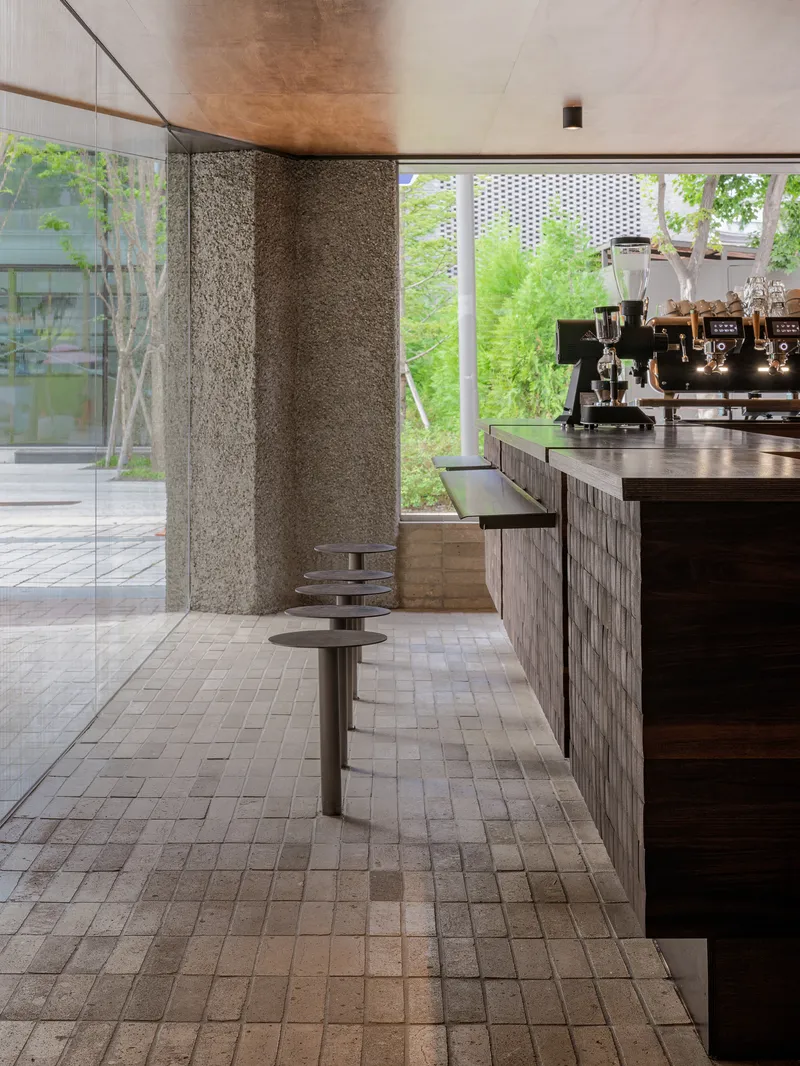
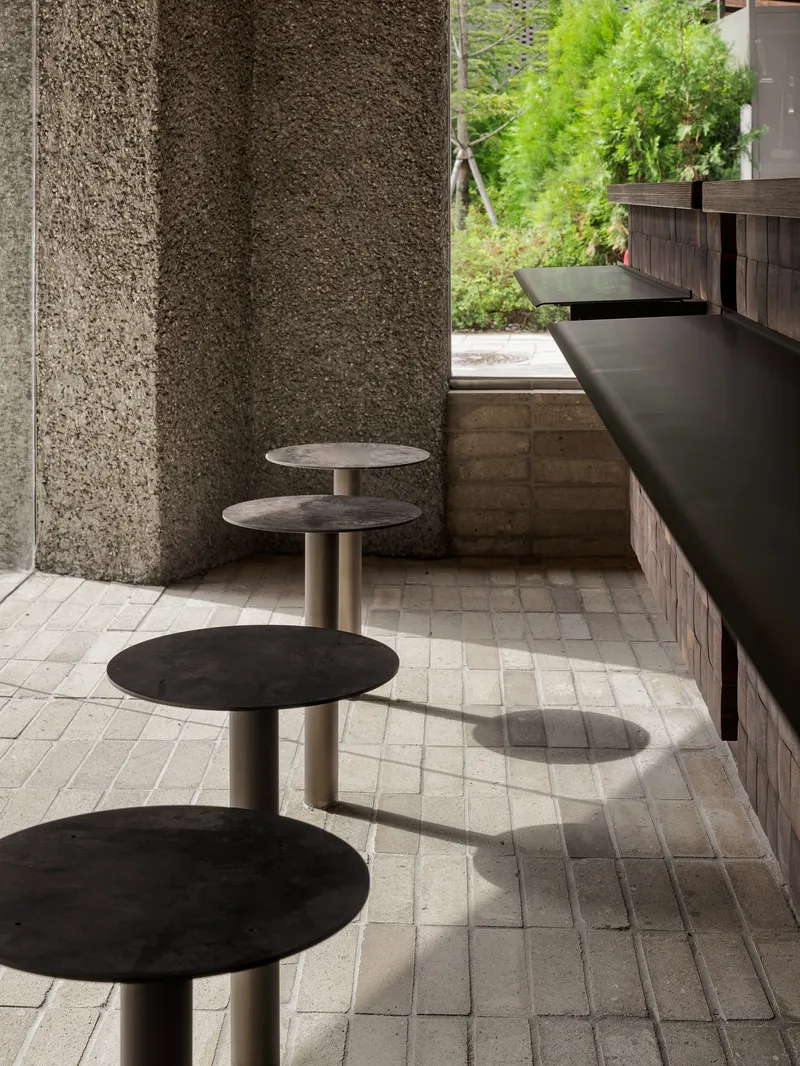
Deeper in the plan, the material register shifts again. A secondary room introduces rough stone walls, black steel columns with carved stone bases, and a heavier, quieter atmosphere. The textured wood ceiling continues overhead, maintaining spatial continuity, but the room reads as more introspective, a space for sitting rather than ordering. Circular metal stools line a counter that faces a planted courtyard through large windows, pulling a narrow band of green into a project otherwise defined by mineral and timber.
The stools themselves are worth noting. Their brushed metal stems and flat circular seats are deliberately austere, objects that refuse to compete with the material richness of the walls and ceiling. They function as punctuation: clean, modern marks against a surface of handworked stone.
Seating as Infrastructure

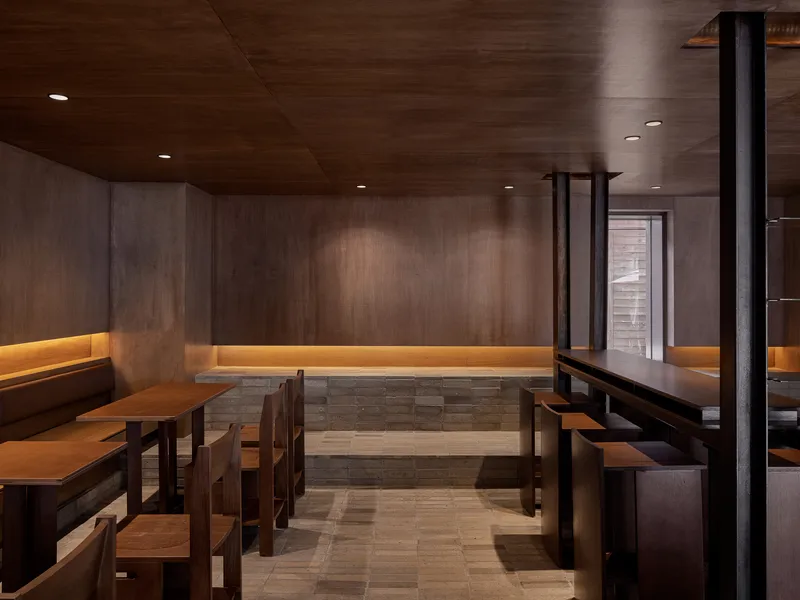

The dining areas split into two registers. Long timber tables paired with metal cube stools populate the main room, arranged beneath the lawang plywood ceiling with its black steel columns. The furniture is low-profile and modular, easy to reconfigure. A secondary seating nook, fully built in, wraps its occupants in timber on all sides: slatted bench bases, continuous LED strip lighting recessed into the wall panels, and a ceiling that drops just enough to feel enclosing without becoming claustrophobic.
In 76 square meters, every seating decision is a spatial one. The built-in nook creates privacy without partitions. The open tables allow the room to breathe. Together they give a tiny café the range of a much larger space, managing to feel neither cramped nor empty.
Threshold and Transparency

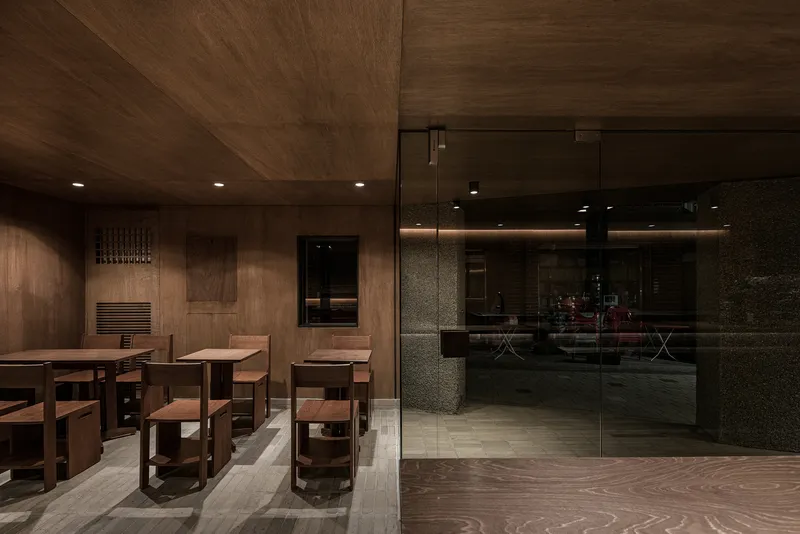
Studio Motif treats the glass partition between interior and exterior not as a wall but as a membrane. Viewed from the seating area toward the glazed entrance, the courtyard reads as an extension of the room. The three square meters donated from the interior reappear here as a planted strip and cantilevered eave, a generous public gesture from a building that can barely afford it. Inside, a glass partition between the dining zone and the service counter creates a similar transparency, letting you see through the entire depth of the space while maintaining acoustic separation.
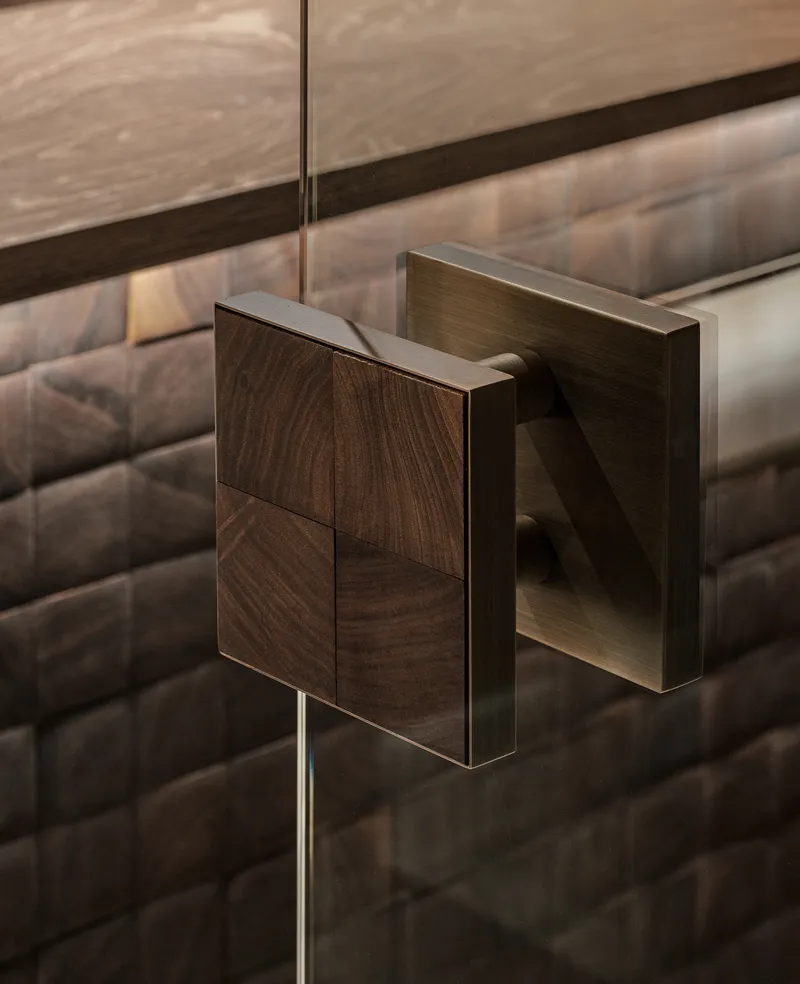
Threshold details reinforce the shift between worlds. A recessed doorway framed by dark walnut mosaic panels and bordered by stone pavers makes the act of entering deliberate, almost ceremonial. Even the brushed metal door handle, mounted on a walnut veneer plate against a tiled wall, is designed to be noticed, an object that announces the care embedded in the surfaces behind it.
Plans and Drawings


The floor plan reveals the angular geometry that the interior photographs hint at. The counter bar runs along one edge of an irregular polygon, with seating distributed in the remaining volume. A back room, accessible behind the service area, contains preparation space and storage. The plan's most telling feature is the thin slice of outdoor space peeled from the building's corner, proof that the cantilevered eave and courtyard threshold were not afterthoughts but structural premises baked into the layout from the start.
Why This Project Matters
Most coffee shop interiors lean on a mood board: exposed brick, pendant lights, reclaimed wood, done. Komfortabel Anguk Coffee works from the opposite direction, starting with a conceptual premise (the transformation of a raw material into something warm and aromatic) and building every material and spatial decision around it. The walnut end-grain counter, the lawang plywood shell, the concrete-to-timber transition: none of these choices are decorative. They are arguments about what a coffee shop can communicate when its designers take the brief literally and architecturally.
The project also makes a case for generosity at small scale. Giving up three square meters in a 76-square-meter building is a genuine sacrifice, and it produces a threshold that most commercial interiors ten times this size never bother to create. Studio Motif treats constraint not as a problem to solve but as a discipline to obey, and the result is a building where every surface, every joint, and every inch of plan has been argued for.
Komfortabel Anguk Coffee by Studio Motif (Park Sung Ho), Jongno-gu, Seoul, South Korea. 76 m², completed 2022. Photography by Choi Yong Joon.
About the Studio
Share Your Own Work on uni.xyz
If projects like this are the kind of work you want to make, uni.xyz is a place to publish your own, find collaborators, and enter design competitions.


Popular Articles
Popular articles from the community


Singing Woman: An Opera House That Performs Before the Curtain Rises
Ovidiu Cristian Pavel's conceptual opera house translates Estonia's choral identity into a sculpted waterfront landmark facing the Baltic Sea.

The Amber Palace Opera: A Geological Fiction Surfaces on Tallinn's Baltic Waterfront
Pierre Brillard reimagines a Baltic legend as a public landscape, opera house, and waterfront promenade rooted in Tallinn's coastal identity.

Cloaked Colonization: A Mobile Underwater Habitat That Moves Like a Fish
Micah Abaya's shortlisted EHC Pacific entry reimagines ocean settlement as a dispersed network of self-sustaining architectural organisms.

Tsunami Convergenics: Turning Catastrophic Ocean Forces into Underwater Housing Infrastructure
A speculative underwater settlement off the coast of Onagawa, Japan, treats tsunamis and typhoons as energy sources rather than threats.

Similar Reads
You might also enjoy these articles

Pixel Gardens: One Repeated Module Stacked Into a Terraced Social Housing Tower for Famagusta
Salem Bader's shortlisted housing tower builds a vertical neighbourhood from one repeated module, offsetting units to carve terraces, light and air.

Bao Huynh Watercolor Atelier: A Serene Art Retreat in Hội An
Bao Huynh Watercolor Atelier in Hội An blends multifunctional art spaces, sustainable design, local materials, and family-friendly living in a serene environment.

Atelier Macri Concept Store Interior Design by CASE-REAL
Atelier Macri store features a "ko" counter, walnut wood details, cork displays, blending retail, gallery, and seamless customer experiences.

Manuel Vargas Izquierdo Stadium and High-Performance Sports Center: Architectural Excellence in Jalpa de Méndez
The Manuel Vargas Izquierdo Stadium blends sustainable design, inclusive sports facilities, and cultural-inspired architecture, revitalizing Jalpa de Méndez’s public spaces.

Explore Coffee Chair Competitions
Discover active competitions in this discipline

Challenge to reimagine the Iron Throne

Photograph architecture without architects

Illustrate the lost glory of Angkor Wat - Render Challenge

Design challenge to reuse E-waste
Comments (0)
Please login or sign up to add comments
No comments yet. Be the first to comment!