
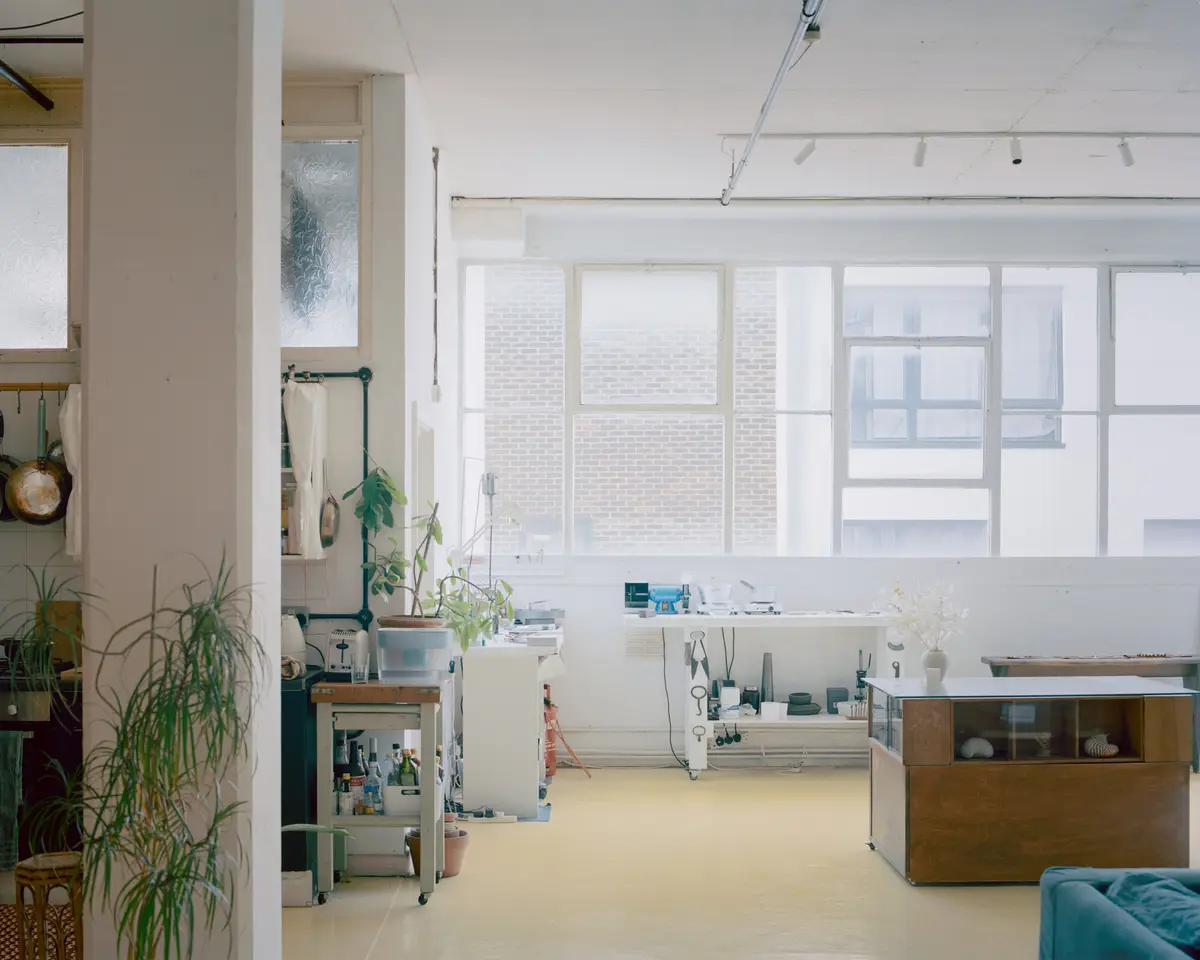
Studio Mutt Converts a Hackney Wick Industrial Unit into a Live-Work Space Shaped by Curtains and Resin
In a former plastics factory at the edge of Queen Elizabeth Olympic Park, soft partitions replace hard walls to keep flexibility alive.


Hackney Wick carries its contradictions openly. It is a post-industrial canal-side quarter that pivoted from manufacturing to rave culture to the 2012 Olympics and, now, to a contested zone of creative studios, co-living experiments, and speculative housing. When Studio Mutt took on Unit 2F, a raw shell inside one of the area's characteristic brick warehouse blocks, the brief was to produce a space that could be home, studio, and gallery without committing permanently to any single identity. That requirement, in a neighborhood where leases are precarious and uses shift season to season, is less a design luxury than a survival strategy.
What makes Unit 2F worth studying is not the budget or the square footage but the hierarchy of materials chosen to negotiate permanence and impermanence. A poured yellow resin floor anchors everything. Plywood joinery defines service zones. And white curtains, hung from ceiling tracks, do the work that stud walls would do in a conventional fit-out. The result is a space that can be a painting studio at noon and a dinner party at eight, with nothing more than a pull of fabric. It is a serious proposition about how architects can intervene in found industrial shells without sealing them shut.
Hackney Wick Context
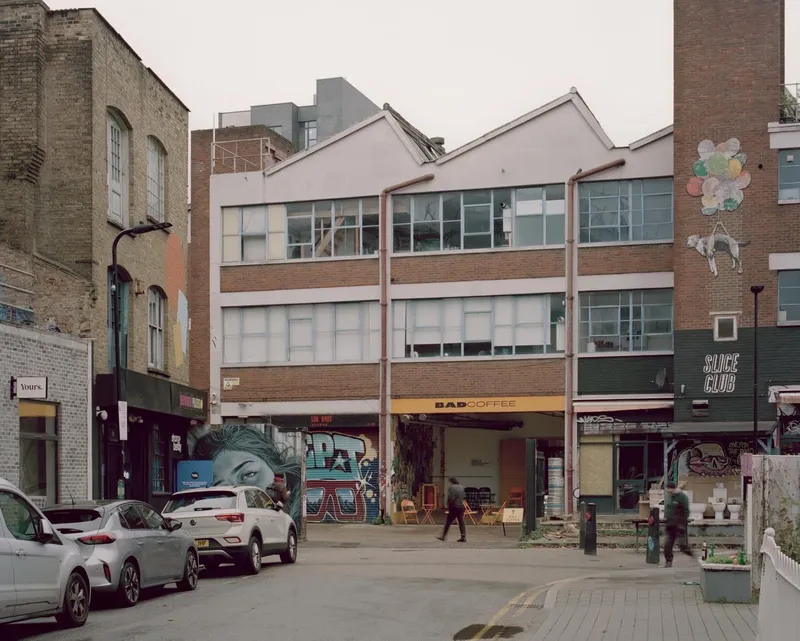
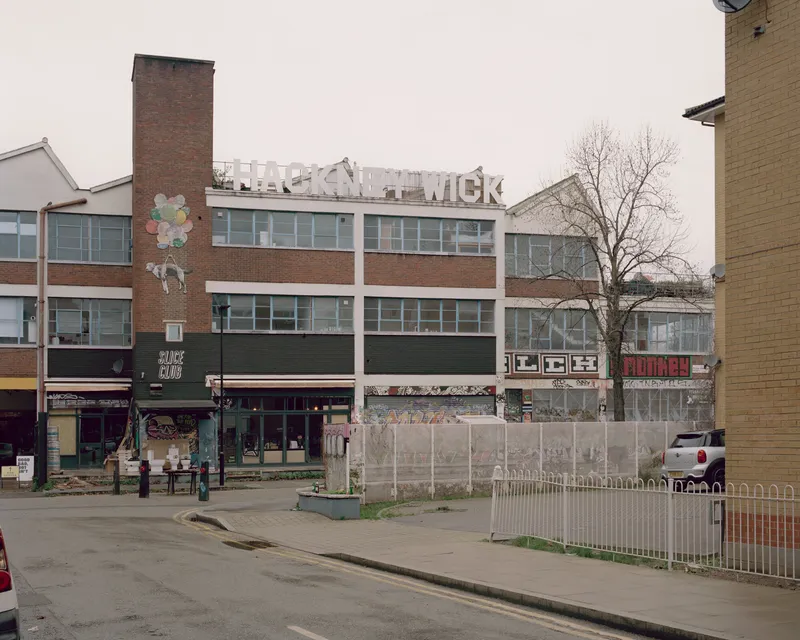
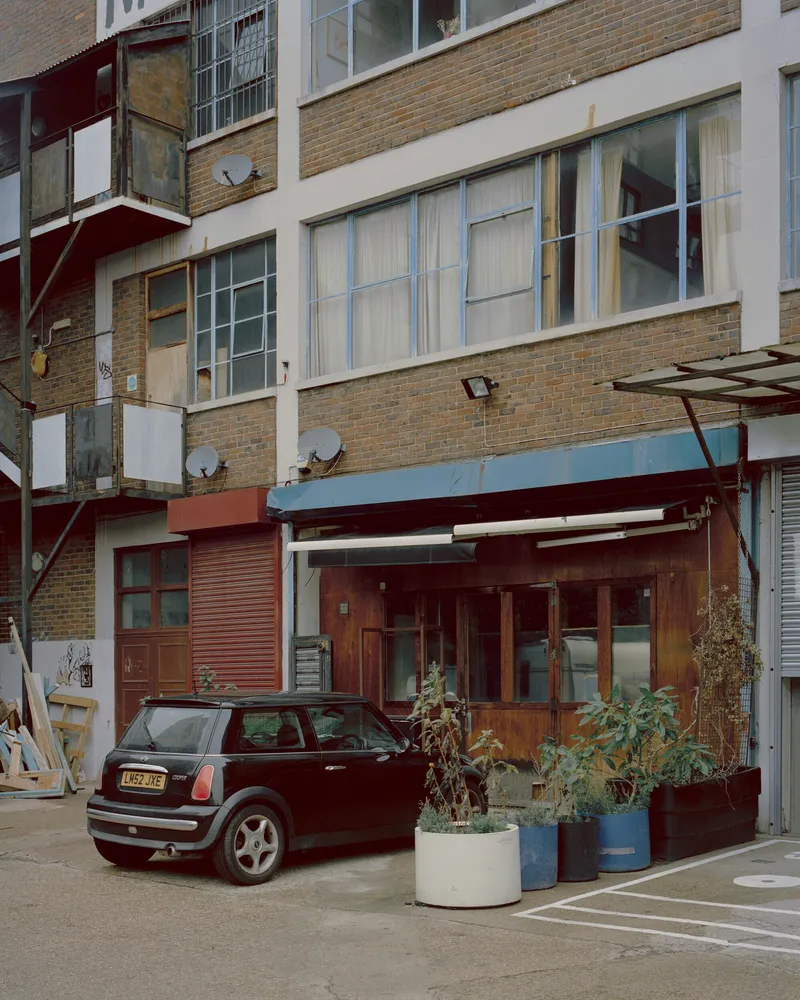
The surrounding streetscape is a collision of eras: Victorian brick stacks, mid-century industrial sheds, and the glossy new-build housing that has crept eastward since the Olympic legacy masterplan began reshaping the area. Unit 2F sits within one of these mixed-use blocks, its facade legible as part of a broader composition of brick, metal-framed windows, and ground-floor shopfronts layered with graffiti. The tower element visible from the street marks the residential stories above; the workspace below inherits the robust proportions of a goods floor.
Studio Mutt wisely made no attempt to mask this context. The large gridded windows that characterize the block are left intact, framing views of neighboring brick walls and canal-side yards. What happens inside the unit is defined against this exterior roughness rather than in spite of it.
Yellow Ground: The Resin Floor as Unifier
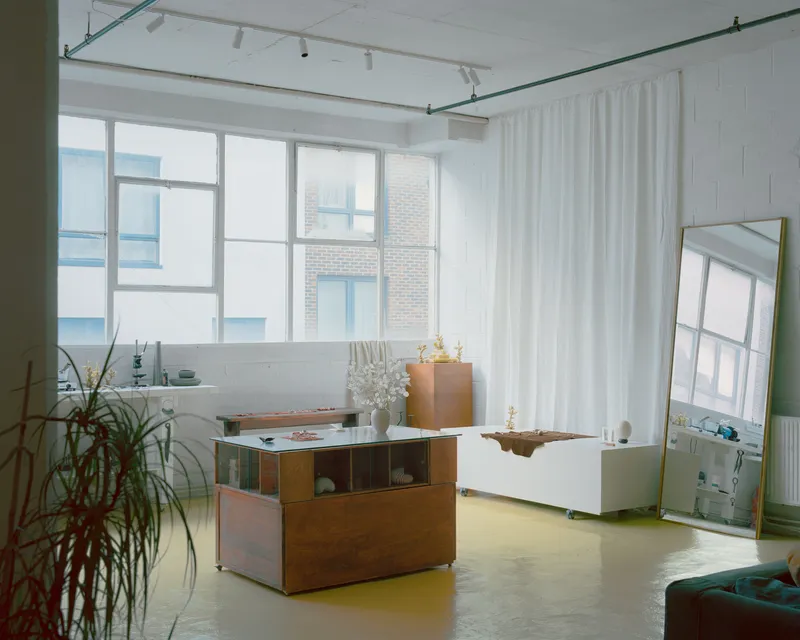
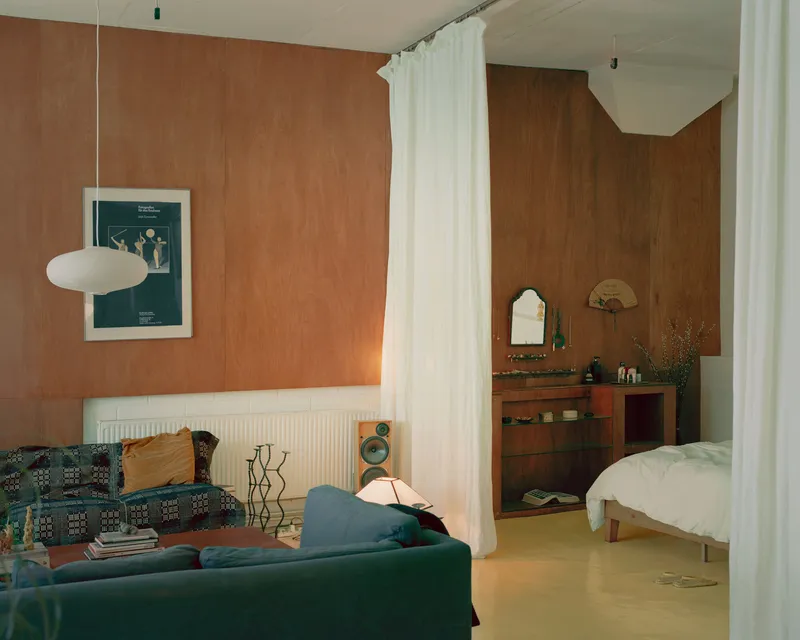
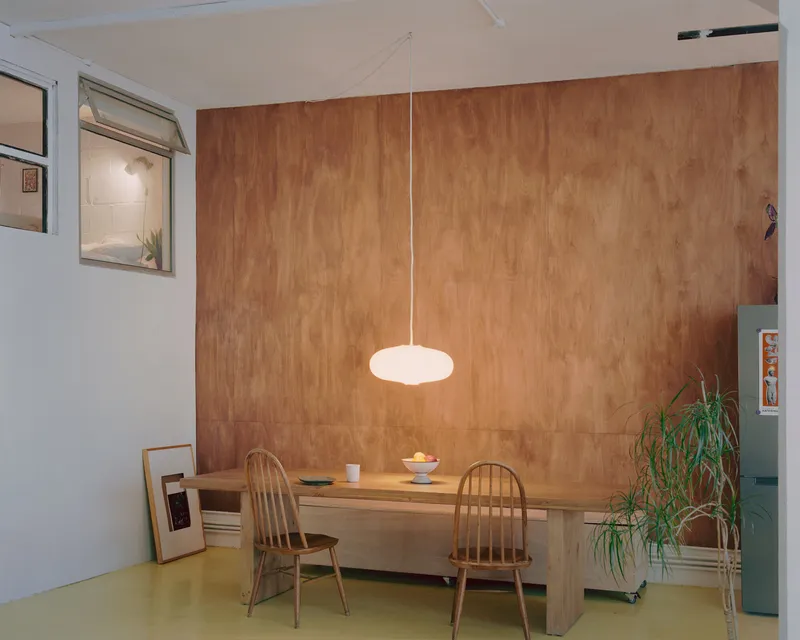
The single boldest move is underfoot. A continuous pour of yellow resin covers the entire floor plate, erasing any trace of previous use and establishing a visual datum that ties together zones that would otherwise read as fragments. The color is warm without being saccharine, and it bounces ambient light from the tall windows upward into the ceiling plane, amplifying the sense of volume in what could easily feel like a dim industrial box.
Resin is also a practical choice: seamless, easy to clean, resistant to paint spills and workshop grit. In a space that needs to flip between creative production and domestic comfort, the floor is the one element that refuses to take sides. It belongs equally to the dining table and the easel.
Curtains as Architecture
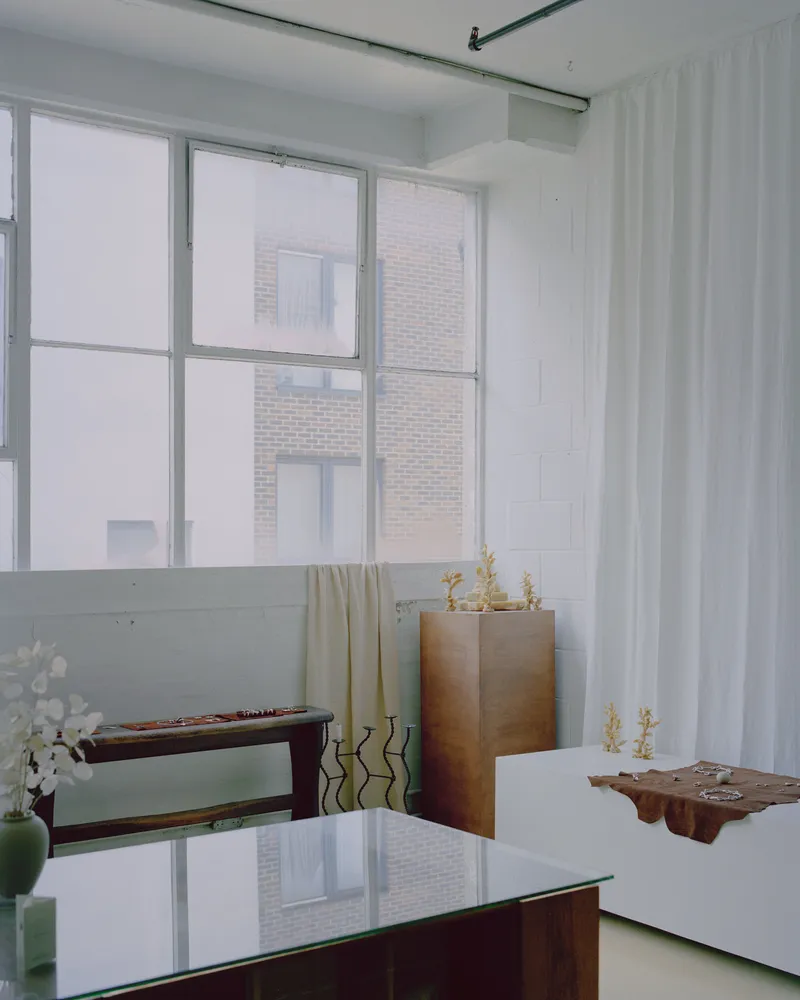
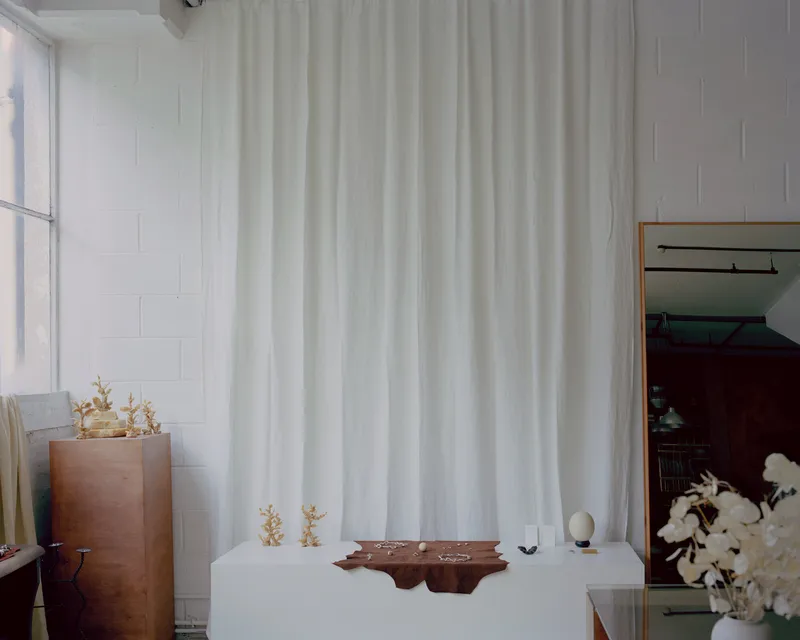
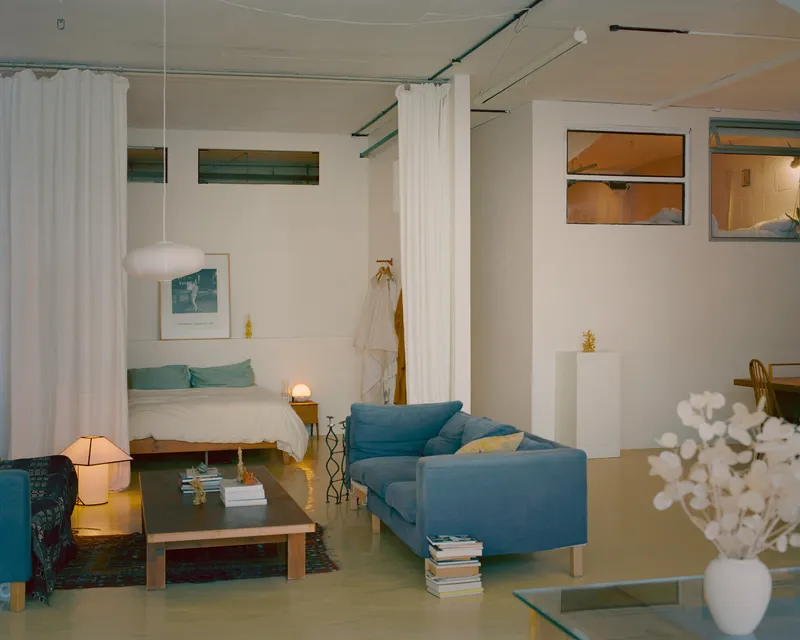
The curtain has a long and underappreciated lineage in modern architecture, from Lilly Reich's velvet partitions at the Barcelona Pavilion to Shigeru Ban's Curtain Wall House. Studio Mutt taps into that lineage with a frankness that avoids both nostalgia and irony. White fabric panels, hung from industrial ceiling tracks, subdivide the open plan into sleeping alcove, living area, gallery zone, and workspace. When drawn back, the full depth of the unit is revealed; when closed, each pocket of space gains a surprising sense of intimacy.
The curtains also do meaningful acoustic and thermal work, softening the hard reflections off brick and concrete that would otherwise dominate the interior. Combined with the terracotta fabric wall panels visible in the living area, they create a layered textile envelope within the masonry shell. It is soft architecture in the most literal sense, and it costs a fraction of what drywall partitions and paint would demand.
Plywood Joinery and the Service Core
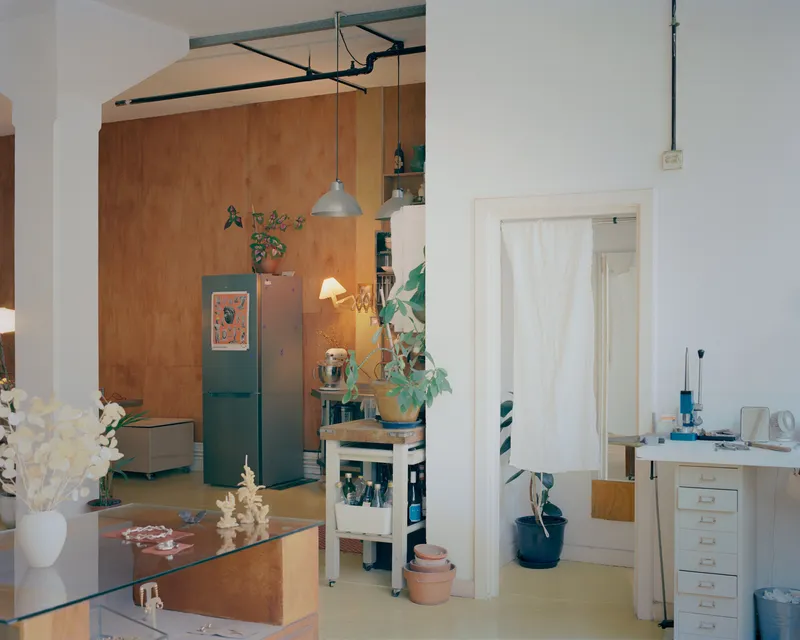
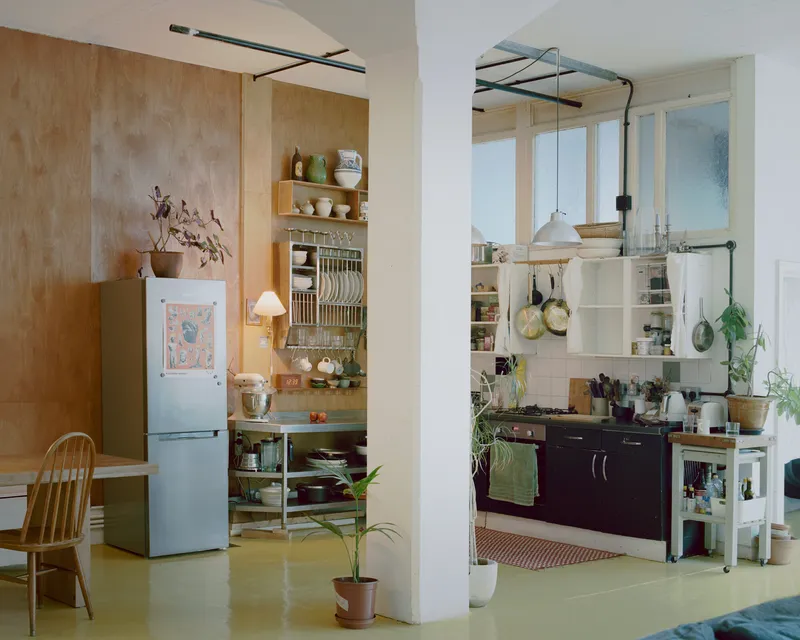
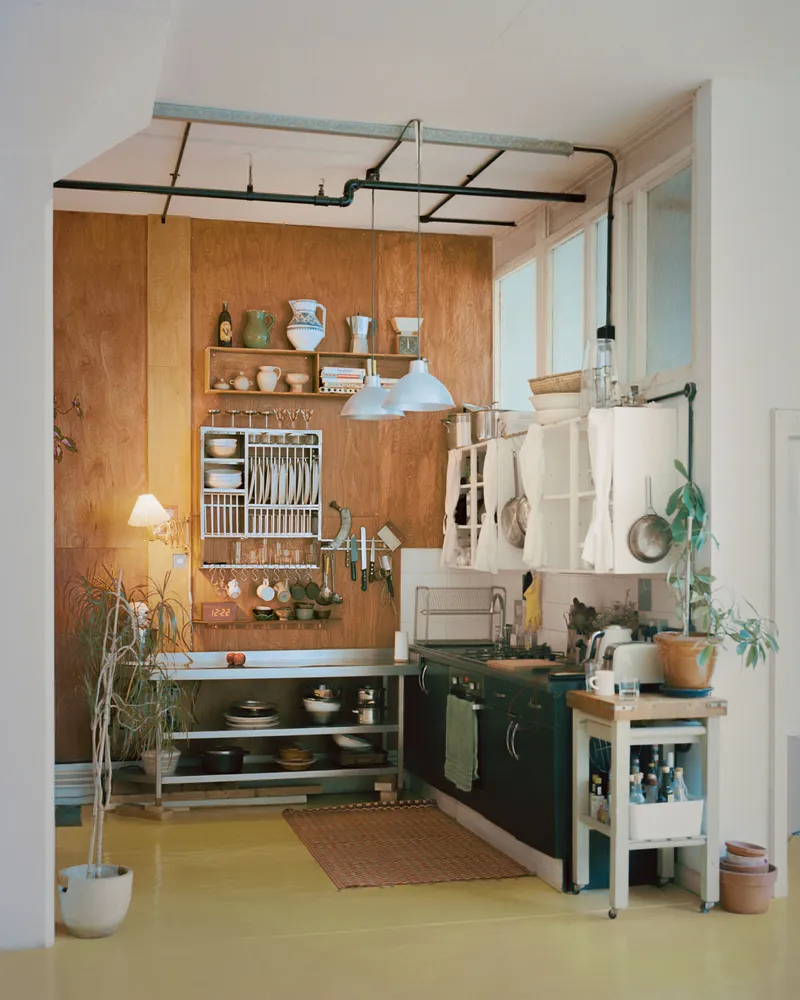
Where the curtains negotiate openness, the plywood elements negotiate utility. A compact kitchen is tucked behind a plywood partition, its open shelving and overhead pipe rack doubling as both storage and display. The cabinetry is simple, almost provisional in appearance, but it is detailed with care: edges are clean, hardware is minimal, and the warm birch tone contrasts deliberately with the cooler white of the surrounding painted brick.
An arched opening punched through the plywood storage wall is a small but telling gesture. It references the proportions of the building's original masonry openings without mimicking them, and it allows sightlines to pass through what could have been a dead-end corridor. Potted plants at the threshold complete a vignette that feels almost domestic in spite of the industrial bones.
Working in the Light
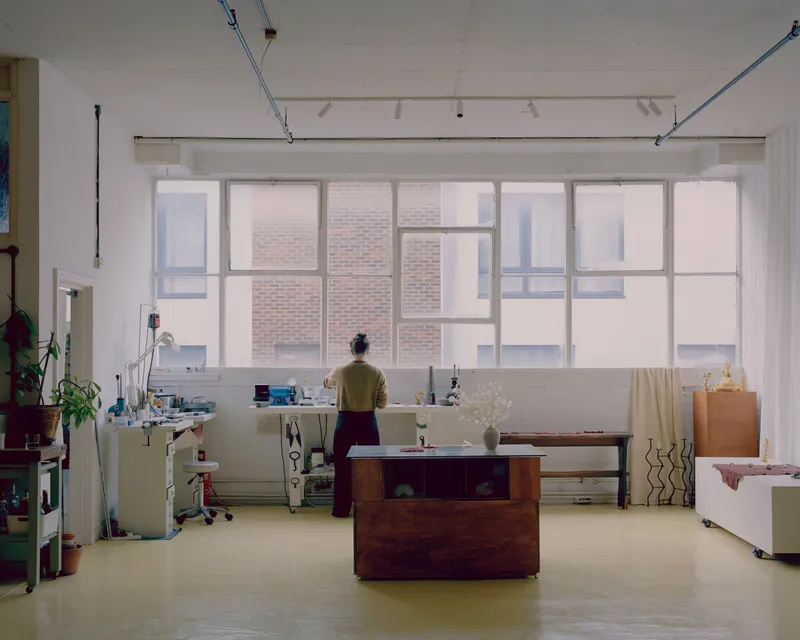
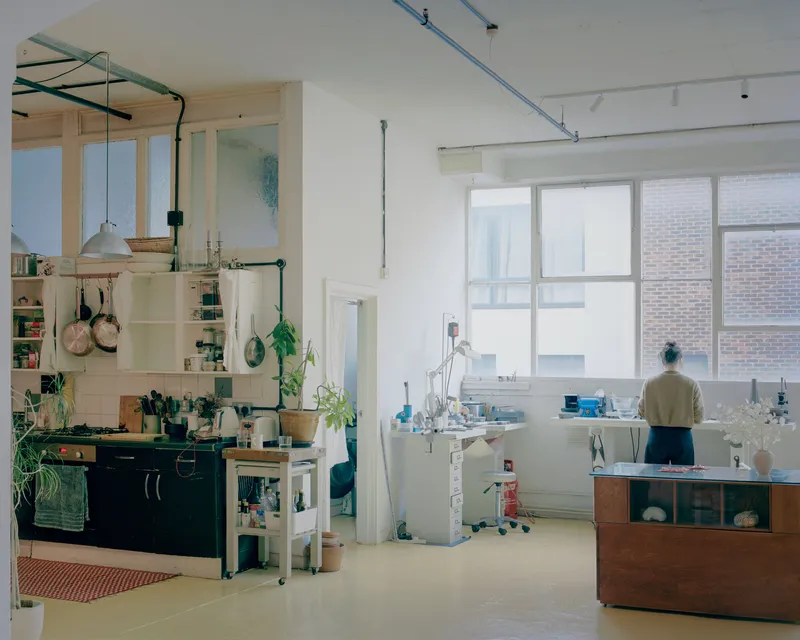
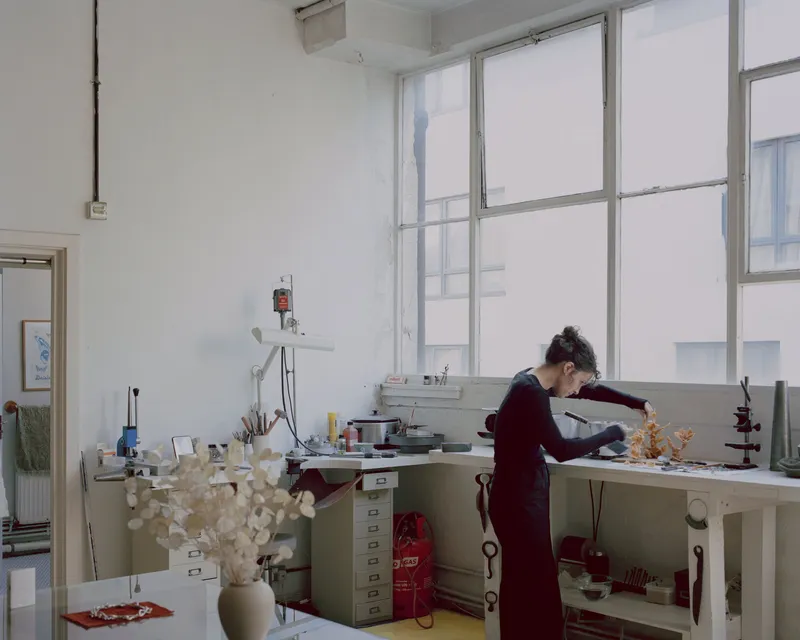
The tall metal-framed windows are the inheritance that makes this conversion viable. They deliver a quality of diffuse, north-facing daylight that artists and designers have sought out in East London warehouse studios for decades. Studio Mutt positions the primary work surfaces, a long desk and a green-topped workshop counter, directly against these windows, ensuring that the most light-hungry activities get the best conditions without any supplementary glazing.
The photographs consistently show occupants at ease in front of these windows, silhouetted against the brick courtyard beyond. It is a convincing image of productive habitation: the workspace is not a corner carved out of a flat but a generous, daylit room that happens to share its floor plate with a bed and a kitchen.
Gallery Mode
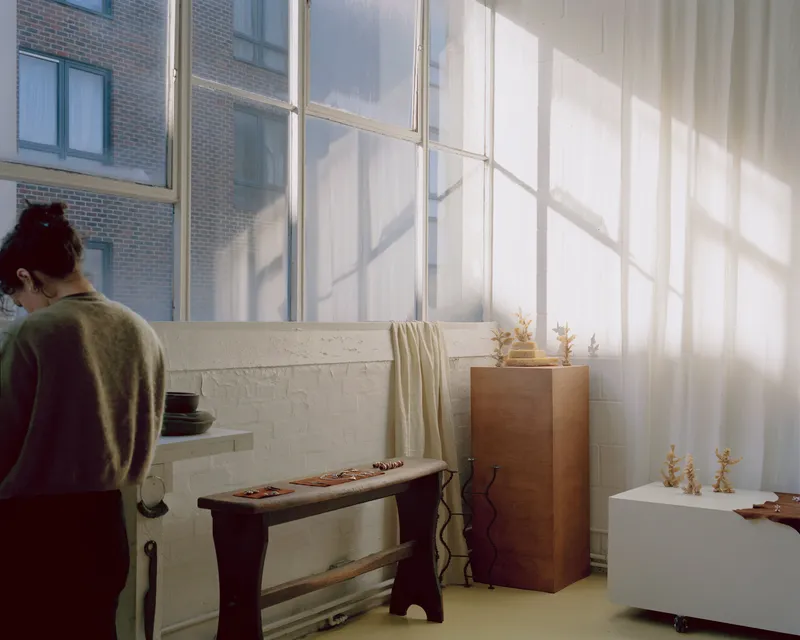
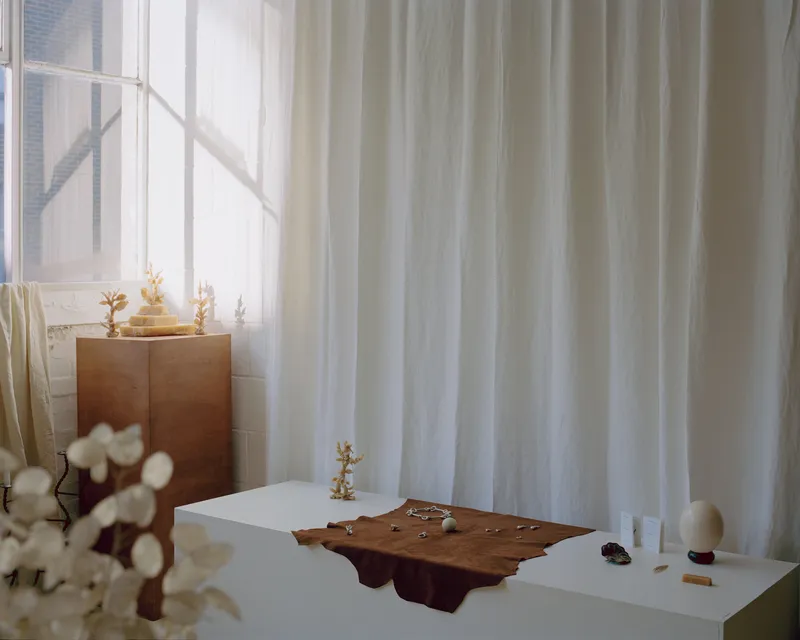
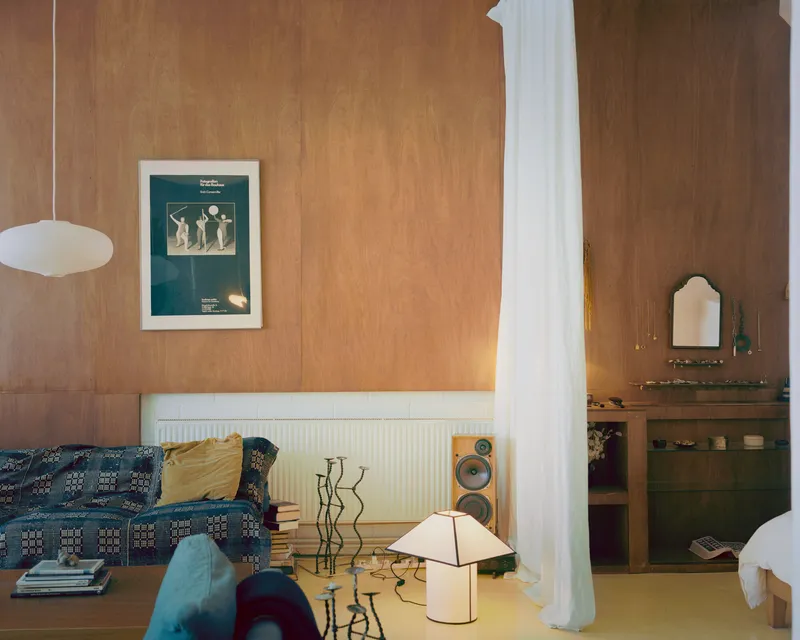
One of the more compelling claims of Unit 2F is that it can operate as a gallery. A white-painted brick partition wall creates a backdrop for hanging work, while the curtain system allows the rest of the space to be screened off during events. A display pedestal bearing an organic wood-form sculpture sits beneath flowing white drapes, staged with an intentionality that reads as exhibition rather than decoration.
The sleeping alcove, lined in plywood and partially screened by sheer fabric wrapped around a structural column, can disappear from view when the curtains close. The boundary between private life and public presentation is literally a pull of cloth. For an artist living and exhibiting in the same footprint, that agility is not a gimmick; it is the economic model that makes staying in a neighborhood like Hackney Wick possible at all.
Atmosphere at Dusk
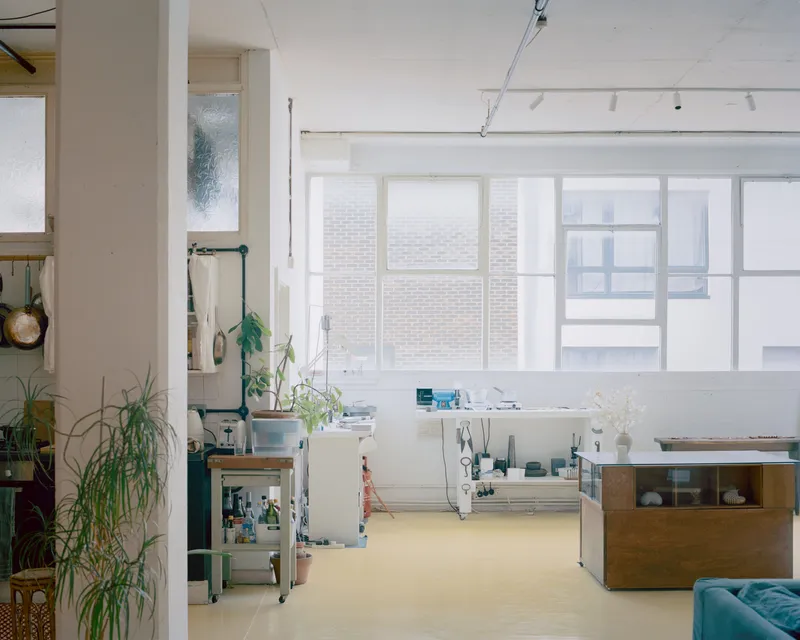
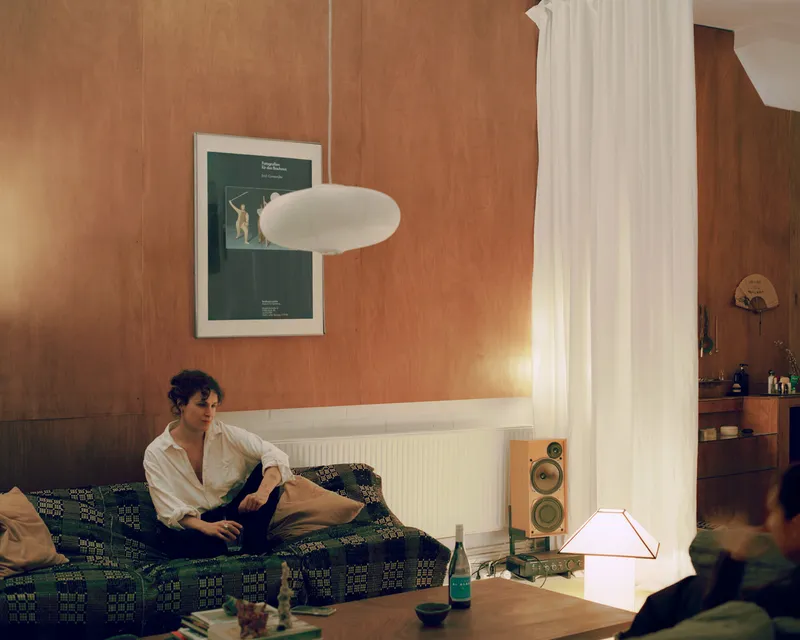
The evening light transforms the space. The yellow floor glows warmer, the curtains become translucent screens catching the last of the daylight from the clerestory windows, and the freestanding furniture casts long shadows that emphasize the generous ceiling height. It is in these twilight moments that Unit 2F most clearly reads as a home rather than a studio, the soft materials absorbing the noise of the day and returning something quieter.
Why This Project Matters
Unit 2F is a small project with an outsized argument. It proposes that the live-work unit, so often realized as a cramped flat with a desk, can instead be a genuinely flexible room where the proportions of work, domesticity, and exhibition shift hour by hour. The material palette, resin, plywood, fabric, and paint, is modest in cost but precise in deployment, and it respects the found condition of the industrial shell rather than erasing it. Studio Mutt demonstrates that you do not need a large budget to produce architecture that is both inventive and humane.
More broadly, the project speaks to a condition that defines creative neighborhoods across every major city: the tension between permanence and precarity. By building in soft, reversible layers rather than fixed partitions, Unit 2F acknowledges that its occupants may not be there forever, and that the space will need to become something else when they leave. That temporal honesty is rare in interior architecture, and it is what elevates this fit-out from a renovation into a proposition about how we might occupy industrial buildings in the decades ahead.
Unit 2F, designed by Studio Mutt, London, United Kingdom. Completed 2025. Photography by Willem Pab.
About the Studio
Share Your Own Work on uni.xyz
If projects like this are the kind of work you want to make, uni.xyz is a place to publish your own, find collaborators, and enter design competitions.


Popular Articles
Popular articles from the community


ETEH Reworks the Shared Spaces of São Domingos School in Brazil Around Timber, Color and Hanging Plants
At São Domingos School in Brazil, 436 m² of hall, refectory and library are recast with timber joinery, a yellow and blue code and trailing greenery.


Aquadapt: An Underwater Habitat That Rewrites Its Rooms by the Hour
Curved modules ring the seabed while one shell shifts from breakfast room to cinema, farm and football pitch as residents' needs change.

The Amber Palace Opera: A Geological Fiction Surfaces on Tallinn's Baltic Waterfront
Pierre Brillard reimagines a Baltic legend as a public landscape, opera house, and waterfront promenade rooted in Tallinn's coastal identity.

Manzana Morphosis: Stretching Barcelona's Grid into a Living Landscape for 2050
A radical reworking of the Eixample manzana turns density into a tool for generous public space, vertical ecology, and environmental performance.

Similar Reads
You might also enjoy these articles

LAVA Architecten Gives Vocational Education a Sawtooth-Roofed Face on a Mechelen School Campus
In Mechelen, Belgium, a 2,053 m² STEM school on a 6×6 m grid turns workshops and classrooms into rooms that can be rearranged as teaching changes.

KEMA Studio Turns a Derelict Marvila Attic into a 60 m² Lighthouse Apartment Above Lisbon
In Lisbon's Marvila district, a rebuilt roof, four skylights and two plywood volumes turn an unlivable attic into a bright home facing the Tagus.

Pixel Gardens: One Repeated Module Stacked Into a Terraced Social Housing Tower for Famagusta
Salem Bader's shortlisted housing tower builds a vertical neighbourhood from one repeated module, offsetting units to carve terraces, light and air.

Bao Huynh Watercolor Atelier: A Serene Art Retreat in Hội An
Bao Huynh Watercolor Atelier in Hội An blends multifunctional art spaces, sustainable design, local materials, and family-friendly living in a serene environment.

Comments (0)
Please login or sign up to add comments
No comments yet. Be the first to comment!