
Studio Woodroffe Papa Wraps 111 Apartments Around a Courtyard with Saw-Tooth Balconies in Bermondsey
A mixed-use housing scheme on a former industrial site near London's Spa Road viaduct rethinks the perimeter block with undulating facades and deep-set ter


London's housing discourse tends to oscillate between the pragmatic and the aspirational, rarely landing on both at once. Dockley Apartments, completed in 2022 by Studio Woodroffe Papa alongside Bordeaux-based Poggi Architecture, makes a convincing case that the two can coexist. Situated on Dockley Road in Southwark, on a 0.34-hectare former industrial plot adjacent to a Grade II listed railway bridge, the scheme packs 111 apartments across 35 distinct typologies into a perimeter block that steps, folds, and angles its way around a central courtyard. The result is a building that looks nothing like the boxy tower blocks it was explicitly designed to counteract.
What makes this project genuinely interesting is the way it weaponizes geometry for domestic benefit. The saw-tooth profile and deep-set angled balconies are not decorative flourishes: they generate dual-aspect, naturally ventilated apartments with generous private outdoor space, while also shading interiors from summer heat gain and stepping down to admit daylight into the courtyard garden. Every formal decision traces back to a measurable performance outcome or a lived spatial quality. In a city where housing density often means compromise, Dockley demonstrates that density and generosity are not opposites.
An Undulating Perimeter
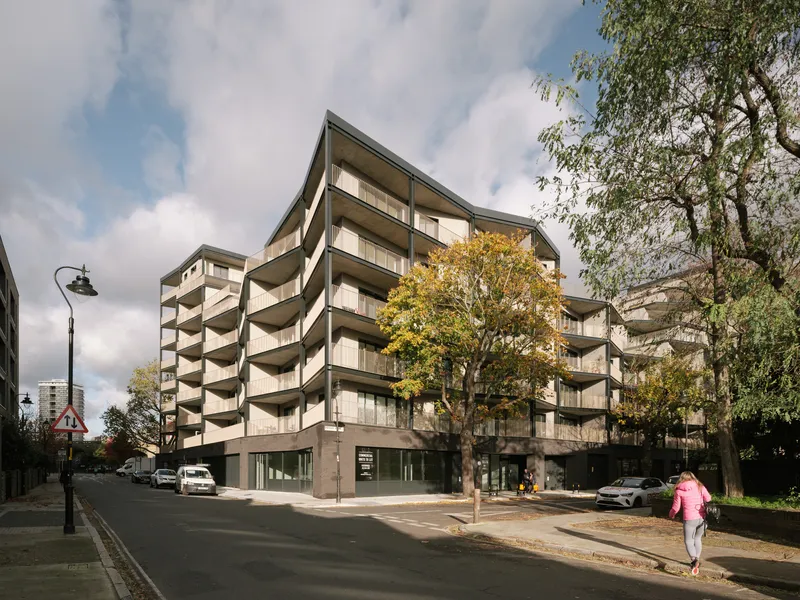
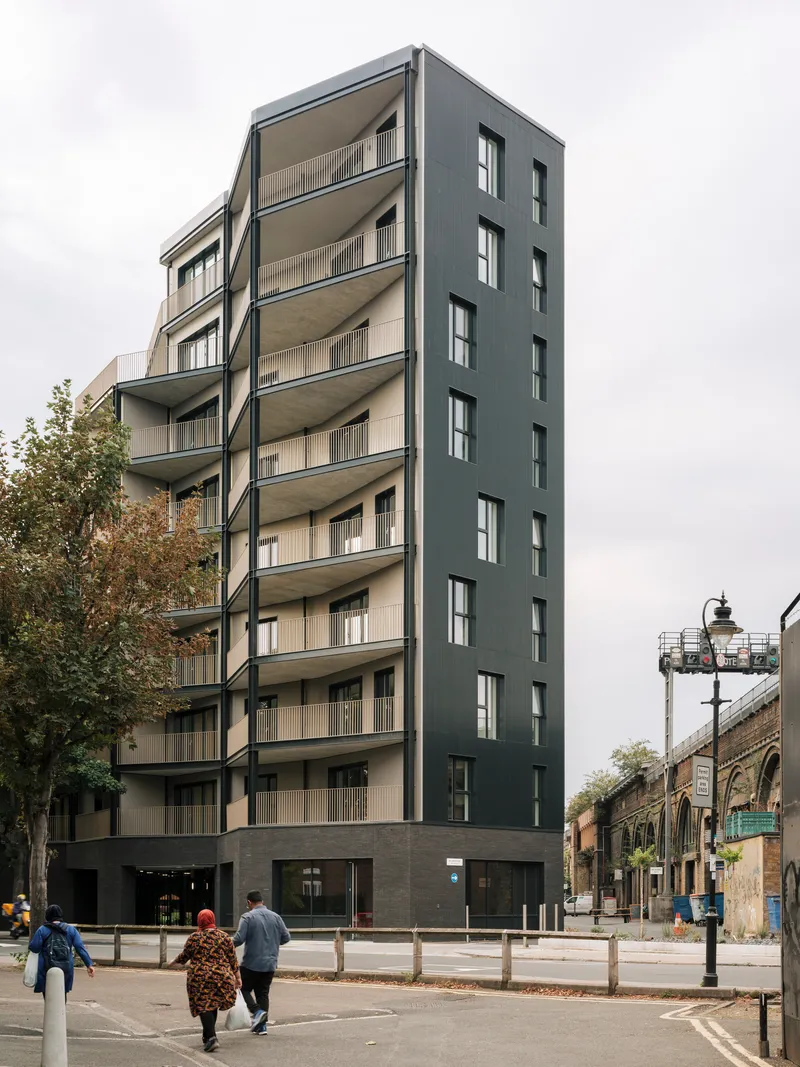
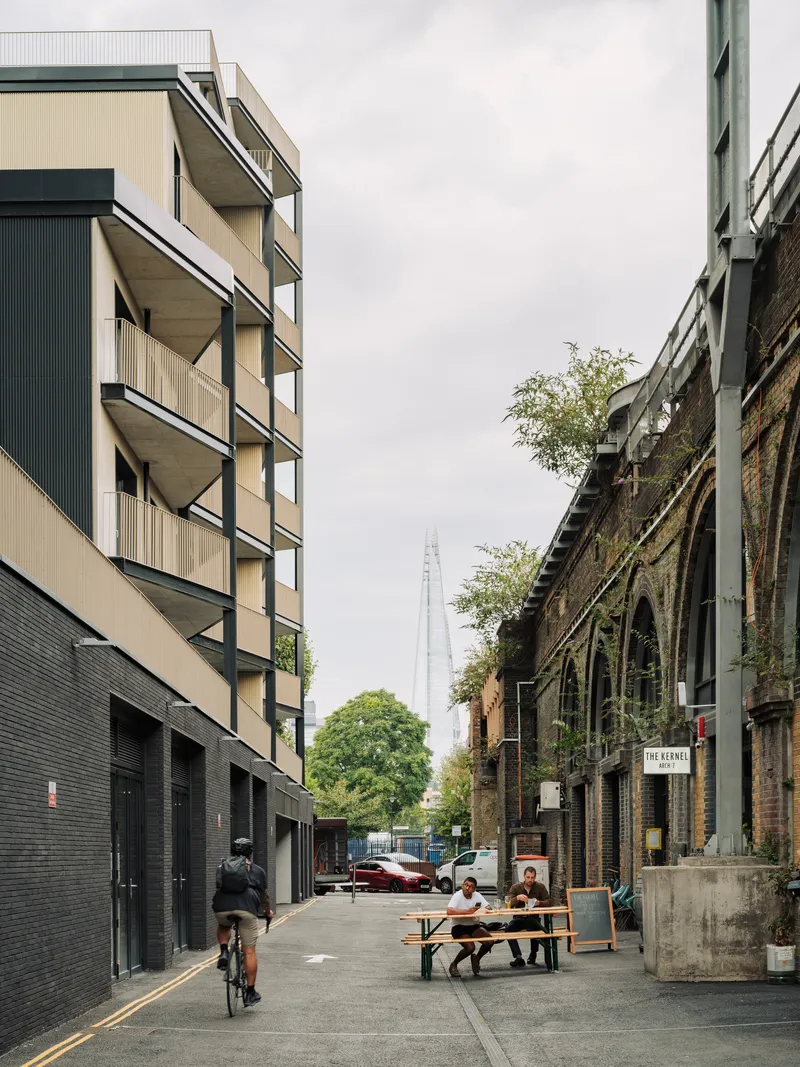
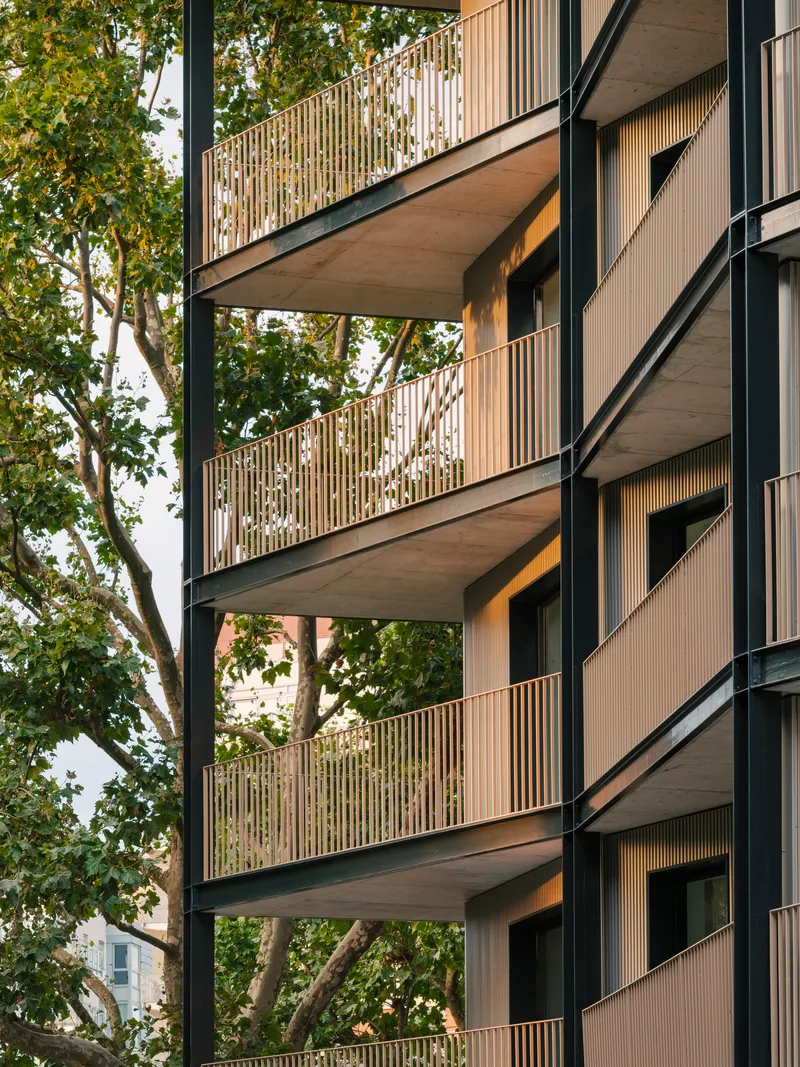
From the street, Dockley reads as a series of interlocking volumes rather than a single mass. The building ranges from four to nine storeys, and its undulating facades respond directly to the mature trees lining the site perimeter, curving around them rather than demanding their removal. The saw-tooth profile creates a rhythm of projecting and receding balconies that breaks down the scale of what is, in plan, a substantial urban block. Steel rainscreen cladding at the upper levels catches light differently across each angled facet, giving the facades a shifting character throughout the day.
At ground level, dark brick grounds the building and establishes a material conversation with the Victorian railway arches next door. The contrast between the heavy masonry base and the lighter metallic upper storeys is deliberate and effective: it roots the building in its industrial context while signaling something contemporary above. The street presence is active without being aggressive, a quality that owes as much to the aluminium curtain wall at ground floor as to the careful placement of commercial and retail entries.
Balconies as Architecture, Not Appendages
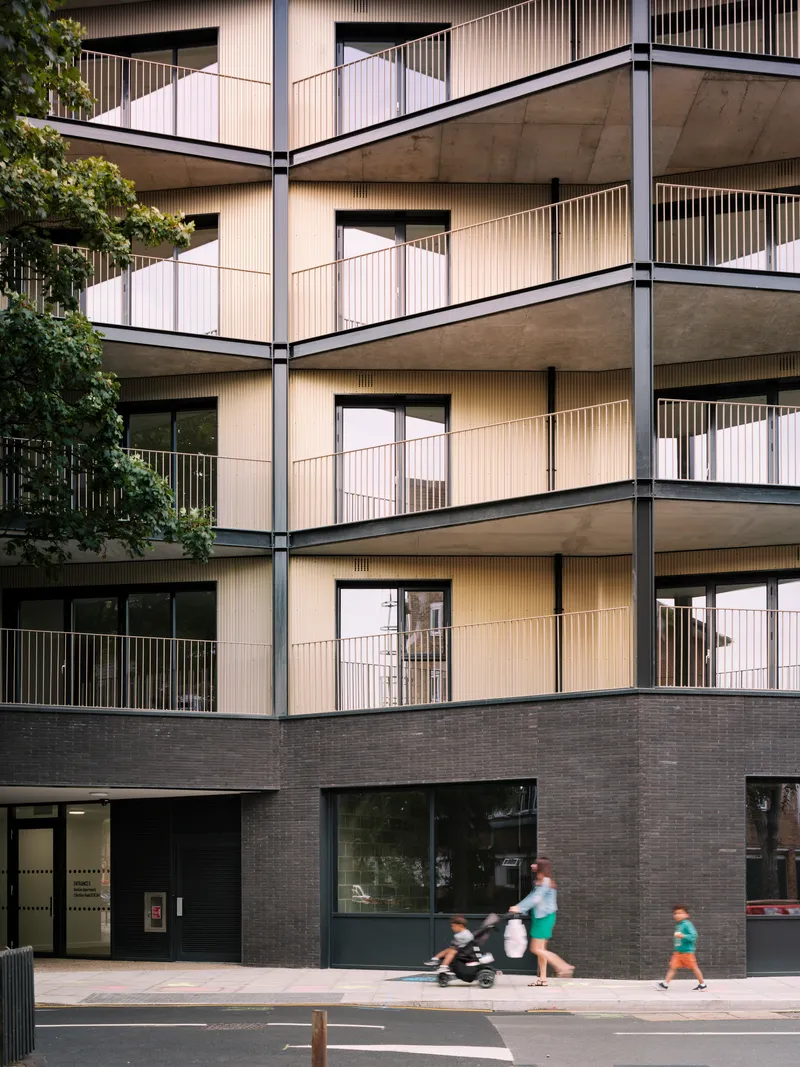
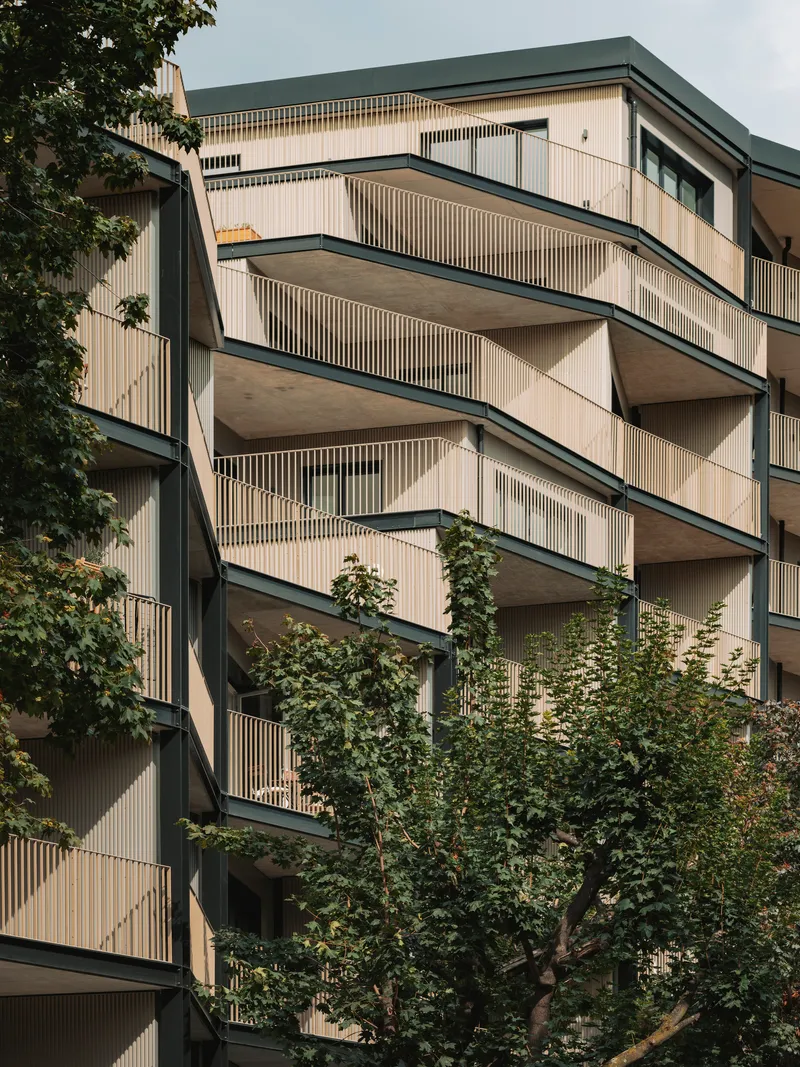
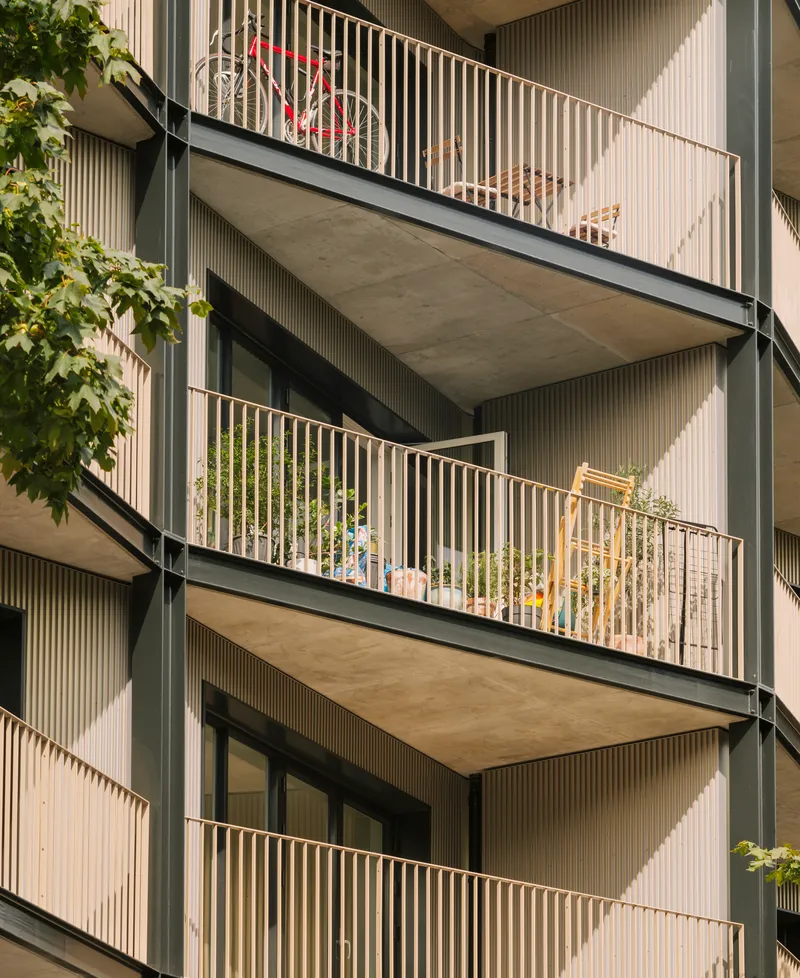
The most visually arresting element of Dockley is the balcony system, and it deserves the attention. These are not the shallow, afterthought balconies that plague so much contemporary housing. They are deep, shaded, angled volumes defined by concrete soffits and vertical metal screening. The screens provide privacy without killing airflow or light, and their vertical rhythm gives the facades a taut, almost textile quality when seen obliquely. Each balcony is a room in its own right, large enough for furniture, planting, and actual habitation.
The angling of the balconies is doing real environmental work. By tilting the openings, the architects maximize solar access in winter while limiting direct heat gain in summer. Combined with the high-performance building fabric, MVHR systems, and underfloor radiant heating, the balconies become part of a coherent passive design strategy rather than a cosmetic gesture. The building's outdoor amenity space nearly doubles what Southwark's planning policy requires, a fact that speaks volumes about the scheme's spatial ambitions.
The Courtyard as Social Infrastructure
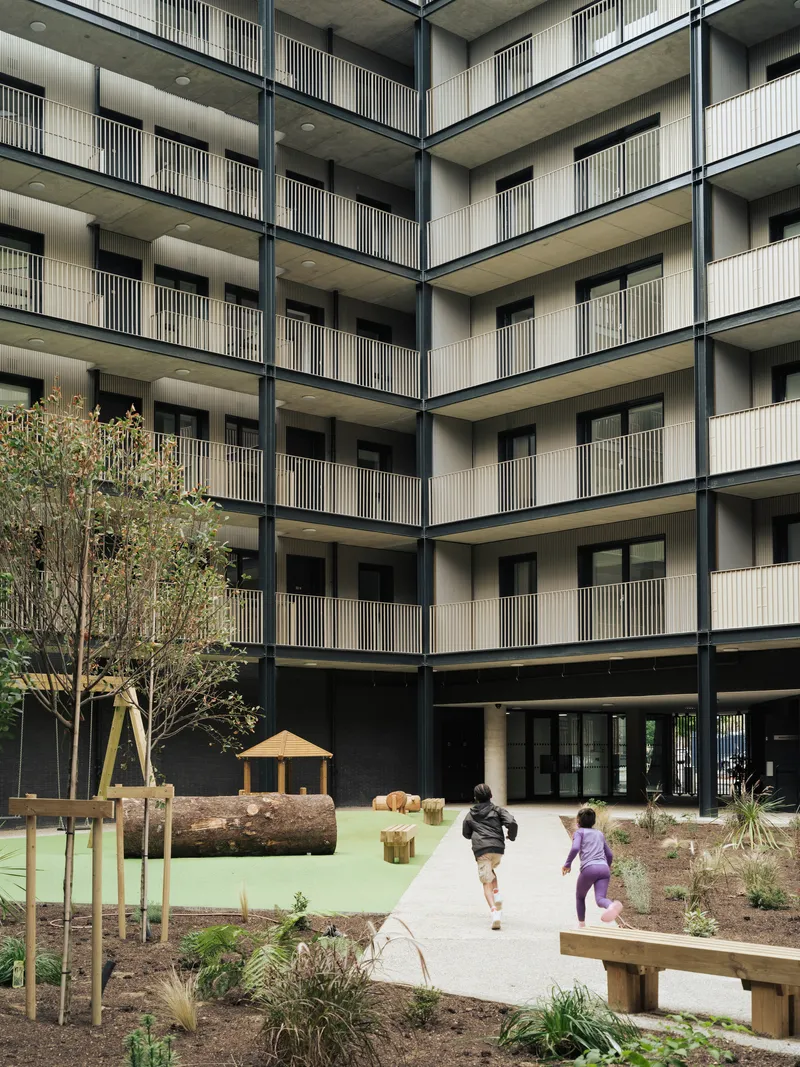
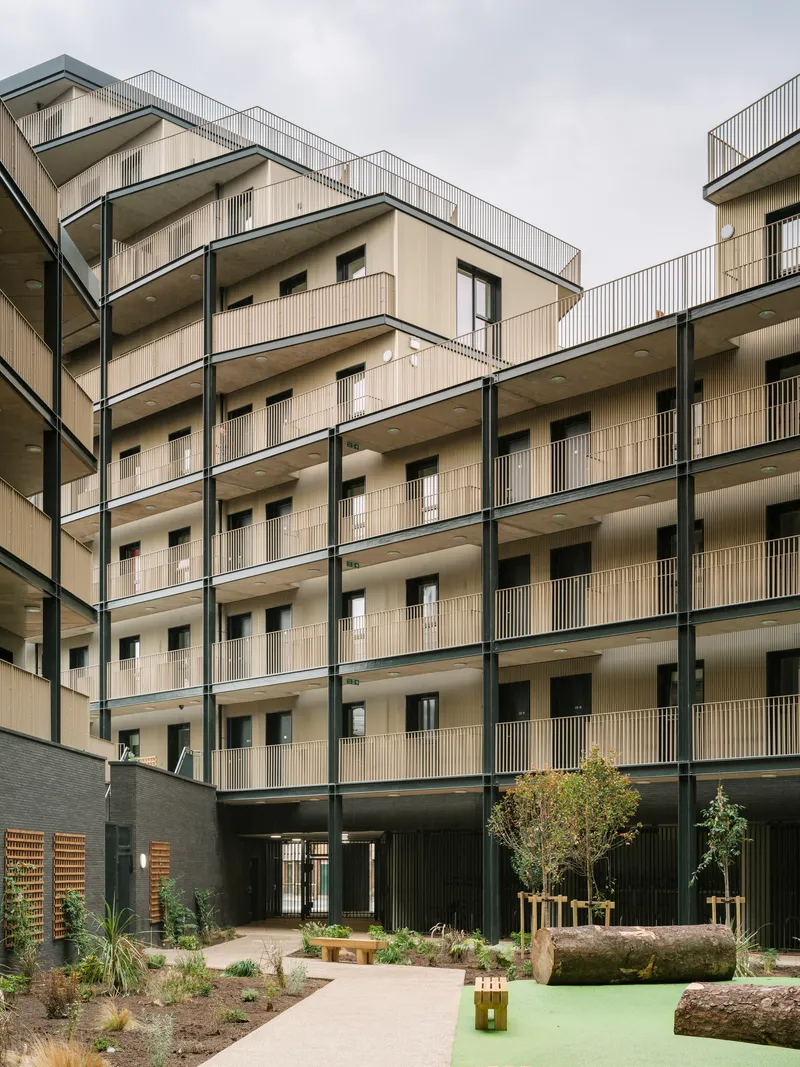
At the heart of the plan sits a shared courtyard with planted beds, young trees, a children's play area, and timber play structures. The terraced section profile is calibrated to maximize daylight and sunlight penetration into this space, ensuring that the courtyard is not merely a leftover void but a genuine amenity. Commercial, restaurant, and retail spaces activate the ground floor edges, creating a threshold between the public street and the semi-private communal garden. The courtyard is legible as a collective living room for the 111 households above.
The external shared walkways that provide access to the apartments reinforce this collective ethos. Drawing on European collective housing models, the circulation is designed to maximize views and light while fostering chance encounters between neighbors. Communal roof terraces at the first, fourth, and fifth levels extend the shared outdoor space vertically, distributing social opportunities across the building's section rather than confining them to the ground.
Inside the Apartments
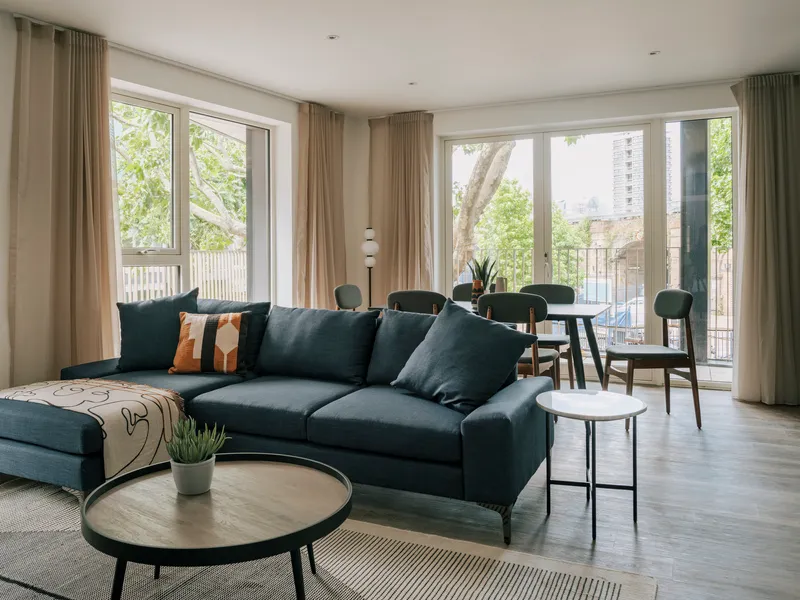
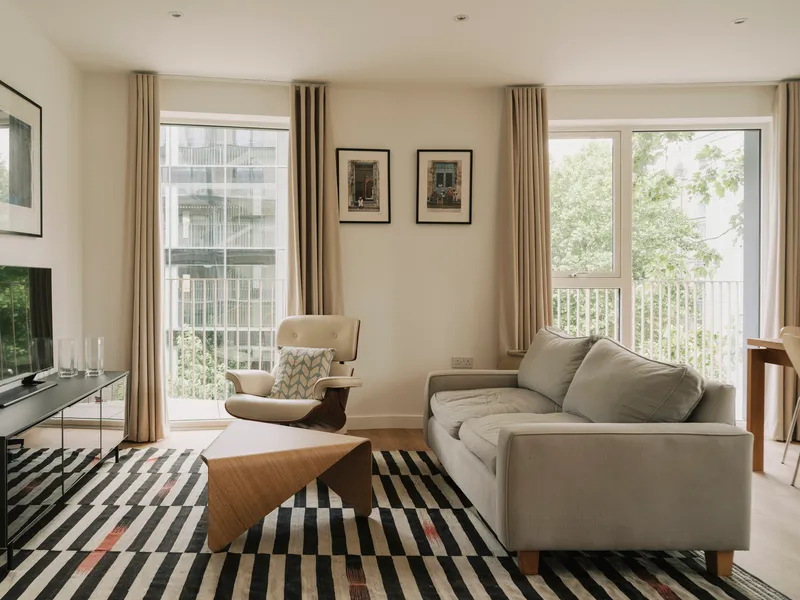
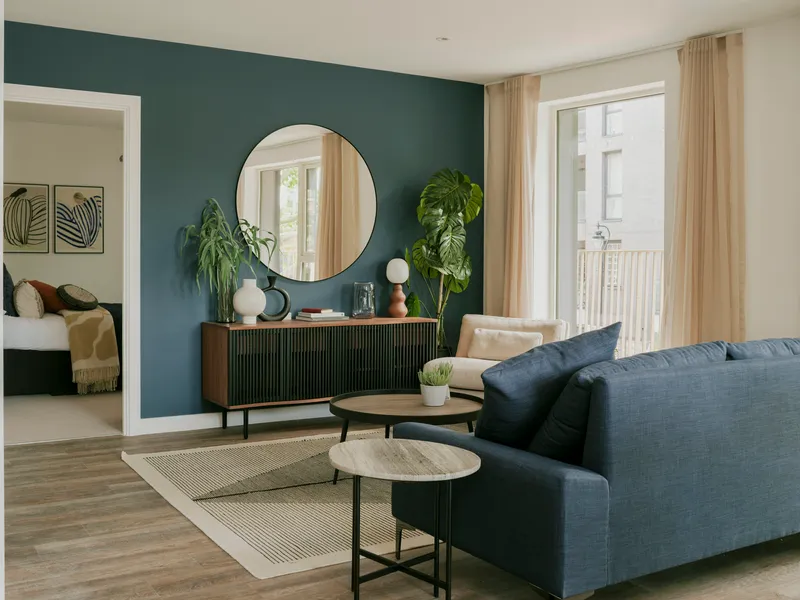
The interiors benefit directly from the formal gymnastics happening on the outside. Floor-to-ceiling glazing opens living spaces onto deep balconies, creating a layered sequence from room to terrace to landscape that makes even the one-bed units feel expansive. The dual-aspect configuration, possible because of the angled plan geometry, delivers cross-ventilation and multiple sight lines within each apartment. Natural light reaches deep into the plans, and the planted balcony edges filter views of neighboring buildings without cutting them off entirely.
The 35 different typologies across 46 one-beds, 44 two-beds, and 21 three-beds reflect a genuine effort to address varied household needs rather than stamping out identical units. Ten percent of the apartments are wheelchair-accessible, and 35.5% of the overall scheme is affordable housing, split between social rental and shared ownership. These are not marginal statistics buried in a planning report; they are the structural premise of the project.
Rooftop and Threshold Spaces
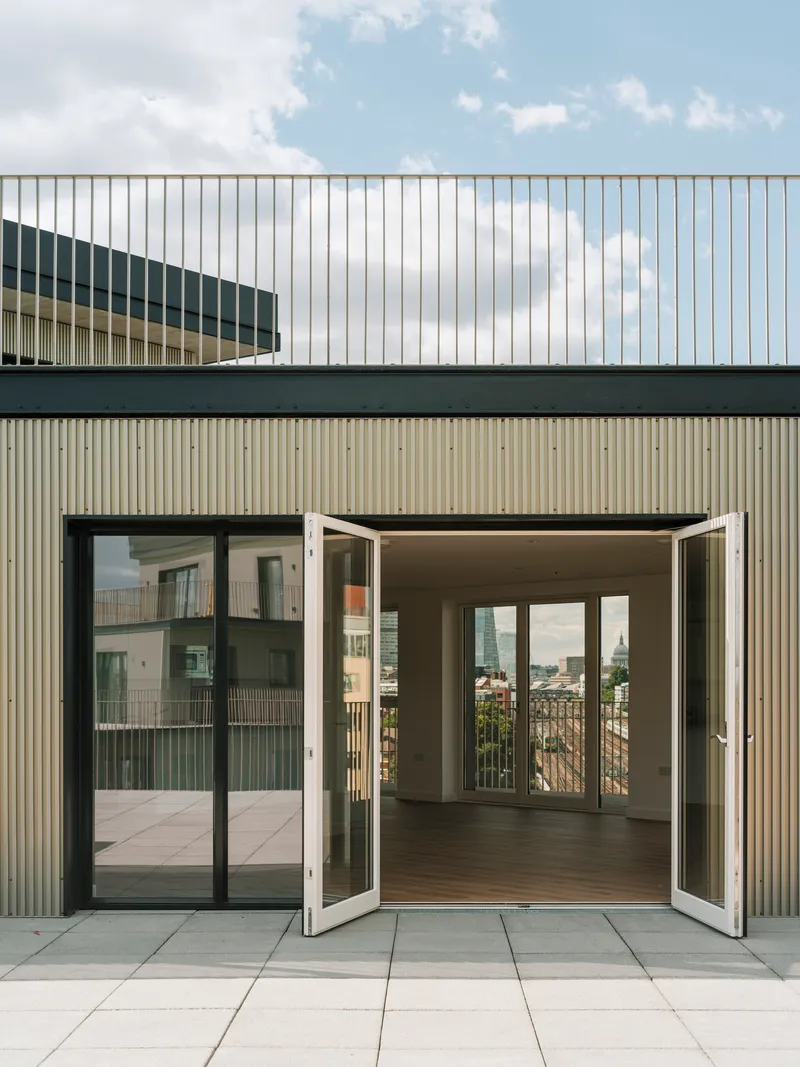
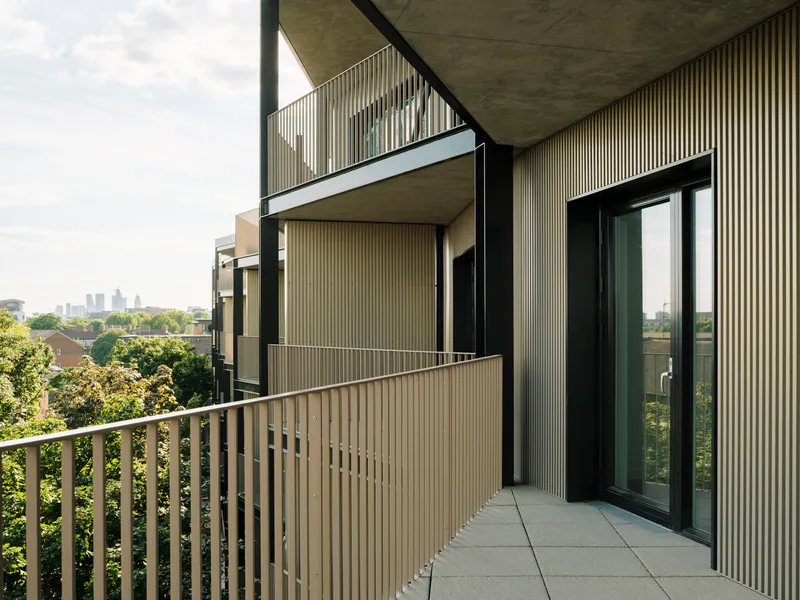
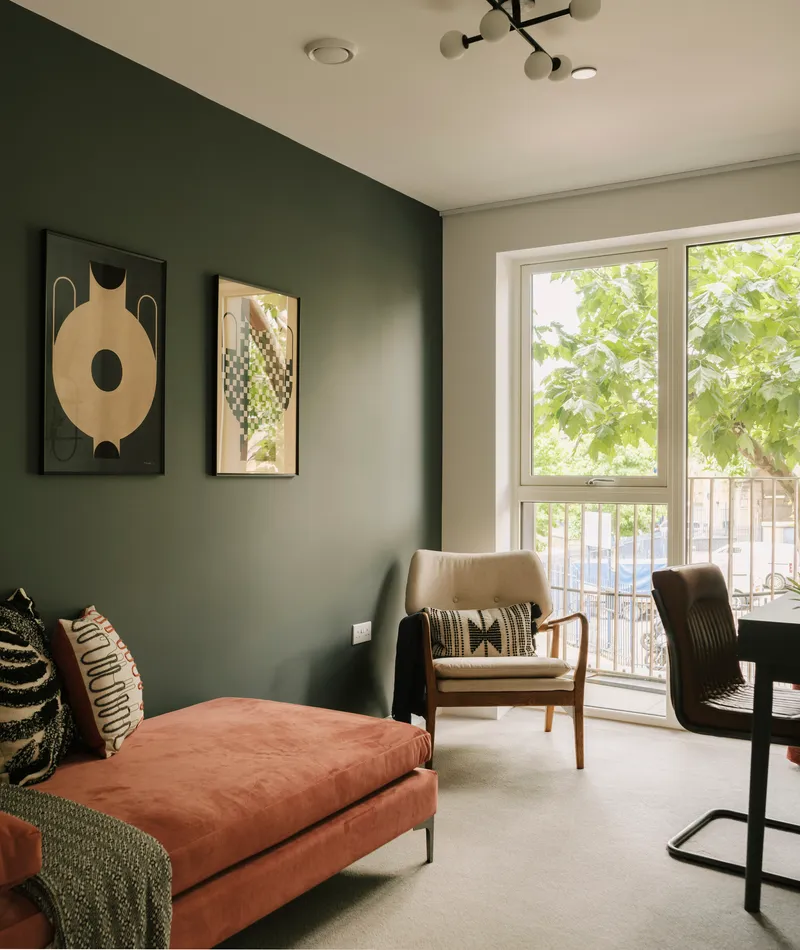
The upper-level terraces and rooftop apartments reveal the full payoff of the stepped massing. At the top of the building, sliding glass doors open onto generous private terraces with long views over Bermondsey's roofscape. The folding glass panels at the rooftop level blur the line between indoor and outdoor living, a luxury often reserved for penthouses but deployed here across multiple levels. Below, the corner seating areas and balcony thresholds demonstrate a consistent attention to the in-between spaces where domestic life actually happens.
Context: Railway Arches and Regeneration
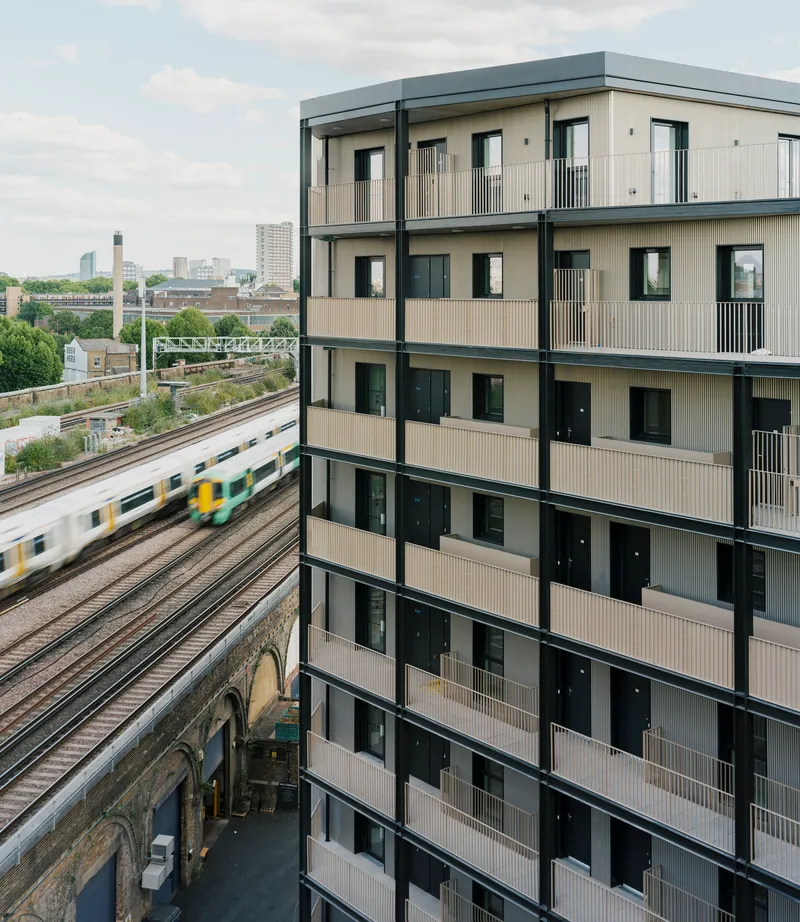
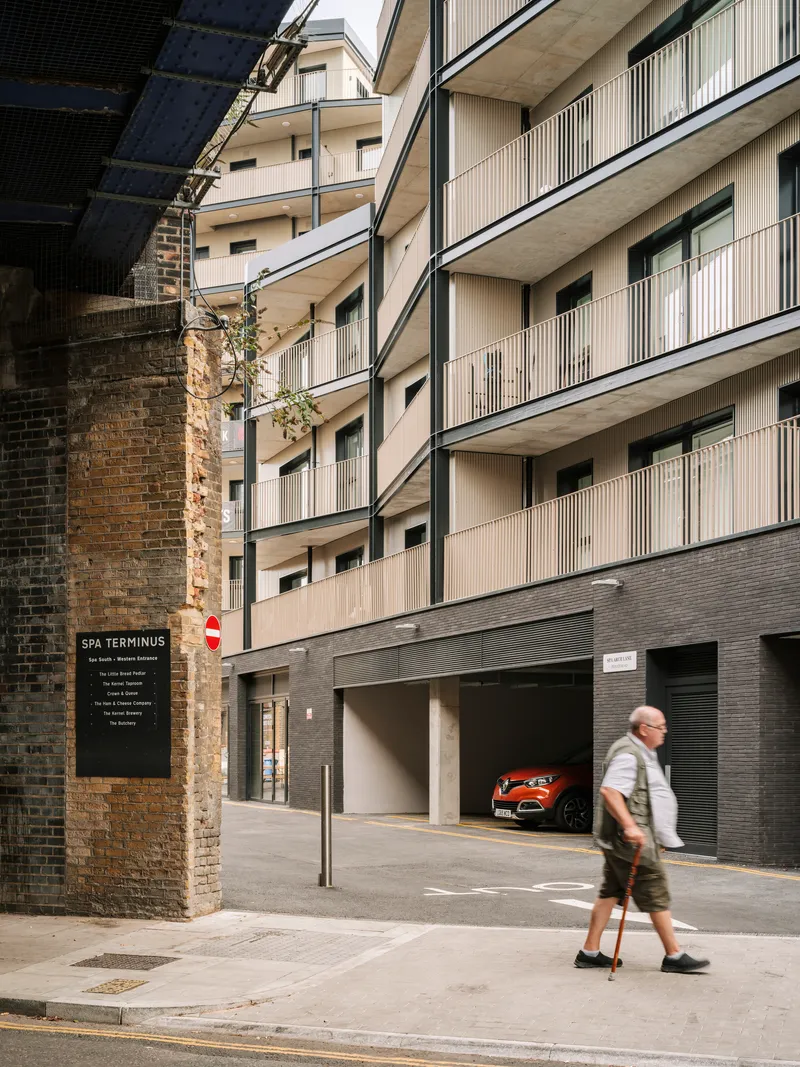
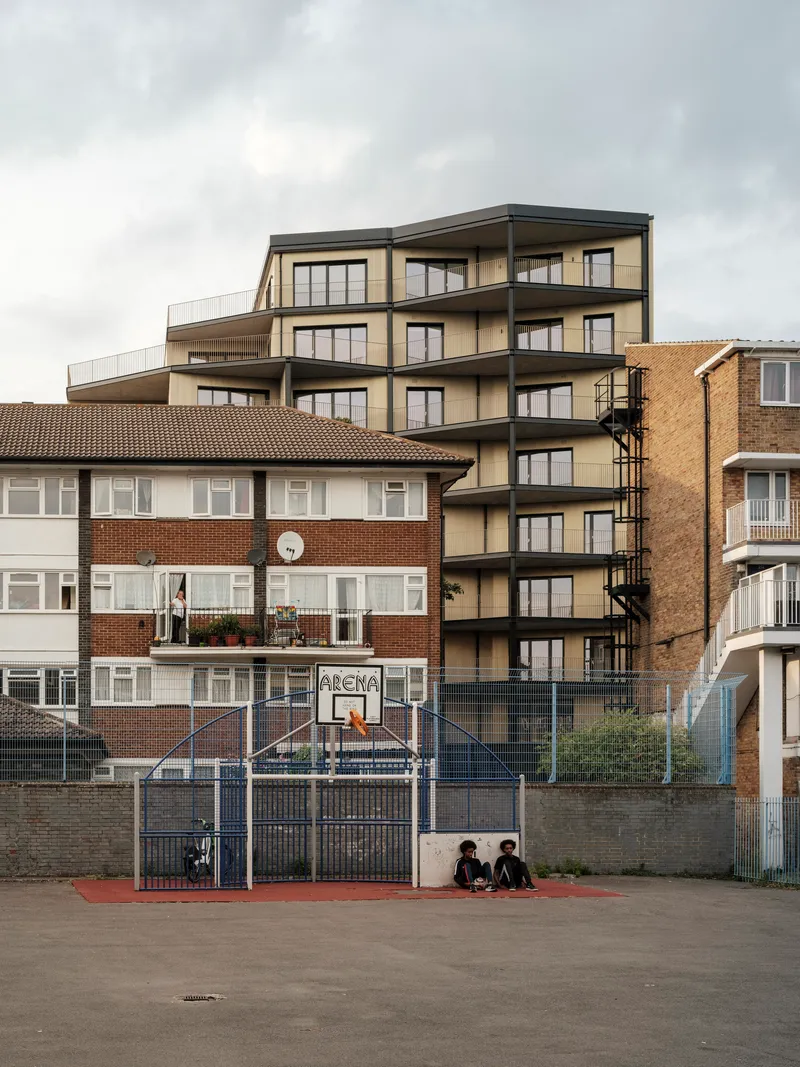
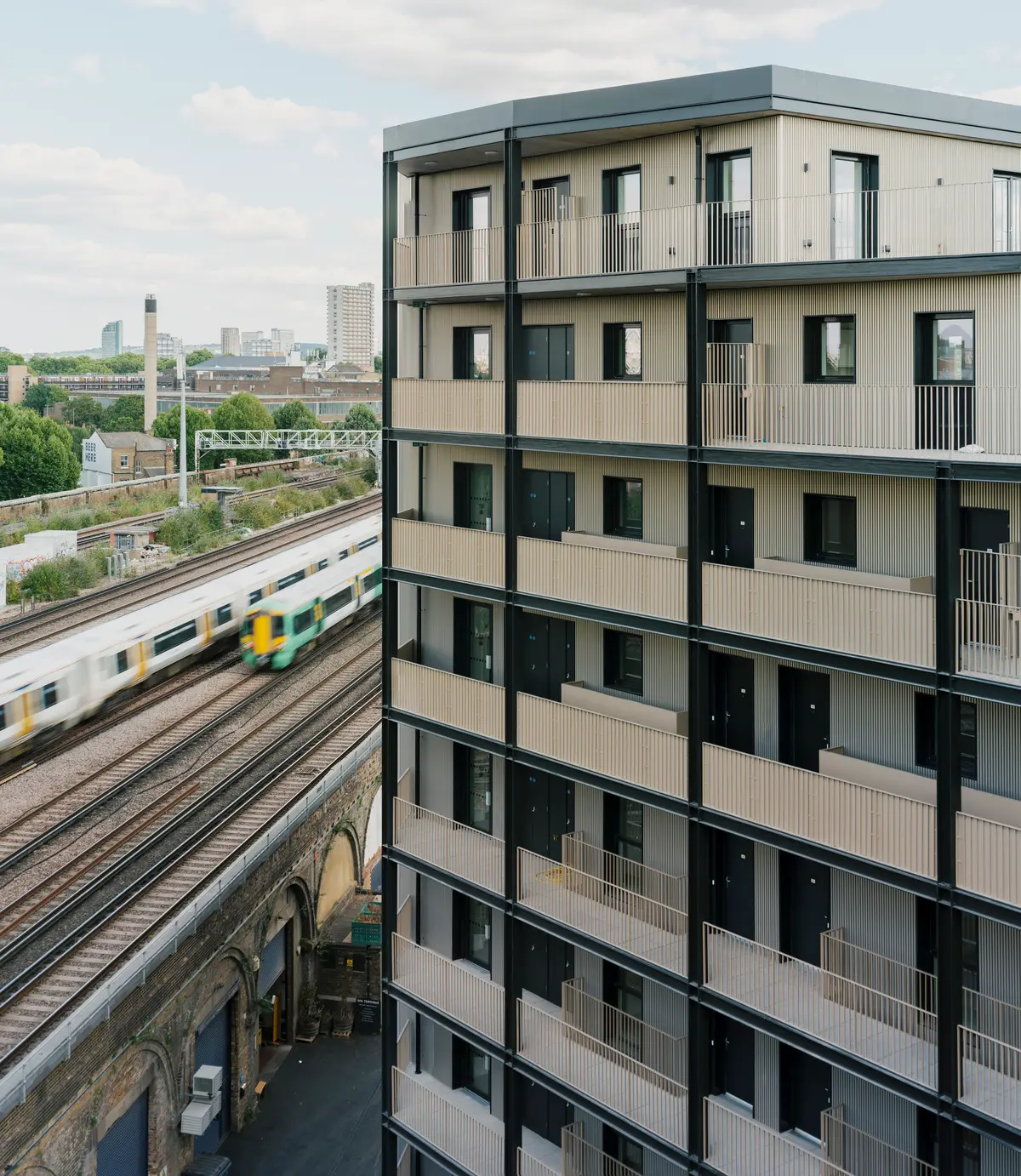
Dockley's site carries significant historical weight. The land began its industrial life in 1836 as part of the Spa Road Railway station, and the adjacent railway arches are now home to Spa Terminus, a community of artisan food producers and traders. The project plugs into a wider regeneration narrative along Southwark's "Low Line," a linear network of activated railway arches that is quietly reshaping the area's identity. The presence of the commuter trains, visible from upper balconies as they blur past the building's eastern facade, is not a nuisance to be screened off but a kinetic backdrop that situates the architecture in the rhythms of the city.
The relationship with the surrounding housing estates and the existing brick infrastructure is handled with care. Rather than imposing a hermetic boundary, the scheme's ground floor permeability and courtyard access create a porous edge that invites connection with the neighborhood. The gold-ribbed metal cladding at certain elevations picks up the warm tones of the Victorian brickwork, a chromatic nod that avoids pastiche.
Materiality and Sustainability
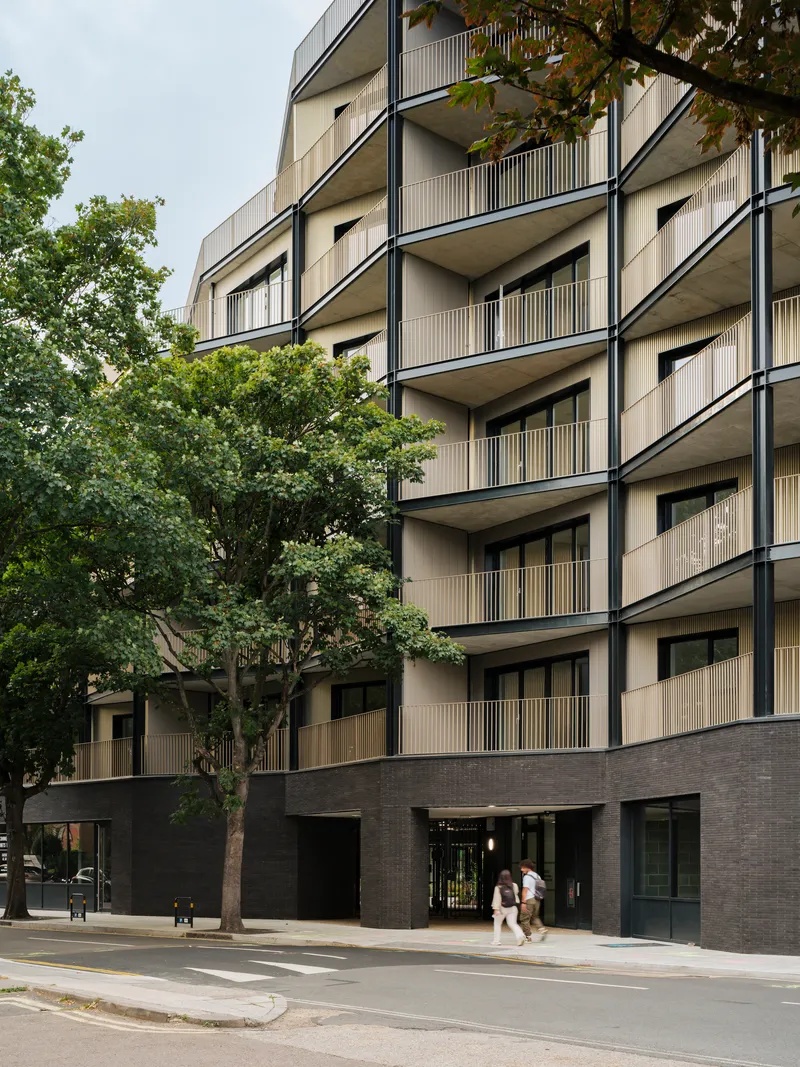
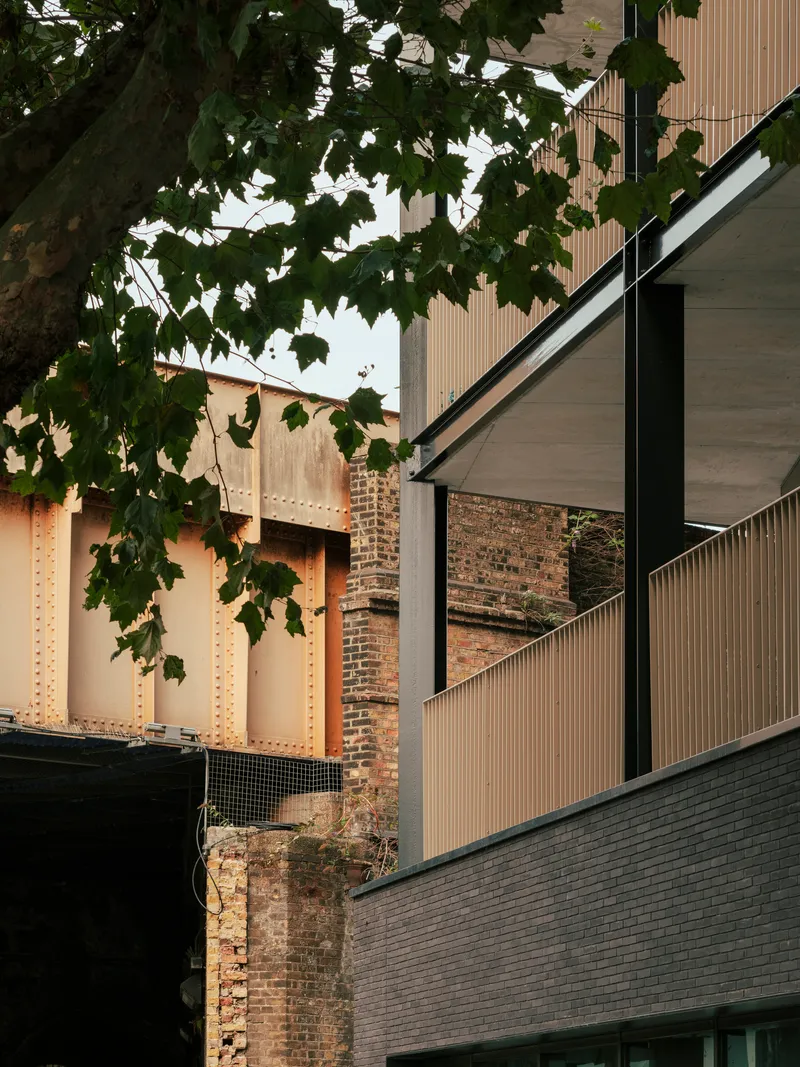
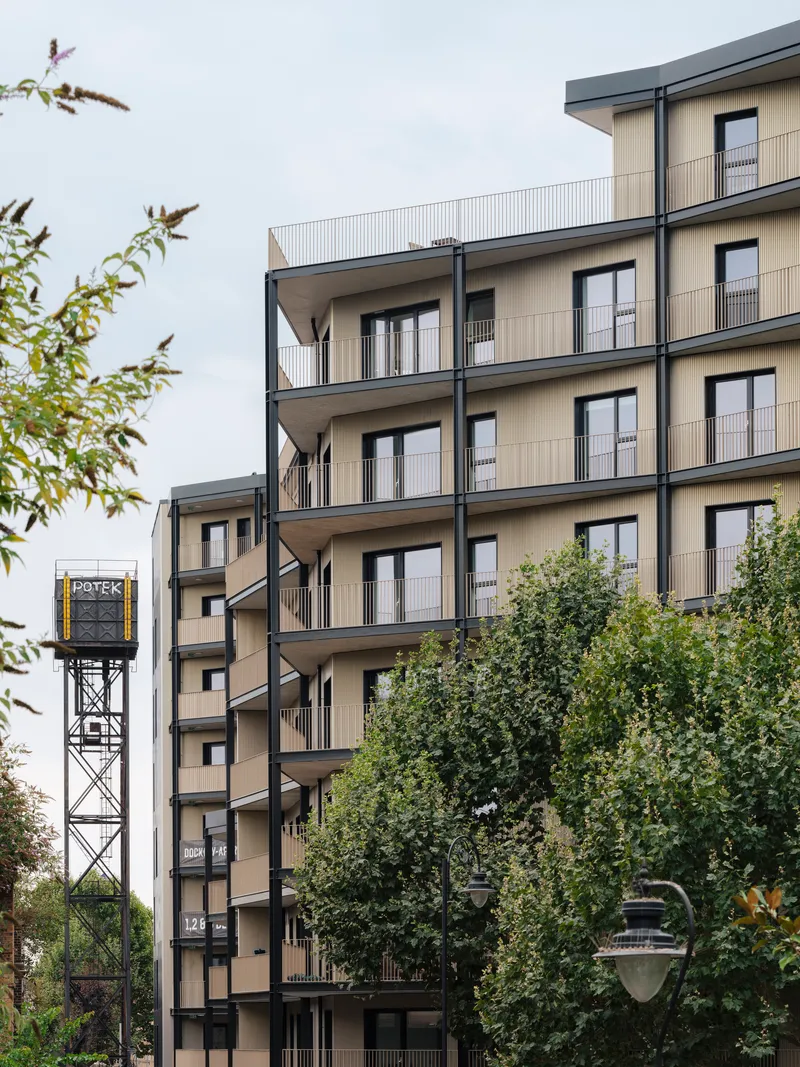
The material palette is deliberately limited: dark brick, steel rainscreen with high recycled content, composite windows, and aluminium curtain wall. The steel cladding panels are designed to be demountable, reusable, and recyclable, a genuine commitment to circular construction principles rather than a greenwashing footnote. The exposed structural grid of steel at certain elevations articulates the building's tectonic logic, making the construction legible without aestheticizing it.
Below ground, the foundation strategy is worth noting. Instead of conventional piled foundations, the engineers deployed Controlled Modulus Columns to strengthen the existing soil into a stiff raft, reducing material use and construction impact. Two photovoltaic arrays on the roof cores contribute to the building's energy balance. The overall construction cost of approximately £2,856 per square meter, while not cheap, reflects the quality of specification and the ambition of the design. This is housing built to perform, not merely to sell.
Plans and Drawings
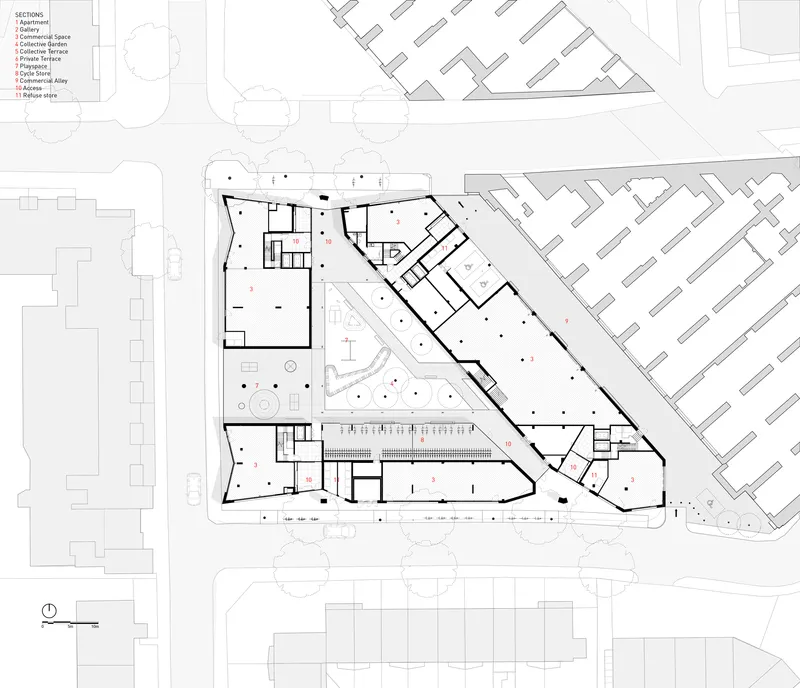
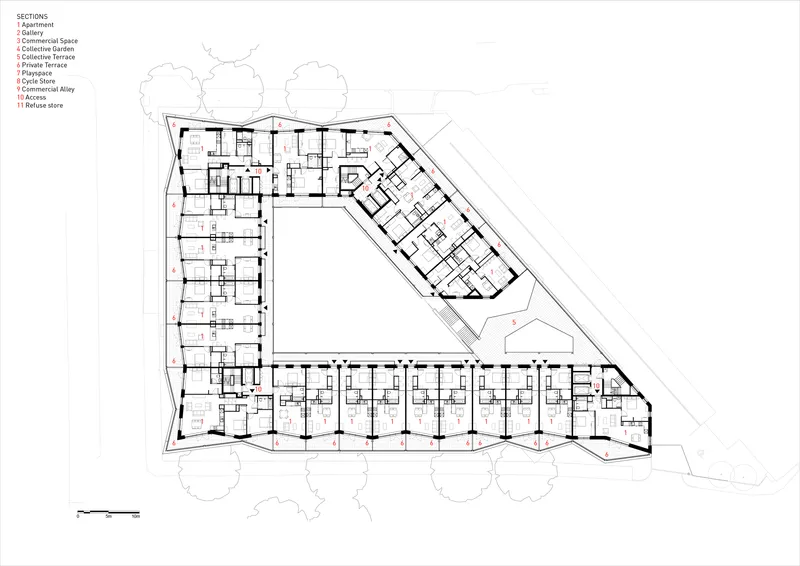
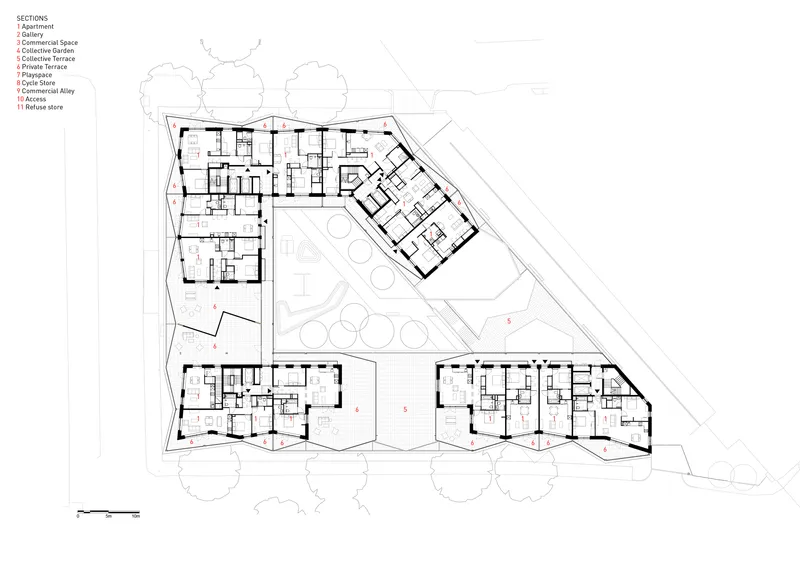
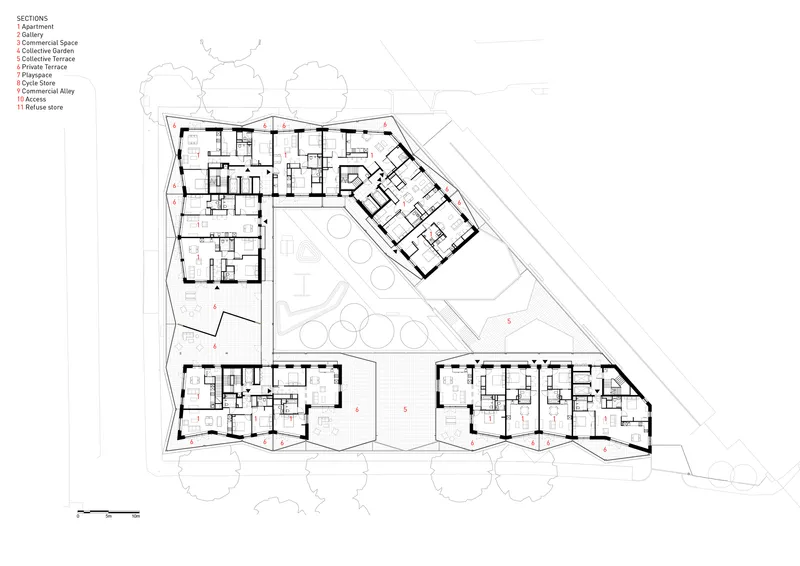
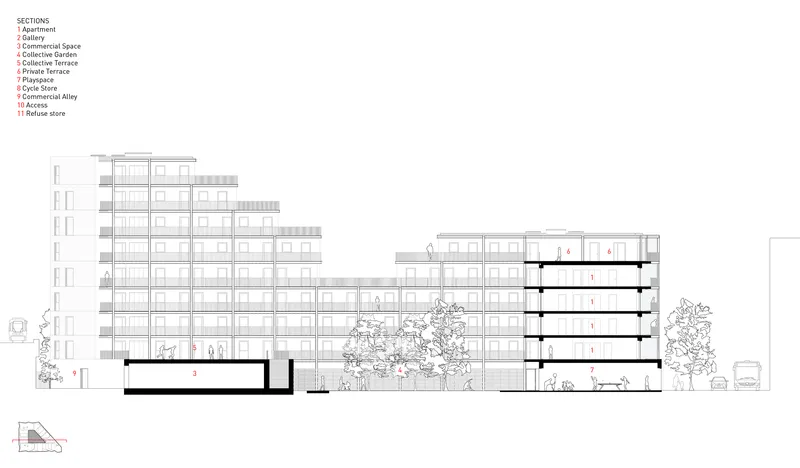
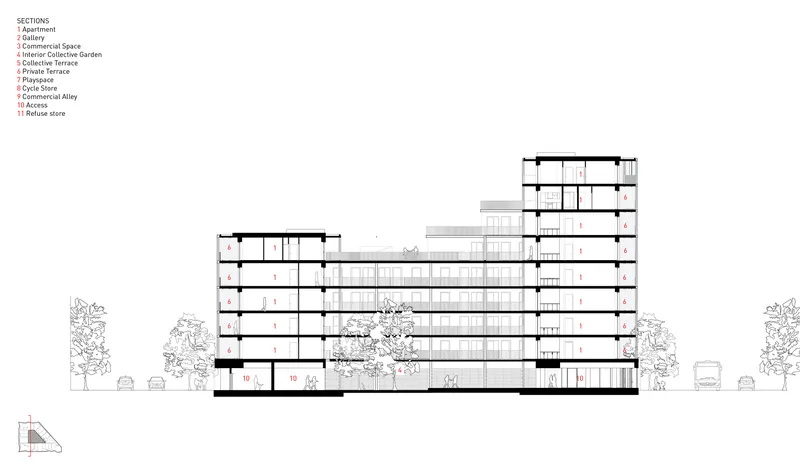
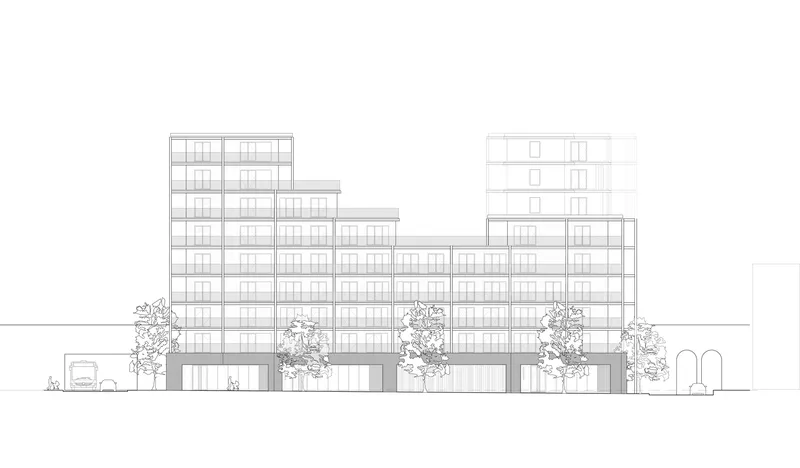
The plans and sections reveal the disciplined logic behind the building's apparently freewheeling geometry. The ground floor plan shows the irregular perimeter wrapping around the central courtyard, with four cores distributing circulation efficiently. At the upper levels, the residential units tighten around the courtyard while the angled corners generate the saw-tooth balconies visible from the street. The sections are the most instructive drawings: the stepped and terraced profiles demonstrate exactly how daylight is channeled into the courtyard and how the building negotiates its variable height from four to nine storeys. The elevation drawing confirms the regular window grid underlying the apparently irregular facade, a reminder that architectural exuberance and structural rationality are not mutually exclusive.
Why This Project Matters
Dockley Apartments matters because it refuses the false choice between density and livability that so much London housing accepts as inevitable. With 111 units on a third of a hectare, the scheme achieves urban intensity without resorting to corridors, single-aspect plans, or token outdoor space. The 35 typologies, the 35.5% affordable provision, and the 10% wheelchair accessibility are not concessions wrung from the architects by planning officers; they are woven into the architectural proposition from the outset. The building proves that housing can be both socially responsible and spatially inventive.
More broadly, the project offers a model for how mid-rise mixed-use housing can engage with complex urban sites. The undulating facade, the courtyard, the activated ground floor, the relationship with the railway arches: these are site-specific responses that could not be transplanted to another location, and that is exactly the point. In an era of generic residential towers, Dockley is stubbornly particular. It knows where it is, who it is for, and what it is made of, and it makes those facts into architecture.
Dockley Apartments by Studio Woodroffe Papa and Poggi Architecture. London, United Kingdom. 10,678 m². Completed 2022. Photography by Tim Crocker.
About the Studio
Share Your Own Work on uni.xyz
If projects like this are the kind of work you want to make, uni.xyz is a place to publish your own, find collaborators, and enter design competitions.


Popular Articles
Popular articles from the community


Cube Design Draws an Ecological Corridor Between Two Shenzhen Hills with the Nankai Building
Beside Shenzhen's container docks, the Nankai Building pairs stacked balconies with a climbing green screen to connect two hillsides across its height.

David Ortega Stacks a Two-Story Mexico City Penthouse Around a Steel Stair and a Pergola-Shaded Roof Terrace
In Colonia Roma, a 300 m² penthouse uses oak joinery, a planted steel stair and a slatted roof pergola to make a new-build apartment feel like a house.


Aquadapt: An Underwater Habitat That Rewrites Its Rooms by the Hour
Curved modules ring the seabed while one shell shifts from breakfast room to cinema, farm and football pitch as residents' needs change.

Opera on the Sea: Driftwood Logic Shapes a Timber Opera House on Estonia's Coast
Trevor Orgill's opera house translates the entangled drift of floating timber into a civic building where wood, water, and music converge.

Similar Reads
You might also enjoy these articles

LAVA Architecten Gives Vocational Education a Sawtooth-Roofed Face on a Mechelen School Campus
In Mechelen, Belgium, a 2,053 m² STEM school on a 6×6 m grid turns workshops and classrooms into rooms that can be rearranged as teaching changes.

KEMA Studio Turns a Derelict Marvila Attic into a 60 m² Lighthouse Apartment Above Lisbon
In Lisbon's Marvila district, a rebuilt roof, four skylights and two plywood volumes turn an unlivable attic into a bright home facing the Tagus.

Pixel Gardens: One Repeated Module Stacked Into a Terraced Social Housing Tower for Famagusta
Salem Bader's shortlisted housing tower builds a vertical neighbourhood from one repeated module, offsetting units to carve terraces, light and air.

Bao Huynh Watercolor Atelier: A Serene Art Retreat in Hội An
Bao Huynh Watercolor Atelier in Hội An blends multifunctional art spaces, sustainable design, local materials, and family-friendly living in a serene environment.

Comments (0)
Please login or sign up to add comments
No comments yet. Be the first to comment!