

Suji Dream School: A Nature-Integrated Educational Haven by ODDs&ENDs Architects
Explore Suji Dream School's nature-integrated design by ODDs&ENDs Architects, blending sustainability, creativity, and education in South Korea.


Redefining Educational Architecture
Suji Dream School in Yongin-si, South Korea, designed by ODDs&ENDs Architects, exemplifies a harmonious integration of nature and learning. Completed in 2020, this 488 m² alternative school caters to 70 primary and secondary students, focusing on happiness, freedom, and a strong connection with the environment.
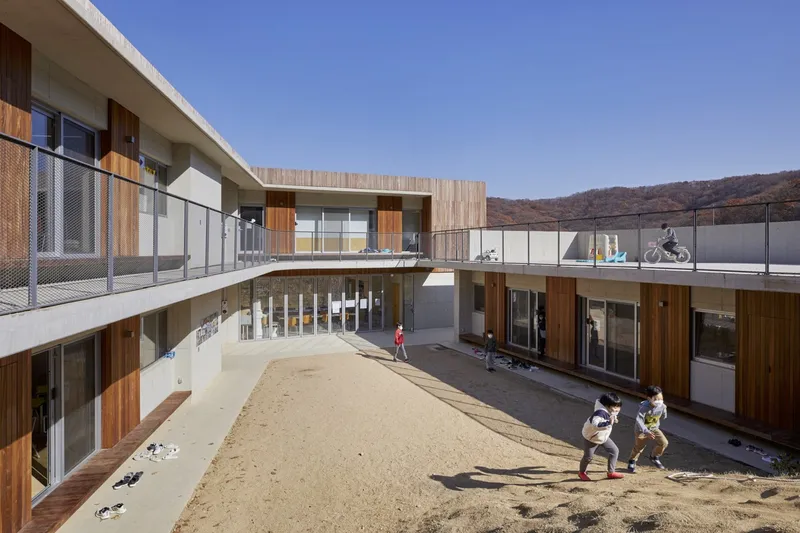
Design Inspiration: Seowon and Nature-Inspired Learning
Suji Dream School draws from the traditional Korean Seowon, academies from the Joseon Dynasty, known for their courtyard-centric design. The school's layout preserves this concept while modernizing it to foster a close relationship with the outdoors.
- Courtyard-Centric Layout: The classrooms encircle a vibrant courtyard, creating a shared outdoor space for learning, play, and community interaction.
- Outdoor Hallways: Eschewing traditional indoor hallways, the design incorporates outdoor passages, reducing the building's footprint and immersing students in nature.
- Toenmaru Porches: Narrow wooden porches line the exterior, providing shaded transitions and connecting indoor spaces with the natural surroundings.

Addressing Challenges with Innovation
Designing on a steep slope with a 3-meter level difference and a site limited to 500 m² posed significant challenges. Despite these constraints, the architects developed a creative solution that maximized space while embracing the landscape.
- Topographical Adaptation: The slope allows seamless connections between floors, enabling the second floor to be accessed naturally by ascending the terrain.
- Expandable Space: The design considers the potential for growth into the surrounding natural environment, ensuring long-term adaptability.
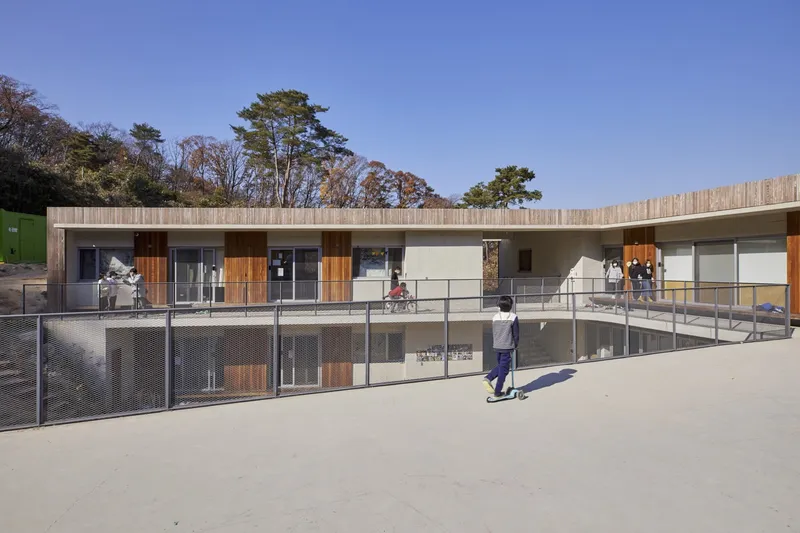
Blending Architecture with Sustainability
The school aligns with sustainable principles, utilizing the natural environment as an extension of its learning spaces.
- Integration with Nature: Students interact daily with the hillside, crafting trails and hideouts among the trees, promoting environmental stewardship.
- Minimal Environmental Impact: Outdoor hallways and open layouts reduce energy consumption and emphasize passive ventilation.

Community-Centric Design Process
Suji Dream School is the result of a collaborative process involving students, parents, and teachers. This participatory approach ensured the design reflected the community's educational philosophy and respect for the environment.
- Parent-Led Initiative: The project began with parents arranging the site and selecting architects after studying architecture themselves for a year.
- Student Contributions: The students shared insights from their forest hideouts, inspiring the architects to design spaces that align with their creative and adventurous spirits.

Key Features of Suji Dream School
- Central Courtyard for Interaction:A versatile space for outdoor classes, events, and play.Encourages collaboration and fosters a sense of community.
- A versatile space for outdoor classes, events, and play.
- Encourages collaboration and fosters a sense of community.
- Innovative Outdoor Circulation:Hallways designed as open-air passages.Enhances connectivity and reduces the need for enclosed spaces.
- Hallways designed as open-air passages.
- Enhances connectivity and reduces the need for enclosed spaces.
- Dynamic Topography Utilization:The sloping terrain integrates naturally with the building’s flow.Facilitates movement and fosters physical activity.
- The sloping terrain integrates naturally with the building’s flow.
- Facilitates movement and fosters physical activity.
- Sustainability-Focused Design:Passive cooling through natural ventilation.Use of local materials and minimal environmental disruption.
- Passive cooling through natural ventilation.
- Use of local materials and minimal environmental disruption.


Architectural Philosophy and Educational Impact
Suji Dream School embodies an architectural philosophy that values sustainability, creativity, and collaboration. Its design not only fulfills the functional requirements of an educational space but also enriches the students’ experience by immersing them in nature.

A Model for Future Educational Spaces
Suji Dream School by ODDs&ENDs Architects serves as a beacon of innovative educational architecture. It showcases how schools can embrace sustainability, prioritize student well-being, and foster a strong connection with the environment. This project is more than a school—it is a nurturing ecosystem for growth, learning, and harmony with nature.


Popular Articles
Popular articles from the community


Cube Design Draws an Ecological Corridor Between Two Shenzhen Hills with the Nankai Building
Beside Shenzhen's container docks, the Nankai Building pairs stacked balconies with a climbing green screen to connect two hillsides across its height.

Jaramillo Van Sluys Arquitectura and Urbanismo Turn a Demolished Registry Lot in Quito into an Orchard Plaza
In Quito's Centro Histórico, a 2,800 m² plaza exposes the San Agustín convent wall and redraws its lost Augustinian orchard in volcanic stone.

Juan García Correa, John González and Claudia Rueda Sink a Circular Amphitheater into a Manizales Engineering Building
On the La Nubia campus in Manizales, Colombia, the S1 Building folds labs and offices into a hillside of ramped lawns that double as a campus route.

LT2A and OPEN Architectes Thread a Brick and Glass High School Through a Wooded Belgian Campus
In Braine-l'Alleud, a 3,000 m² wing for Collège Cardinal Mercier pairs pale brick with a glazed colonnade, deferring to a small chapel and a dense wood.

Similar Reads
You might also enjoy these articles


Hodi-Mandai Geram
Project Function: Preservation and revitalization of the Intangible heritage and socio-spatial identity of the Hodi by Housing, Cultural Memory Center, Sacred Grove, landscape, local tourism economy


Olio Towers: A Mid-Rise for Performers That Fuses Housing, Rehearsal, and Stage
Located blocks from Houston's Theater District, this modular tower stacks living units around a central performance atrium.

Oasis: Modular Green Housing Carved into Dhaka's Urban Fabric
A shortlisted Plugin Housing entry reclaims unauthorized settlements in Dhaka with stepped concrete volumes, green roofs, and ventilation-driven design.

Black Hole: A Floating Megastructure for the Post-Physical Era
Emiliano Mazzarotto envisions a spherical, self-scaling arena where e-sports, digital hotels, and holographic stadiums replace traditional public space.

Explore Educational Building Competitions
Discover active competitions in this discipline

Challenge to design public laboratory

Challenge to reimagine the Iron Throne

Photograph architecture without architects

Illustrate the lost glory of Angkor Wat - Render Challenge
Comments (0)
Please login or sign up to add comments
No comments yet. Be the first to comment!